
How to Make Cat Food Broth: Safe Recipe and Portions
This post contains affiliate links. As an Amazon Associate, we earn from qualifying purchases.
Two ingredients. Meat and water.
That’s the short version of how to make cat food broth, and it’s also the version Tufts Cummings School of Veterinary Medicine endorses. Their guidance names boiling unseasoned meat or vegetables in plain water as the safest homemade recipe. Everything past that point is a decision about which meat, how much water, and how long you’re willing to stand at the stove.
To make cat food broth, simmer unseasoned meat or bones in plain water with no salt, onion, or garlic, then strain out every solid before serving. Tufts veterinary nutritionists call plain unseasoned meat boiled in water the safest version, and Chewy caps servings at 2 tablespoons per 20 pounds of body weight, once a day.
The Allium rule is the one that gets broken by accident. Onion, garlic, leek, chive and scallion all carry disulfides and thiosulfates, which are sulfur-based compounds that rupture a cat’s red blood cells. Chewy’s veterinary reviewer notes the concentrated powders do the most damage per gram, which is why a stock cube built for human soup is a bad starting point.
What follows is the pot, the clock, the portion, and the shelf life. Then the four situations where the correct amount of broth is none.
Key Takeaways
- No salt, onion, or garlic at any stage; powdered Allium is the most dangerous form per gram.
- Simmer times across published recipes run from 90 minutes to 8 hours, and the appliance you own decides more than the recipe does.
- Serve 2 tablespoons per 20 pounds of body weight once daily, and never more than 10% of daily food intake.
- Refrigerate within 1 hour and use it within 3 to 4 days per Chewy, though Boulder Holistic Vet allows 7 days.
- Prescription and stone-dissolution diets are the one case where broth can actively work against the cat.
What Actually Goes in the Pot
Tufts puts the formula plainly: unseasoned meat or vegetables boiled in plain water. That’s the whole recipe. The rest is a choice about bones versus parts and how much water covers them.
Plain unseasoned meat or vegetables boiled in unsalted water forms the base of a pet-safe broth. Commercial stocks introduce sodium and Allium ingredients that damage feline red blood cells, and the concentrated powdered forms of onion and garlic carry the highest risk per gram. Straining removes every solid before serving, including bone fragments.
The bone-to-water numbers don’t agree between the two most-cited recipes. Rover uses 1 to 2 pounds of unseasoned bones in 6 to 8 cups of water. Chewy uses 4 to 4.5 pounds of chicken parts in roughly 6 cups. That’s close to double the bone per cup in the Chewy version, so the two batches aren’t interchangeable when you portion them out.
Then there’s the list of things that never go in:
- Onion, garlic, leek, chive, scallion. Chewy’s reviewer explains the mechanism: disulfides and thiosulfates damage red blood cells and can kill them outright.
- Salt. Chewy flags large amounts as causing brain swelling and damage. Nothing in this recipe needs it.
- Olive oil. Rover advises against roasting bones in oil because cats digest it poorly. Only one source raises this, so treat it as a caution rather than a settled rule.
- Anything from a stock cube. Human stock is built on onion, garlic and sodium, in that order of concern.
I’ve read homemade broth recipes posted in cat groups that called for a whole onion for flavor. That’s a serious error. Onion is the exact ingredient Tufts says to avoid in any form, powders included. If you’re building a homemade cat food recipe from scratch, the same discipline applies to every ingredient you add.
How Long Should You Simmer Cat Food Broth?
Ninety minutes to 8 hours. Those are the numbers the published recipes actually use, Rover says at least 8 hours, while Boulder Holistic Vet says 90 minutes, and the spread is wide enough that the recipe you pick matters less than the pot you own.
| Method | Time | Who publishes it |
|---|---|---|
| Stock pot, two chicken legs | 90 minutes | Boulder Holistic Vet |
| Stock pot, bones | At least 8 hours | Rover |
Pick the appliance you’ll actually use. Chewy’s stovetop version is 4 hours uncovered on low, which is the only version that fits a weeknight. Boulder Holistic Vet’s clinic recipe gets there in 90 minutes with two chicken legs. Rover’s goes at least 8 hours.
Rover’s method is also the only one that asks you to stand at the pot and skim the white foam that rises to the surface, periodically, for the length of the cook. Leave it and the foam stays in the broth.
Easy to miss: The bone load swings by roughly double between the two most-cited recipes, 1 to 2 pounds in Rover’s version against 4 to 4.5 pounds in Chewy’s. Two batches that look identical in the pot are not the same concentration, so measure portions at the end instead of eyeballing them.
If there’s a dog in the house as well, the same pot of bone broth covers both bowls, and the Allium rule doesn’t change for either animal.
How to Make Cat Food Broth: The Step-by-Step Method
Seven steps, one pot, and a strainer that matters more than the pot does.
Before you start: Cooked bones and solid splinters have to come out completely before anything goes in a bowl; Chewy’s veterinary reviewer is explicit about it. Hot broth also needs to cool to room temperature before it goes near a fridge. And keep every Allium ingredient, including powders and stock cubes, off the counter for the whole session.
- Choose unseasoned meat or bones. Rover’s version uses marrow bones, oxtail or hooves; Chewy’s uses chicken backs, wings, drumsticks or thighs. Ask the butcher whether anything is seasoned or marinated, because a garlic rub on the bone ends up in the broth.
- Cover with water. 6 to 8 cups for a 1 to 2 pound bone batch. Come up short and the batch cooks down to almost nothing before the timer ends.
- Boil, then drop to a simmer. A hard rolling boil for hours breaks the meat into particles small enough to pass through the strainer, and then it’s in the bowl.
- Skim the foam. White foam rises early in the cook. Rover’s recipe has you take it off periodically; leaving it in gives you a foamier, cloudier broth.
- Add vegetables only if you want them. 1 to 2 celery stalks and 1 to 2 carrots, per Rover. They get strained out and thrown away, which is why Untamed argues any ingredient besides meat is practically redundant in a cat broth.
- Strain every solid out. Line the strainer with cheesecloth for a clearer result, which is Chewy’s trick. Bones, fragments, vegetables, all of it goes.
- Cool, then chill and lift the fat. Chewy’s method is 3 to 4 hours in the fridge until the fat on top sets solid, then scoop it off and discard it. Boulder Holistic Vet skips this step entirely.
How Much Broth Can a Cat Actually Have?
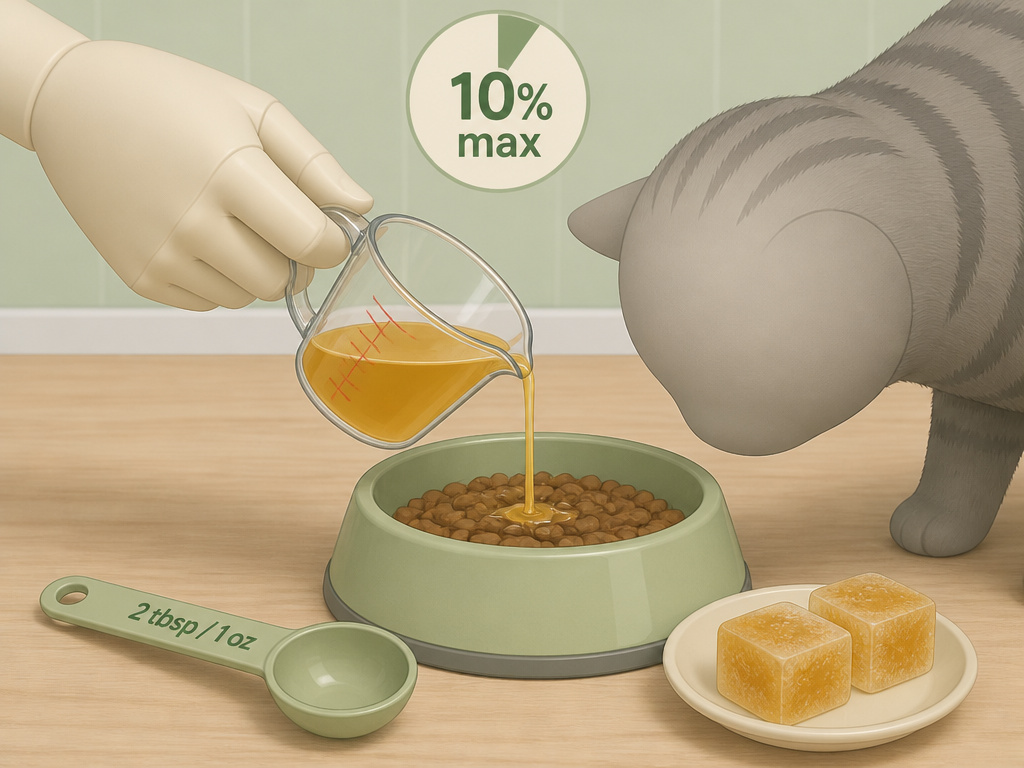
Chewy’s serving figure is about 1 ounce, or 2 tablespoons, per 20 pounds of body weight, once a day. Frozen cubes get a harder cap of one cube per day.
The ceiling matters more than the serving. Chewy states that broth should make up no more than 10% of a pet’s daily food intake and labels the recipe for intermittent or supplemental feeding. Untamed independently calls chicken broth an occasional snack rather than an everyday meal. Two sources, same conclusion.
People ask me whether a splash of something richer will get a picky cat eating. My answer is no. Adding scraps or a heavy topper dilutes the balance of a complete diet and piles on calories fast, and a spoon of the same food, warmed, does more.
Warming releases aroma, which is probably half of why it works.
If the goal is moisture rather than flavor, adding water to cat food does the same job with no cooking at all. Broth earns its place as one of the cat food toppers a cat will actually accept. Treat it as flavor with a moisture bonus, and keep the water bowl in the picture.
Storing It Without Wrecking It
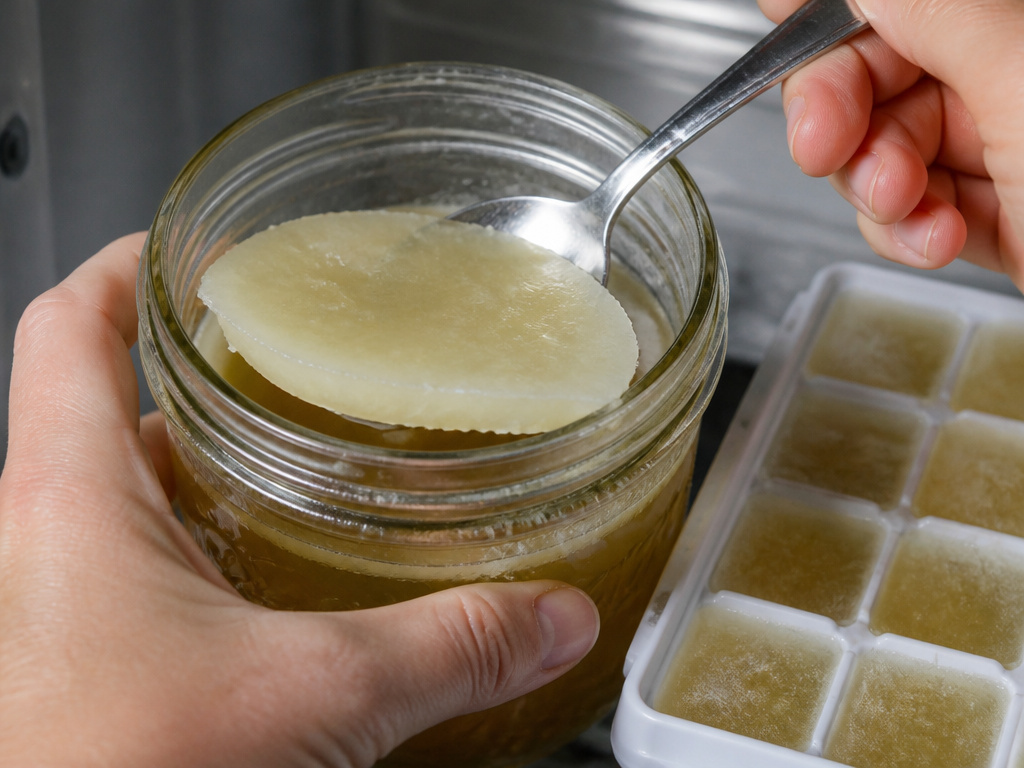
The storage numbers are where the sources split hardest, and the gap is not small.
| Storage question | Limit | Source |
|---|---|---|
| Refrigerator shelf life | 3 to 4 days | Chewy (DVM-reviewed) |
| Refrigerator shelf life | 7 days | Boulder Holistic Vet |
| Freezer shelf life | Up to 6 months | Boulder Holistic Vet |
| Mason jar headspace | At least 1 inch | Chewy |
| Ice cube tray fill | Three-quarters full | Chewy |
Chewy says 3 to 4 days in the refrigerator and up to 3 months in the freezer, while Boulder Holistic Vet says 7 days and 6 months; the sources disagree, so choose deliberately. Chewy’s page carries a named DVM reviewer; Boulder Holistic Vet’s 7 days and 6 months come without a stated basis. When two sources disagree and one is more cautious and better reviewed, take the cautious one.
Ball Mason jars work fine if you leave at least 1 inch of headspace and screw the lid on fully only once the broth is frozen, which Chewy puts at about 24 hours. Ice cube trays get filled three-quarters full.
After 3 to 4 hours in the fridge, the fat on the surface sets into an opaque, waxy disc you can lift off with a spoon. Chewy has you discard it. Boulder Holistic Vet doesn’t ask for the step at all, and Rover warns separately that broth is rich in fat and too much at once upsets a cat’s stomach.
Refrigerate within an hour of the pot coming off the heat. Past four days in the fridge, the batch goes down the sink. Broth is a pot of water and bones; the gamble isn’t worth it.
The same rules apply to any homemade pet food you store, not just broth. For portion sizes, freezing broth in portions into trays and bags beats one large container you have to thaw and re-chill.
When Broth Is the Wrong Answer
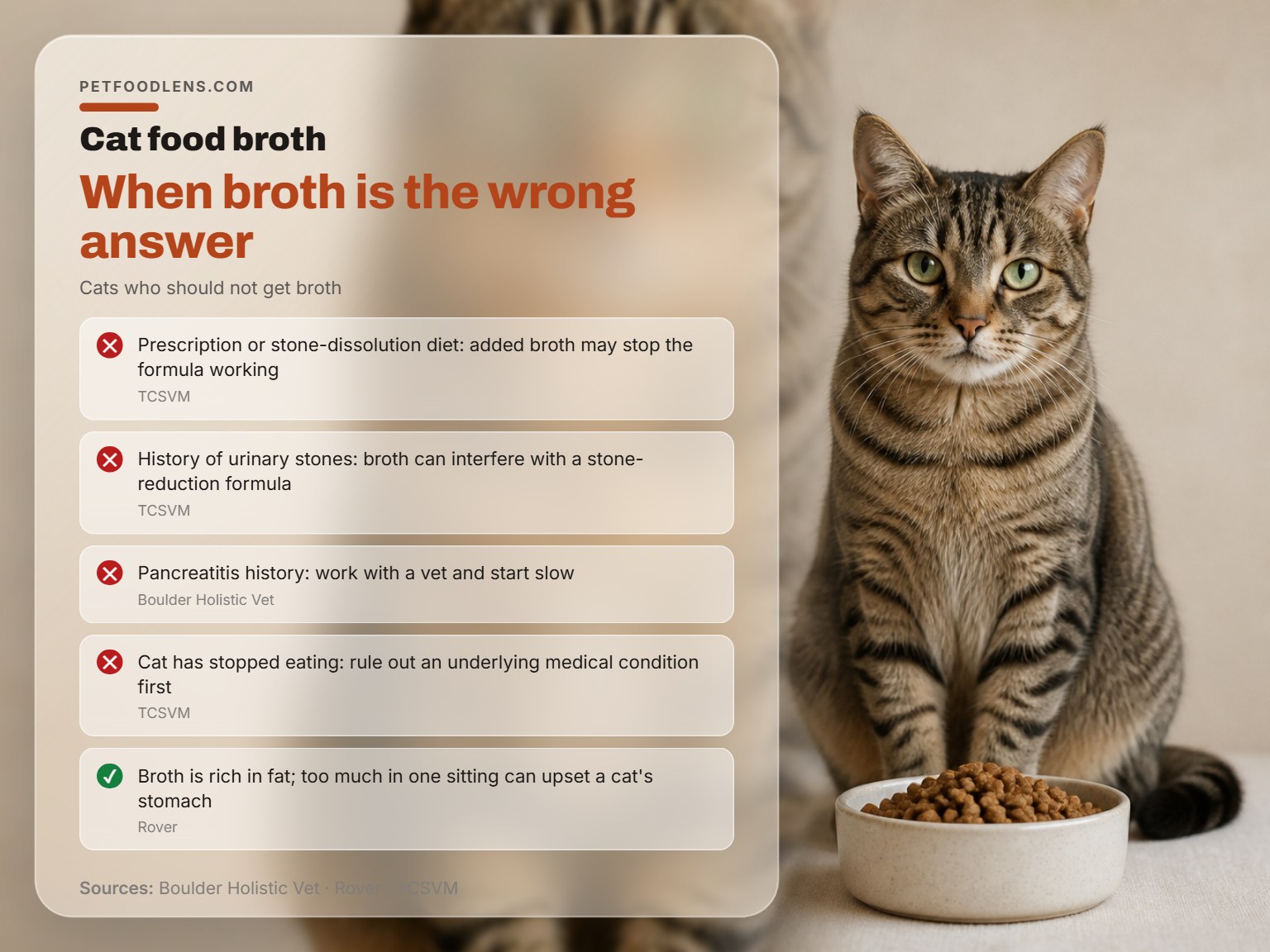
The four cats most likely to be offered broth are the four who should not get it.
Prescription and Therapeutic Diets
Tufts states that adding broth may prevent strict allergy diets and bladder-stone-reduction formulas from working therapeutically. That covers therapeutic urinary and allergy diets, including elimination diets for suspected food allergies. The failure is quiet. Nothing at the bowl tells you the diet stopped working.
Cats With a History of Urinary Stones
Tufts names pets with a history of urinary stones as a case where added moisture helps. The same page warns that broth can interfere with a stone-reduction formula. Both statements are true at once, and the resolution is a conversation with your vet rather than a recipe tweak.
Pancreatitis and Fat Load
Boulder Holistic Vet advises working with a vet and starting slow for any pet with a pancreatitis history. Rover adds that broth is rich in fat and too much in one sitting can upset a cat’s stomach.
A Cat That Has Stopped Eating
Tufts recommends ruling out an underlying medical condition before using broth to tempt a picky cat. Appetite loss is a symptom first and a preference second.
Skip this if: Your cat is on a prescription or stone-dissolution diet. Tufts says added broth may stop those formulas working, and you will not see a sign of it at the bowl.
A bland diet for cats during a stomach upset is a different tool from a daily broth, and the two get confused constantly. One is short-term and vet-directed; the other is a supplement.
Commercial Broth Versus Homemade: Read the Label
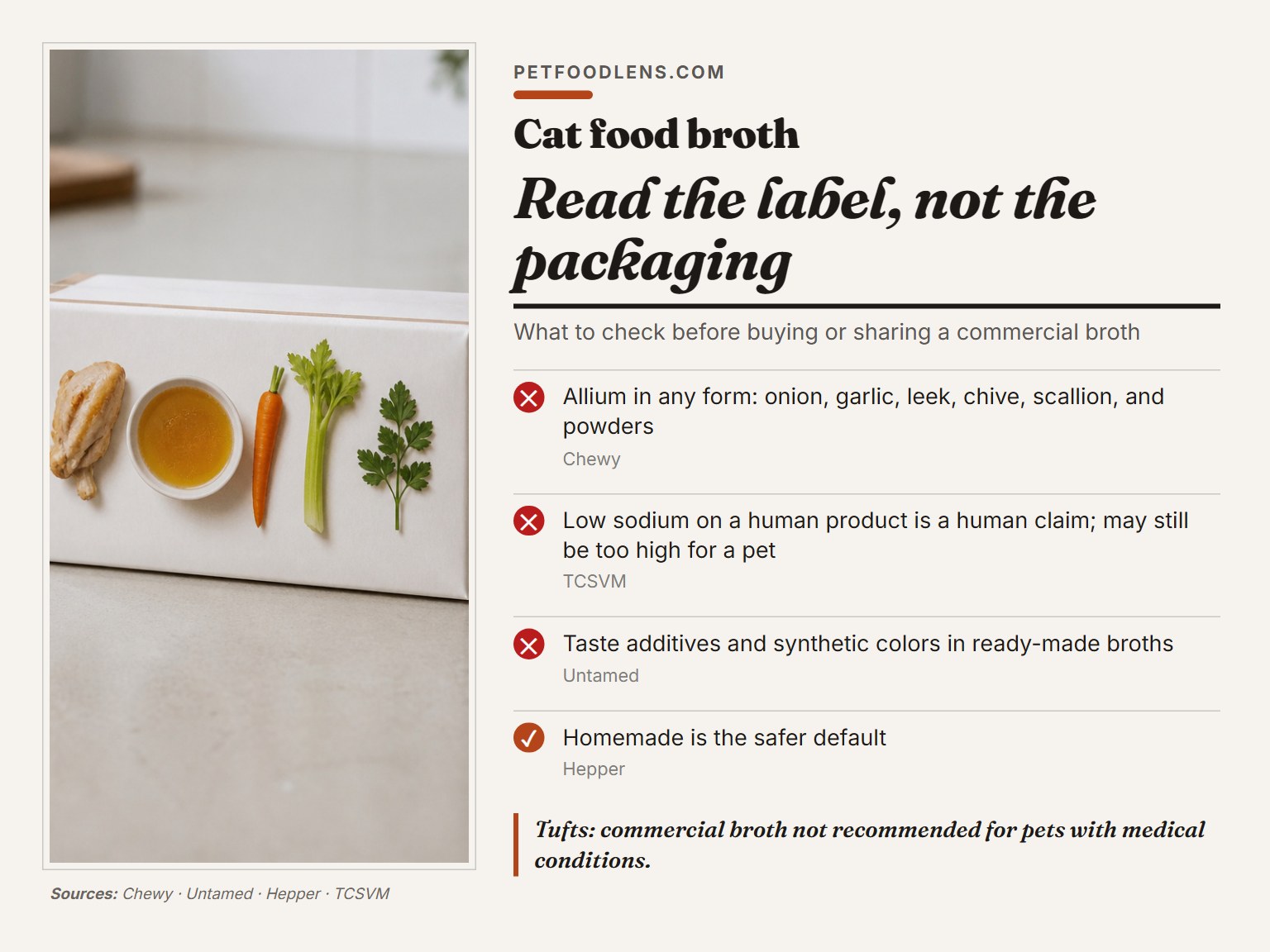
Ever flipped a carton of pet broth over and found garlic powder on the list? It happens more than the packaging suggests.
Tufts is direct about it: even broths branded low sodium may be too high in sodium, and commercial broth is not recommended for pets with medical conditions. Rover points out that broths made for humans typically contain onions, garlic and sodium. Untamed adds that ready-made broths may carry taste additives and synthetic colors to compensate for a lack of real meat.
Hepper favors homemade over commercial broth, while Tufts warns even low-sodium commercial broths may be too high in sodium; the sources disagree on how safe commercial broth is. Homemade is the safer default.
Reading a Commercial Broth Label
- Allium in any form. Onion, garlic, leek, chive, scallion, and the powdered versions that carry the highest dose per gram.
- Sodium. Low sodium on a human product is a human claim. Tufts notes those broths may still be too high for a pet with a medical condition.
- Additives and colors. Untamed flags taste additives and synthetic colors in ready-made broths.
- The word broth itself. Nothing about that word commits a manufacturer to anything you can verify.
Rover’s own recipe page concedes the point, quoting DVM360 that bone broth may provide a bioavailable source of minerals and nitrogen, but whether it benefits pets eating complete and balanced diets is questionable. That’s the honest position, and it sits awkwardly next to the rest of the same page.
I don’t recommend a commercial broth for a cat with any diagnosed condition, and Tufts says the same thing more carefully. For a healthy cat, unsalted broth from your own pot is the version you can actually verify.
Read the label, not the packaging.
If the goal is moisture, the best cat food toppers start with wet food and a little water, which is a shorter path than a pot of bones.
Frequently Asked Questions
Can I use store-bought chicken broth for my cat?
Not without reading the label, and probably not even then. Tufts notes that even broths labeled low sodium may be too high in sodium for a pet with a medical condition, and Rover points out that human broths are typically built on onion, garlic and salt. Untamed adds that ready-made broths may carry taste additives and synthetic colors.
How long does homemade cat broth keep?
Chewy’s DVM-reviewed guidance is 3 to 4 days in the refrigerator. Boulder Holistic Vet gives 7 days and 6 months. Use the shorter numbers; the downside of being wrong is a sick cat, and the downside of being cautious is one pot of water.
Can kittens have broth?
Untamed advises a small portion only for kittens that have already started on solid food, to avoid overloading a young digestive system. Chewy’s general advice applies as well: check with a vet before adding any new food.
Do I need to skim the fat off?
Chewy’s method chills the broth 3 to 4 hours until the fat sets, then has you discard it. Boulder Holistic Vet’s recipe skips the step entirely, and Rover warns that broth is rich in fat and too much at once can upset a cat’s stomach. Chewy chills the broth and skims the solidified fat, while Boulder Holistic Vet skips the step and Rover warns broth is rich in fat; the sources disagree, so decide with your cat’s sensitivity in mind.
Can I add vegetables to cat broth?
Rover lists 1 to 2 celery stalks and 1 to 2 carrots as optional, strained out before serving. Untamed argues that any ingredient besides meat is practically redundant for a cat, since the feline digestive system is built to process meat. Rover lists optional celery and carrots that are strained out, while Untamed argues any ingredient besides meat is practically redundant for a cat; either position is defensible. The vegetables are for flavor, not nutrition.
Is bone broth actually good for cats?
Rover’s page quotes DVM360 saying bone broth may provide a bioavailable source of minerals and nitrogen, but whether it benefits pets eating complete and balanced diets is questionable. Tufts is blunter: there’s no way to determine the nutrient profile of homemade broth. It’s a palatable source of moisture and flavor, not a supplement with a known dose.
The Bottom Line
If your cat is on any prescription or stone-dissolution diet, stop here and call the vet before the pot goes on. That’s the one hard stop in this whole article, and it’s the one most recipe pages never mention.
For everyone else, the first step this week is smaller than you’d expect. Put 2 tablespoons of unsalted broth beside the regular bowl and see whether it gets touched. If it doesn’t, you’ve lost a tablespoon and learned something about your cat.
Here’s the concession: none of this fixes a cat that isn’t drinking enough on dry food. Broth is capped at 10% of daily intake, and 10% of a dry diet is still a dry diet. If hydration is the real problem, the lever is the food, not the topper.
And the storage numbers worth remembering are Chewy’s 3 to 4 days versus Boulder Holistic Vet’s 7 days, the sources disagree, so pick the one you can stand behind. That’s how to make cat food broth that you can actually stand behind a week later.
