
How to Use Cat Food Toppers for Hydration: Step-by-Step
This post contains affiliate links. As an Amazon Associate, we earn from qualifying purchases.
To use cat food toppers for hydration, keep toppers and treats at or below 10% of your cat’s daily calories and choose a topper with a stated moisture content you can actually read on the label. VCA Animal Hospitals sets that 10% ceiling; a pet needing 1,000 calories a day gets no more than 100 calories from toppers and treats. Learning how to use cat food toppers for hydration starts with reading the label.
That stated water number is where the arithmetic starts. A can at 78% moisture is mostly water by weight, so the useful question becomes what the remaining 22% delivers: protein, fat, and the taurine a cat cannot make on its own.
What follows covers the calorie ceiling, three named toppers and how each one is dosed, the dry matter math behind a moisture claim, and the switch schedule that keeps a cat eating instead of sulking.
Key Takeaways
- Cap toppers and treats at 10% of daily calories. VCA’s worked example puts a 1,000-calorie pet at 100 calories of topper and 900 from complete food.
- A moisture number is not a quality number. Wild Earth lists 78% max and Loveabowl up to 85%, and none of those figures say anything about protein quality.
- Check whether the can is complete or complementary before it becomes a meal. Loveabowl calls its wet food complementary; Wild Earth says a full can works as a complete meal.
- Skip the topper if the bowl comes back empty. VCA’s guidance is blunt on that point.
- Plan the switch in days, not minutes. Manufacturer schedules run from 7 to 10 days (Wild Earth) to 1–2 weeks (Loveabowl).
Is a Cat That Drinks From the Bowl Actually Hydrated?
Bowl volume tells you less than it looks like it does. Domestic cats descend from desert hunters and carry a limited thirst drive, so a cat can drink steadily and still run a low total water intake if the food is dry, which is the how to use cat food toppers for hydration question in miniature.
Domestic cats descend from desert-dwelling ancestors and carry a naturally limited thirst drive. A cat eating food at 70 to 80% moisture takes in water through the meal itself and can offset a low urge to drink, which is why bowl volume alone is a poor measure of daily intake.
The AAHA wet cat food guidance lays out the mechanism: a high-moisture diet dilutes urine and increases urination, which makes the bladder less hospitable to crystal formation.
That is the whole case for toppers in one sentence. Not flavor. Water.
Working out how much water a cat should drink per day is worth doing once, if only to see how little of it arrives through a bowl. If your cat ignores the bowl entirely, the harder half of the job is learning to get a cat to drink water without turning the kitchen into a negotiation.
The 10% Calorie Ceiling That Decides How Much Topper Is Safe
Ten percent is the number that governs everything else when you compare a how to use cat food toppers for hydration. VCA defines a topper as an ingredient added to the usual food to improve the eating experience or the taste of the meal, and then caps toppers plus treats together at 10% of daily calories.
The arithmetic is easy to run. A pet that needs 1,000 calories a day to hold weight should get no more than 100 calories from toppers and treats, with the remaining 900 coming from a complete and balanced food.
Push past that line and the diet stops being balanced. VCA warns that feeding more than 10% of calories as toppers or treats can unbalance a pet’s diet and could lead to obesity.
People ask me whether table scraps will make a food more appealing. A small amount of the same food works better as a topper, and it does not dilute the balance of a complete diet or stack calories on top of an already complete meal.
What counts toward the ceiling, in practice:
- Any wet topper spooned over kibble, including the pate you consider “just moisture.”
- Freeze-dried pieces, lickable tubes, and dental chews. All of it.
- Table food, which is the category most owners forget to count.
- Broth, if it carries calories. Plain broth mostly does not, but read the can.
Common mistake: Treating a moisture-rich topper as free food because it looks like water. Two tablespoons of pate on top of a full kibble ration quietly pushes daily calories past maintenance, and the extra weight shows on the scale long before anyone thinks to cut the portion back.
If you want a wider shortlist before you commit to one product, this rundown of cat food topper types separates the moisture plays from the flavor plays.
How Do You Pick a Topper That Actually Adds Water?
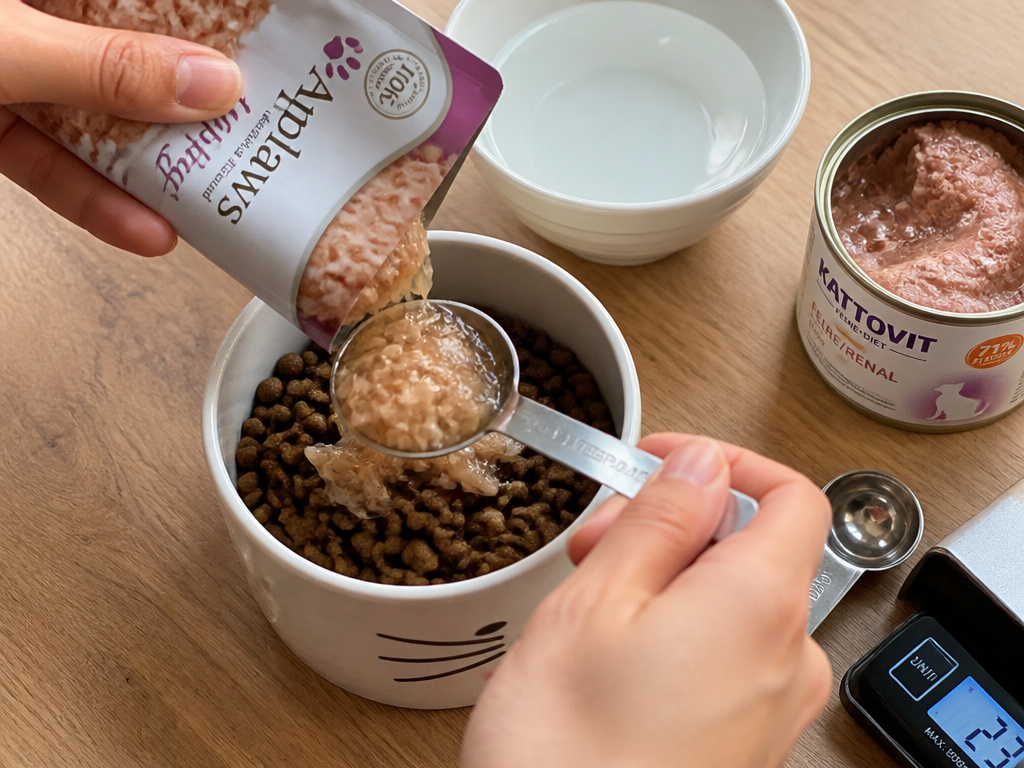
Start with the guaranteed analysis, not the front of the pouch. Three products on the market publish moisture numbers you can compare directly, and their serving instructions differ enough to matter.
| Product | Stated moisture | Printed serving guidance | Complete or complementary |
|---|---|---|---|
| Catit Top ‘n’ Treat | Not stated in source | Up to 1 pouch (60 g) daily | Complement to complete food |
| Wild Earth Unicorn Pate | 78% max | 1 to 2 tbsp as topper | Full can marketed as complete meal |
| Loveabowl wet cat food | Up to 85% | Treat or meal topper | Complementary food |
Catit Top ‘n’ Treat: one 60 g pouch a day
Catit sells these as single-serve pouches, 60 g each, three to a bag, with real chicken or tuna as the main ingredient and a jelly texture. The feeding line is specific: up to one pouch daily as a treat or food topper alongside a complete wet or dry food, with fresh water available at all times.
That is a convenient dose for a cat who needs encouragement, and the pouch format means no half-can in the fridge. See current reviews on Amazon if you want the jelly-versus-pate comparison from other owners.
Wild Earth Unicorn Pate: 1 to 2 tablespoons, 78% moisture max
Wild Earth prints 78% moisture maximum and gives three separate doses: 1 to 2 tablespoons stirred into kibble as a light topper, 1/3 to 1/2 can as a side dish, or 1 tablespoon as a transition aid increased over 7 to 10 days.
Here is the part the front of the can does not settle. Wild Earth says a full can works as a complete meal and also calls the product a side dish, which is a wide claim to hold at once. Check availability and read that page yourself before you build a diet around it.
Loveabowl: complementary, up to 85% moisture
Loveabowl is upfront that its wet food is a complementary food, not a complete diet, and states moisture of up to 85%. It also lists taurine, which matters if the topper is displacing complete food rather than sitting beside it.
For a cat already on a solid complete food, that positioning is honest and useful. For a cat being fed mostly topper, it is a problem.
If the goal is a full bowl of moisture rather than a spoonful, the better comparison is wet cat food for hydration rather than the topper aisle. And if you want the shortlist narrowed further, these best cat food toppers are ranked by what they actually contribute.
The Label Math: Moisture Percent vs Dry Matter
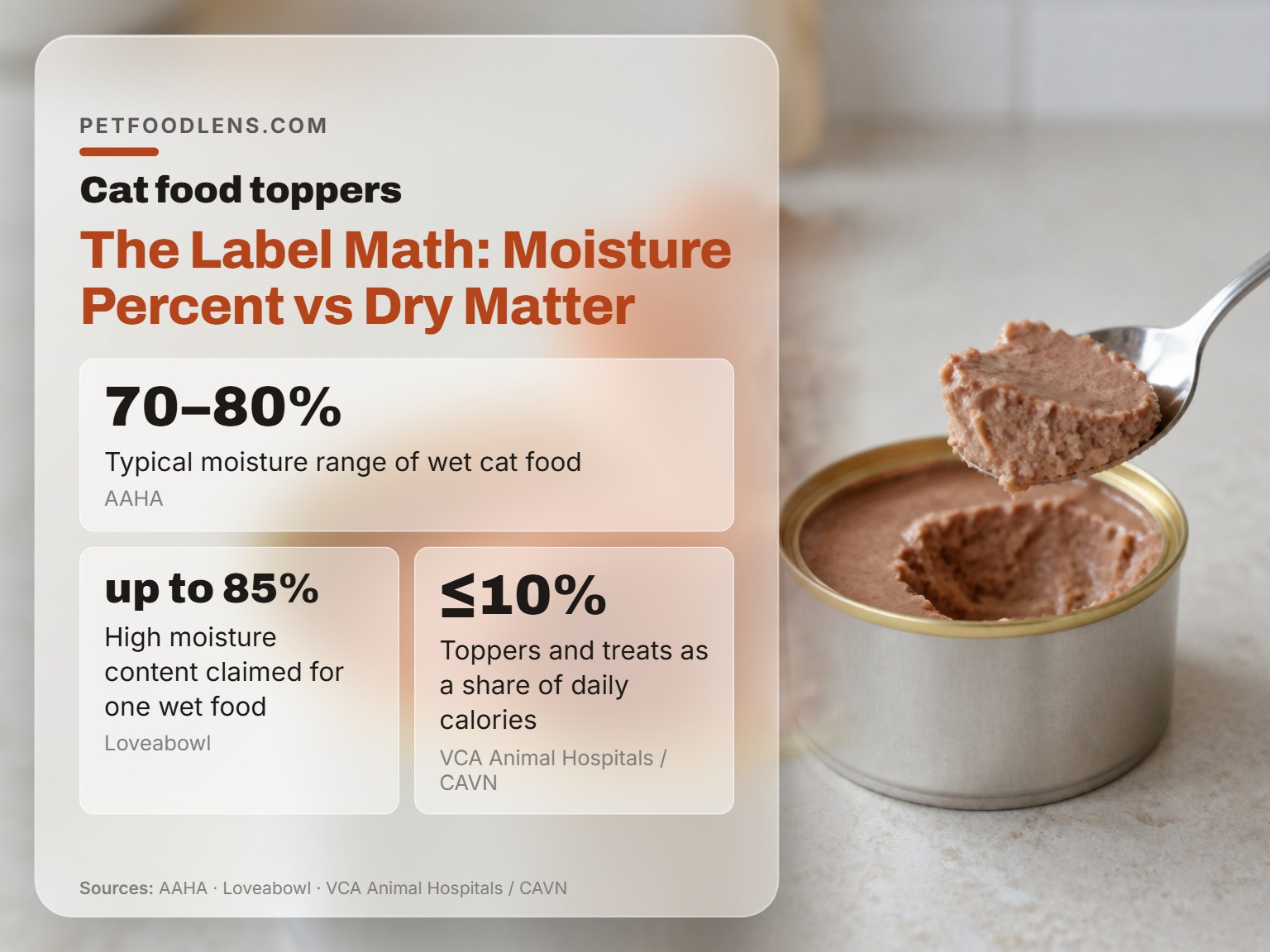
I work out protein and fat on a dry matter basis about once a week out of habit, usually on the back of whatever can is in front of me. The moisture line gets read first, because it changes every number under it.
Dry matter basis means removing the water from the calculation so two foods can be compared on the part that feeds the cat. A can at 78% moisture is 22% dry matter, and the protein percentage on the label is measured against the whole can, water included.
That is a texture tell as much as a label tell. A high-moisture pate spreads like soft butter under a fork, while a low-moisture stew leaves cubes sitting in thickened water that smells faintly of starch rather than meat.
A moisture percentage is a water measurement, not a quality grade. Two cans at 78% can sit at opposite ends of the protein scale, and the only way to see the difference is to convert both to dry matter and compare.
If the can is already open and the cat is lukewarm about it, a spoon of warm water stirred through does more for intake than a new product does. The mechanics of that are covered in add water to cat food, and it costs nothing to test tonight.
How to Introduce a Topper Without a Hunger Strike
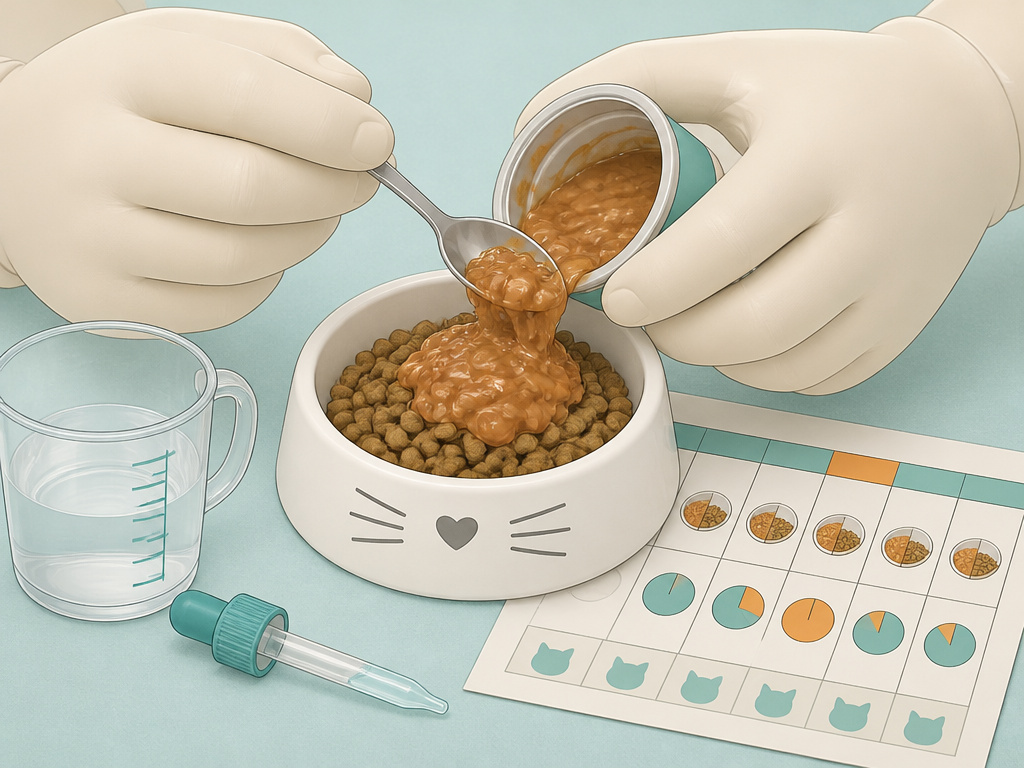
Fast switches fail more often than slow ones. I have watched cats refuse a bowl for two days after an overnight swap, and a cat that stops eating is a bigger problem than a cat that eats dry food.
Manufacturers do not agree on the schedule, so pick one and hold it. Loveabowl publishes a 75/25 progression across a week: days 1 and 2 at 75% old food and 25% new, days 3 and 4 at 50/50, days 5 and 6 at 75% new, and day 7 fully on the new food in most cases, with a 1–2 week overall transition. Wild Earth runs a different version, starting at 1 tablespoon and increasing gradually over 7 to 10 days.
- Start with a teaspoon, not a tablespoon. A large first dose gets refused, and a refused bowl sets the whole schedule back.
- Hold each ratio for two days before shifting. Cats build tolerance to a new texture slowly, and rushing the middle steps is where most switches collapse.
- Keep the base food measured while you add. If the topper replaces part of the ration instead of stacking on it, the calorie ceiling stays intact.
- Stop and call the vet if the cat refuses food for more than a day or two. For an overweight cat, that timeline is a real risk rather than a stubbornness contest.
I would rather see a cat eat a mediocre dry food than watch an owner win a standoff over a better one. A two-day hunger strike in a heavy cat is a veterinary phone call, not a training exercise.
When a Topper Is the Wrong Tool
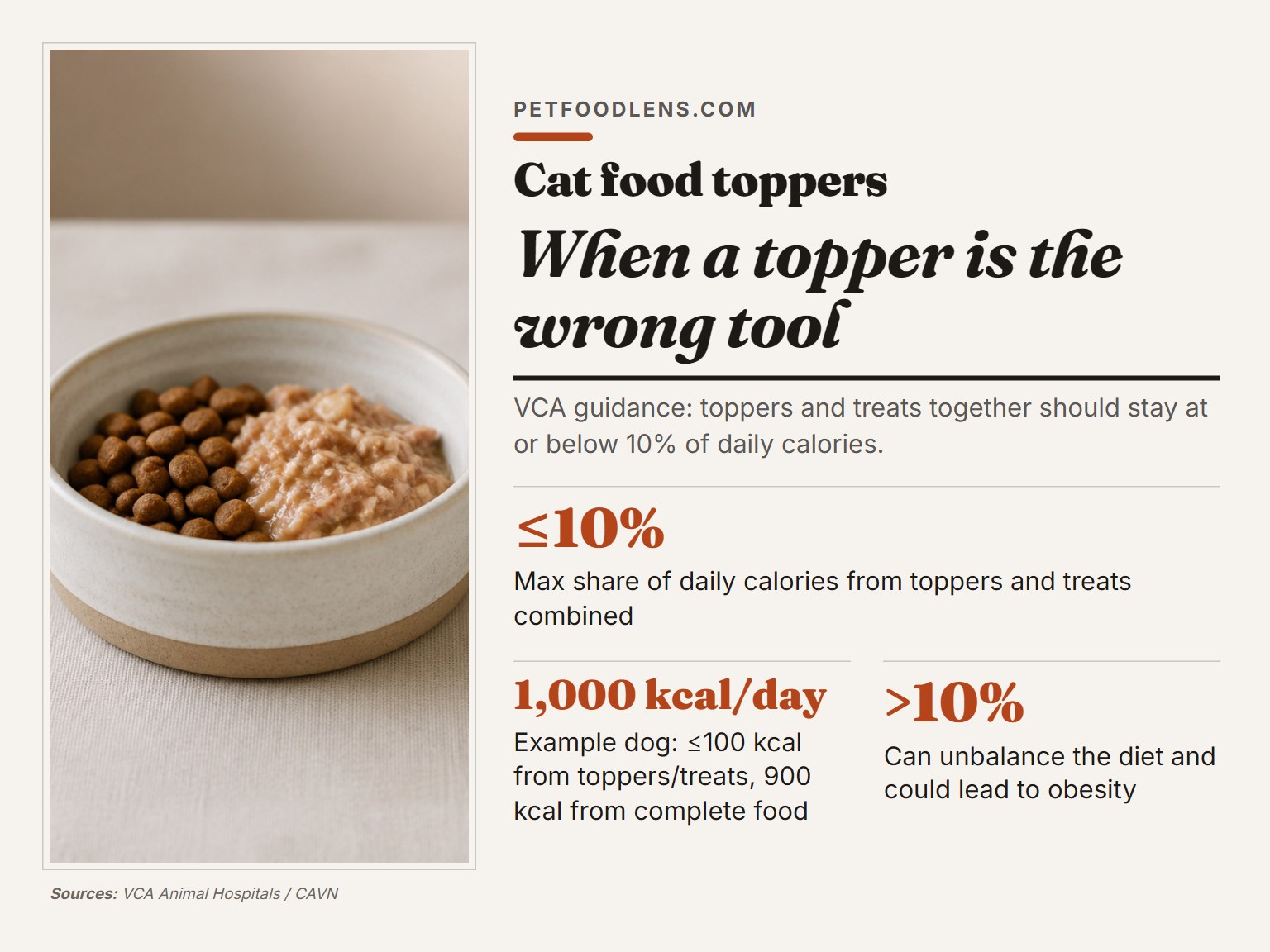
If the bowl comes back empty at every meal, VCA’s guidance is that there is usually no reason to add a topper at all. A cat cleaning the bowl is already eating.
The other cases are environmental before they are nutritional. In a multi-pet house, feeding cats separately reduces competition and interruption, and an older cat or one on a special diet should be fed in a quiet room where nobody else can push in.
Then there is the arithmetic problem. A topper that pushes past 10% of daily calories unbalances a complete diet, and the risk climbs faster in a cat that is already overweight.
Skip this if: your cat has been diagnosed with kidney disease or urinary crystals. Loveabowl markets its high-moisture food as a good choice for cats with kidney issues but tells buyers to ask a vet about the right diet, and that is the correct instruction. I am not a clinician, and a therapeutic diet is a prescription decision, not a label-reading decision.
One more label detail worth knowing. Of the three products here, only Wild Earth publishes a taurine minimum. Catit’s guaranteed analysis does not list taurine at all. That is fine when the topper is a small addition to complete food, and it becomes a real question when the topper is replacing meals.
Where the Labels and the Vets Don’t Agree
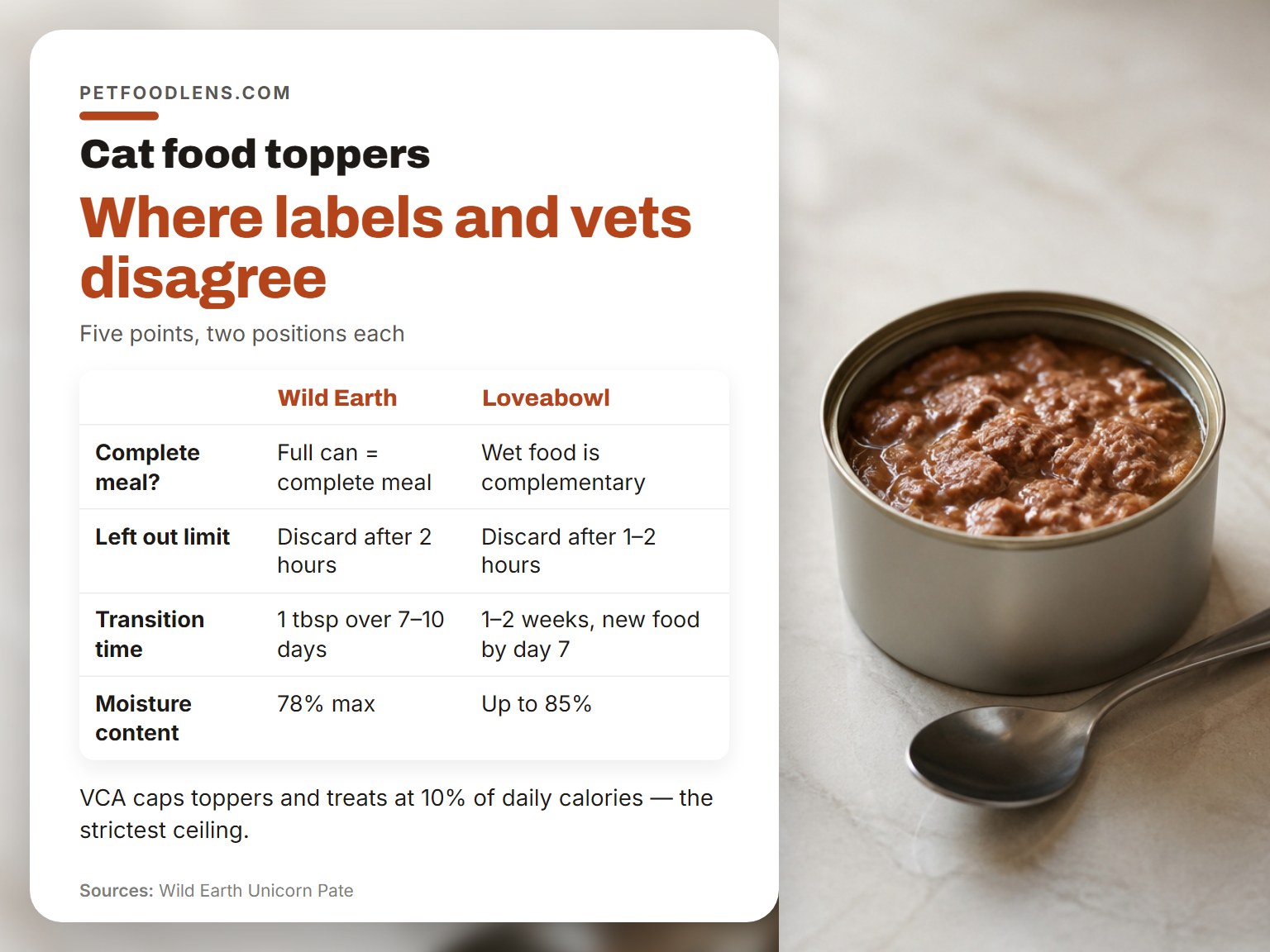
The sources contradict each other on five points, and pretending otherwise would be worse than useless. Here is each position with the name attached.
| Question | One position | The other |
|---|---|---|
| Is a can a complete meal? | Wild Earth: a full can works as a complete meal | Loveabowl: its wet food is a complementary food |
| How long can an opened can sit out? | Wild Earth: discard food left out for two hours | Loveabowl: discard after 1 to 2 hours |
| How much topper per day? | Catit: up to one 60 g pouch daily | Wild Earth: 1 to 2 tbsp; VCA: 10% of daily calories |
| How long does a switch take? | Wild Earth: 7 to 10 days | Loveabowl: 1 to 2 weeks, new food by day 7 |
| Stated moisture content | AAHA: approximately 70 to 80% | Wild Earth 78% max; Loveabowl up to 85% |
Read the strictest line in each row and you will not go far wrong. That means the 10% calorie ceiling as the cap, the 1 to 2 hour discard window (Loveabowl) versus two hours (Wild Earth) as the limit, and the longer transition as the schedule.
The completeness row is the one that costs people money. A buyer cannot assume a wet topper is nutritionally complete, because two manufacturers in the same category make opposite claims. Read the can, not the category.
For the wider picture on what a moisture-forward diet looks like across a full day, this guide to cat food for hydration covers the bowl and the can together. And if you are making your own liquid addition, keep the ingredient list short: cat food broth should be water and cooking juice, with no onion, garlic, or salt anywhere in the pot.
Frequently Asked Questions
How much topper can I add to a cat’s food each day?
Keep toppers and treats combined at or below 10% of daily calories, per VCA Animal Hospitals. For a cat eating 1,000 calories a day, that is 100 calories of topper, which is a small spoonful rather than a half can. Weigh the base food first, then decide what fits.
Is a high-moisture topper enough water on its own?
No. A topper adds water, but AAHA’s point is that total intake across the day is what counts, and a topper at 10% of calories contributes a modest share of it. The base food does most of the work.
Do I need to refrigerate an opened pouch or can?
Yes. Wild Earth instructs refrigerating the unused portion, and Loveabowl says an unopened can needs no refrigeration but an opened one should be covered and stored cold. Discard what has been out: two hours per Wild Earth, 1 to 2 hours per Loveabowl.
Can I use the same topper every day?
Catit’s feeding line allows up to one pouch daily, so daily use is within the manufacturer’s instruction. Rotate the base food before you rotate the topper, and watch the calorie total rather than the variety.
What if my cat has kidney disease?
Ask your vet before changing anything. Loveabowl states its high-moisture food suits cats with kidney issues and then advises asking a vet about the suitable diet, which is the right order of operations. A topper is not a treatment.
The Bottom Line
If toppers and treats are adding up to more than a tenth of your cat’s daily calories, cut the topper before you cut the food. The complete diet is the part doing the nutritional work, and the topper is the part doing the water and the encouragement.
Start this week with one measurement, not one purchase. Find the calorie figure on your cat’s current food, work out what a tenth of the daily total looks like, and see how much of that tenth you are already spending on extras. Most owners I talk to are surprised by the answer.
The honest limit on all of this: none of it fixes a cat that already has crystals, kidney disease, or a weight problem. That is a veterinary conversation, and the label will not get you there.
