
How to Make Frozen Dog Treats: Step-by-Step
This post contains affiliate links. As an Amazon Associate, we earn from qualifying purchases.
To make frozen dog treats, blend a dog-safe base with liquid, pour into small silicone molds, and freeze until solid. Plain yogurt, cooked chicken, or unsweetened peanut butter all work. Published freeze times range from 1-2 hours to overnight depending on the source and mold size.
Small molds matter because of the tooth. Barden Greenfield, DVM, a Tennessee pet dentist, describes a slab fracture of the upper 4th premolar from dogs chewing hard ice. That injury often exposes the pulp and needs root canal therapy or surgical removal. The risk rises with the size of the frozen cube.
By the last section you’ll know how to make frozen dog treats for your dog, how long to freeze them, and the one ingredient check that matters more than everything else on this page.
Key Takeaways
- Check every nut butter for xylitol before it goes in the bowl; it is toxic to dogs.
- Use small silicone molds or small cubes, not full ice cube trays, because the fracture risk rises with cube size.
- Freeze times disagree across sources: Peel with Zeal says 1-2 hours, Pujols says at least 2 hours, Rover’s total time is 4 hours 20 minutes, and Dogs Trust says overnight. Small molds set sooner.
- Dairy is the split: AKC says skip yogurt entirely for lactose-intolerant dogs; Whole Dog Journal steers toward fermented dairy or coconut milk; Peel with Zeal says only a small percentage of dogs are lactose intolerant and suggests chicken stock.
- Treats should be fed in moderation and included in the dog’s daily calorie intake; the complete food does the nutritional work.
What Goes In (and What Never Does)
Every guide to how to make frozen dog treats starts with a base the dog can digest and a liquid that freezes clean. Get those two right and the rest is portion size.
The upper 4th premolar is the tooth most often fractured by hard chewing. A slab fracture splits the tooth and frequently exposes the pulp, producing significant oral pain. Treatment options are root canal therapy or surgical removal of the tooth. Risk increases with the size of the frozen cube.
The avoid list is short and has no exceptions. Xylitol, macadamia nuts, grapes, raisins, onions, and chocolate all appear on the Animal Health Foundation frozen treats do-not-use list. Xylitol is the one that hides, and it hides in peanut butter.
The avoid list, per the Animal Health Foundation and the AKC:
- Xylitol, the sugar substitute that is toxic to dogs and shows up in nut butters and some yogurts
- Macadamia nuts, grapes, raisins, onions, and chocolate, all on the same do-not-use list
- Flavored yogurt with artificial sweeteners, which is why plain is the only safe default
The xylitol check
Xylitol appears on ingredient lists under several names: xylitol, birch sugar, or sometimes under a general “sugar alcohol” line. If any of those appear, the jar does not go in the bowl. This is the one check you cannot skip.
The safe side is broader than the avoid list. Here is what is actually in it: plain unsweetened yogurt, cooked chicken, unsweetened peanut butter, mashed banana, pureed berries, and cooked sweet potato all freeze well. If you want the baked version instead of frozen, the same base ingredients work as homemade treats with a longer shelf life.
Which Base Actually Works: Yogurt, Chicken, or Peanut Butter?
Yogurt is the popular choice and the wrong one for a lot of dogs. The three bases behave differently in the freezer, and the source ratios are not interchangeable.
| Base | Source ratio | Main caveat |
|---|---|---|
| Plain yogurt | 4 oz yogurt + 4 oz water (Rover) | AKC: skip entirely if lactose intolerant |
| Cooked chicken | 1 breast + 500ml poaching water (Dogs Trust) | Blend a full minute or it won’t pour |
| Unsweetened peanut butter | 1/3 cup per batch (Pujols) | Check the label for xylitol every time |
The AKC meat treat recipe runs 2 cups grilled skinless chicken, 3/4 cup plain low-fat yogurt, 1 carrot, and 3 tablespoons olive oil. That is a full batch. For small dogs, the AKC suggests piping little droplets onto a parchment-lined baking sheet instead of filling a full mold. The frozen PBJ dog treats recipe from the Pujols Family Foundation goes the other direction: 1/4 cup strawberries, 1/4 cup blueberries, and 1/3 cup natural unsweetened peanut butter, spooned into ice cube trays halfway.
I have never met a dog that turned down a frozen peanut butter treat, and I have met plenty that turned down yogurt. If you want the treat to actually get eaten, start with the base the dog already loves and adjust the liquid from there.
The lactose question
Three sources, three positions on dairy. The AKC uses yogurt in its recipe but warns against it entirely for lactose-intolerant dogs. The Animal Health Foundation says many dogs are lactose-intolerant and steers toward fermented dairy like yogurt or kefir, or unsweetened coconut milk. Peel with Zeal says only a small percentage of dogs are lactose-intolerant and suggests chicken stock as the substitute.
Read those three together and the positions differ: the AKC says skip yogurt entirely for lactose-intolerant dogs, the Animal Health Foundation steers toward fermented dairy or coconut milk, and Peel with Zeal says only a small percentage of dogs are lactose intolerant and suggests chicken stock. The disagreement is real, not a misreading.
If you go the peanut butter route, xylitol-free peanut butter is not optional. It is the whole safety check.
How Long Do Frozen Dog Treats Actually Take to Freeze?
How long does it actually take? Depends who you ask, and the four published answers span from 1 hour to overnight.
| Source | Stated freeze time | Mold size noted |
|---|---|---|
| Peel with Zeal | 1-2 hours | Silicone mold or ice cube tray |
| Pujols Family Foundation | At least 2 hours | Ice cube trays, half-filled |
| Rover (Kiki Kane) | 4 hours 20 minutes total | About 1 oz per well |
| Dogs Trust | Overnight | Small silicone molds |
Size matters here. Small molds at one ounce freeze faster than a full ice cube tray, and Rover’s 4-hour 20-minute total includes 20 minutes of prep. Rover’s 4-hour 20-minute figure is one published number, while Dogs Trust’s overnight is the longest. Dogs Trust’s overnight is the safest for a full tray.
If you’re scaling up to batch production, freeze the mixture in portioned containers rather than one giant block.
Leave headroom in each well or the mold overflows.
The Equipment That Changes the Outcome
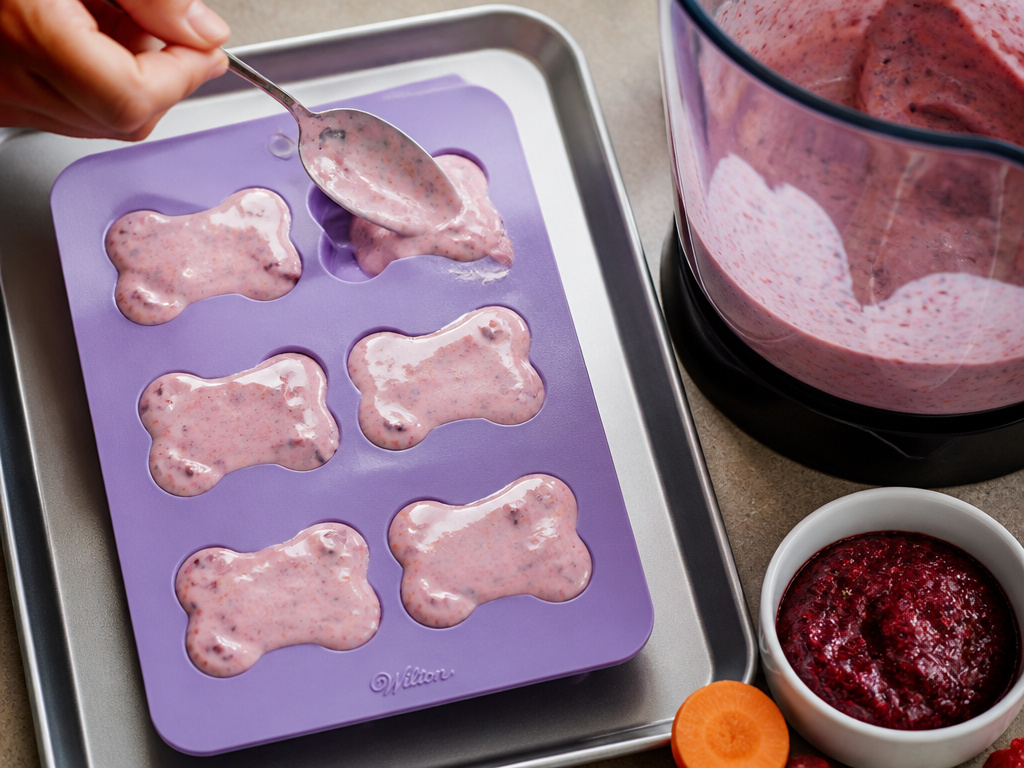
Three pieces of equipment do the work: a blender, a silicone mold, and something to carry the mold on.
Before you start: Ice cubes are the highest-risk frozen treat because dogs chew them hard; the fracture risk rises with cube size. Melting treats make floors slippery, so serve indoors on a towel or mat. Never leave a frozen treat unattended with a dog that gulps.
The method, in order:
- Blend the base and liquid until pourable. Dogs Trust blends chicken and poaching water for a full minute; Peel with Zeal runs berries and yogurt for about 90 seconds. The mixture should pour like thick cream, not plop like paste.
- Add any bonus ingredients: a tablespoon of plain yogurt, a few pureed berries, or a slice of carrot as an edible stick.
- Pour into the mold, leaving headroom for expansion. If you’re using a silicone mold, set it on a baking sheet first. Rover calls a full mold “a devil of a time moving” without support.
- Freeze until solid. Published times range from 1-2 hours to overnight depending on the source and mold size.
- Pop out and serve on a towel or mat if you’re indoors, because melting treats make a mess on furniture and flooring.
Support the mold. That is the step most people skip.
The Classic Kong is the standard for stuffing and freezing, per the Animal Health Foundation. For silicone molds, Rover uses a bone mold that fills 6 to 9 bone-shaped wells at around 1 ounce each. Store-bought frozen dog treats are fine as a backup, but the homemade version is where you control the ingredient list.
Why the Ice Cube Habit Is the One to Break
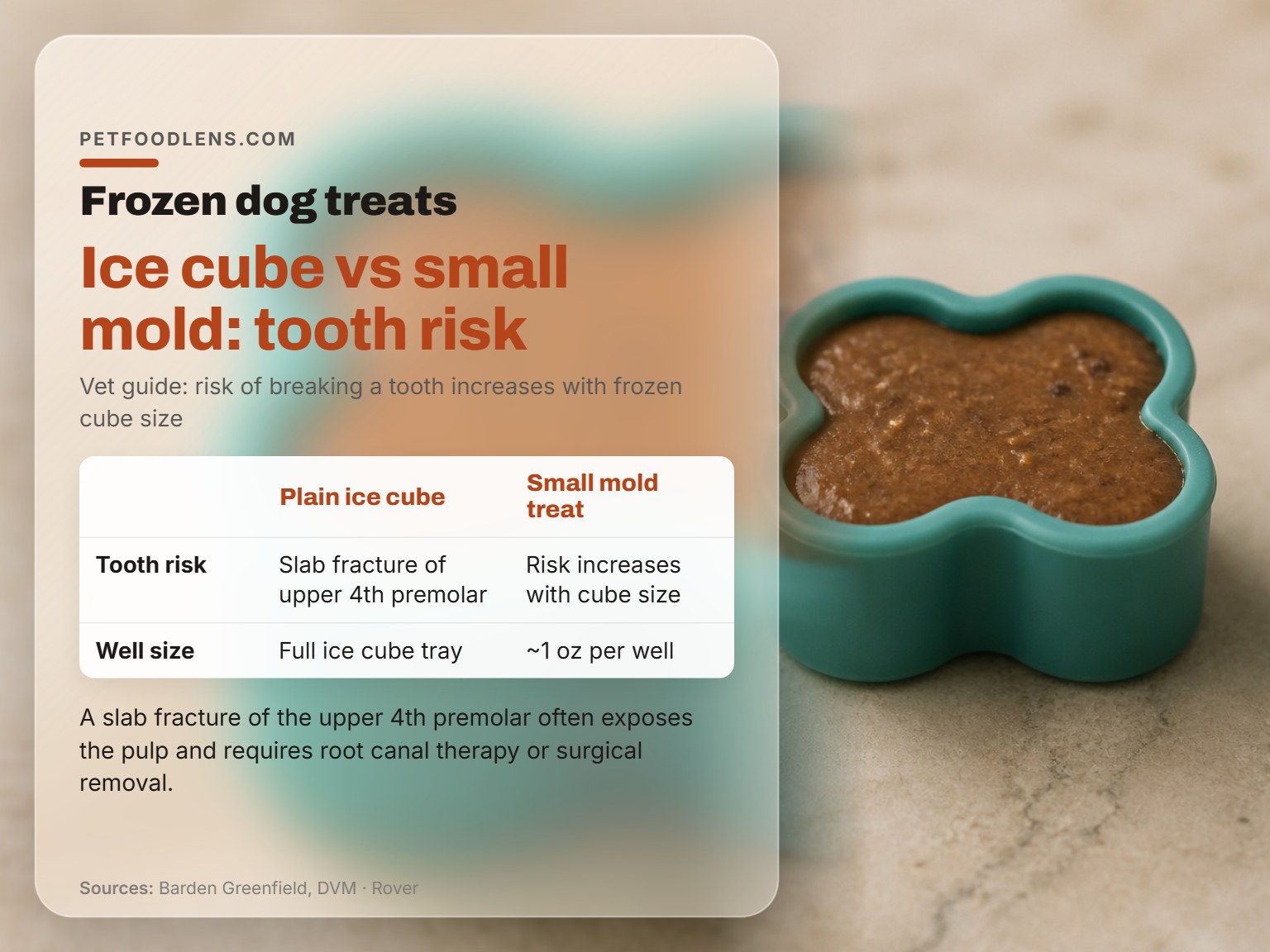
A plain ice cube is a common frozen treat, and the vet quoted in the Animal Health Foundation’s guide says that is the wrong default. I’ve watched owners freeze full ice cube trays and call it a treat. It is a treat, and it is also the highest-risk shape in the freezer.
Chew force is the mechanism. A dog bites down on a hard cube and the force transfers straight into the upper 4th premolar, the large carnassial tooth at the back of the mouth. A slab fracture splits the tooth vertically. The pulp is exposed, the dog is in pain, and the treatment is a root canal or extraction.
Why the mold size matters
A 1-ounce well and a larger well produce very different treats. The larger treat takes longer to freeze, takes longer to eat, and puts more force on the tooth when the dog chews. Size down, not up.
The Animal Health Foundation also notes that small amounts of honey help prevent a too-hard freeze, though the same source warns to limit sugar overall. That is an internal tension in the guidance, and it does not resolve cleanly for every dog.
Storage: The Airtight Rule Nobody Follows
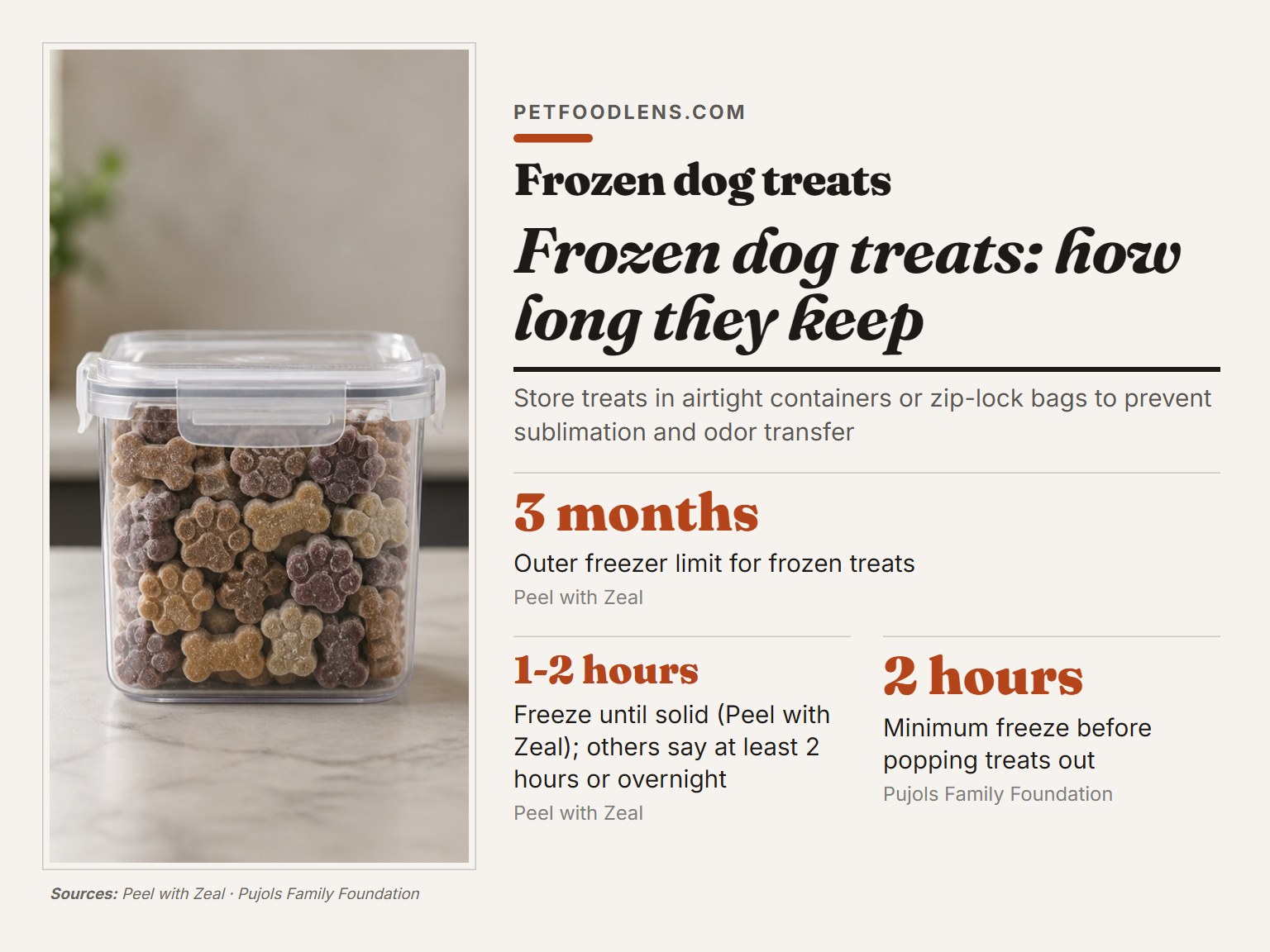
The Animal Health Foundation names the failure mode directly: sublimation. Frozen food loses moisture to the dry air inside a freezer, and the treat goes chalky, grainy, and picks up odors from whatever else is in there.
The fix is an airtight container or a zip-lock bag. I label every bag with the freeze date. If you’re storing more than a single batch, store homemade treats in labeled containers so the oldest batch gets used first.
Peel with Zeal gives an outer limit of 3 months for frozen treats. How long homemade treats last depends on the base and the container, not the recipe. A treat that has been in the freezer too long comes out with a white, chalky surface and a dry, crumbly texture. That is sublimation, and it is your signal to toss the batch.
Storage checklist:
- Airtight container or zip-lock bag
- Freeze date written on the label
- Oldest batch used first
- Toss anything with a chalky, dry surface
If your dog is on raw, freeze raw dog food in single-serve portions so you’re not thawing and refreezing the same block.
If you’re moving treats from freezer to fridge, thaw them overnight in the refrigerator, not on the counter.
When Your Dog Can’t Have Dairy
Your dog eats the first frozen yogurt treat fine and has loose stool by the next morning. That is the lactose signal, and it is common enough that the Animal Health Foundation builds it into its main guide.
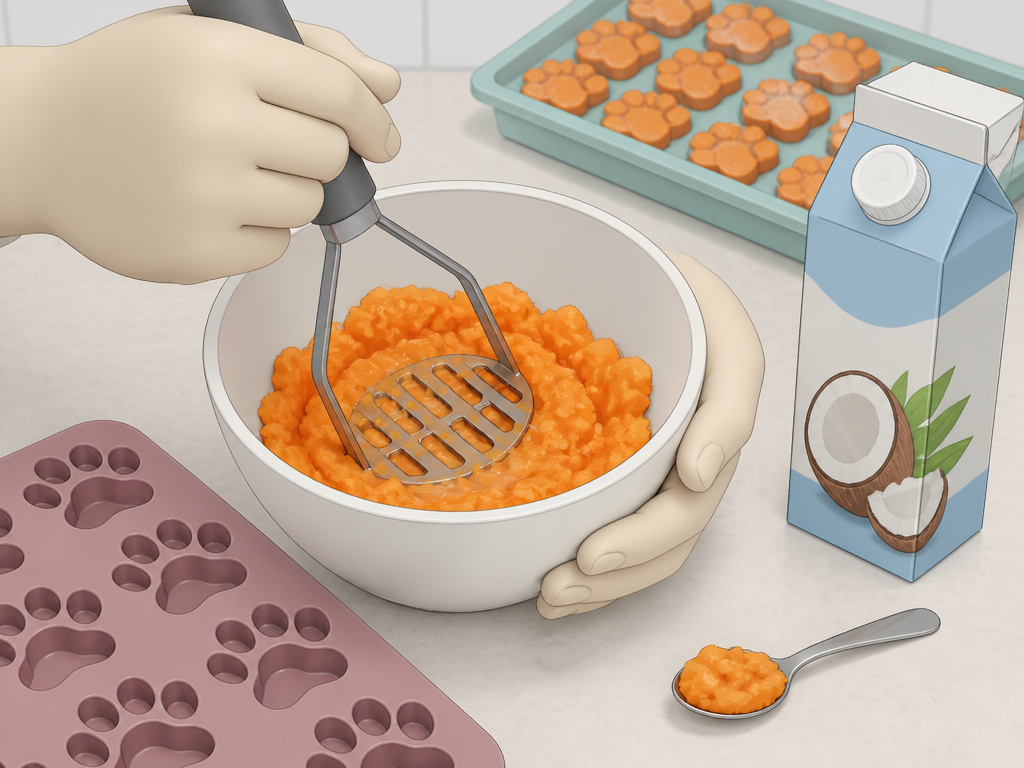
The dairy-free options are broader than they look. Unsweetened coconut milk is lactose-free and freezes clean. Chicken stock works as a liquid base. Cooked sweet potato mashed with a little water freezes into a dense, chewy treat that most dogs take to immediately.
For a dairy-free base, sweet potato dog treats work as a frozen option too. Mash cooked sweet potato with a little water and freeze in the same molds.
Test small. A teaspoon of the mixture before freezing tells you whether the dog will eat it, and it tells you whether the dog tolerates it.
Frequently Asked Questions
Can I use ice cube trays instead of silicone molds?
Yes, with a caveat. Ice cube trays work, but the cubes come out larger than most silicone molds and the fracture risk rises with cube size. If you use a tray, fill each cavity halfway so the treats are smaller, and set the tray on a baking sheet before you move it to the freezer.
How many frozen treats can I give my dog per day?
Treats should be fed in moderation and included in the dog’s daily calorie intake. Dogs Trust explicitly says food enrichment should be fed in moderation and included in the dog’s daily calorie intake. A frozen treat is a treat. It is not a meal replacement.
Is peanut butter safe for dogs?
Plain unsweetened peanut butter is safe. The one hard stop is xylitol, a sugar substitute that is toxic to dogs and appears in some “natural” nut butters. Check the label every time you buy a new jar. If the ingredient list includes xylitol, the jar does not go in the bowl.
Can I freeze the treats inside a Kong toy?
Yes. The Animal Health Foundation recommends filling a sturdy dishwasher-safe, nontoxic, hollow, hard rubber toy like a Classic Kong with the mixture, blocking any extra holes, and leaving one large hole open for filling. Store the filled toy in a sealed freezer container or zip-lock bag.
How long do frozen dog treats last in the freezer?
Peel with Zeal gives an outer limit of 3 months. The practical limit is shorter if the container is not airtight, because sublimation dries the treat out and it picks up freezer odors. Label the bag with the freeze date and use the oldest batch first.
What if my dog is lactose intolerant?
Substitute unsweetened coconut milk, chicken stock, or a pureed sweet potato base. The Animal Health Foundation steers toward fermented dairy like yogurt or kefir, but the AKC says skip yogurt entirely for lactose-intolerant dogs. If your dog has had loose stool after dairy before, treat the AKC position as the safer default.
The Bottom Line
One rule decides whether the batch is worth making: check the nut butter label for xylitol before anything else goes in the bowl. That is the one failure mode with no recovery, and it hides in the ingredient most recipes call for.
If you’re starting this week, buy a silicone mold with 1-ounce wells and a jar of plain unsweetened peanut butter. Skip the ice cube tray. The first batch will tell you whether your dog prefers savory or sweet, and the second batch is where you actually dial in the ratios.
Fair warning: feeding treats in moderation and counting them in daily calories is the part most owners ignore. A frozen treat is a treat. The complete food still does the nutritional work, and a dog that fills up on pupsicles is a dog that skips dinner.
