
How to Make Sweet Potato Dog Treats: Oven vs Dehydrator
This post contains affiliate links. As an Amazon Associate, we earn from qualifying purchases.
To make sweet potato dog treats, wash the potatoes, slice them 1/4 inch thick, spread the slices in a single layer, and dry them low and slow: 250°F in the oven for 2.5 to 3 hours, or 120°F to 130°F in a dehydrator for 8 to 12 hours. Discard any green or sprouted parts and cool completely before feeding.
Those two time ranges, 2.5 to 3 hours and 8 to 12 hours, are the whole decision. An oven finishes a batch in an afternoon. A dehydrator runs overnight while you sleep and you forget it exists until morning. Either way, the process is the same as how to make sweet potato dog treats.
What follows is the slice thickness argument, the temperature split between the published recipes, both how to make sweet potato dog treats methods step by step, and a storage range that runs from one week to three depending on whose number you trust.
Key Takeaways
- 1/4 inch is the chew line for DogTipper. Thinner slices roast into chips, and DogTipper won’t go below 1/4 inch for anything described as a chew, while UCANR gives a range of 1/8 inch to 1/4 inch.
- Oven at 250°F for 2.5 to 3 hours per Zoetis Petcare and DogTipper, turning halfway; Taste of Home runs 200°F for 2 to 3 hours instead, and both work, the lower one just needs patience.
- Dehydrator at 120°F to 130°F for 8 to 12 hours, and rearrange the trays around the 3-hour mark so the far trays move closest to the fan.
- Refrigerator life is genuinely contested: one week per DogTipper, about two weeks per UC ANR (fridge or cool room temperature), up to three weeks per Taste of Home. Freeze whatever you won’t finish.
- Treats are a supplement, not a meal. The complete food does the nutritional work, and the treat does not.
Slice Thickness Decides Everything Else
Thickness decides whether you get a chew or a chip, and every source that publishes this how to make sweet potato dog treats recipe draws the line in a slightly different place.
UC ANR gives a range of 1/8 inch to 1/4 inch. Zoetis Petcare says 1/4 inch, lengthwise or into coins. DogTipper is the strictest for chews, stating no thinner than 1/4 inch. Taste of Home says 1/4 inch or thicker and warns that slices cut too thin roast into chips rather than chews.
Slice thickness sets both drying time and shelf life. Thin slices dry fast and turn brittle; thicker slices stay chewy but hold more moisture at the center. DogTipper states the trade-off directly: thicker slices will not dry out as well and carry a shorter shelf life, even in the refrigerator.
That last point is the one most recipes skip. Going thicker buys you a chewier chew and costs you shelf life. A 1/4-inch round dries to a leathery, faintly translucent amber. An 1/8-inch round goes pale and snaps between your fingers.
Dehydrated sweet potato is often pitched as a rawhide substitute, and the sweet potato chews breakdown is worth reading before you swap out rawhide entirely.
If you’d rather buy than bake, the best sweet potato dog treats list covers what’s actually on the shelf, and the same label rules apply there.
What Temperature Actually Dries a Sweet Potato Slice?
Low enough that the slice dehydrates instead of roasting. That’s the principle. The published numbers run from 200°F to 350°F, and the sources do not agree on which one is correct.
Zoetis Petcare calls for 250°F for approximately 3 hours. DogTipper bakes at 250°F for 2.5 to 3 hours, turning halfway through. Taste of Home preheats to 200°F and bakes 2 to 3 hours. UC ANR sets a dehydrator to 120°F to 130°F for 8 to 12 hours. Food Network roasts whole potatoes at 425°F for about an hour, then drops to 350°F for the treats.
| Method | Set To | Runs For |
|---|---|---|
| Dehydrator | 120°F to 130°F | 8 to 12 hours |
| Oven, low | 250°F | 2.5 to 3 hours |
| Oven, lower | 200°F | 2 to 3 hours |
| Air fryer | not published | 8 minutes |
| Oven, dough-based | 350°F | not published |
Read that last row carefully. Food Network’s 350°F is not a dried sweet potato slice at all. It’s a dough built from 1 3/4 cups of sweet potato puree, oat flour, rolled oats, and baking soda, rolled 1/8 inch thick and cut with a 3-inch bone-shaped cutter. That recipe yields approximately 40 treats. It’s a biscuit, and a biscuit bakes hot.
So the real disagreement is narrower than it looks for a plain dried slice: Taste of Home uses 200°F, while Zoetis Petcare and DogTipper use 250°F, and Food Network roasts at 425°F then bakes the treats at 350°F. Both low-oven approaches work. The 200°F version takes longer and browns less.
Before you start: A mandoline blade cuts before you register it, so use the hand guard DogTipper insists on or the cut-proof gloves Taste of Home recommends. Raw sweet potato is dense enough to wedge a knife, so work on a stable board with a flat, trimmed end. Wash your hands before you handle the potatoes, which UC ANR lists as step one for a reason.
The Dehydrator Method: 120°F to 130°F for 8 to 12 Hours
Two sweet potatoes fill a full set of dehydrator trays, which is the batch size DogTipper works with.
- Wash your hands first. UC ANR puts this ahead of the potatoes, and it’s the step people skip.
- Wash the sweet potatoes and pat them dry. Skip the drying and you’re adding surface water the dehydrator has to remove before it can start on the potato.
- Leave the peel on. UC ANR states there’s no need to peel. Scrub the skin with a dish brush instead.
- Slice 1/8 to 1/4 inch thick. A hand-held mandoline gets you even rounds fast, and the hand guard is the whole reason to own one.
- Lay the slices in a single layer on the trays. Overlap them and the covered edges stay damp while the exposed edges go brittle.
- Set 120°F to 130°F and run 8 to 12 hours. Going hotter than that range shortens the time and dries the outside before the center gives up its moisture.
- At about 3 hours, rearrange the trays. Move the trays farthest from the fan and heating element closest to it, then continue.
- Start checking at the rotation, then check every hour. DogTipper’s instruction, and it beats trusting a clock.
Where this goes sideways: Humidity. DogTipper names household humidity as one of four variables that change drying time, alongside crispiness, slice thickness, and dehydrator temperature. No source gives a humidity threshold, so on a wet week add hours and check hourly instead of pulling the batch on schedule.
A finished slice bends without snapping and shows no damp sheen where it folds. If it cracks clean in half, you’ve made chips.
If you want this same process applied to chicken or other vegetables, the guide to dehydrating dog treats walks the same variables. UC ANR publishes the full method in its UC ANR dehydrated dog treats guide, including the hand-washing step and the airtight storage note.
The Oven Method: 250°F for 2.5 to 3 Hours
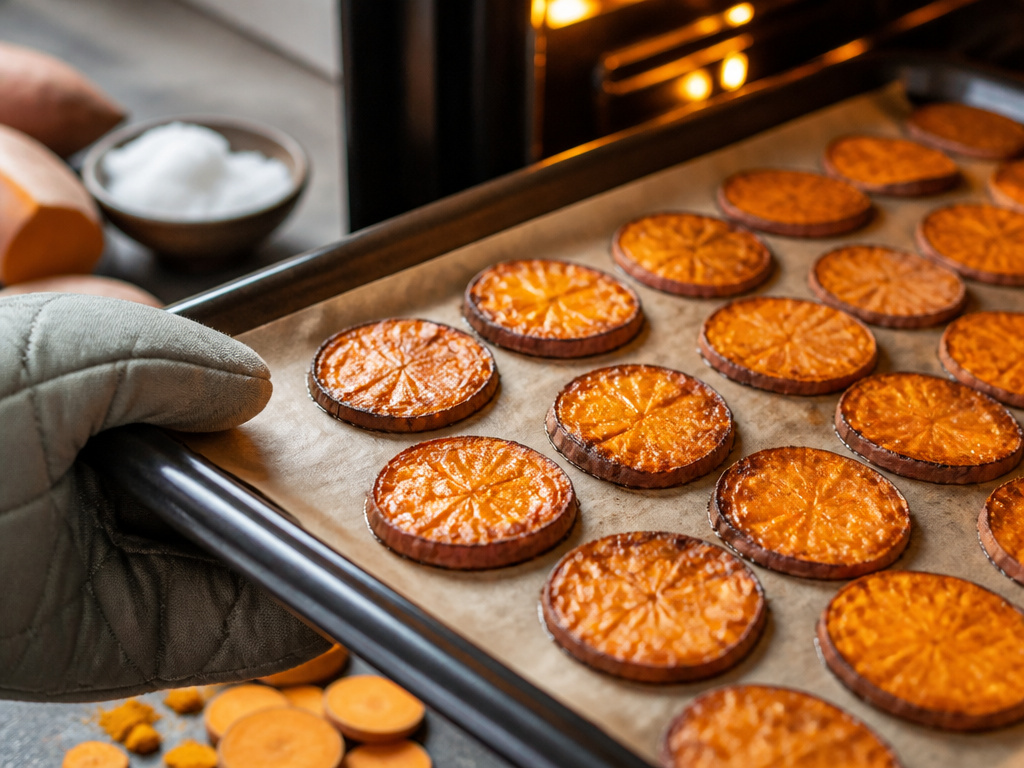
Turning the tray halfway is the step most recipes bury in a parenthetical, and it’s the one that decides whether your batch dries evenly or comes out leathery on one side.
- Preheat to 250°F. Zoetis and DogTipper agree on this number.
- Wash and slice to 1/4 inch. Coins or lengthwise strips, whichever shape your dog takes apart more easily.
- Spread in a single layer on a baking sheet. Taste of Home uses a 15x10x1-inch pan lined with parchment.
- Bake 2.5 to 3 hours, turning halfway through. Skip the turn and the underside stays soft while the top case-hardens.
- Cool completely before feeding. Food Network is explicit about this, and a hot slice straight off the tray is how you get a burned mouth and a suspicious dog.
The kitchen smells like caramelized sugar around the two-hour mark. That’s moisture leaving and sugars concentrating, not burning.
Taste of Home runs a different version at 200°F: 2 medium sweet potatoes peeled and sliced 1/4 inch thick, tossed with 1 1/2 tablespoons melted coconut oil and 1 tablespoon ground turmeric, baked 2 to 3 hours until shrunken and chewy. Fair warning: turmeric stains fingers and fabric, so use a steady hand when you sprinkle it.
The Softer, Flour-Based Version
If you want a soft baked treat rather than a dried chew, Taste of Home’s variation mixes one mashed sweet potato with 2 cups flour, two eggs, and 1/4 cup unsweetened applesauce, then rolls, cuts, and bakes until set.
Which flour you pick changes the texture more than the recipe admits, and flour for dog treats is the variable that decides whether you get a snap or a crumb. University extension programs publish their own versions too, and the Oklahoma 4-H dog baking treats handout is one of several floating around.
Oven behavior is consistent enough across recipes that the general notes on how to bake dog treats apply here without modification.
I stopped trusting the word “premium” on packaging years ago, and I treat recipe claims the same way. A blog calling a treat recipe “vet-approved” is doing marketing, not nutrition. Read what’s in it and who formulated it, and if nobody signed their name to the formulation, assume nobody did.
Do You Need to Peel Sweet Potatoes for Dog Treats?
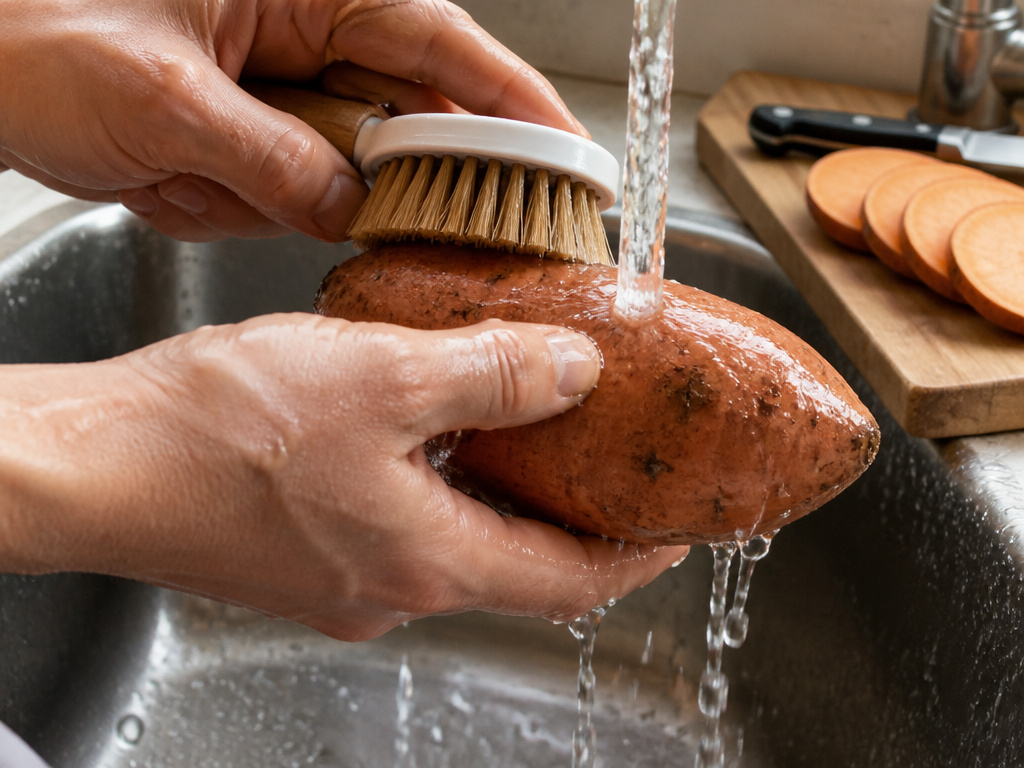
Not necessarily. UC ANR states plainly that there’s no need to peel, and DogTipper scrubs the skin with a dish scrubber and leaves it on, while Taste of Home peels the sweet potatoes.
Taste of Home is the outlier, and it contradicts itself. The ingredient list specifies peeled sweet potatoes. Two paragraphs later, the body text says you don’t need to peel. That’s one source holding two positions, which tells you the peel isn’t load-bearing either way.
Here’s how I’d call it:
- Leave the peel on if you’re dehydrating, as UC ANR and DogTipper do, though Taste of Home peels. It holds the slice together and there’s no texture penalty after 8 hours.
- Peel it if you’re making the coconut-oil version or a dough, where a tough skin fights the texture you’re building.
- Scrub either way. A dish brush under running water, then pat dry.
- Cut out the eyes and any green patches before slicing, which every source agrees on.
How Long Do Homemade Sweet Potato Dog Treats Last?
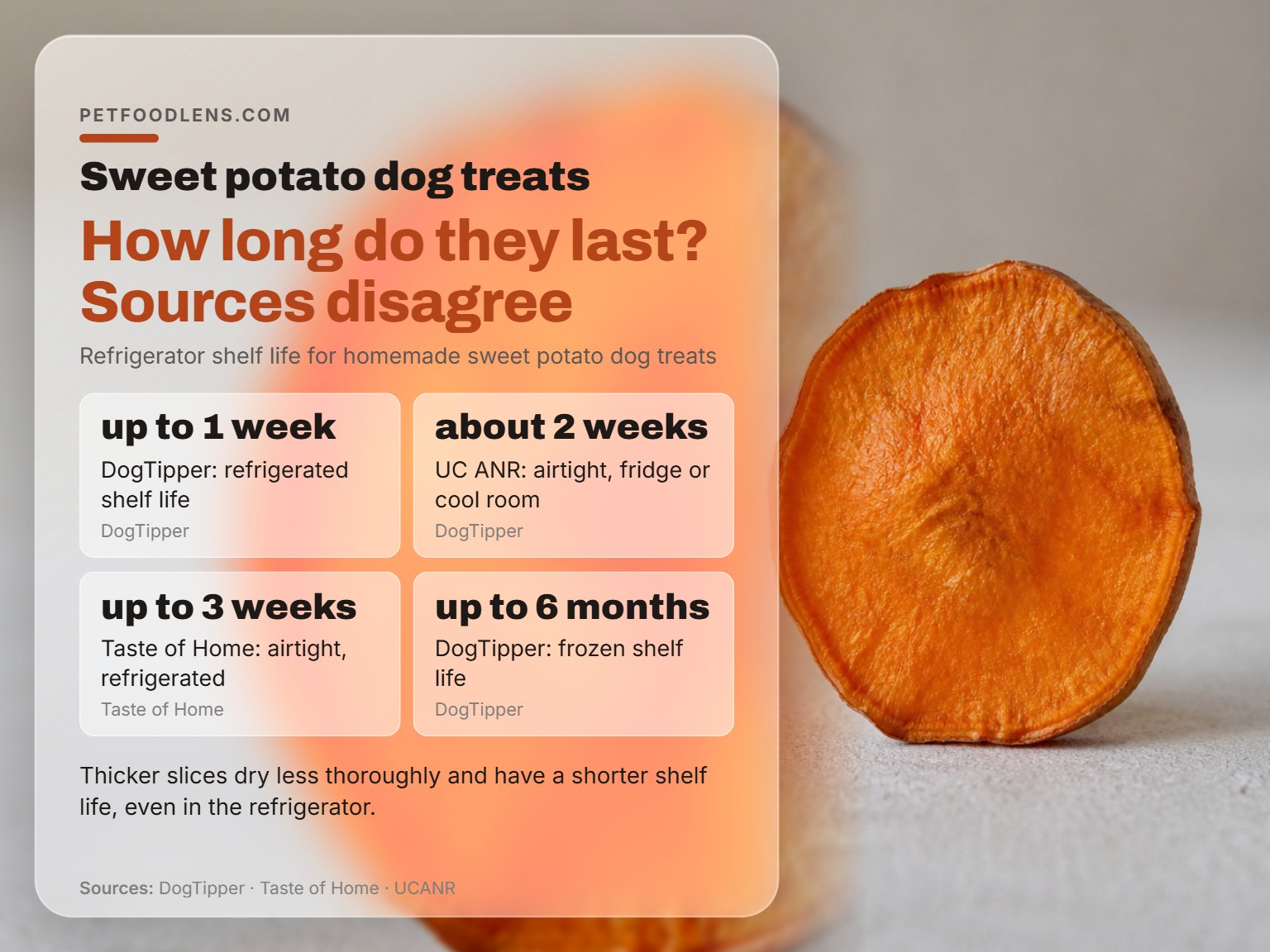
Storage numbers disagree more than any other part of this recipe, and the gap between the low and high answer is two full weeks.
| Source | Where It Says to Store | Stated Shelf Life |
|---|---|---|
| UC ANR | Airtight, fridge or cool room | about two weeks |
| DogTipper | Refrigerated | up to one week |
| Taste of Home | Airtight, refrigerated | up to three weeks |
The spread isn’t carelessness. DogTipper’s own note explains part of it: thicker slices don’t dry as thoroughly and carry a shorter shelf life even in the refrigerator. A batch cut at 1/4 inch and pulled early will not match a batch cut at 1/8 inch and left the full 8 to 12 hours.
Food Network’s recipe is a different product again, a flour-and-oat biscuit rather than a dried slice, so it isn’t a fair comparison to the other three.
The rules for storing homemade dog treats apply here without modification. Airtight is the whole game, whether that’s Ziploc bags, screw-top jars, or plastic and glass containers, all of which UC ANR names.
Freezing Buys You Six Months
DogTipper gives up to 6 months frozen. Taste of Home says freeze for longer storage, then thaw before serving or hand them over frozen, which doubles as a slow treat on a hot day.
Press two slices together before you store anything. If they stick and stay stuck, they weren’t dry enough and the refrigerator won’t rescue them.
Where Homemade Treats Belong in the Diet
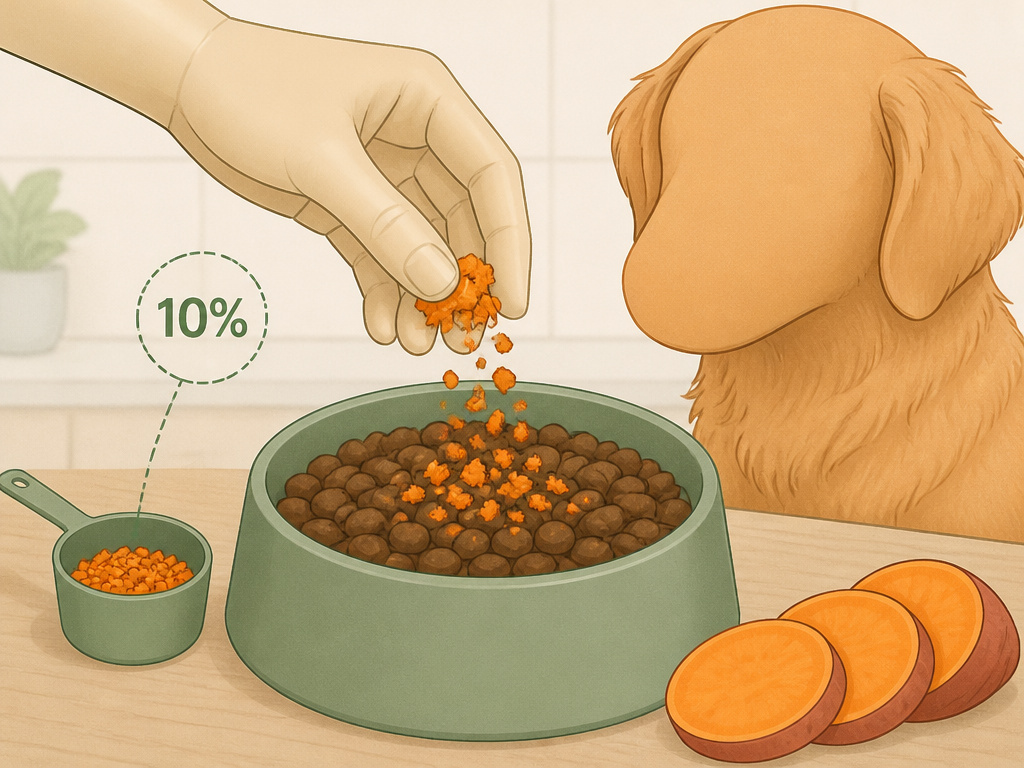
Treats are a supplement. The complete food does the nutritional work, and a sweet potato slice does not.
Most homemade treat recipes I get asked about are fine as treats and a disaster as meals. That’s not a knock on sweet potato. Zoetis lists it as low in calories and a source of fiber, with vitamins A, B6, and C plus potassium, iron, and beta-carotene. None of that adds up to a complete diet.
The 10 Percent Line
My rule: treats are a supplement, and the commercial complete food carries the rest. Blow past that line and you’re not supplementing a diet, you’re diluting one.
Zoetis adds the obvious caveat that tolerance depends on age, health history, and existing conditions, and that a veterinarian should be consulted before any new food goes in the bowl. I’m not a clinician. If your dog has a diagnosed condition, this recipe is not the place to experiment.
Treats as Toppers
Keep the complete kibble or canned food as the base and use the homemade treats as toppers. Boring, and it works every time. A crumbled sweet potato chew over a bowl gets the same tail wag as a whole one and doesn’t move the calorie math.
A treat that replaces a large share of the bowl isn’t a treat. It’s an unbalanced diet with a nice smell.
Any new food needs a slow ramp. Knowing how to introduce new treats to a dog properly means one small piece and a day of watching, not a handful on the first night.
The broader case for homemade dog treats rests on knowing exactly what went into them. That’s the only real advantage over a bag, and it evaporates if you don’t control the portion.
Frequently Asked Questions
Can dogs eat sweet potato skin?
Yes, and UC ANR explicitly says peeling isn’t required, though Taste of Home peels the sweet potatoes. Scrub the skin clean with a dish brush and pat it dry before slicing. Cut out the eyes and any green patches first, since those get discarded regardless of which source you follow.
How thick should I slice sweet potato dog treats?
For a chew, DogTipper says no thinner than 1/4 inch. For a thinner training treat, 1/8 inch works, and UC ANR gives the full range as 1/8 inch to 1/4 inch. Anything thinner roasts into chips, per Taste of Home, and anything thicker holds moisture and shortens shelf life.
Can I use a dehydrator instead of an oven?
Yes, and the settings differ sharply: 120°F to 130°F for 8 to 12 hours, per UC ANR, versus 250°F for 2.5 to 3 hours in an oven. The dehydrator takes longer but runs unattended. Rearrange the trays around the 3-hour mark so the far trays rotate toward the fan.
How do I know when sweet potato dog treats are done?
Bend one. A finished slice flexes without snapping and shows no damp sheen at the fold. DogTipper suggests starting checks when you rotate the trays and then checking every hour, since humidity, thickness, and temperature all shift the finish time.
Do sweet potato dog treats need refrigeration?
The sources disagree, which is worth knowing. UC ANR says about two weeks in an airtight container in the fridge or at cool room temperature. DogTipper says up to one week refrigerated. Taste of Home says up to three weeks refrigerated. Freeze what you won’t finish inside a week.
The Bottom Line
Start with one sweet potato, a 1/4-inch slice, and a 250°F oven. Turn the tray halfway through, start checking at 2.5 hours, and cool completely before anything goes in a bowl. That single batch tells you more about your oven and your knife than any recipe can.
One threshold worth writing down: if a slice still feels cool and tacky when you press two together, it goes back in. Under-dried treats are the only failure mode here that gets worse in storage rather than better.
And the concession. If your dog is on a therapeutic or prescription diet, or has a condition your vet is actively managing, skip this whole article and ask them first. I read labels for a living and I still don’t prescribe.
