
How to Make Homemade Dog Treats: Step-by-Step
This post contains affiliate links. As an Amazon Associate, we earn from qualifying purchases.
To make homemade dog treats, bake a simple dough at 350 degrees F for 12 to 40 minutes depending on the recipe, roll it 1/4 to 1/2 inch thick depending on the recipe, and keep treats under 10 percent of your dog’s daily calories. Sources disagree on times and thickness; they agree on the temperature and the ceiling.
Those four sets of numbers for how to make homemade dog treats come from four different doughs, not four attempts at the same one. A half-inch ball of five-cup flour dough and a quarter-inch sheet of oat-and-pumpkin dough need very different time in the same oven.
What follows walks the three dough routes, the flour question, the storage fight over the freezer, and the two places where a treat stops being a treat at all.
Key Takeaways
- Keep treats under 10 percent of daily calories. Hill’s Pet and Dr. Holly Boyden land on the same ceiling from different directions.
- 350 degrees F is the temperature most sources use for their basic biscuits, though Oregon Humane’s apple cookies also drop to 325 degrees F. Bake times run from 12 to 40 minutes depending on the dough.
- Roll evenly, not thin. OSU says 1/4 inch and Oregon Humane says 1/2 inch; the sources disagree on thickness, so follow the recipe you’re using.
- Read the peanut butter label for xylitol before the jar goes anywhere near the bowl.
- The freezer is contested. Hill’s says don’t, OSU and Oregon Humane say do, and Dr. Holly Boyden allows cooked meat-based snacks in the freezer for up to three months.
The 10 Percent Ceiling Comes Before the Recipe
Treats are a garnish. The bowl is the meal.
Commercial complete diets are formulated to meet AAFCO or FEDIAF nutrient profiles, and at least 90 percent of a dog’s daily calories should come from that complete food. Homemade treats occupy the remaining 10 percent or less, because heat processing alters the nutritional characteristics of the food and a home recipe is not formulated to be complete.
Two sources land on that split independently. Hill’s Pet caps homemade treats at 10 percent of total daily intake, and gives the reason plainly: heat alters the nutritional characteristics of the food. Dr. Holly Boyden, writing for Buddy Pet Insurance, puts the complete-and-balanced floor at 90 percent of daily calories under AAFCO or FEDIAF guidelines.
Nearly every homemade treat recipe I’m asked about works as a treat and falls apart as a meal. The failure is arithmetic, and it happens quietly. A dog doesn’t need many biscuits before the bowl is doing most of the work.
I’m not a veterinarian, so I can’t diagnose or manage anything. What I can tell you is that the base food carries the nutrition and the treat sits on top of it. Change the base slowly, and apply the same caution when you introduce new treats to a dog with a touchy gut.
Three Ways to Make the Dough, and Which One Fits Your Kitchen
Three routes exist: a flour dough you roll and cut, a ground-kibble dough you shape by hand, and a canned loaf you slice straight from the tin.
| Route | What it is | Best for | Watch out for |
|---|---|---|---|
| Rolled flour dough | Oat or wheat flour, egg, fat, liquid | Shaping bone or paw shapes | Thickness drift between middle and edge |
| Ground kibble dough | 2 cups dry food, 1 to 1.25 cups water | Dogs already on that food | Cookies won’t flatten like people cookies |
| Sliced canned loaf | 1/4 inch slices of canned food | Fastest route, microwave | Only certain formulas work |
Route one is what people mean by how to make homemade dog treats. Oklahoma State’s oat-and-pumpkin dough is built on whole grain oat flour and bakes at 350 for 25 minutes.
Route two is Hill’s kibble method. Grind 2 cups of dry food to a powder in a blender, work in roughly 1 to 1.25 cups of water until it forms a dough, then bake at 350 for about 30 minutes or until crispy. Hill’s puts the yield at approximately two dozen treats.
Route three is the fastest. Hill’s cuts a canned loaf into 1/4 inch slices, cuts those into bite-sized pieces, and microwaves them on high for 2.5 to 3 minutes.
If you want one route and your dog has a sensitive stomach, take route two. It’s built from the food the dog already tolerates, so you aren’t introducing a new protein and a new flour in the same week.
Extension services publish this material for 4-H projects as well as for pet owners, which is why the Oklahoma 4-H dog treat baking guide sits alongside the university’s recipe page. Pumpkin and peanut butter are the two ingredients most people start with, so pumpkin dog treats and peanut butter dog treats are the natural first variations on that base.
How to Make Homemade Dog Treats: The Base Method
The base method is the same across every source I checked, and it’s short.
Before you start: Raw egg in the dough is a genuine hazard; the AKC notes that raw egg whites can cause biotin deficiency in dogs, so use a recipe that bakes the egg through. Check every jar of peanut butter and every tub of yogurt for xylitol, which both the Oregon Humane Society and the AKC list as toxic to dogs. If you’re handling raw meat for a meat-based treat, cook it to an internal temperature of at least 75 degrees C, and keep raw meat away from young children and immunocompromised people in the house.
- Mix the dry ingredients first. Flour, baking powder, and any dry binder go in one bowl. Add them after the wet ingredients and you’ll chase lumps around the bowl.
- Add the wet ingredients and bring it together. OSU’s method adds water only after everything else is mixed. Reverse the order and the dough turns slack before you’ve had a chance to judge it.
- Knead for 3 to 5 minutes, until the dough forms a ball. That’s Oregon Humane’s instruction. Skip the knead and the dough tears at the edges when you roll it.
- Roll to an even thickness. OSU says 1/4 inch. Oregon Humane says 1/2 inch. Evenness matters more than the number, because a sheet that’s thin at the rim and thick in the middle bakes unevenly no matter what you set the timer to.
- Cut the shapes and chill them. OSU puts the cut shapes in the refrigerator until the oven is ready. Warm dough slumps on the parchment and loses its edges.
- Bake at 350 degrees F. Times vary by recipe, from 12-15 minutes for beefy doggie cookies to 35-40 minutes for OSU’s second recipe. More on that spread below.
- Cool completely before serving. OSU is explicit about this step, and it isn’t just about burned mouths. A warm biscuit steams inside a sealed container and softens everything stacked against it.
Where this goes sideways: Rolling the dough thinner at the edges than the middle. The thin rim scorches before the center dries, and you end up with a batch that’s burnt outside and chewy inside.
A finished biscuit sounds hollow when you tap it against the counter. An underbaked one lands with a dull thud and gives under your thumb.
The full set of bake parameters for each dough is worth reading before you start, and the how long to bake dog treats breakdown covers the timing spread in more detail. The original recipes and both OSU doughs are documented in the Oklahoma State homemade dog treat recipes.
Which Flour Should You Use for Dog Treats?
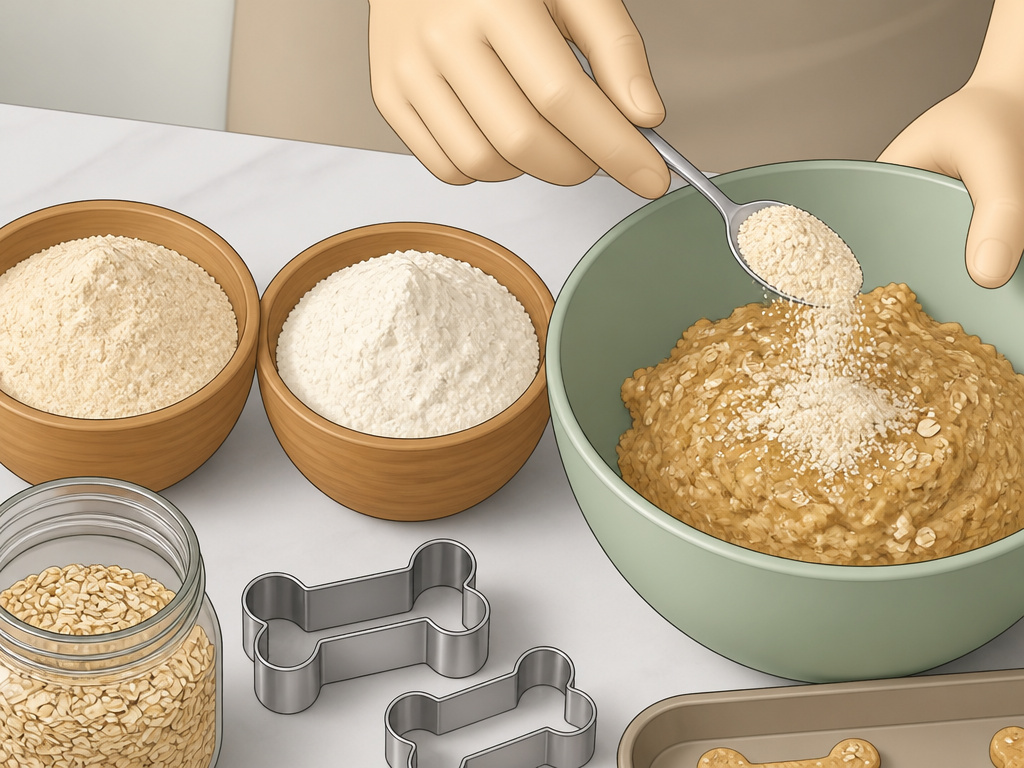
Wheat is common in shelter and extension recipes, but it’s the wrong answer for some dogs.
Oat Flour
Whole grain oat flour is what OSU builds both of its doughs on. It’s also the fix OSU reaches for when a dough turns sticky: add a little oat flour to bring it together. OSU adds a caveat worth repeating, though. The biscuits look best without that extra flour, so add it sparingly and accept a slightly rougher shape.
Oregon Humane notes that for dogs allergic to wheat or corn, oat, rice, coconut, or other non-wheat flour is the alternative.
Wheat Flour
Oregon Humane’s own basic biscuit recipe uses wheat flour, and so does its apple cookie recipe. Wheat works, it’s cheap, and it rolls cleanly. It’s just not universal.
Oregon Humane says it directly: some dogs are allergic to wheat or corn, and shelter dogs may also have upset stomachs. For those dogs, the handout points to oat, rice, coconut, or another non-wheat flour.
Rice, Coconut, and the Other Non-Wheat Options
Oregon Humane names oat, rice, coconut, or other non-wheat flour as alternatives for wheat- or corn-sensitive dogs.
Match the flour to the dog, not to the recipe. Oregon Humane recommends oat, rice, coconut, or another non-wheat flour for dogs allergic to wheat or corn.
The broader comparison of flour for dog treats is worth a look if you’re feeding a dog with a known sensitivity, and oat flour dog treats covers grinding your own from rolled oats. Oregon Humane’s full booklet, including the wheat-based basic recipe and the non-wheat substitutions, is in the Oregon Humane Society treat recipe PDF.
How Long Do Homemade Dog Treats Last?
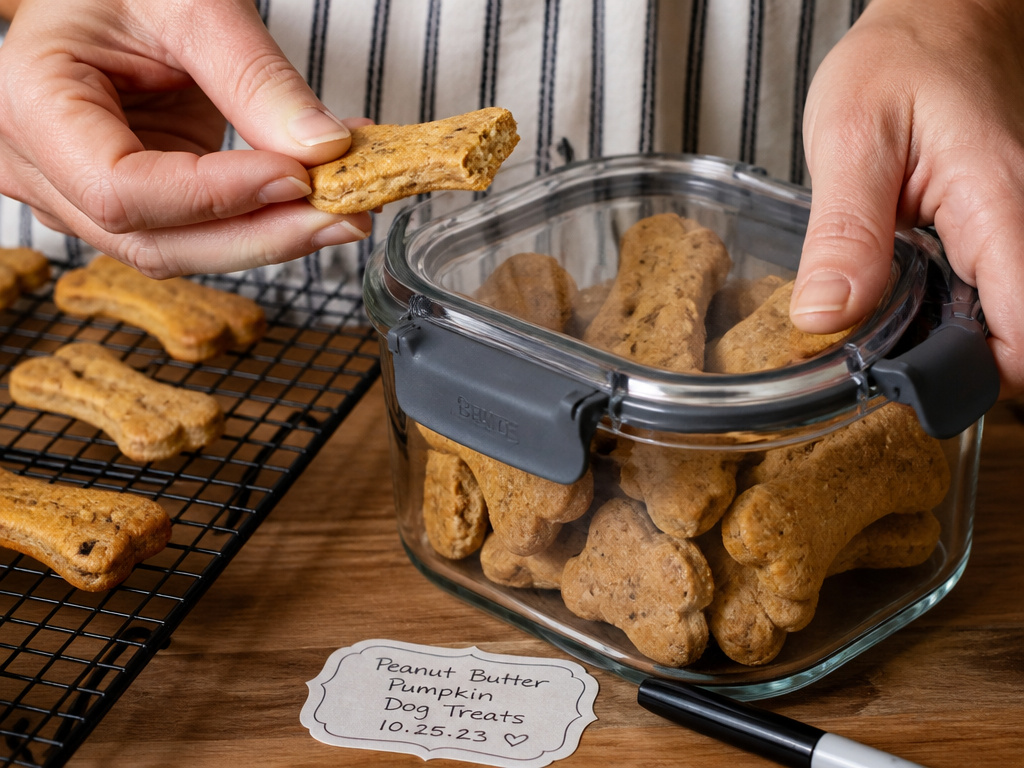
Five to seven days in the refrigerator is Hill’s Pet’s guidance for refrigerated leftovers.
| Source | Refrigerator | Freezer | Room temperature |
|---|---|---|---|
| Hill’s Pet | Discard after 5 to 7 days | Do not freeze | Not stated |
| Oklahoma State University | 1 week | Freezes well | Not stated |
| Oregon Humane Society | Not stated | Beefy cookies freeze | Not stated |
| Buddy Pet Insurance (Dr. Boyden) | Cooked meat 3 days | Cooked meat 3 months | Biscuits 2 weeks airtight |
The freezer is where these sources genuinely split, and it’s worth naming who holds which position rather than picking a winner. Hill’s states flatly: do not freeze homemade treats. OSU says the opposite, that biscuits keep in the refrigerator for a week or freeze for later use, and that its second recipe’s treats freeze well. Oregon Humane stores its beefy doggie cookies in the fridge or the freezer. Dr. Boyden allows cooked meat-based snacks in the freezer for a maximum of three months.
Shelf life splits the same way. Hill’s says discard refrigerated leftovers after 5 to 7 days. OSU gives one week in the refrigerator. Dr. Boyden separates the categories: crisp baked goods such as biscuits last up to two weeks in an airtight container, while cooked meat snacks get 3 days in the fridge.
Those aren’t reconcilable as a single rule, because they’re describing different products. A dry biscuit and a moisture-rich meat snack are not the same storage problem.
The part nobody mentions: The label on the container. Oregon Humane asks you to mark what the treats are and when they were made, and an undated zip-bag is exactly how a batch from three weeks ago gets fed in week four.
If you open a container and the smell has gone flat and slightly stale, the date on the lid is telling you the same thing. Trust it over your memory. The homemade dog treats storage guide covers labeling and container choice in more depth.
What Changes for Small Dogs, Cats, and Prescription Diets?
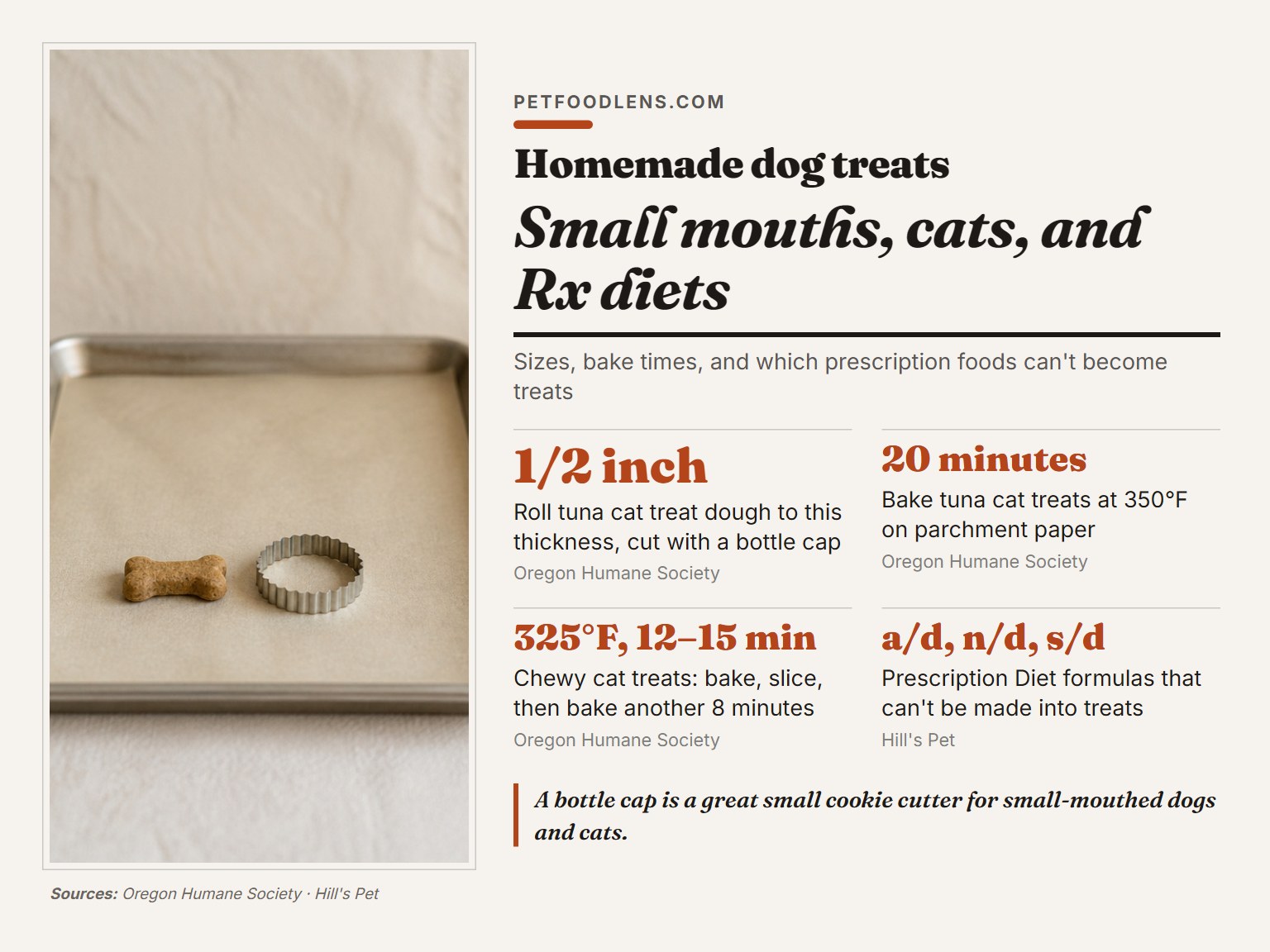
A bottle cap and a 1/4 inch slice of canned food are two different answers to the same question: how big should this thing be?
Oregon Humane’s answer for small mouths is a bottle cap, which it calls a great small cookie cutter for small-mouthed dogs and cats. The AKC has a version for frozen treats: for small dogs, pipe little droplets onto a parchment-lined baking sheet before freezing.
Cats are a separate recipe file. Oregon Humane’s tuna treats roll to 1/2 inch, cut with a bottle cap, and bake for 20 minutes at 350 on parchment. Its chewy cat treats bake at 325 for 12 to 15 minutes, get sliced, then go back in for another 8 minutes.
Frozen treats are the easiest win in summer, and the frozen dog treats method is a different process from anything baked above. The AKC’s frozen yogurt version warns against any yogurt containing xylitol, which is poisonous to dogs.
When the Dog Is on a Prescription Diet
Hill’s is specific about which of its own formulas can’t be turned into treats with the standard recipe: Prescription Diet a/d Canine/Feline, n/d Canine, and s/d Canine. If your dog eats one of those, the recipe below doesn’t apply to that food.
Dr. Boyden’s guidance covers the general case. If a dog is on a strict therapeutic diet, check with your vet before offering anything new. That’s the same line I’d draw. I’m not a veterinarian, and a therapeutic diet is a clinical decision.
The AKC’s full set of recipes, including the egg and frozen yogurt versions, is in the AKC vet-approved dog treat recipes.
Frequently Asked Questions
Can you freeze homemade dog treats?
The sources disagree, and both positions are on the record. Hill’s Pet says do not freeze homemade treats. Oklahoma State University says biscuits freeze well for later use, and Oregon Humane stores its beefy doggie cookies in the fridge or freezer. Dr. Holly Boyden allows cooked meat-based snacks in the freezer for a maximum of three months. Pick one approach, label the container, and stay consistent with it.
How many homemade treats can a dog have in a day?
Treats should stay at or under 10 percent of daily calories, with the other 90 percent coming from a complete and balanced diet meeting AAFCO or FEDIAF guidelines. Hill’s and Dr. Boyden arrive at that split separately. The practical version: count the treats against the bowl, not against nothing.
What temperature do you bake homemade dog treats at?
350 degrees F is consistent across Oklahoma State, Hill’s, Oregon Humane, and the AKC. What changes is the time. Oregon Humane’s beefy doggie cookies run 12 to 15 minutes, OSU’s first recipe runs 25 minutes, and OSU’s second recipe runs 35 to 40.
Is peanut butter safe for dogs?
Peanut butter containing xylitol is not safe, and Oregon Humane is explicit that the peanut butter must not contain xylitol because it is toxic to dogs. Cold peanut butter from the fridge is easier to work into dough if you microwave it briefly first.
Can I use regular wheat flour instead of oat flour?
Yes, and Oregon Humane’s own basic biscuit recipe does. But Oregon Humane also notes that some dogs are allergic to wheat or corn, and recommends oat, rice, coconut, or another non-wheat flour for those dogs.
Can I make homemade treats from a prescription diet?
Not from all of them. Hill’s states that Prescription Diet a/d Canine/Feline, n/d Canine, and s/d Canine cannot be made into homemade treats using its recipe. For any therapeutic diet, check with your veterinarian before adding anything.
The Bottom Line
The recipes are the easy part. What separates a batch that helps your dog from one that quietly unbalances the diet is the arithmetic around it, and that arithmetic is the same whether you bake oat-and-pumpkin biscuits or microwave slices of canned loaf.
Here’s the concession: if your dog is already on a therapeutic diet, most of this article doesn’t apply to you. The exclusion list is short and specific, and a vet needs to be in that conversation.
For everyone else, one concrete first step this week. Take a normal day, set aside every treat your dog actually gets, and look at the pile next to the bowl. If the treats are more than 10 percent of your dog’s daily calories, cut the treats, not the recipe.
And if you want one answer: bake the OSU oat-and-pumpkin dough at 350 for 25 minutes, roll it evenly, cut it small, and treat it as a topper on a complete food.
