
How to Make Pumpkin Dog Treats: 4 Vet-Backed Recipes
This post contains affiliate links. As an Amazon Associate, we earn from qualifying purchases.
To make pumpkin dog treats, combine canned pumpkin puree with flour and xylitol-free peanut butter, roll the dough, and bake at 300-375°F depending on the recipe. Four vet-backed versions below range from 12 to 40 minutes, and every one skips pumpkin pie mix.
Three things drive every version of how to make pumpkin dog treats: the pumpkin itself must be pure puree, the peanut butter has to be xylitol-free, and the bake time depends on how thick you roll the dough. Get those right and the recipe is forgiving. Get them wrong and the treat either crumbles or the dog ends up at the vet.
Below are four recipes from veterinary schools and animal health organizations, plus the dosing math, storage rules, and the one ingredient check that matters more than any other.
Key Takeaways
- Use pure canned pumpkin, never pumpkin pie mix. Pie mix adds sugar and spices that don’t belong in a dog treat.
- Check the peanut butter label for xylitol before anything else. Xylitol is toxic to dogs and can be fatal.
- Bake time depends on thickness, not just temperature. The recipes below range from 12 to 40 minutes.
- PDSA caps treats at 10% of daily food allowance, though UGA and AKC give no quantitative cap.
- Cool completely before serving. Warm treats burn mouths, and cool treats hold their shape.
What Makes a Pumpkin Treat Safe for Dogs?
Two ingredients decide whether a pumpkin treat is safe: the pumpkin itself and the peanut butter.
Pumpkin-based dog treats are safe when the pumpkin is 100% pure canned puree and the peanut butter is free of xylitol. Pumpkin pie mix contains added sugars and spices. Xylitol is an artificial sweetener that is toxic to dogs and can be fatal if ingested.
The how to make pumpkin dog treats pumpkin question is easy. UGA College of Veterinary Medicine, the AKC, and DogHealth.com all specify pure canned pumpkin, not pumpkin pie mix. DogHealth.com goes further and says to use an edible pumpkin, not a decorative one, if you’re making your own puree.
Common mistake: Grabbing the can next to the puree on the shelf. Pumpkin pie mix sits right beside it and the labels look similar. The pie mix has sugar, cinnamon, nutmeg, and sometimes cloves. None of those belong in a dog treat.
The peanut butter question is the one that gets people. Xylitol is an artificial sweetener that shows up in some “natural” and “sugar-free” peanut butters. DogHealth.com calls it extremely toxic and potentially fatal. PDSA extends the warning to applesauce as well, since birch sugar is another name for xylitol.
That’s worth pausing on. The UGA recipe and the AKC recipe both check peanut butter only. PDSA checks both peanut butter and applesauce. If you’re using the PDSA recipe, check both.
For a deeper look at what pumpkin does and doesn’t do for a dog’s digestion, see pumpkin for dogs.
The 4 Vet-Backed Pumpkin Dog Treat Recipes
These four recipes come from a veterinary college, a land-grant university, a UK veterinary charity, and a consumer dog health site. They use different flours, different pumpkin quantities, and different bake profiles.
| Recipe | Flour | Pumpkin | Bake Temp | Bake Time |
|---|---|---|---|---|
| UGA Peanut Butter Bites | 2 cups all-purpose | 1 cup | 375°F | 12 min |
| OSU Oat Biscuits | 2 1/2 cups oat flour | 3/4 cup | 350°F | 25 min |
| PDSA Rice Cookies | 160g rice flour + 25g oats | 145g | 150°C (Gas 2) | 12 min |
| DogHealth Crispy Oats | 2 cups ground oats | 2/3 cup | 300°F | 25-30 min |
Before you start: Xylitol in peanut butter is toxic to dogs and can be fatal, so read the label before you open the jar. The oven runs at 300-375°F, so use a mitt and keep the hot sheet pan out of reach until the treats cool completely. Cool treats also hold their shape, so don’t skip the cooling step.
Recipe 1: UGA Peanut Butter and Pumpkin Bites
The UGA vet DIY pet treat guide is the simplest of the four. Three ingredients, one bowl, 12 minutes in the oven.
- Preheat the oven to 375°F.
- Mix 1 cup canned pumpkin puree with 1/2 cup pet-safe peanut butter in a large bowl.
- Stir in 2 cups flour until a dough forms.
- Roll the dough on a lightly floured surface and cut shapes with a cookie cutter.
- Place treats 1/2 inch apart on an ungreased cookie sheet.
- Bake for 12 minutes.
- Cool completely before serving.
That’s it. The dough should feel tacky but not sticky. If it clings to your fingers, add a little flour.
Recipe 2: OSU Whole Grain Oat Biscuits
The Oklahoma State homemade dog treats recipe is the most involved of the four. It uses six ingredients.
- Preheat the oven to 350°F.
- Whisk 2 1/2 cups whole grain oat flour with 1 tbsp baking powder.
- In a separate bowl, whip 1/2 cup unsalted natural creamy peanut butter with 2 tbsp coconut oil.
- Beat in 2 eggs and 3/4 cup pumpkin until smooth.
- Add the flour mixture and stir until a dough forms.
- Roll to 1/4 inch thickness on wax paper.
- Cut shapes and place on a parchment-lined baking sheet.
- Bake for 25 minutes or until light brown.
- Cool completely before serving.
If the dough is sticky, add a little oat flour. The oat flour dog treats guide covers the swap in more detail if you want to try it with a different flour.
OSU publishes a full nutritional panel, which is rare for a treat recipe.
Recipe 3: PDSA Rice Flour Cookies
The PDSA pumpkin cookie recipe is the only one of the four that’s explicitly for cats as well as dogs. It uses grams, so pull out the kitchen scale.
- Preheat the oven to 150°C (Gas mark 2).
- Blend 55g grated carrot, 60g applesauce, and 145g pumpkin until smooth.
- Mix 160g rice flour with 25g oats in a separate bowl.
- Add the wet mixture and form a dough.
- Roll to 1/4 inch thickness on a surface dusted with 20g plain flour.
- Cut 20 biscuits and place them on a lined baking sheet.
- Bake for 12 minutes, turning halfway.
- Cool before serving.
PDSA says the applesauce must be xylitol-free, and so must the peanut butter if you’re adding it. That’s the only source of the four that checks both.
Recipe 4: DogHealth Crispy Oat Treats
The easy pumpkin dog treats from the AKC use ground oats instead of flour. The texture comes out closer to a granola bar than a biscuit.
- Preheat the oven to 300°F.
- Mix 2 cups ground oats, 2/3 cup pumpkin, and 1/2 cup peanut butter in a bowl.
- Scoop spoonfuls onto a parchment-lined baking sheet.
- Bake for 25-30 minutes, flipping halfway.
- Cool completely before serving.
DogHealth.com uses a lower temperature of 300°F, which it says dries the treats out instead of browning them for a crispy snap, though other sources bake at higher temperatures. If you want to try baking dog treats at a higher temperature, watch them closely.
Why Do Sources Disagree on Bake Temperature?
Three credible sources, three different bake profiles for near-identical dough.
UGA says 375°F for 12 minutes. OSU says 350°F for 25 minutes. DogHealth.com says 300°F for 25-30 minutes. PDSA, working in Celsius, says 150°C (Gas mark 2) for 12 minutes. AKC doesn’t specify a temperature at all, only “approximately 20 minutes.”
The range isn’t a contradiction. It’s a thickness difference. AKC rolls the dough to 1/8 inch. OSU and PDSA roll to 1/4 inch, and UGA rolls its turkey treats to about 1/4 inch. Thinner dough bakes faster, and thicker dough needs more time, though sources disagree on the exact temperature and timing.
Where this goes sideways: Rolling one batch at 1/4 inch and the next at 1/8 inch without adjusting the timer. The thin batch burns while the thick one is still raw in the middle.
I’ve seen two batches from the same dough come out different because the second roll was thicker. The fix is to roll the whole batch to a consistent thickness before cutting, not to eyeball each piece.
The practical rule: match your bake time to your thickness, not to the recipe’s headline number. If you roll to 1/4 inch, OSU bakes at 350°F for 25 minutes, while UGA bakes at 375°F for 12 minutes and PDSA at 150°C for 12 minutes; if you roll to 1/8 inch, AKC bakes for approximately 20 minutes without specifying a temperature.
How to Store Homemade Pumpkin Treats
Storage depends on moisture. The drier the treat, the longer it keeps.
| Source | Fridge | Freezer | Notes |
|---|---|---|---|
| UGA | Up to 3 days | After 3 days | Freeze leftovers after three days |
| OSU | 1 week | Yes | Freeze for later use |
| DogHealth.com | Up to 1 week | Not specified | Store airtight |
The disagreement here is small. UGA says freeze after three days. OSU and DogHealth.com both say a week in the fridge. The sources disagree on storage time: UGA says freeze after three days, while OSU and DogHealth.com say up to a week in the fridge.
If your treats bend instead of snapping, they’re too moist to keep at room temperature; UGA says freeze after three days, while OSU and DogHealth.com allow up to a week in the fridge.
A properly dried treat snaps cleanly in half. A soft one bends and leaves a moist crumb. If yours bend, UGA says freeze them after three days, while OSU and DogHealth.com allow up to a week in the fridge.
For a full breakdown of how to store homemade dog treats, including freezer bags and label dates, that guide covers the details. If you want a cold-weather version, these frozen dog treats skip the oven entirely.
The Xylitol Check That Prevents a Vet Visit
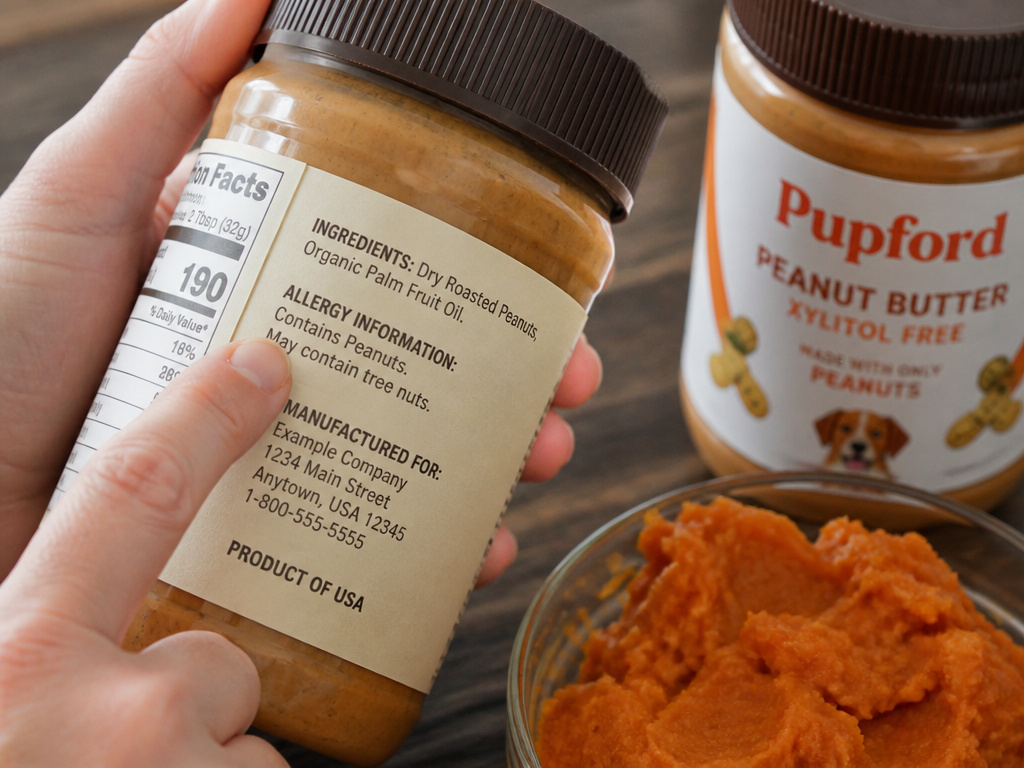
Grab the peanut butter jar. Turn it over. Look for xylitol on the ingredient list.
Easy to miss: “Natural” and “sugar-free” peanut butters are the most likely to contain xylitol. The mainstream brands don’t use it, but the smaller “healthy” labels sometimes do.
DogHealth.com calls xylitol extremely toxic to dogs and potentially fatal if ingested. PDSA extends the warning to applesauce, since birch sugar is another name for the same compound.
I keep a separate jar of xylitol-free peanut butter in the pantry just for dog treats, so I never grab the wrong one by mistake. The mainstream creamy versions are the safest bets if you don’t want to read every label.
If you’re using the PDSA recipe, check both the peanut butter and the applesauce. If you’re using UGA, AKC, or OSU, the peanut butter is the only vector.
How Much Pumpkin Treat Is Too Much?
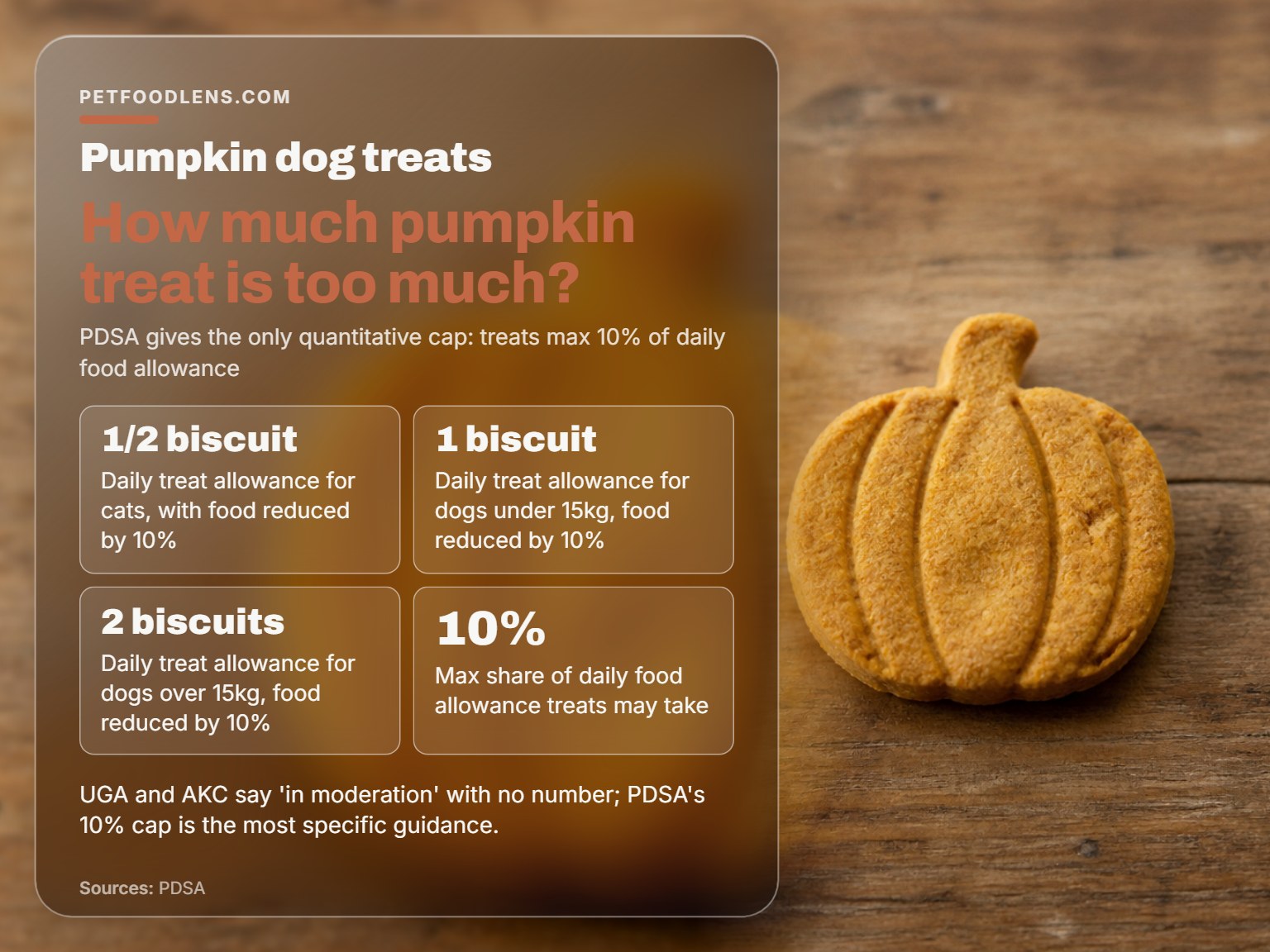
PDSA is the only source of the four that gives a quantitative cap.
| Pet | Daily Treat Allowance | Food Reduction |
|---|---|---|
| Cats | 1/2 biscuit | 10% |
| Dogs under 15kg | 1 biscuit | 10% |
| Dogs over 15kg | 2 biscuits | 10% |
UGA and AKC both say “in moderation” without a number, while PDSA gives a 10% cap; that’s the disagreement worth naming, and PDSA’s cap is the most specific guidance in the set.
The species question is also unsettled. PDSA’s recipe is for cats and dogs. UGA, AKC, and OSU are dog-only. If you’re making these for a cat, use the PDSA version and halve the biscuit.
I’ve had more than one owner tell me they’d “switched to homemade” after finding a pumpkin treat recipe online. The treats were fine. The meals were not. Keep the complete food as the base and use treats as toppers.
For more on homemade dog treats as a category, that guide covers the broader recipe landscape.
Frequently Asked Questions
Can I use fresh pumpkin instead of canned?
Yes, but use an edible pumpkin, not a decorative one. DogHealth.com says to cut the pumpkin in half, remove the stem, and bake until very soft, about 1 hour and 15 minutes. Then scoop the flesh out of the shell and mash it. The result is the same puree you’d get from a can.
Is pumpkin pie mix safe for dogs?
No. UGA, AKC, and DogHealth.com all flag pumpkin pie mix as unsafe. It contains added sugars and spices that don’t belong in a dog treat. Use 100% pure canned pumpkin instead.
How do I know if my dog is allergic to pumpkin?
Watch for vomiting, diarrhea, or itching after the first treat. Pumpkin is generally well tolerated, but any new food can trigger a reaction. Start with a small piece before giving a full treat.
Can cats eat pumpkin dog treats?
PDSA’s recipe is formulated for cats and dogs, and cats can have half a biscuit a day. The other three recipes are dog-only. If you’re making treats for a cat, use the PDSA version and follow the dosing.
Do I have to refrigerate pumpkin dog treats?
UGA says freeze after three days. OSU says a week in the fridge. DogHealth.com says airtight up to a week. If your treats bend instead of snapping, refrigerate them.
The Bottom Line
The four ways to make pumpkin dog treats here all work, and the differences between them come down to flour, thickness, and bake time. Pick the one that matches the flour you have on hand and the texture your dog prefers.
PDSA’s dosing is the most specific guidance available, and it’s the one to follow if you want a number rather than “in moderation,” though UGA and AKC give no quantitative cap.
If you’re learning how to make pumpkin dog treats for the first time, start with the UGA recipe. Three ingredients, 12 minutes, and the dough is forgiving. Once you’ve got that one down, move to the OSU version for a chewier biscuit and the PDSA version if you want to include the cat.
And check the peanut butter label every time. Xylitol is the one ingredient that turns a treat into a vet visit.
