
Pumpkin for Dogs Pros and Cons: What Vets Actually Say
This post contains affiliate links. As an Amazon Associate, we earn from qualifying purchases.
Pumpkin for dogs pros and cons, weighed honestly: plain canned or cooked pumpkin is safe, cheap, and roughly 90% water, but the fiber per spoonful is tiny. A medium dog would need nearly 12 cups a day to match one high-fiber therapeutic diet, so pumpkin works as a low-risk extra, not a treatment.
That twelve-cup figure is the part worth sitting with when you weigh the pumpkin for dogs pros and cons. It comes from the veterinary nutrition service at Tufts, which ran the arithmetic against a measured therapeutic diet rather than against a bag of treats.
What follows covers the forms that are safe, the published dose scales that contradict each other, the parts of a pumpkin that cause obstructions, and the specific signs that mean stop and call your vet.
Key Takeaways
- Plain 100% canned or cooked pumpkin is the only form worth using. Pie mix can carry xylitol, which is toxic to dogs.
- 83 calories and about 7 grams of fiber per cup makes pumpkin a dilute fiber source next to psyllium, at close to 50 grams per cup.
- The rind and stem are the dangerous parts, and hard chunks can lodge in the esophagus or the small intestine.
- Published doses run from ¼ teaspoon to 4 tablespoons per meal, depending on which source you trust, with Tufts at ¼ teaspoon to 2 tablespoons and the AKC at 1 to 4 tablespoons. Start at the bottom.
- Diarrhea past 24 to 48 hours, or diarrhea with blood, vomiting, or lethargy, needs a vet rather than another spoonful.
Is Pumpkin Good for Dogs? What the Numbers Actually Say
The safety question has a short answer. Texas A&M says no part of a pumpkin is directly toxic to a dog unless it is old and moldy, and Petfood Industry finds no evidence of toxicity in the literature, while PetMD warns that pumpkin pie filling may contain sugar, nutmeg, cloves, and sometimes xylitol, which are dangerous to dogs.
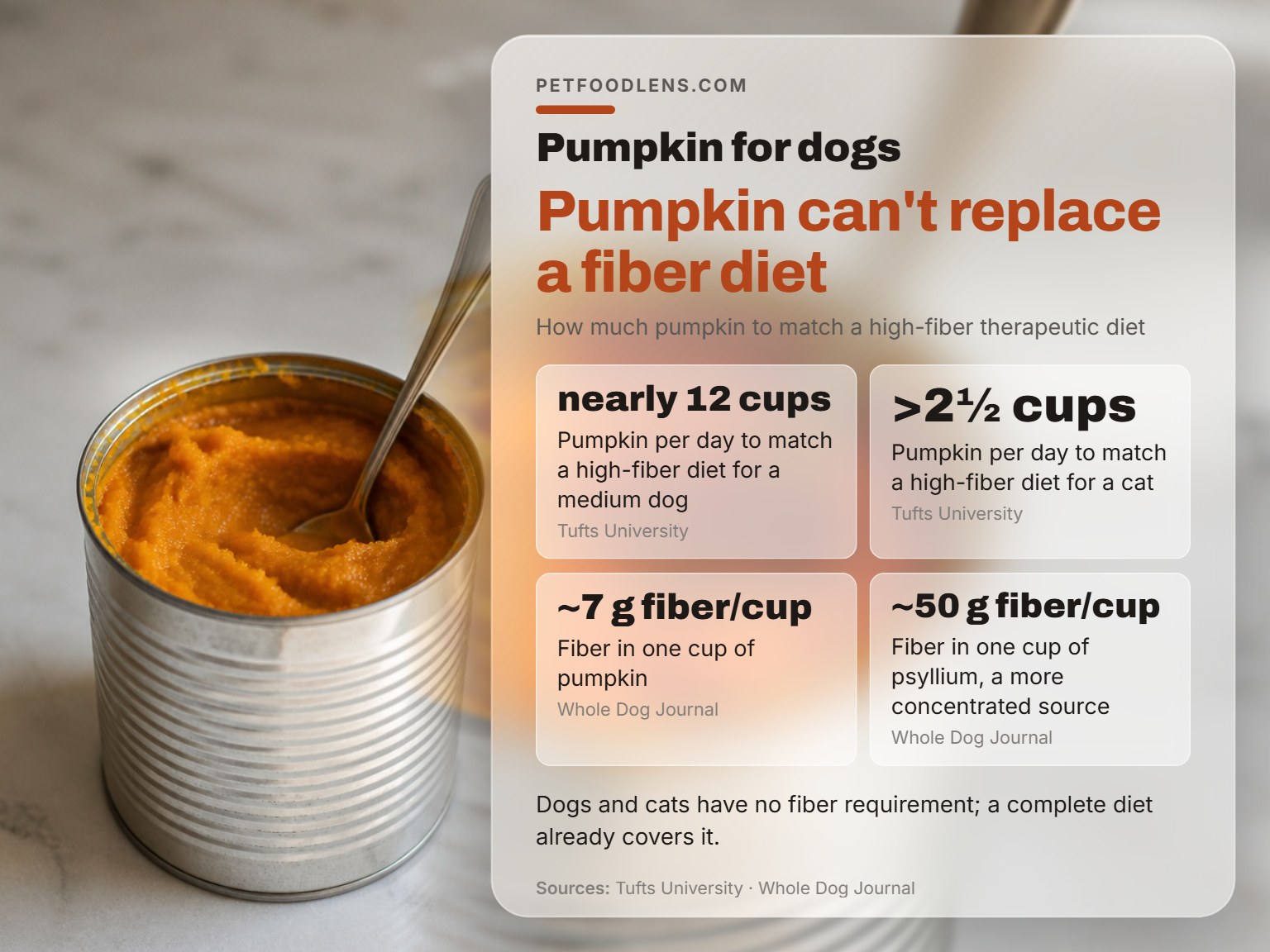
Canned pumpkin carries roughly 83 calories and about 7 grams of fiber per cup, and roughly 90 percent of pumpkin’s weight is water. Psyllium husk powder carries close to 50 grams of fiber per cup. No-salt-added canned pumpkin holds 12 milligrams of sodium per cup, while some salted brands reach nearly 600 milligrams. The fiber math is why a spoonful does so little.
The Tufts veterinary pumpkin guidance is the source of that arithmetic, and it’s blunt. Matching one high-fiber therapeutic diet would take more than 2½ cups of pumpkin a day for a cat and nearly 12 cups a day for a medium-sized dog.
Twelve cups. Keep that number in your head the next time a blog calls a tablespoon of pumpkin a fiber supplement.
Psyllium is the concentrated option, and the Whole Dog Journal notes it has to be unflavored with no added sweeteners. That’s a conversation with your vet, not a swap to make on your own.
None of this makes pumpkin useless. Tufts also points out that dogs and cats don’t require fiber in their diets at all, and the Whole Dog Journal concedes that nutritionists agree while still recommending fiber for colitis, constipation, and anal gland trouble.
The real advantage is water and volume. Texas A&M puts pumpkin at roughly 90% water, which makes it filling for a dog on a weight-loss plan without much of a calorie cost.
It’s also everywhere. A 2017 Petfood Industry analysis found pumpkin in nearly 20% of dry dog food recipes and slightly more than 15% of dry cat food recipes.
One sourcing caution. The USDA figures that circulate for 100 grams of pumpkin (555 calories, 40 grams of fat) are impossible for a food that’s 90% water, and Petfood Industry flagged them as a likely transcription error. Use the per-cup numbers instead.
The Dose Scales Don’t Agree, and That’s Worth Knowing
Four published dose ranges disagree with each other, and not one of them came from a feeding trial.
| Source | Suggested amount | Basis |
|---|---|---|
| Whole Dog Journal | ½ to 1 tsp (20 lbs and under), 1 tbsp (21 to 35 lbs), 2 tbsp (over 35 lbs) | Starting point, then trial and error |
| Tufts University | ¼ teaspoon to 2 tablespoons per meal | What owners typically report giving |
| AKC | 1 to 4 tablespoons per meal | Diarrhea and mild constipation |
| InnoVet | 1 teaspoon (small dogs) to 1 to 2 tablespoons (large) | General feeding guide |
The reason those numbers wander is simple, and it is central to the pumpkin for dogs pros and cons. There is no dose-finding study to anchor any of them, which the Whole Dog Journal states plainly and which the wider literature backs up. Petfood Industry notes there’s little publicly available peer-reviewed research on how pumpkin affects dogs at all.
So you’re working from clinical experience and owner reports, not from measured trials. That’s worth knowing before you treat a number on a website as a prescription.
The pumpkin dosage for dogs question gets a 1-to-4-tablespoon answer from the American Kennel Club, and that range is wide enough to cover a Chihuahua and a Labrador in the same sentence.
Before you start: Fiber pulls water into the gut, so a dog that’s already dehydrated can get worse rather than better. Offer water with every meal that includes pumpkin, and treat vomiting, lethargy, or weakness as a reason to call your vet instead of topping up the bowl.
Here’s how I’d introduce it, in order.
- Check the label first, before the first spoonful. Pie mix can carry xylitol, and a dog doesn’t get a second attempt at that mistake.
- Start at the bottom of your dog’s weight band rather than the middle. Doubling the amount on day one is how owners turn a firm stool into a loose one.
- Mix it into the regular meal instead of serving it alone. The fiber then arrives with water and protein rather than as a standalone snack.
- Hold the amount steady and watch the stool. If it loosens, cut back. If nothing changes, pumpkin probably isn’t the tool for this problem.
Canned, Fresh, or Pie Mix: Which One Goes in the Bowl
The can in the pantry is the practical choice, and the label decides whether it’s safe.
| Form | What the numbers show | Verdict |
|---|---|---|
| 100% canned pumpkin | 83 kcal and about 7 g fiber per cup | Safe, and the default pick |
| Canned pie mix | Up to 281 kcal per cup from added sugar | Avoid; may contain xylitol |
| Fresh pumpkin, cooked | Similar water and fiber, lower calorie density | Safe once peeled and softened |
| Salted canned pumpkin | Nearly 600 mg sodium per cup | Avoid for heart or kidney cases |
For a plain canned default, choose a can that says ‘100% pumpkin’, because the ingredient list is one line and the sodium stays at 12 milligrams per cup.
Here’s where the sources split. The AKC says canned pumpkin is more concentrated in fiber and nutrients than fresh because fresh pumpkin holds more water. Texas A&M describes raw and canned pumpkin as fairly similar in water and fiber, with canned running higher in calories and possibly added sugars.
Both can be right depending on the can and the squash. The practical read: canned is consistent, fresh is variable, and neither is a fiber powerhouse.
An open can keeps five to seven days in the refrigerator. That’s the honest limit, and it’s shorter than most people assume when they open a big can for a small dog.
If you’d rather bake than open a can, homemade pumpkin treats let you control what goes in, which matters more than the convenience you give up.
The Pie Mix Trap
Pumpkin pie filling is the one form that can genuinely hurt a dog. PetMD lists sugar, nutmeg, cloves, and sometimes xylitol among the possible contents, and nutmeg and xylitol are both dangerous.
The xylitol warnings are worth comparing. The AKC, Texas A&M, and PetMD all flag it specifically. The Whole Dog Journal’s warning stops at sugar and calories, which is accurate as far as it goes and less complete than it should be.
Read past the front of the package. The ingredient line is the only part of the label that has to tell the truth.
Raw Pumpkin, Rind, and Seeds: Where the Real Risk Sits
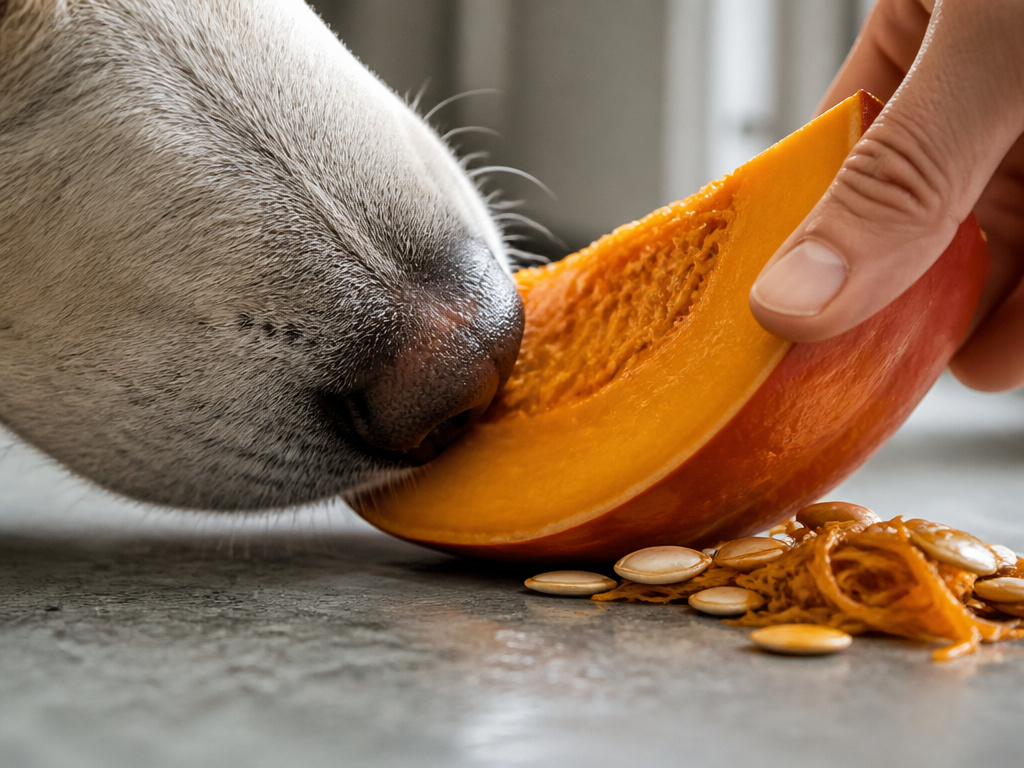
The soft orange flesh is the safe part. The hard shell around it is the part that causes obstructions.
The Texas A&M pumpkin safety article lays out the mechanics. A chunk that isn’t chewed properly lodges in the esophagus, and a piece that does get swallowed can pass into the small intestine and stop there.
The esophagus doesn’t grind. It pushes, and a hard, slick piece of rind doesn’t compress on the way down.
Keep these out of reach:
- The rind, which is the part Texas A&M calls the most dangerous
- The stem, which is tough enough to survive a determined chewer
- Carving scraps left on the floor, which is how most of these cases start
Seeds are a different question. InnoVet notes plain seeds aren’t toxic but should be given sparingly, unsalted, and ideally ground. Texas A&M points out that seeds and fibrous strands are high enough in fiber that a large amount causes stomach upset.
Feeding pumpkin seeds to a dog is a small-amount proposition, and the same seed safety notes apply whether the seeds are headed for a dog bowl or a bird feeder.
PetMD advises against feeding raw pumpkin at all, citing poor digestibility and a choking or blockage risk. InnoVet says to cook it until soft, which treats raw as workable but not ideal. Texas A&M treats raw and canned as broadly comparable in water and fiber.
PetMD advises against feeding raw pumpkin at all, InnoVet says to cook it until soft, and Texas A&M treats raw and canned as broadly comparable, so the disagreement is about degree.
Does Pumpkin Help Diarrhea or Make It Worse?
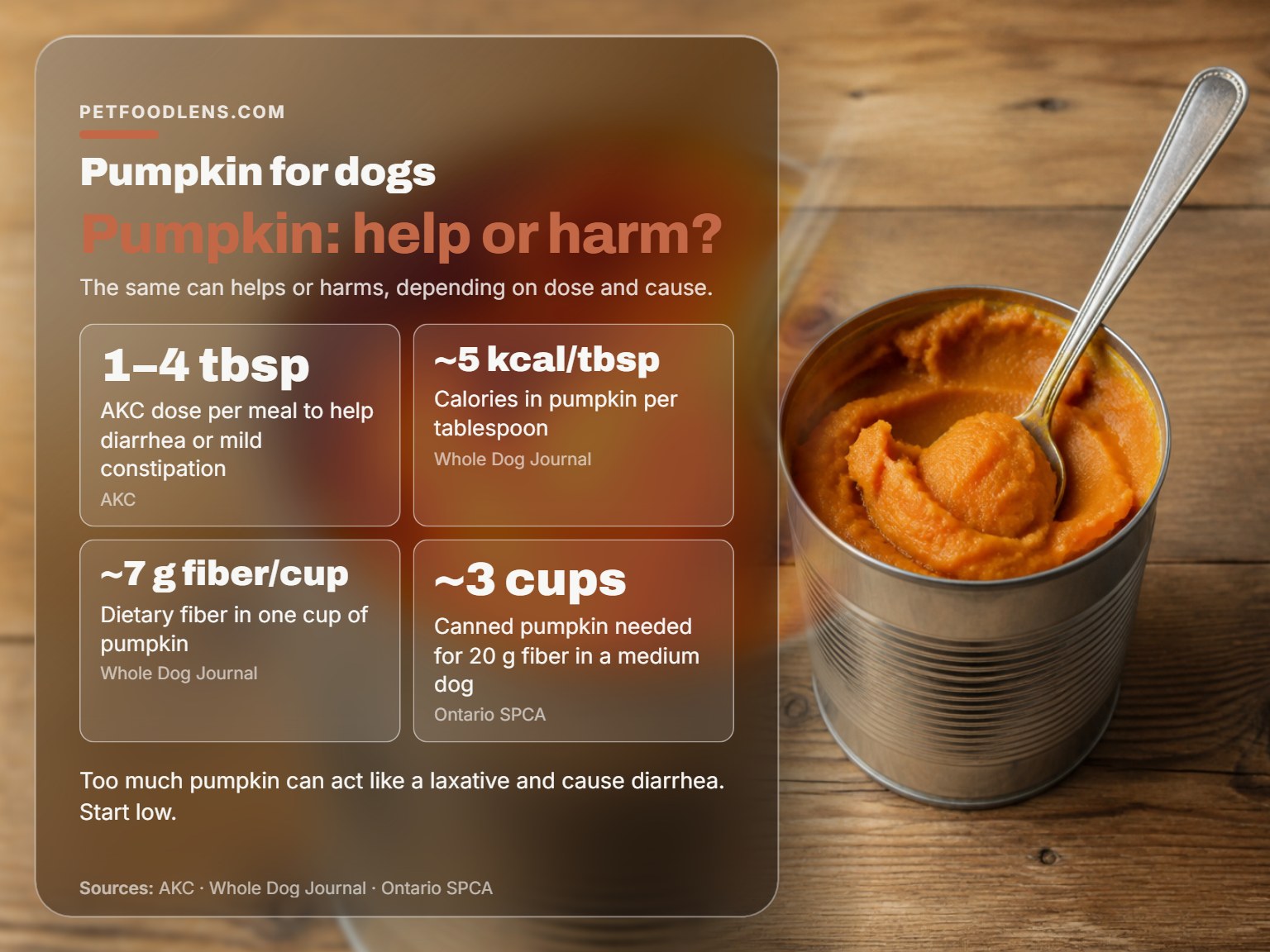
Both outcomes come out of the same can, and the difference is dose and cause.
The AKC recommends 1 to 4 tablespoons of pumpkin or pumpkin powder per meal to help with diarrhea and to ease mild constipation, while the Whole Dog Journal warns that too much pumpkin for a dog with diarrhea can act like a laxative and PetMD states that excess pumpkin causes diarrhea. The soluble fiber absorbs water and adds bulk, which firms a loose stool.
Past a certain amount, that same water-holding works the other way. The Whole Dog Journal warns that too much pumpkin for a dog with diarrhea can act like a laxative, and PetMD states plainly that excess pumpkin causes diarrhea.
So the dose that helps and the dose that harms sit closer together than most owners expect. Start low.
Hydration matters as much as the fiber. The AKC notes that dogs should be well hydrated whenever fiber intake goes up, because dehydration makes constipation worse rather than better.
Where fiber isn’t enough, the AKC notes that vets sometimes pair it with probiotics for dogs, which is a different intervention with a different evidence base. A spoonful of squash and a live-culture supplement aren’t interchangeable.
The Puppy Exception
The Ontario SPCA is direct about this one: pumpkin is not the top choice for getting fiber into a puppy’s diet. The same source works out that hitting 20 grams of fiber for a medium dog takes about 3 cups of canned pumpkin, roughly 711 grams, which is not a realistic puppy portion.
Their alternative is unglamorous and better supported. Splitting a puppy’s food into four meals a day has been shown to improve stool quality and consistency.
The AKC adds the harder line. Puppy diarrhea is especially concerning and should always be treated as a potential emergency.
How to Read a Pumpkin Label Without Getting Fooled
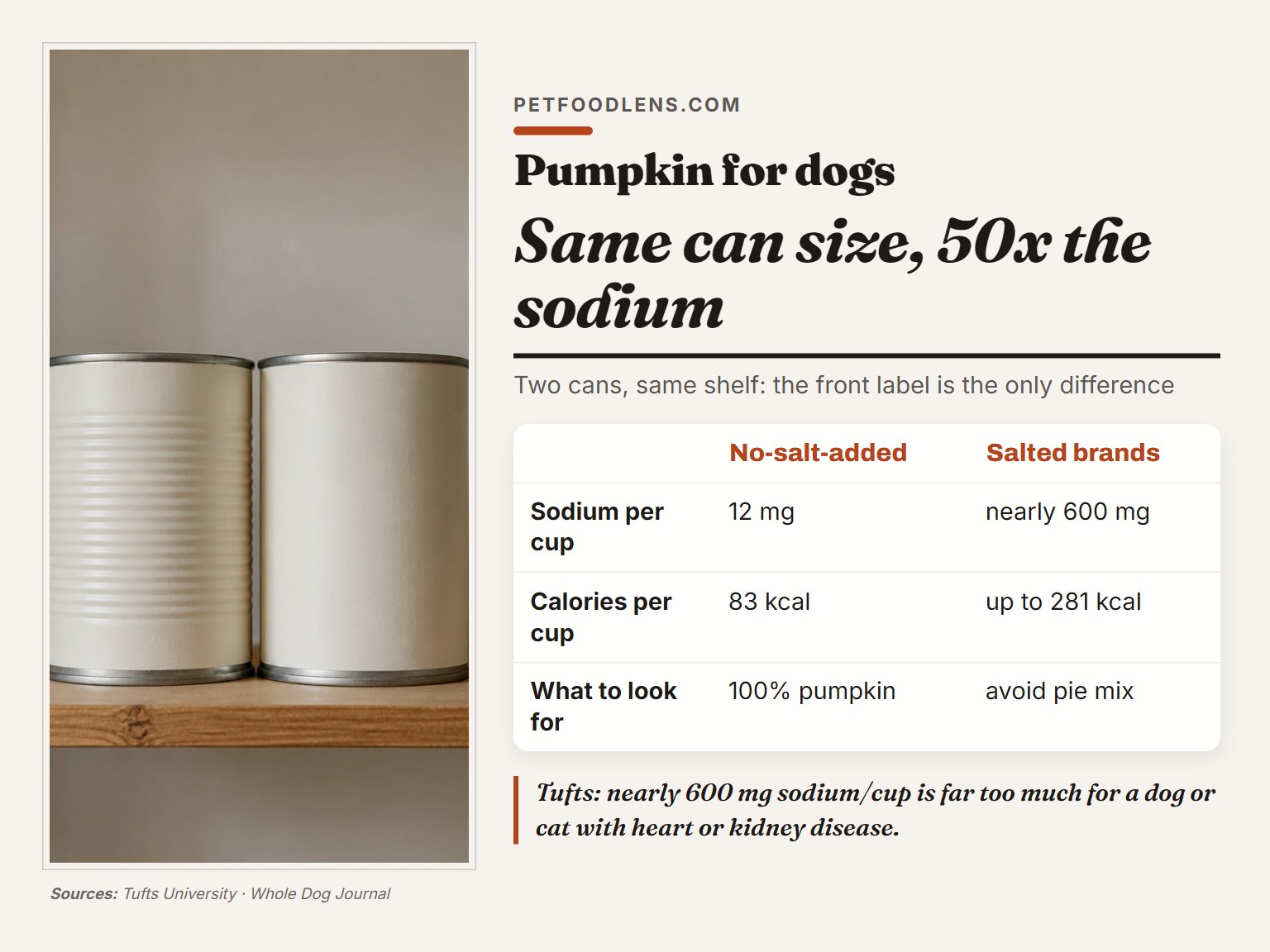
Two cans sit on the same shelf at the same size with the same orange artwork. One is 83 calories a cup and the other runs up to 281, and the only thing separating them is a word on the front.
I once read the fronts of about fifteen over-the-counter urinary bags for cats. Nearly all of them said “supports” or “promotes,” and not one said “dissolves.” That single verb is the difference between a marketing claim and a tested diet, and pumpkin labels run the same play.
“Supports digestion” is a claim. “100% pumpkin” is a fact you can check in four seconds.
Sodium is the number most owners never look at. No-salt-added canned pumpkin holds 12 milligrams per cup. Some salted brands run nearly 600 milligrams, which Tufts flags as far too much for a dog or cat with heart or kidney disease.
That’s a fifty-fold spread inside the same grocery aisle, and it’s printed in the same small type as everything else.
When Pumpkin Is the Wrong Move
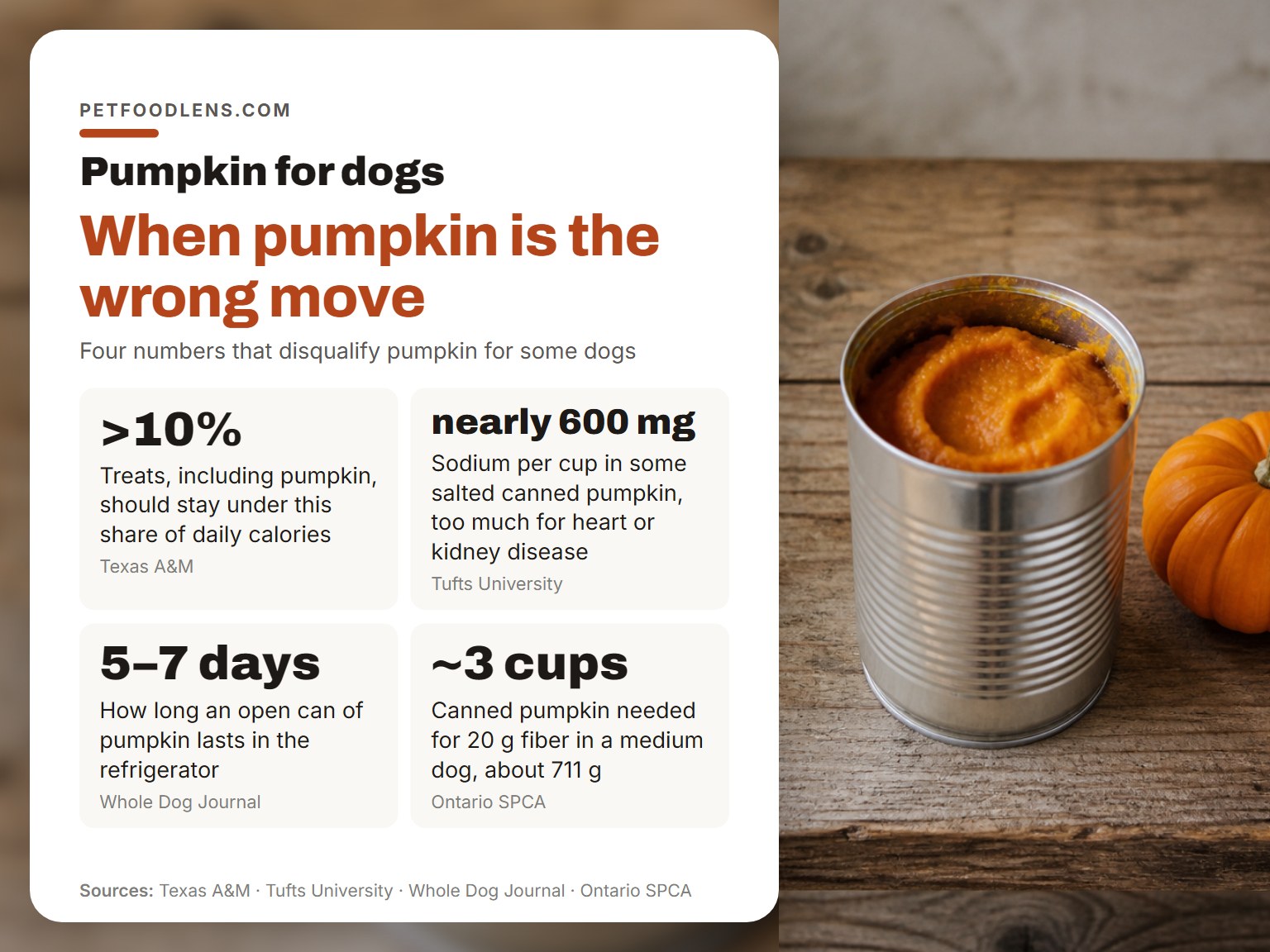
Some dogs should never see the can.
- Puppies with diarrhea. The AKC treats it as a potential emergency, and the Ontario SPCA doesn’t consider pumpkin a first-choice fiber source at this age.
- Dogs on a prescription diet. PetMD is clear that nothing outside the diet should be fed unless the vet approves it.
- Dogs with heart or kidney disease, where a salted can pushes sodium far past what the condition tolerates.
- Any dog already near the treat ceiling, since Tufts and Texas A&M both cap extras at under 10% of daily calories.
That 10% figure is the one that quietly disqualifies a lot of home feeding. A small dog on a weight-loss diet can hit it with a couple of tablespoons.
Where this goes sideways: Topping a prescription diet with pumpkin because it seems harmless. PetMD’s guidance is that dogs on prescription diets shouldn’t get anything outside the diet unless the veterinarian says it’s fine, and “it’s just squash” doesn’t override that.
Freshness is the other trap. An old pumpkin announces itself before you cut into it: soft patches, a duller orange, and a sour, fermented smell closer to a wet basement than to a squash.
Texas A&M’s rule is the one I’d tape inside a pantry door. If you wouldn’t eat it or let your kid eat it, the dog shouldn’t eat it.
If you want a second opinion on the safety basics, the pumpkin safety for cats and dogs guidance from the Animal Humane Society is a reasonable cross-check before you change anything.
Easy to miss: Mold and bacteria, not pumpkin itself, are the toxicity variable. Texas A&M is explicit that no part of a pumpkin is directly toxic unless it’s old enough to have mold on it.
The Supplement Question: What Pumpkin Can’t Fix
A complete and balanced diet already covers the fiber question, which is why this aisle sells reassurance more than it sells nutrition.
I spend most of my working hours on cat formulations, so I’ll flag my own limit here: the dog side of this evidence is thinner than the cat side, and I read it with that in mind.
Pumpkin tends to get stacked with turmeric for dogs, fish oil, and a probiotic, which is three or four products aimed at a problem nobody has named yet.
The order should be reversed. Name the problem first, then decide whether a food, a fiber source, or a supplement is the right tool.
If the goal is a chewy fiber-carrying treat rather than a spoonful of purée, sweet potato for dogs brings its own calorie math and deserves the same label check.
Where a supplement does earn its place, it’s usually veterinary-directed and specific: a named probiotic for a diagnosed gut issue, or an omega-3 product for a skin or joint condition a vet has actually examined.
A multivitamin on top of a complete diet is the opposite of that. It adds expense and can push nutrients past need.
Frequently Asked Questions
How much pumpkin should I give my dog?
Published ranges run from ¼ teaspoon to 4 tablespoons per meal depending on the source, which tells you how soft the evidence is. The Whole Dog Journal’s weight-based scale is the most practical starting point: ½ to 1 teaspoon for dogs 20 pounds and under, 1 tablespoon for 21 to 35 pounds, and 2 tablespoons over 35 pounds. Start at the low end and adjust based on stool.
Can dogs eat pumpkin every day?
Small amount daily is generally fine, and PetMD supports that with the caveat to stop if digestive upset appears. The ceiling is caloric: Tufts and Texas A&M both put extras at under 10% of total daily calories. A dog on a weight-loss diet hits that limit quickly.
Is pumpkin good for constipated dogs?
The AKC lists 1 to 4 tablespoons per meal as helpful for mild constipation, and hydration matters as much as the fiber. A dog that’s straining with no stool at all needs a vet, because the cause may be an obstruction or an enlarged prostate rather than ordinary constipation.
Can dogs eat pumpkin seeds?
Plain seeds aren’t toxic, but they’re high in fiber and a large amount causes stomach upset. InnoVet’s guidance is sparingly, unsalted, and ideally ground. Skip the salted roasted kind entirely.
Is canned pumpkin better than fresh?
The sources disagree. The AKC says canned is more concentrated because fresh holds more water, while Texas A&M describes the water and fiber content as fairly similar, with canned running higher in calories and possibly added sugars. Texas A&M describes the water and fiber content as fairly similar, with canned running higher in calories and possibly added sugars. Canned is more consistent; fresh is more variable.
Can cats have pumpkin too?
Yes, in a much smaller amount. InnoVet suggests around half a teaspoon of plain pumpkin mixed into food. Tufts notes that matching a therapeutic fiber dose in a cat would take more than 2½ cups a day, which tells you how little a garnish actually contributes.
The Bottom Line
Here’s the trigger I’d use. If your dog’s stool hasn’t changed after a few days of plain pumpkin at the low end of the weight scale, stop buying it. You’ve answered the question, and the answer was no.
The concession matters too. I know commercial cat formulations far better than dog nutrition, and the dog research here is thinner than the confident tone of most pumpkin articles suggests. There’s no dose-finding study, and the published scales disagree by an order of magnitude.
So treat pumpkin as what it is: a cheap, watery, low-risk food that occasionally helps a mild gut problem and rarely hurts a dog when it’s plain.
The moment the problem is recurring rather than a one-off, the can was never the answer. That’s a vet conversation, and it’s a shorter one if you bring the actual label with you.
