
Pumpkin Seeds for Birds Pros and Cons: The Honest Answer
This post contains affiliate links. As an Amazon Associate, we earn from qualifying purchases.
Pumpkin seeds for birds work as a high-fat treat: dried kernels run about 49% fat, so a few go a long way. As a dewormer, the one controlled chicken trial found 2 g per bird per day only moderately effective against two worm genera, and inferior to mebendazole.
Fat is the number that decides how the pumpkin seeds for birds pros and cons question fits into a week. A budgie working through three kernels has taken on a real slice of its daily calories, and that is before the rest of the dish gets counted.
What follows: the fat math, the deworming trials people keep citing, portions by bird size, and the one seasonal rule that belongs to wild finches rather than your cockatiel.
Key Takeaways
- 49 g of fat per 100 g in dried kernels is the reason portions stay tiny.
- Small birds get 1 to 3 kernels occasionally; a cockatiel or conure tops out around 2 to 5.
- Watch droppings, appetite, and weight for 24 to 48 hours after the first offering.
- Obesity or fatty liver means a vet call before you add any high-fat treat.
- The BTO’s May to October pause covers garden feeding, not your indoor bird.
Pumpkin Seeds for Birds Pros and Cons: The Fat Number Comes First
Dried pumpkin seed kernels sit at roughly 49 g of fat per 100 g, which puts them closer to a nut than to a carrot.
Dried pumpkin seed kernels contain approximately 49 g of fat per 100 g. That concentration places the seed in the same energy-dense group as nuts and oilseeds, which is why veterinary feeding guidance keeps pumpkin seed in the treat category rather than the meal category. Portion size governs whether the food fits a formulated diet.
Compare them to the other things people hand out as treats. A handful of nuts for birds carries a similar fat load, which is why both belong on the same short leash.
The mechanism behind that matters more than the number. Fat is the densest energy source in any seed, so a bird fills its crop on a small volume and stops eating the pellets that carry the vitamins and minerals it actually needs. That is how most seed-only diet problems start. The bird feels full and walks away from the bowl.
You can see the fat in the bag. Shelled pepitas leave a faint greasy sheen on the inside of the packet, and the fine grey dust at the bottom is kernel fragments rather than dirt.
Are Pumpkin Seeds a Dewormer? What the Trials Actually Show
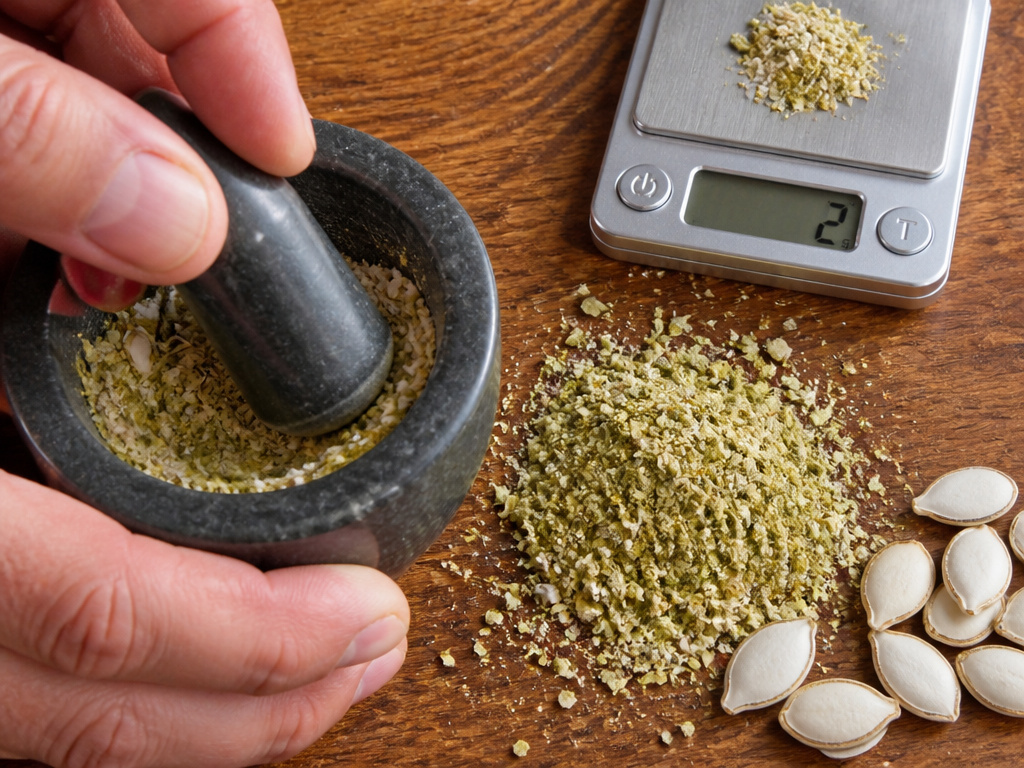
Partly, and less than the folklore suggests.
The trial everyone cites is the TUBITAK in vivo pumpkin seed efficacy work from Acorda and colleagues in 2019. Ninety Philippine Jolo native chickens, 4 to 5 months old and 1 to 2 kg, were used in the trial.
One group got plain mash. One got 2 g of ground pumpkin seed per bird per day. One got mebendazole at 30 mg/kg body weight.
Three worm genera turned up: Ascaridia, Heterakis, and Raillietina. Against the first and third, pumpkin seed was moderately effective. Against Heterakis it was only marginally active. It also cut egg output moderately. Mebendazole beat it on every measure.
Extension material has pushed back from the other direction, calling the deworming claim “yet to be confirmed by research.” Both positions survive contact with the evidence. The trial is real but narrow. The folk claim is broad and largely untested.
There is a dosing problem nobody mentions. A calculated 2 g assumes the bird eats the seed. Cucurbitacin, the compound behind bitterness in squash, varies by cultivar, and extension guidance on feeding pumpkins notes that animals refuse bitter seed outright. A refused dose is zero.
| Role people give it | What the evidence supports | Practical limit |
|---|---|---|
| Occasional treat | High energy, minerals, easy to handle | 1 to 3 kernels for small birds |
| Dewormer | Moderate vs Ascaridia and Raillietina, marginal vs Heterakis | Tested at 2 g/bird/day in 1 to 2 kg chickens |
| Formulated diet ingredient | 9% in layers, 10% in broilers, no performance loss | Species-specific, not a home-mixing recipe |
I wouldn’t run pumpkin seed as a dewormer on a bird I cared about. The trial used ground seed at a measured dose in 1 to 2 kg chickens, and the result still came second to a drug that costs almost nothing. Worm burdens are a vet question, not a kitchen one.
The Three Poultry Trials, and Why None of Them Studied Your Parrot
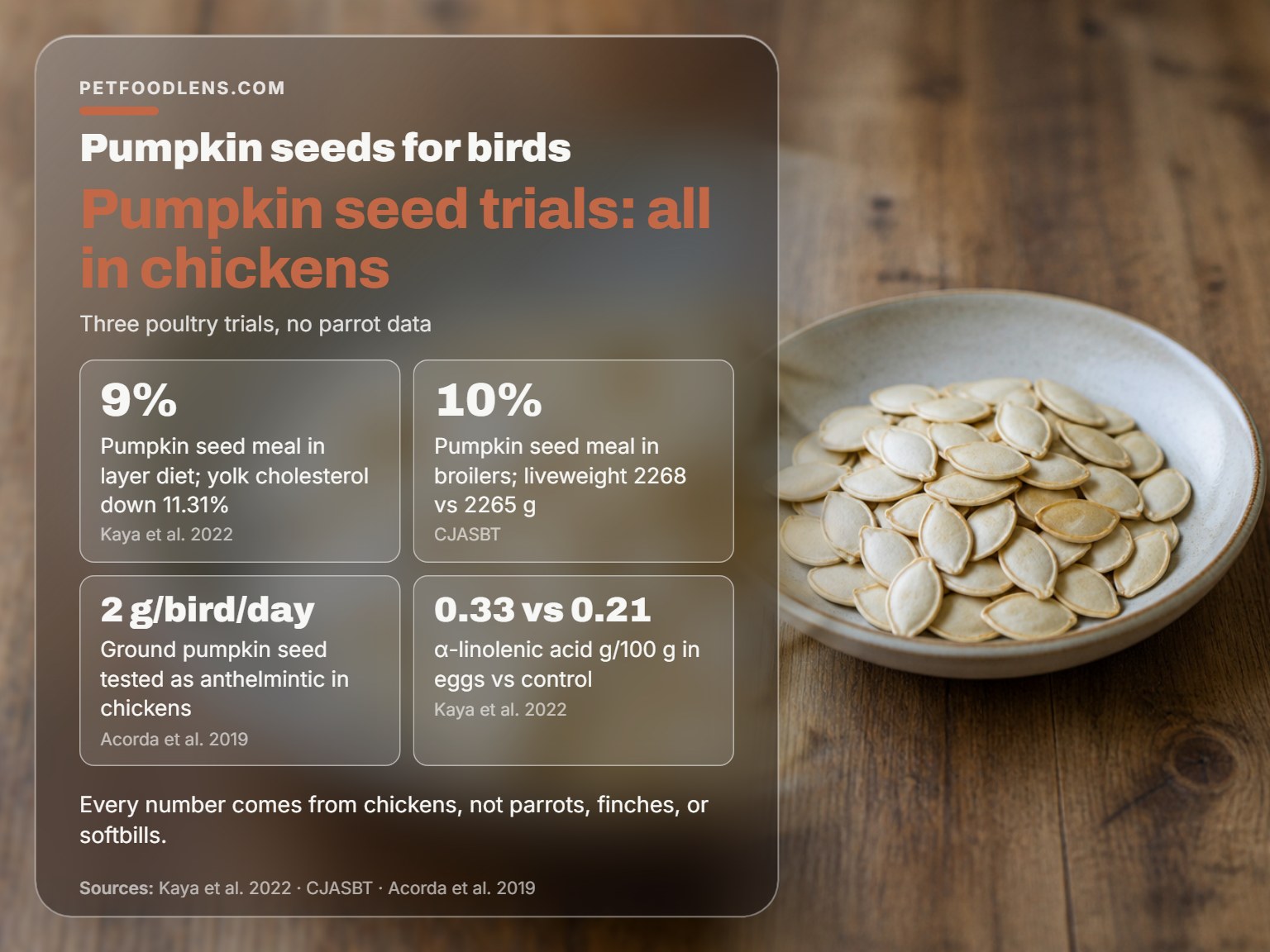
Kaya and colleagues fed 9% pumpkin seed meal to eighty 50-week-old Tetra SL layers and then measured the eggs.
Yolk cholesterol dropped 11.31% and whole-egg cholesterol dropped 10.38%. α-linolenic acid rose to 0.33 g/100 g against 0.21 in the control, and linoleic acid to 20.65 against 18.37. Arachidonic acid fell 3.91%, and the n-6/n-3 ratio came down 15.52%. The eggs carried roughly 120 mg more α-linolenic acid per 100 g of yolk.
The PMC study on pumpkin seed meal also tracked storage. Over 28 days at 21 °C and 5 °C, the 9% group held higher Haugh units and lower albumen pH.
The broiler work ran 120 Cobb-500 chicks for 49 days at 10% pumpkin seed meal. Viability hit 95%. Final liveweight was 2268 g against 2265 g, feed conversion 2.13, breast yield 23.73% against 23.52%. Abdominal fat went down and the meat tasted the same. The authors put the ceiling at 10%.
Klir and colleagues added the review layer in 2017. Broilers at 5 g/kg dry matter showed lower blood cholesterol, lower triglycerides, and lower mortality with no change in production traits. Pumpkin seed cake carries higher metabolizable energy and crude protein than soybean meal, and substituted 10 to 15% for soybean meal in lambs without shifting production.
| Trial | Birds | Pumpkin seed level | Main result |
|---|---|---|---|
| Acorda et al. 2019 | 90 Jolo native chickens, 4 to 5 months | 2 g/bird/day, ground | Moderate vs two worm genera, marginal vs Heterakis |
| Kaya et al. 2022 | 80 Tetra SL layers, 50 weeks | 9% pumpkin seed meal | Yolk cholesterol down 11.31% |
| Cuban J. Agric. Sci. | 120 Cobb-500 broilers, 49 days | 10% pumpkin seed meal | Liveweight 2268 vs 2265 g, less abdominal fat |
Every number above comes from chickens. None of it comes from a parrot, a finch, or a softbill. My own depth is with cats, so I’ll say plainly where this runs out: scaling a 2 g dose from a 1 to 2 kg chicken down to a bird a fraction of that size is arithmetic, not evidence.
The fatty acid story is the one piece that travels. α-linolenic acid is the fat flaxseed is known for, and the same enrichment logic applies here: it’s a diet-formulation effect, not something you can eyeball in a dish.
How Many Pumpkin Seeds Can a Bird Have?
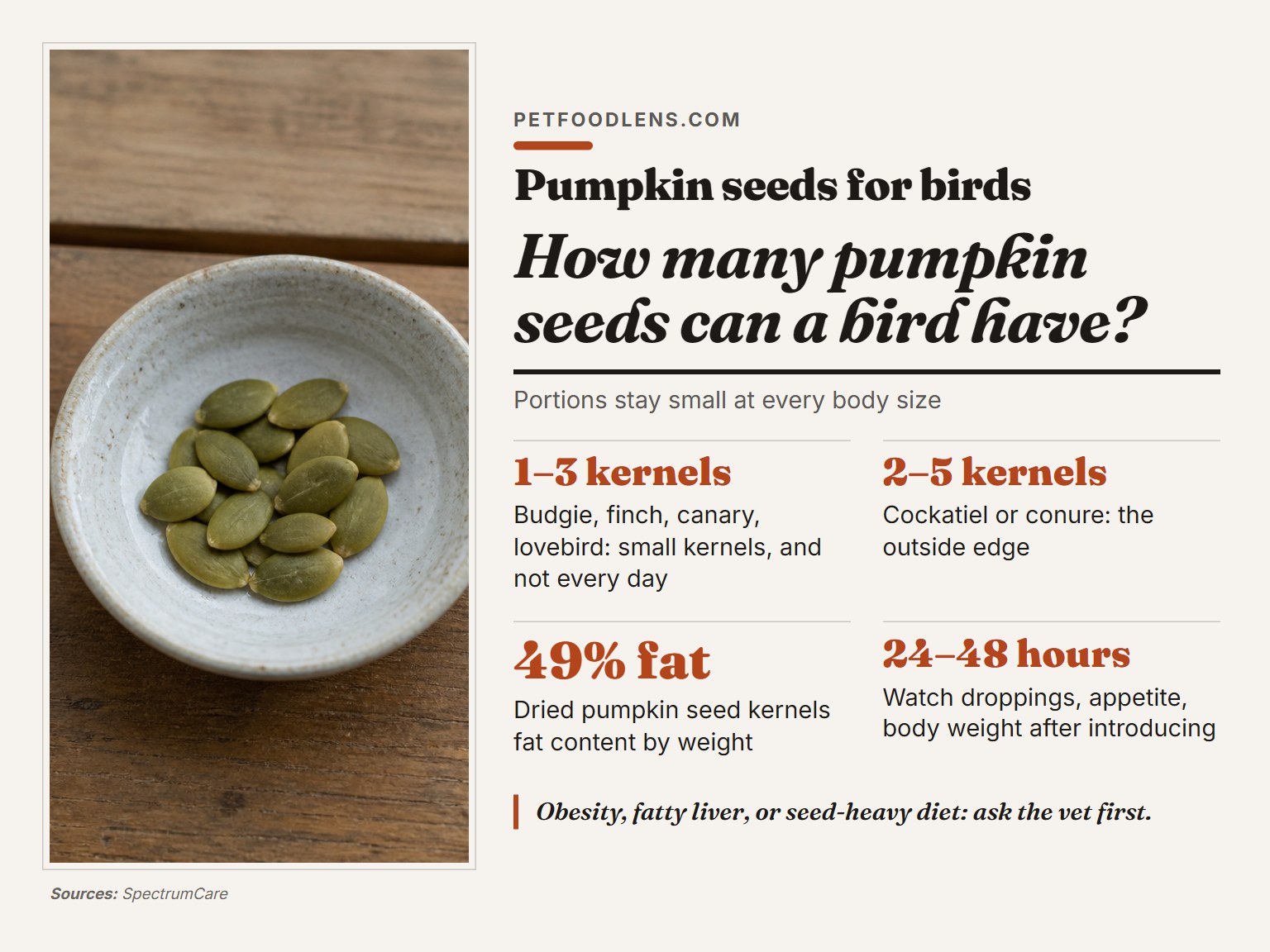
Portions scale with body size, and the numbers stay small at every size.
- Budgie, finch, canary, lovebird: 1 to 3 small kernels, and not every day.
- Cockatiel or conure: 2 to 5 kernels is the outside edge.
- Larger parrots: measured portions, not open access to a bowl.
- Obesity, fatty liver, or a seed-heavy base diet: ask the vet first.
Here’s how to actually introduce them.
- Start with one kernel. A pile tells you the bird ate. One kernel tells you whether it will touch the thing at all.
- Keep it plain and dry. A buttered or salted kernel turns a fat question into a sodium question, and sodium is the one that ends in a vet visit.
- Watch droppings, appetite, and body weight for 24 to 48 hours. Skip the watch and a loose dropping three days later gets blamed on the wrong food.
- Pull the leftovers. Damp shelled seed in a dish grows mold, and mold in a cage is a respiratory problem rather than a diet problem.
The 24 to 48 Hour Check
The observation window is the whole safety net. Watch for vomiting or repeated regurgitation, loose droppings, reduced droppings, a fluffed posture, or trouble perching.
None of those signs are specific to pumpkin seed. That’s the point. They tell you something changed, and the only thing you changed was the dish.
Husks left in the dish look like a full dish from across the room. That’s the trap. Topping up over empty shells is the mistake I see most often, and it quietly doubles the portion without anyone noticing.
Common mistake: Refilling the dish without checking for husks. The bird already ate; you’re stacking a second serving on top of the evidence.
Plain, Unsalted, and Nothing Else
Not one said “dissolves.” That single verb separates a marketing claim from a tested diet, and bird seed bags run the same play with the word “natural.”
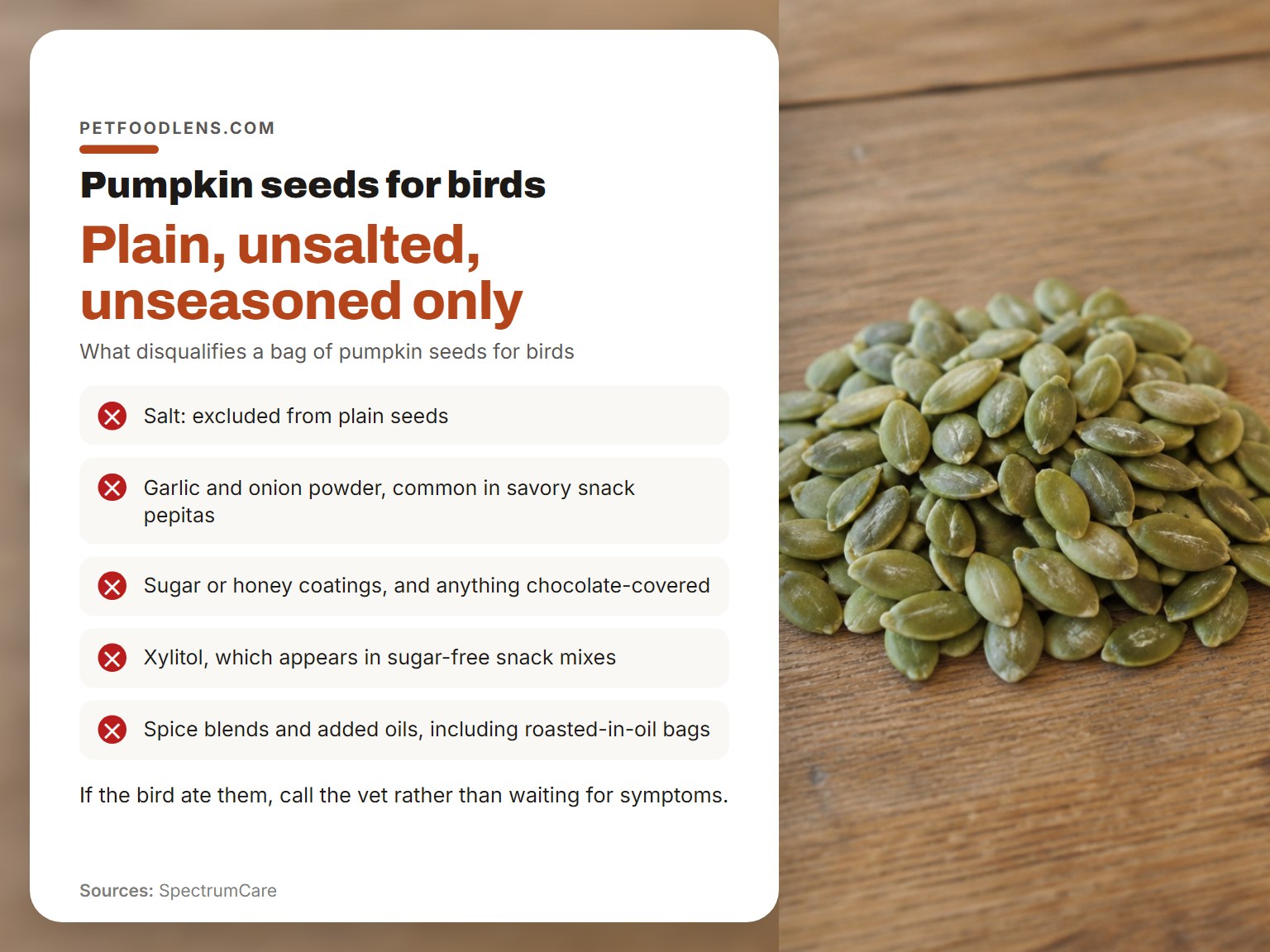
For pumpkin seeds the rule is shorter than any label: plain, unsalted, unseasoned, raw or dry-roasted.
Things that disqualify a bag outright:
- Salt, which is the fastest route to a sick bird out of this whole list.
- Garlic and onion powder, both of which turn up in “savory” snack pepitas more often than you’d think.
- Sugar or honey coatings, and anything chocolate-covered.
- Xylitol, which appears in sugar-free snack mixes.
- Spice blends and added oils, including the roasted-in-oil bags sold for people.
Those are the same categories that show up across bird food ingredients to avoid, and the response is the same: if the bird ate them, call the vet rather than waiting for symptoms.
A bag of shelled pepitas that’s past its date smells faintly of old paint, and the kernels go soft instead of snapping when you bend one. That’s rancidity, and it’s a reason to buy smaller bags.
Pumpkin itself is more forgiving than the seed. It can be parboiled, plunged into cold water to stop the cooking, and frozen for later, which is the method the AFA Watchbird avian diet article describes for corn and broccoli. Pumpkin seeds, in that same source, are simply noted as high in minerals and feedable fresh or dried.
Skip this if: your bird is carrying extra weight, has fatty liver concerns, or already eats a seed-heavy diet. High-fat treats are the wrong lever to pull first, and the vet has better options than you do.
Wild Birds vs Pet Birds: The Seasonal Rule That Doesn’t Transfer
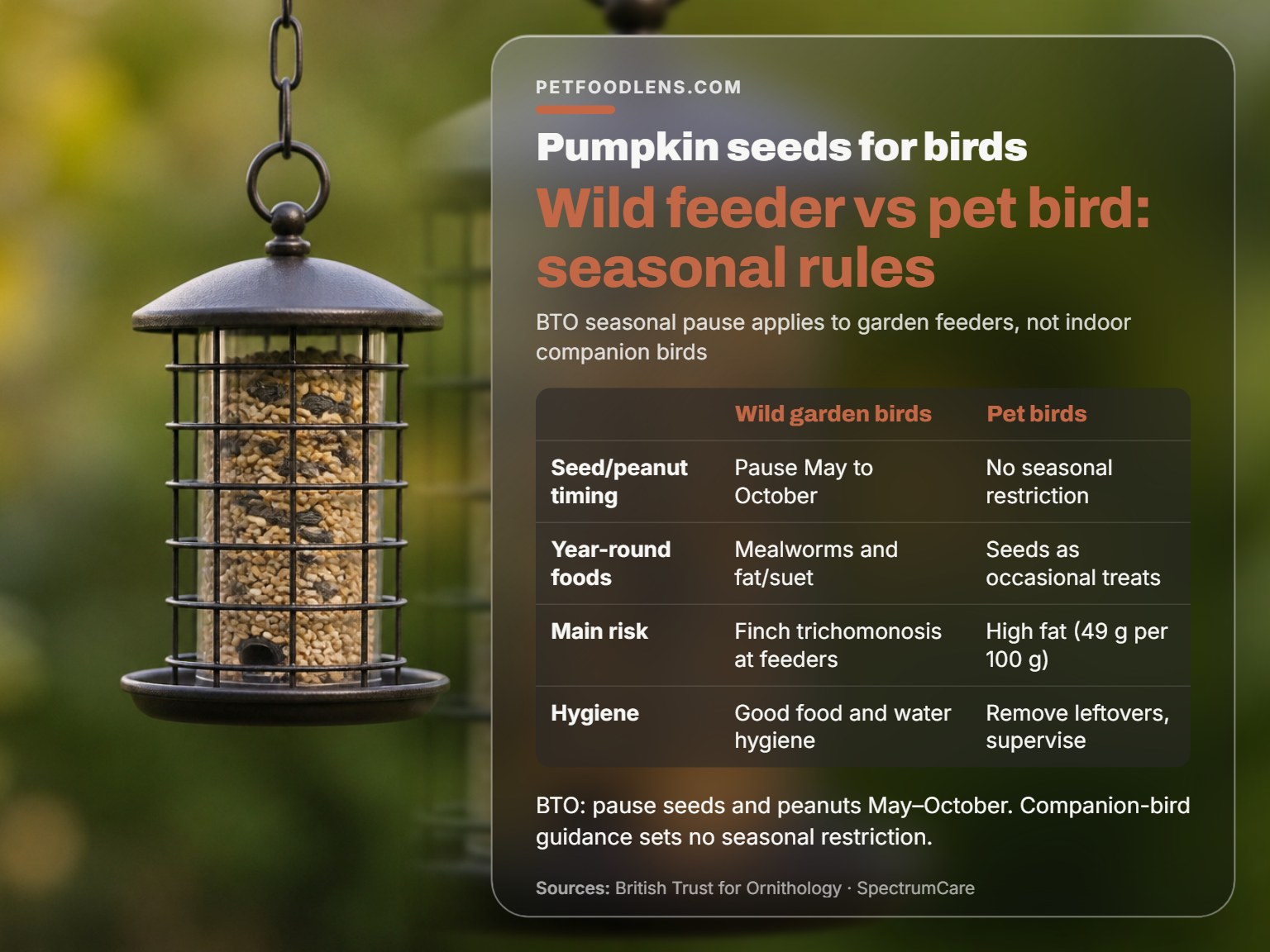
Garden feeding advice and companion bird advice get quoted at each other constantly, and they describe different animals in different settings.
The BTO feeding garden birds report sets out the current position plainly: feed seeds and peanuts from November to April, and pause during May to October to reduce the impact of finch trichomonosis. Mealworms and fat or suet provision can continue year-round. Good food and water hygiene runs alongside all of it.
The BTO also declined to mandate that ringers stop using peanuts and seed, choosing targeted hygiene guidance instead.
None of that transfers to an indoor cockatiel. Trichomonosis spreads where birds crowd the same feeder, and your living room doesn’t work like a feeding station.
If you keep an outdoor feeder, the seed choice matters less than the calendar. safflower seeds get recommended as a finch option, and the May to October pause applies to them exactly the same way.
A feeder that never empties is a feeder that never gets cleaned. The summer pause isn’t only about disease season; it’s the only maintenance window most gardens ever get.
Where I’d Spend the Treat Budget Instead
Pellets first, then vegetables, then seeds as the small minority of the day.
Harrison’s Bird Foods Adult Lifetime is the pellet I’d start a parrot on, because it’s formulated as a complete diet rather than a seed mix with vitamins sprayed on. Lafeber Nutri-Berries are the better bridge for a bird that already eats seed, since the shape mimics a seed head and the bird has to work at it. Kaytee Exact is the mid-priced option most stores actually stock, which matters on a Sunday when you’ve run out.
Sprouted seeds are the underrated corner of this category. Sprouting doesn’t turn a seed into a pellet and it isn’t a license to free-feed. What it does is force handling: rinse, drain, rinse again, keep it cold, throw out what you don’t use.
The practical version is to supplement a seed-based diet with pellets and vegetables rather than swapping one for the other outright. Birds eat selectively, and an abrupt swap usually means the pellets sit untouched while the bird waits you out.
Sunflower seeds make the comparison clearly. A sunflower seeds mix and a bag of pepitas are both fat delivery systems, and variety across the two isn’t the same thing as balance across the week.
I’d rather see a bird eat a pellet it tolerates than a seed it loves. That’s the whole argument in one line.
Frequently Asked Questions
Can birds eat pumpkin seeds every day?
SpectrumCare advises keeping dried kernels, at about 49 g of fat per 100 g, in the treat category as a small minority of the daily diet rather than a bowl that stays full, while AFA Watchbird presents pumpkin seeds as a normal vegetable-diet component that can be fed fresh or dried.
Are pumpkin seeds a natural dewormer for birds?
They have some activity, and the evidence is narrower than the reputation. The controlled chicken trial found moderate effectiveness against Ascaridia and Raillietina, marginal activity against Heterakis, and a result inferior to mebendazole. Extension material still calls the claim unconfirmed.
Can I feed the seeds from a Halloween pumpkin?
Only if the pumpkin was never treated. Bleach soaks, candle wax, and paint all make the seeds and flesh unsafe, and those are common on carved pumpkins. A pumpkin grown for eating is a different proposition from one that sat on a porch.
Do pumpkin seeds need to be shelled?
SpectrumCare advises supervising closely and removing leftovers if shelled seeds are offered, while AFA Watchbird notes pumpkin seeds can be fed fresh or dried. If you offer them in the shell, supervise and pull the leftovers so nothing sits damp in the dish and molds.
Are pumpkin seeds safe for budgies and finches?
In tiny amounts, yes. Think 1 to 3 small kernels occasionally rather than a spoonful, and watch droppings, appetite, and body weight over the following 24 to 48 hours after the first offering.
The Bottom Line
If your bird already eats a seed-heavy diet, the pumpkin seed question is the wrong question. Fix the base first, then argue about treats.
The one thing worth doing this week: count the husks in the dish before you top it up. Most of the dishes I’ve seen were being refilled over a layer of empty shells, which means the bird was getting fed twice and nobody noticed.
None of this is a knock on pumpkin seed. It’s a treat with a real mineral load and a fat number you can plan around, and the pumpkin seeds for birds pros and cons argument mostly comes down to portion and frequency.
The deworming claim is the one I’d retire. A worm burden belongs to a vet with a fecal float, not to a bag of pepitas.
