
Probiotics for Dogs Pros and Cons: Which Ones Hold Up?
This post contains affiliate links. As an Amazon Associate, we earn from qualifying purchases.
Probiotics for dogs pros and cons, honestly weighed: they help a narrow set of cases, and only when the product has trial evidence behind it. Pro-Kolin Advanced cut median diarrhea duration to 32 hours against 47 on placebo in one trial. A separate trial found no significant difference.
The 32-hour figure and the null result come from two different products, tested against different endpoints. One measured how long diarrhea lasted. The other measured how long until stool looked acceptable again. Both trials are sound, and the tub in your cupboard answers neither question.
What follows is the evidence, the label checks that separate a real product from a story, and the situations where the right move is a vet visit rather than a supplement.
Key Takeaways
- Two trials, two answers. Pro-Kolin Advanced beat placebo on diarrhea duration (P=.008); a separate multi-strain trial found no significant difference (p=0.17).
- The effect is temporary. In a synbiotic trial, 45 bacterial species shifted at week 4 and every change was back to baseline by week 6.
- No product has a blanket recommendation. A JAVMA review concluded that no specific probiotic can be recommended for use.
- Strain and dose beat brand storytelling. Enterococcus faecium 4b1707 is the strain in the product with the positive trial; “probiotic blend” on a label tells you nothing.
- For chronic gut disease, food carries the evidence. A systematic review found dietary intervention is the major key and probiotics add no significant improvement.
What the research actually shows about probiotics for dogs
165 studies went in. Seventeen came out.
That’s the shape of the systematic review of canine probiotics published in the Journal of Veterinary Internal Medicine, with a search cutoff of April 1, 2017. Twelve of the 17 included studies dealt with acute gastrointestinal disease and five with chronic disease.
A systematic review screened 165 studies and included 17, with a search cutoff of April 1, 2017. Twelve addressed acute gastrointestinal disease and five addressed chronic disease. The authors flagged small sample sizes and moderate-to-high risk of bias across the included studies, and the evidence base predates most products now on shelves.
That date matters more than it looks. The review’s evidence base was fixed before most of the tubs you can buy today existed, so a product launched since then has no entry in it.
The probiotics in small animal medicine review in JAVMA reached a blunter conclusion: no specific product can be recommended for use. That’s a review of the whole field, not one trial with an axe to grind.
Why two trials reached opposite conclusions
The Pro-Kolin Advanced field trial was double-blinded, placebo-controlled, and run across 14 practices in the UK and Ireland. It measured median diarrhea duration. The randomized trial acute canine diarrhea study measured time to acceptable fecal consistency, which is a different endpoint with a different definition of success.
| Trial | Arm | Endpoint | Result |
|---|---|---|---|
| Pro-Kolin field trial | Pro-Kolin Advanced | Median diarrhea duration | 32 h vs 47 h placebo, P=.008 |
| Frontiers RCT | Probiotic | Time to acceptable stool | 3.5 days vs 4.8 placebo, p=0.17 |
| Frontiers RCT | Metronidazole | Time to acceptable stool | 4.6 days, p=0.17 |
Different products, different endpoints, different sample sizes. The Pro-Kolin trial compared a single named strain against placebo. The Frontiers trial compared a multi-strain product against both placebo and a drug. Reading one as a verdict on the other is how the probiotics for dogs pros and cons debate ends up argued past each other on forums.
Do probiotics help acute diarrhea or not?
Sometimes. Less than the tub implies.
The Frontiers trial randomized dogs to a probiotic, metronidazole, or placebo. Time to acceptable fecal consistency came out at 3.5 days for the probiotic arm, 4.6 days for metronidazole, and 4.8 days for placebo. The difference was not statistically significant (p=0.17).
A dog with acute diarrhea goes from a firm stool to a wet, gassy squirt in a few hours, and the smell turns sharply sour rather than the usual earthy note. Owners notice that shift before they notice anything else.
That null result is worth sitting with. Metronidazole, a drug prescribed for years for exactly this problem, also failed to separate from placebo in that trial.
The Pro-Kolin trial found the opposite. Median diarrhea duration was 32 hours against 47 on placebo (P=.008), resolution was 1.60 times faster (95% CI 1.08-2.44, P=.02), and the need for additional medical intervention dropped to 3.5% (2/57) from 14.8% (9/61) with a relative risk of 0.88 (95% CI 0.77-0.99, P=.04).
So a strain-specific product with a trial behind it beat placebo. A multi-strain product did not. That’s the most useful sentence in this whole category, and almost no product page will say it.
What probiotics do to the gut microbiome, and how long it lasts
The synbiotic trial used 20 billion CFU a day across seven strains, plus 50 mg a day of inulin, for four weeks. Then the researchers sequenced what happened.
At week 4, 45 bacterial species had increased at least twofold, and 43 of those 45 were Lactobacillales. E. Coli decreased 2.8-fold (adjusted p<0.01). By week 6, every change had returned to baseline.
That washout is the finding nobody puts on the tub. The bacteria moved in, did something measurable, and left. Continuous dosing is what sustains the shift, and the reviewed studies carry no long-term safety data for continuous dosing.
The canine intestinal microbiota modification review lays out the same picture across the wider literature: the microbiome is modifiable, and the modification is not permanent.
I’ve stopped treating a positive microbiome study as a product endorsement. A shift in bacterial populations is a measurement. It does not tell you the dog got better, and a shift that reverses by week six tells you the dose has to keep coming.
There’s a second wrinkle. The synbiotic trial found that dogs with higher baseline Proteobacteria and lower baseline Lactobacillales responded more robustly. A protocol tested on one group of dogs will not behave the same way in a dog whose gut already looks different.
Probiotics for Dogs Pros and Cons, Sorted by Evidence
Three things go wrong with the probiotic pitch, and none of them are the bacteria’s fault.
- The evidence is thinner than the shelf suggests. Seventeen included studies, small samples, and moderate-to-high risk of bias across the board.
- The effect stops when you stop. Back to baseline by week 6 in the one trial that measured it.
- No long-term safety data for continuous dosing appears in the reviewed studies.
- Chronic disease is a different question. The systematic review found dietary intervention remains the major key and that probiotic supplementation seems not to add significant improvement.
On the other side of the ledger: one product has a randomized, placebo-controlled trial with a statistically significant result on a clinically meaningful endpoint. That’s a real pro, and it’s more than most supplements in any category can claim.
Common mistake: Buying a multi-strain “immune support” blend for a healthy dog with no gut symptoms. There’s no diagnosis to measure against, so you can’t tell whether it did anything, and the microbiome shifts reverse by week 6 of stopping.
Probiotic claims in food and probiotic claims in a tub get regulated differently, which is why probiotics in pet food is a separate conversation from supplements. The same logic runs through probiotics for cats; the species differ and the evidence base is thinner, but the label problems are identical.
How to read a probiotic label without getting fooled
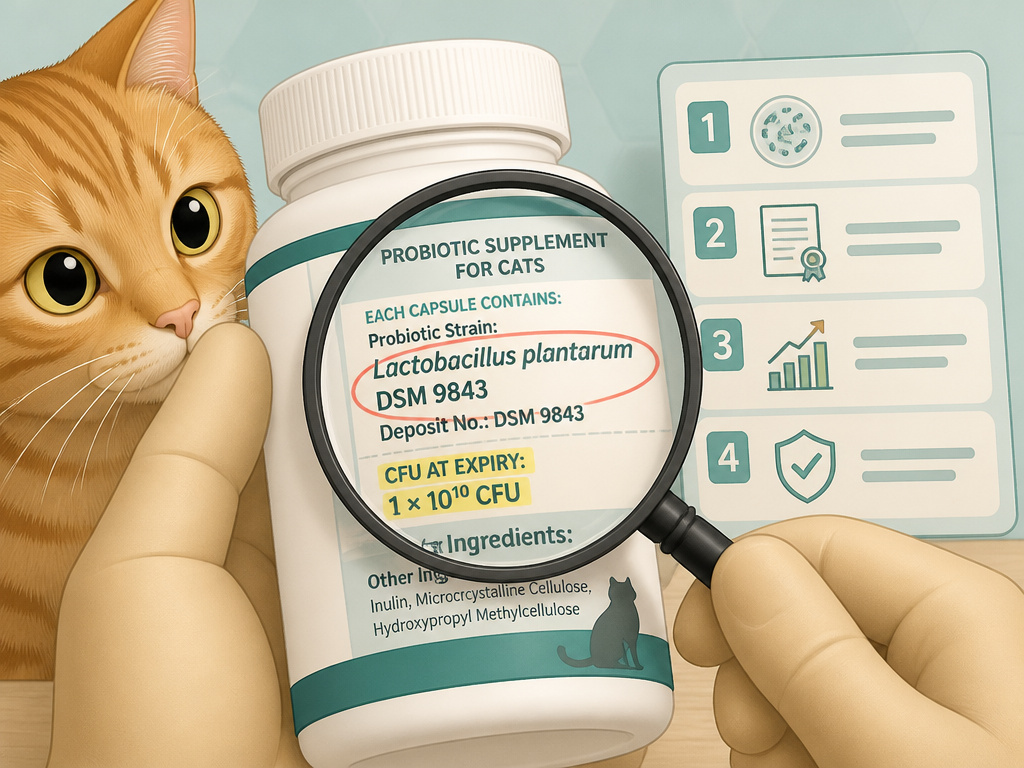
Fifteen tubs on a shelf, all of them saying “supports.”
I ran that exact exercise on OTC urinary bags once: read the front, count the verbs. Fifteen of them said “supports” or “promotes,” and none said “dissolves.” Probiotic packaging runs the same play, and the strain designation is usually the smallest line on the panel.
Before you start: Live bacteria and antibiotics work against each other, so don’t run both at once unless the product is a yeast-based one indicated for concurrent use. Xylitol in sugar-free human foods is toxic to dogs and can be fatal. A puppy with watery stool, or any dog with blood in it, needs a vet before a supplement.
- Find the strain designation, not just the genus. Enterococcus faecium 4b1707 is a strain. “Enterococcus faecium” alone is a species, and species-level naming tells you almost nothing about whether the product was tested.
- Check the CFU count against the trial dose. The synbiotic trial used 20 billion CFU a day. A product listing 1 billion is not the same intervention, whatever the front of the tub says.
- Look for a duration. The trial ran four weeks. A tub with no serving guidance beyond “daily” is asking you to invent the protocol.
- Read the adequacy statement on the food, not just the supplement. If the diet is already complete and balanced, you’re adding on top of a closed formula.
- Know whether you’re holding a yeast or a bacterium. Saccharomyces is a yeast, and it’s the category registered for use alongside antibiotics. The bacterial products are not.
The strain name is the only line that matters
A genus and species on a label tells you what family the organism belongs to. It does not tell you which isolate was tested, at what dose, or in which dogs. Two products can both say “Lactobacillus acidophilus” and share nothing else.
What “supports digestive health” legally means
It means the product is being sold as a supplement rather than a drug, so it cannot claim to treat, cure, or prevent anything. “Supports” is the verb you’re allowed to use when you can’t say “treats.” That’s the whole trick, and it’s legal.
I formulate cat food, not dog food, and I’m not a veterinarian. When a label question turns into a diagnosis question, I stop and send people to their vet.
Do prebiotics matter as much as the probiotic?
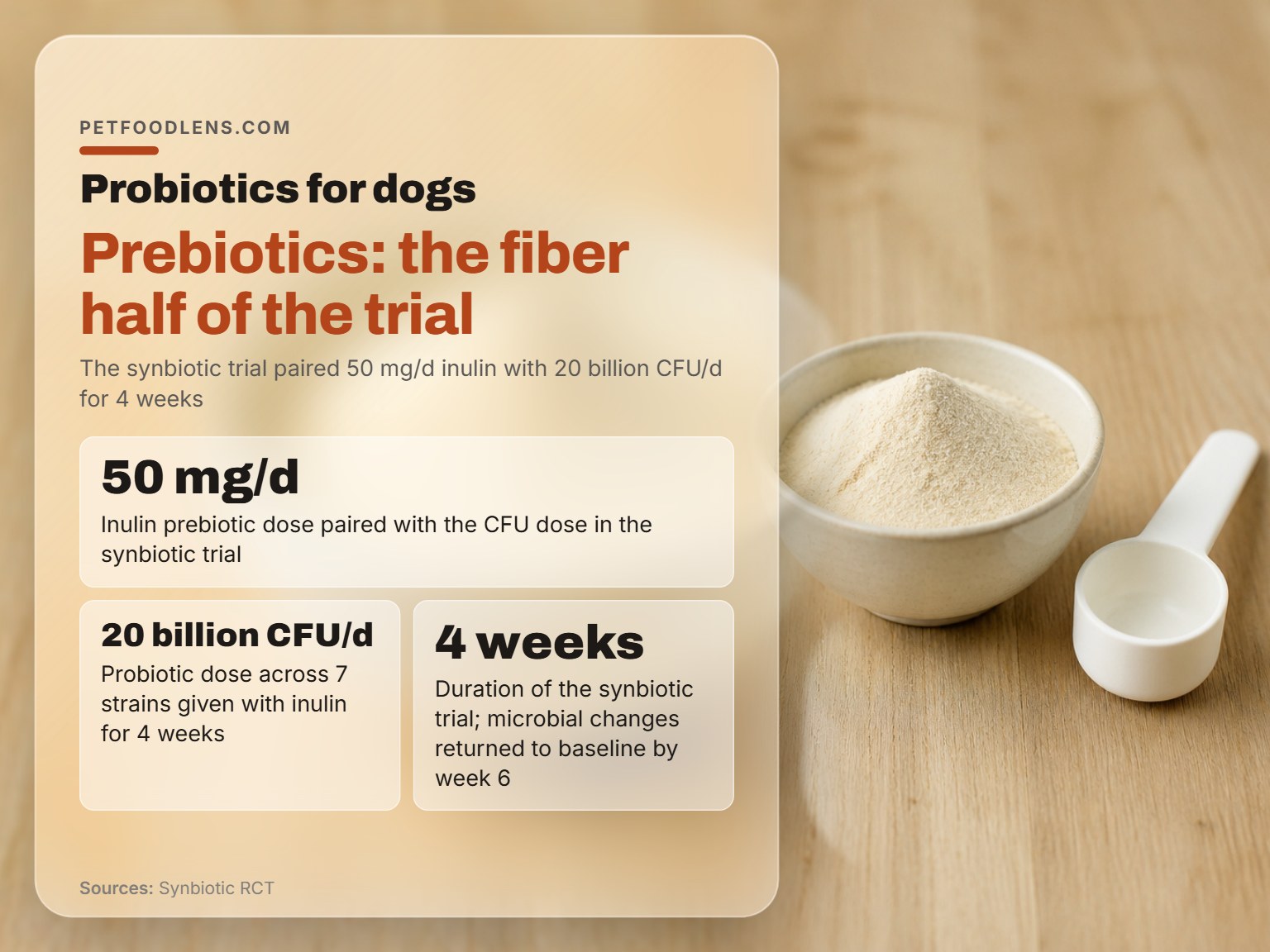
Three words decide most of this: fiber, dose, and duration.
Prebiotics are the food for the bacteria. The synbiotic trial paired 50 mg a day of inulin with the CFU dose, which is why it’s called a synbiotic rather than a probiotic. Inulin is the prebiotic used in the trial, and prebiotics in pet food covers the fiber sources that do the same job.
Grain-free dry foods often swap corn for peas, potato, or tapioca, so the carbohydrate load barely moves. If you’re buying grain-free for the fiber, check what replaced the grain.
The probiotics and prebiotics combination is what the trial actually tested, and it’s the version with data behind it. A dog food with probiotics is doing two jobs at once: it has to be complete and balanced, and it has to carry a live culture dose.
When the food does more than the supplement
For chronic gastrointestinal disease, the systematic review is unambiguous. Dietary intervention remains the major key. Probiotic supplementation seems not to add significant improvement. If your dog has been loose for weeks, the lever is the diet, and dog food for gut health is where that conversation starts.
When a probiotic is the wrong tool
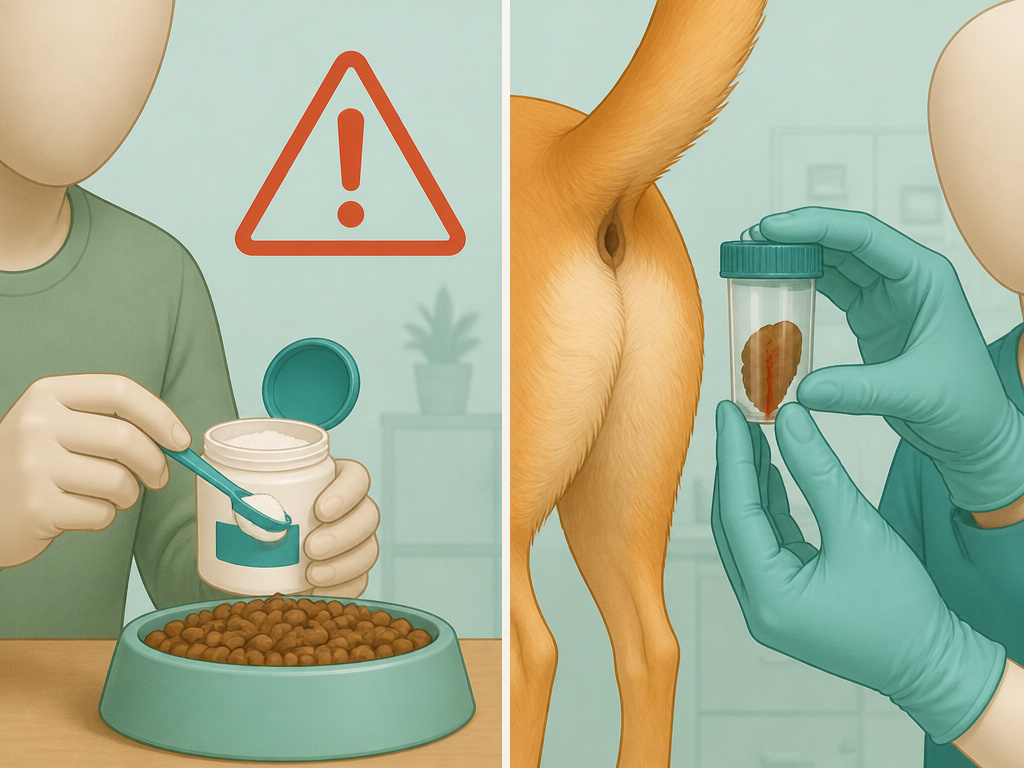
A dog with bloody diarrhea does not need a supplement. He needs a vet today.
| What you’re seeing | Likely driver | Right move |
|---|---|---|
| Sudden watery stool, dog otherwise bright | Dietary indiscretion, stress, travel | Short course of a trial-backed product; vet if no change |
| Loose stool for weeks, weight loss | Chronic enteropathy | Vet first; diet change carries the evidence |
| Blood in stool, vomiting, lethargy | Infection, parvovirus, obstruction | Vet today; no supplement |
Where this goes sideways: Adding a supplement to a therapeutic diet without telling the vet. Those diets are formulated to a fixed mineral and protein target, and an owner-added product can push calcium or phosphorus off that target over weeks.
The probiotics in canine feed review is the one to read before you add anything to a prescription diet. The actual review of dietary probiotic supplementation in dogs is the one to read before you add anything to a prescription diet.
A dog on antibiotics is the other case that gets handled badly. Live bacteria and antibiotics work against each other, so the bacterial products wait until the course finishes. Saccharomyces is the exception, because it’s a yeast and antibiotics don’t touch it.
Which products are worth considering
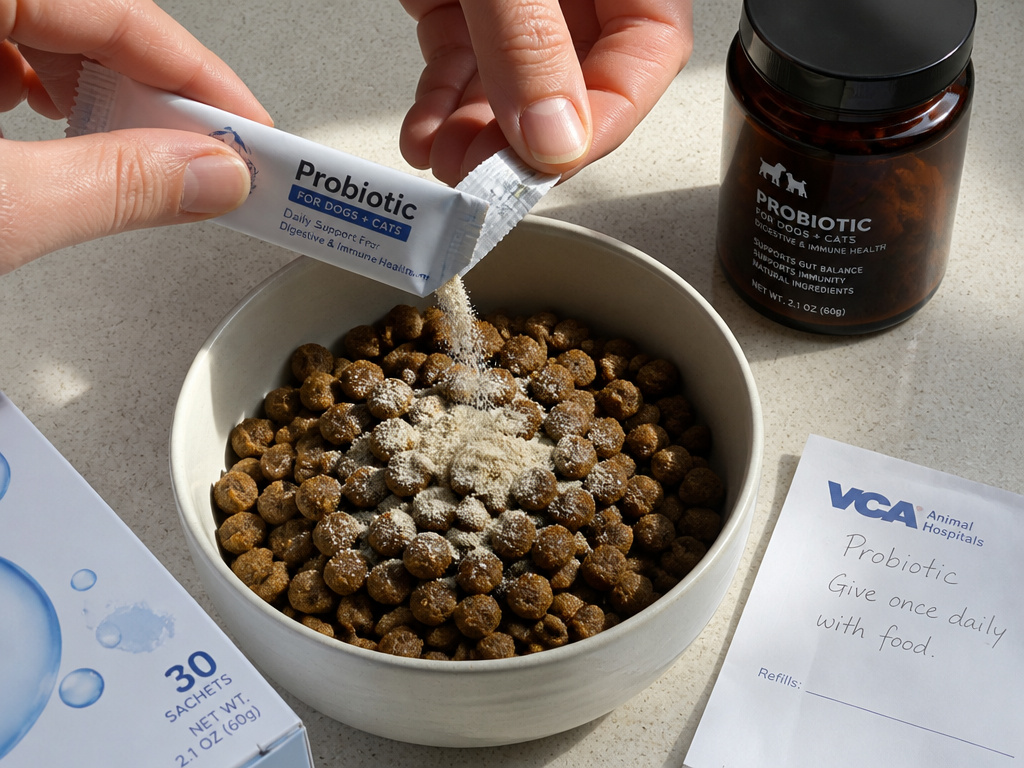
Purina Pro Plan FortiFlora is the product most owners name first, and it’s not the one with the best trial behind it.
FortiFlora comes as 30 single-serve sachets, dosed once a day, and it’s sold as a veterinary supplement for sensitive stomachs and loose stools. Owner reports describe it as palatable and easy to sprinkle. What it doesn’t have, in the literature summarized here, is a strain-specific randomized trial on the scale of the Pro-Kolin work.
The sachet is a fine, pale powder that clumps if the box gets damp, and it coats kibble evenly enough that most dogs eat it without a fight. Owner reviews describe it as a probiotic powder and, in the same breath, as a prebiotic. Those two words describe different things.
Pro-Kolin Advanced is the one with the trial. It contains Enterococcus faecium 4b1707, and the field trial behind it measured median diarrhea duration and the need for additional medical intervention.
For chronic gut disease, the evidence points at food before it points at a tub. Hill’s Prescription Diet i/d and Royal Canin Gastrointestinal are the category a vet reaches for, and they’re formulated to a fixed target rather than a marketing story. A dry dog food with probiotics is the most common delivery format, and also the one where the dose is hardest to check.
A probiotic is a short course for a specific problem, not a daily habit. If you can’t name the problem and the end date, you’re buying hope in a sachet.
If you want one answer and your dog has acute, uncomplicated diarrhea: Pro-Kolin Advanced for a short course, and a vet call if the stool hasn’t firmed up.
Frequently Asked Questions
Are probiotics for dogs safe to give every day?
The reviewed studies don’t answer that. They carry no long-term safety data for continuous dosing, and the microbiome changes reversed by week 6 in the one trial that measured washout. A short course for a specific problem is a different risk profile from a daily habit.
Do probiotics help a dog with diarrhea?
It depends on the product. Pro-Kolin Advanced shortened median diarrhea duration to 32 hours against 47 on placebo (P=.008). A separate multi-strain trial found no significant difference from placebo (p=0.17). Strain and dose decide the answer, not the word “probiotic” on the front.
Can I give my dog probiotics while he’s on antibiotics?
Not the bacterial ones. Live bacteria and antibiotics work against each other, so the bacterial products wait until the course finishes. Saccharomyces is a yeast and is the category registered for use alongside antibiotics.
Are probiotics for dogs worth it for a healthy dog?
For a healthy dog with no gut symptoms, there’s nothing to measure against. The systematic review found the effect on chronic disease was not significant beyond dietary intervention, and the healthy-dog microbiome shifts reverse by week 6 of stopping.
What’s the difference between probiotics and prebiotics for dogs?
Probiotics are the live organisms. Prebiotics are the fiber that feeds them, and inulin is the one used in the synbiotic trial at 50 mg a day. A product with both is a synbiotic, which is the version that actually got tested.
The Bottom Line
Everything above assumes a dog with acute, uncomplicated diarrhea and an owner willing to read a label. That assumption breaks in four places: blood in the stool, a puppy under a year, a dog already on medication, or a problem that’s been running for weeks. In any of those, the probiotic is not the first call.
Here’s the concession most supplement pages won’t make. For chronic gut disease, the evidence points at the diet, not the tub. The systematic review says dietary intervention remains the major key. If you’re choosing where to spend, spend on the food.
And here’s the contrarian part. I’d rather see an owner buy one product with a strain-specific trial and use it for a week than buy three blends and use them forever. The first is a decision. The second is a subscription.
