
Probiotics for Cats Pros and Cons: What the Evidence Shows
This post contains affiliate links. As an Amazon Associate, we earn from qualifying purchases.
Probiotics for cats pros and cons rest on weaker evidence than the packaging suggests. A 2025 systematic review found only 5 of 7 probiotic trials improved fecal consistency, and rated overall certainty low to very low. Most trials enrolled healthy young adults, not sick cats.
The 5-of-7 number sets the tone for everything below. Probiotics can shift the gut microbiome, but the shift does not always translate into firmer stool or fewer flare-ups. The trials that do show benefit are small, short, and mostly run on healthy cats.
What follows: the honest pros, the honest cons, the products that have actually been tested, and the one question to ask your vet before you buy anything.
Key Takeaways
- Only 5 of 7 probiotic trials improved fecal consistency in a 2025 systematic review, and overall certainty was rated low to very low.
- EFSA rejected all 5 efficacy studies submitted for L. Reuteri NBF-2 in cats, so label claims and regulatory review do not match.
- Most trials enrolled healthy young adults, not sick cats, which is exactly the population owners want to help.
- Proviable-DC showed a 6.0 to 4.4 fecal score improvement in an open-label trial, but it had no placebo and only 53 cats.
- Postbiotics are not interchangeable with live probiotics; the heat-killed form did not raise B. Animalis abundance in the CECT 8145 trial.
What Do Probiotics Actually Do in a Cat’s Gut?
A probiotic is a live microorganism that, when given in adequate amounts, confers a health benefit. That definition comes from the ISAPP consensus, and the word “adequate” is doing a lot of work.
A probiotic must be alive at the point of consumption, present in a dose that has been tested, and tied to a specific strain with published evidence. A CFU count on a label without a strain name and a trial behind it is just a number.
The mechanism is straightforward in theory. Beneficial bacteria colonize the gut lining, compete with pathogens for space and nutrients, and produce short-chain fatty acids that feed the cells lining the colon. In practice, the cat’s existing microbiome often resists colonization by whatever you feed it. That resistance is why study results are so inconsistent.
A 2023 review of gut probiotics dogs and cats review lays out the mechanisms in detail. The short version: it works when the strain matches the problem, and it fails when it does not.
Probiotics for Cats Pros and Cons: Where the Evidence Holds Up
The strongest evidence in cats is for chronic diarrhea, and even there the picture is mixed. The Proviable-DC trial published in JFMS in 2024 is the most-cited positive result.
The Proviable-DC Trial: What 53 Cats Showed
Fifty-three cats with chronic diarrhea completed a 21-day course of the Nutramax Proviable-DC synbiotic. Mean fecal score improved from 6.0 to 4.4, with a P value under 0.001. Seventy-two percent of owners reported improvement.
That sounds like a win. It is also an open-label, uncontrolled trial with no placebo. Owners who paid for a supplement and expected improvement reported improvement. That is a known bias, and the study design cannot rule it out.
The systematic review of cat probiotics that screened the same literature rated overall certainty low to very low. Both things are true. The trial showed a real change in fecal score. The review says the evidence base is too weak to call it settled.
Worth knowing before you start: A fecal score is a visual scale, and it is subjective. Two technicians looking at the same stool can disagree. That is why the open-label design matters more than the P value.
The Cons Most Product Pages Skip
The first con is that many products on the shelf are not probiotics by definition. The AVMA probiotics veterinary medicine article states that commercial small-animal probiotic and synbiotic products “do not fulfill the criteria required to qualify as a probiotic.” That is a 2017 statement, and the market has not cleaned itself up since.
The second con is the EFSA problem.
Why Did EFSA Reject All Five Efficacy Studies?
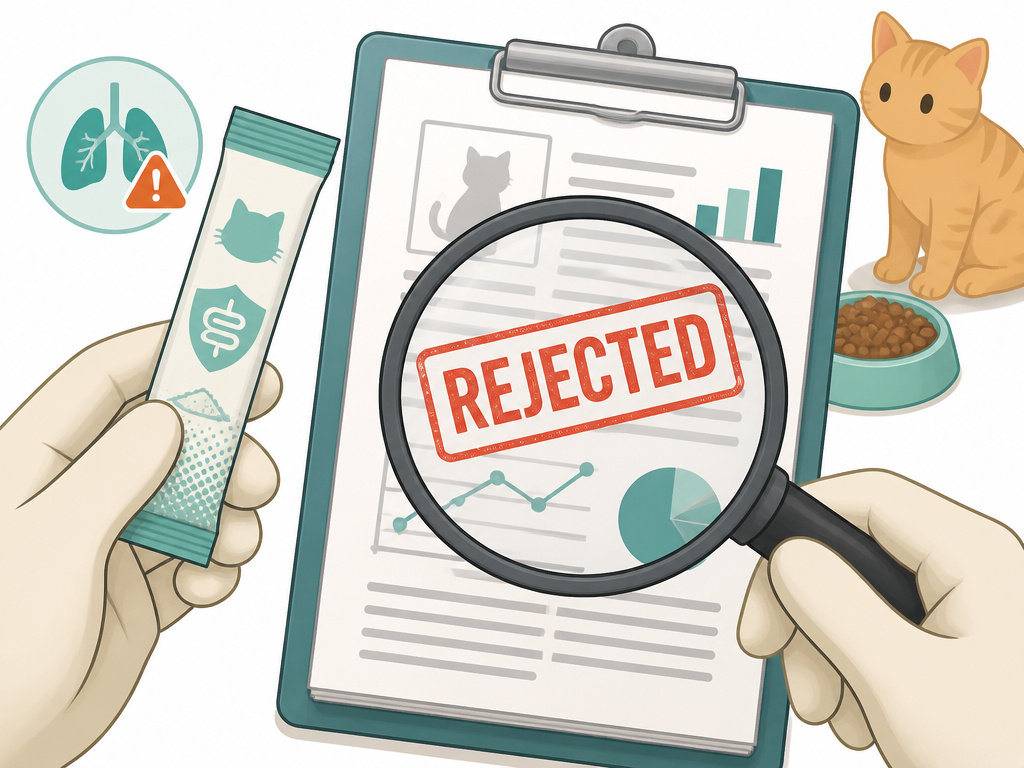
The European Food Safety Authority reviewed L. Reuteri NBF-2 (DSM 32264) as a feed additive for cats in 2019. It set a minimum dose of 6 x 10^9 CFU per animal per day, which remains the only cat-specific dose in a regulatory opinion. Then it rejected every efficacy study the manufacturer submitted.
The 15-Day Study EFSA Rejected
One of the five studies ran for 15 days and included sick animals. Three used individually housed cats with subjective fecal scoring by lab staff. None of the five reported randomization methodology. EFSA concluded it was “not in the position to conclude on the efficacy” of the strain for cats.
That is the regulatory version of “we cannot tell if this works.” The product still sells with label claims. The gap between the label and the EFSA opinion is the single clearest example of why you should not trust the front of the package.
EFSA also flagged L. Reuteri NBF-2 as a potential respiratory sensitiser. If you handle a powdered probiotic, that matters for you, not just the cat.
Which Probiotic Products Have Actually Been Tested?
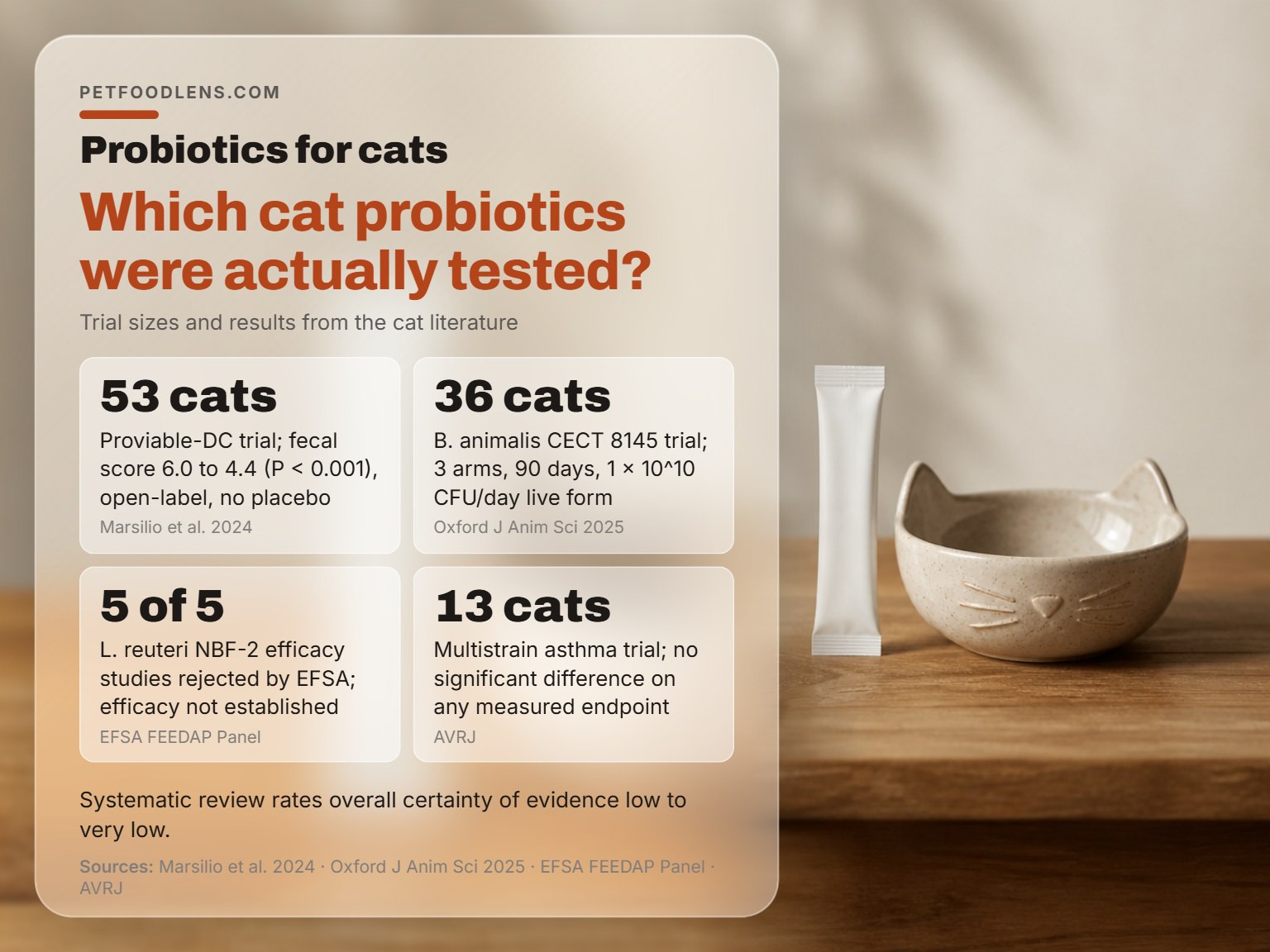
Three products come up repeatedly in the cat literature and in vet clinics. The table below compares what was actually tested against what the label claims.
| Product or Strain | Trial Design | Key Result |
|---|---|---|
| Nutramax Proviable-DC | 53 cats, 21 days, open-label, no placebo | Fecal score 6.0 to 4.4 (P < 0.001) |
| B. Animalis CECT 8145 (live) | 36 cats, 90 days, 3 arms, placebo-controlled | 1 x 10^10 CFU/day; live form raised B. Animalis |
| L. Reuteri NBF-2 (DSM 32264) | 5 studies, all rejected by EFSA | Efficacy not established |
| Multistrain asthma trial | 13 cats, 2 weeks, placebo-controlled | No significant difference on any endpoint |
FortiFlora, Proviable, and the CFU Question
Purina Pro Plan FortiFlora is a commonly used product, usually because it is palatable and easy to sprinkle on food. The strain is Enterococcus faecium SF68. Nutramax Proviable-DC is the one with the 2024 chronic diarrhea trial behind it.
FortiFlora comes as a fine powder that most cats lick off the food without noticing. The texture is closer to flour than to a capsule.
The CFU count on the label is not the number that reaches the cat. Storage temperature, moisture, and time on the shelf all reduce viability. A product that states a CFU count at time of manufacture may have a fraction of that at expiry. I check the expiry date before the CFU count, every time.
For a deeper walkthrough of strain selection, the cat probiotic guide covers how to read the back of the bag.
When Probiotics Are the Wrong Tool
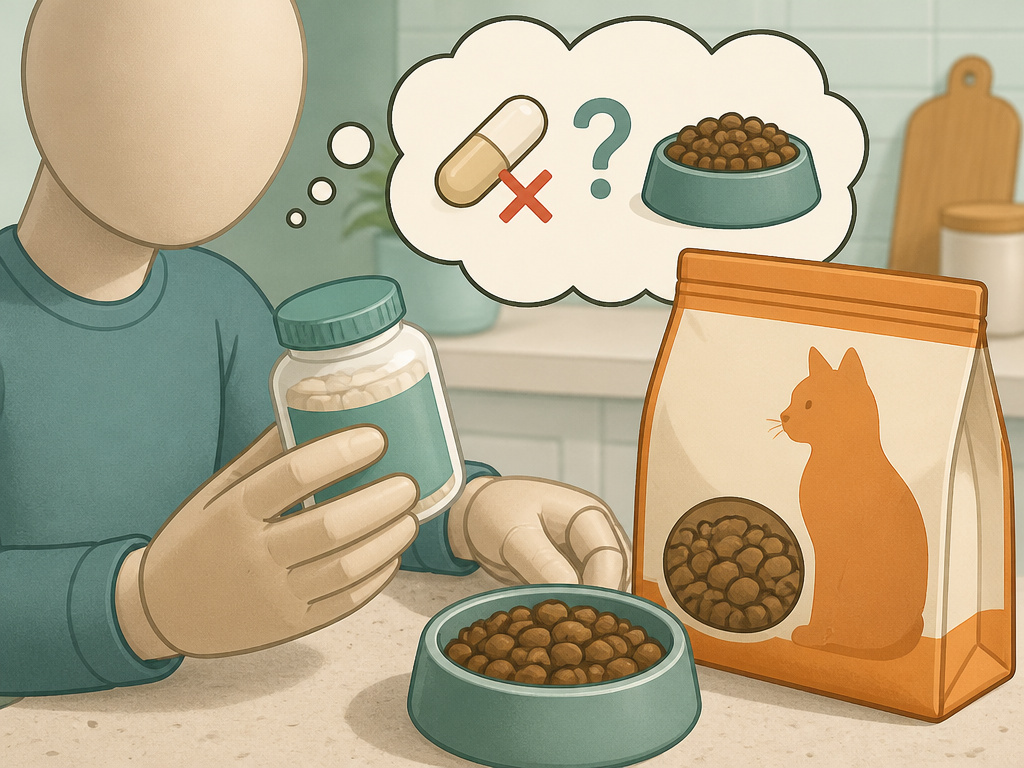
Probiotics are not a fix for a cat that is vomiting, losing weight, or has blood in the stool. Those signs need a vet visit, not a supplement.
Here is the practical takeaway from my own early mistakes. When I first started working with cat owners on GI issues, I would suggest a probiotic, a food switch, and a feeding schedule change all at once. The diarrhea would stop and I would have no idea which one did it. Now I change one variable at a time, and I tell owners to do the same.
That rule matters more with probiotics than with almost anything else, because the effect size is small and the placebo effect is large. If you change three things and the stool firms up, you have learned nothing.
A cat food for GI issues switch is often the higher-yield intervention. A cat food for loose stools with a novel protein or a hydrolyzed formula is often the higher-yield intervention, especially for chronic cases.
Common mistake: Adding a probiotic to a complete and balanced diet and expecting it to fix a problem the diet is causing. If the food is the problem, the probiotic is a bandage on a wound that needs stitches.
How to Read a Probiotic Label Without Getting Fooled
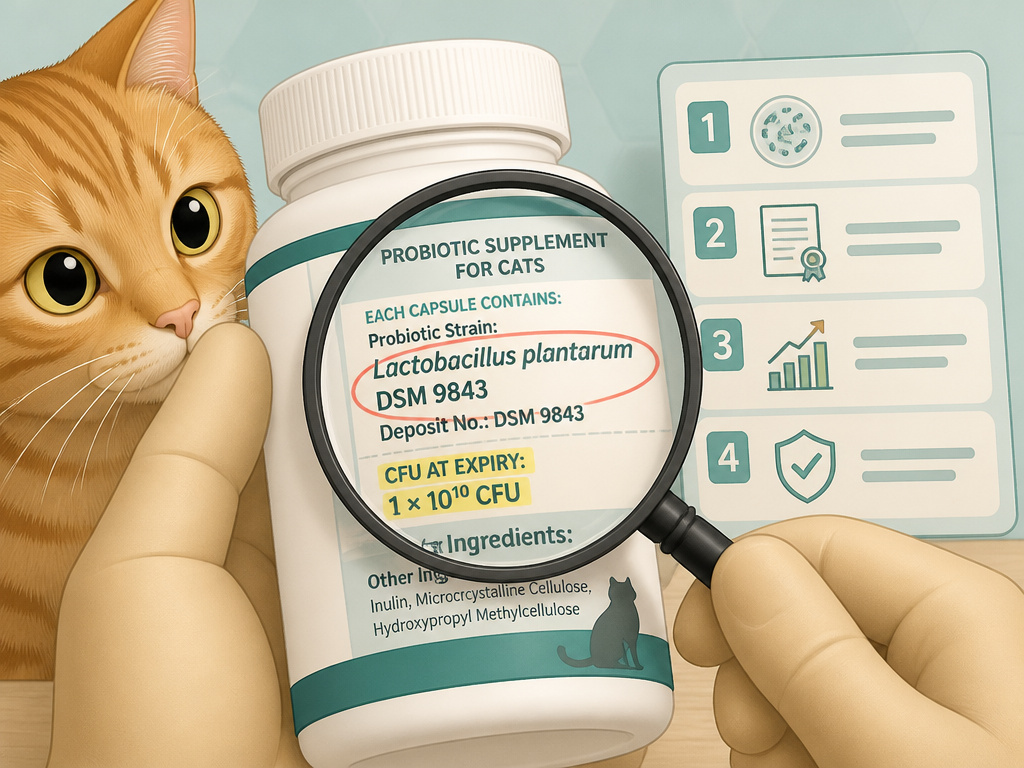
Start with the strain name, not the CFU count. “Lactobacillus acidophilus” is a species. “Lactobacillus acidophilus D2/CSL (CECT 4529)” is a strain with a deposit number, and that is what you need to match to a trial.
Here is the order I read a label in:
- Strain name and deposit number. If the label says only the species, skip it. There is no way to know what was tested.
- CFU count at expiry, not at manufacture. A product with a CFU count guaranteed at expiry is more useful than one with a count only at manufacture and no expiry guarantee.
- Whether the product has been through a feeding trial. Proviable-DC has. Most do not.
- The prebiotic side of the formula. A synbiotic pairs the live strain with a fiber source. The prebiotics side matters for whether the strain survives the stomach.
The probiotics in pet food question is separate from the supplement question. Food that has probiotics added at manufacture may not have viable CFU by the time you open the bag, and the cat food with probiotics category is full of products that do not disclose the strain.
Easy to miss: The serving size on the label is often per capsule or per scoop, not per meal. If you split the dose across two meals, you halve the CFU per feeding. That may still be fine, but it is not what the trial tested.
When to Ask Your Vet Before Buying
The 2025 review flags that data are insufficient for at-risk groups and sick cats. That is the population most owners want to help, and it is the population the trials did not study.
If your cat has kidney disease, diabetes, inflammatory bowel disease, or is on immunosuppressants, do not start a probiotic without a vet. The Edinburgh evidence-based biotics review is a useful document to bring to that conversation. The probiotics canine feline gastroenterology value review is another resource to discuss with your vet.
There is also a species question. Probiotics for dogs are not interchangeable with probiotics for cats. The strains that have been tested in dogs are not the same strains that have been tested in cats, and the doses differ.
The honest answer for most healthy cats with no symptoms is that a probiotic is unlikely to do anything. The supplement aisle is selling reassurance, and reassurance is not the same as evidence.
Frequently Asked Questions
Are probiotics safe for cats?
For healthy cats, the short-term safety profile is good. EFSA flagged L. Reuteri NBF-2 as a potential respiratory sensitiser for humans handling the powder, so wash your hands after mixing. For sick cats, ask your vet first.
Do cat probiotics actually work?
It depends on the strain and the problem. The 2025 systematic review found only 5 of 7 probiotic trials improved fecal consistency, and rated overall certainty low to very low. The strongest single result is Proviable-DC for chronic diarrhea, but that trial was open-label with no placebo.
How long should I give a probiotic before deciding it works?
The Proviable-DC trial used a 21-day course. The Proviable-DC trial used a 21-day course, after which you can evaluate. If you see no change in fecal score or vomiting frequency, stop.
Can I give my cat probiotics and prebiotics together?
Yes. A synbiotic pairs them on purpose. The prebiotic feeds the strain. The prebiotic guide covers which fiber sources pair with which strains.
Are postbiotics as good as live probiotics?
The CECT 8145 trial compared the live probiotic against a heat-killed postbiotic at the same dose. The postbiotic matched the live form on CAZy gene output but did not increase B. Animalis abundance. The two are not interchangeable.
The Bottom Line
One rule most product pages skip: if your cat has no symptoms, the probiotic is doing nothing for you. The evidence base is strongest for chronic diarrhea, and even there it is a small effect in a small trial.
The practical first step this week: read the back of the bag you are considering and check for a strain name with a deposit number. If it only lists the species, put it back on the shelf.
This all changes if your cat is sick. A cat with vomiting, weight loss, or blood in the stool needs a diagnosis before a supplement. Probiotics are a targeted tool for a specific problem.
The probiotics for cats pros and cons come down to a single question: what problem are you trying to solve? If you cannot name the problem, the supplement is not the answer.
