
Dry Cat Food Pros and Cons: What the Bag Hides
This post contains affiliate links. As an Amazon Associate, we earn from qualifying purchases.
Dry cat food pros and cons split into three trade-offs: kibble runs 3% to 11% water against 60% to 87% for wet food, it stores at room temperature for less money than canned, and most of the disease risk blamed on it tracks calories and body condition rather than the format.
The moisture gap is the whole argument in miniature. A cat eating kibble takes in 3% to 11% of its food weight as water. A cat eating canned takes in more than half. Every hydration claim on the front of a bag traces back to that one number.
What follows works through the label first, then the disease claims, then the cases where dry food is genuinely the wrong call: the moisture figures, the extrusion temperatures, the four AAFCO statements, and the one group of cats that should be eating wet.
Key Takeaways
- Moisture is the whole difference. Dry food is 3% to 11% water, semi-moist is 15% to 35%, and wet food is 60% to 87%.
- Extrusion sterilizes the kibble. About 95% of dry dog and cat food is extruded at 80°C to 200°C, and 130°C is the floor for killing spores.
- The diabetes link is contested: one study found no significant correlation (P=0.29), while another found control cats ate more dry food than diabetic cats. In a study of 96 diabetic cats and 192 matched controls, the dry-food share of the diet was not significant (P=0.29).
- Free-choice bowls are where dry food bites. A measured portion and a bottomless bowl are different diets wearing the same bag.
- Wet is the right call for oxalate stones and cystitis. That part of the conventional advice survives the evidence.
The Dry Cat Food Pros and Cons, Read Off the Label
Dry cat food is 3% to 11% water. That one figure drives the cost advantage, the shelf-life advantage, and most of the arguments people have about the format.
Dry cat food contains 3% to 11% moisture, against 60% to 87% in wet foods and 15% to 35% in semi-moist products. Dry matter therefore makes up roughly 90% of the kibble by weight, which concentrates every nutrient figure on the guaranteed analysis relative to a canned diet of the same calorie density.
The sources don’t fully agree on the exact moisture figure. A review of dry cat food moisture content puts dry food at 3% to 11%. The Merck Veterinary Manual puts it at about 90% dry matter and 10% water. Both land in the same neighborhood, and neither changes the comparison.
| Format | Water content | Dry matter |
|---|---|---|
| Dry | 3%–11% (PMC) / ~10% (Merck) | ~90% |
| Semi-moist | 15%–35% (PMC) / 25%–40% (Merck) | 60%–75% |
| Canned / wet | 60%–87% (PMC) / 68%–78% (Merck) | 22%–32% |
One survey cited in that review found dry diets are the most popular choice for cats in the UK, US and Australia. That popularity explains why the format gets defended so hard, and it says nothing about suitability.
Semi-moist products, the semi-moist cat food category that mostly shows up as treats now, sit at 15% to 35% moisture. The full spread of cat food formats is really a moisture spectrum with a marketing layer on top.
Why Extrusion Makes Dry Food One of the Safer Formats
Extrusion cooks, shapes and sterilizes kibble in a single pass. About 95% of dry dog and cat foods are made that way, according to the Merck Veterinary Manual.
The temperatures matter. Manufacturers run the extruder somewhere between 80°C and 200°C (176°F to 392°F), and 130°C (266°F) is the minimum needed to kill both microbes and bacterial spores. Merck notes those are the same ranges used for human food.
That processing record is why the PMC review describes contamination of dry food as uncommon. Microbiological contamination is far more common in raw food. Seven organizations, including the AAHA, AAFP, AVMA, CDC and the FDA’s Center for Veterinary Medicine, discourage feeding raw or undercooked animal protein. Neither freezing nor freeze-drying destroys all pathogens and spores, so raw cat food carries a load that extrusion removes.
The same extrusion lines make dry dog food, which is why recalls tend to cover both species at once.
Here’s what the cooking step does and doesn’t buy you:
- Cooks the starch so the kibble holds shape and stays crunchy at room temperature.
- Kills vegetative bacteria and spores at 130°C and above.
- Doesn’t protect the bag once it’s open. Kitchen humidity and a warm cupboard take over from there.
- Doesn’t fix a formulation error. A thiamine deficiency outbreak in cats was traced to defective dry food in Taiwan.
A cooking step that reaches 130°C kills the spores. Nothing about that changes when the kibble cools, which is why dry food’s safety record is a processing story rather than a packaging one.
A bag that’s been open a while in a humid kitchen smells like old cooking oil, and the kibble surface goes tacky under your fingers. That’s fat oxidizing, and it’s the usual reason a half-finished bag gets refused.
The Recall That Shows the Limit of Cooking
In November 2023, TFP Nutrition expanded a voluntary recall to cover every dry dog, dry cat and catfish formula made at its Nacogdoches, Texas facility, over potential Salmonella contamination.
That expansion grew out of a limited recall on 20 October 2023 covering 50-pound bags of Retriever Mini Chunk Chicken Recipe with manufacturing dates from 3277 TFP to 3278 TFP. The original lot went to Arkansas, Arizona, California, Louisiana, Mississippi, New Mexico, Nevada, Oklahoma, Texas and Utah. The TFP Nutrition voluntary recall notice lists the affected codes.
The lesson sits in the gap between the die and the bag. A sterilized kibble can still pick up Salmonella before it’s sealed, and the failure scales to a whole plant’s output.
Before you start: Dry pet food is a handled product, and Salmonella moves from kibble to hands to mouth. Wash your hands after every scoop, keep the bag sealed and off the floor, and check recall lists before you open a new bag. Children, the elderly and immunocompromised adults carry the higher risk.
Two more facts worth holding onto. It is illegal in the US to sell commercial pet food contaminated with Salmonella. And infected pets that look perfectly healthy can be carriers, passing it to other animals or to people.
Does Dry Food Cause Diabetes, Obesity, or Kidney Disease?
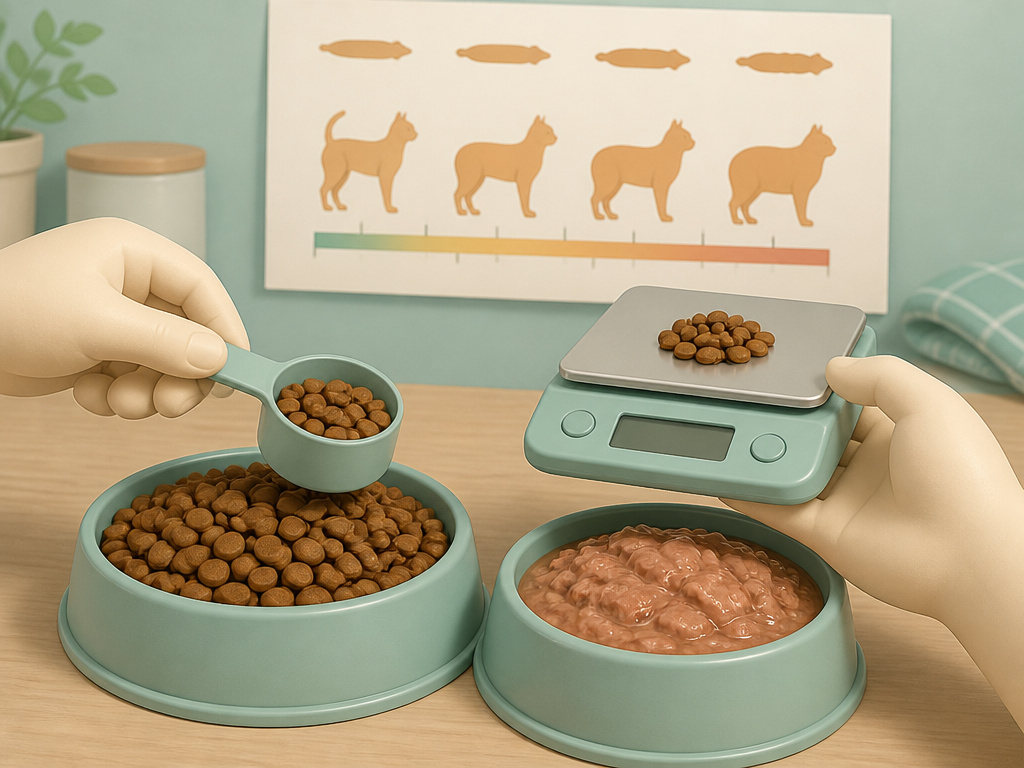
On kidney disease the studies don’t support the claim; on diabetes the findings are mixed, with one study finding no significant correlation and another pointing weakly toward lower risk on dry. On obesity, the effect is real but the mechanism is calories.
Where the diabetes studies actually point
A dry food disease risk in cats review covers the largest study: 96 cats with diabetes and 192 matched controls. The share of dry food in the diet was not significantly correlated with developing diabetes (P=0.29). Indoor confinement (P=0.002) and low physical activity (P=0.004) were.
A separate review found the opposite direction again. Control cats ate a higher proportion of dry food than diabetic cats, at a median of 79% versus 44% of dry matter intake per day. That points weakly toward lower risk on dry, not higher.
Both findings are retrospective and neither settles the question. What they do is undercut the confident version of the claim.
Carbohydrate content does affect glucose metabolism, though. A high-carbohydrate, low-protein diet (48% carbohydrate, 26% protein, 26% fat of calories) produced 20% to 32% higher peak postprandial glucose than a moderate-carbohydrate, high-protein diet (27/47/26) in healthy cats fed one meal a day.
The obesity question is a calorie question
Some studies do identify dry feeding as a potential obesity risk factor. The same review lists the competing ones: how much food is fed, high-fat high-calorie food, treats, a cat that eats greedily, and being a neutered indoor male with limited exercise.
The epidemiological studies on dry versus wet have not accounted for the number of calories being fed. That’s the confound that breaks most of them. The AAHA nutrition and weight guidelines put body condition scoring and portion control at the center for exactly this reason.
One growth-phase finding is worth flagging. Feeding more than 250 g of wet food daily between 2 and 6 months, alongside a diet over 50% dry food, was associated with obesity at 2 years of age. That result belongs to kitten feeding during growth, not to adult maintenance.
CKD and urinary disease: the claim that outran the evidence
Dry food has not been implicated as a risk factor for chronic kidney disease. One study found commercial dry cat food, along with filtered water and an indoor lifestyle, was associated with a significantly decreased risk.
At least one trade publication states flatly that the dry-diet/CKD association is not supported by the research. That position is stronger than the peer-reviewed review supports, and it’s the outlier here.
Lower urinary tract disease is genuinely mixed. Some studies flag dry diets as a risk factor for feline interstitial cystitis and urolithiasis. Others haven’t confirmed it, and one found cats that developed cystitis were more likely to be fed canned food. The review’s own conclusion is that there doesn’t seem to be a risk for LUTD across all cats from dry feeding.
| Claim | What the evidence shows | Where it comes from |
|---|---|---|
| Dry food causes diabetes | No significant link (P=0.29); controls ate more dry than diabetics | PMC2387258; PMC11104037 |
| Dry food causes obesity | Calories and portion size explain more than format | PMC11104037 |
| Dry food causes CKD | Not supported; one study found lower risk | PMC11104037; trade press |
| Dry food causes LUTD | Mixed; wet preferred once stones or cystitis exist | PMC11104037 |
The wet vs dry food for cats comparison gets much simpler once you separate the format from the calories and the body condition score.
What About Carbohydrates and the Obligate Carnivore Argument?
Cats are obligate carnivores. That’s a real biological fact, and it gets stretched into claims it can’t carry.
Start with the actual numbers. Carbohydrate in contemporary North American dry cat diets runs 4.5 to 12 g per 100 kcal. A neutered, sedentary, confined cat eats roughly 80 kcal per kg of body weight per day, so a 5 kg cat takes in about 400 kcal and somewhere between 18 and 48 g of carbohydrate.
Spread that across the day and it shrinks further. Cats in one study ate a median of 9 meals per day, which works out under 1 g of carbohydrate per kg of body weight per meal even at the top of the range.
Two studies found that dry carbohydrate-containing diets did not alter blood glucose concentrations. Starch specifically made no significant difference to postprandial glucose (3.7 ± 0.7 mmol/L, n=16) against a carbohydrate-free diet (3.2 ± 0.8 mmol/L, n=14) at 1, 3 or 6 hours after feeding. Sucrose did produce a mild persistent hyperglycemia at 4.5 ± 0.5 mmol/L (n=15), but commercial dry diets carry carbohydrate as complex starch and fiber, not simple sugar.
The review’s own wording is that concern about long-term carbohydrate feeding is speculation. A second review is blunter: dietary carbohydrates are not a cause of feline obesity, and the type and amount matter far more than the category, though other studies identify dry feeding as a potential obesity risk factor alongside calories, treats and activity.
Reduced-carbohydrate diets do have a role in managing feline diabetes. They can also backfire when they’re very high in fat, which promotes the obesity that drives the disease in the first place.
Grain-free deserves its own paragraph. A dry cat diet carbohydrate content study found carbohydrate in contemporary North American dry cat diets runs 4.5 to 12 g per 100 kcal. Lower, yes. Also overlapping, because those ranges cross.
I’ve stopped treating grain-free as a nutritional category. It tells you which starch the formulator reached for, and a pea-and-tapioca formula can land in the same carbohydrate range as a rice one. Run the numbers on the guaranteed analysis instead.
The part nobody mentions: A low-carbohydrate kibble is still kibble. The moisture figure doesn’t move, so the hydration argument that favors canned food doesn’t transfer to a dry food with a better carb number.
How Do You Read a Dry Cat Food Label Without Being Fooled?
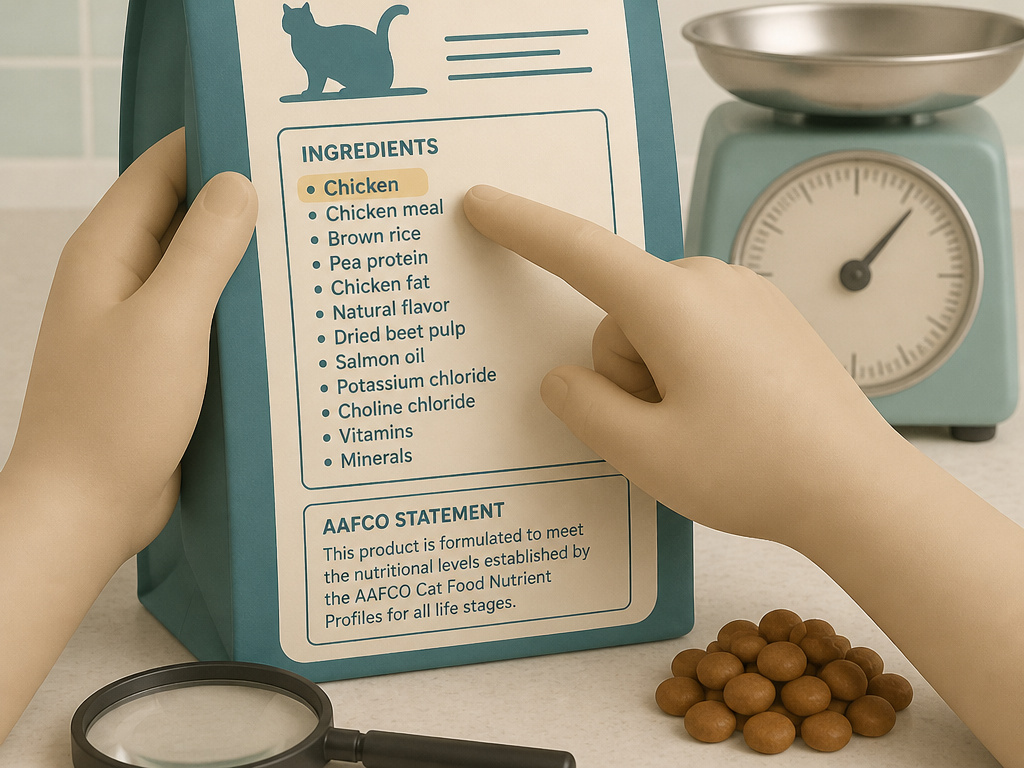
The ingredient panel is the only part of the bag with rules attached to it. Everything on the front is advertising.
Ingredients are listed in descending order by weight, on an as-fed basis. That’s the detail that trips people up. Chicken listed first at 75% moisture contributes far less to the food’s dry matter than chicken meal would.
Ingredient splitting is the other trick. Round wheat and wheat flour listed separately each appear lower on the panel than the total wheat actually is, which is exactly the point of listing them that way.
Why “chicken” first doesn’t mean chicken first
Work it through. A fresh chicken entry that is three-quarters water pushes a lot of weight onto the scale and very little protein into the bag. A named meat meal is already dry, so it ranks lower while delivering more. Front-of-bag “real chicken first” is frequently a water-weight illusion.
The four AAFCO statements that matter
AAFCO recognizes four nutritional adequacy categories: growth, maintenance, gestation/lactation, and all life stages. One of four possible adequacy statements must appear on every label. If a product doesn’t meet complete-and-balanced requirements, it has to carry the line “This product is intended for intermittent or supplemental feeding only.”
That sentence is the single most useful thing on a bag. A food carrying it isn’t a sole diet, whatever the picture on the front suggests.
Here’s the sequence I’d use:
- Find the AAFCO statement. If it says intermittent or supplemental, the food isn’t complete, and feeding it as the only diet leaves gaps that show up in coat and weight before anything dramatic happens.
- Check the calorie line. It must be stated as metabolizable energy in kcal/kg and per household measure. No per-cup figure means you can’t portion, and portioning is where most weight gain starts.
- Read the ingredient order, then discount it. As-fed weights flatter wet ingredients. Look at the first three and ask what they contribute on a dry matter basis.
- Hunt for splitting. Peas, pea protein and pea fiber listed separately is one ingredient wearing three hats. Treat it as a red flag on any label.
- Ignore quality words. The label isn’t allowed to reference ingredient quality or grade, so “premium” and “ancestral” carry no regulated meaning.
Two more label rules worth knowing. If a product uses “less” or “reduced calories,” it must name the comparison product and state the percentage of calorie reduction. And feeding guidelines on the bag are general recommendations at best. Body weight and body condition have to be monitored, because the bag has never met your cat.
Where this goes sideways: Buying on the ingredient list alone. The label can’t state ingredient quality, so two bags with near-identical panels can differ in digestibility, and the panel won’t tell you which is which.
Rub a piece of kibble between your fingers. Fresh, it crushes to a dry grit. A bag past its best smears and leaves a shine on your skin.
If the cat won’t eat it, none of this matters, which is why dry cat food for picky eaters is its own problem.
When Dry Food Is the Wrong Choice, and How to Switch
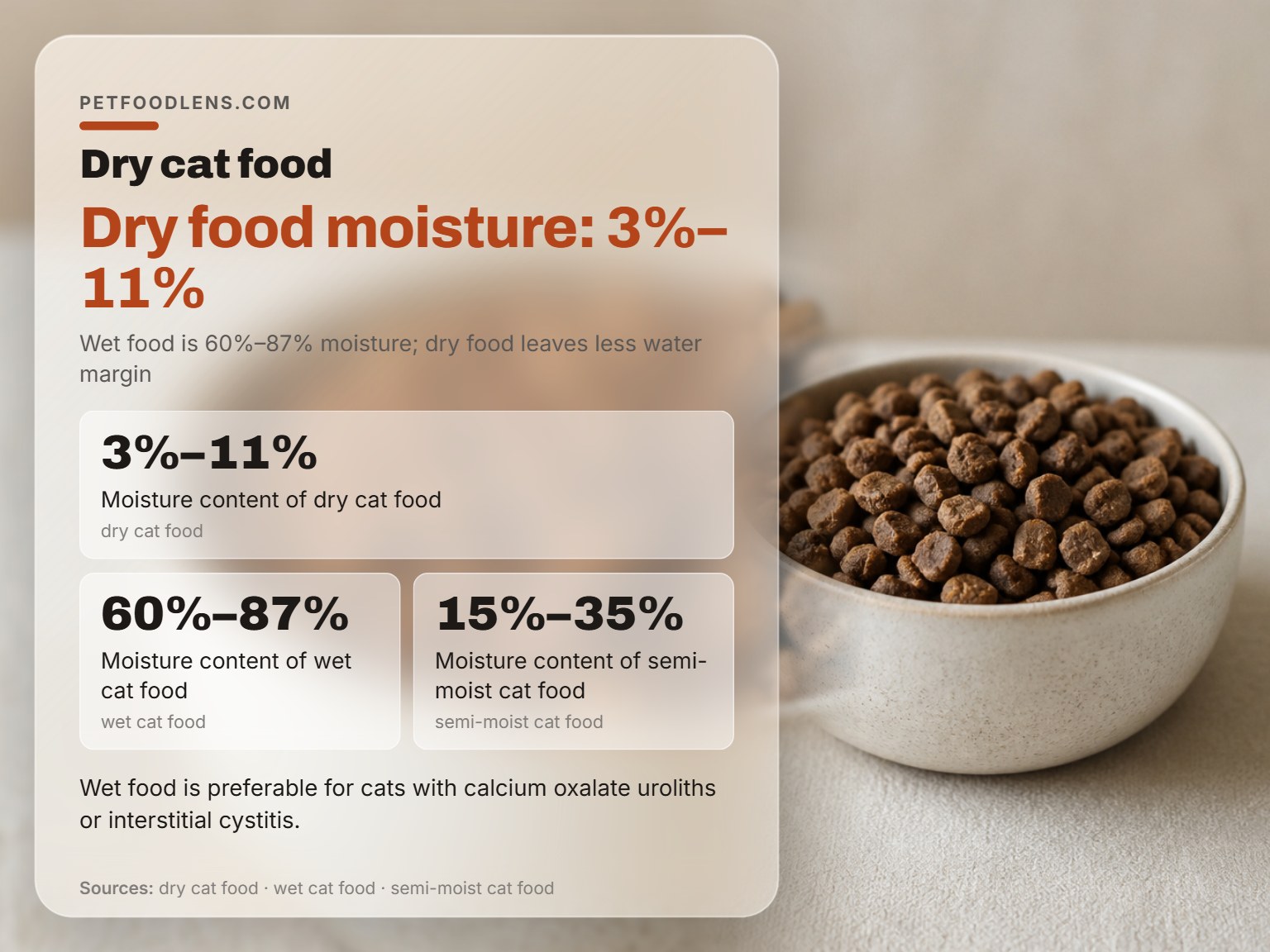
Some cats should not be eating dry food. The list is shorter than the internet suggests, but it’s real.
The wet cat food pros and cons case is strongest for cats with calcium oxalate uroliths or interstitial cystitis. That’s the clearest finding in the literature, and it turns on a specific condition where moisture and urine chemistry both matter.
The other case is free-choice feeding. Dry food can be fed free choice for cats able to self-regulate intake and hold a healthy body condition. Plenty of cats can’t, and a bottomless bowl removes the only control you had.
- Cats with oxalate stones or cystitis. Wet or a therapeutic diet, decided with a vet.
- Overweight cats on a free-choice bowl. Measure the day’s food and stop refilling on demand.
- Cats that barely drink. Cats produce more concentrated urine than dogs and have lower weight-specific water requirements, so a low-moisture diet leaves less margin.
Fountains don’t close the gap, by the way. A cat on kibble at 3% to 11% moisture is still taking in a fraction of the water a canned-fed cat gets, and a fountain doesn’t change the food. Where fountains help is with cats that genuinely like moving water. Where they fail is maintenance: filters and pump housings that don’t get cleaned regularly turn into a biofilm display.
Worth saying plainly too: simply feeding canned food is not guaranteed to increase water intake or reduce urine specific gravity. The format gives you a tool, not a result.
If you want a middle option, freeze-dried cat food rehydrates with added water in a way kibble doesn’t.
Switching without a standoff
I’ve run this transition more times than I can count, and the failures are almost always pace. One client had a picky cat in its early teens, and we both expected the switch to fail. We stretched the transition out slowly, starting with a teaspoon of wet stirred into the kibble, and the cat ate the new food without any fuss. It changed how much patience I build into every plan.
The mechanics are simple. Start with a teaspoon of wet mixed into the kibble and increase it slowly. A cat that stops eating during a transition is a vet call, not a stubbornness contest. That goes double for an overweight cat, where hepatic lipidosis is the real risk.
The urinary formula trap
Read the fronts of over-the-counter “urinary health” bags and nearly all of them say “supports” or “promotes.” None of them say “dissolves.” That one verb separates a marketing claim from a tested diet.
A bag with a pH-balanced sticker on it hasn’t been through the same exam.
A large manufacturer with formulation staff and feeding trials behind it beats an elaborate origin story every time.
Frequently Asked Questions
Is dry food bad for cats?
Not on the evidence. Dry food hasn’t been implicated in chronic kidney disease, and the diabetes studies don’t show a significant link to the dry share of the diet. The real risks are portion size, free-choice feeding and body condition, and all three apply to any format.
Do cats on dry food need extra water?
They take in less water from the food, since kibble is 3% to 11% water against 60% to 87% for wet. Whether that shows up as a measurable difference in water turnover is contested. Some studies found cats on low-moisture diets drink less; others found no difference in intake or body water content. A fountain or a second bowl is cheap insurance, not a fix.
Is grain-free dry cat food better?
It’s lower in carbohydrate on average, and that’s the whole of the claim. Carbohydrate in contemporary North American dry cat diets runs 4.5 to 12 g per 100 kcal, and the type and relative amount of carbohydrate matter more than the category. Grain-free is a marketing category, not a nutritional upgrade.
Can I feed my cat dry food only?
Yes, if the food carries a complete-and-balanced AAFCO statement and the cat holds a healthy body condition on a measured portion. Watch the cats that can’t self-regulate, and treat any history of oxalate stones or cystitis as a reason to add wet.
Is dry food good for a cat’s teeth?
Some specially formulated dry foods may provide a beneficial massage of the teeth and gums that helps decrease periodontal disease. That’s a narrow claim about specific products, and it doesn’t extend to ordinary kibble. If dental health is the goal, ask your vet which products carry evidence behind the claim.
The Bottom Line
Two numbers settle the dry cat food pros and cons: a moisture figure and a calorie figure. Only one of them is about the bag.
Here’s the trigger that should change your mind. If your cat has had a calcium oxalate stone or a cystitis episode, stop optimizing kibble. Wet or a therapeutic diet, decided with your vet, is the answer, and no fountain closes that gap.
For everyone else, the first step this week is a kitchen scale. Weigh the day’s kibble once, write the number on the bag, and feed to that instead of to the scoop. Most of the obesity and diabetes argument evaporates the moment the portion is measured.
One concession. None of this helps if the bag itself is the problem. A formulation error or a contaminated lot fails a cat regardless of how carefully you portion, which is what recall lists and lot codes are for. Checking them takes less time than reading the front of the bag.
