
How to Read a Dog Food Feeding Chart: Cups to Calories
This post contains affiliate links. As an Amazon Associate, we earn from qualifying purchases.
To read a dog food feeding chart, start with the weight band and the cups-per-day figure, then treat that number as a starting estimate. Convert the cups to calories using the kcal per cup figure, weigh the food in grams, and monitor your dog’s body condition over time.
The number you just read off the bag was written to cover an average dog inside a whole weight band; state labeling guidance asks that feeding directions provide at least the daily amount, while Nebraska Extension reads the same chart as an estimate for an average animal that can still overfeed a couch-bound dog. Knowing how to read a dog food feeding chart helps you see why that average may not match your dog. That leaves the conversion to you, plus a check against the dog standing in your kitchen.
What follows is the calorie math, the one measurement question where the sources flatly disagree, and the adjustment loop that catches a bad number before your dog’s waistline does.
Key Takeaways
- The printed chart can run high against calculated energy needs for a typical indoor, neutered dog in my own comparisons across several foods.
- Weigh the food in grams. VCA Animal Hospitals calls a gram scale the most accurate way to repeat the same amount at every meal, while university extension guidance still describes an 8-oz cup as the standard measure.
- Calorie content is not mandatory on all labels, so a bag with no kcal per cup figure leaves you working from the guaranteed analysis instead, though Nebraska Extension’s worked example assumes a kcal per cup figure is commonly available.
- Read the adequacy statement first. A food labeled for adult maintenance only is not built for puppies, pregnant females, or seniors.
- Monitor body condition over time and adjust the amount rather than trusting the chart to stay right.
What the Feeding Chart Is Actually Telling You
The NC agriculture pet food label example shows what a compliant feeding table looks like: weight bands down the left, cups per day on the right, and an instruction to split the total across two feedings.
Feeding directions on a compliant pet food label state a daily amount tied to the product’s intended use. An all-life-stages product carries separate directions for puppies, adults, and gestating or lactating dogs. The statement describes an average animal within each weight band rather than an individual dog’s requirement.
The legal floor is thinner than most owners assume. Feeding directions have to state a daily amount, and they have to match what the product is actually for, though Nebraska Extension notes label guidelines are merely estimates for the average animal that can still overfeed. An all-life-stages food carries directions for puppies, adults, and gestating or lactating dogs; a maintenance food doesn’t have to.
The table is one of seven elements on a pet food label, sitting alongside the guaranteed analysis, the ingredient list, and the adequacy statement. It’s the one owners read first and trust hardest, which is a problem given what it actually measures.
Feeding directions describe an average animal, not yours. The FDA is explicit that directions are not a guarantee of adequacy, and the AKC dog food label guide reads the same rules the same way: breed, temperament, and environment all move intake around.
Why Does the Bag Chart Run High for an Indoor Dog?
I ran bag charts against calculated energy needs across several foods, and the pattern held. For a typical indoor, neutered dog, the chart came out higher than the math.
Not every food, and not every dog. Consistently enough that I stopped treating the printed amount as a target.
The reason sits in how to read a dog food feeding chart and how the bands are built. The NC example splits adult dogs into four ranges, and the widest one covers a broad spread. A number printed for that band has to work for the dog at the top of it, which leaves the dog at the bottom eating like a bigger animal.
Put a dog at the low end of a wide band and it eats the same amount as a much heavier dog. That’s the part nobody mentions.
I don’t start an owner on the chart number. I start them below it and let body condition pull the amount back up if the dog is losing weight. Quiet gain because a bag said so is a hard thing to undo.
Cup or Scale? Where the Sources Genuinely Split
Which one do you actually reach for at 6am, when the dog is already circling the bowl and you’re half awake?
The two most useful sources on this question give opposite answers, and both have a reason.
The University of Nebraska-Lincoln Extension treats an 8-oz dry measuring cup as the standard “one cup” of kibble and suggests marking a scoop to that volume. VCA Animal Hospitals says weighing the food in grams is the most accurate way to get the same amount at every feeding.
| Question | 8-oz cup (extension guidance) | Gram scale (VCA) |
|---|---|---|
| What it measures | Volume of kibble | Weight of kibble |
| Repeatability | Shifts with how the kibble settles | Same number every fill |
| Setup cost | A scoop and a marker | A digital scale and a bowl |
| Best for | Reproducing the chart as printed | Reproducing your own number |
Neither method is wrong. The cup is what the chart is written in, so it’s the only way to reproduce the printed figure exactly. The scale is the only way to reproduce your own figure exactly, which is what you want once you’ve decided the chart ran high.
Whichever you pick, the failure mode is the same: a scoop topped off by eye. Small errors in measuring portions compound across a week of meals.
Cooperative extension offices keep Extension pet food feeding guidelines online alongside the university publications, and the volume-versus-weight question is where the two traditions part company.
The Three Numbers You Need Off the Label
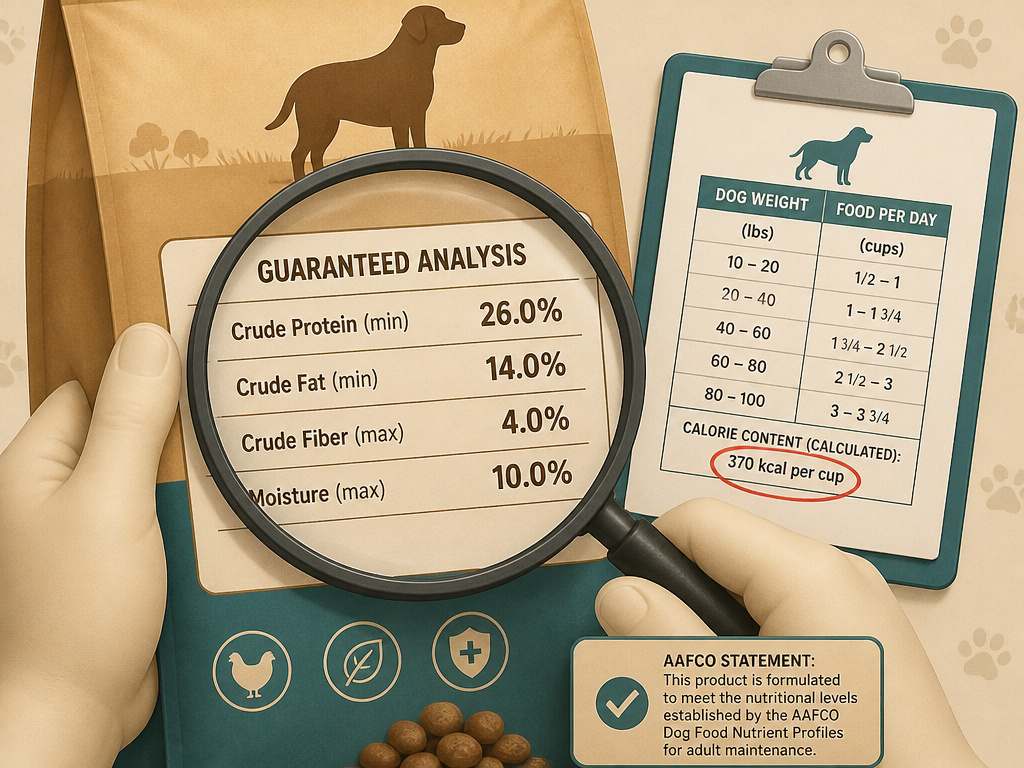
Three figures on that bag decide whether the chart means anything at all.
The Guaranteed Analysis Gives You Percentages, Not Calories
Crude protein, crude fat, crude fiber, and moisture are the four figures every label has to display. The NC worked example lists protein at 12 percent minimum, fat at 13 percent minimum, fiber at 5 percent maximum, and moisture at 20 percent maximum.
Read the min and max labels carefully. Those are guarantees, not measurements, and they say nothing directly about energy density. Two foods can both carry a 13 percent fat minimum and deliver very different calories per cup.
The guaranteed analysis panel is where those four numbers live, and it’s the panel most owners skip on the way to the feeding table.
The Calorie Statement Is Voluntary
The FDA states that calorie content is not mandatory on all pet food labels, while Nebraska Extension’s worked example depends on a kcal per cup figure, which assumes you can find one.
Availability is brand-dependent. Some packages print it, some put it on a manufacturer site, and some leave you with nothing to divide by.
The Adequacy Statement Decides Whether the Chart Applies At All
The NC example label reads “formulated to meet the AAFCO Dog Food Nutrient Profiles for Adult Maintenance,” which makes it unsuitable for puppies.
VCA notes that foods labeled for adult dogs may not be balanced for puppies, pregnant females, or senior pets. Nebraska Extension’s advice is to check the adequacy statement against your dog’s life stage before anything else on the package.
I check that statement before I read anything else on a label. I learned it the slow way, after comparing two foods where one turned out to be labeled for intermittent feeding only.
How to Convert the Chart Into Calories
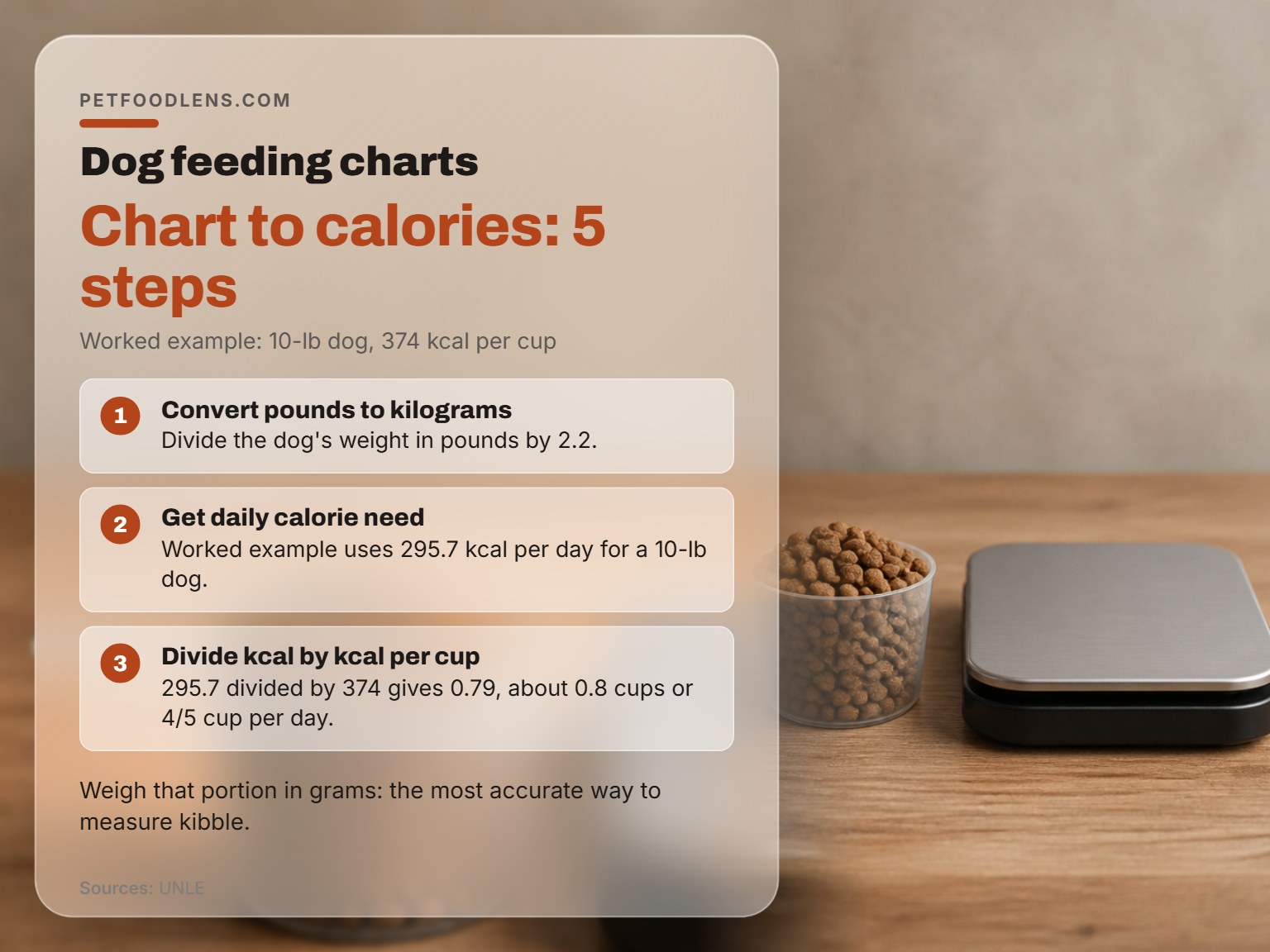
Five steps and one scale.
Before you start: Check the sell-by or best-used-by date before you trust any number on the bag. Expired kibble loses nutritional value and can grow harmful bacteria or mold that can sicken a dog. If you store food in a bin, empty and wash it between bags. Old oxidized fat leaves a tacky film on the plastic, and every fresh batch meets that residue on day one.
- Find the kcal per cup figure. It sits near the feeding table or on the manufacturer’s site. Skip this and the rest of the math is guesswork dressed up as precision.
- Convert your dog’s weight to kilograms. Divide pounds by 2.2. Get this wrong and every downstream number carries the same error.
- Get the daily calorie requirement. Nebraska Extension’s worked example uses 295.7 kcal per day for a 10-pound dog. Borrow a figure from your vet or an extension publication rather than guessing here.
- Divide calories by kcal per cup. 295.7 divided by 374 gives 0.79, so about 0.8 cups or 4/5 cup per day. Stop at this step and you’ve done the whole calculation on paper and none of it in the bowl.
- Weigh that portion in grams.
Notice what just happened. The chart gave you a number for a 10-pound dog, and the math gave you a number for a 10-pound dog. The NC example puts a 10-pound dog at 1 cup per day. Nebraska Extension’s worked example, on a food with 374 kcal per cup, lands at about 0.8 cups.
Different foods, so treat that as illustrative rather than exact. The direction is the one I keep seeing.
Most owners want a how much to feed number they can act on today, and the chart is the fastest route to one. The kcal per cup figure is what turns that route into an answer. The Pet Foods: How to Read Labels publication from Nebraska Extension works the whole thing through with a real example if you want to see the arithmetic laid out.
Where the Chart Breaks: Overlapping Bands, Life Stages, and Treats
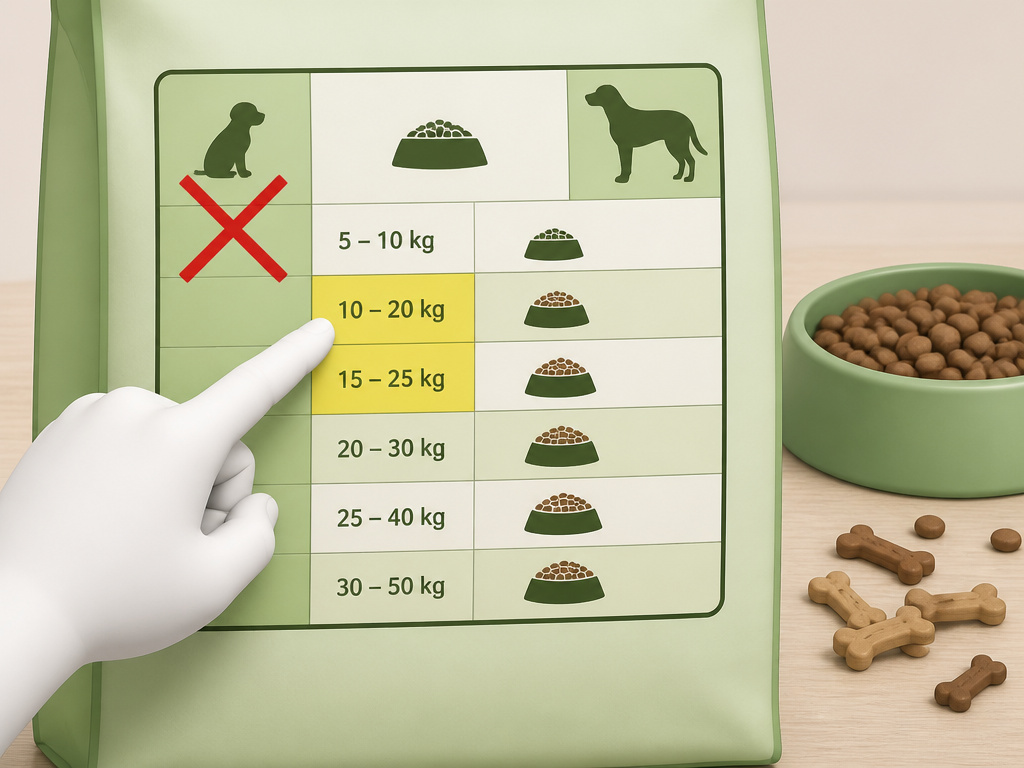
A chart that puts your dog in two rows at once has already told you what it’s worth.
The Overlapping Band Problem
Some brand charts use overlapping weight ranges, so one dog can land in two rows. Pick the row that matches the dog’s body condition rather than the row that gives you the smaller scoop.
Life Stage and the Adequacy Statement
The NC example is Adult Maintenance only. Feed that chart to a growing puppy and you’re using directions written for a different animal. AAFCO’s framework provides two separate sets of nutrient requirements, one for the adult animal and one for growth, gestation, and lactation.
What the Chart Doesn’t Cover
Treats, table food, and snacks sit outside the feeding table entirely, and VCA’s advice is to give your vet an honest account of all of it. The chart only counts the kibble.
- Treats and toppers. A handful here and there never appears on the bag, and it lands in the same daily total.
- Activity and environment. The AKC notes that breed, temperament, and environment all influence intake, which is why a working dog and a sofa dog of the same weight aren’t the same animal.
- Body condition. Nebraska Extension goes further than most: a low-activity or overweight dog may need less than the label minimum.
- Life stage. A maintenance chart and a growth chart are not interchangeable.
Where this goes sideways: Topping the bowl up because the dog cleaned it. Appetite is not a portion gauge, and a dog that finishes every meal will keep finishing every meal while the weight creeps on.
The Two-Week Adjustment Loop
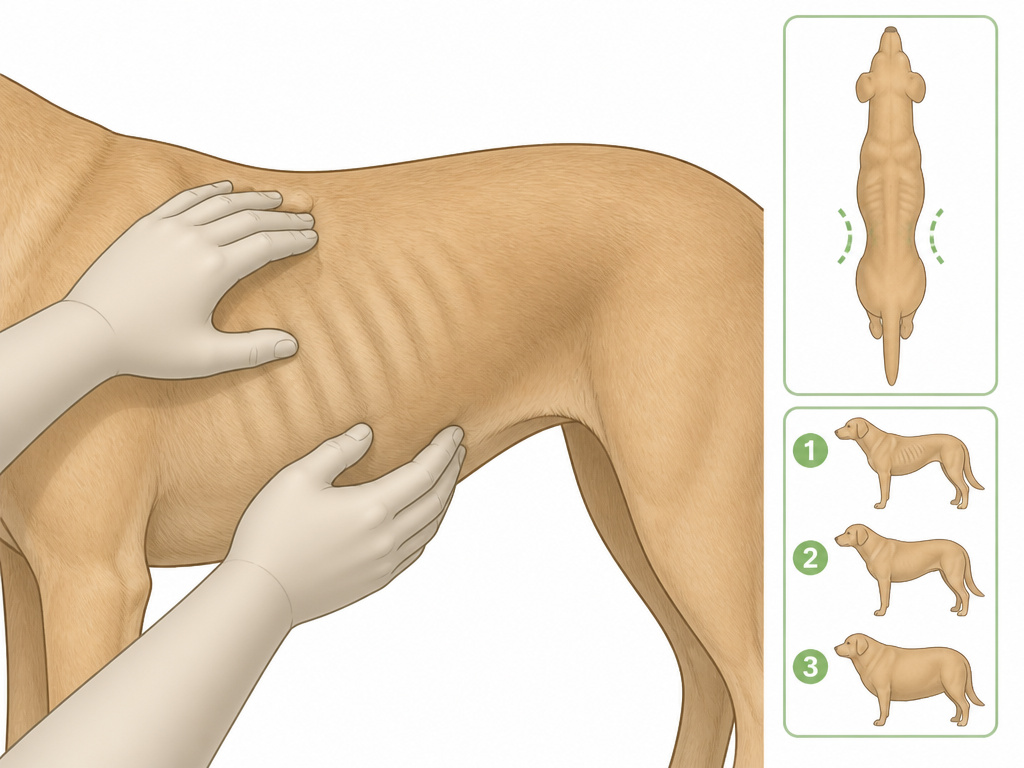
Body condition scoring is the feedback loop that catches a bad number before the vet does.
Run your hands along the ribs. The ideal dog has a clear waistline from above, an abdomen tucked up at the back, and ribs you can feel easily under a thin layer. If you’re pressing to find them, the portion is running high.
Recheck body condition regularly. Weight moves slowly enough that a daily look tells you nothing, and fast enough that a stretch of the wrong amount shows up as a different dog.
| What you see and feel | What it usually means | What to change |
|---|---|---|
| Ribs easy to feel, visible waist | Portion is about right | Hold the amount, recheck in two weeks |
| Ribs hard to find under a layer | Running over | Reduce the daily amount and recheck |
| Waist gone, back looks flat | Over by more than a little | Reduce and book a vet check |
| Ribs and spine sharp, no waist fat | Running under | Increase gradually and recheck |
Purina’s body condition scoring system is published on purina.com and printed on many of their bags, and it’s a reasonable chart to hold your hands against.
If the ribs have gone missing, start with weight loss portions that come down gradually rather than all at once.
A single weigh-in tells you little. A dog’s weight swings on water and gut contents day to day, so one reading is noise. Repeated weigh-ins on the same scale over time show a trend.
Two things not to do. Don’t apply a maintenance chart to a puppy, a pregnant bitch, or a nursing one, because the NC example is explicit that an Adult Maintenance statement makes the food unsuitable for puppies and the same logic governs the chart. Don’t keep feeding the chart amount once the ribs have gone, because a small daily overshoot can eventually read as a flat back in the mirror and a different number on the scale.
If you want a starting point and you’re buying fresh food, I’d run this math on a mainstream bag before I’d run it on a boutique label with a wolf on the front. That’s my bias and I’ll own it.
Frequently Asked Questions
Does the feeding chart on the bag tell me how much to feed my dog?
It tells you a daily amount for an average dog in your dog’s weight band. The FDA states feeding directions are not a guarantee of adequacy, and both the AKC and Nebraska Extension describe them as estimates rather than prescriptions. Treat the number as a starting point you adjust from.
Should I measure dog food in cups or grams?
Both are defensible. University extension guidance uses an 8-oz dry measuring cup as the standard measure, which lets you reproduce the chart exactly. VCA Animal Hospitals recommends weighing in grams as the most accurate way to repeat the same amount at every feeding. Pick one and stay consistent with it.
Why doesn’t my dog’s food have a calorie statement?
Because it isn’t mandatory on all labels. The FDA confirms calorie content is not required on all labels, so availability depends on the brand, though Nebraska Extension’s worked example assumes a kcal per cup figure is commonly available. Without a kcal per cup figure you can’t convert the chart into calories, and you’re left adjusting by body condition alone.
Can I use the adult chart for a puppy?
No. A food carrying an Adult Maintenance adequacy statement is not suitable for puppies, and AAFCO’s requirements are split into one set for adults and one for growth, gestation, and lactation. Use directions written for the life stage on the label.
What if my dog sits between two weight bands?
Some brand charts use overlapping ranges, so this happens more than owners expect. Choose the row that matches the dog’s body condition rather than defaulting to the higher one, then let the two-week recheck settle it.
How often should I change the amount I feed?
Regular rechecks are a workable rhythm. Nebraska Extension’s guidance is to monitor weight over time and adjust both how much and what the dog eats, using body condition as the signal rather than appetite.
The Bottom Line
Here’s the trigger. If the chart amount and your calculated number differ by more than a rounding error, trust the math and let body condition referee the rest.
This week, weigh one meal in grams on a kitchen scale and write the number on the lid of the food bin. That single habit does more than any chart.
None of this replaces a vet for a dog with a medical condition. I work from labels and published formulations, which means I can’t see manufacturing quality, ingredient sourcing, or batch consistency. A good-looking panel can still hide a problem I have no way to detect.
And I’d rather see an owner weighing kibble on a cheap kitchen scale than following any chart perfectly. The scale is the habit that survives.
