
How Much Dog Food to Feed by Weight: Weigh, Don’t Scoop
This post contains affiliate links. As an Amazon Associate, we earn from qualifying purchases.
How much dog food to feed by weight starts with calories. On a 382 kcal/cup food, a 21-35 lb dog gets 1 2/3 to 2 1/3 cups a day and a 51-75 lb dog gets 3 to 3 3/4 cups; a denser food means fewer cups for the same dog.
Calorie density is what moves those cup counts. A cup is a volume measure, so a light, airy kibble packs fewer calories into the same scoop than a dense, fatty formula does, and the how much dog food to feed by weight chart on the bag shifts with it. The weight bands stay put. The cups under them do not.
What follows: two published charts that disagree for the same dog, the resting-energy math that settles the argument, and a body-condition check that tells you whether the number was right.
Key Takeaways
- Calories set the portion; cups only express it. Two foods with different calorie density give the same dog different cup counts for the same body weight.
- The bag chart is a starting estimate, not a prescription. PetMD treats it as a first guess adjusted against body condition, while AAHA advises owners to calculate RER/MER rather than rely solely on package guidelines.
- Weigh the kibble on a kitchen scale. A dipped cup versus a poured cup of the same kibble are not the same weight.
- A neutered dog often needs about 10% below calculated maintenance energy as a starting point, per AAHA, and some need 10% to 20% below.
- Count the treats. A handful of snacks can equal 50% of a small dog’s daily energy requirement.
Two Published Charts, Two Different Answers for the Same Dog
A 30 lb dog sits in the 21-35 lb band on both the Purina Pro Plan chart and the Purina One chart. The two charts disagree by roughly half a cup a day.
A dog food feeding chart converts body weight into a volume of kibble using an energy equation. The equation estimates resting energy expenditure from body weight raised to the power of 0.75, then multiplies by an activity factor. That product is divided by the food’s calorie density to give cups per day.
The PetMD version is built on Purina Pro Plan Adult Shredded Blend Beef & Rice at 382 kcal per cup. The Purina One shelter sheet is built on its own formula. Line them up and the spread shows.
| Weight band | Purina Pro Plan chart (382 kcal/cup) | Purina One chart |
|---|---|---|
| 21-35 lb | 1 2/3 to 2 1/3 cups | 1 3/4 to 2 1/2 cups |
| 36-50 lb | 2 1/3 to 3 cups | 2 1/2 to 3 1/4 cups |
| 51-75 lb | 3 to 3 3/4 cups | 3 1/4 to 4 1/4 cups |
| 76-100 lb | 3 3/4 to 4 2/3 cups | 4 1/4 to 5 cups |
| Over 100 lb | 4 2/3 cups + 1/4 cup per 10 lb | 5 cups + 1/3 cup per 10 lb |
The over-100-lb line is the clearest tell. PetMD adds 1/4 cup for every 10 lb over 100. Purina One adds 1/3 cup. Same manufacturer family, two different numbers, both printed in good faith.
Reading a dog food feeding chart gets easier once you accept that the weight bands are calorie bands wearing a weight label. Change the food and the cups move. Change nothing and they still move, because the two charts were never meant to agree.
What the Bag Chart Is Built From, and Why One in Five Cannot Be Checked
Sutherland and colleagues pulled 200 dry dog foods sold in Canada and reverse-engineered 584 label feeding equations. Nearly one in five would not resolve.
The published figures: 19.9% (116 of 584) of label equations were undeterminable, meaning they could not be traced back to any NRC equation. At low body weights it was worse, at 22.3% (65 of 292). The most common single equation covered 24.7% of the sample. The second most common covered 22.8%.
That is a peer-reviewed audit of commercial dog food feeding equations, not an opinion column. The same study found that not every product in the sample calculated energy density with the Modified Atwater equation required for an AAFCO compliance claim.
AAHA’s position lines up with that finding. The 2021 AAHA nutrition guidelines state plainly that AAFCO does not standardize how feeding guidelines are derived, so owners should run the resting-energy and maintenance-energy math themselves rather than lean on the package.
Where this goes sideways: Trusting the over-100-lb line on a bag. Percent error grows with body weight in that audit, which makes the largest dogs the least well served by the chart written for them.
Why Large-Dog Charts Are the Least Reliable
The error is not evenly spread. Sutherland’s team noted that percent errors in label guidelines were larger at higher body weights, possibly from alternate exponents in the underlying equations. A 15 lb terrier’s chart is roughly right. A 90 lb retriever’s chart is a looser guess.
Owners end up reading the number as a target when it is closer to a ceiling with slack in it. That is the label guidelines problem in one line: the format looks precise and the derivation is not.
The Resting-Energy Math That Replaces the Guess
The how much dog food to feed by weight calculation starts with resting energy requirement, or RER, which is the energy a dog burns doing nothing at all. Everything else is a multiplier stacked on top.
Before you start: Underweight dogs should not get one large meal to catch up, because Purina’s own shelter guidance warns that too much food at once or an abrupt diet change causes digestive upset. Free-choice bowls raise obesity risk. And a dog on a therapeutic diet needs a vet’s number, not a chart.
- Convert pounds to kilograms. Divide body weight in pounds by 2.2. A 30 lb dog is 13.6 kg.
- Apply the multiplier. A typical pet dog uses 95 x (body weight in kg)^0.75. An active adult uses 130 x (body weight in kg)^0.75. That gap alone swings the target by roughly a third.
- Adjust for neuter status. AAHA puts 10% below calculated maintenance energy as the starting point for a neutered dog, and 10% to 20% below for some breeds and individuals.
- Divide by calorie density. Take the daily calorie figure and divide it by the kcal per cup printed on the bag.
The AAHA feeding normal dogs guide sets the outer bounds. Maintenance energy ranges from 90% of RER for a sedentary dog up to almost 200% of RER for an endurance athlete in extreme conditions. Most pet dogs sit near the bottom, since AAHA reports roughly 70% are minimally active.
A worked example makes it concrete. A 10 lb dog at 95 x (4.5 kg)^0.75 gives a resting-energy figure you then divide by the food’s calorie density. Divide that calorie figure by the kcal per cup printed on the bag to get the daily cups, which is often less than a full scoop would deliver.
The underlying nutrient reference here is the National Research Council dog nutrition report, which is where those energy equations originate. If you want the shorter route, this walkthrough on how to calculate calorie needs skips straight to the number.
Then convert back to volume using the bag’s kcal per cup. If the bag does not print it, the math stops there.
Weigh the Kibble, Don’t Scoop It
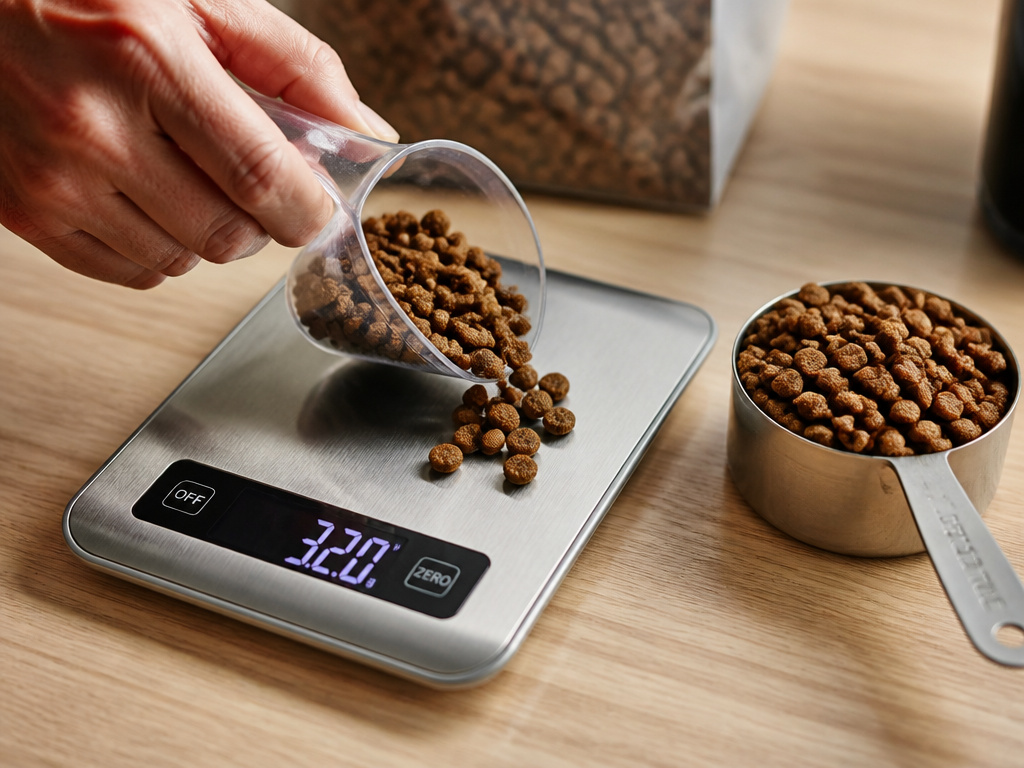
A client asked whether she could just leave the bowl down and let the dog self-regulate. Later the dog had gained weight and she had not changed the food once.
That pattern repeats. Unmeasured bowls drift upward, because a dog eating to appetite takes more than a dog eating to a target. I recommend weighed portions even though it takes more effort.
The volume problem is real. An 8-oz measuring cup is the standard “cup” of kibble, and most scoops in a kibble bag are not marked to it. Three things swing the weight of that cup:
- How it is filled. A dipped cup that gets a shake weighs more than a cup poured and leveled with a knife.
- Kibble size and shape. Large, irregular pieces leave air gaps that small round kibble does not.
- Settling. Kibble that has ridden around in a car sits denser than kibble straight from a fresh bag.
A cheap digital scale removes all three variables at once. An Escali Primo reads to a gram and costs less than a bag of food.
Weighing also makes comparison possible. When you know the food delivers 382 kcal per cup and you are feeding 120 grams, you can check the calorie total against the math instead of guessing. The full method is covered in using a kitchen scale, and the volume-versus-weight tradeoff is covered under measuring dog food portions.
How Much Should You Feed a Puppy by Weight?
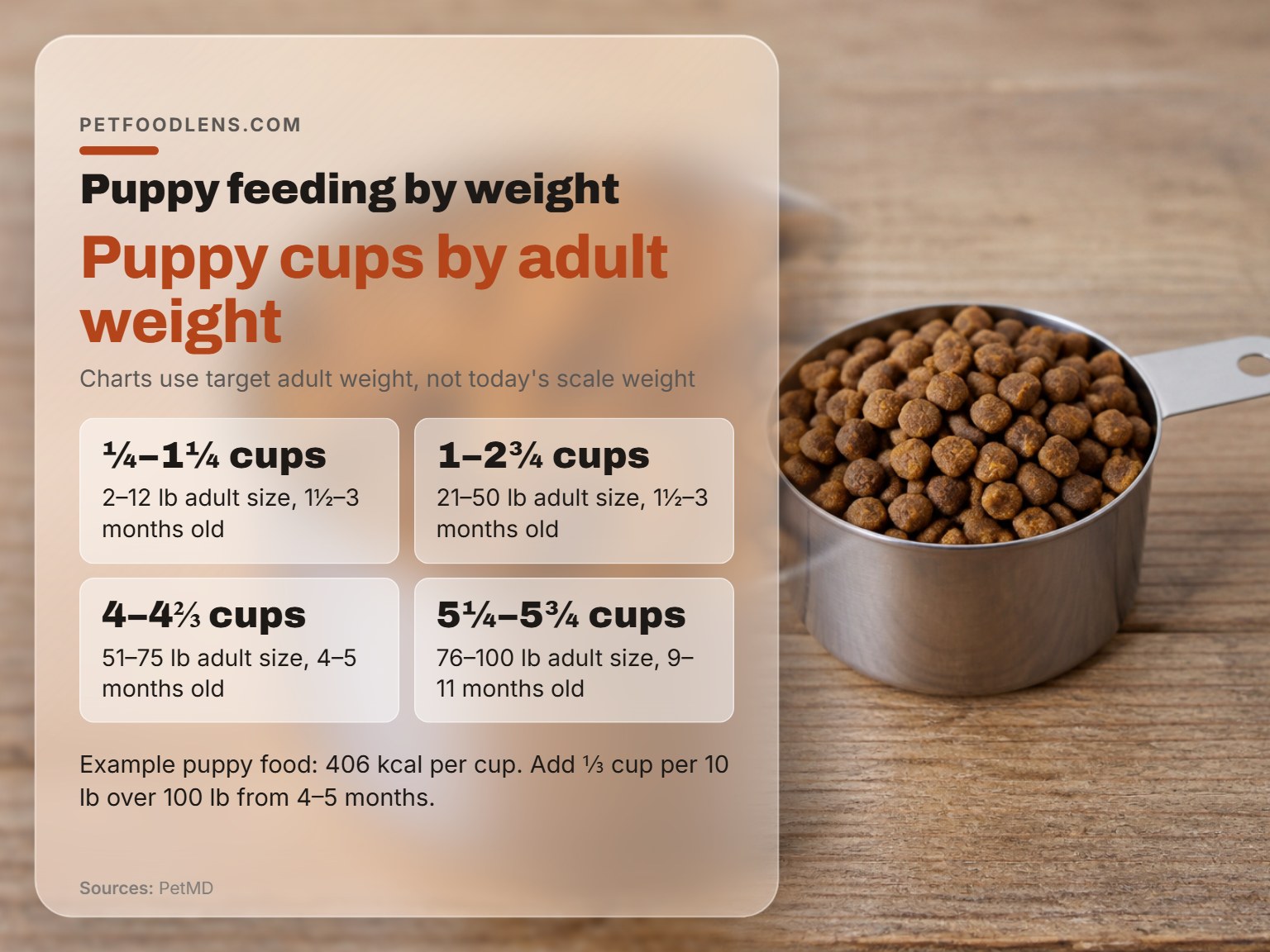
Puppy charts use the weight the dog will reach as an adult, not the weight on the scale today. That single detail trips up more new owners than any other part of the chart.
The PetMD puppy example is Purina Pro Plan Puppy Shredded Blend Chicken & Rice at 406 kcal per cup. Because the bands are keyed to mature weight, you look up the adult size first, then the current age.
Puppies 1.5 to 3 Months
A puppy headed for 2-12 lb gets 1/4 to 1 1/4 cups a day. One headed for 21-50 lb gets 1 to 2 3/4 cups a day. The range is wide because growth rate varies enormously at this stage.
Puppies 4 Months and Older
A puppy headed for 51-75 lb gets 4 to 4 2/3 cups a day at 4-5 months. One headed for 76-100 lb gets 5 1/4 to 5 3/4 cups a day at 9-11 months. For litters or giant breeds heading past 101 lb, add 1/3 cup for each 10 lb over 100, starting from the 4-5 month column.
I would rather see an owner weigh a puppy’s food regularly than trust a scoop. Growth rate changes fast enough that a fixed cup goes stale in a fortnight.
Puppies under a year also need more frequent feedings than adults, and the recommended amounts change quickly as they grow. The weight bands by adult size are laid out in this portion guide by breed size if you want the full table.
Treats, Wet Food, and the Calories Nobody Counts
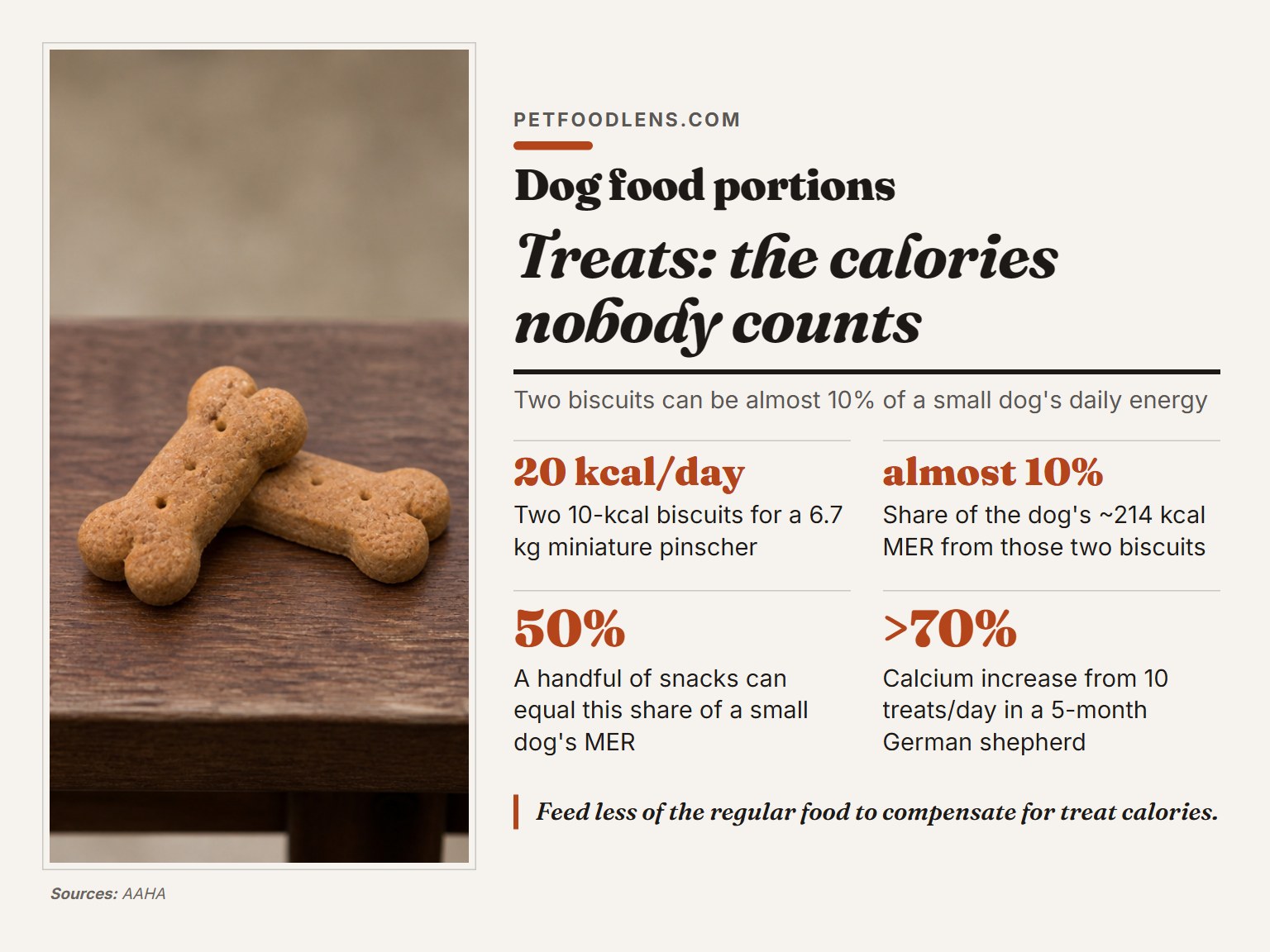
Two biscuits a day. That is the entire treat budget for a 6.7 kg miniature pinscher, and it works out to almost 10% of its roughly 214 kcal daily requirement.
AAHA’s numbers on this are blunt. A handful of dog snacks can equal 50% of a small dog’s daily energy requirement, or 10% of a large breed’s. The owner has to feed less of the regular food to compensate, and almost nobody does.
Where Treat Calories Actually Land
The calcium side is worse than the calorie side for growing dogs. AAHA gives the example of a five-month German shepherd puppy getting 10 training treats a day at 62 mg of calcium each. That pushed daily calcium intake more than 70% above what a large-breed puppy food already supplied.
I count treats first now, before I touch the kibble number. It is easier to subtract the treat calories from a total than to explain to an owner why the bowl went down.
Cut the kibble ration by the treat calories, not by your patience for the dog’s feelings about biscuits.
If the total is already too high and the dog needs to lose weight, the reduction plan matters more than the starting number. This guide to portions for weight loss covers the rate, and the slower version of the same math applies to underweight dogs gaining back.
The Two-Week Check That Tells You If the Number Was Right
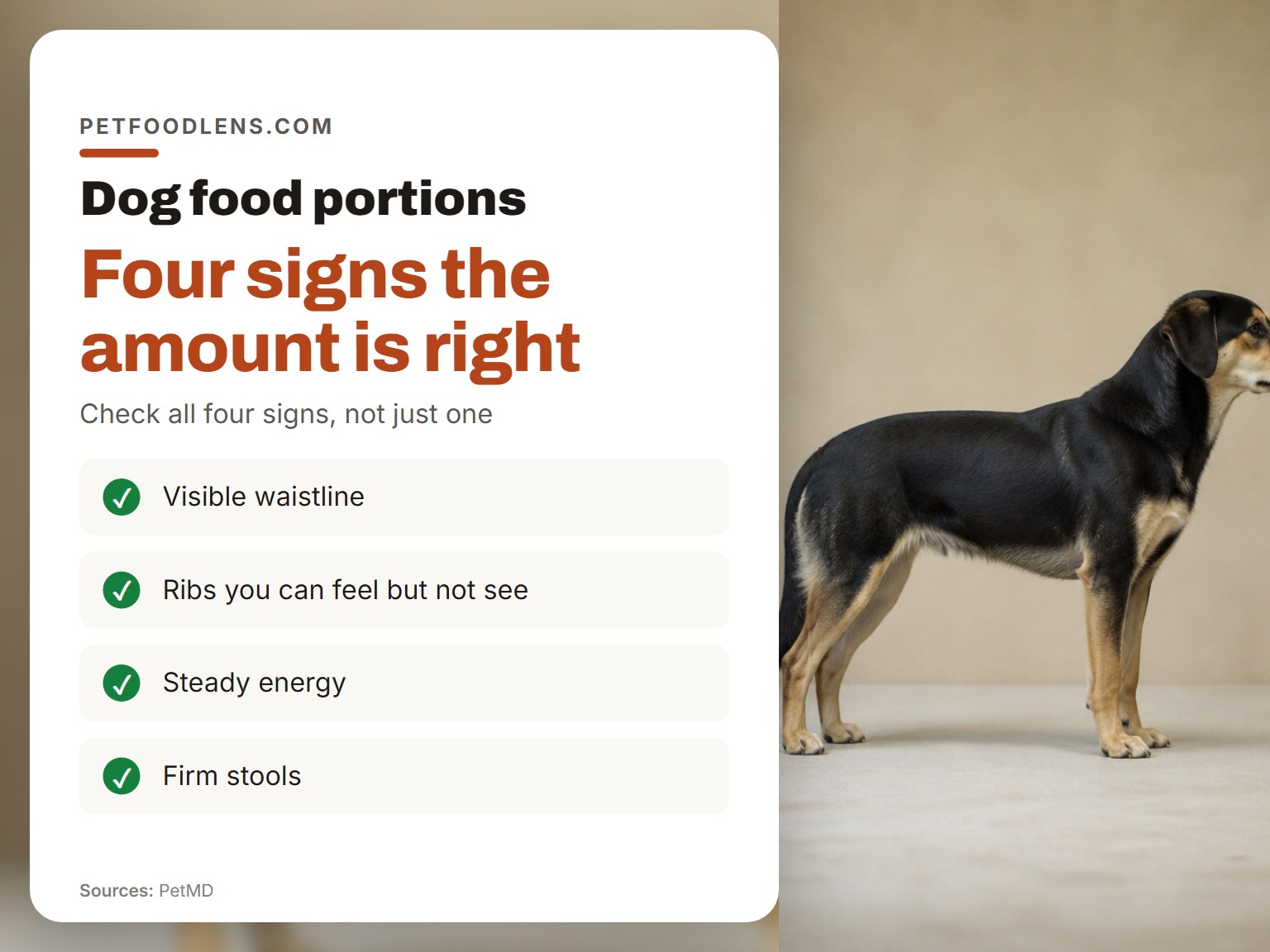
Your hands are a better judge than the scale. Body condition tells you whether the calorie target landed, and it shows up before the number on the scale moves much.
PetMD lists four signs of adequate feeding: a visible waistline, ribs you can feel but not see, steady energy, and firm stools. Check all four, not one.
| What you see and feel | What it means | What to change |
|---|---|---|
| Ribs easy to see, hip bones sharp | Too thin | Increase slowly, never one large meal |
| Ribs felt but not seen, waist visible | On target | Hold the current amount |
| Waist gone, ribs under a soft layer | Overweight | Cut 10% and recheck later |
| No waist, ribs hard to find | Obese | Vet visit before any cut |
My own interval is a few weeks between adjustments. Shorter than that and you are reading noise. Longer and a small drift has time to become a habit.
Easy to miss: A dog that looks fine standing can look heavy sitting. Judge the waistline from above and from the side, with the dog standing square on all four feet.
AAHA’s guidance is to start conservative and titrate upward or downward against body weight, which is the opposite of what most owners do. They start at the top of the bag range and stay there.
Frequently Asked Questions
Does the feeding chart on the bag work for every dog?
It works as a starting estimate for PetMD, but AAHA notes that AAFCO does not standardize how those guidelines are derived and advises owners to calculate RER/MER rather than rely solely on package guidelines; the 2021 audit found roughly one in five label equations could not be reverse-engineered at all.
Should I feed once a day or twice?
Twice is the better default for most adult dogs, and PetMD says so directly. AAHA surveys found owners split between one and two meals a day, but meal-restricted feeding gives more precise control over the dose than a free-choice bowl. Puppies under a year need more frequent feedings than adults.
How do I know if I’m feeding enough?
Check for a visible waistline, ribs you can feel but not see, steady energy, and firm stools. Those four signs together are a better signal than the scale alone, because a dog can hold weight while losing condition or the reverse.
Do I need to change the portion as my dog ages?
Yes. Puppy amounts are keyed to mature weight and change quickly with age, and adult maintenance energy shifts with activity and neuter status. A neutered adult often needs 10% below calculated maintenance energy as a starting point, and some need 10% to 20% below.
What if the bag does not list calories per cup?
Then you cannot convert calories to cups, and you are working from the weight chart alone. Calorie density is not required on the label, so some products leave it off. Ask the manufacturer for the kcal per cup figure, or switch to a food that publishes it.
The Bottom Line
If your dog’s ribs are getting hard to find under your fingers, stop adjusting the chart and cut the ration by 10%. That is the trigger. AAHA puts 10% below calculated maintenance energy as a reasonable starting point for a neutered dog, and it is a smaller move than most owners expect to make.
Fair warning: this whole method assumes a dog with normal thyroid function and no other disease. If your dog is eating the calculated amount and still gaining, or losing on a full ration, the math is not the problem and a vet needs to see the dog.
The chart on the bag is a first draft written by someone who has never met your dog. Treat it that way.
