
How to Measure Dog Food Portions: Weigh, Don’t Scoop
This post contains affiliate links. As an Amazon Associate, we earn from qualifying purchases.
To measure dog food portions, weigh the kibble in grams on a kitchen scale instead of filling a cup. In a 100-owner trial, cup and scoop measurements overestimated the correct amount by up to 1.5 times, and the smallest volumes carried the biggest error.
Volume is the weak link in how to measure dog food portions. Kibble bridges and settles inside a cup, so the same scoop holds a different mass depending on how hard you shake it and how full the bag is. That gap is where the extra calories hide, and it compounds every single day.
What follows covers what the published research actually found, which device survived testing, how to weigh a day’s ration in one pass, and how to fold treats and other people in the house into the same number.
Key Takeaways
- Weigh in grams, not cups. In a study of 100 dog owners, cup and scoop measurements ran up to 1.5 times the correct gram amount.
- Small portions carry the biggest error. Inaccuracy peaked at 1/4 cup, which puts small breeds at the highest risk of quiet, steady overfeeding.
- A gram scale is the gold standard. That’s the conclusion of the Royal Canin Canada research summary, and two peer-reviewed papers point the same way.
- Treats come out of the ration. Royal Canin caps them at 10% of daily rations, and roughly half of surveyed owners don’t subtract them.
- The bag’s chart is a starting point. Peer-reviewed work describes commercial feeding guidelines as conservative estimates of energy needs.
Why a Cup Can Overshoot by 80% or More
Published error figures for cup measuring run from 80% to 152%, and the gap between them is a methods problem rather than a disagreement about direction.
Every study behind those numbers points the same way. Volume is a poor stand-in for weight when the thing you’re measuring is irregular pellets.
Dry kibble is sold by weight and measured by volume. A one-cup dry-food cup, a two-cup graduated-liquid cup, and a two-cup plastic scoop were tested against an electronic scale across three volumes, and measured volume diverged from correct weight at every volume and with every device. Accuracy tracked both the volume measured and the device used.
The cleanest trial is the 2019 one on owner accuracy using measuring devices. Researchers recruited 100 dog owners in Southwestern Ontario during the summer of 2016, at pet specialty retailers and at the University of Guelph. Everyone was 18 or older, owned a dog, and fed dry food. Owners who fed only canned food were excluded.
Each owner measured assigned volumes with an assigned device, and an electronic scale checked the result. Accuracy was tied to both the volume measured and the device used, and both associations were statistically significant.
| Source | Method | Reported error |
|---|---|---|
| Prior cup research, cited in the 2019 trial | Repeated measures of one volume | Up to 80% overestimation |
| Royal Canin Canada study summary | 100 owners, three devices, three volumes | Up to 1.5 times correct grams |
| Canadian feeding-practices paper | Cites a recent owner study | Up to 152% overestimation |
Those figures don’t reconcile into one number, and I won’t pretend they do. Different studies, different protocols.
The 1.5 times figure is Royal Canin Canada’s summary of the 100-owner trial. Set beside the 152% figure, the two don’t line up neatly. Treat the range as the finding and the exact percentage as unsettled.
One limitation matters for your kitchen. The authors flag that the devices differed in both style and maximum volume. The ranking isn’t a clean contest between devices.
Which Measuring Device Actually Holds Up?
Ten fills of one scoop, ten weights on the scale, and the spread was wider than I expected.
That was my own informal test with a dry kibble. How hard I shook the scoop and how full the bag was moved the number more than I expected. Kibble can pack tighter depending on the pellet, so the same scoop can hold noticeably more grams.
A cup is a volume guess wearing a measurement’s clothing for how to measure dog food portions.
What the Three-Device Test Actually Showed
Among the three devices tested, the one-cup dry-food cup was more accurate than the two-cup graduated-liquid cup and the two-cup food scoop. That’s a real result and a narrow one. All three still produced error.
| Device | What it measures | Tested result |
|---|---|---|
| One-cup dry-food cup | Volume, sized for kibble | Most accurate of the three |
| Two-cup graduated-liquid cup | Volume, marked for liquid | Less accurate than the dry cup |
| Two-cup food scoop | Volume, no graduations | Less accurate than the dry cup |
| Gram scale | Mass in grams | Gold standard, per the researchers |
The researchers’ own conclusion goes further than the device ranking. Weighing pet food is the gold standard, and the recommendation is to weigh the daily allowance once per day.
For a portion in the tens of grams, you want a scale that reads in grams. A digital kitchen scale that reads in grams is the one I keep on the counter, and a second reliable gram scale is the other one I’d hand a client without hesitating.
The 5-Step Weighing Routine (and Where It Goes Wrong)
Five steps and one scale.
- Weigh the whole day at once. Pull the day’s total into one bowl and split it later. Weighing each meal separately gives you more chances to drift, and the larger volume is measured more accurately.
- Tare the bowl, every time. Skip it and you’re weighing ceramic, not kibble. That error goes straight into the dog.
- Work from calories, not the cup line. The cup line on the bag is a translation of a calorie target, and translations lose accuracy at every step.
- Split the weighed ration across meals. Same total, divided however your dog eats. Splitting doesn’t change the math, it just spreads it out.
- Write the number on the lid. A target you can’t see is a target you’ll re-guess by Thursday.
Kibble doesn’t pour like flour. It bridges in the scoop and then collapses, so the display jumps in steps instead of climbing smoothly. Watch the number settle before you lift the bowl.
Weigh Once a Day or Once a Meal?
Royal Canin’s consumer guidance says to use weighing scales for each meal once the correct portion is identified. The Royal Canin Canada research summary recommends weighing the pet’s daily allowance once per day.
Both work. The once-a-day version has an edge, because larger volumes are measured more accurately and one weighing is easier to keep doing. I weigh the day’s ration in one pass and split it into two bowls.
If you want the full walkthrough on using a kitchen scale for this, the sequence matters more than the hardware.
Why Small Dogs Get Hit Hardest
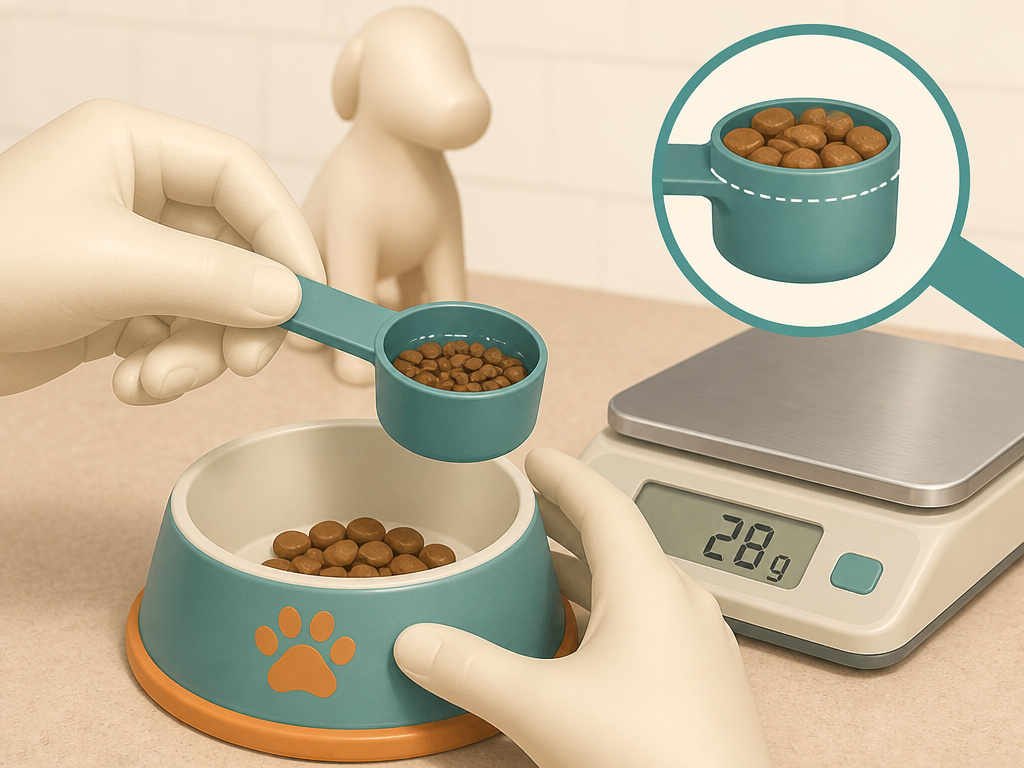
A toy breed is the worst case, and every source here says so.
The greatest inaccuracy in the 100-owner trial showed up at the smallest volume tested, 1/4 cup. Small dogs eat smaller volumes, so they land in exactly that zone.
Both peer-reviewed papers report an increased risk of overestimating feeding amounts for small dogs. The Canadian feeding-practices paper puts it plainly: the problem is exacerbated for smaller dogs with smaller food and energy requirements.
The arithmetic explains it. An extra few grams is a rounding error on a large dog’s day and a meaningful share of a small dog’s.
The smaller the portion, the bigger the share any measuring error takes. Precision has to scale with the dog, not with the scoop.
That’s the mechanism behind a slow gain you can’t explain. The scoop didn’t change. The dog didn’t change. The error was always there, and it mattered more at small volumes.
For starting numbers, our portion by breed size ranges are a reasonable first target to weigh against.
How Do Treats Fit Into the Daily Ration?
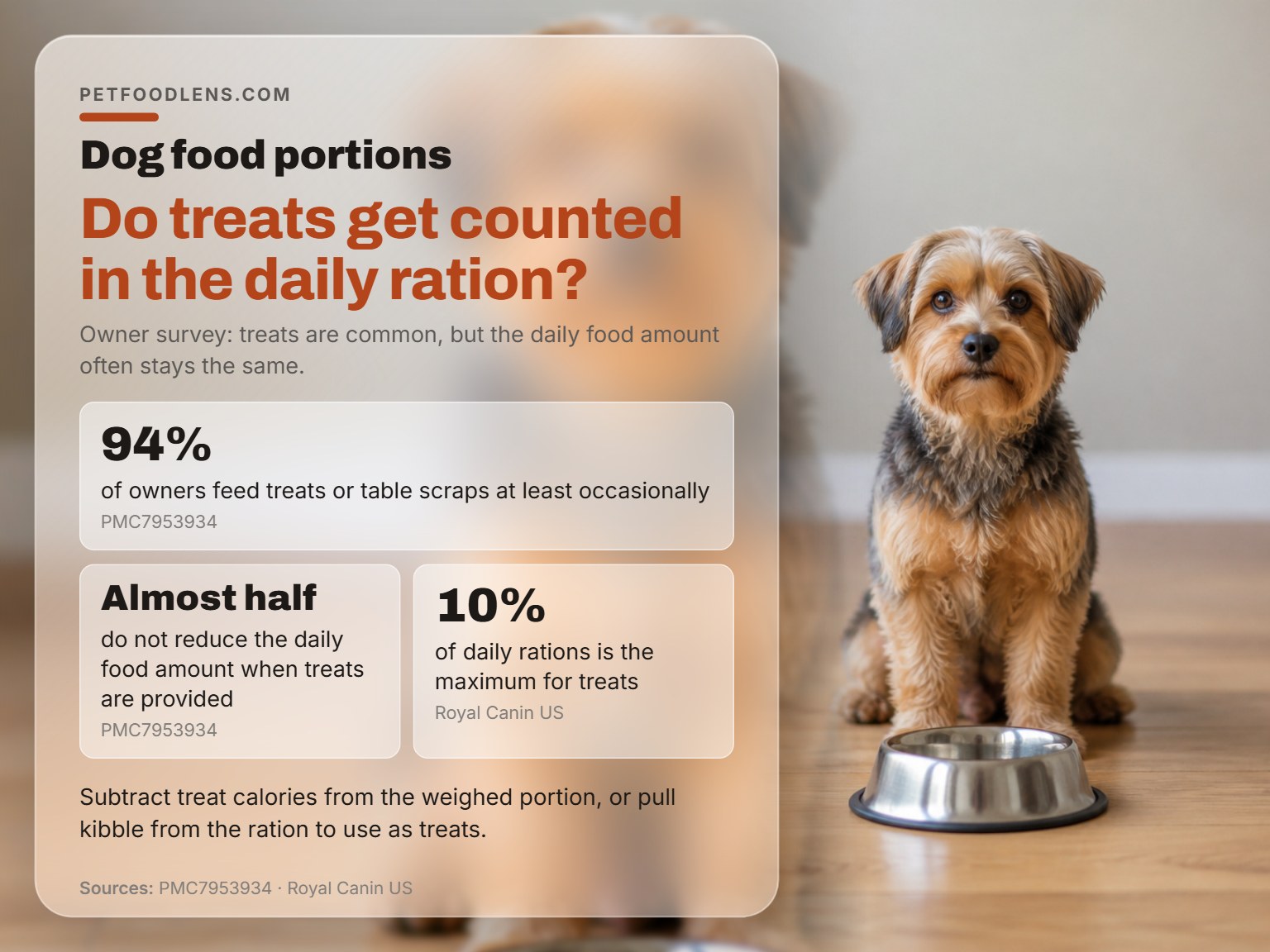
Nearly 94% of surveyed owners feed treats or table scraps at least occasionally. Almost half don’t reduce the daily food amount to compensate.
Those figures come from the Canadian owner feeding practices research, and they’re the reason a weighed ration can still overshoot.
- Cap treats at 10% of the day’s rations. That’s Royal Canin’s figure, and it’s a ceiling rather than a target.
- Subtract, don’t add. Note the calories in the treat and take them out of the weighed portion.
- Or pull kibble from the ration. Same calories, same nutrients, no subtraction arithmetic.
- Skip the human food. Royal Canin advises against adding it to the ration because it upsets the nutritional balance and calorie intake.
I’d rather see a dog get a weighed treat pulled from the day’s ration than a “small” handful that never gets counted. The handful is where the math quietly dies.
The other half of the treat problem is interpretation. A dog asking for food constantly isn’t necessarily hungry. Royal Canin lists habit, boredom, and attention seeking as the usual explanations, and adds that persistent food seeking can also signal illness such as parasites.
If your dog is underweight and you’re trying to add rather than trim, the same weighing discipline applies. Our guide to weight gain portions covers the direction change.
Who in the House Is Actually Feeding the Dog?
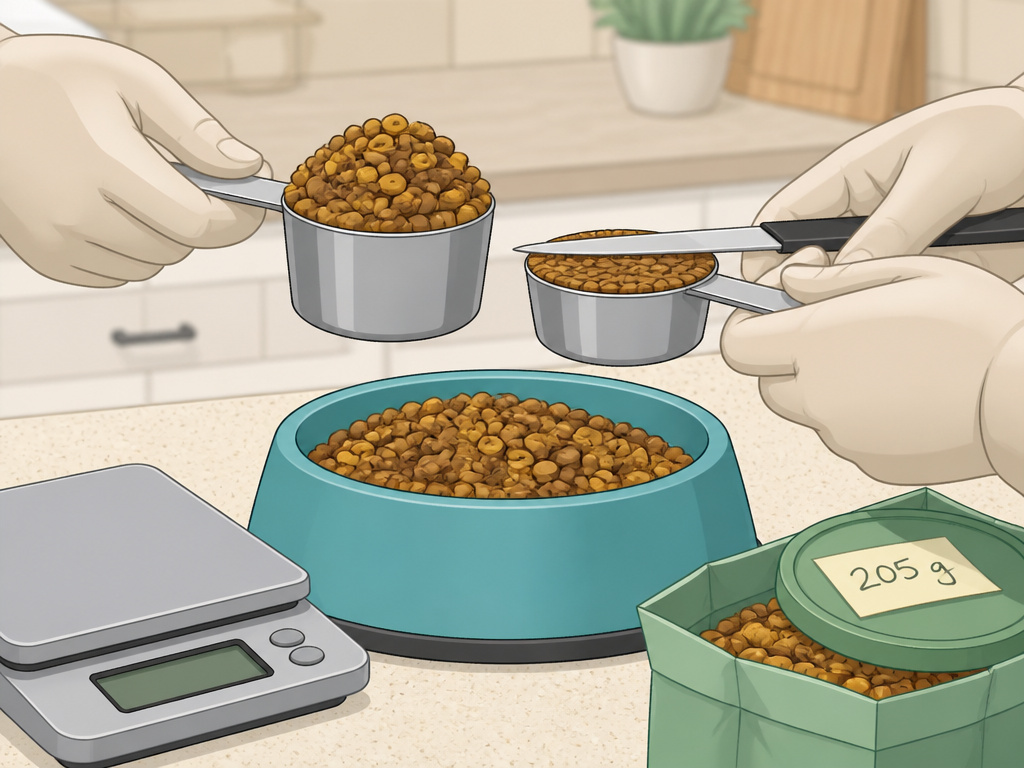
Two people, two scoops, two different ideas of what a full cup looks like.
The 2019 trial ran into this directly. The authors flagged it as a practical problem that it is likely important for veterinary professionals to find out who in the household is feeding the dog. It’s likely important for veterinary professionals to find out who feeds the dog and make sure that person is taught accurate measuring.
One number doesn’t survive two sets of hands unless someone owns it.
- Name one feeder. One person sets the gram target and everyone else uses it.
- Keep the scale on the counter. A scale in a drawer is a scale that gets skipped.
- Write the target on the lid. Anyone who feeds checks the number instead of estimating.
Most owners in the Canadian survey did adjust the amount of food according to their dog’s weight. The intent is already there. The gap is precision, not willingness.
How to Measure Dog Food Portions When the Bag Disagrees
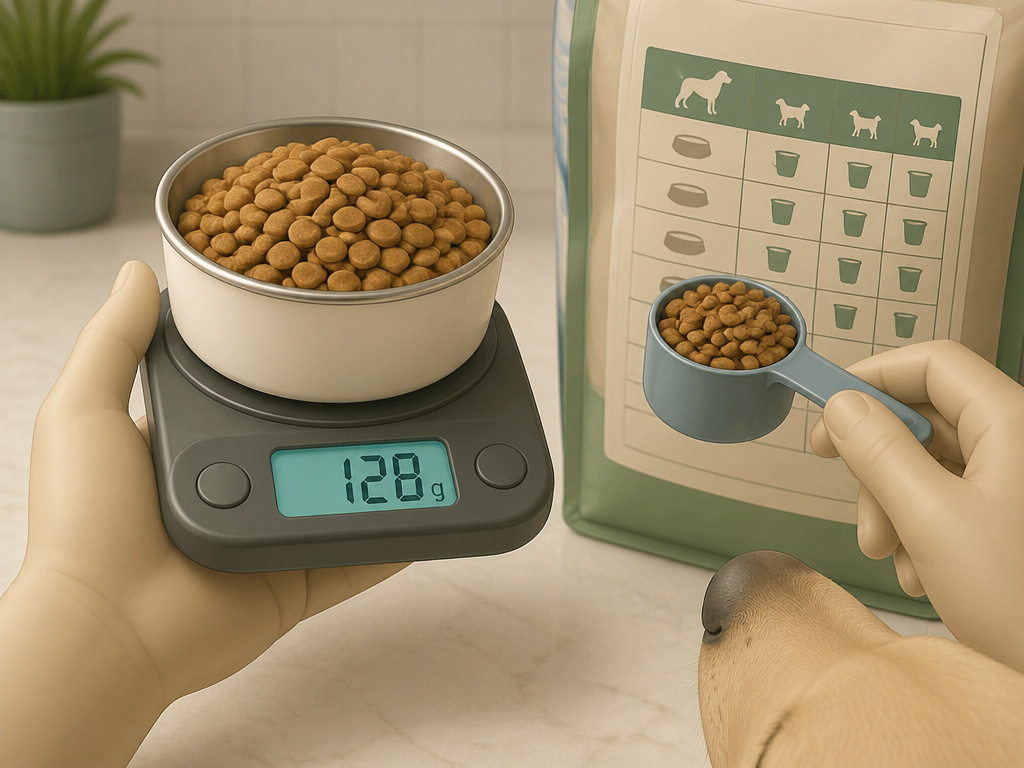
The chart on the bag is a population average, and your dog is one animal inside that population.
Feeding guidelines on commercial packages are described in the peer-reviewed literature as a suggested starting point and as conservative estimates of energy needs. Royal Canin’s consumer page says much the same: start with the feeding guide for the food you’ve chosen, and treat recommended quantities as guidelines that change through the dog’s life.
Whatever brand you feed, the label math works the same way. Start where the pet food label feeding instructions tell you to start, then convert to grams and adjust from there.
Common mistake: Reading the cup line as a prescription. It’s a translation of a calorie estimate for an average dog of that size, and your dog is not average by definition.
Why Cups-Only Labels Make This Harder
Knowing daily intake in grams is difficult when the label only gives cups. Some packages list both, but not all, and that gap is a real barrier for an owner who’s willing to switch to a scale.
There’s a second layer under it. If the calorie figure on the bag is shaky, the cup line built on top of it is shaky too.
That’s why I’d rather you build the target from dog food calories and a body condition check than from the back of the bag alone. Our feeding chart walkthrough covers how to read the panel without over-trusting it.
Royal Canin’s own material splits in an interesting way. The consumer page leads with the feeding guide and mentions weighing scales once, near the end. The professional brochure from Royal Canin Canada leads with weighing and calls it the gold standard. Same company, two audiences, two different emphases.
One more thing worth saying out loud. This whole discussion assumes kibble. Raw food portions run on different math, and the measuring-device research doesn’t transfer cleanly.
How Do You Adjust Portions When Weight Creeps?
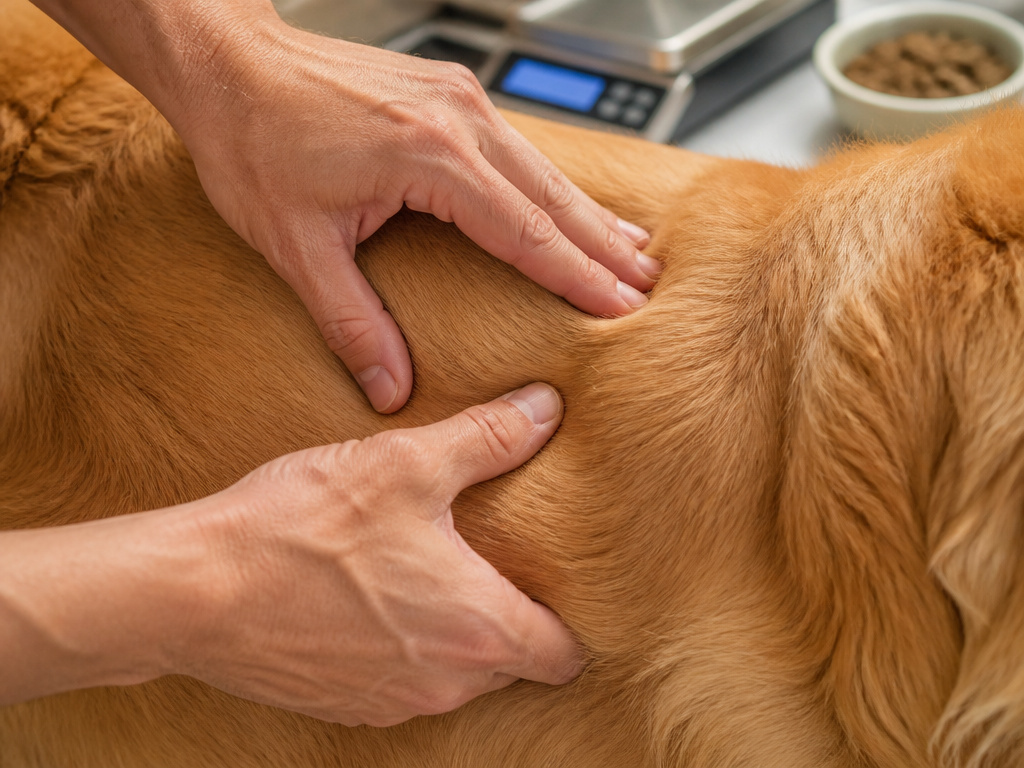
Body condition score is the feedback loop, and it’s a hands-on check rather than a number on a bag.
Royal Canin’s guidance is to alter daily calorie intake or diet if a dog gains weight, and to expect portions to shrink as a dog ages and slows down. Gram scales make those adjustments easy, because you’re changing a number instead of guessing at a fraction of a cup.
If the weight is going the wrong way, our portions for weight loss guide walks the adjustment in order.
Reading Body Condition Without a Scale
Run your hands along the ribcage. You want to feel ribs under a thin layer, not see them and not hunt for them. Look down at the waist from above. Photograph it regularly, because slow change is invisible day to day.
Change one thing at a time. Swap the food and the portion in the same week and you can’t tell which one moved the weight, so you’ll spend the next adjustment chasing the wrong variable. Change one thing at a time so you can tell which one moved the weight.
The part nobody mentions: Weighing is only as good as the number you’re aiming at. If the target came from a bag chart and a guess, a precise scale just makes the wrong number consistent.
If you’re unsure, Royal Canin’s advice is to consult a veterinarian, and that’s the right call. I’m not a clinical specialist. A dog with a real weight problem needs someone who can examine it, not a comparison table.
Frequently Asked Questions
How accurate are dog food measuring cups?
Not very. In a 100-owner trial, cup and scoop measurements overestimated the correct gram amount by up to 1.5 times. Prior research cited in the same paper reported up to 80% overestimation, and a recent owner study reported up to 152%. The figures come from different protocols, so treat the range as the finding.
Should I weigh my dog’s food every day?
Weighing the daily allowance once per day is the recommendation from the Royal Canin Canada research summary. Royal Canin’s consumer guidance suggests weighing each meal once the correct portion is identified. Both beat a scoop.
Why are small dogs more likely to be overfed?
Inaccuracy was greatest at the smallest volume tested, 1/4 cup. Small dogs eat smaller volumes, so they sit in the worst zone. Both peer-reviewed papers report a higher risk of overestimating portions for small dogs.
Do treats count toward the daily portion?
Yes. Royal Canin caps treats at 10% of daily rations and advises subtracting their calories from the daily portion. Nearly 94% of surveyed owners feed treats at least occasionally, and almost half don’t adjust the food amount to compensate.
Can I use a regular kitchen scale?
Kitchen scale that reads in grams works fine. Tare the bowl before you add kibble, and weigh the whole day’s ration in one pass so you’re measuring a larger, more accurate volume.
Does this apply to wet or raw food?
The measuring-device research was done on dry food, and the 2019 trial excluded owners who fed only canned food. Wet and raw feeding involve different volumes and different math, so don’t carry the cup-error figures across without checking.
The Bottom Line
Here’s the concession first. All of this rests on dry-food research. The 2019 trial excluded owners who fed only canned food, and it looked at dogs, not cats. If your dog is on wet or raw, the volume problem shrinks and the calorie math changes shape.
The first step is small and it takes one evening. Fill the scoop you’re using right now several times and weigh each fill. The spread will tell you more about your dog’s daily intake than a guess.
And if you take one position away from this, take mine: I’d rather you weigh roughly than scoop precisely. A scale that’s a few grams off still beats a cup that’s off by a wide margin, and it beats it every single day.
