
How to Read a Pet Food Label: In the Right Order
This post contains affiliate links. As an Amazon Associate, we earn from qualifying purchases.
To read a pet food label, check four things in order: the nutritional adequacy statement, the guaranteed analysis converted to dry matter, the ingredient list, and the manufacturer’s name and address. Much of the rest of the package is optional promotional content. The eight required items are the legal floor every brand clears.
That dry matter conversion is the step that separates knowing how to read a pet food label from just glancing at one. A can carrying 78% moisture is mostly water by weight, so the protein and fat numbers printed beside it describe a food that is roughly one-fifth solid matter. Divide by that smaller number and two foods can swap places in the ranking.
What follows walks the eight required items, the guaranteed analysis line by line, the ingredient rules, and the places where two regulators read the same sentence differently.
Key Takeaways
- Check the adequacy statement first. A food claiming only “intermittent or supplemental feeding” is not a complete diet, whatever the front panel implies.
- Convert to dry matter before comparing anything. A 78% moisture can and a 12% moisture bag are not on the same scale.
- “With” is a 3% promise. “Dog Food with Beef” needs beef at 3% of the product; “Beef Dog Food” needs 95%.
- “Crude” names the test, not the ingredient. It refers to the assay method, not the quality of the nutrient.
- Buy a bag you’ll finish before it goes stale. An opened bag can oxidize over time.
The Eight Items Every Pet Food Label Has to Carry
Eight items are mandatory on a pet food label, and the AAFCO Model Regulations list them in a fixed order. Miss one and the label does not clear a state feed inspector.
The quantity statement must appear on the lower third of the principal display panel and must be expressed in both avoirdupois and metric units. Net weight or volume stated in pounds alone does not satisfy the requirement. State rules built on the AAFCO Model repeat the same placement and dual-unit demand.
The list itself is short:
- Brand and product name
- Species name, in words, on the principal display panel
- Quantity statement
- Guaranteed analysis
- Ingredient statement
- Nutritional adequacy statement
- Feeding directions
- Guarantor name and address
A picture of a dog is not a species declaration. The species has to appear in words, which is why most labels fold it into the product name as “Beef Dog Food” or “Salmon Treats for Cats.”
The guarantor line is the one buyers skip and shouldn’t. It names the party responsible for the product, and the city, state, and zip code must be shown even when the street address is left off. If a contract manufacturer makes the food, the label has to say so with “manufactured for:” or “distributed by:” in front of the address. The AAFCO labeling requirements resource covers the full item list and the wording each one needs.
Products without a brand name still need some sort of unique identifier. That gap is real, and it is one the eight-item list does not solve.
What the Guaranteed Analysis Measures, and What “Crude” Doesn’t
The guaranteed analysis panel prints four numbers as floors and ceilings, never as averages. Minimum crude protein, minimum crude fat, maximum crude fiber, and maximum moisture are always required.
Then the panel gets more interesting than most buyers expect.
What “crude” actually means
“Crude” refers to the analysis method, not the quality of the nutrient. Two foods can print identical crude protein numbers while one supplies amino acids the other doesn’t.
| Guaranteed analysis line | Always required? | What it does not tell you |
|---|---|---|
| Crude protein, minimum | Yes | Digestibility or amino acid balance |
| Crude fat, minimum | Yes | Whether the fat is animal or plant |
| Crude fiber, maximum | Yes | Soluble versus insoluble fiber |
| Moisture, maximum | Yes | Nothing, once you convert to dry matter |
| Ash, maximum | Only if listed | Which minerals make up the ash |
A sample analysis in the Wisconsin guide reads 21.0% crude protein, 8.0% crude fat, 4.5% crude fiber, and 12.0% moisture. Those are the four lines you will find on nearly every can and bag in the aisle.
The ash and low-fat rules
If a label includes ash in the guaranteed analysis, it must be shown as a maximum and listed immediately after the maximum moisture line. Voluntary guarantees go after moisture or ash, in the same order the nutrients appear in the AAFCO Dog or Cat Food Nutrient Profiles.
Guarantees for substances outside those profiles go last, with an asterisked disclaimer reading “Not Recognized as an essential nutrient by the AAFCO Dog (or Cat) Food Nutrient Profiles.”
A low-fat claim flips one rule. Both the maximum and minimum percentages of crude fat must then be guaranteed, so the range is bounded on both ends.
Common mistake: Reading the guaranteed analysis as a quality score. It is a lab summary with a floor and a ceiling, and a food can hit every number while using ingredients a cat digests poorly.
The guaranteed analysis panel rewards a slow read. The AAFCO pet food label reading guide spells out the ordering rules in full.
Why 78% Moisture Isn’t a Quality Problem
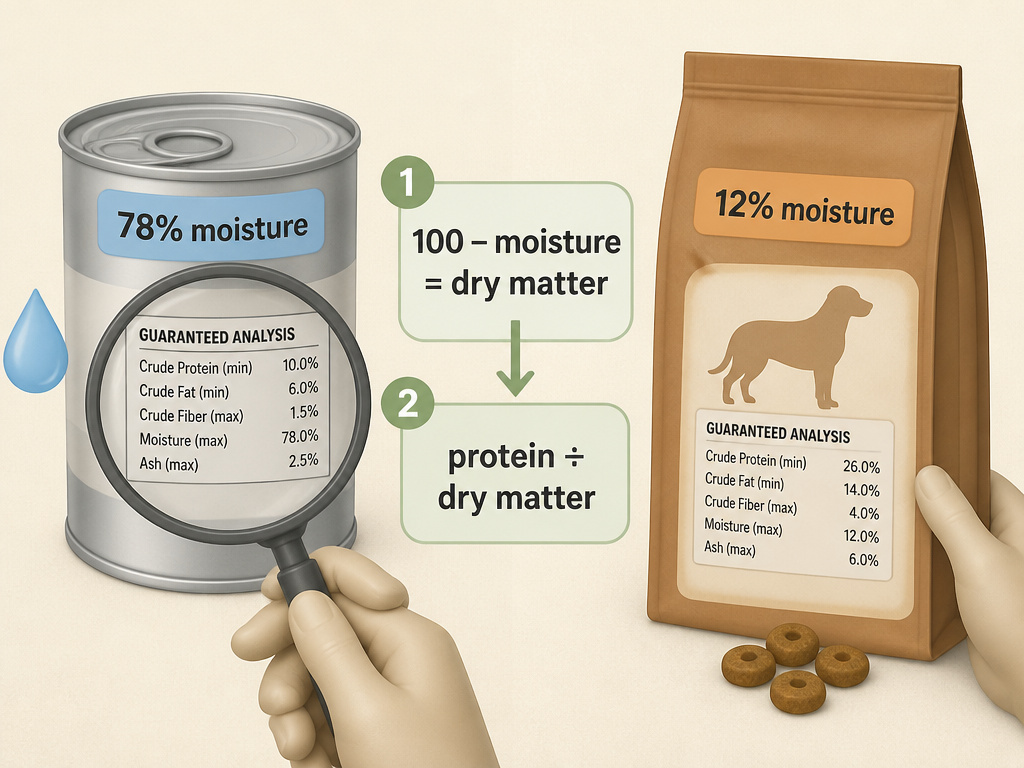
A can that reads “moisture 78% max” is describing water. Every canned food is mostly water by weight, and 78% is an ordinary figure for a pate.
You can see it before you read a word.
The dry matter math
Subtract the moisture percentage from 100 to get dry matter. Then divide the nutrient percentage by that number.
Take the Wisconsin sample. Protein 21.0%, moisture 12.0%, so dry matter is 88%. Divide 21.0 by 88 and you get about 24% protein on a dry matter basis.
Now run a canned food at 78% moisture. Dry matter is 22%. Divide by 22 instead of 88 and the same printed guarantee reads four times higher.
The printed percentage never moves. The number you divide it by does.
The dry matter basis comparison is the only honest way to rank a can against a bag. The Wisconsin DATCP pet food label guide notes that canned food guarantees appear lower than dry food labels because of the water content.
The Ingredient List: Descending by Weight, As Formulated
Flip the bag over and the first three lines read chicken, chicken meal, brown rice. Read lines four and five and you find peas and pea protein, split apart so neither one outranks the chicken.
That is legal. It is also the single most common way a label flatters itself.
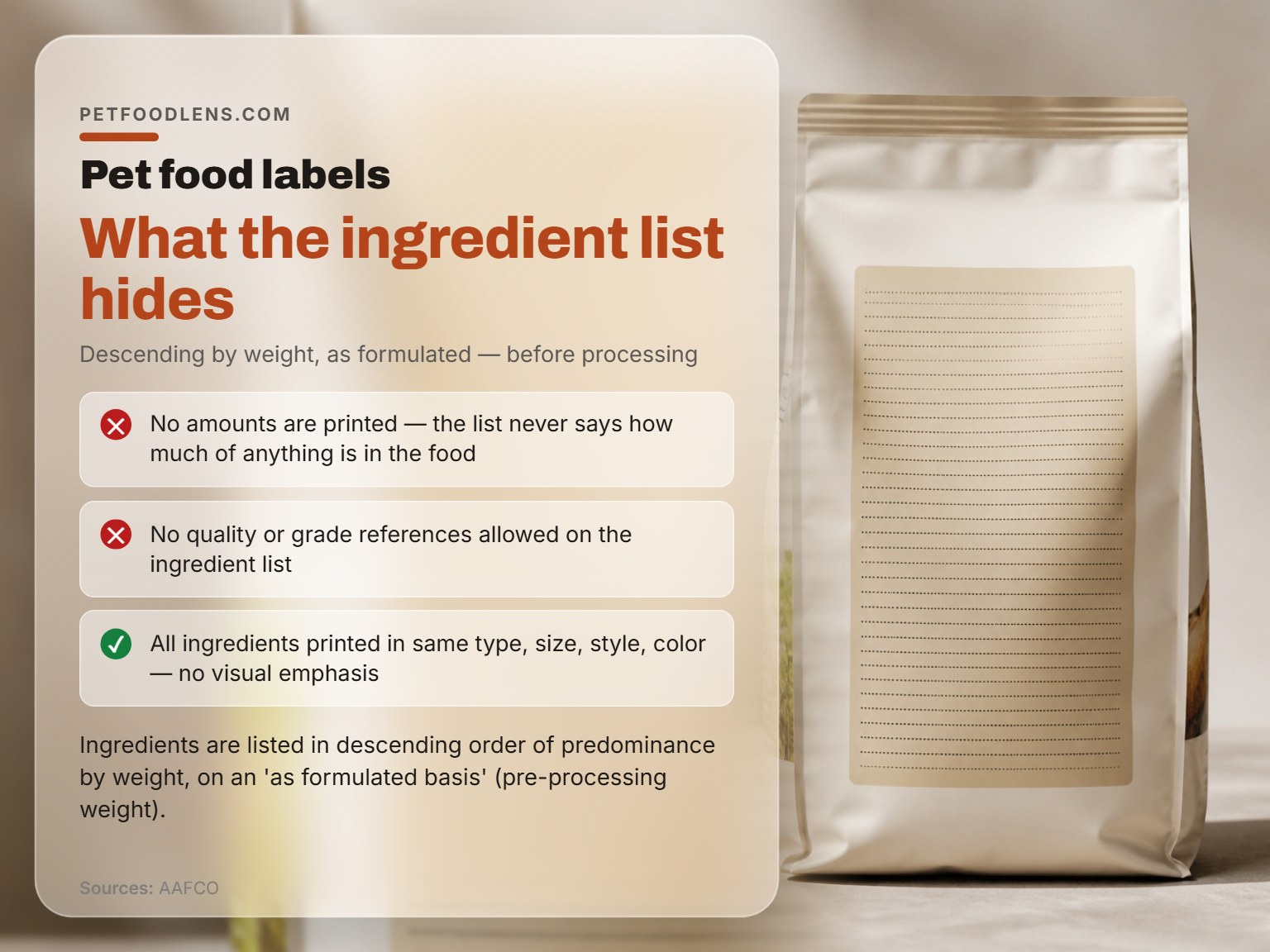
Ingredients are listed in descending order of predominance by weight, on an “as formulated basis.” That means the weight going into the mixer, before processing, not the weight in the finished kibble.
Here is what the ingredient list cannot tell you:
- How much of anything is in the food. No amounts are printed, ever.
- Whether an ingredient is good or poor quality. Quality and grade references are barred outright.
- Whether a named meat leads by dry weight. Water in fresh meat inflates its position.
- Whether two plant ingredients are one ingredient split in two. Peas, pea protein, and pea fiber are three lines on the label and one pile on the scale.
The rules around the list are tighter than most people assume. No brand names are allowed in it. All ingredients must be printed in letters of the same type, size, style, and color, so nothing gets visual emphasis. If meat or meat byproducts come from anything other than cattle, swine, sheep, or goats, the species has to be declared by name.
If the first ingredient is a fresh meat, subtract the water before you celebrate. Fresh meat carries a lot of moisture, so a named meat listed first can contribute less protein by weight than a meal listed third.
I read for the hiding places before I read the protein name. Fat and digest are where cross-contaminants live.
The ingredient splitting pattern is worth learning by sight. For the species-specific version, see cat food ingredient list and dog food ingredients.
What “Beef Dog Food” and “Beef Flavored” Actually Promise
Then I went and read what the term actually guarantees, which is close to nothing, and I stopped starting at the front. Now I open at the guaranteed analysis and the ingredient list, and I treat the front panel as advertising copy.
The front panel sells a feeling. The ingredient list is where the claims get tested.
| Label wording | What it requires | Watch for |
|---|---|---|
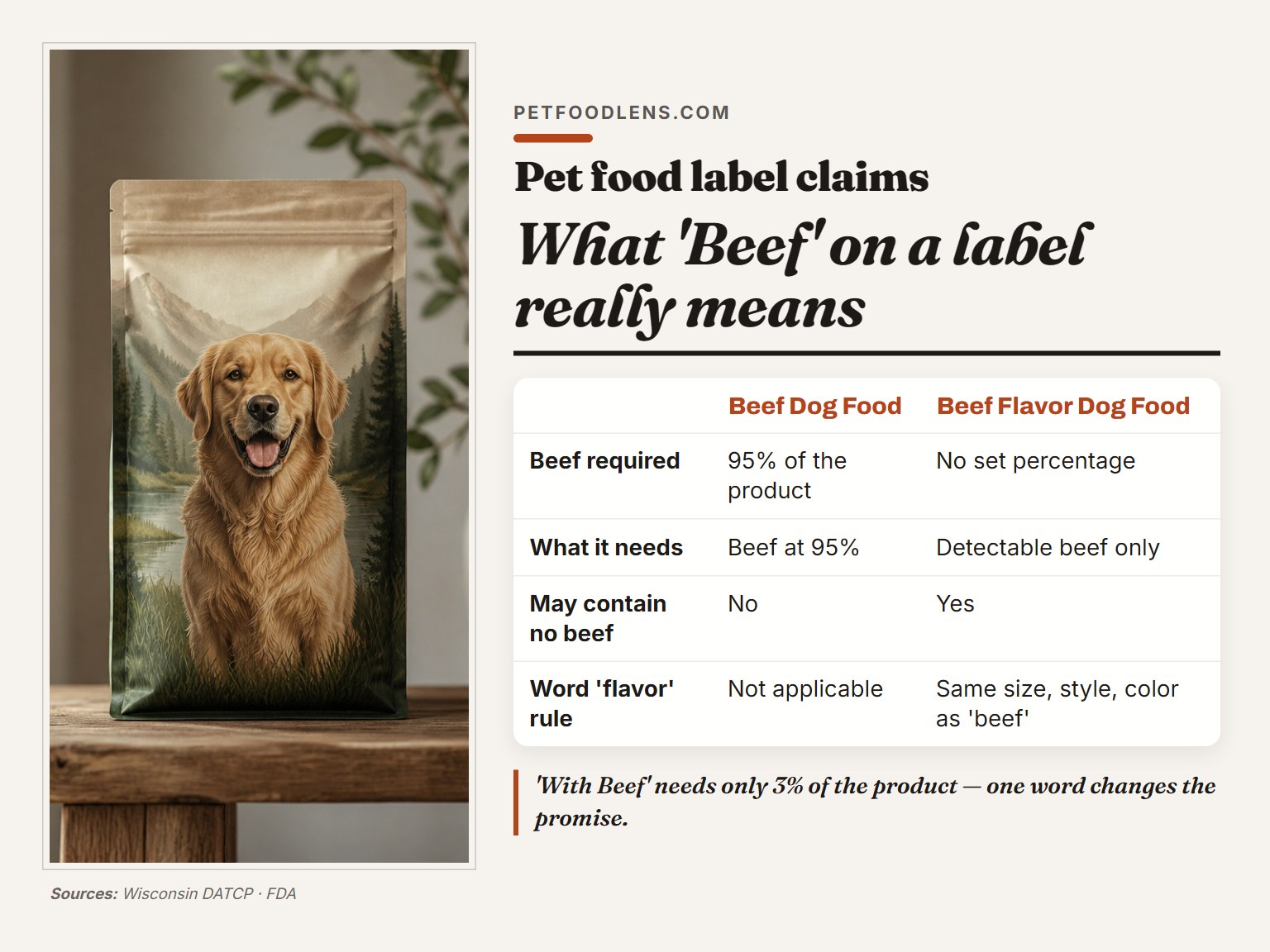
| “Beef Dog Food” | Beef at 95% of the product | The strongest claim on the shelf |
| “Dog Food with Beef” | Beef at 3% of the product | One word changes the promise |
| “Beef Flavor Dog Food” | Detectable beef, no set percentage | May contain no beef at all |
| “100%” or “All” | Barred if the product has more than one ingredient | A claim the rules do not allow |
The “with” rule catches people constantly. When a label says “Doggie Dinner with Beef,” the named ingredient need only be at least 3% of the product. On the flavor side, a specific percentage of beef is not required at all, but the product must contain enough to be detected, and the word “flavor” must appear in the same size, style, and color as the word “beef.”
Where this goes sideways: Buying on the word “with.” The named ingredient needs 3% of the product, so a bag can put “with salmon” on the front and still be built on chicken meal. Nothing printed is false. The front panel just answers a question you didn’t ask.
Ingredient names used in the product name must also appear in order of predominance by weight. That is a detail worth knowing when a name stacks two proteins. The Ohio Department of Agriculture pet food guide covers the naming rules and the calorie content heading.
“Lite” and similar claims carry their own burden: the label must show the percentage reduction in calories or fat and name a product for comparison. For the wider set of front-panel phrases, see misleading pet food claims and named meat.
Where Do the Sources Disagree on Pet Food Labels?
Where do the sources disagree on pet food labels? In three places that matter, and the first one shows up right in the ingredient list.
The collective-name question is the sharpest split: AAFCO says ingredients must be listed individually and that collective terms like “animal protein products,” “grain products,” or “roughage products” cannot be used on pet food products, while FDA says an ingredient is exempt from the common-or-usual-name requirement if it is a collective name meeting 21 CFR 501.110.
| Question | AAFCO position | FDA position |
|---|---|---|
| Collective ingredient names | Not allowed on pet food; list individually | Exempt from the common-name rule under 21 CFR 501.110 |
| Source of authority | Model Regulations that states adopt | 21 CFR part 501, plus individual state laws |
| Drug and disease claims | Not addressed in the eight-item checklist | Can trigger “new animal drug” status requiring approval |
The second split is legal framing. FDA describes its rules as the federal baseline and states that animal food products are also subject to individual state laws. AAFCO describes its Model Regulations as the standard states adopt in practice, and notes that a state may vary from the Model. A label legal in one state may not be legal in another.
The third split is drug claims. Expressed or implied claims that a product cures, treats, prevents, or mitigates disease can indicate an intent to offer it as a new animal drug, which needs approval before it appears on the label. That constraint is absent from AAFCO’s eight-item checklist.
Wisconsin adds a fourth wrinkle. Its rules require drug information on the label when the feed contains one or more drugs, which sits outside the eight items entirely.
The federal pet food labeling requirements are published in 21 CFR part 501, and the FDA page is the place to check a claim that sounds like medicine.
How to Read a Pet Food Label in the Right Order
The order matters more than the effort.
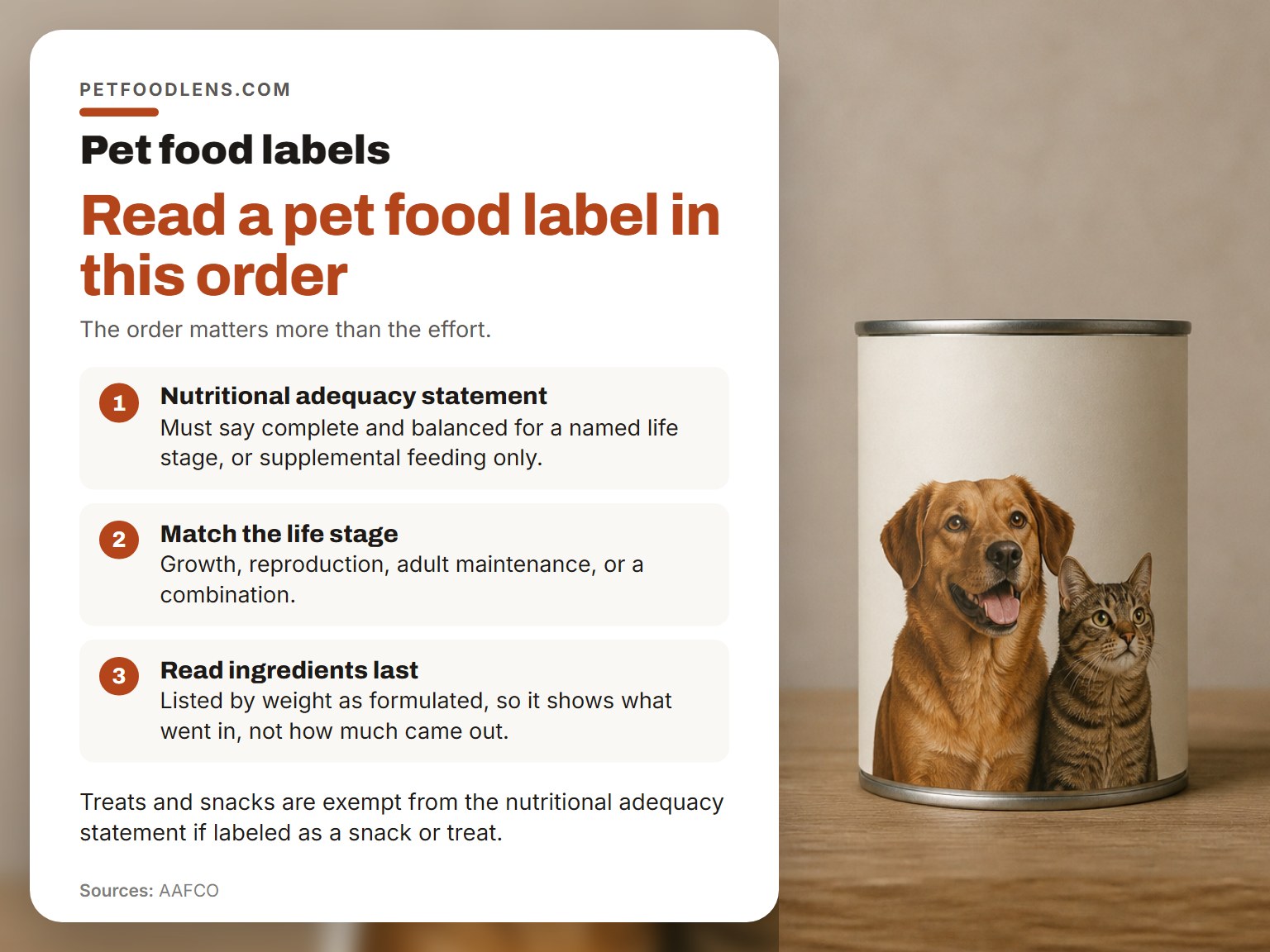
- Find the nutritional adequacy statement. It has to say the food is complete and balanced for a named life stage, or that it is intended for intermittent or supplemental feeding only. Skip this and you can build a cat’s whole diet on a topper.
- Match the life stage to the animal. Growth, reproduction, adult maintenance, or a combination. A kitten fed an adult-maintenance food misses requirements the label never claimed to meet.
- Convert the guaranteed analysis to dry matter. Comparing a 78% moisture can to a 12% moisture bag without converting gets the ranking backwards.
- Read the ingredient list last. Order is by weight as formulated, so it tells you what went in, not how much came out.
- Check the guarantor. City, state, and zip code, plus “manufactured for” if someone else made it.
One exemption trips people up. Products conspicuously identified on the principal display panel as a snack, treat, or supplement are exempt from the nutritional adequacy statement, and feeding directions are optional for treats that are not complete and balanced.
The AAFCO nutritional adequacy statement is the first thing I look for and the last thing most buyers notice. Feeding directions are guidelines rather than rules, since breed, temperament, and environment all affect intake. The feeding guidelines explain how to read the chart without treating it as a prescription.
How Big a Bag Should You Buy?
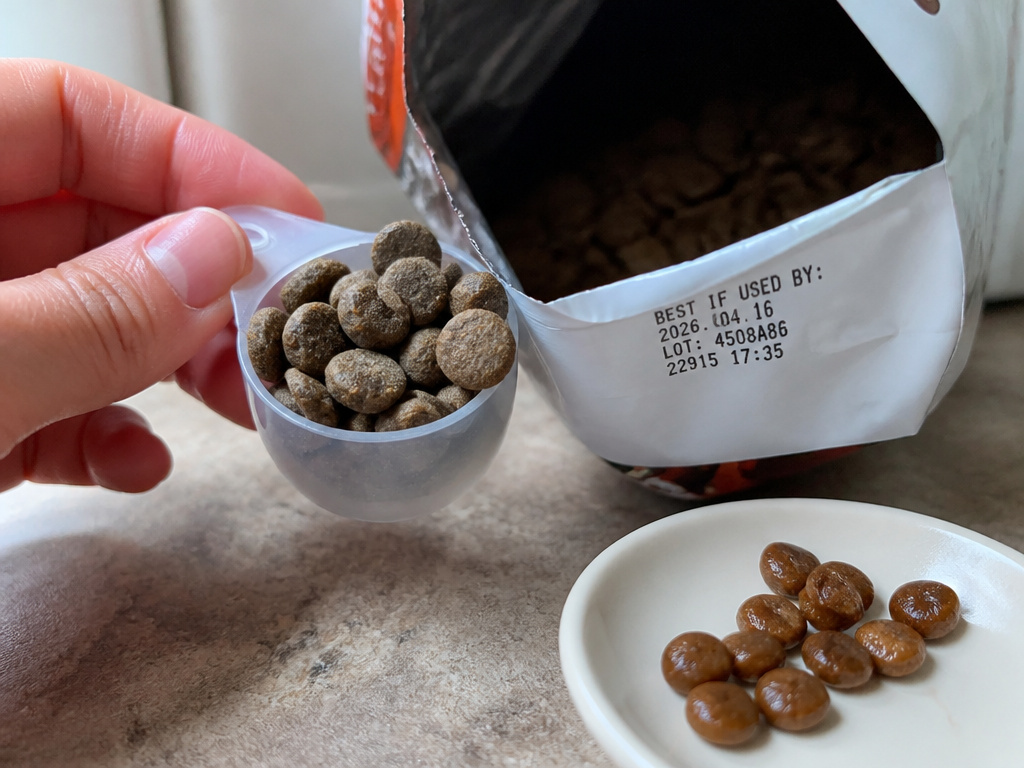
How big a bag should you buy? Smaller than the one on sale, in most cases.
Once opened, the last third has had a long time to oxidize, and the per-pound savings evaporate if half of it gets tossed or the cat quits eating it.
You can smell the problem before you see it. Fat that has gone over smells like old crayons or a dusty attic, and the kibble goes dull and matte instead of slightly shiny.
If the bag is cheaper per pound but you’re scooping from it in month four, it isn’t cheaper.
Check the date code before you check the size. The expiration dates guide covers where the stamp hides and how to read the format.
The bag does not care whose name is on it.
Frequently Asked Questions
Does “crude protein” mean low-quality protein?
No. “Crude” refers to the analysis method used in the lab, not the grade or quality of the nutrient. A food can print a high crude protein minimum and still supply amino acids a cat digests poorly.
Can a treat be labeled complete and balanced?
It can, but most are not. Products conspicuously identified as a snack, treat, or supplement are exempt from the nutritional adequacy statement. Feeding directions are optional for treats only when they are not complete and balanced and are labeled as snacks or treats.
Why do canned foods show lower protein percentages than dry foods?
Water content. The Wisconsin guide notes that guarantees on canned pet food appear lower than on dry food labels because of the water. Convert both to dry matter and the gap usually narrows or reverses.
Is a label approved in one state legal everywhere?
Not necessarily. AAFCO notes that a state may vary from the Model Regulations, so a label legal in one state may not be legal in another. Federal rules under 21 CFR part 501 apply on top of state law.
What does “human-grade” require on a pet food label?
The product must be clearly labeled for its intended use as animal food, including the phrase “dog food” in the same size as the phrase “human-grade.” The claim does not by itself make the food safer or more digestible.
Do organic claims on pet food follow their own rules?
There are currently no official regulations specific to the labeling of organic foods for pets, though the USDA is developing some. In the meantime, a food claiming to be organic must meet the ingredient, production, and handling requirements of the USDA National Organic Program.
The Bottom Line
None of this makes you your cat’s nutritionist. I’m not a veterinarian, and nothing on a label helps you manage kidney disease, diabetes, or a suspected food allergy. Those start with an exam and bloodwork, and a therapeutic diet chosen by a vet outranks anything you or I pick off a shelf.
Where label reading earns its keep is the ordinary decision: two similar foods, one shelf, no obvious winner. Palatability beats a spreadsheet.
This week, take the food already in your cupboard and do one thing. Subtract the moisture from 100, divide the protein by what’s left, and write the number down. That’s the practical version of how to read a pet food label: one subtraction, one division, one number you’ll compare every future bag against.
