
How to Read a Guaranteed Analysis: What the Numbers Hide
This post contains affiliate links. As an Amazon Associate, we earn from qualifying purchases.
To read a guaranteed analysis, check three things: the nutrient order (N, P2O5, K2O for fertilizer; crude protein, crude fat, crude fiber, then moisture for feed), whether the numbers are as-fed or dry matter, and the guaranteed minimums rather than averages. A pet food label’s percentages are minimums by weight, not the actual content of the bag.
The as-fed clause is the one that trips up readers comparing a canned food to a kibble. Both print their protein as a percentage of the whole product, water included, so the wet food’s number looks tiny next to the dry bag’s. That gap is mostly water, not nutrition. Knowing how to read a guaranteed analysis helps here.
What follows walks the order rule, the as-fed correction, the ash and selenium triggers that force extra guarantees, and the math that turns any of these percentages into pounds of actual nutrient.
Key Takeaways
- Feed and fertilizer use different nutrient orders. Pennsylvania feed law runs protein, fat, fiber, moisture; fertilizer runs N, P2O5, K2O. Applying one rule to the other label gets it wrong.
- Every guarantee is a floor, not an average. Arkansas Extension calls it the minimum concentration; Clemson calls it a manufacturer warranty that the analysis by weight is present. A bag can legally hold more, never less.
- Guarantees are as-fed, not dry matter. CDFA requires the as-is basis, so wet and dry foods can’t be compared until you convert.
- Ash over 9.0% forces calcium, phosphorus, and sodium (or salt) onto the label.
- Sliding scales like “protein 15-18%” are prohibited in Pennsylvania feed law. In Pennsylvania, one number per guarantee.
What the Guaranteed Analysis Actually Guarantees
Flip the bag over and the guaranteed analysis is the table of minimums the manufacturer legally stands behind. Arkansas Extension calls it the minimum concentration of nutrients in the product; Clemson frames the same table as a warranty that the stated analysis by weight is present.
The guaranteed analysis states the minimum percentage of each nutrient by weight in the finished product. For feed, guarantees apply to the whole feed, follow Pennsylvania’s fixed order of crude protein, crude fat, crude fiber, and moisture, and are stated on an as-fed basis rather than a dry matter basis.
Here’s the practical takeaway: a guarantee is a floor. If the label guarantees a minimum crude protein percentage, the bag holds at least that much, and the manufacturer is on the hook for that floor under state law. It doesn’t promise that number is the average, and it doesn’t promise the protein is digestible.
Arkansas Extension and Clemson describe the same number differently. Arkansas calls it the minimum concentration; Clemson calls it a manufacturer warranty that the analysis by weight is present. Both readings matter: the floor is legal, and the warranty is enforceable.
Early in my own reading, I let the word “natural” on a front label shape my opinion of a food for about a month. When I finally checked what the term does and doesn’t guarantee, I started going straight to the guaranteed analysis and the ingredient list. The front of the bag had told me nothing I could verify.
Before you trust any number on the back, the how to read a guaranteed analysis question starts with checking the AAFCO nutritional adequacy statement. It tells you whether the food was tested by feeding trial or only formulated on paper, and a formulated-only food can clear its guarantees while failing the cat.
Reading a pet food label front to back means treating the front as advertising and the back as the contract. The AAPFCO fertilizer label guide sets the model language most states copy, including the rule that a percentage represents only the amount of an individual nutrient relative to the total product by weight.
What the guarantee does and doesn’t promise:
- It promises at least the stated percentage, by weight of the whole product.
- It doesn’t promise an average, a maximum, or anything about digestibility.
- It doesn’t promise the food is complete or balanced; that’s the adequacy statement’s job.
A bag of kibble has a faint, dry, cereal smell when you open it; a can of pate smells like wet metal and liver. Neither smell tells you the protein content, which is why the back panel exists.
Why the Order Changes Between Feed and Fertilizer
A fertilizer label and a pet food label both say “guaranteed analysis,” and they don’t mean the same order. Fertilizer runs Total Nitrogen, Available Phosphate, Soluble Potash; Pennsylvania feed law runs crude protein, crude fat, crude fiber, moisture.
The Fertilizer Order
Under the AAPFCO model statute, any primary nutrients claimed must be reported as Total Nitrogen (N), Available Phosphate (P2O5), and Soluble Potash (K2O), in that order. The percentage represents the amount of the individual nutrient relative to the total product by weight.
Clemson’s reading a fertilizer label factsheet puts the same three numbers in plain terms and adds a slow-release test: compare water-insoluble nitrogen to total nitrogen. Clemson states that by law a slow-release fertilizer must carry at least one-third of its nitrogen in slow-release form, while AAPFCO’s model text does not restate that 33 percent threshold, so state adoption varies. AAPFCO’s model text doesn’t restate that 33 percent threshold, so treat the figure as a state adoption rather than a universal rule.
The Feed Order
Pennsylvania’s feed code fixes a different order: crude protein (min), crude fat (min), crude fiber (max), moisture (max), then additional guarantees. The Pennsylvania guaranteed analysis regulation also prohibits the sliding scale outright, so a range like “protein 15-18%” isn’t allowed.
| Label Type | Order of Guarantees | Basis |
|---|---|---|
| Fertilizer (AAPFCO) | N, P2O5, K2O | Percentage by weight |
| Feed (7 Pa. Code 72.4, Pennsylvania) | Protein, fat, fiber, moisture | As-fed |
| Commercial feed (CDFA) | Whole feed, percent | As-fed, not dry matter |
The two regimes are separate statutes. AAPFCO governs fertilizer; Pennsylvania’s feed code governs animal feed in that state, pet food included. A reader who applies the N-P-K order to a pet food label will misread the first three numbers entirely.
The distinction between a guaranteed analysis vs typical analysis matters when you compare a how to read a guaranteed analysis too. A typical analysis is an average from a lab; a guaranteed analysis is a legal floor. They aren’t interchangeable.
If the first number on the label is nitrogen and you’re holding a bag of cat food, you have the wrong label. Pennsylvania feed law prints protein first. Fertilizer prints nitrogen first. The order is the tell.
Common mistake: Trusting the three big numbers on the front of a pet food bag as the full analysis. The guaranteed analysis table on the back carries the ash, moisture, and mineral guarantees the front leaves off.
Why Can’t You Compare Wet and Dry Food Straight Off the Label?
Open a can of cat food and a bag of kibble side by side and the protein numbers look like different species. The can reads low, the bag reads high, and neither number tells you which food delivers more protein per calorie.
CDFA’s feed guidance is blunt on this: all guarantees must be on an as-fed basis, not a dry matter basis. The percentage is measured against the whole product, water included. A canned food is mostly water, so its protein percentage is diluted by moisture that contributes no protein at all.
A can of pate looks dense and uniform; a bag of kibble rattles like dry cereal when you shake it. That difference in water is the whole reason the label numbers can’t be compared straight across.
To compare them, convert to a dry matter basis: subtract the moisture percentage from 100, then divide the nutrient percentage by that dry matter figure. The same correction is what makes a fair wet vs dry food comparison possible at all.
The CDFA commercial feed guarantee guidance is explicit that guarantees apply to the whole feed and are stated in percent unless a rule says otherwise.
I’ve watched people dismiss a quality canned food because its protein number looked half the kibble’s. Convert both to dry matter and the ranking often flips. The can was doing the same work in more water.
I’ve run workshops where a student who had never read a guaranteed analysis spotted a moisture-inflated protein claim faster than people who had read labels for years. The conversion takes two minutes. People skip it anyway.
Where this goes sideways: Comparing a canned food’s protein to a kibble’s without converting. The wet food’s number is diluted by moisture, so it always looks lower than it is.
When Ash Tops 9.0% and Moisture Tops 15.0%
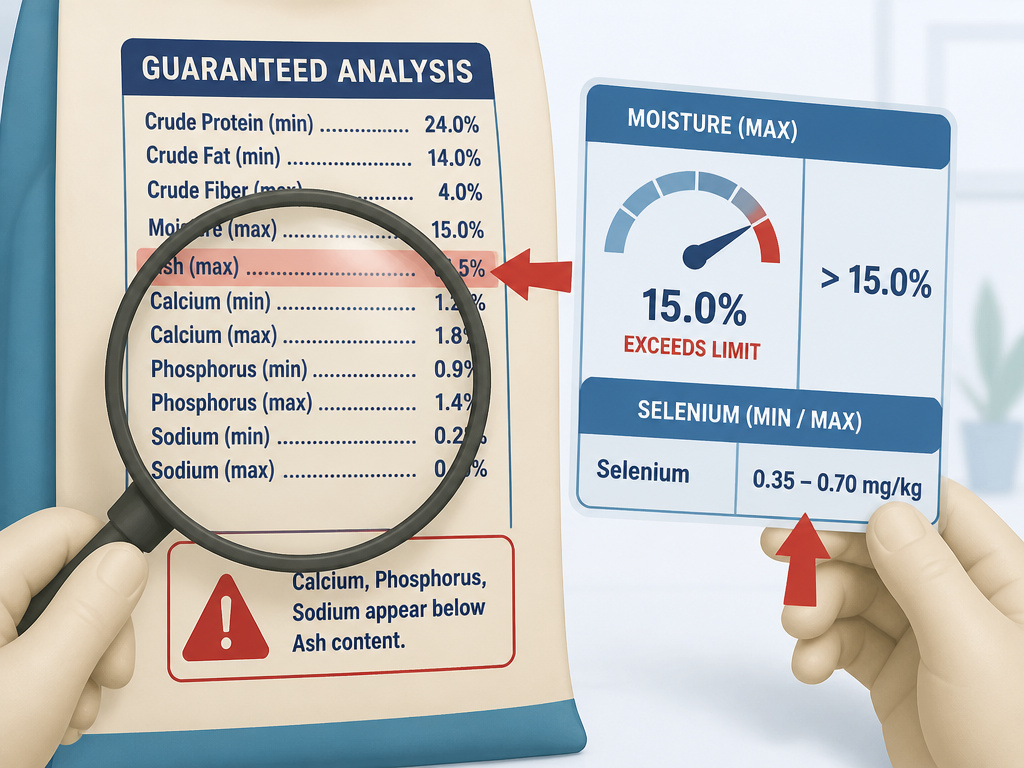
One threshold on a feed label forces extra guarantees that most readers never expect. Cross it and the label owes you more numbers.
The Ash Trigger
CDFA lists maximum ash as a basic guarantee, with an exception: a single-ingredient product isn’t required to guarantee maximum ash unless its ingredient definition says so. But if ash is over 9.0 percent, the label must also guarantee calcium, phosphorus, and sodium (or salt).
The ash content in pet food number is the one most readers skip, and it’s the one that tells you how much mineral load the food carries.
The Moisture and Selenium Triggers
Moisture works the same way. A maximum moisture guarantee (or minimum dry matter) is a basic requirement on feed labels.
| Guarantee | Trigger | What the Label Must Add |
|---|---|---|
| Ash | Over 9.0% | Calcium, phosphorus, sodium (or salt) |
| Selenium | Added over 0.3 ppm | Minimum and maximum selenium |
Selenium has its own tolerance ladder. Under 1 ppm, the maximum can’t exceed the minimum by more than 0.5 ppm; between 1 and 5 ppm, by more than 1 ppm; between 5 and 25 ppm, by more than 2.5 ppm; between 25 and 50 ppm, by more than 5 ppm; and over 50 ppm, by more than 10 percent of the minimum.
The part nobody mentions: A single-ingredient feed can skip the maximum ash guarantee entirely unless its ingredient definition requires it. Absence of an ash number isn’t proof of low ash.
How Do You Spot a Sliding-Scale or Zero Guarantee?
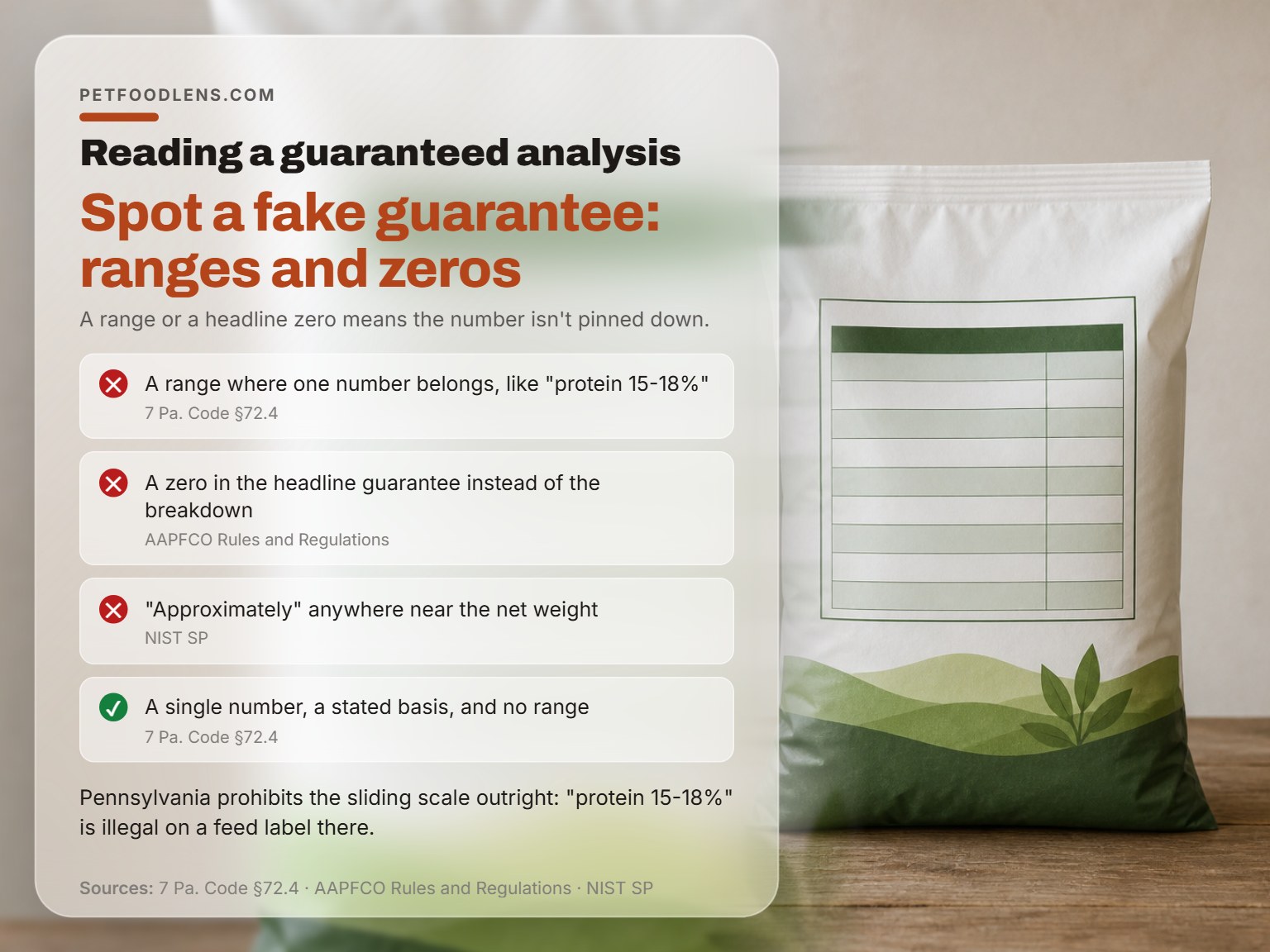
A guarantee with a range in it isn’t a guarantee in Pennsylvania, where feed law prohibits the sliding scale outright, so “protein 15-18%” is illegal on a feed label in that state.
Fertilizer rules add a second trap. AAPFCO says zero guarantees should not be made and shall not appear in the statement, except inside a nutrient breakdown. A zero inside the breakdown marks a nutrient the manufacturer didn’t guarantee. It doesn’t mean the product contains none.
The same discipline applies to protein percentages: a single number, a stated basis, and no range.
A range on a label is a confession. It says the manufacturer won’t stand behind one number, and a guarantee you can’t pin down isn’t a guarantee.
Red flags on a guaranteed analysis: – A range where a single number belongs, like “protein 15-18%” (prohibited in Pennsylvania)
- A zero in the headline guarantee instead of the breakdown
- A protein number with no moisture guarantee to convert against
- An “approximately” anywhere near the net weight
The range is the tell I look for first in Pennsylvania, where a manufacturer who won’t commit to one number is telling you something about the testing behind it.
The Math: Turning Percentages Into Pounds of Nutrients
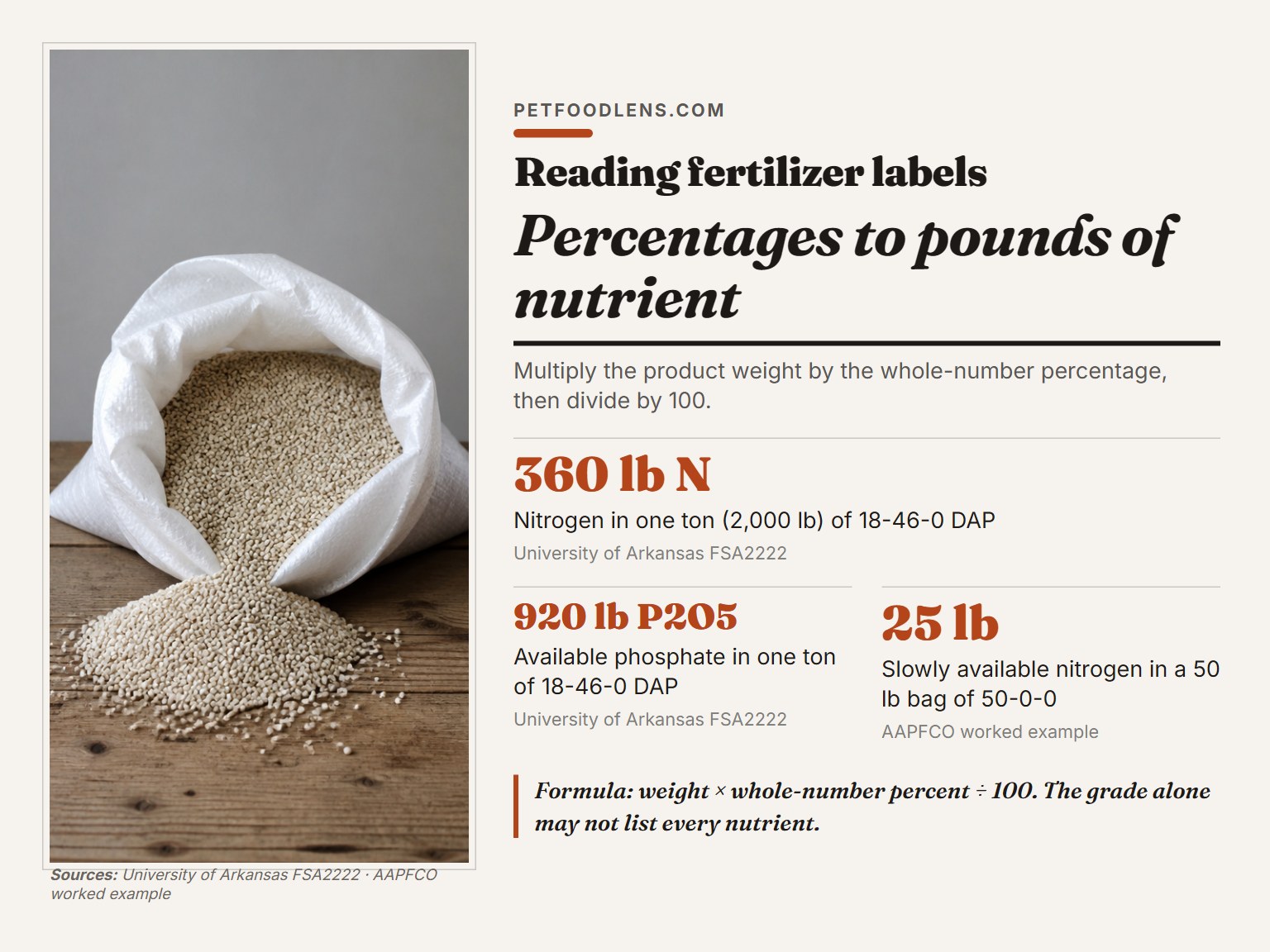
Arkansas Extension gives the cleanest formula for turning a guarantee into actual nutrient: multiply the weight of the product by the whole-number percentage and divide by 100.
The Multiplication
One ton (2,000 lb) of DAP with a guaranteed analysis of 18-46-0 holds 360 lb of nitrogen and 920 lb of P2O5. The math is 2,000 times 18 divided by 100 for nitrogen, and 2,000 times 46 divided by 100 for phosphate.
AAPFCO’s own worked example makes the same point from the other direction. A product claiming “50% slowly available nitrogen” implies a grade of at least 50-0-0, and a 50 lb bag holds 25 lb of it. The multiplication is the same on any bag.
GreenView’s Fairway Formula bag prints a guaranteed analysis of 27-0-5, with N-P-K listed first, which is the order the model statute requires. The Arkansas table lists ammonium sulfate at 21-0-0-24(S), where the S stands for sulfur. That letter suffix is a nutrient the grade alone doesn’t show.
The Arkansas Extension FSA2222 walks the multiplication and warns that the grade alone doesn’t list every nutrient, so the full guaranteed analysis table is the reference.
To compare two foods, work in this order:
- Find the moisture guarantee first, because you need it to convert. Skip it and every later comparison is guesswork.
- Subtract moisture from 100 to get dry matter. Get this wrong and the whole conversion is off.
- Divide each nutrient percentage by the dry matter figure. This is the step that makes wet and dry comparable.
- Compare the converted numbers, not the label numbers. Comparing label numbers is how a canned food gets dismissed.
- Check the adequacy statement before you trust any of it. A food can clear its guarantees and still fail a feeding trial.
Once you can convert a guarantee to pounds, the next comparison is energy, and calorie content is reported on its own line.
Frequently Asked Questions
Does a guaranteed analysis tell you the actual nutrient content?
No. It states the minimum percentage the manufacturer guarantees by weight. Arkansas Extension calls it the minimum concentration; Clemson calls it a warranty that the stated analysis is present. The bag can legally hold more than the guarantee, never less.
Why is the order different on fertilizer and feed labels?
Fertilizer follows the AAPFCO order of Total Nitrogen, Available Phosphate, and Soluble Potash. Pennsylvania feed law follows a separate order of crude protein, crude fat, crude fiber, and moisture. They’re two different statutory regimes, not one universal format.
What does as-fed mean on a pet food label?
It means the percentage is measured against the whole product, water included, rather than against dry matter. CDFA requires the as-fed basis, which is why a canned food’s protein percentage looks lower than a kibble’s until you convert.
Is a range like “protein 15-18%” legal?
Not in Pennsylvania. The state’s feed code prohibits the sliding scale and requires a single number. A range is a red flag there.
What triggers extra guarantees on a feed label?
Ash over 9.0 percent forces calcium, phosphorus, and sodium onto the label. Maximum moisture (or minimum dry matter) is a basic guarantee on a feed label. Selenium added over 0.3 ppm forces minimum and maximum selenium.
Can a food clear its guaranteed analysis and still be poor?
Yes. The guarantee is a floor on paper. A food can meet every minimum and still fail a feeding trial, which is why the AAFCO adequacy statement matters as much as the numbers.
The Bottom Line
One rule most label guides skip: if the moisture guarantee is missing, stop. You can’t convert to dry matter without it, and every comparison after that point is a guess dressed up as math.
The guaranteed analysis is a floor, not a snapshot. It tells you the least a food contains, by weight, on an as-fed basis. It doesn’t tell you the average, the digestibility, or whether the food was ever tested on a cat.
If you want a first step this week, pick one can and one bag from your shelf and convert both to dry matter. The ranking will surprise you often enough that you’ll stop trusting the front of the bag.
None of this replaces a vet for a cat with kidney disease, diabetes, or a suspected allergy. The label math tells you what’s in the food. It doesn’t tell you what a sick cat needs.
