
Guaranteed Analysis vs Typical Analysis: Which Counts?
This post contains affiliate links. As an Amazon Associate, we earn from qualifying purchases.
Guaranteed analysis vs typical analysis splits along legal lines: the guaranteed analysis is the only binding figure on a pet food label, expressed as minimums for protein and fat and maximums for fiber and moisture, while typical analysis is an unregulated manufacturer average with no legal definition, format, or tolerance.
That word “binding” is doing most of the work in that sentence. A guaranteed minimum is a promise a manufacturer can be cited for breaking. A typical average is a courtesy, and nothing enforces it. Label-reading guides quote the two interchangeably, which is how an owner ends up holding a can of pate next to a bag of kibble and drawing a conclusion that the guaranteed analysis vs typical analysis numbers never supported.
What follows walks the difference line by line: what the panel legally guarantees, why nobody regulates the word “typical,” the dry matter math that makes any comparison honest, and the places where AAFCO, the FDA, and veterinary nutrition bodies flatly disagree about which number you should trust.
Key Takeaways
- Protein and fat on the panel are floors, not measurements. A food can legally contain more than the number printed, and the panel will never tell you how much more.
- “Typical analysis” has no legal definition in the US. AAFCO confirms there is no mandated format, tolerance, or verification requirement, so a brand can publish an unverified average.
- Wet and dry food cannot be compared straight off the label. Peer-reviewed guidance requires converting to a dry matter or metabolizable energy basis first.
- AAFCO compliance is a minimum-adequacy standard. It is not a quality guarantee and it is not a consistency guarantee.
- The precise tolerances quoted on affiliate sites are unsourced. No AAFCO or FDA document establishes a 112-nutrient, plus-or-minus 5 percent lot-release standard.
What the Guaranteed Analysis Actually Guarantees
Four numbers appear on every panel in a fixed order, and each one is a floor or a ceiling rather than a measurement.
The guaranteed analysis panel lists crude protein, crude fat, crude fiber, and moisture in that fixed order under AAFCO model regulations and 21 CFR 501.4. Protein and fat are stated as minimums, fiber and moisture as maximums. These are legal floors and ceilings, not laboratory measurements of the food in the bag.
Crude protein and crude fat are minimums. Crude fiber and moisture are maximums. That asymmetry matters more than most owners realize.
- Crude protein: the least protein the food will contain. Not the amount it does contain.
- Crude fat: a floor, and the figure most often misread as a target.
- Crude fiber: a ceiling, which is why “high fiber” is hard to verify from the panel alone.
- Moisture: a ceiling that quietly changes the meaning of every other number on the label.
The panel layout is not a style choice. 21 CFR 501.4 governs how guaranteed analysis must be formatted for animal food sold in the US, and a panel that is materially false is actionable as misbranding under the FD&C Act. That is the whole enforcement mechanism, and it is a real one. If you want the full walkthrough of the panel itself, how to read a guaranteed analysis covers the layout line by line.
Here is the part that gets lost. AAFCO compliance is a minimum-adequacy standard. It confirms the food clears a floor. It says nothing about quality and nothing about whether the next batch matches this one.
I have had people email me a photo of a panel and ask whether the food is any good. A panel cannot answer that question. It was never built to.
Why ‘Typical Analysis’ Has No Legal Definition
Nobody regulates the phrase.
AAFCO is explicit about this. “Typical analysis” is not a regulated label element. There is no legal definition, no mandated format, no tolerance, and no verification requirement. A manufacturer can run a lab average, publish it, and there is no standard against which anyone can call it wrong.
That is a strange gap once you sit with it. The guaranteed analysis is defined down to the unit and the qualifier. The typical analysis, which is the number veterinary nutritionists actually want, has no rules at all.
I spent years treating the two as roughly the same information in different clothes. They are not. One is a legal instrument and one is a marketing document that happens to contain useful data when the manufacturer is honest.
The practical consequence is that a typical analysis is only as good as the company publishing it. Some are lab means from real batch testing. Some are a single formulation target from years ago that nobody has re-run.
Where this becomes a real problem is in claim language. The same gap that lets a brand publish an unverified average also lets it rely on misleading pet food claims that sound quantitative without being checkable. “Tested for quality” and “laboratory verified” mean whatever the marketing department decided they mean.
Guaranteed Analysis vs Typical Analysis: Which Number Answers Your Question?
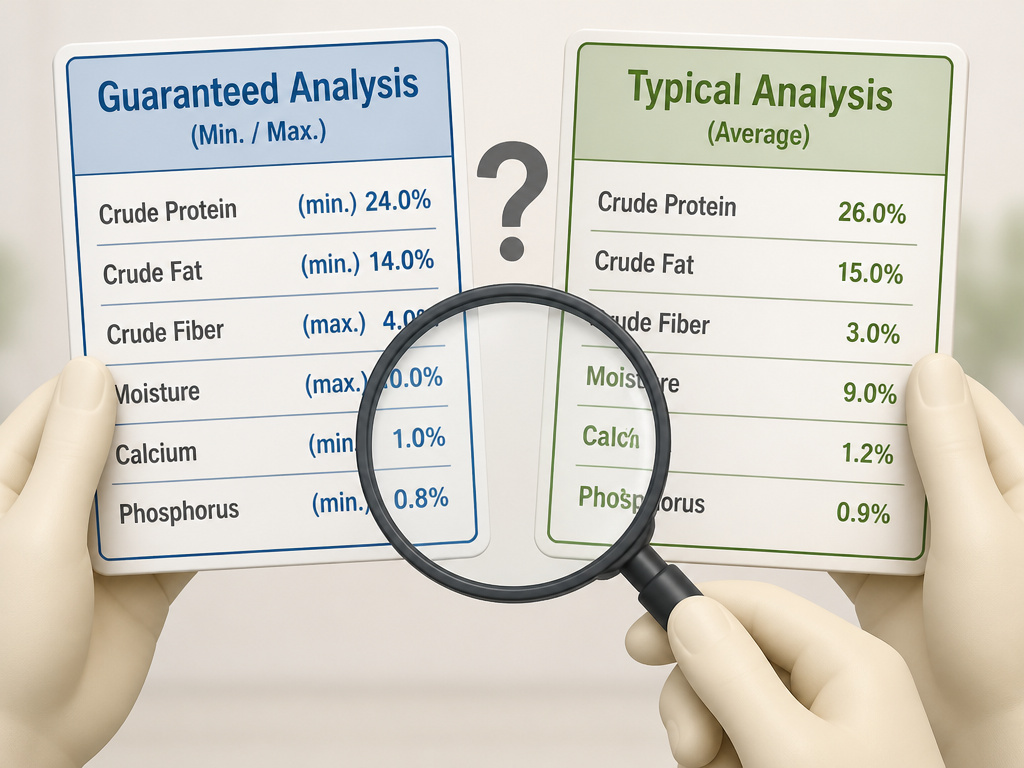
Ask two questions and you get two different numbers.
If the question is “does this food meet the AAFCO nutrient profile for an adult cat,” AAFCO and the FDA hold that the guaranteed analysis is the answer because it is the only legally binding figure, while WSAVA and veterinary nutrition sources argue guaranteed analysis is insufficient for clinical comparison and typical data should be requested. If the question is “how much protein is this cat actually eating per day,” the guaranteed analysis is close to useless, because a minimum tells you a floor and you need an average.
| Question | Guaranteed Analysis | Typical Analysis |
|---|---|---|
| Who defines it | AAFCO model regulations and FDA format rules | Nobody; no legal definition exists |
| What the number represents | A legal minimum or maximum | A lab-measured or stated average |
| Best used for | Compliance checks and AAFCO profile comparison | Formulation and clinical nutrient math |
| Enforceable | Yes, through misbranding rules | No standard exists to violate |
| Published format | Fixed order, fixed qualifiers | Whatever the brand decides |
Read that table left to right and the whole argument falls out. The two numbers are not competing versions of the same fact. They answer different questions for different audiences.
For anything involving actual nutrient intake, WSAVA and veterinary nutrition sources say you need the typical figure on a basis you can compare, while AAFCO and the FDA maintain the guaranteed analysis is the correct basis for compliance and profile comparison. That means dry matter basis or an energy basis, never the as-printed percentage.
Why Can’t You Compare a Can to a Bag Straight Off the Label?
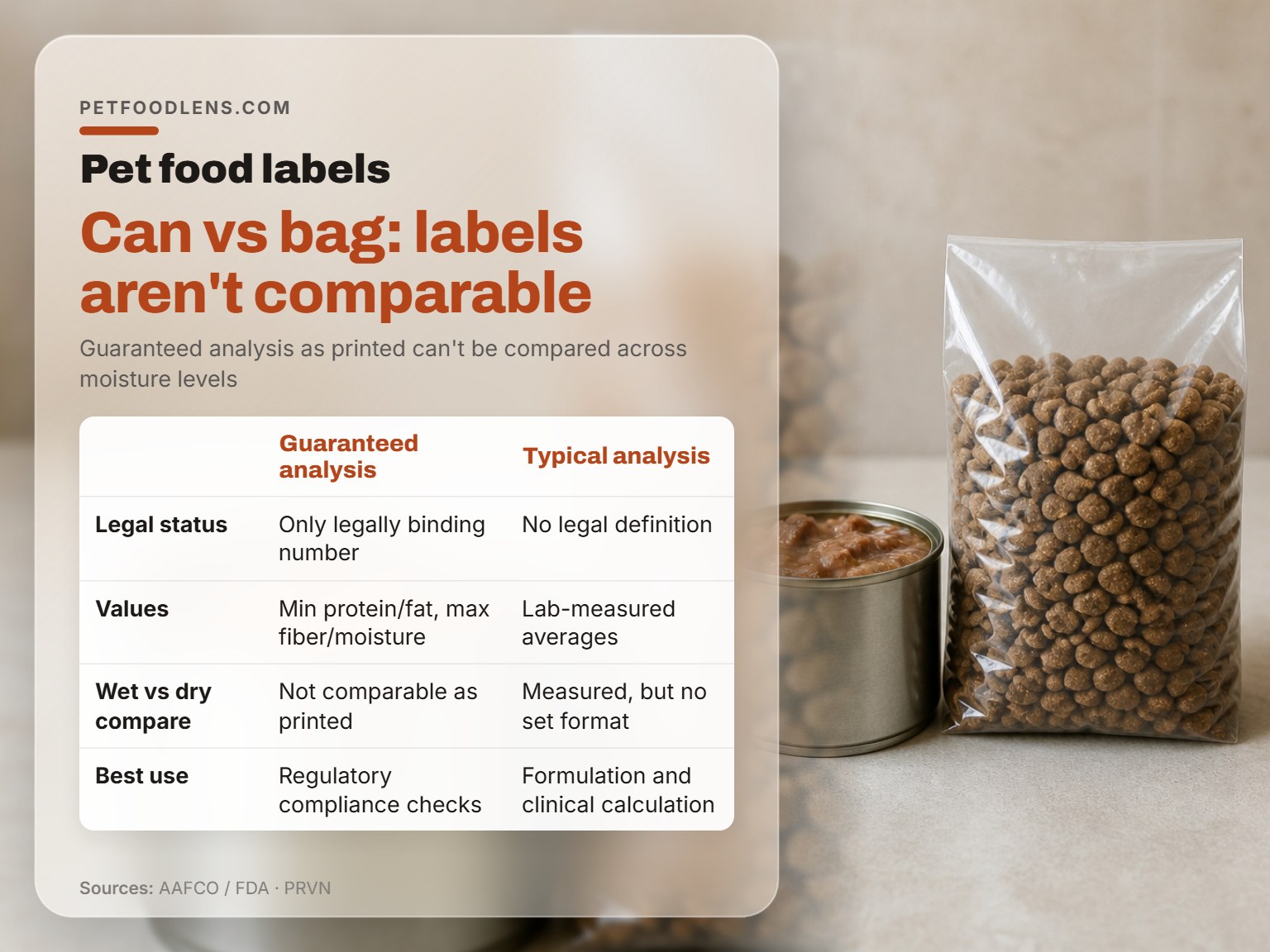
Picture a can of pate and a bag of kibble on the same counter, both with a protein figure printed on the panel.
The can looks lower. It almost always does. Peer-reviewed veterinary nutrition guidance says that raw comparison is not valid, because most of the can is water and the panel reports protein as a share of the whole product, water included, while AAFCO and the FDA treat guaranteed analysis as the correct basis for comparing products against AAFCO nutrient profiles.
Peer-reviewed veterinary nutrition guidance holds that guaranteed analysis as printed is not comparable between wet and dry food, while AAFCO and the FDA treat guaranteed analysis as the correct basis for comparing products against AAFCO nutrient profiles. You have to convert to a dry matter or metabolizable energy basis before the numbers mean anything side by side.
Converting to a Dry Matter Basis
- Find the moisture percentage on the panel. It is the last line in the fixed order, and it is a maximum rather than a measured value.
- Subtract moisture from 100. The remainder is the dry matter, the portion of the food that is not water. Skipping this step is the single most common error in label comparison.
- Divide the nutrient percentage by the dry matter figure. Multiply by 100 to express it as a percentage of dry matter.
- Compare only converted figures. A converted number against a raw number is worse than no comparison at all, because it looks rigorous.
The NRC’s Nutrient Requirements of Dogs and Cats goes a step further and expresses requirements on a metabolizable energy basis, per 1000 kcal. That is the standard veterinary nutrition works from, and it is the only basis that stays honest across a pate, a kibble, and a freeze-dried food.
Why Per 1000 kcal Beats Percentages
Percentages hide energy density. Two foods can carry identical protein percentages and deliver very different amounts of protein per calorie, because one is dilute with water and the other is calorie-dense.
Per 1000 kcal ME removes that. It tells you what the cat gets per unit of energy consumed, which is the thing that actually matters when you are calculating intake.
If protein is the specific question, how to compare protein percentages walks the conversion with worked examples, and comparing wet and dry food handles the moisture problem directly.
A can of pate hits you with a wet, metallic smell the moment the lid comes back. A bag of kibble smells like warm cereal and rendered fat. Neither smell tells you a thing about protein content, and neither does the number printed on the front.
Where the Nutrition Bodies Genuinely Disagree
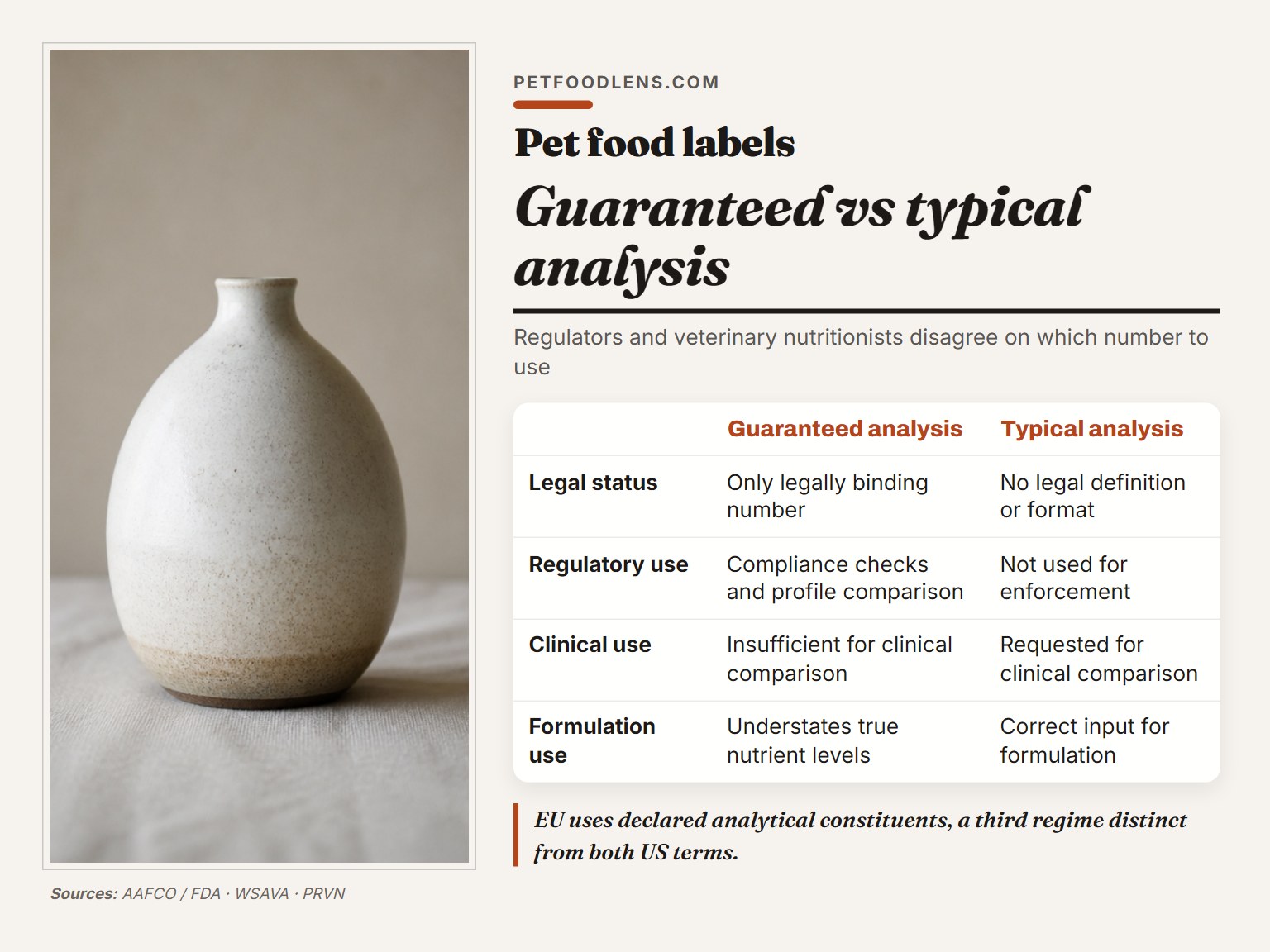
The disagreement is real and neither side is being sloppy.
AAFCO and the FDA hold that the guaranteed analysis is the correct basis for regulatory compliance checks and for comparing a product against the AAFCO nutrient profiles. Their reasoning is sound: it is the only legally binding number, so it is the only one an enforcement action can rest on.
The veterinary nutrition side holds something different. The WSAVA Global Nutrition Guidelines state that guaranteed analysis is insufficient for clinical comparison and that typical or measured data should be requested instead. Peer-reviewed literature on therapeutic and hydrolyzed diets makes the same argument, on the grounds that guaranteed minimums understate true nutrient levels. Small Animal Clinical Nutrition (Hand et al.) treats typical analysis as the correct input for formulation and veterinary calculation. UC Davis guidance says home-prepared diet formulation requires measured typical values, not guaranteed analysis.
| Body | Position on which number to use |
|---|---|
| AAFCO and FDA | Guaranteed analysis is the only legally binding figure |
| WSAVA Global Nutrition Guidelines | Guaranteed analysis is insufficient for clinical comparison |
| Peer-reviewed veterinary nutrition | Request typical analysis for therapeutic and hydrolyzed diets |
| UC Davis veterinary nutrition | Home-prepared diets require measured typical values |
| EU Regulation (EC) No 767/2009 | Declared analytical constituents, not min/max values |
The AAFCO and FDA Position
Compliance runs on the guaranteed analysis because it is the only figure with a legal definition behind it. A food that fails its guaranteed minimum is misbranded, and FDA CVM has documented cases where panels did not match laboratory results, including protein and fat falling below the guaranteed minimum. Recalls repeatedly cite exactly this kind of labeling discrepancy.
The Veterinary Nutrition Position
Clinical math runs on typical values because a floor is not an average. If you are calculating how many grams of protein a cat receives per 1000 kcal, a guaranteed minimum gives you a number that is wrong in a predictable direction.
There is also a third regime worth knowing about. EU Regulation (EC) No 767/2009 requires “analytical constituents” for protein, fat, fiber, ash, and moisture as declared values rather than min/max qualifiers. That is neither of the US terms, and it does not resolve the argument.
Where this goes sideways: Treating the AAFCO position as proof that the label is clinically sufficient. It is sufficient for enforcement and for profile comparison. It is not sufficient for calculating what a sick animal is eating, and the bodies that do that math say so in print.
The Tolerances on the Affiliate Sites That Don’t Exist
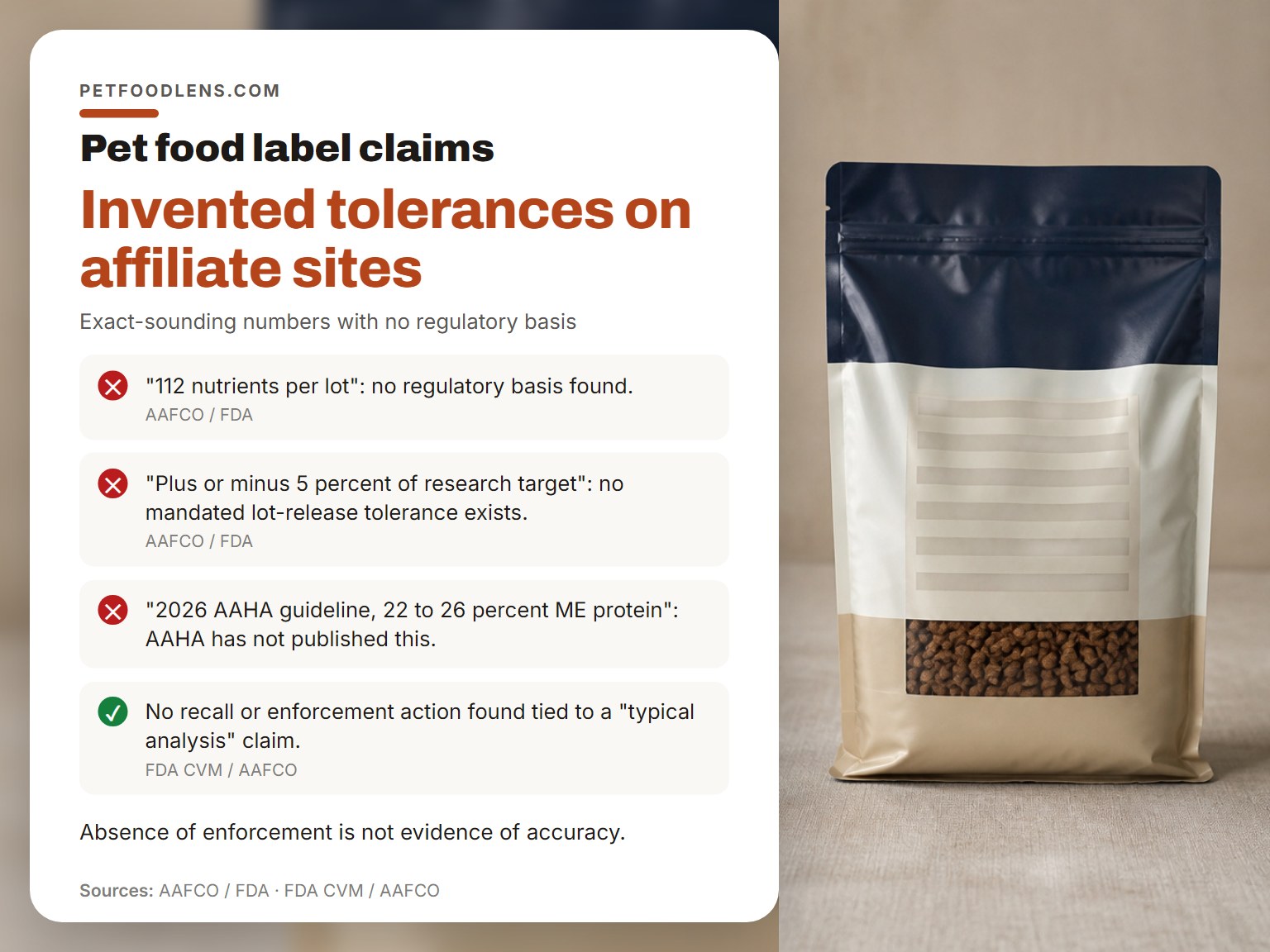
Those precise-sounding tolerances are invented.
Search this topic and you will land on affiliate listicles quoting exact numbers with total confidence. One, from Furry Folly about Hill’s, claims the brand tests every lot for 112 nutrients and releases only within plus or minus 5 percent of a research target, with a lot-specific QR code acting as a certificate of analysis, though AAFCO and FDA say no such mandated standard exists. Another, from Furry Folly about Purina, cites a “2026 AAHA guideline” specifying 22 to 26 percent metabolizable energy protein with a plus or minus 3 percent margin, though AAHA has not published such a diabetic-dog macro standard.
Neither holds up. No AAFCO or FDA source establishes a 112-nutrient, plus-or-minus 5 percent lot-release standard. AAHA has not published a diabetic-dog macronutrient standard with those figures; its diabetes material is a management guideline, not a macro specification.
- “112 nutrients per lot”: no regulatory basis found.
- “Plus or minus 5 percent of research target”: no mandated lot-release tolerance exists.
- “2026 AAHA guideline, 22 to 26 percent ME protein”: AAHA has not published this.
Read past the front of the bag, and past the affiliate article too. A number with no source behind it is worse than no number, because it borrows authority it did not earn.
The part nobody mentions: There is no recall or enforcement action on record tied to a “typical analysis” claim. Not because those claims are always accurate, but because the term carries no legal standard to violate. Absence of enforcement is not evidence of accuracy.
The regulatory half of this is worth reading properly, and AAFCO statements explains how the nutritional adequacy claim sits alongside the panel.
What Should You Actually Ask the Manufacturer For?
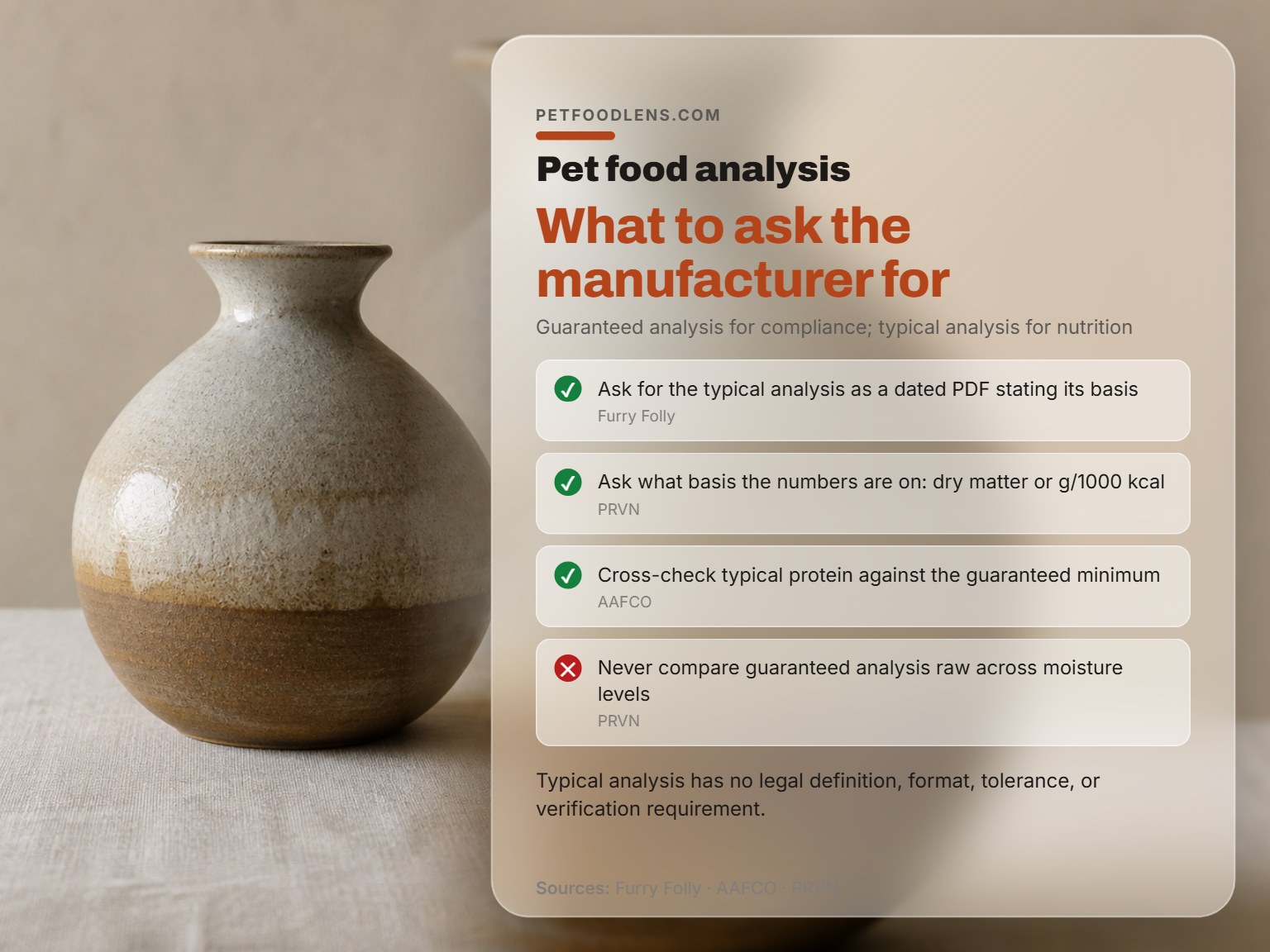
The practical move is to ask for both documents and use them for different jobs.
- Ask for the typical analysis as a PDF, not a web page summary. A real one is dated and states the basis it is reported on.
- Ask what basis the numbers are on. A typical analysis reported as-fed is only marginally more useful than the panel. You want dry matter or, better, grams per 1000 kcal.
- Ask for the lot or batch date. An undated average could be from a formulation the company stopped making.
- Cross-check the guaranteed analysis against the typical. If the typical protein sits far above the guaranteed minimum, that is normal and expected. If it sits below, something is wrong.
- Ask whether the food was fed in a trial or formulated on paper. The adequacy statement tells you which, and it changes how much weight the rest deserves.
If a manufacturer cannot produce a typical analysis on request, that is information. It does not prove the food is bad. It does prove nobody outside the company can verify the nutrient content, and you should weigh the marketing accordingly.
For the wider label context, reading a pet food label covers how the adequacy statement, the panel, and the ingredient list fit together.
The short version: guaranteed analysis for compliance questions, typical analysis for nutrition questions, and never the two compared raw across moisture levels.
Frequently Asked Questions
Is typical analysis more accurate than guaranteed analysis?
It is more representative, which is a different thing. A typical analysis reflects measured or stated averages, so it tells you roughly what is in the food. A guaranteed analysis tells you the legal floor the food must clear. The WSAVA Global Nutrition Guidelines argue typical data is the appropriate input for clinical comparison, while AAFCO and the FDA argue the guaranteed analysis is the binding figure, a genuine disagreement between the bodies. Both are right about their own question.
Can I compare a wet food and a dry food using the guaranteed analysis?
Not as printed, according to peer-reviewed veterinary nutrition guidance, which holds that guaranteed analysis is not comparable between products with different moisture levels, while AAFCO and the FDA treat guaranteed analysis as the correct basis for comparing products against AAFCO nutrient profiles. Convert both to a dry matter basis first, or better, to grams per 1000 kcal of metabolizable energy. Only then does the comparison mean anything.
Why do recalls mention the guaranteed analysis?
Because it is the only figure with a legal standard attached. FDA CVM has documented cases where panels did not match laboratory results, and recalls repeatedly cite products failing to meet the guaranteed analysis, such as protein falling below the guaranteed minimum or a nutrient exceeding a guaranteed maximum. A failed guaranteed analysis is a misbranding issue, which is enforceable.
Does a “meets AAFCO” statement mean the food is high quality?
It means the food clears a minimum-adequacy standard. AAFCO compliance is not a quality guarantee and not a consistency guarantee. It confirms the formulation meets a nutrient profile. It says nothing about ingredient sourcing, batch-to-batch variation, or whether the typical analysis matches the label.
Where do I get a typical analysis?
Ask the manufacturer directly, and ask for it on an energy basis. Some publish it on request, some publish it as a downloadable product guide, and some cannot produce one at all. Veterinary nutrition literature recommends requesting manufacturer product guides for exactly this reason, particularly for therapeutic and hydrolyzed diets where guaranteed minimums understate actual nutrient levels.
The Bottom Line
Here is the threshold that decides it. If you are checking whether a food is legally adequate, use the guaranteed analysis and stop there. If you are calculating what an animal is actually eating, the guaranteed analysis cannot get you there and you need the typical figure on a dry matter or per-1000-kcal basis.
The first step this week is small. Pick one food you feed and email the manufacturer asking for the typical analysis reported in grams per 1000 kcal, with a date on it. Whatever comes back tells you more about that company than the front of the bag ever will.
One concession, and it is an important one. I am not a veterinarian, and this stops being a label exercise the moment a cat has kidney disease, diabetes, or a diagnosed allergy. Therapeutic and hydrolyzed diets are where guaranteed minimums understate reality the most, and where a wrong assumption does real harm. Take the typical analysis to your vet and let them run the numbers against the case in front of them.
For a healthy adult cat, though, the math above is enough to keep you honest. Read past the front of the bag. The back panel is where the actual argument lives.
