
How to Compare Wet and Dry Food Fairly: Dry Matter First
This post contains affiliate links. As an Amazon Associate, we earn from qualifying purchases.
How to compare wet and dry food fairly: convert every number on the guaranteed analysis to a dry matter basis. Divide the as-fed percentage by 100 minus the moisture percentage, then multiply by 100. A 12% protein wet food at 78% moisture works out to 54.5% protein once the water is removed.
Skip that conversion and the panel reads backwards. A can of wet food lists 12% crude protein next to a bag of dry food listing 37%, and the kibble looks like three times the food. The can is mostly water, and water contributes nothing to the protein number once you strip it out.
What follows is the arithmetic, the source disagreements that make one moisture number unreliable, and the two comparisons that matter more than the front of the bag: protein on a dry matter basis and cost per 1,000 calories.
Key Takeaways
- Convert first, compare second. Every percentage on the can or bag is diluted by water, so the only fair comparison is dry matter basis.
- The moisture number itself is not reliable. Published ranges run dry food from 6% to 12% and wet food from 70% to 85%, and lab methods disagree by up to 0.9 points.
- Protein and fat look higher in wet food once you convert. Typical wet food runs 40-55% protein on a dry matter basis against 30-45% for dry.
- Cost per pound is a trap. Compare cost per 1,000 calories, since a wet food’s water weight inflates the price per pound.
- Opened wet food does not keep for a week on the counter. Sources split from “about an hour” at room temperature to “5-7 days refrigerated and covered,” and the fridge is what makes the longer number true.
How to Compare Wet and Dry Food Fairly: Read the Panel First
The guaranteed analysis is a legal disclosure. Protein and fat carry minimums on that panel, while moisture and fiber carry maximums, so the four numbers describe boundaries rather than a nutritional summary.
The guaranteed analysis lists nutrient percentages as fed, meaning water is counted in the total. Because moisture varies from roughly 10 percent in kibble to 75-82 percent in canned food, the same protein percentage represents very different amounts of actual protein per unit of dry food.
The four numbers on the panel do different jobs:
- Crude protein, min: a floor, not a measurement.
- Crude fat, min: a floor, not a measurement.
- Crude fiber, max: a ceiling, not a target.
- Moisture, max: a ceiling on water, not a quality claim.
That’s the whole problem in one paragraph. A kibble guaranteeing 26% protein and a fresh food guaranteeing 11% look like a blowout on the panel. Convert both to a dry matter basis and the fresh food wins: 11 divided by 28 (the dry matter) times 100 is 39.3% protein, against 26 divided by 90 times 100, which is 28.9%.
The math reverses the ranking. That difference is large enough to change which food you pick.
How Do You Convert to a Dry Matter Basis?
The formula is one line of arithmetic: divide the as-fed percentage by 100 minus the moisture percentage, then multiply by 100.
Here is the math as a sequence you can run on any label in under a minute:
- Find the moisture percentage on the guaranteed analysis. It’ll be listed as “moisture, max.”
- Subtract that from 100 to get the dry matter percentage. A can at 78% moisture is 22% dry matter.
- Divide the nutrient percentage by the dry matter percentage. 12 divided by 22 is 0.545.
- Multiply by 100. That gives 54.5% protein on a dry matter basis.
Where this goes sideways: Treating the label moisture number as exact. The AAFCO study found the 135 °C oven method biased high by 0.86 percentage points on one dry cat food sample, which is enough to shift the dry matter conversion.
A Worked Example on Four Foods
The table below runs four foods through the same conversion, and the two that look weakest on the panel come out strongest once the water is removed.
| Food | As-fed protein | Moisture | Dry matter protein |
|---|---|---|---|
| Wet (12% protein) | 12% | 78% | 54.5% |
| Dry (37% protein) | 37% | 12% | 42% |
| Fresh (11% protein) | 11% | 72% | 39.3% |
| Kibble (26% protein) | 26% | 10% | 28.9% |
The arithmetic is the easy part. Remembering to run it every time, on every food, before you trust a comparison, is the hard part.
Why Is the Moisture Number on the Label Unreliable?
Two labs can measure the same bag of kibble and disagree by nearly a full percentage point. That’s enough to move a dry matter conversion by a point or more.
The AAFCO moisture determination report tested retail pet foods against three methods: Karl Fischer titration, a 135 °C oven for 2 hours, and a 104 °C oven for 3 hours. For dry cat food from one vendor, Karl Fischer read 5.58% moisture, the 135 °C oven read 6.44%, and the 104 °C oven read 5.98%.
The 135 °C method was systematically biased high across every dry sample, which means a label moisture number derived from that method overstates the water and understates the dry matter.
The mechanism is straightforward. The 135 °C oven drives off water and a slice of volatile compounds along with it, so the weight loss overstates moisture. The 104 °C oven is gentler and tracks the Karl Fischer reference more closely. For wet cat food, no difference was detected between either oven method and Karl Fischer, so the method choice matters most on dry food.
What does that mean for a label reader? The moisture number on a bag is a reasonable estimate, not a measurement you should treat as exact. If you’re comparing two dry foods that sit within a point of each other on moisture, the difference is inside the noise.
What the Sources Actually Disagree About
Every popular article on this topic repeats the same wet and dry moisture ranges. The ranges are wrong at the edges, and the sources do not agree with each other.
The UK Pet Food formats fact sheet says dry food runs approximately 8-10% moisture and wet food approximately 70-80%. Zoetis puts dry at 10-12% and wet at 75-80%. GoodVets says dry is 6-10% and wet is 70-85%. Meow Servant says dry is 6-10% and wet is 75-82%. Catster says dry is less than 20% and does not give a wet range. Chompz says dry is around 10% and wet is about 70-75%.
| Source | Dry food moisture | Wet food moisture |
|---|---|---|
| UK Pet Food | approx 8-10% | approx 70-80% |
| Zoetis | 10-12% | 75-80% |
| GoodVets | 6-10% | 70-85% |
| Meow Servant | 6-10% | 75-82% |
| Chompz | around 10% | about 70-75% |
| Catster | less than 20% | not stated |
The AAFCO lab data sits inside all of those ranges and confirms none of them exactly. Measured moisture was 6.87-10.32% for dry dog food, 5.58-8.83% for dry cat food, 74.37-81.10% for wet dog food, and 76.50-81.43% for wet cat food. The 8% floor that UK Pet Food publishes is contradicted by a direct measurement of 5.58% on one dry cat food.
Here is the practical takeaway. Use the actual label on the food in front of you, not a published range. The range is a rough map; the label is the territory.
I will not tell you a can of wet food is fine sitting out for five days. UK Pet Food says 5-7 days refrigerated and covered, and that is a food-safety ceiling, not a target. Catster says about an hour at room temperature. Both can be true at once, and the fridge is what makes the difference.
Protein, Fat, and Carbs on a Dry Matter Basis
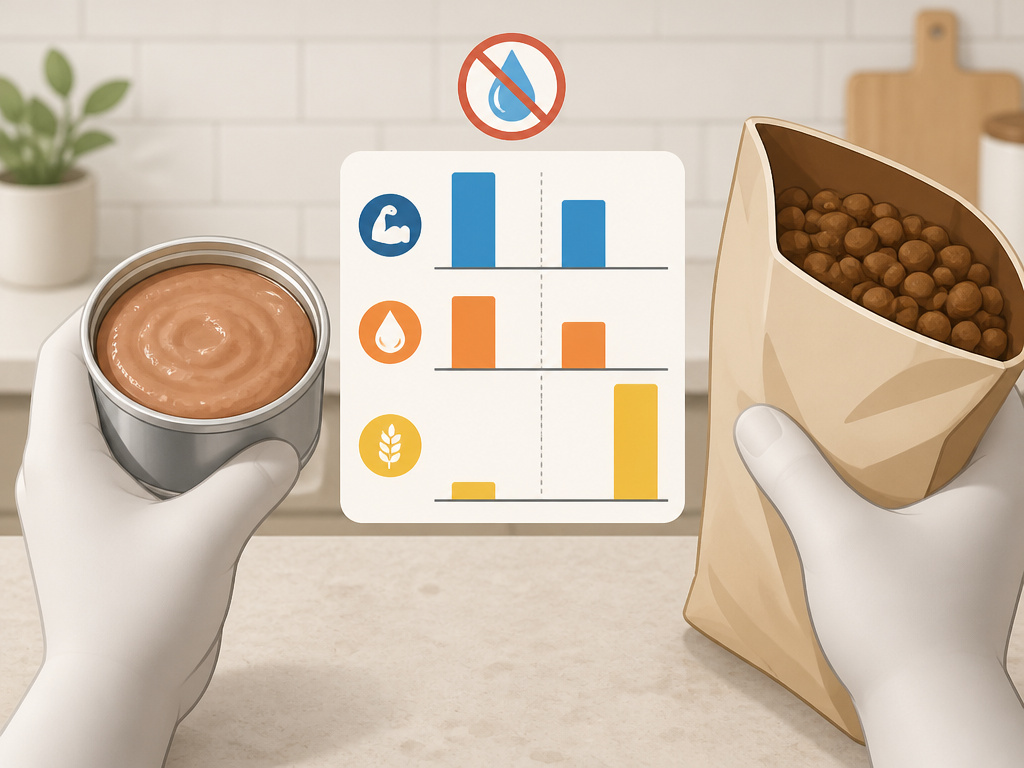
Once you convert both foods to dry matter, a pattern emerges in many commercial products: wet food runs higher in protein and fat and dramatically lower in carbohydrates, though McGill notes wet and dry foods have similar protein and fat levels with dry foods containing significantly more carbohydrates.
What the Typical Numbers Look Like
The typical published values look like this:
- Protein (DMB): wet 40-55%, dry 30-45%.
- Fat (DMB): wet 20-35%, dry 15-25%.
- Carbohydrates (DMB): wet 1-15%, dry 25-50%.
- Calories: wet 80-120 kcal per 100g, dry 350-400 kcal per 100g.
Those are aggregate figures from a commercial source, not a controlled study, so treat them as a rough map rather than a spec sheet. The pattern holds; the exact numbers will move by brand, which is why comparing protein percentages across formats requires the conversion rather than the front-of-bag number.
Early on I compared two cat foods on the as-fed numbers and picked the one with the higher protein. Then I ran the dry matter conversion and the ranking flipped. The food I had rejected was the higher-protein formula once the water came out. I have converted every comparison since.
A high-moisture pate looks glossy and slumps on the plate. A lower-moisture pate holds a firm shape and reads as denser food, which is a useful visual check before you even flip the can over.
The carbohydrate gap is the one that surprises most owners. Dry food runs 25-50% carbs on a dry matter basis, wet food runs 1-15%, and the difference is structural. Starch is what holds a kibble together, so a dry food has to carry more of it. That’s a manufacturing constraint more than a knock on kibble. But if your cat is diabetic or prone to weight gain, the carb number is the one to look at, and the vet is the one to ask.
Calories and Cost: The Comparison Most Owners Skip
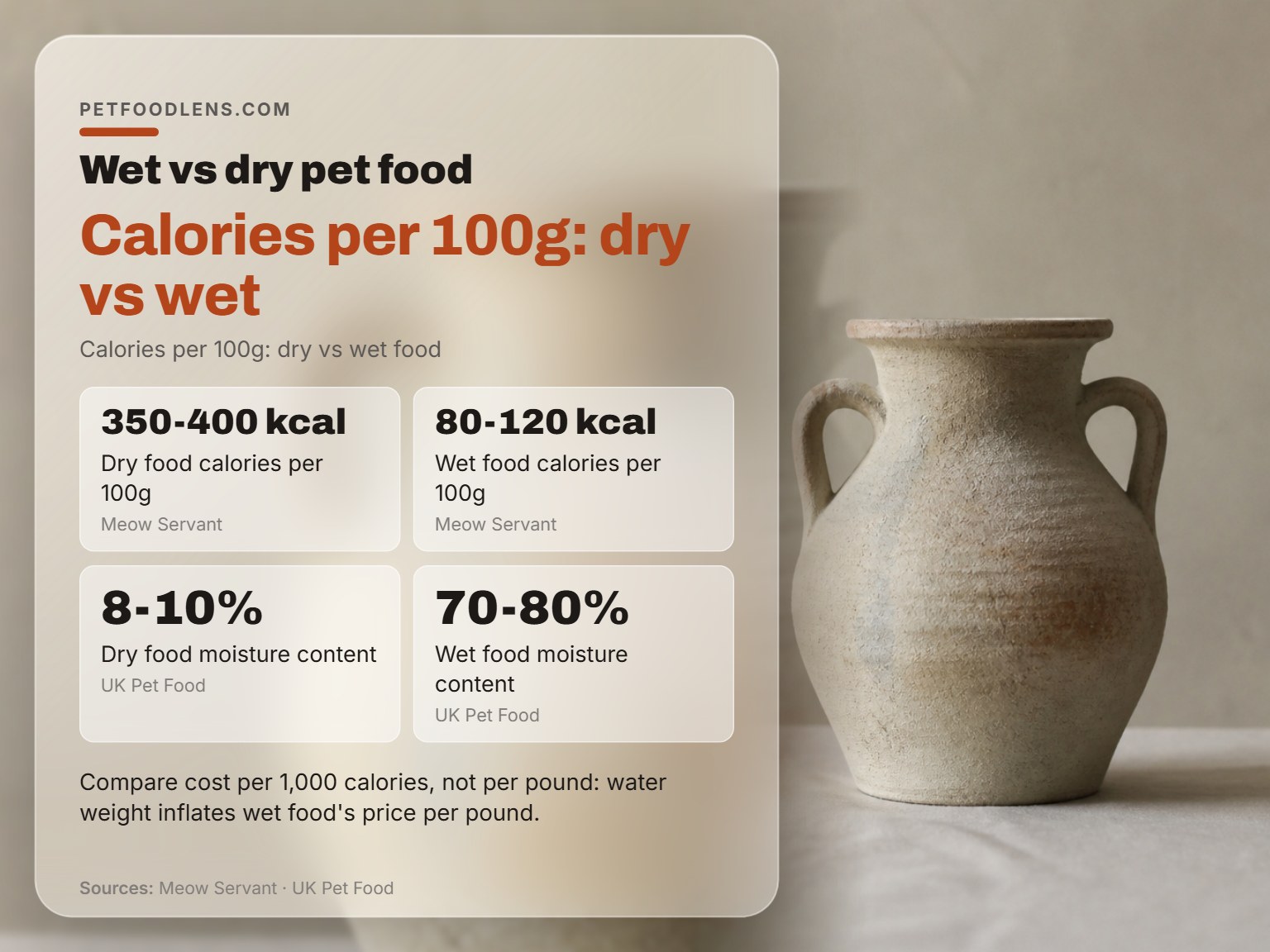
The calorie gap between wet and dry is large: dry food runs about 350-400 kcal per 100g, wet food about 80-120 kcal per 100g.
That gap is why cost per pound is the wrong number to compare. A wet food’s water weight inflates the price per pound, so the dry food looks cheaper than it is per calorie. Compare cost per 1,000 calories instead, and the gap narrows.
Easy to miss: Comparing cost per pound between wet and dry. Wet food’s water weight inflates the price per pound, so the dry food looks cheaper than it is per calorie.
The comparing calories in pet food arithmetic is the same shape as the dry matter conversion: pull the kcal per kilogram or kcal per cup off the label, normalize to a common unit, and compare. Most owners never do it, which is why the “wet food is too expensive” claim survives so well. It is more expensive per pound. It is not always more expensive per calorie.
I have run this comparison on enough foods to know the cost-per-calorie gap is smaller than the price-per-pound gap suggests.
For a dog on a budget, the kibble vs canned dog food comparison usually lands on kibble as the base and canned as a topper. For a cat, the wet vs dry cat food math often lands the other way, because the moisture content does work that the calorie number doesn’t capture.
Storage, Safety, and the Transition Between Formats
A can of wet food left on the counter is not the same food hours later. Bacterial growth in a high-moisture environment is fast, and the sources that give a longer window are all assuming refrigeration.
Before you start: An opened can of wet food left at room temperature for more than about an hour is a bacterial-growth risk, and Catster puts the ceiling at about an hour. Dry food stored warm goes rancid as the fats oxidize, which shows up as a sharp, crayon-like smell in the bin. Keep the wet food in the fridge and the dry food in a cool, dry cupboard.
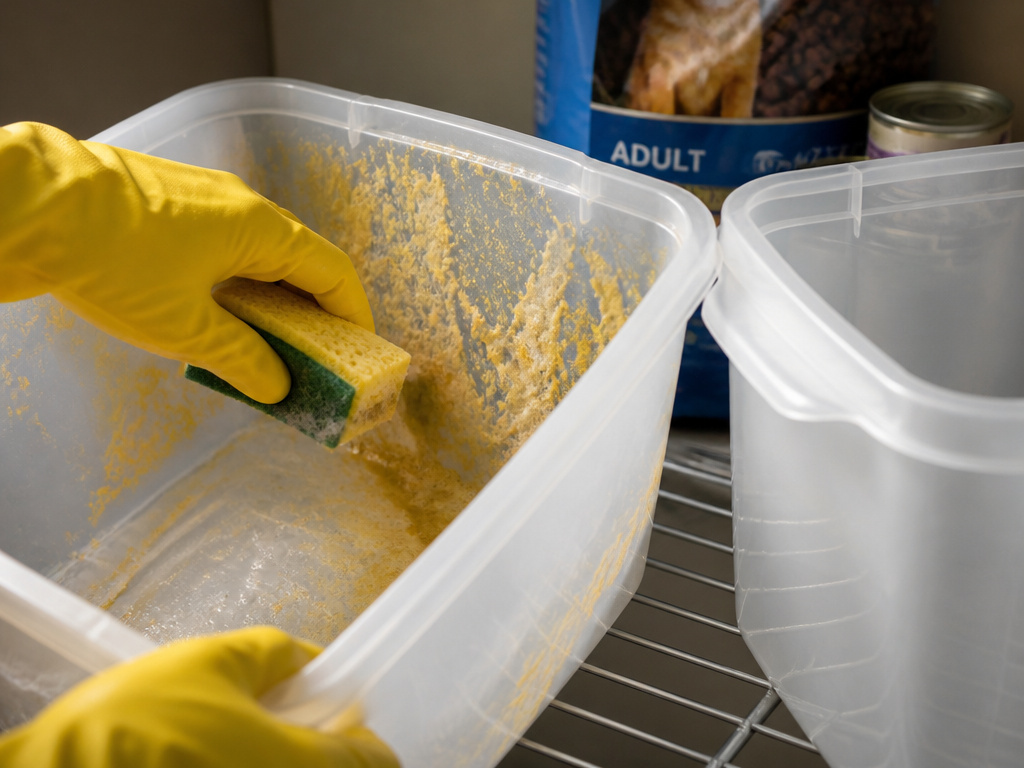
I dumped out a bin at the bottom of a pantry once and found a yellowish, tacky film on the walls and a sharp crayon-and-paint smell. Fresh kibble had been poured over that residue, so every new batch met old oxidized fat on day one. If you use a bin, empty it completely and wash it with hot soapy water between bags, then dry it fully. Damp plastic plus fat residue is a bad pairing.
Switching Between Formats Without a Hunger Strike
Slow switches are recommended over fast ones. A gradual shift over about a week, starting with a small amount of wet mixed into kibble, works better than swapping the bowl overnight and arguing with a cat who then refuses to eat.
A cat that stops eating during a transition is a vet call, not a stubbornness contest. Overweight cats are the ones to watch when a cat goes off food.
For puppies and large breed dogs fed wet food alone, the UK Pet Food sheet flags a specific problem: the dog may feel full and finish the meal before nutrient requirements are met. That’s a case for a vet conversation, not a label comparison.
The wet food and hydration angle is the other reason owners switch. The moisture content in wet cat food matters more than the brand on the can. UK Pet Food also recommends one water bowl per pet plus one extra, the 1+1 rule.
Frequently Asked Questions
Is wet food better than dry food for cats?
Neither format is consistently superior. UK Pet Food says superiority should be measured on content, not format, and both wet and dry foods can carry the AAFCO nutritional adequacy statement that confirms complete and balanced nutrition. The decision comes down to moisture, cost, and what your cat will actually eat.
How do I compare protein in wet and dry food?
Convert both foods to a dry matter basis first. Divide the as-fed protein percentage by 100 minus the moisture percentage, then multiply by 100. A wet food at 12% protein and 78% moisture works out to 54.5% protein on a dry matter basis, which is higher than most kibble.
How long can opened wet food stay in the fridge?
UK Pet Food says up to 5-7 days if the food is covered to minimize air exposure and refrigerated. Zoetis says to serve wet food fresh at each meal and throw away leftovers. Catster says not to leave wet food out at room temperature for more than about an hour. The safe answer is to refrigerate promptly and use the shorter end of the range.
Should I mix wet and dry food?
Mixing is fine for most cats and dogs, and it’s a common way to add moisture without giving up the convenience of kibble. Divide the daily feeding amount proportionally between the two formats so you don’t overfeed. GoodVets recommends a gradual switch over a week to avoid digestive upset.
What’s the difference between as-fed and dry matter basis?
As-fed means the percentage includes the water in the food. Dry matter basis strips the water out so foods with different moisture levels can be compared fairly. AAFCO nutrient profiles are published on a dry matter basis, so you convert the label’s as-fed figures before comparing.
The Bottom Line
Here is the practical takeaway for how to compare wet and dry food fairly. If you only do one thing after reading this, convert the guaranteed analysis on your cat’s current food to a dry matter basis and write the number on the lid of the container. Most owners have never done it, and the number that comes out is often different enough from the front of the bag to change the decision.
If the wet food you’re considering runs higher in dry matter protein than the kibble you feed now, and your cat is healthy, the wet food is the better protein buy. If the gap is small, the choice comes down to moisture, cost, and what your cat will actually eat.
One caveat worth stating plainly. Everything above assumes a healthy adult cat or dog. If your animal has kidney disease, diabetes, or a food allergy, the dry matter comparison is still useful, but it’s a starting point for a conversation with your vet, not a substitute for one.
