
How Often to Feed a Goldfish: 5 Sources Compared
This post contains affiliate links. As an Amazon Associate, we earn from qualifying purchases.
How often to feed a goldfish is genuinely contested: Hikari labels say 2 to 4 times daily, the CVMA says once daily suffices, and a 2015 trial found 2 feeds a day gave the best weight gain. Once or twice daily sits inside every range.
The spread tracks the question each source is answering. A hatchery chasing weight gain, a vet worried about murky water, and a manufacturer selling pellets are optimizing three different things, and the answer to how often to feed a goldfish changes with the target. Pick the target that matches your tank.
What follows compares the five positions side by side and gives you the numbers to set a schedule you can keep.
Key Takeaways
- Hikari’s three goldfish labels all say 2 to 4 times daily, and all three cap the portion at what the fish clears in a few minutes.
- The CVMA allows once daily, which sits at the bottom of the published range and still counts as adequate.
- A 2015 trial found 2 feeds a day beat 1, 3 and 4 for weight gain, while feed conversion was best at a single daily feed.
- Below 10 C (50 F) or above 30 C (86 F), Hikari says reduce the amount fed, and the USFWS goes further with every-other-day winter feeding.
- Uneaten food comes out after every feeding. On that point every source agrees without qualification.
How Often to Feed a Goldfish: Five Sources, Five Answers
Hikari’s labels say 2 to 4 times daily. The CVMA says once daily suffices. Both are current, both are defensible, and they can’t both be the whole story.
Commercial goldfish labels direct feeding two to four times daily, limited to what the fish clears in a few minutes. Veterinary guidance permits once daily. Federal hatchery guidance allows a single daily pinch for two small fish. Controlled trials split between two feeds and four feeds per day.
| Source | Daily frequency | What it optimizes |
|---|---|---|
| Hikari Oranda Gold, Bio-Gold+, Saki-Hikari | 2 to 4 feeds | Growth and colour on a prepared diet |
| CVMA | Twice daily, or once daily | Basic health and water quality |
| USFWS Leaflet 57 | One pinch daily for two small fish | Hatchery survival |
| Merck Veterinary Manual | At least daily | Adult maintenance |
| Hafeez-ur-Rehman et al. 2015 | 2 feeds for weight gain, 1 for efficiency | Growth performance |
Where the Manufacturer Labels Agree
All three Hikari goldfish labels carry the same four instructions, worded almost identically. Feed 2 to 4 times daily. Don’t exceed what the fish clears in a few minutes. Remove uneaten food after the feeding period. Reduce the amount when water sits consistently below 10 C (50 F) or above 30 C (86 F).
That last line is the one I’d frame. It comes from a pellet manufacturer rather than a veterinary body.
The CVMA sits at the other end. It allows twice daily but says once daily will also suffice, and it puts the general dose at one pinch per fish per feeding. That’s a per-fish figure, which is a different unit from the USFWS per-tank figure, and the difference is the subject of a later section.
Why Two Goldfish Feeding Trials Reached Opposite Conclusions
Hafeez-ur-Rehman and colleagues ran 40 goldfish at a 2% bodyweight ration for eight weeks in 2015 and found 2 feeds a day produced the best weight gain. Four feeds a day produced the lowest. Feed conversion ran the other way, best at one feed and degrading with every increase in frequency.
The Design Difference That Explains It
- 2015 trial: 40 goldfish at 20 g average, 2 fish per replicate across 5 replicates, meals at 0800, 1200, 1600 and 2000 for the higher-frequency groups.
Notice what the trial holds constant. The ration is 2% of bodyweight, so the study doesn’t test whether more food helps. They test whether the same daily total, divided differently, changes growth. That’s a narrower question than the one most owners are actually asking.
For the broader version of that question across species, the feeding frequency picture is messier still.
How Long Should Food Stay in the Tank?
Hikari says a few minutes. OATA says no more than a minute or so. That gap matters more than it looks, because the window is what converts a frequency into an actual portion.
A pellet that’s been in the water for a few minutes goes soft and pale and starts shedding a fine dust into the water column. That dust is what feeds the bacteria you’re trying not to grow.
Set the window at one minute and you’ll feed less than the label implies. Set it at five and you’ll feed more. Pick one and hold it, because switching between them is how tanks drift.
Common mistake: Judging the portion by how eagerly the fish eat. The CVMA is explicit that overfeeding can be lethal, which means appetite is a poor guide to how much they need.
The practical version: drop food in, start a timer, and net out whatever is still there when it goes off. Do that for a week and you’ll know your tank’s real portion without weighing anything.
The Pinch Problem: Two Authorities, Two Different Pinches
The CVMA defines a pinch as roughly 1/4 to 1/8 teaspoon, measured per fish, per feeding. The USFWS says a pinch of food daily is sufficient for two small goldfish. Same word, half the allowance.
| Ration reference | Amount | Applies to |
|---|---|---|
| CVMA pinch | 1/4 to 1/8 tsp per fish, per feeding | General home feeding |
| USFWS pinch | One pinch daily, shared between fish | Two small goldfish |
| Merck maintenance | 3% of body weight daily | Adult fish |
| Merck fry ration | Up to 5% of body weight daily | Fry and fingerlings |
| 2015 trial ration | 2% of body weight daily | Trial conditions only |
The 2% figure is a trial ration, not a feeding recommendation. Merck’s 3% is a maintenance target for adults. Those are different numbers serving different purposes, and averaging them produces a figure no source actually endorses.
If you want a starting point, the CVMA pinch is the most usable home measure because it’s per fish and it’s volumetric. Adjust from there based on what the tank looks like a week later.
Before you start: Overfeeding is the failure mode that kills fish here. The CVMA calls it potentially lethal, and the USFWS leaflet notes excess food pollutes water and lowers oxygen fast enough to kill fish before help arrives. Remove uneaten food after every single feeding, no exceptions.
I once handed a client a feeding amount straight off a label and forgot to count the treats and toppers going in between meals. Two months later the animal had gained visible weight, and every plan I’ve written since counts everything that goes into the bowl. Fish sit outside my hands-on species experience, so on this topic I’ll stay with what the sources actually say.
Fry and Small-Mouthed Fish
Merck puts fry and fingerlings at up to 5% of body weight daily, well above the adult maintenance figure. The CVMA adds that flakes should be crumbled for smaller fish, and Merck makes the same point about small-mouthed species generally.
For a fuller look at feeding fish fry, the ration math changes enough to deserve its own treatment. The pinch measure doesn’t scale down well, and crumbling is doing more work than most owners realise.
Getting how much to feed right matters more than hitting an exact frequency. And if you’re already seeing cloudiness, the overfeeding fish checklist starts with the portion, not the schedule.
What Changes Below 10 C and Above 30 C?
Hikari sets two triggers: reduce the amount fed when water sits consistently below 10 C (50 F) or above 30 C (86 F), based on activity level and tank condition. The USFWS goes further for winter, recommending feeding every other day.
Neither source tells you to stop feeding entirely.
Cold Water: Reduce or Skip?
Here’s where the sources genuinely part company, and the article you’re reading is one of the few that will say so plainly.
- Hikari: reduce the amount, scaled to how active the fish are and how the tank looks.
- USFWS: feed every other day through winter.
- Merck: most aquarium fish should be fed at least daily, with an exception for carnivorous fish that take large meals once or twice a week.
That Merck exception gets quoted constantly in goldfish threads and it doesn’t apply. It’s written for large-meal carnivores, and a goldfish isn’t one.
The US Fish and Wildlife hatchery leaflet is the only source here that commits to an alternate-day winter schedule. Hikari commits only to a reduction. Both defer to observed activity rather than a gram figure, which means you’re making a judgment call either way.
Above 30 C: The Cutoff Only Hikari Sets
No equivalent heat trigger appears in the CVMA, USFWS or Merck guidance in this set. Hikari sets a 30 C (86 F) line.
That doesn’t make it wrong, but you should treat it as one source’s guidance. If your tank runs hot in summer, reducing the amount is a low-risk move regardless of which authority you were following before.
For the wider schedule picture, the goldfish feeding guide covers how frequency interacts with water changes and tank size.
Feeding a Goldfish While You’re Away
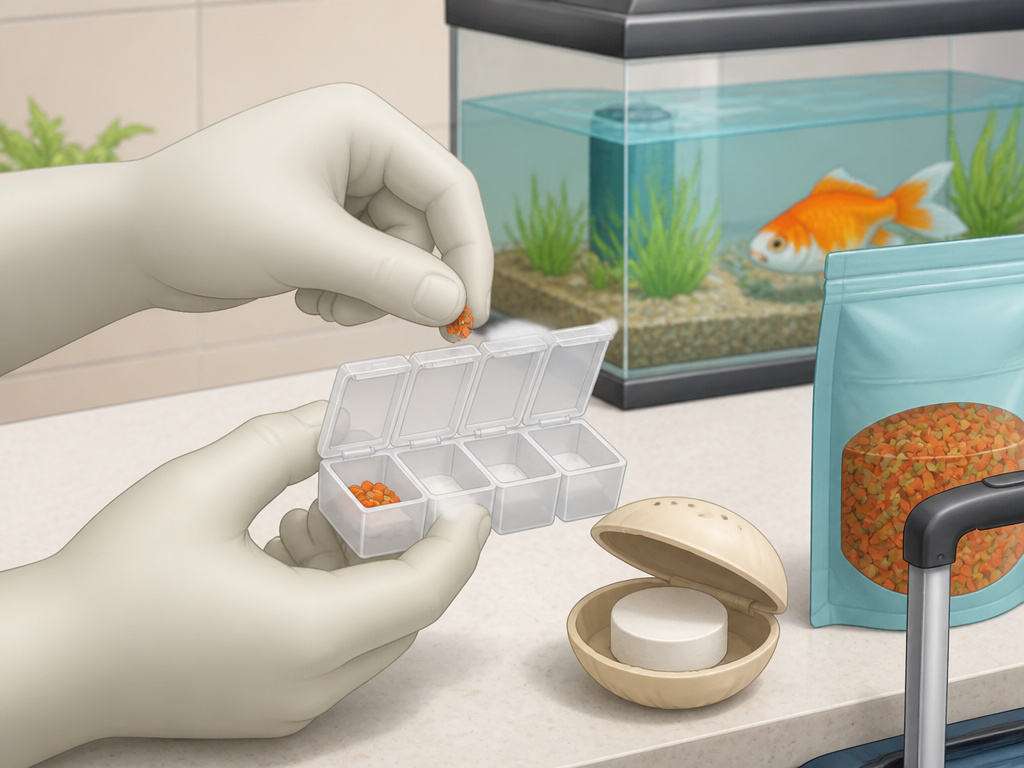
Friday night, bag by the door, tank in the hallway, and a decision to make about Saturday and Sunday.
The CVMA is direct about this. If fish are left for more than a day, a weekend or week feeder shell should go in the tank unless a pet sitter is handling regular feedings. If you do use a sitter, show them the exact portion rather than describing it.
- Work out the portion before you leave. Measure it into a bag or pill box per feeding so nobody has to eyeball a pinch at 7am.
- Decide between a feeder shell and a sitter. A shell covers the gap; a sitter covers the gap and the observation. Pick based on how long you’re gone.
- Show the sitter the portion, not the container. The CVMA specifically warns that a sitter needs to be shown how much to feed, because overfeeding is the standard failure when someone else takes over.
An automatic fish feeder solves the timing problem but not the portion problem. You still have to dial it in, and most of them dispense more than a goldfish needs on the lowest setting.
For a longer trip, the feeding fish on vacation breakdown covers the multi-week case, which is a different problem again.
Storing Goldfish Food: The Dates Most Owners Ignore
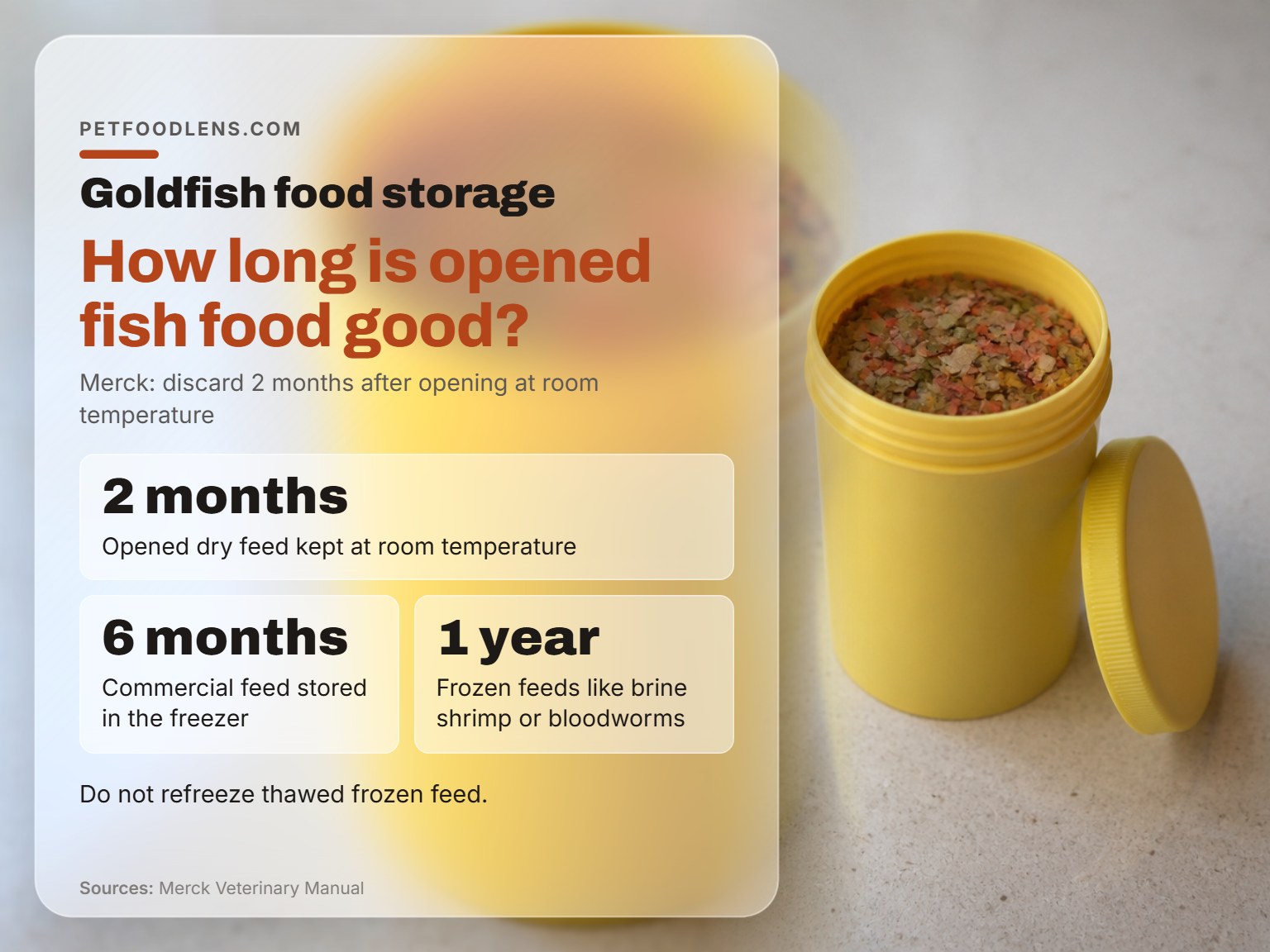
Merck’s guidance is blunt: a feed container kept at room temperature should be discarded two months after opening. Not two months after the best-before date. Two months after you break the seal.
Fish food goes rancid because it’s high in protein and oil, and Opened tubs that have been sitting in a warm cupboard for a season are a real risk, not a theoretical one.
Easy to miss: Freezer storage extends the window to six months, not indefinitely. Merck puts commercial feeds stored in the freezer at six months before discard, and frozen feeds like brine shrimp or bloodworms at one year.
Room Temperature vs Freezer
Merck’s storage rules break down into four usable points: dry feeds in a pest-proof container at low humidity and low temperature, two months at room temperature, six months in the freezer, and no refreezing once a thawed frozen feed has warmed up.
Two months is shorter than most people expect. Write the opening date on the lid with a marker and the rule enforces itself.
If you’re choosing what to buy in the first place, the goldfish food comparison covers pellet versus flake and why sinking versus floating changes how much actually gets eaten. Saki-Hikari Fancy Goldfish, for instance, is a sinking pellet at roughly 1.3 to 1.6 mm, which suits a fancy goldfish that struggles to come up for food.
Frequently Asked Questions
Can I feed my goldfish just once a day?
Yes. The CVMA states plainly that once daily feeding will suffice, and the 2015 trial found feed conversion was actually best at one feed per day. What you give up is the maximum weight gain seen at two feeds per day.
Is it better to feed twice or four times a day?
The sources disagree and you should know that going in. Hikari’s labels allow up to four feeds. The 2015 trial found four feeds produced the lowest weight gain of any group tested. Two feeds a day sits inside the Hikari range and matches the 2015 trial’s best weight-gain result.
How much is one pinch of goldfish food?
The CVMA puts a pinch at roughly 1/4 to 1/8 teaspoon, measured per fish per feeding. The USFWS uses the same word for a shared pinch across two small goldfish.
Should I feed less in winter?
Hikari says reduce the amount when water stays consistently below 10 C (50 F), scaled to activity level. The USFWS recommends feeding every other day in winter. Neither source recommends a full fast.
How long can goldfish go without food?
The CVMA addresses this directly: if fish are left for more than a day, a weekend or week feeder shell should be placed in the tank unless a pet sitter is doing regular feedings. Beyond that window, arrange coverage rather than stretching the gap.
The Bottom Line
Everything above assumes a healthy adult goldfish in water at normal room temperature. Fry, sick fish, and anything sitting in an unheated tank in January need different numbers, and none of these sources hand you a gram figure for those cases. That’s the honest limit of the published guidance.
One trigger worth memorising: if the water goes murky within a day of feeding, cut the ration before you touch anything else. The CVMA names murky water as the direct consequence of overfeeding, and it shows up long before weight change does.
Start with one feeding time, held for a week, at a portion you measured once. Then adjust from what the tank tells you rather than from what the tub says. The label is a range, not a prescription, and the fish in front of you is the only data source that’s actually about your tank.
