
How to Feed Fish Fry: Frequency, Amount, and Timing
This post contains affiliate links. As an Amazon Associate, we earn from qualifying purchases.
To feed fish fry, start small and often: hand-feed a fine crumb eight to ten times a day until every fry is actively eating, then drop to about five feeds daily as they grow. Feed 1 to 2 percent of body weight per feeding and stop when water drops below 40 F or climbs above 68 F.
That 1 to 2 percent figure comes from trout fed nearly to satiation, not from a rule about how to feed fish fry based on how a fry’s gut works.
What follows is the practical sequence: when to start, how often, how much, what temperature does to all three, and the two places where the published guides flatly contradict each other.
Key Takeaways
- Hand-feed 8 to 10 times a day at the start, per SRAC Publication No. 223, until every fry is actively eating.
- Drop to about 5 feeds a day as the fry grow, and keep 2 or 3 of them by hand so you can actually watch the fish.
- Feed 1 to 2 percent of body weight per feeding for trout near satiation, while larval fish overall eat far more relative to weight.
- Pull the feed below 40 F or above 68 F water temperature, and withhold it entirely when fish are sick.
- Weigh-count fry weekly for the first 4 to 6 weeks and recalculate the ration instead of trusting a printed chart.
When Should You Start Feeding Fry?
Trout fry start taking prepared feed seven to ten days after hatching, according to SRAC Publication No. 223. That is later than most people expect, and it is the biological trigger rather than a guess.
The classroom version of the same event uses a visual cue instead of a calendar. Salmonids in the Classroom, a DFO-partnered school program, says to begin when a quarter of the fry are swimming about in the middle of the tank. Watch for that quarter.
First feeding marks the transition from yolk absorption to exogenous feeding, when the fry must find food outside the body. Fry that have not taken prepared feed within roughly a week of swim-up are running on stored energy. The trigger is behavioral: active mid-water swimming by a visible share of the population indicates readiness.
When you compare a how to feed fish fry, feed size matters more than feed brand at this stage. A fry food that is too coarse for the fry just sinks and rots. SRAC recommends a large kitchen strainer for spreading finely ground starter feed, which tells you the target texture: dust, not pellets.
I read ingredient panels for a living, mostly cat food. A fry diet is a different panel with different numbers, but the same rule holds. The front of the jar is marketing. The back is the diet.
How Often Should You Feed Fish Fry?
Two credible guides disagree about this, and both are describing real fish.
SRAC Publication No. 223 runs hot: eight to ten hand feeds per day until all fry are actively feeding, then an automatic feeder with two or three hand feedings daily so the fish can be observed, gradually stepping down to about five times per day.
Salmonids in the Classroom runs cooler: every hour for the first two days, then four times a day at a fixed 1/16 teaspoon.
The National Academies Press sits furthest out, noting that swim-up fry should be fed at least once every hour during normal light hours, with no fasting allowance stated.
| Source | Frequency | Amount per feed | Weekend feeding |
|---|---|---|---|
| SRAC Publication No. 223 | 8 to 10 daily at first, down to about 5 | 1 to 2 percent of body weight | None allowed |
| Salmonids in the Classroom | Hourly for 2 days, then 4 times daily | 1/16 tsp, fixed | Skipped |
| Nutrient Requirements of Fish | At least hourly during light hours | 50 to 300 percent of body weight daily | None stated |
Compare it side by side and the shape is clear. The hatchery source is feeding for growth rate. The classroom source is feeding for a school schedule and a small tank. Both are internally consistent, and neither is a universal rule.
The 8-to-10 vs 4 Times a Day Split
The gap comes down to what each source is optimizing. A production hatchery wants maximum growth per unit of feed, and near-satiated fish fed often convert better. A classroom wants a routine students can follow without fouling the tank.
For a home batch, the useful move is to pick the frequency your day can actually support and then watch the tank. Feeding frequency matters less than whether the fry are clearing what you put in.
Where this goes sideways: Choosing a number off a table and never watching the tank. Both schedules assume somebody is checking that the fry actually eat. Skip that check and the number means nothing.
How Much Feed Goes In at Each Feeding?
The National Academies Press puts larval intake at 50 to 300 percent of body weight per day, against 2 to 10 percent for subadult fish grown to market size. That sounds impossible next to SRAC’s numbers until you check the units.
SRAC’s figure is 1 to 2 percent of body weight per feeding, measured on trout fed nearly to satiation, meaning the point where they stop chasing food. The National Academies figure is per day, across every feeding, and it covers larval fish generally rather than trout specifically.
The two sources are answering different questions.
I would rather see a keeper weigh one scoop a single time than follow a chart for a whole season. The chart has never met your fish.
Why the Spoon Is a Bad Unit
Salmonids in the Classroom specifies 1/16 teaspoon regardless of fish weight. It breaks the moment anything changes.
SRAC takes the other route. Fry gain weight fast, so the guide says to sample count weekly for the first 4 to 6 weeks and adjust the daily ration to the new average weight.
For a home fry tank, portion size is best set by watching the water, not by trusting a measuring spoon.
The Temperature Window That Stops Most Feeding Errors
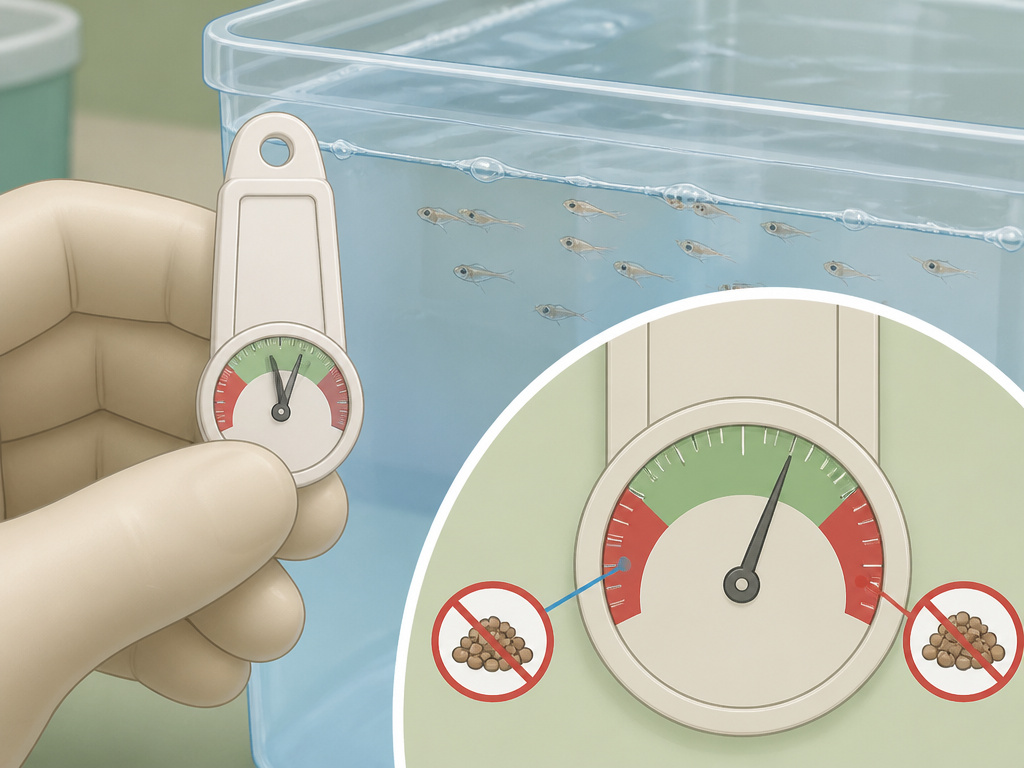
Forty degrees Fahrenheit is the floor. Sixty-eight is the ceiling.
SRAC Publication No. 223 is direct about it: restrict feeding when water temperature drops below 40 F or rises above 68 F. Outside that band, digestion slows or the fish are stressed enough that feed becomes a liability.
The classroom manual treats cold differently. It allows the front cover to stay off overnight and on weekends only if the water stays below 10 C, which is roughly 50 F. That treats sub-10 C as a workable working range rather than a feeding cutoff.
- Below 40 F: restrict feeding, per SRAC Publication No. 223.
- Above 68 F: same restriction, same source.
- Below 10 C (about 50 F): the classroom manual still runs a normal schedule here.
- Cold tank, cover on: fry stay shy and may not rise to feed at all.
It just will not grow fast, and the margin for error shrinks.
Particle Size, Delivery, and the Kitchen Strainer Trick
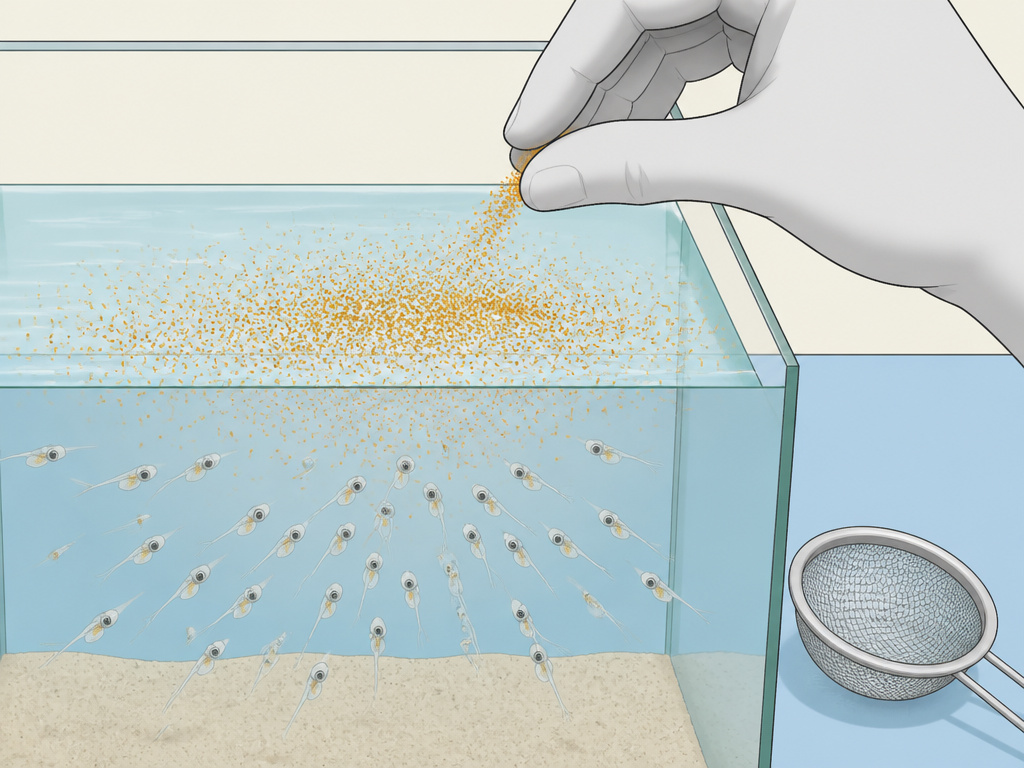
You switch the filter off and the tank goes quiet. The hum stops, the surface settles, and the fry come up.
That pause is not cosmetic. Salmonids in the Classroom says to turn the filter off, sprinkle the food gently to avoid startling the fry, then turn it back on.
SRAC adds a distribution rule: when fry are under 2 inches long, spread feed over at least two-thirds of the water surface.
Particle Size by Fish Weight
Feed has to match the mouth. The National Academies Press cites particle sizes matched to fish weight, and the progression is steep.
SRAC’s hand-feeding method is worth copying exactly:
- Turn the filter off.
- Scatter roughly twice as many pellets as there are fish across the tank.
- Work inside a 5- to 10-minute window.
- Repeat at 10-minute intervals until the ration is out or feeding activity drops.
- Turn the filter back on.
Feed the water, not the fish. Scatter the ration across two-thirds of the surface and the slow fry still get a meal.
If you are running a pair in a dedicated breeding tank, the same rule holds with less room to work. Scatter wide, and never drop the whole ration in one spot.
Live Food, Enrichment, and Where Prepared Diets Fail
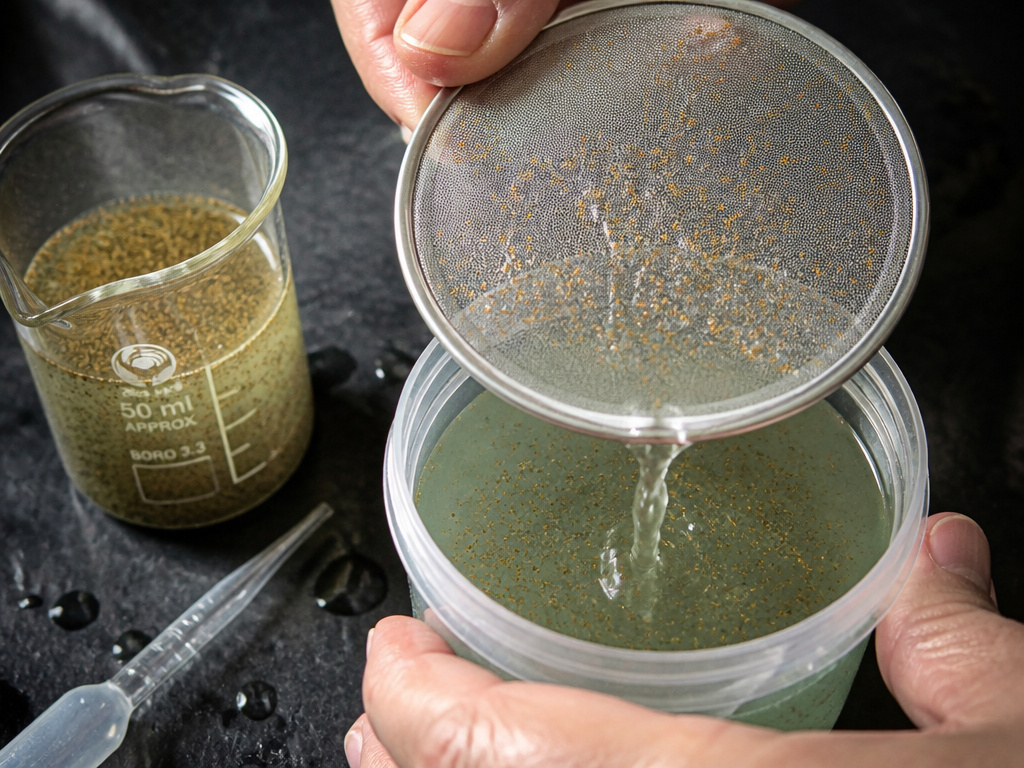
Live zooplankton solve a problem prepared crumbles cannot.
The National Academies Press notes that rotifers (Brachionus plicatilis) and brine shrimp (Artemia) are the only zooplankters produced in mass quantities as live food for larval fish. It also notes that many fish larvae are sensitive to a deficiency of n-3 polyunsaturated fatty acids, the fats that drive growth and survival in the first weeks.
That sensitivity is why enrichment exists. Two documented methods: feed newly hatched zooplankton for 24 hours on marine algae or yeast high in n-3 PUFA, or expose the nauplii to a lipid emulsion such as fish oil with an emulsifier for 3 to 12 hours before offering them.
Formulated starter diets have their own constraints. Diets with 70 to 80 percent good-quality fishmeal support good growth in salmonids, per the same source. When casein was the major ingredient, larvae of sturgeon, channel catfish, and common carp suffered severe mortality.
Enriching Live Food Before It Goes In
The NOAA flounder manual gives a working recipe. Add 10 g of Algamac 2000, about one teaspoon, per 100 million rotifers. Blend for 3 minutes. Let the culture enrich for 2 hours. Then filter one liter per tank through a 55-micron screen and rinse with clean seawater before feeding.
That is a hatchery-scale protocol, and home cultures run smaller. The principle scales: enrich, then rinse, then feed.
Easy to miss: Check that the rotifers are alive before they go in. The NOAA manual is explicit that feeding dead rotifers can kill fish within a few hours. A dead batch does not sink and wait. It fouls the water while the fry are still swimming in it.
For a home setup, live food is more practical than it sounds. A baby brine shrimp hatch covers the gap between starter crumb and larger fare. An infusoria culture covers the days before that, when fry are too small for anything with a shell.
Overfeeding: What It Looks Like in the Water
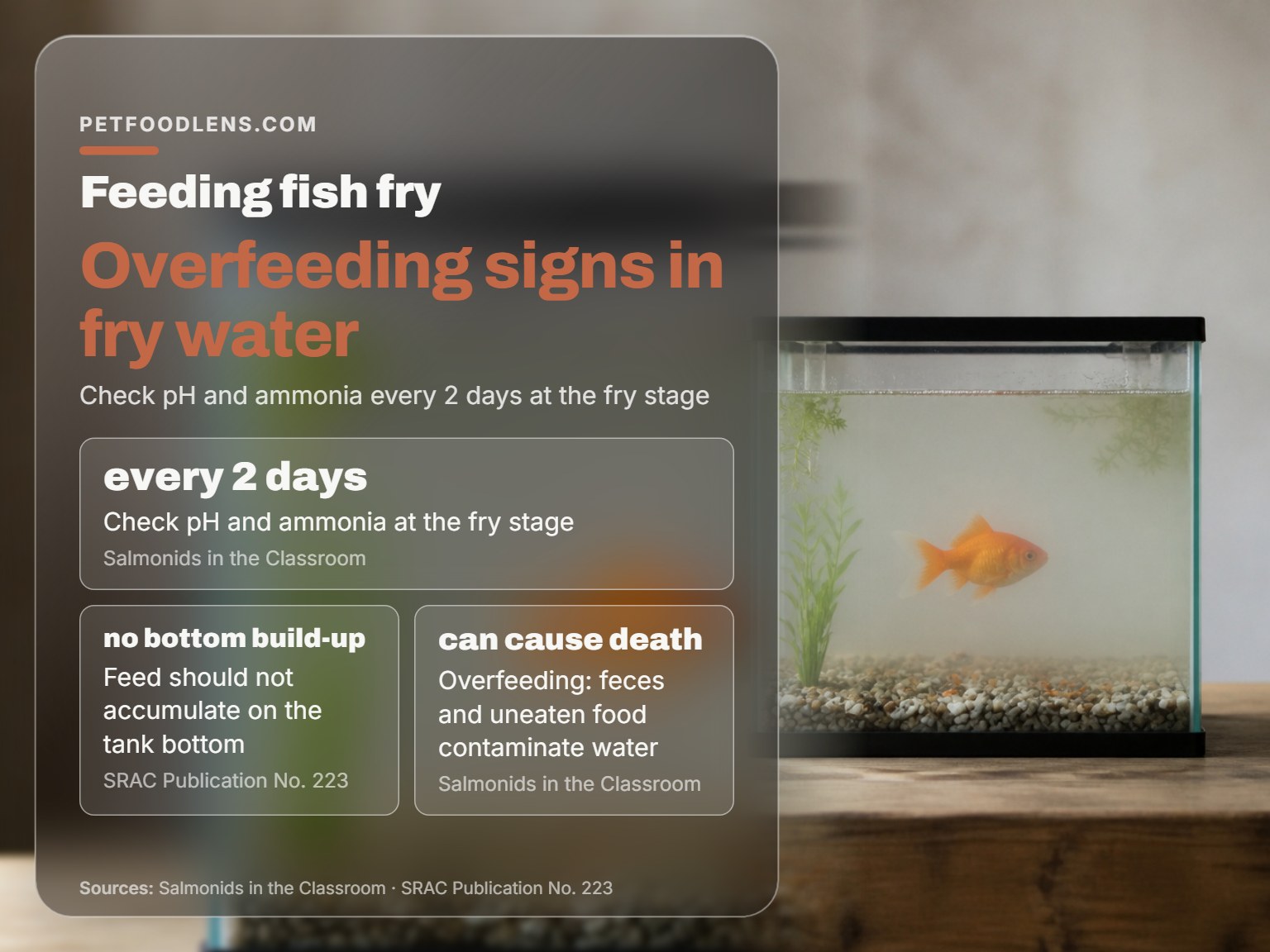
Ever watched a tank go milky two hours after a feed?
That haze is the tell. Salmonids in the Classroom puts it plainly: overfeeding is not a favor, because feces and uneaten food contaminate the water and can cause death. The manual calls for checking pH and ammonia every 2 days at the fry stage.
SRAC adds the mechanical version: feed should be distributed throughout the tank and should not accumulate on the bottom.
| What you see | What it usually means | What to change |
|---|---|---|
| Water goes hazy within hours | Uneaten feed breaking down | Cut the ration, siphon the bottom |
| Waste trailing from the fish | More feed going in than is being digested | Skip the next feed entirely |
| Fry hanging at the surface | Oxygen dropping as feed decays | Water change, then stop feeding |
| Sour smell when gravel is disturbed | Feed trapped in the substrate | Vacuum, then feed smaller amounts |
That last row is the one people miss. A tank can look clear and still smell wrong at the gravel line.
Cutting the ration is the first move, and overfeeding is easier to prevent than to correct once the water has turned. If you are already fighting cloudy water, fix the feed volume before you touch the filter.
The 24-Hour Rule Before Handling, and the 3-Day Rule Before Transport
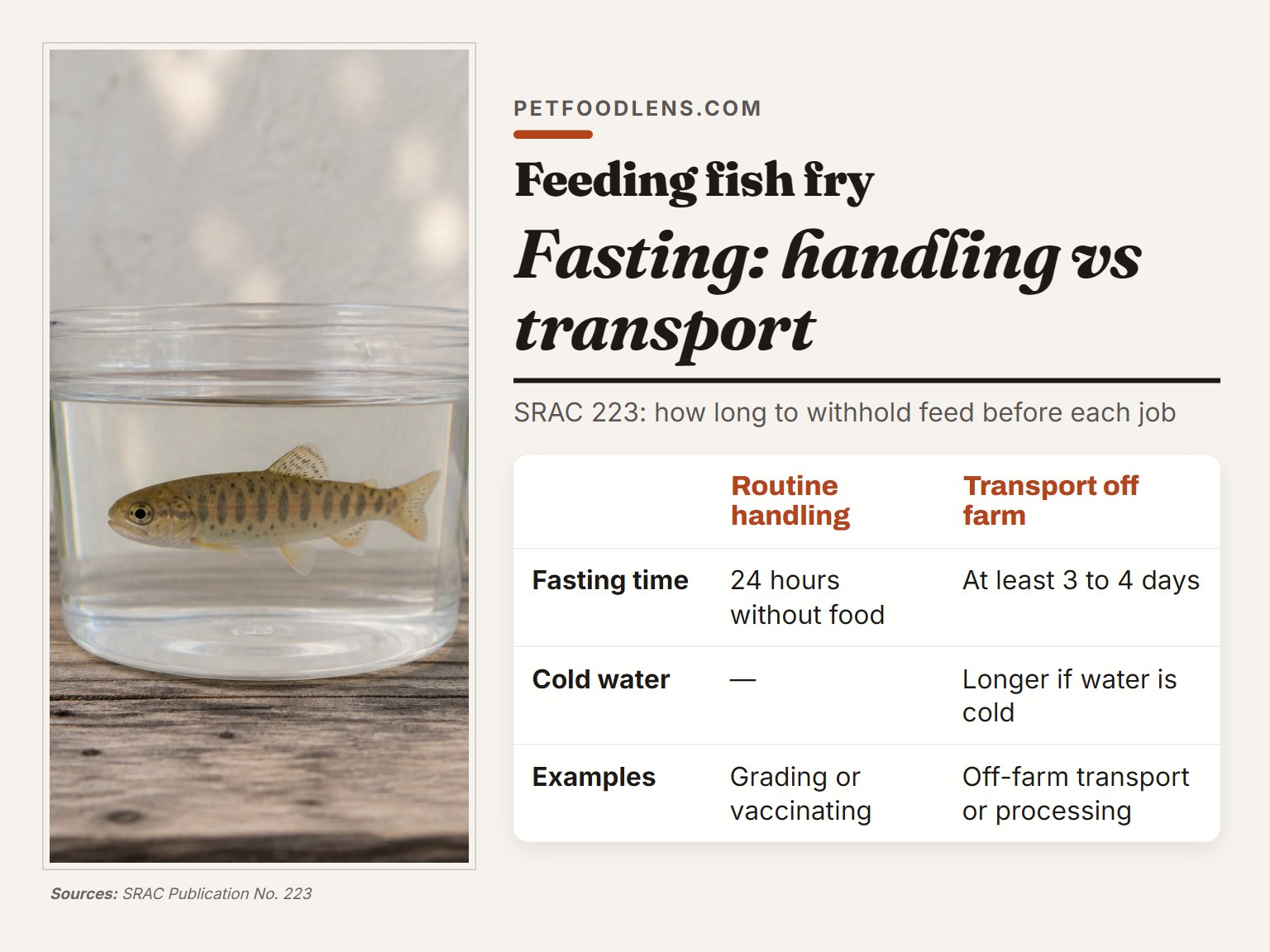
Three situations call for pulling the feed entirely: illness, handling, and transport.
SRAC Publication No. 223 says feeding rates should be reduced or feed withheld completely when fish are sick. It also sets two fasting clocks that are easy to confuse.
Routine handling such as grading or vaccinating needs 24 hours without food. That is enough to empty the gut without stressing the fish further.
Transport off the farm or processing needs at least 3 to 4 days, and longer if the water is cold. Cold water slows digestion, so the gut empties more slowly.
Fasting Before Handling vs Before Transport
The difference is distance and duration.
Pick the clock that matches what you are actually doing.
The part nobody mentions: The fasting clocks assume the fish were healthy going in. A sick fish fasted for transport arrives weaker than it left, and no amount of clean water fixes that after the fact.
Frequently Asked Questions
How long can fish fry go without food?
The classroom manual says you do not need to feed on weekends, which implies a two-day gap is survivable for healthy fry in a stable tank. SRAC’s schedule has no weekend allowance, and the National Academies reference states no fasting allowance either. The sources genuinely disagree here, so treat a weekend gap as a classroom compromise rather than a hatchery standard.
Do fish fry need food at night?
No. The National Academies reference specifies feeding during normal light hours, and the classroom manual calls for turning the lights off at night so the fry get a light and dark cycle. Fry find food by sight, so a night feed mostly sinks and rots.
Can I feed fish fry crushed flake food?
Sometimes, if you grind it fine enough. SRAC’s guidance is to use finely ground starter feeds spread with a kitchen strainer, which tells you the target is dust rather than flakes. A flake that stays intact is too big for a half-inch fry and will sink past it.
How do I know the fry are actually eating?
Watch for active feeding rather than counting what disappears. SRAC’s trigger for stepping down the frequency is the point where all fish are actively feeding, and the classroom manual starts the whole schedule when a quarter of the fry are swimming mid-tank. If fry ignore the surface, the manual suggests releasing a pinch just under the water so it drifts down.
What water temperature should stop feeding?
SRAC Publication No. 223 says to restrict feeding below 40 F or above 68 F. The classroom manual treats water below 10 C (about 50 F) as workable rather than a cutoff. Both can be right: the 40 F line is a production guideline, and a slow classroom tank still takes some food.
The Bottom Line
Here is the threshold I would hand anyone starting a batch this week. If your water sits below 40 F or above 68 F, fix the water before you touch the feed. No ration survives a temperature the fish cannot digest in.
Everything above also assumes you can see the fry eat. If the tank is opaque or the fry are buried in gravel, the schedule is guesswork. Clear the view first.
And one position I will defend even though the guides stop short of it: on a small batch, do every feed by hand. SRAC already recommends keeping two or three hand feedings in the schedule even with an automatic feeder running. I would go further. The feeder counts pellets. You count fish.
That is how to feed fish fry in one line: small amounts, many times, watched by somebody who is paying attention.
