
How to Avoid Overfeeding Fish: 2-to-3-Minute Rule
This post contains affiliate links. As an Amazon Associate, we earn from qualifying purchases.
To avoid overfeeding fish, set the daily ration from body weight instead of the bag chart: UF/IFAS puts maintenance at 0.5 to 1.0 percent of body weight per day, and pond systems cap at 120 pounds per acre per day. Then confirm with consumption time and an ammonia test.
Those two figures measure different things, and that gap is where most feeding arguments start. Pounds per acre per day describes what a pond’s bacteria and algae can absorb. Percent of body weight describes what one fish needs. Swap them and you get a number that looks precise and means nothing. Knowing how to avoid overfeeding fish begins with keeping these two measures straight.
What follows walks through the three measurement systems, the five signals that you already overshot, and the correction that works without draining the tank.
Key Takeaways
- 0.5 to 1.0 percent of body weight per day is UF/IFAS’s maintenance range for aquarium fish, and it’s a planning floor, not a target to hit exactly.
- Pond systems have hard ceilings: 120 pounds per acre per day for regular ponds, 200 for intensively aerated, 250 for split ponds, per Mississippi State.
- Food still there after 5 minutes means you overfed by Aqueon’s aquarium rule (NAERLS allows up to 20 minutes in ponds), and Aqueon’s correction is to cut the next portion by 50 percent.
- Skip the feeding entirely when dissolved oxygen is low, per NAERLS, because decomposing feed is what drives it lower; the FAO instead advises reducing or omitting feed as temperature falls.
- Weigh flake food rather than scooping it, since volume tells you almost nothing about what the fish actually get.
Why a Fixed Percentage of Body Weight Fails
A flat “5 percent of biomass per day” is the most repeated feeding instruction online, and the FAO flags it as a failure mode by name.
No single feeding rate holds across a growing cycle. The FAO Fisheries Technical Paper states that rates must be modified according to fish size, age, and water conditions, and that a fixed 5 percent of biomass applied across a whole growing cycle produces near starvation in the early stages and gross overfeeding with water quality problems later.
The reason is arithmetic. A small fish eating 5 percent of its body weight gets a small ration. A larger fish on the same percentage gets a much bigger ration, which is more than it needs. The percentage has to fall as the fish grows, or the ration climbs while the requirement drops.
NAERLS Table 4, drawn from ICA 1991 data, shows the slide for tilapia:
| Fish Size (g) | Daily Rate (% body weight) | Practical Read |
|---|---|---|
| 10-20 | 5% | Small fish, high metabolic demand |
| 80-100 | 4% | Rate steps down as growth slows |
| 150-200 | 3% | Down from 5 percent at the small end |
Those numbers are local to tilapia in Nigerian pond culture. What transfers is the shape of the curve.
For aquarium fish, the UF IFAS fish nutrition publication gives a maintenance range of 0.5 to 1.0 percent of body weight per day and a minimum of five feeding days per week. That’s far below the 5 percent figure at the low end. Both numbers are correct, because they describe different animals in different systems.
The FAO animal feed quantity guidance adds the behavioral half: when too much feed is presented, fish eat past requirement and feed conversion gets worse. Appetite measures something different from requirement.
I’d start any new tank at the bottom of that UF/IFAS range and hold it before touching it. The fish will tell you if it’s wrong when you compare a how to avoid overfeeding fish approach to their behavior.
What Does the 2-to-3-Minute Rule Actually Measure?
Aqueon’s 2-to-3-minute window and NAERLS’s 20-minute rule describe the same observation at two very different scales.
Aqueon’s version: feed only what the fish clear in 2 to 3 minutes, add a little more if they finish inside 2 minutes, and siphon out anything still there at 5 minutes. NAERLS Bulletin 152’s version: feed only what the fish consume in 20 minutes or less, and treat feed still stirred up from the pond bottom 20 minutes later as an overfeeding indicator.
Both rules work. Neither travels.
| Source | Rule As Written | System |
|---|---|---|
| Aqueon | Clear in 2-3 min; remove at 5 min | Home aquarium |
| NAERLS Bulletin 152 | Clear in 20 min or less | Pond culture |
| Mississippi State | Feed to near-satiation, minimal leftovers | Catfish production pond |
The gap isn’t sloppiness. A pond holds a bacterial and algal population that breaks feed down within minutes, and its fish are eating a ration spread across an acre of water. A small tank holds a filter and a handful of fish. Apply the pond’s 20-minute rule there and the food dissolves before anything eats it.
Where this goes sideways: Borrowing the 20-minute pond window for a 40-gallon tank. Pond bacteria and algae absorb that load; a filter doesn’t, and the oxygen sag shows up at predawn, which is exactly when NAERLS says to look for fish gulping at the surface.
Pond Rules and Tank Rules Are Not Interchangeable
Mississippi State says it plainly in its own publication: there are no standard feeding practices across the industry, because every pond of fish behaves differently. The extension service calls catfish feeding “a highly subjective process” and labels its own numbers as guidelines.
That admission matters more than the numbers. If a land-grant extension service with decades of feeding-study data calls its recommendations guidelines, a bag chart printed for a hundred species deserves less trust, not more.
Working out how to avoid overfeeding fish comes down to two inputs: an accurate body weight and a percentage you’re willing to defend. Everything else is feedback.
For a community tank feeding schedule, the practical loop is: pick a portion, feed it, time how long it takes to clear, adjust. That’s the same loop FAO describes as feeding to demand, and it beats any printed table.
The Pond Ceiling: 120 Pounds per Acre per Day
120 pounds per acre per day is Mississippi State’s long-term average ceiling for a regular pond, and it’s a ceiling, not a target.
The same Mississippi State catfish feeding guide sets 200 pounds per acre per day for intensively aerated ponds and 250 for split ponds. It also notes that feeding above those rates is fine sometimes, provided water quality holds. The ceiling is a water-quality limit wearing a feeding-rate costume.
Here’s the part that gets skipped. SRAC Publication 463 puts the ammonia risk threshold at 100 pounds per acre per day, which sits below Mississippi State’s 120-pound ceiling for the same regular pond. The water-quality publication is stricter than the feeding publication. When two credible sources disagree, the safer number wins.
What most people get wrong: Treating the pond ceiling as the safe operating point. SRAC’s ammonia threshold sits 20 pounds below Mississippi State’s ceiling, so the gap between those two numbers is the margin you’re actually working inside.
Ammonia rises for two reasons at once. Fish excrete it through the gills and in their feces, and the amount tracks how much feed goes in. Uneaten feed adds a second load as bacteria break it down. More feed means more ammonia from both directions.
The pH Multiplier Nobody Checks
Total ammonia nitrogen is a mix of toxic un-ionized ammonia and a harmless ionized form. Only the un-ionized fraction hurts fish, and its share climbs with temperature and pH.
For every one-unit rise in pH, the toxic fraction increases about ten times, per SRAC 463 ammonia report. That single multiplier explains why two ponds with identical ammonia readings can be in completely different trouble.
SRAC’s worked example: at pH 8.6, 30 C, and a total ammonia nitrogen reading of 3 mg/L, multiply 0.2422 by 3 to get 0.73 mg/L of toxic un-ionized ammonia. That’s past the 0.6 mg/L level SRAC says kills fish over a few days. Chronic damage starts far lower, at 0.06 mg/L, where gill and kidney damage and reduced growth appear.
So a “fine” ammonia reading on a cheap test can be a dying pond at pH 8.6. Test pH alongside ammonia or the number means nothing.
I’d rather see a hobbyist own an ammonia and pH test kit than an automatic feeder. The feeder controls input. The test tells you whether the input was right.
Five Signs You Already Overfed
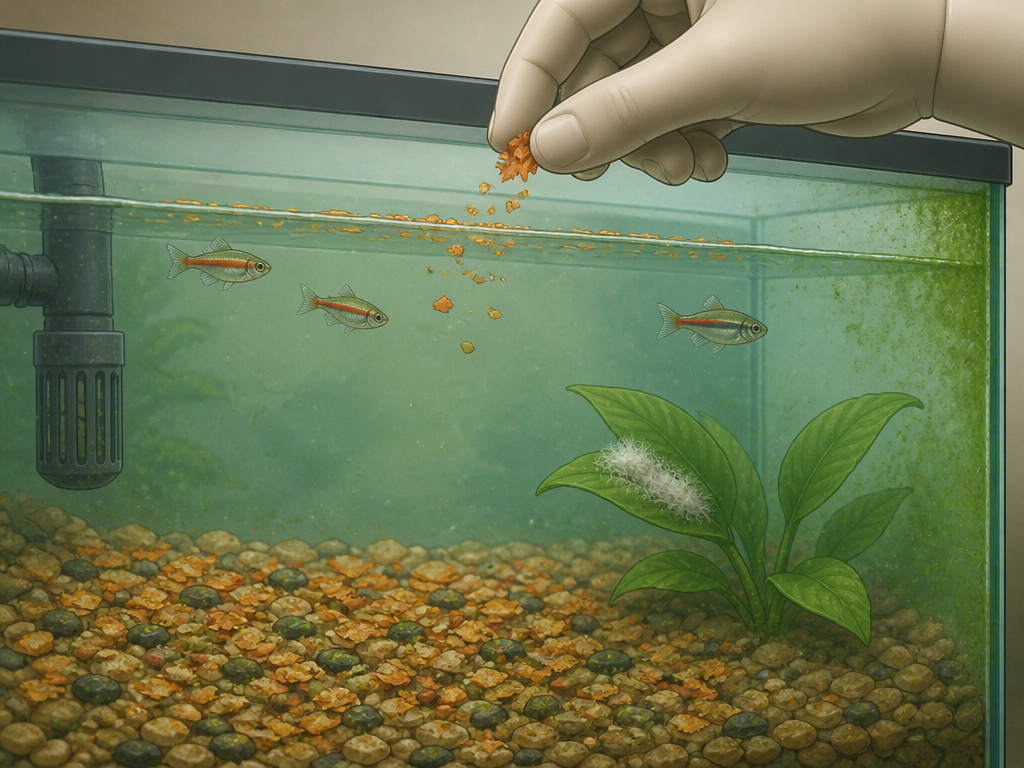
Five signals, ordered by how quickly they show up.
- Food still on the bottom after 5 minutes. Aqueon’s threshold. If the fish have lost interest and the food is still there, the portion was too big.
- Feed still stirred up from the pond bottom 20 minutes later. NAERLS’s pond equivalent, and the clearest sign that feed is going somewhere other than fish.
- A submerged object visible only at 25 cm or less. Both FAO and NAERLS use this as the phytoplankton warning. The bloom is being fed by your ration, not by the fish.
- Fish at the surface gulping air before dawn. NAERLS reads this as decomposing feed having driven dissolved oxygen down overnight.
- A fuzzy white fungus on the substrate, plants, or decor. Aqueon calls this an extreme case, and by the time it appears the tank has been overfed for a while.
You hear number four before you see it: Fish at the surface in the half-light are pulling air instead of feeding.
The NAERLS fish feeding practices report lists three of these as its own overfeeding indicators, which is worth noting because it’s a pond document and the signals hold in a glass box too.
In a planted tank, excess food does double damage: it decays and it fertilizes the algae you’re already fighting. Uneaten feed is biologically degraded in the water and acts as fertilizer for plankton growth, which is the mechanism behind every bloom warning above.
Rule of thumb: Judge the portion by what the fish leave behind. What they take tells you about appetite, and appetite runs ahead of requirement every time.
When Should You Skip a Feeding Entirely?
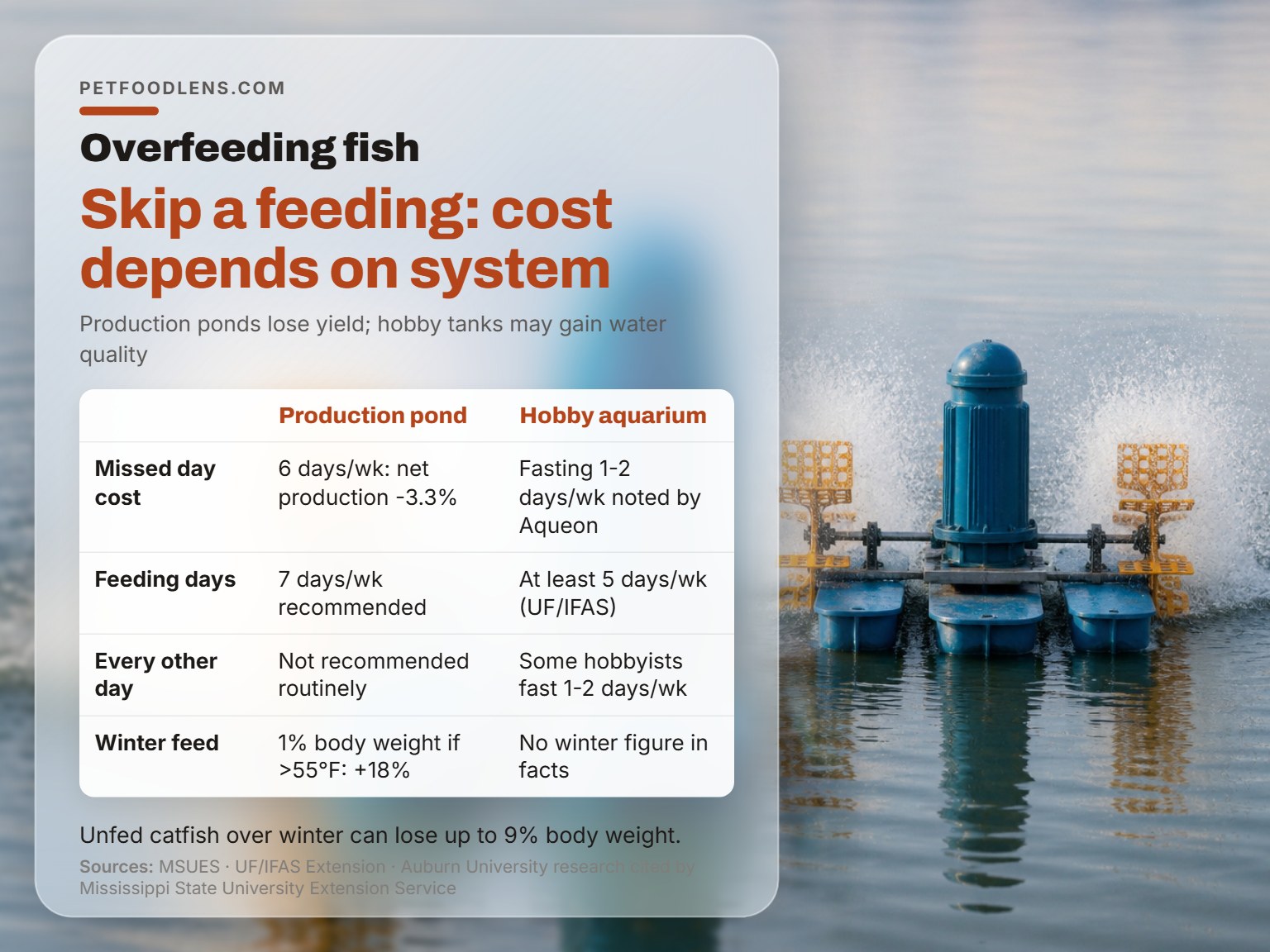
Some days the right amount of feed is none.
NAERLS is direct: suspend feeding when dissolved oxygen is low. The FAO advises reducing or omitting feed as temperature falls, though Mississippi State notes catfish fed 1 percent of body weight when water exceeds 55°F gain weight over winter.
- Low dissolved oxygen. Feeding adds ammonia and bacterial load, both of which consume oxygen.
- Cold water. FAO advises reducing or omitting feed as temperature falls, because fish stop eating at the rate the ration assumes.
- An active bloom. If the water is thick enough to hide an object at 25 cm, the system is already loaded.
- A tank that’s still clearing. Food dropped into disturbed water just adds to the load. Feeding after a water change is fine once things settle.
Winter is where the numbers get interesting. Auburn University research cited by Mississippi State found that food-sized catfish held over winter without feed lose up to 9 percent of body weight, while catfish fed 1 percent of body weight when water temperature exceeds 55 F gain 18 percent over the winter. Skipping feed isn’t neutral. It has a measurable cost.
The fasting question splits the sources, and the split is real. Mississippi State does not recommend feeding every other day or every third day for routine grow-out: fish can’t make up missed feed, processing yield drops, and the cycle lengthens. Its data puts numbers on it. Feeding six days a week cut net production by 3.3 percent versus seven, and five days a week cut it by 6.9 percent. UF/IFAS, by contrast, says fish should probably be fed at least five days per week, and Aqueon notes some hobbyists fast one or two days a week.
Aqueon, writing for aquariums, notes that some hobbyists fast their fish one or two days a week to clear the digestive system. UF/IFAS lands in between, recommending at least five feeding days per week.
Read all three together and the pattern is obvious. Production ponds optimize yield per acre, so a missed day costs money. A hobbyist optimizes water quality in a closed system, where a missed day costs nothing and may help. The feeding frequency answer depends on which of those you’re running.
An automatic feeder removes the human error from portion size, but it also removes the daily look at the water that catches problems early. Set it, then still look.
Feeding fish while on vacation is where overfeeding does the most damage, because nobody is there to siphon the leftovers.
Fixing an Overfed Tank Without Draining It
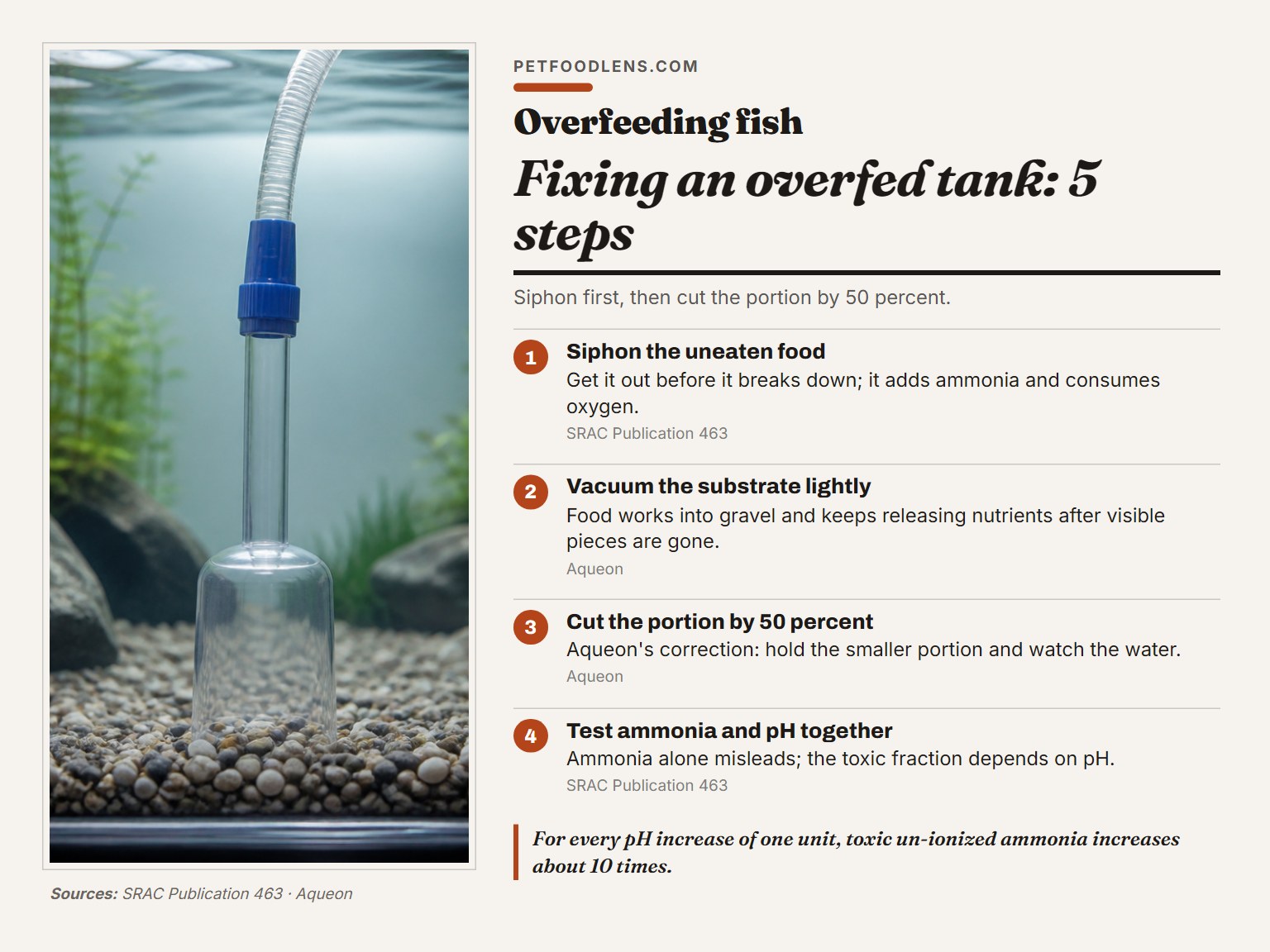
The correction starts with a siphon, not a new food.
Aqueon’s sequence is short: siphon out the uneaten food, lightly vacuum the substrate, and cut the amount per feeding by 50 percent. That last step is the one people skip, and skipping it puts you back where you started.
- Siphon the uneaten food. Get it out before it breaks down, because every hour it sits adds ammonia and consumes oxygen.
- Vacuum the substrate lightly. Food works into gravel and keeps releasing nutrients after the visible pieces are gone.
- Cut the portion by 50 percent. Aqueon’s correction. Hold the smaller portion and watch the water before adding anything back.
- Test ammonia and pH together. Ammonia alone misleads, because the toxic fraction depends on pH.
- Re-time the feeding. Watch how long the new portion takes to clear and adjust from that, not from the bag.
FAO’s version of the same idea is feeding to demand: adjust the daily rate by how much of the previous day’s feed was actually consumed. The fish’s leftovers are the feedback signal, and they’re more honest than your estimate.
Getting the portion right is the only reliable way to keep water clear in a tank that clouds after every feeding. Water conditioners treat the symptom.
Weigh the Flakes, Don’t Scoop Them
UF/IFAS makes a point that sounds minor and isn’t: the volume of flake food needed to meet a fish’s nutritional needs is deceptively high, so the author recommends weighing the diet to avoid accidental underfeeding. Flakes are mostly air. A scoop tells you nothing.
A scale settles it. Weigh the portion once, note what it looks like in your hand, and you have a reference for every feeding after that.
Format changes the calculation too. A sinking pellet behaves nothing like a flake, and small pellets suit fish that can’t take a standard pellet. Same visual volume, different weights. Same visual volume, three different weights.
Feed Storage Rules That Actually Matter
Fish feed goes rancid, because it carries fish meal and fish oil. UF/IFAS recommends buying it at least monthly, storing it cool and dry, and never keeping it more than three months. Refrigeration is out, since the moisture in a fridge does more harm than good. Freezing works.
The vitamin point matters more than people expect. UF/IFAS does not recommend feeds without stabilized ascorbic acid, because unstabilized vitamin C degrades in storage before the fish ever eat it.
Easy to miss: A fresh bag of the same food is a different product from the bag in the cupboard. Rancid oil and degraded vitamin C both look identical to the eye.
Bottom line: the portion is a calculation, and the water is the audit.
Frequently Asked Questions
How do I know if I’m overfeeding my fish?
Start with the consumption clock. Aqueon’s threshold is food still present at 5 minutes with fish showing no interest. Then check the water: a submerged object visible only at 25 cm means the bloom is being fed by your ration. Either signal alone is enough to cut the portion.
Is it better to underfeed or overfeed fish?
Aqueon states plainly that it’s always best to underfeed, especially in new aquariums, because uneaten food clouds water and drives ammonia and nitrite up. The FAO makes the mirror argument from the production side: fish eat past requirement when too much is offered, and feed conversion suffers. Mississippi State, by contrast, advises feeding catfish daily as much as they will eat with minimal to no leftovers.
Can I feed my fish every other day?
Mississippi State does not recommend it for routine grow-out, because fish can’t compensate on feeding days and production drops measurably, while Aqueon notes some hobbyists fast one or two days a week deliberately and UF/IFAS recommends at least five feeding days per week. The sources disagree, and the answer depends on whether you’re optimizing yield or water quality.
How long should fish food take to be eaten?
It depends on the system. Aqueon’s aquarium rule is 2 to 3 minutes, with leftovers removed at 5, while NAERLS’s pond rule allows 20 minutes; the two sources disagree on the window, and applying the pond window to a filtered tank gives the food time to dissolve before anything eats it.
Does overfeeding cause ammonia spikes?
Yes, from two directions. SRAC 463 explains that fish excrete ammonia through gills and feces in amounts that track feeding rate, and that bacteria breaking down uneaten feed add a second load. The toxic fraction then multiplies about ten times for every one-unit pH rise.
What should I do if I’ve already overfed?
Siphon out the remaining food, vacuum the substrate lightly, and cut the next portion by 50 percent, which is Aqueon’s correction. Then test ammonia and pH together rather than ammonia alone, since the same reading means different things at different pH levels.
The Bottom Line
Here’s the trigger I’d hand anyone running a pond: if your total ammonia nitrogen reads 3 mg/L at pH 8.6 and 30 C, SRAC’s own math puts you at 0.73 mg/L of toxic un-ionized ammonia, past the 0.6 mg/L kill threshold. That’s the number to run before you feed again, not after the fish start gasping.
For a tank, the first step this week is smaller than that. Weigh one portion on a scale and time how long it takes to clear. You’ll have a real number instead of a scoop.
A concession, because it matters: none of the pond math transfers to a 20-gallon tank, and none of the tank rules transfer to an acre of water. Pick the system you actually have and use the numbers built for it.
The part I’d defend hardest is the least popular one. Your fish will eat more than they need every single time you offer it, and a clean bowl at the end of a feeding is not proof you got it right.
