
How to Feed Fish While on Vacation: 3 Trip-Length Plans
This post contains affiliate links. As an Amazon Associate, we earn from qualifying purchases.
How to feed fish while on vacation splits into three trip lengths. Under four days: no food needed. Seven to ten days: a water change before you leave, and the feeding question is genuinely split between the guides. Past eleven days: a person visits. Most adult fish can go about a week without eating according to Dr. Benjamin Rosenbloom, though other sources give different windows, and water quality fails long before hunger does.
Ammonia is what sits behind that last sentence. Both Trout Unlimited chapters build their entire vacation protocol around keeping it low, and Dr. Jessie Sanders names overfeeding without water chemistry maintenance as the point where tanks crash. The how to feed fish while on vacation question is really about waste going in and coming out.
What follows is the trip-length breakdown, the two feeder types and where the sources split on them, the prep work that happens before you pack, and what the first three days back actually require.
Key Takeaways
- Three days without food is not an emergency. Trout Unlimited’s Mid-Atlantic guide states it flatly, and Trout Unlimited’s Pennsylvania chapter says a 2-4 day weekend needs no food.
- The water change before you leave matters more than the food you leave behind. Up to 10 gallons split morning and afternoon, or 20-25% depending on which chapter you follow.
- Auto feeders are the most contested item on this list. Trout Unlimited’s Mid-Atlantic guide rules them out, while two veterinarians and two manufacturers treat them as a usable option past a week.
- Vacation feeder blocks are the weakest option on the shelf. Low nutrition, fouled water, and fish that may not recognize them as food.
- Write the plan down. A feeding chart or a pill box of pre-measured portions beats any verbal instruction.
How Long Can Fish Actually Go Without Food?
Dr. Benjamin Rosenbloom puts most adult fish at about a week without eating, with two weeks at most, while other sources give different windows depending on species. That number comes from Dr. Benjamin Rosenbloom, DVM, and it lines up with what most hobby-level guides publish.
Adult fish tolerate roughly one week without food, with two weeks described as the outer limit by one veterinarian. Cold-water trout go longer: a ten-day absence without food or water changes is listed as survivable. The binding constraint is water quality, since uneaten food and fish waste convert to ammonia.
The numbers scatter once you leave “most adult fish” behind.
| Source | Stated window | Applies to |
|---|---|---|
| Trout Unlimited, Mid-Atlantic | 3 days without food is not a threat | Trout, classroom tanks |
| Trout Unlimited, Pennsylvania | A 2-4 day weekend, no food | Trout |
| Dr. Benjamin Rosenbloom, DVM | 1 week, 2 weeks at most | Most adult fish |
| Aquarium Co-Op | A week or more | Healthy fish, species dependent |
| Aqueon | A weekend | All but newly hatched fry |
The spread comes from species rather than a disagreement about biology. Rosenbloom points out that fish without stomachs, like goldfish and suckermouth catfish, graze constantly and need more regular meals than an ambush predator that eats rarely in the wild. Water temperature pushes the same fish in the same direction: warmer water means faster metabolism means a shorter safe window, which is central to how to feed fish while on vacation.
Fry are the hard exception. Newly hatched fish may need 3-8 feedings per day on a high-protein diet, and older, less active fish drop to 2-7 feedings per week. Outside a vacation, how often to feed aquarium fish depends on species and temperature; on vacation, the calendar overrides both.
Species first, calendar second.
Three Trip-Length Plans, and What Changes at Each Threshold
Three numbers decide everything: three days, ten days, eleven days.
| Trip length | Feed during? | Water change before | Sitter |
|---|---|---|---|
| 3-4 days | Optional; skipping is fine | 20-25% | Check equipment once |
| 7-10 days | Split: skip, or feed twice | Up to 10 gal, split AM/PM | Every 2-3 days |
| 11+ days | Once halfway, or twice | Up to 10 gal, split AM/PM | Every 3-4 days |
Short Trips (3-4 Days)
Trout Unlimited’s Pennsylvania chapter says trout survive a 2-4 day weekend without food, but someone should confirm the equipment is running. If you feed anyway, do it Friday morning and pull the leftovers with a turkey baster and a net. Skipping the meal is also a legitimate call. A 20-25% partial water change before you leave does more for the tank than the meal would.
Mid-Length Trips (7-10 Days)
Here the two Trout Unlimited chapters disagree outright. Mid-Atlantic says trout survive a ten-day vacation without food or water changes. Pennsylvania says feed at least twice. Aquarium Co-Op sides with Mid-Atlantic for anything a week or less.
Pick one and write it down. A plan nobody wrote down is a plan nobody follows.
Long Trips (11+ Days)
Both chapters agree someone should visit. Mid-Atlantic says once, halfway through, with the same amount of food given the day before departure. Pennsylvania says at least twice, with 3-4 days between visits. Feeding means waste, and waste means siphoning gravel and replacing the de-chlorinated water you pulled out.
Why Does Water Quality Beat Starvation Every Time?
Ammonia kills faster than hunger.
Trout Unlimited’s Mid-Atlantic guide puts it plainly: trout are more at risk from poor water quality than from starvation. Sanders makes the same point from the clinical side, naming overfeeding without water chemistry maintenance as the specific combination that produces disasters.
You can see it before you can measure it. The fish hang near the surface. By the time the test kit confirms it, the damage is done.
Three days without food is not a fish emergency. Three days of rotting food is.
Learning how to avoid overfeeding fish is the single highest-value skill for anyone leaving a tank in someone else’s hands. It’s also the skill sitters are least likely to have.
Automatic Feeders: Where the Guides Actually Split
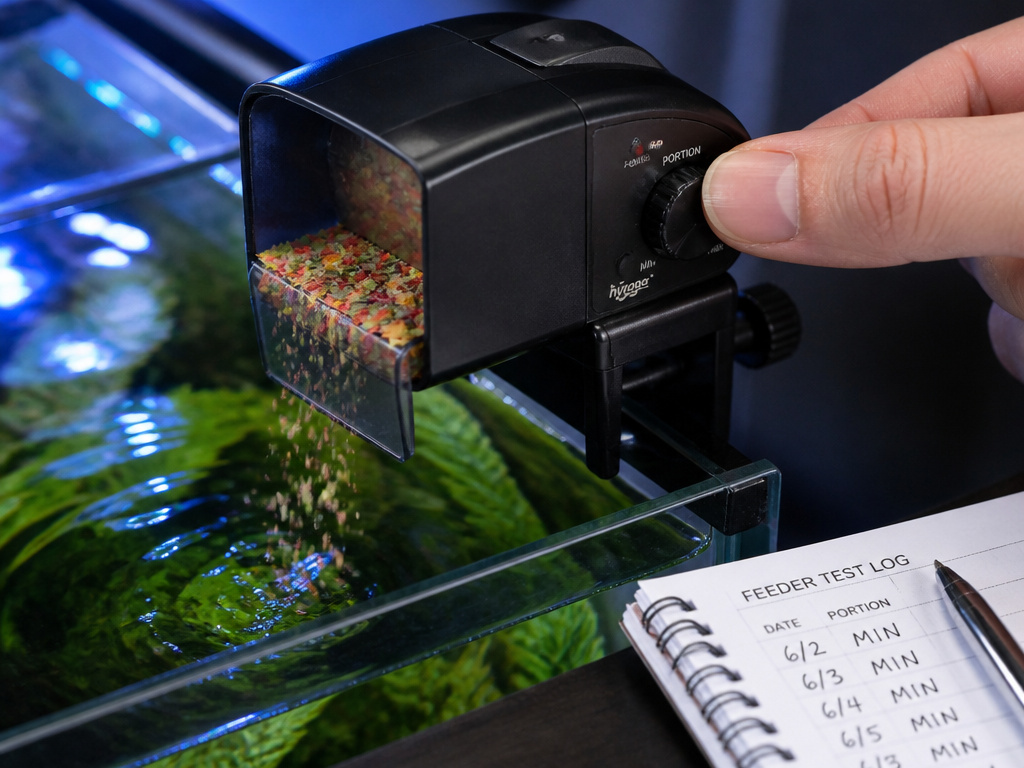
Trout Unlimited’s Mid-Atlantic guide rules them out, while two veterinarians and two manufacturers treat them as a usable option for anything past a week.
The feeding fish over extended breaks guidance is the document that says no, and its reasoning is procedural. It prefers a human with a logged feeding chart, because a human can notice a dead filter. An automatic fish feeder solves the labor problem and creates a new one: nobody is watching it.
The case for them, from the other side:
- Rosenbloom’s version is to set the feeder to the minimum amount you think the fish need to get by, on the logic that a fish without underlying health problems is very unlikely to starve.
- Sanders prefers units you can portion out in advance, dropping a measured amount every 12 or 24 hours rather than a fixed sprinkle.
- Aqueon notes that economy units dispense every 12 hours, while upscale models let you program specific times.
- Aquarium Co-Op’s Auto Feeder runs up to 4 feedings a day on a rechargeable battery rated for 3-6 months per charge.
The best automatic fish feeders for this job share one trait: a portion you can set genuinely small.
Where this goes sideways: A feeder that jams open can dump excess food into the tank in one drop. Test it for several days before departure, not the night before, and confirm the amount landing in the water is what you intended.
Vacation Feeder Blocks: What the Label Doesn’t Say
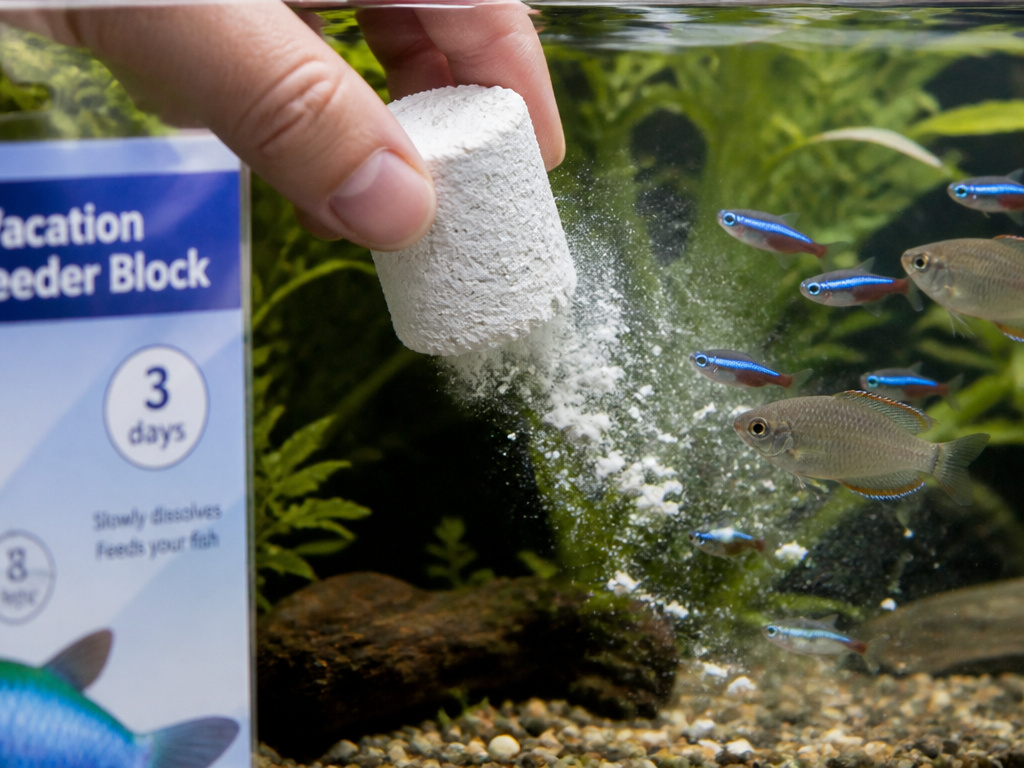
Aqueon’s Tropical Vacation Feeder is one block for 5-6 medium-sized fish, rated for up to 3 days. That’s the manufacturer’s own spec, printed on the package, and it’s a narrower claim than most buyers assume.
Aqueon’s instructions are specific: after the block dissolves, perform a water change and siphon out any remnants. They also suggest trying one a week before you leave and discontinuing all other feeding during that trial.
The case against vacation feeder blocks comes from two directions, though Aqueon presents them as a usable option. Sanders says they tend to be low in nutrition and can severely foul the water, and that fish may ignore them entirely because they aren’t used to eating from one. Aquarium Co-Op is blunter: ammonia spikes and algae blooms, because the block dissolves into particles too small for larger fish to eat.
I’d rather leave a tank unfed for a week than drop a dissolving block into it. The block feeds the water first and the fish second.
Read the package for the length and tank size it’s actually rated for. A block built for a three-day trip is not a solution for an eleven-day trip.
If Someone Is Watching the Tank, Write It Down
You come home to green water. The sitter followed the instructions exactly. The instructions said “a pinch, once a day.”
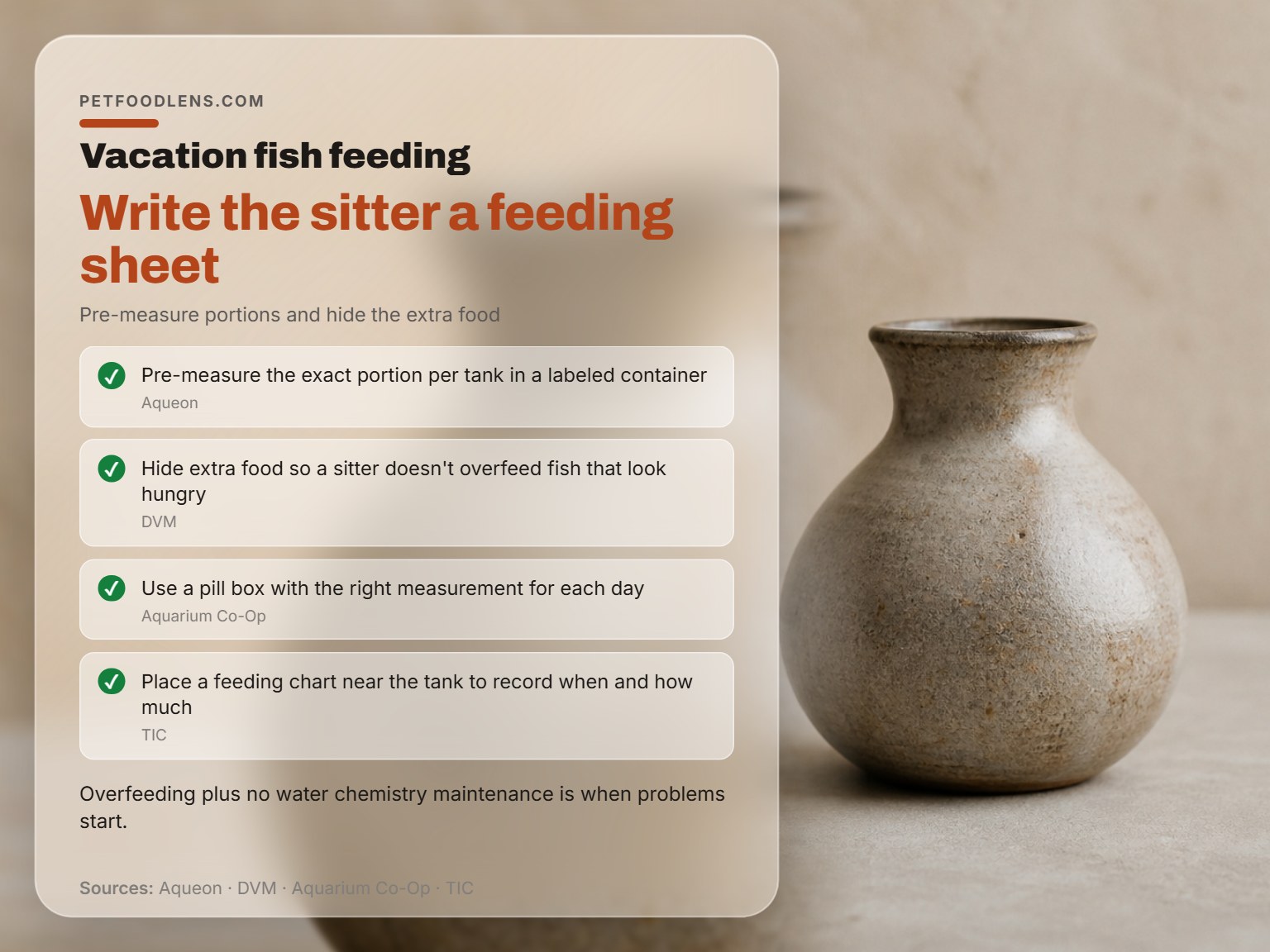
Sources that cover sitters generally favor removing the judgment call, though they disagree on how often a sitter should visit. Trout Unlimited asks for a feeding chart near the tank where staff record when and how much was fed. Aquarium Co-Op recommends a pill box loaded with the correct portion for each day. Aqueon suggests measuring out individual packets per feeding.
A workable sitter sheet covers five things:
- The exact portion per tank, pre-measured. Not a scoop size. A labeled container.
- Where the food is, and where the rest of it isn’t. Sanders advises hiding the extra, because a sitter who sees a hungry-looking fish will feed it.
- What to do after a missed day. Nothing. Skip the past containers and feed only the remaining days’ portions.
- Which tank gets how many frozen cubes, written on the glass. Frozen food dirties the water less and leaves fewer leftovers than dry.
- Who to call if the filter stops.
How long fish food lasts matters here too, since sealed daily packets hold their quality better than an open tub a sitter leaves unsealed.
The Prep Work That Starts 48 Hours Before You Pack
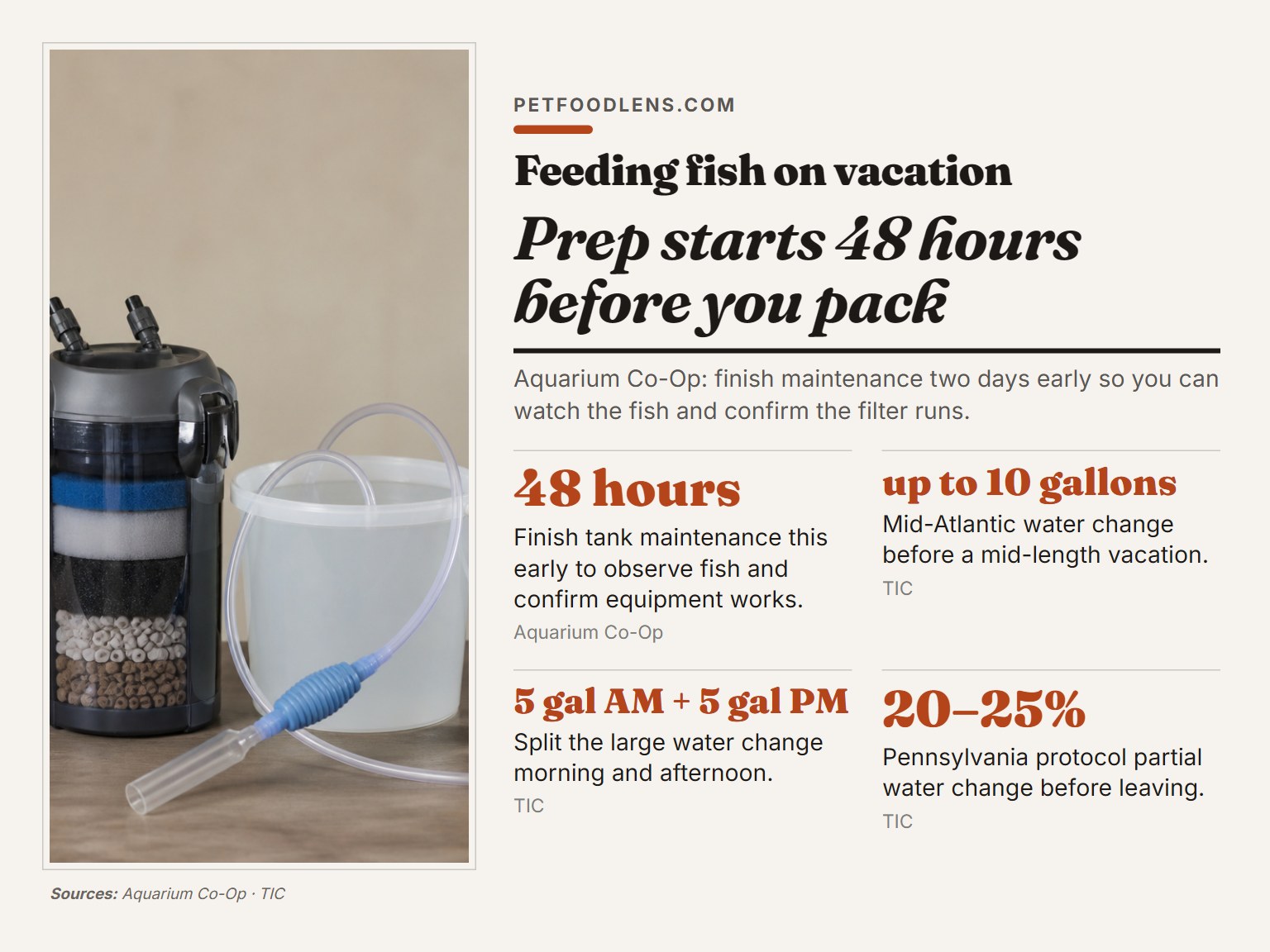
Aquarium Co-Op’s rule is 48 hours, and the reason is observation. Finishing maintenance two days out leaves you time to watch the fish and confirm the filter is actually running before you walk out the door.
- Do the maintenance two days early. Partial water change, vacuum the substrate, clean the filter if it needs it.
- Change the water properly. Trout Unlimited’s Mid-Atlantic protocol allows up to 10 gallons, split as 5 in the morning and 5 in the afternoon. Pennsylvania uses 20-25% instead.
- Watch the temperature on cold-water systems. Frozen de-chlorinated bottles hold the tank below 57F until the chiller brings it back to its normal 52F.
- Dose the bacteria after a large change. Mid-Atlantic calls for Special Blend and Nite-Out II to follow the water change.
- Clear the leftovers. Turkey baster for the bottom, net for the surface, before you go.
- Confirm the equipment. A filter that quits mid-trip creates the same oxygen crash as feeding fish in a power outage, except nobody is home to catch it.
Before you start: Unplug the heater and filter before you put a hand in the water. Match replacement water to tank temperature before it goes in. De-chlorinate in the bucket, never in the tank.
One caveat on all of this: the Trout Unlimited protocols assume cold-water trout systems with a chiller. A tropical tank runs a faster metabolism and a shorter safe window. Classroom trout programs also have a second reference worth keeping on hand, the USFWS aquarium care and maintenance guide.
The First Three Days Back
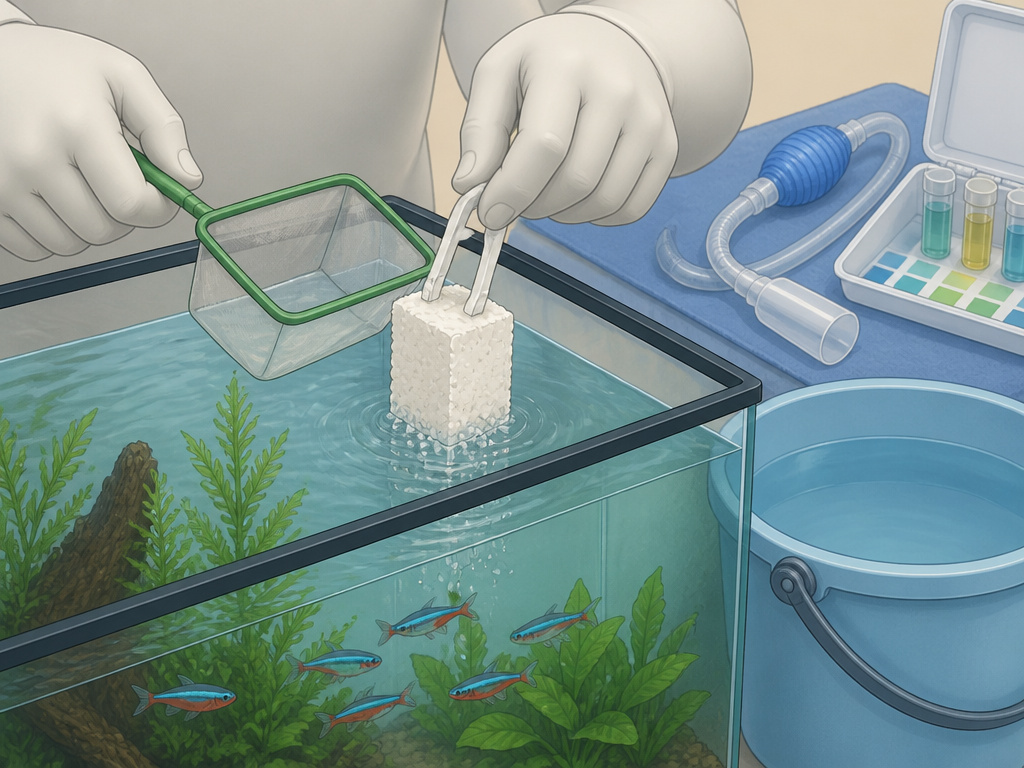
Aqueon’s return checklist is short and easy to skip. If you were gone a week or more, perform a water change within a few days of getting home. Remove the block or the automatic feeder and resume normal feeding.
Signs of injury or disease show up early, and that’s the window where a small problem is still small.
Frequently Asked Questions
Can fish really go a week without food?
Most adult fish can, per Dr. Benjamin Rosenbloom, who puts the outer limit at two weeks. Aquarium Co-Op says healthy fish handle a week or more depending on species. The exceptions are fry, fish recovering from illness, and any tank you’ll be away from for more than a week.
Are vacation feeder blocks better than nothing?
Not according to two of the three sources that address them. Dr. Jessie Sanders calls them low in nutrition and says they can severely foul the water. Aquarium Co-Op says they cause ammonia spikes and algae blooms. Aqueon sells them and rates one block for 5-6 medium fish over up to 3 days, with a water change and siphoning afterward.
How much water should I change before a trip?
Trout Unlimited’s Mid-Atlantic chapter allows up to 10 gallons, split into 5 in the morning and 5 in the afternoon. The Pennsylvania chapter specifies a 20-25% partial change. The two figures use different bases, so pick the one that matches how you normally measure.
What’s the biggest mistake people make with a fish sitter?
Overfeeding. Sanders recommends hiding the extra food so an unfamiliar sitter doesn’t top up a fish that still looks hungry. Pre-measured daily portions, whether in packets or a pill box, remove the guesswork entirely.
Do I need to feed baby fish before I leave?
Yes, and the standard advice inverts. Newly hatched fish may need 3-8 feedings a day, and Aquarium Co-Op lists fry as one of three cases where the no-feeding method shouldn’t be used at all. Aqueon makes the same exception for newly hatched fry on weekend trips.
The Bottom Line
If your tank is small, newly set up, or heavily stocked, it is less stable than a larger, well-established aquarium. Aqueon flags those three conditions as the least stable.
For everyone else, do this today: write your trip length on a sticky note, match it to the trip-length table above, and schedule the water change for 48 hours before departure. That’s the whole plan.
The food is the part everyone worries about and the part that matters least.
