
How Often to Feed Aquarium Fish: 3 Numbers That Decide It
This post contains affiliate links. As an Amazon Associate, we earn from qualifying purchases.
Feed most adult aquarium fish at least once a day, at about 3% of body weight, according to the Merck Veterinary Manual. Large-meal carnivores can drop to once or twice a week, and fry take up to 5%.
Three numbers carry that answer: a percentage of body weight, a meals-per-day count, and a life-stage multiplier. They come from different sources, and those sources do not fully agree with each other. The disagreement is the useful part, because it tells you which variable to move when your tank doesn’t match the book.
What follows walks through what each source actually says, how to dose a ration without a lab scale, where the rule inverts by species, and what an automatic feeder can and cannot reproduce.
Key Takeaways
- At least one meal a day is the floor for most adult fish, per the Merck Veterinary Manual, though large-meal carnivores may be fed once or twice a week.
- 3% of body weight daily for adults; up to 5% for fry and fingerlings.
- Once or twice a week is correct for carnivores that swallow large meals whole.
- Twice daily is not automatically better for food fish; Mississippi State found the extra feed was not fully converted to weight gain, though a juvenile betta/guppy trial used twice daily as its control.
- Dry food expires 2 months after opening at room temperature, and 6 months in the freezer.
How Often to Feed Aquarium Fish: The 3% Rule and the Daily Floor
The Merck Veterinary Manual answers how often to feed aquarium fish with two numbers and one exception. Adult fish get 3% of body weight daily for maintenance, and fry or fingerlings get up to 5%.
Ration is expressed as a percentage of body weight rather than a volume or a pinch. Adult maintenance sits at 3% of body weight per day, with fry and fingerlings allowed up to 5%. Feed weight varies sharply between flake and pellet, so the percentage must be calculated against the food actually in use.
The exception sits in the next sentence of the same manual. Most aquarium fish should be fed at least daily, except for carnivorous fish that ingest large meals, which may be fed once or twice a week.
That is the whole rule. Two numbers, one carve-out.
Where it gets messy is the ration basis. Merck measures food as a percentage of the fish. Mississippi State Extension measures it as whatever the fish will clear. A JUWEL feeder measures it as a dial position. All three are legitimate, and none of them converts cleanly into the others.
| Source | What it recommends | Ration basis |
|---|---|---|
| Merck Veterinary Manual | At least daily; once or twice a week for large-meal carnivores | 3% of body weight, 5% for fry |
| Mississippi State Extension | Once daily; twice daily not necessarily beneficial | Satiation with minimal leftovers |
| JUWEL EasyFeed manual | Up to 2 feeds per day, 6 hours apart | Portion set by controller B |
Read those rows together and the practical answer falls out. Daily feeding is the default. The percentage is how you size the meal. Satiation is how you check the percentage was right.
Bottom line: pick a daily frequency first, then size the meal in grams, then let what’s left on the substrate tell you whether you got it right.
Twice a Day Is Not Automatically Better
Feeding twice a day feels more generous. The production data says otherwise.
Mississippi State Extension’s catfish work found that fish fed twice daily were offered more feed than fish fed once daily, and the extra feed was not completely converted into weight gain. The likely reason is simple: an unattended second meal is easy to overfeed, and leftover feed spoils water quality.
The same publication put numbers on skipped days:
- Twice daily: more feed offered, but not fully converted to weight gain.
- Six days a week instead of seven: net production down 3.3%, feed conversion 4.8% worse.
- Five days a week: net production down 6.9%, feed conversion 7.9% worse.
- Every other day or every third day: not recommended for routine feeding at all.
Those figures come from ponds, not from a typical community tank. Treat them as a direction rather than a prescription.
The direction holds, though. An extra meal is not free growth. It is extra food that has to be eaten, digested, and kept out of the filter.
Temperature moves the schedule too. Auburn research cited by the same extension service found food-sized catfish held over winter without feed can lose up to 9% of body weight, while fish fed 1% of body weight when water exceeds 55°F gain 18% over the winter.
Outdoor pond fish hit the same wall, which is why koi feeding frequency by season is a different question from a heated indoor tank sitting at a constant temperature all year.
For a mixed tank with several species on one clock, the feeding schedule for community tanks has to reconcile fish that want two small meals with fish that want one large one.
One meal, measured, beats two meals guessed at.
How Do You Turn 3% of Body Weight Into Actual Food?
You need two numbers you probably don’t have: the weight of the fish, and the weight of the food.
The food number is the one people skip. Flake and micro pellet foods do not weigh the same per spoonful, and flaked feeds tend to be much lighter than pelleted feeds. A pinch of flake between your fingers weighs almost nothing. The same volume of pellet is a different meal entirely.
Volume lies. Weight doesn’t.
Portion work taught me one thing that transfers straight from a food bowl to a fish tank. Grams are consistent and scoops are not. A kitchen scale is the cheapest tool in this conversation and the one that changes outcomes most often.
Weigh a small sample of your actual food on a kitchen scale and note how much space it takes in the spoon you use. Skip this and “one scoop” means nothing the moment you change brands.
- Establish the fish’s weight. A single large fish can go in a tared container on a scale. A community tank means adding up the stock list. Guess here and the whole ration is off.
- Multiply by 0.03 for adults, or 0.05 for fry and fingerlings.
- Split the total across your meals. Two feeds means half at each, which matters because a feeder’s second feed lands 6 hours after the first.
- Check what’s left on the substrate after the meal and trim the ration if anything survives.
Step 5 is the one that actually calibrates the number. The percentage gets you close. The leftovers get you right.
Commercial operations don’t eyeball this. They write it down as a recirculating aquaculture feeding SOP so the person with the feed bucket isn’t improvising at 6 a.m.
If the arithmetic feels like too much for a Tuesday night, how much to feed aquarium fish goes through the ration question in more detail.
Weighing food feels excessive right up until the first time you do it. Then you find out your usual pinch was running well past the ration, and you have been doing it that way for a year. I have watched that exact realization land with dry cat food and with flake food, and the face is the same both times.
Where the Rule Breaks: Fry, Carnivores, and Bottom-Dwellers
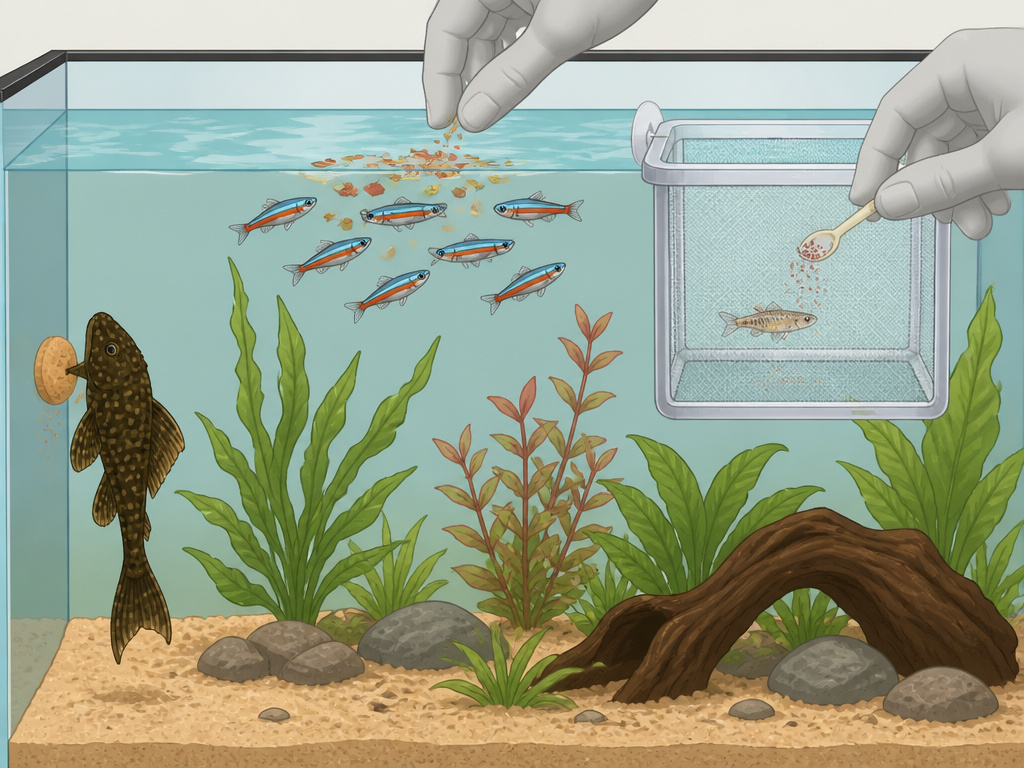
A tank with a bristlenose on the glass, a school of tetras at the surface, and a juvenile in a breeder box is three feeding schedules sharing one water volume.
Fry and Fingerlings
Fry and fingerlings get the higher ceiling: up to 5% of body weight daily, per the Merck manual. That is a deliberately higher percentage than an adult gets, and it is not a rounding error.
The Betta and guppy feeding frequency study tested juveniles at 1, 2, 3, and 4 meals per day over 60 days in 3 L tanks, with 2 meals per day as the control. That design detail matters. The researchers treated twice daily as the baseline, not as an upper limit.
Large-Meal Carnivores
The Merck exception is written around meal size, not species. A fish that takes a whole prawn in one go is not eating a 3% ration. It is eating a meal that takes time to clear, and the manual allows once or twice a week for exactly this group.
Bottom-Dwellers and Catfish
Merck is blunt about loricariids and Corydoras: “This is not an acceptable practice, and these fish should receive targeted feeding.” The unacceptable practice is expecting them to live on what the other fish miss.
Common mistake: Dropping one sinking wafer in the corner and calling the Corydoras fed. The pleco finds it first, it’s gone in minutes, and the Corydoras spends the rest of the day browsing an empty substrate.
Goldfish are their own case, and how often to feed goldfish is worth reading separately because the answer moves with water temperature and body size. They are also the species with the most published frequency work behind them, including the goldfish growth and feeding frequency research in the Journal of Nutrition.
Bettas carry a similar reputation problem, and feeding frequency for bettas goes through the frequency question for that species specifically.
What an Automatic Feeder Can and Cannot Do

The JUWEL EasyFeed can be programmed for at most two feeds per day, so it cannot produce “three meals a day.”
Its manual is unusually specific. The feeder programs up to two feeds per day. The first feed fires the moment you switch it on and repeats every 24 hours at that time. If you select a second feed, it fires exactly 6 hours after the first and repeats every 24 hours.
The manual’s own worked example: activation at 9 a.m. Gives feedings at 9 a.m. And 3 p.m.
Set the feeder for a time you are normally home to watch the tank, not the time that sounds natural. The 6-hour gap is fixed, so a 4 p.m. Start puts the second feed at 10 p.m. With the lights off, and the manual explicitly warns against that.
The 6-Hour Gap Problem
The manual tells you to consider the timing so you don’t feed when the lights are out, and to set the programme so feed releases while the lights are on. It offers no way to change the interval.
That is a real limitation. The juvenile trial above tested up to four meals a day. No JUWEL setting produces that, and the interval is not user-adjustable.
Other manual details worth knowing before you mount one:
- Batteries: AA cells, included with the unit. Replace or remove them and the feeder has to be re-programmed.
- Feed loading: don’t compress the feed in the container, or it won’t release evenly.
- Quantity: adjusted on controller B.
- Manual release: the M button drops extra feed or tests the mechanism.
- Humidity: the unit can be connected to an air pump to keep the food dry.
If you’re comparing units, automatic fish feeders differ mostly on how many feeds they can produce and whether the interval is adjustable. And if a feeder is standing in for you while you’re gone, feeding fish while away is the bigger question.
If you want a feeder whose schedule is documented down to the hour, the JUWEL EasyFeed is the one to look at; the manual tells you exactly what it will and won’t do before you buy it.
Protein, Particle Size, and Why Flake Weighs Nothing
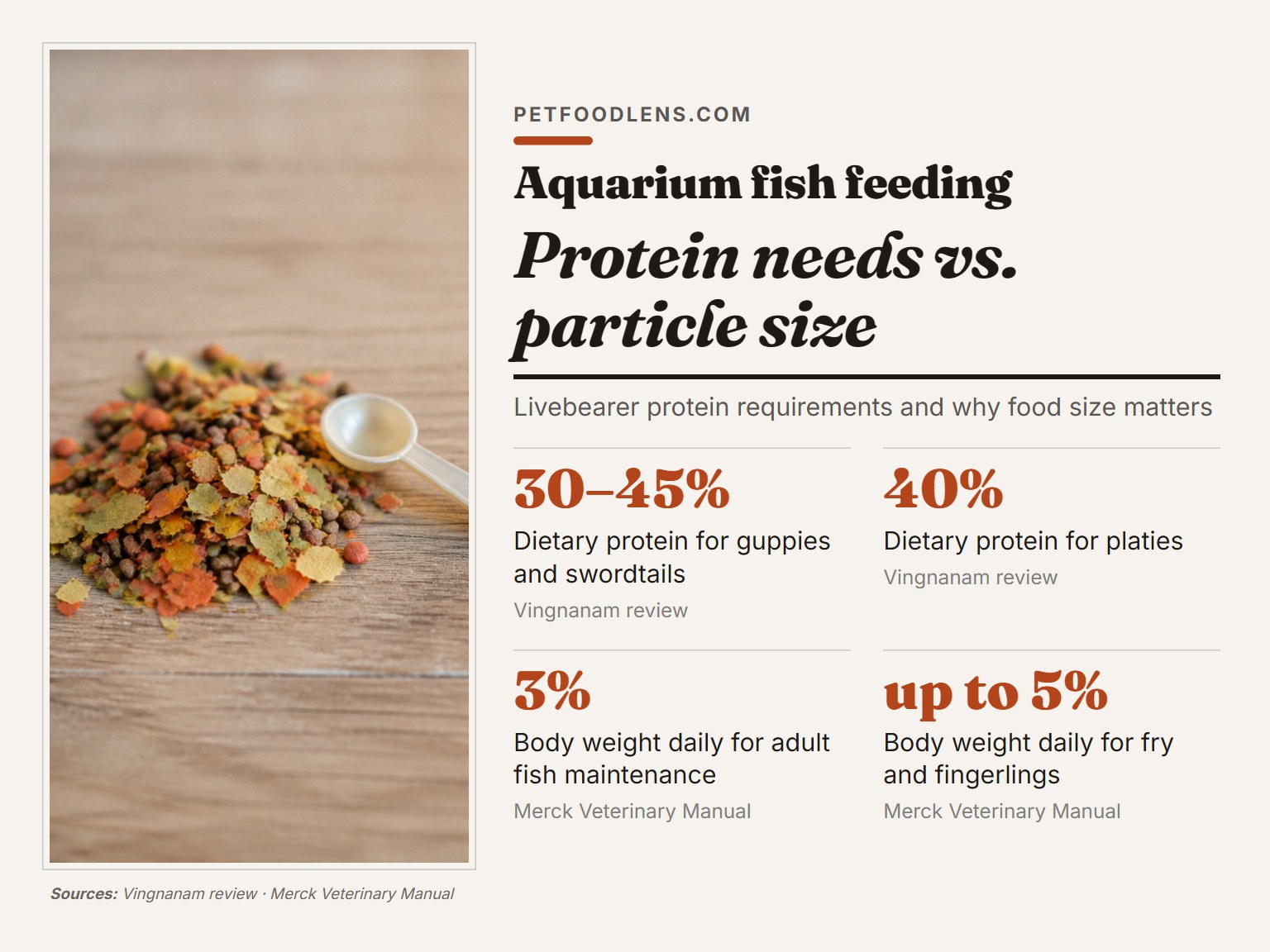
Livebearers need somewhere between 30% and 45% dietary protein, depending on the species.
The ornamental fish feeding strategies review puts the estimates at 30-45% for guppies and swordtails and 40% for platies, with essential amino acids alongside. It also notes that feeding frequency affects growth and reproductive performance in those species.
Protein level matters less to frequency than particle size does. A food the fish can’t ingest cleanly is wasted food, and wasted food is what actually fouls the water.
Merck is specific here. Surface feeders should get floating feed, bottom-dwellers should get items that sink rapidly, and the particle has to be small enough to swallow. Flake that is too large for a small-mouthed fish can be crushed. Flake fed to a large cichlid produces a messy tank, because a big fish can’t eat enough flake to meet its requirement.
Open a container that has been sitting in a warm room since spring and it smells like old cooking oil, flat and slightly sharp at the back of the throat. That is oxidation, and it is the reason the storage numbers later in this piece exist.
I read fish food labels the same way I read a cat food panel: protein percentage first, then whatever ingredient is carrying it.
How Do You Know You’re Feeding the Right Amount?
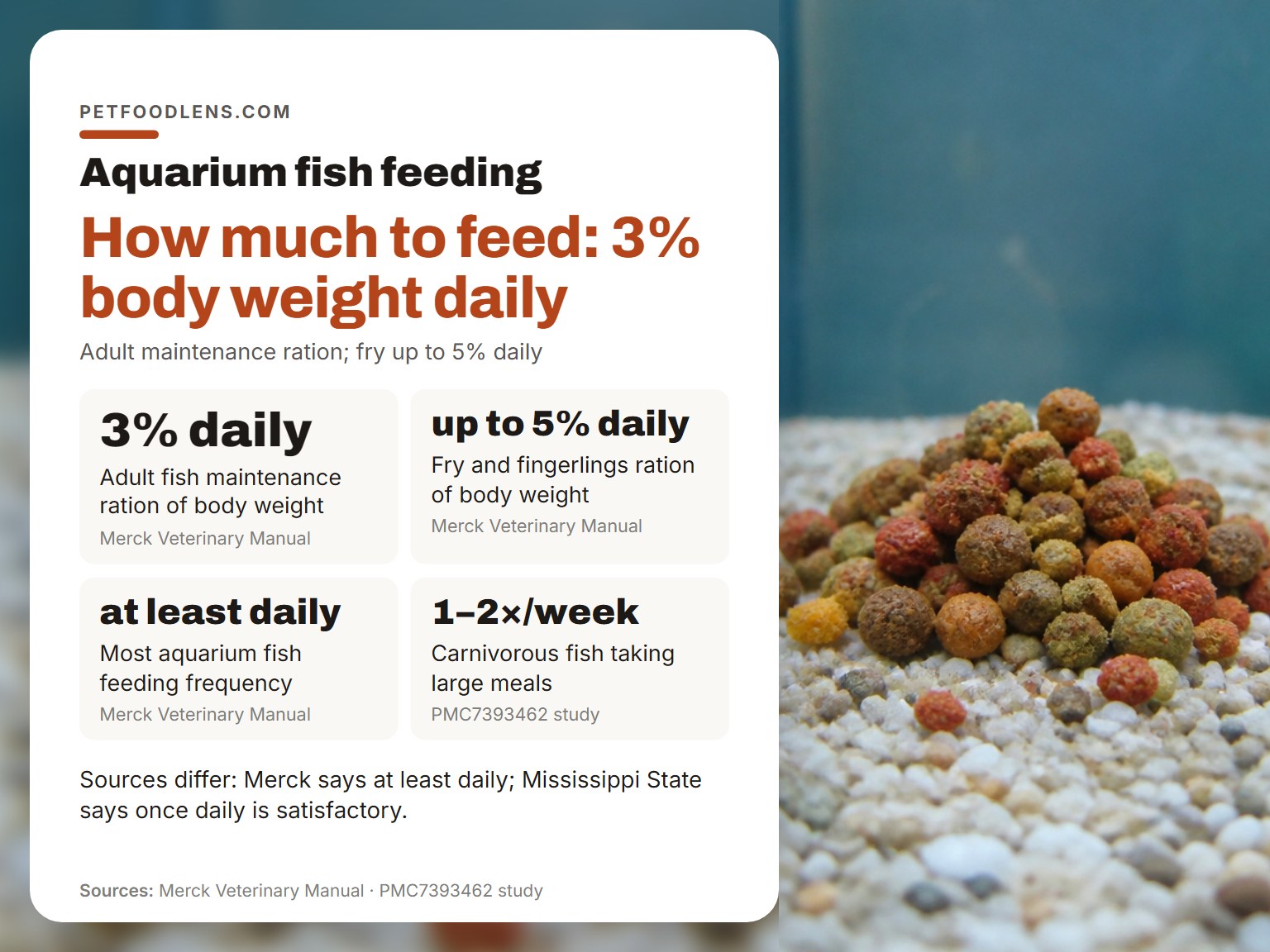
The tank tells you before the fish do, and it usually tells you late.
Overfeeding shows up as leftover feed first and water quality second. Mississippi State puts it plainly: leftover feed spoils water quality, and overfeeding is easy when you can’t tell whether the fish have finished.
| What you see | Likely cause | What to change |
|---|---|---|
| Pellets still on the substrate after a feed | Ration too large for the stock | Cut the portion, keep the frequency |
| Cloudy water a day after feeding | Uneaten food breaking down | Feed less per meal and watch the meal |
| One fish plump, the rest thin | One fish taking the whole ration | Target-feed the slower fish separately |
| Feed clumped at the feeder outlet | Feed compressed in the container | Loosen it; the manual says not to compress |
Leftover pellets fur over with a white fuzz. That fuzz is the ration you didn’t need.
Where this goes sideways: Chasing a cloudy tank with a bigger filter. The filter is processing waste that shouldn’t exist, and the ration is the variable that actually moved.
The downstream effects of overfeeding fish go well past cloudy water.
Condition is measurable, too. The juvenile trial above calculated condition factor from weight and length, which is the fish version of a body condition score. Looking at a fish from above catches drift earlier than a number on a bag ever will.
Storage Quietly Sets Your Real Feeding Schedule
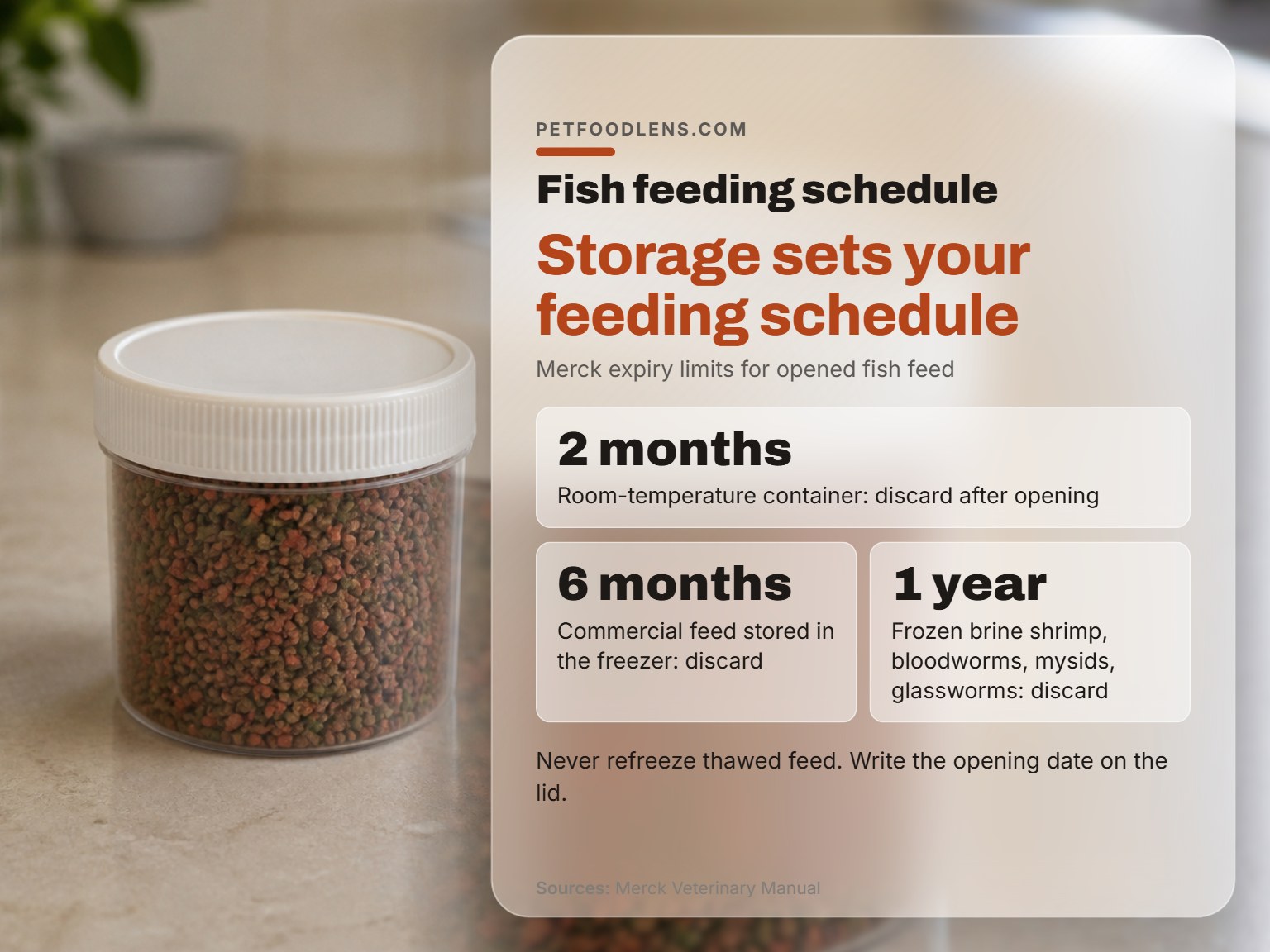
Storage failures show up as feeding failures.
Merck gives hard expiry numbers, which is rare in this hobby:
- Room-temperature container: discard 2 months after opening.
- Freezer: 6 months.
- Frozen brine shrimp, bloodworms, mysids, glassworms: 1 year.
- Never refreeze anything that has thawed.
Fish feeds carry high protein and oil content, and both deteriorate fast. Merck names the failure chain directly: high humidity and high temperature degrade the diet, promote mold growth, risk mycotoxin production, and drive rancidity. Dry feed belongs in a pest-proof container in a low-humidity, low-temperature spot.
A rancid feed still looks like feed. Nothing on the label changes when the oil goes off, which is why the date on the lid matters more than the picture on the front.
The short version: write the opening date on the lid in marker, and replace on schedule rather than on smell.
Frequently Asked Questions
How often should I feed my aquarium fish?
Most adult fish need at least one meal a day, per the Merck Veterinary Manual. Large-meal carnivores are the exception and can be fed once or twice a week. Fry and fingerlings take more, up to 5% of body weight daily.
Is it better to feed once or twice a day?
It depends on the fish, and the sources don’t agree. Mississippi State found twice daily was not necessarily beneficial for food fish, because the extra feed wasn’t fully converted. A juvenile trial on bettas and guppies used twice daily as its control group, which suggests it’s a reasonable baseline for young fish.
Can I skip a day of feeding?
MSU Extension does not recommend every-other-day or every-third-day feeding for routine grow-out, because fish can’t make up the missed feed on the days they are fed. A short fast during treatment is a different question from a routine schedule.
How much food should I give each time?
Adults get about 3% of body weight daily; fry get up to 5%. Weigh the food in grams rather than measuring by eye, because flake and pellet weights differ sharply for the same volume.
Do bottom-feeding fish need their own food?
Yes. Merck specifically names loricariids and Corydoras, says they should receive targeted feeding rather than surviving on leftovers, and calls the leftover approach unacceptable.
How long does fish food last?
Two months at room temperature after opening, six months in the freezer, and one year for commercial frozen feeds. Thawed frozen feed should not be refrozen.
The Bottom Line
One threshold is worth carrying out of this: if the container has been open longer than two months at room temperature, replace it before you adjust anything else. Stale feed changes how much the fish eat, which changes the ration math, and you’ll spend a week tuning a number that was never the problem.
Everything above assumes a healthy adult fish in a cycled tank. A hospital tank, a fish under treatment, or a tank mid-cycle runs on different rules, and that’s a conversation for a vet rather than a feeding chart.
The question of how often to feed aquarium fish has a documented answer, and it fits on an index card. One measured meal a day, weighed in grams, at 3% of body weight for most adult fish; large-meal carnivores may be fed once or twice a week, and juveniles can take more frequent meals.
