
How Often to Feed Koi? Match the Label, Not the Calendar
This post contains affiliate links. As an Amazon Associate, we earn from qualifying purchases.
To decide how often to feed koi, match the number of feeds to water temperature, the product’s own label, and fish size. Most established ponds run two to four meals a day in warm water, fewer as the water cools, and none once koi go dormant for winter.
The product’s own label is where that range gets specific, and it is also where the trouble starts. Hikari’s Saki-Hikari Multi-Season and its own coldwater guide give different numbers for the same 59-64F water. The coldwater guide says one to two feeds a day. The Multi-Season label says two to four.
What follows is how to read the temperature bands, why the labels disagree, and how to set a ration you can defend when the pond, the product, and the fish are all telling you something slightly different.
Key Takeaways
- Match feeds to temperature and the label, not to habit or the calendar.
- Frequency alone does not grow koi faster when the total daily ration is fixed.
- Clear leftovers within 3-5 minutes (Hikari Staple) or up to 15 minutes (Koi Organisation International).
- Fish size changes the count: juveniles take 3-5 small meals, large adults 1-3.
What the Temperature Bands Actually Say
Every koi food label carries a temperature table, and the tables do not match each other. That is the first thing to understand before you pick a number.
Koi feeding frequency scales with water temperature because digestion and metabolism slow as the water cools. Manufacturer charts divide the year into bands, each with a stated number of feeds per day, and each band carries a lower limit below which the product is not intended for use.
Hikari’s Saki-Hikari Multi-Season is valid above 54F (12C). Above 64F (18C), the label says feed two to four times daily based on koi activity. Between 54F and 64F, it says the same: two to four times daily, preferably during the warmest part of the day. Between 41F and 54F, it says regulate the amount by activity and pond conditions.
Hikari Staple runs a different table. Above 60F, feed one to two times daily. Above 70F, feed two to four times daily. The Staple label also sets a clearance rule: do not exceed what the fish eat within three to five minutes, and remove whatever is left.
Then there is Hikari’s coldwater guide, which contradicts both in places. In chilly water, Hikari’s coldwater guide says feed no more than two times daily, or four for small koi, while the Multi-Season label says two to four times daily in the 41-54F band. In the coldest range, Hikari’s coldwater guide says you may stop feeding until spring, while the Multi-Season label says to feed carefully regulated amounts between 41F and 54F.
| Water temp | Saki-Hikari Multi-Season | Hikari Staple | Hikari coldwater guide |
|---|---|---|---|
| Above 68F (20C) | Switch to Growth or Color Enhancing | 2-4x daily (above 70F) | As often as you like |
| 54-64F (12-18C) | 2-4x daily | 1-2x daily (above 60F) | 1-2x daily (59-68F) |
| 41-54F (5-12C) | Regulate by activity | Not specified | No more than 2x daily |
| Coldest range | Not specified | Not specified | May stop; none in hibernation |
The table is the honest picture. Three documents from one manufacturer, three different answers for the same pond.
For a broader seasonal breakdown, the koi feeding guide on this site walks the same bands month by month.
Why the 59-64F Band Is the Problem
The 59-64F overlap is where the contradiction is sharpest. Hikari’s coldwater guide puts 59-68F at one to two feeds daily. The Multi-Season label puts 54-64F at two to four feeds daily. Same manufacturer, same water, roughly double the frequency.
Which one is right? Neither document says the other is wrong. The coldwater guide is written for general cold-water feeding. The Multi-Season label is written for that specific product, which is built around easily digested ingredients and a probiotic.
When two documents from the same manufacturer give different numbers for the same water, pick the more conservative one and watch the fish. The label is a starting point, not a prescription.
My read: start at the lower number and increase only if the fish are active and the water tests are clean. A koi that ignores food is telling you something the chart cannot.
Why the Labels Disagree With Each Other
The disagreement has a cause. Each label is written for a specific product, a specific fish size, and a specific water range. Copy one number onto a different food and you have applied advice that was never meant for it.
Japan Koi (japankoi.jp) makes this point directly. It says no single temperature chart gives the right daily frequency for every koi and diet, and a warm spell is not a reason to increase frequency if the fish are not eating. It frames Hikari’s numbers as product-specific examples, not maximum targets.
That is a fair correction. A chart is a starting point. The fish and the water are the actual data.
There is a second reason the labels disagree: the products are built differently. Saki-Hikari Multi-Season is formulated for cooler water. Hikari Staple is a general daily diet. Different food, different feeding schedule.
The front of the bag is the paint and the chrome. The temperature table is the engine specs.
The part nobody mentions: Saki-Hikari’s label says its benefits are only valid with continued, uninterrupted feeding as an exclusive daily diet. Switch foods mid-season and the label’s frequency advice no longer applies to what you are actually feeding.
That is a real constraint. If you mix diets, or feed a home-made ration alongside, you are outside the conditions the label was written for. Read the panel, not the front of the bag.
A pond fish food built for cool water is not the same as a growth diet, and the feeding schedule changes with it.
How Often to Feed Koi in Cold Water?
What does a koi do at 45F when food hits the water? Often it rises and takes a pellet. That reflex is not a signal that the gut can handle a full ration.
Hikari’s coldwater guide gives the clearest rule. In chilly water, feed no more than two times daily, or four times for small koi. In the coldest range, technically you may stop feeding until spring. If the koi are active, you may feed an amount they consume within a minute or so, but never more.
The Multi-Season label takes a softer line. Between 41F and 54F, it says feed carefully regulated amounts based on activity and pond conditions. It does not say stop.
That is a genuine disagreement, and the article should not pretend otherwise. One Hikari document says you may stop. Another says feed regulated amounts in the same band.
Where this goes sideways: Feeding a full ration at 45F because the fish came to the surface. Appetite in cold water is a reflex, not a signal that the gut can handle the load. Undigested food fouls the water, and ammonia can climb.
The practical resolution is to watch the fish, not the calendar. If koi are sitting on the bottom and ignoring food, stop. If they are moving and taking pellets, feed a small amount and remove what they leave.
Here is the cold-water sequence in plain terms:
- Below 41F (5C): stop. Hikari’s coldwater guide says no feeding is necessary once koi are in hibernation mode, while the Multi-Season label gives a 41-54F band of carefully regulated amounts.
- 41-54F (5-12C): regulate by activity. Small amounts, warmest part of the day, and remove anything left.
- 54-64F (12-18C): two to four small feeds, preferably midday, per the Multi-Season label.
The Hibernation Question
When koi are in hibernation mode, Hikari’s coldwater guide says no feeding is necessary. That is the clearest statement in any of the documents.
The Multi-Season label does not use the word hibernation. It simply gives the 41-54F band and says regulate. The two positions are not identical, and a keeper in a cold climate has to decide which one to follow.
My take: below 41F (5C), stop. Hikari’s coldwater guide says no feeding is necessary in hibernation, while the Multi-Season label gives a 41-54F band of carefully regulated amounts. A koi that is dormant is not burning calories it needs to replace.
Does Feeding More Often Actually Grow Koi Faster?
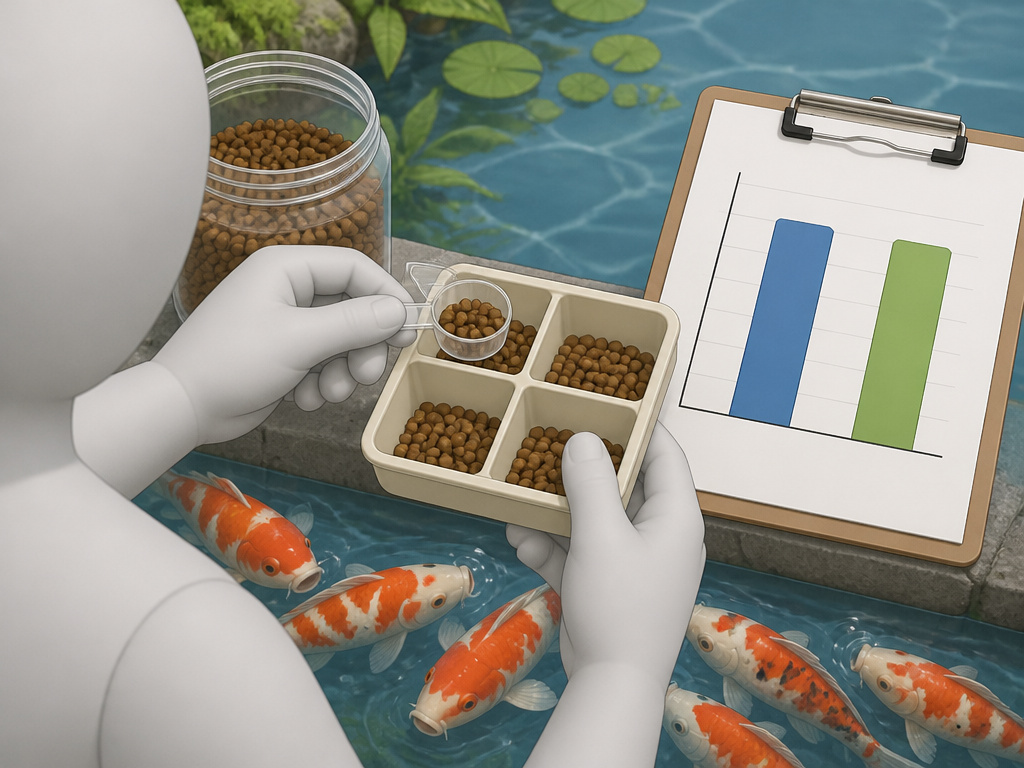
Two peer-reviewed studies, two different answers. The difference matters because it decides whether you add meals or add food.
The 2017 study in Aquatic Sciences and Engineering fed koi fry (0.015 g) two, three, or five times a day at 18% body weight for 60 days. Final mean weights were 0.474, 0.494, and 0.579 g. Feed conversion, growth rate, protein efficiency, and survival showed no significant difference across the groups (p>0.05).
The 2010 study in the Korean Journal of Fisheries and Aquatic Sciences fed red-and-white koi fingerlings averaging 6.3 g at one, two, three, or four meals a day, to satiation or 80% satiation, for six weeks. Weight gain, feed efficiency, and protein efficiency improved as frequency and satiation rate increased. Four meals a day to satiation produced the best growth under those conditions.
So one study says frequency did not matter. The other says it did. Both are peer-reviewed. Both used small fish.
The difference is in the design. The 2017 study fixed the ration at 18% body weight. The 2010 study fed to satiation, which means the fish could eat more when offered more meals. That is the key: frequency helped when it let the fish eat more, not when the total was fixed.
A 2025 meta-analysis cited by Japan Koi Malaysia supports that reading. Across 145 study cases from 53 publications, increasing feeding frequency tended to improve feed conversion, but when total daily feed was fixed, more frequent feeding did not automatically increase average daily growth.
Frequency is not a growth lever on its own. Divide the daily ration; don’t add to it.
That is the rule I would put on the pond wall. If you want more growth, feed more total food within the system’s capacity. If you want better distribution and less waste, feed more often at the same total.
The koi feeding frequency growth study is worth reading in full if you want the satiation details. The fry study is the counterweight.
Match the Ration to Fish Size, Not Just Temperature
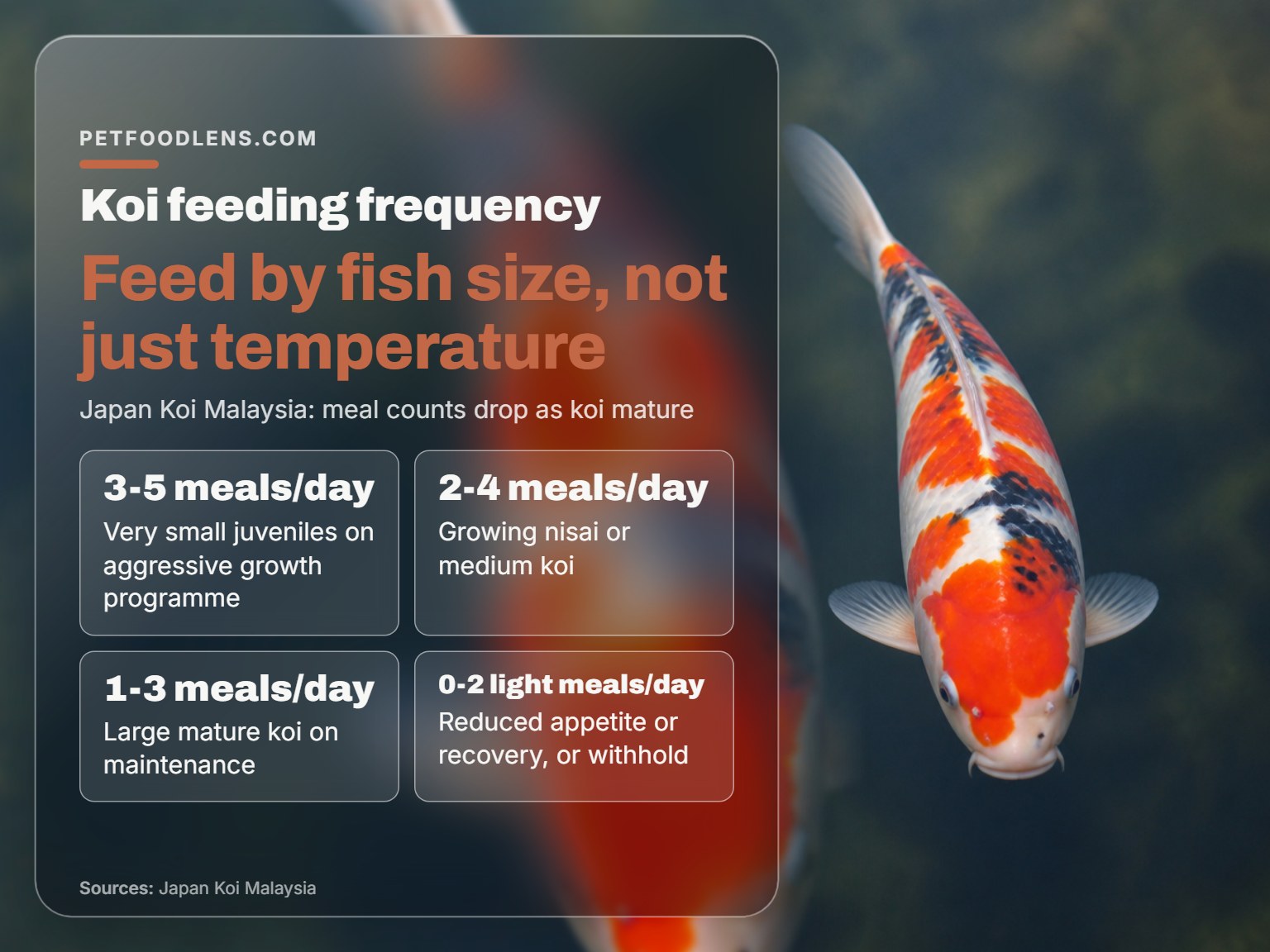
A juvenile and an adult should not eat on the same schedule. Temperature sets the ceiling. Fish size sets the count.
Japan Koi Malaysia publishes a practical framework that separates the two. Very small juveniles on an aggressive growth programme take three to five small meals a day. Growing nisai or medium koi take two to four. Large mature koi on maintenance take one to three.
| Fish stage | Starting frequency | Main caution |
|---|---|---|
| Very small juveniles | 3-5 small meals/day | Ration and water quality set the ceiling |
| Growing nisai / medium | 2-4 meals/day | Only if body condition and filter support it |
| Large mature koi | 1-3 meals/day | Large meals create competition |
| Show conditioning | 2-4 measured meals/day | Don’t confuse frequency with maximum feeding |
| Reduced appetite / recovery | 0-2 light meals/day or withhold | Find the cause first |
The logic is simple. Small fish have a higher metabolic demand per unit of body mass and a smaller gut. They cannot eat their whole daily requirement in one or two feedings, so the ration gets divided.
Large koi are the opposite. Their daily ration as a percentage of body weight is lower, and their meal capacity is bigger. A mature fish can meet its needs on fewer meals, and the keeper’s goal shifts from growth to condition and water quality.
This is where a lot of ponds go wrong. A schedule built for juveniles gets copied onto adults, and the adults get overfed. The how much to feed question is separate from the frequency question, and both have to be answered.
The same logic that governs how often to feed aquarium fish applies here, but koi are bigger and eat more. Do not substitute goldfish food vs koi food without checking the protein and temperature specs.
Dividing the Daily Ration
The arithmetic is not complicated. Meal size in grams equals the planned daily ration divided by the number of meals.
Japan Koi Malaysia gives a worked example: a 360 g/day target divided into six meals is 60 g each. Four meals would be 90 g each. Two meals would be 180 g each.
The mistake is adding meals without reducing meal size. Put an automatic feeder on a pond, add cycles, and the total food going in doubles while the keeper thinks they have only increased frequency.
Four discharges within 45 minutes are biologically closer to one extended feeding than four separate meals. Space them out. Three to four hours between meals is a workable interval for a four-meal daytime programme.
Here is how to set a ration in four steps:
- Measure the water temperature at feeding time, not the air temperature. The label bands are written for water.
- Pick the band from the product label and note the lower limit. Feeding below it wastes food and fouls the water.
- Divide the daily ration by the number of meals. Skipping this step is how automatic feeders double the feed going in.
- Watch the fish eat and remove leftovers. If pellets are still there after a few minutes, cut the next ration.
The Leftover Window: 1 Minute, 5 Minutes, or 15?
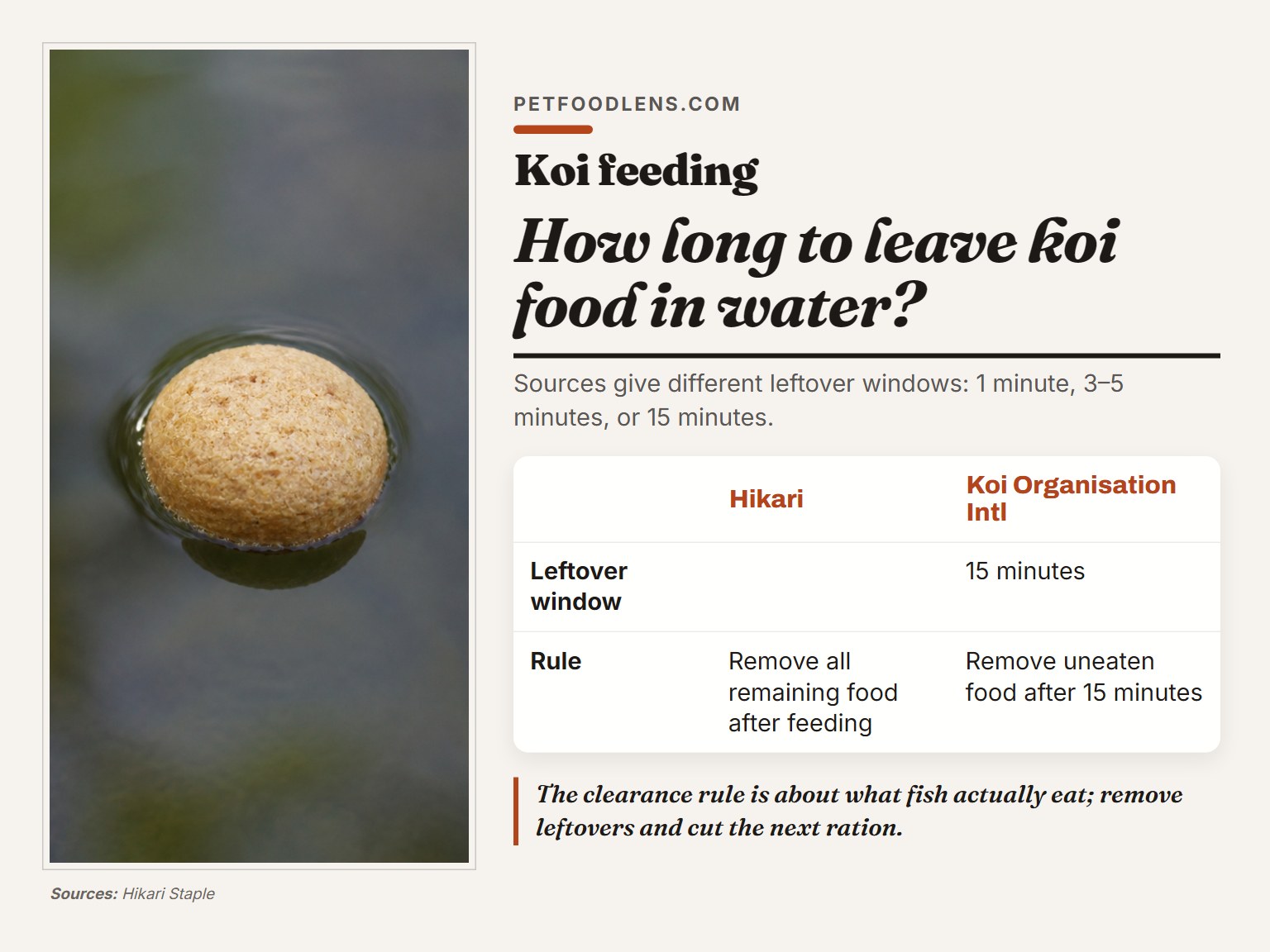
The sources do not agree on how long to leave food in the water. The sources do not agree on how long to leave food in the water, and the difference is large enough to matter.
Hikari Staple says do not exceed what the fish eat within three to five minutes, and remove all remaining food after the feeding period. Hikari’s coldwater guide says, at 41-50F, feed an amount consumed within a minute or so. Koi Organisation International, in its cold water koi feeding and nutrition paper, says remove uneaten food after 15 minutes.
The sources give a minute, three to five minutes, and fifteen minutes.
The resolution depends on water temperature and food type. In cold water, digestion is slow and the fish are sluggish, so a shorter window makes sense. In warm water with active fish, a few minutes is reasonable. The 15-minute figure is Koi Organisation International’s rule, while Hikari Staple uses three to five minutes and Hikari’s coldwater guide uses about a minute at 41-50F.
Easy to miss: The clearance rule is about what the fish actually eat. Offering what they eat within a few minutes does not mean topping up for the whole period. Remove leftovers and cut the next ration.
The overfeeding problem almost always starts here. Food that is not eaten breaks down, and the filter has to process it. A pond that was stable can swing quickly.
You can see it before you test for it. A pond that’s being overfed can go cloudy and the water can take on a green-grey haze.
Timing: When in the Day to Feed
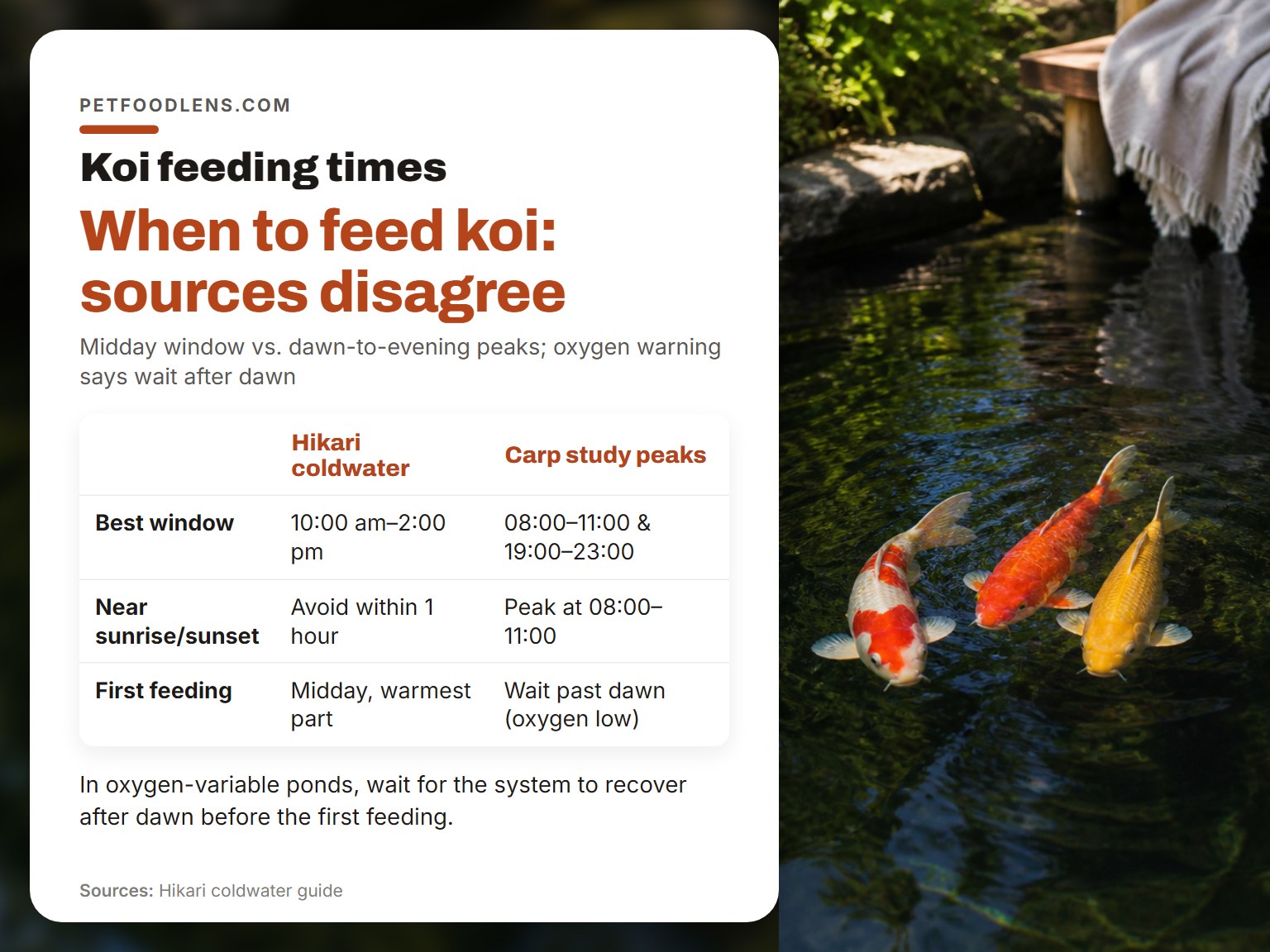
At 6am the pond is flat and the koi are hanging near the bottom. That is not the moment to feed, at least not in a pond where oxygen drops overnight.
Hikari’s coldwater guide says feed between 10:00 am and 2:00 pm if possible, and always avoid feeding within one hour of sunrise or sunset. Japan Koi Malaysia cites a temperature study that found two feeding peaks in common carp, around 08:00-11:00 and 19:00-23:00. It also warns that dissolved oxygen can be lowest near dawn, so the first feeding should wait until the system recovers.
Those are not the same advice. Hikari’s window is midday. The carp study’s peaks are morning and evening. The oxygen warning says do not feed at first light.
The sources disagree: Hikari’s coldwater guide favors 10:00 am to 2:00 pm, Japan Koi Malaysia’s cited study shows peaks around 08:00-11:00 and 19:00-23:00, and Japan Koi Malaysia warns to wait for the system to recover after dawn. In a well-aerated recirculating pond, the dawn oxygen swing is small and the clock is flexible. In a green-water or heavily stocked pond, oxygen is the limiting factor, and midday is safer.
A short list of timing rules that hold across the sources:
- Feed midday when oxygen is stable. Hikari’s 10:00 am to 2:00 pm window is the safest default.
- Avoid the hour around sunrise and sunset.
- In oxygen-variable ponds, wait for the system to recover after dawn before the first feeding.
- Keep evening meals small and check the pond before dark.
Evening feeding is possible but needs more judgment. Uneaten pellets are harder to see after dark, and oxygen falls overnight. A modest evening meal works in a well-aerated pond. A large late meal in a marginal pond is asking for trouble.
Frequently Asked Questions
How often should I feed koi in summer?
In warm water above 70F, most established ponds run two to four meals a day. Hikari Staple gives two to four times daily above 70F. Japan Koi Malaysia gives two to four meals for most established ponds. Small juveniles can take three to five small meals. Watch water quality and cut back if ammonia rises.
Can I feed koi once a day?
Yes, for large mature koi on a maintenance programme. Japan Koi Malaysia puts large mature koi at one to three meals a day. The total daily ration matters more than the number of meals. A single large meal creates more competition at the surface, so two smaller meals often distribute food better.
Should I stop feeding koi in winter?
Below 41F (5C), yes. Hikari’s coldwater guide says you may stop feeding until spring, and when koi are in hibernation mode, no feeding is necessary. Between 41F and 54F, the Multi-Season label says feed carefully regulated amounts. Watch the fish and the water rather than a fixed date.
Do koi need more food when the water is warm?
They can eat more, but the total ration still has a ceiling. Hikari’s coldwater guide says koi can lose appetite at higher temperatures and suggests smaller amounts of easily digested food. The 2025 meta-analysis found that more frequent feeding did not increase growth when the total daily feed was fixed.
What is the best time of day to feed koi?
Midday is the safest general window. Hikari’s coldwater guide recommends 10:00 am to 2:00 pm and warns against feeding within an hour of sunrise or sunset. In ponds where dissolved oxygen drops overnight, wait until the system recovers after dawn before the first feeding.
The Bottom Line
The honest answer to how often to feed koi is that no single chart covers every pond, and the labels themselves disagree. Hikari’s own documents give different numbers for the same 59-64F water. The research disagrees on whether frequency grows fish faster.
Here is the one rule I would keep. If your water is below 41F (5C) and the koi are dormant, stop feeding. Above that, match the count to the label, divide the daily ration rather than adding to it, and clear leftovers within a few minutes.
If you take one action this week, measure your water temperature at feeding time and write down what the fish actually eat. That record will tell you more than any chart, and it is the only data that is specific to your pond.
