
Dry Dog Food Pros and Cons: What the Label Hides
This post contains affiliate links. As an Amazon Associate, we earn from qualifying purchases.
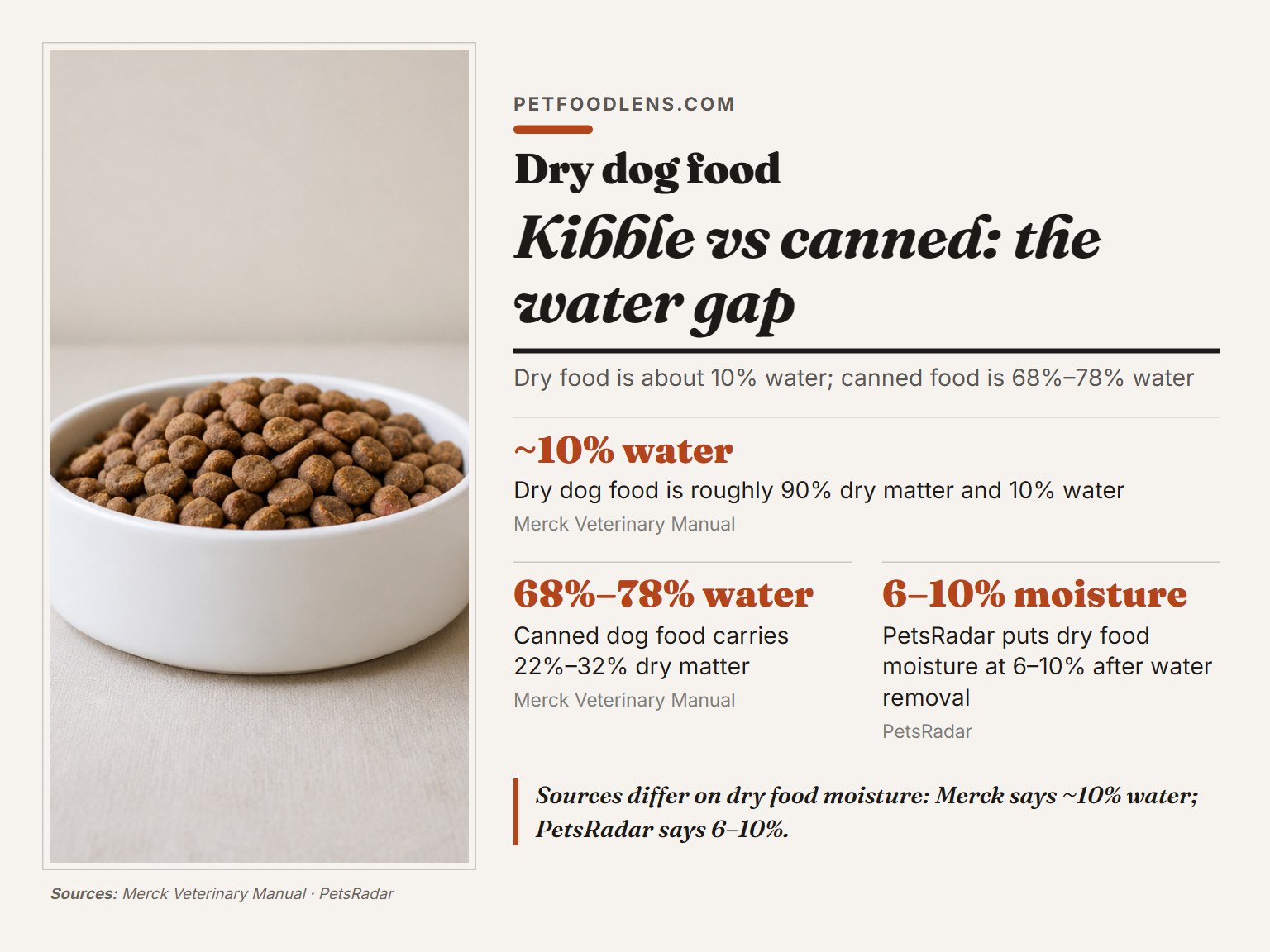
Dry dog food pros and cons start with moisture: kibble runs about 90% dry matter and 10% water, which makes it cheap and shelf-stable but delivers far less water per bite than canned food at 68%-78% water. Formulation matters more than format.
Water content is the number the front of the bag never prints, and it decides how the rest of the label should be read. A food at 10% water and a food at 70% water cannot be lined up on the percentages printed in their guaranteed analysis. Convert both to dry matter first.
What follows is the honest version. Where kibble earns its place, where the dental claim falls apart, which label statements are legally enforced and which are decoration, and the storage mistake that quietly turns a bag bad.
Key Takeaways
- Compare on dry matter, not as-fed percentages. A 10% water food and a 70% water food can’t be lined up any other way.
- “Complete and balanced” is a legal claim. It has to be backed by one of three verbatim AAFCO statements.
- Dental benefit needs a dental diet. Ordinary kibble has thin evidence behind it; VOHC-accepted products are the exception.
- Water is where kibble loses. Canned food is 68%-78% water against roughly 10% in dry.
- Recalls hit every format. Vitamin D ran up to roughly 70 times the intended level in 2018; Salmonella drove a 2023 recall.
Why “Dry” Is a Moisture Range, Not a Fixed Number
Two published figures describe the same bag, and they don’t match. The Merck Veterinary Manual puts dry dog food at roughly 90% dry matter and 10% water. PetsRadar, working from the manufacturing process, describes dry food as 6%-10% moisture once most of the water is removed.
Dry pet food is made by cooking and extruding a blend of grains, meats, fats, minerals, and vitamins, then forcing the mixture through a die where a knife cuts the kibble to shape. Extrusion temperatures range from about 80 °C to 200 °C (176 °F to 392 °F), and a minimum of 130 °C (266 °F) is needed to kill both microbes and bacterial spores.
Process variation is a real failure mode, not a theoretical one.
Neither figure is wrong. Merck is describing typical composition. PetsRadar is describing the result of a process that pulls water out. Treat both as ranges and you’ll read labels more accurately.
| Format | Water | Dry Matter |
|---|---|---|
| Dry | ~10% | ~90% |
| Semimoist | 25%-40% | 60%-75% |
| Canned | 68%-78% | 22%-32% |
Semimoist sits in the middle at 25%-40% water, which is why semi-moist dog food keeps on a shelf without refrigeration. Canned food is 68%-78% water, and that single number is the whole basis of the wet dog food argument.
What the Ingredient List Actually Tells You
The Merck Veterinary Manual states it flatly: no reference to quality or grade of an ingredient is allowed on a pet food label. That one rule kills most of what buyers think they’re reading.
Ingredients are listed in descending order by weight, on an as-fed basis. That’s the phrase that matters. An ingredient listed first can still contribute less to the finished food than one listed fourth.
The Chicken Problem: Fresh Versus Meal
Chicken at 75% moisture contributes a much smaller share of total nutrients to the dry matter than the same ingredient added in a dry form, like chicken meal. So “chicken first” is a moisture artifact as often as it’s a formulation choice.
Ingredient splitting works the same way. List wheat and wheat flour as separate entries and the total wheat looks smaller than it is. Merck names this practice directly.
What most people get wrong: Reading the ingredient list as a ranking of quality. Merck notes that no quality or grade claim is permitted on the label at all, so the list ranks weight, not worth. Two foods with near-identical nutrient profiles can carry completely different lists, and you can pay more for the list without getting a different diet.
Kibble shape and size come from the die at the end of the extruder, which is why types of dry dog food mostly differ in what goes into the mix before that point rather than in the finished piece.
Is Dry Dog Food Actually Bad for Teeth?
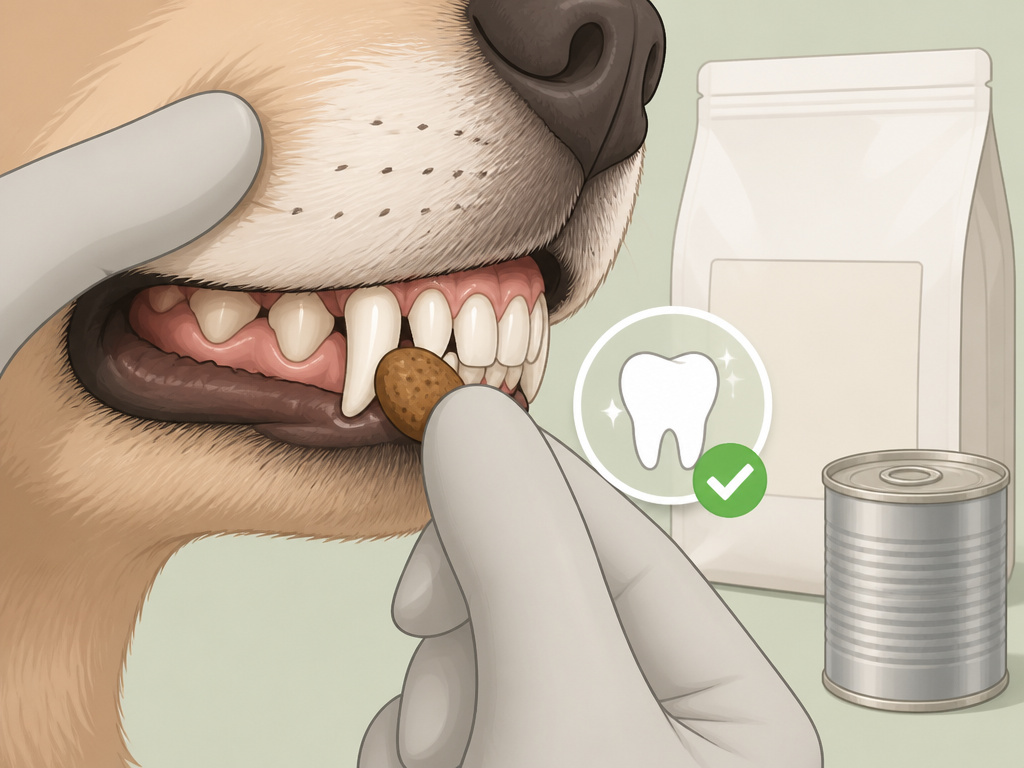
Vets and consumer guides do not agree here, and the gap is worth understanding before you pay extra for a dental claim.
The Merck Veterinary Manual position is that certain specially formulated dry foods may provide beneficial massage of the teeth and gums to help decrease periodontal disease. PetsRadar’s position is blunter: there is surprisingly little evidence that dry food improves dental health unless it’s a specially formulated dental diet, and meaningful improvement is likely only with Veterinary Oral Health Council approved foods.
Read those two side by side and the disagreement is narrower than it looks. Both restrict the benefit to specially formulated dental diets. What they split on is how much ordinary kibble does.
If a dental claim on a bag is not backed by Veterinary Oral Health Council acceptance, treat it as decoration. Both sources here limit the real benefit to specially formulated dental diets.
Framing the kibble vs canned choice as a dental decision is the weakest version of that argument. Pick your format on water and calories, then buy a dental product if your vet says you need one.
The Label Claims That Carry Legal Weight
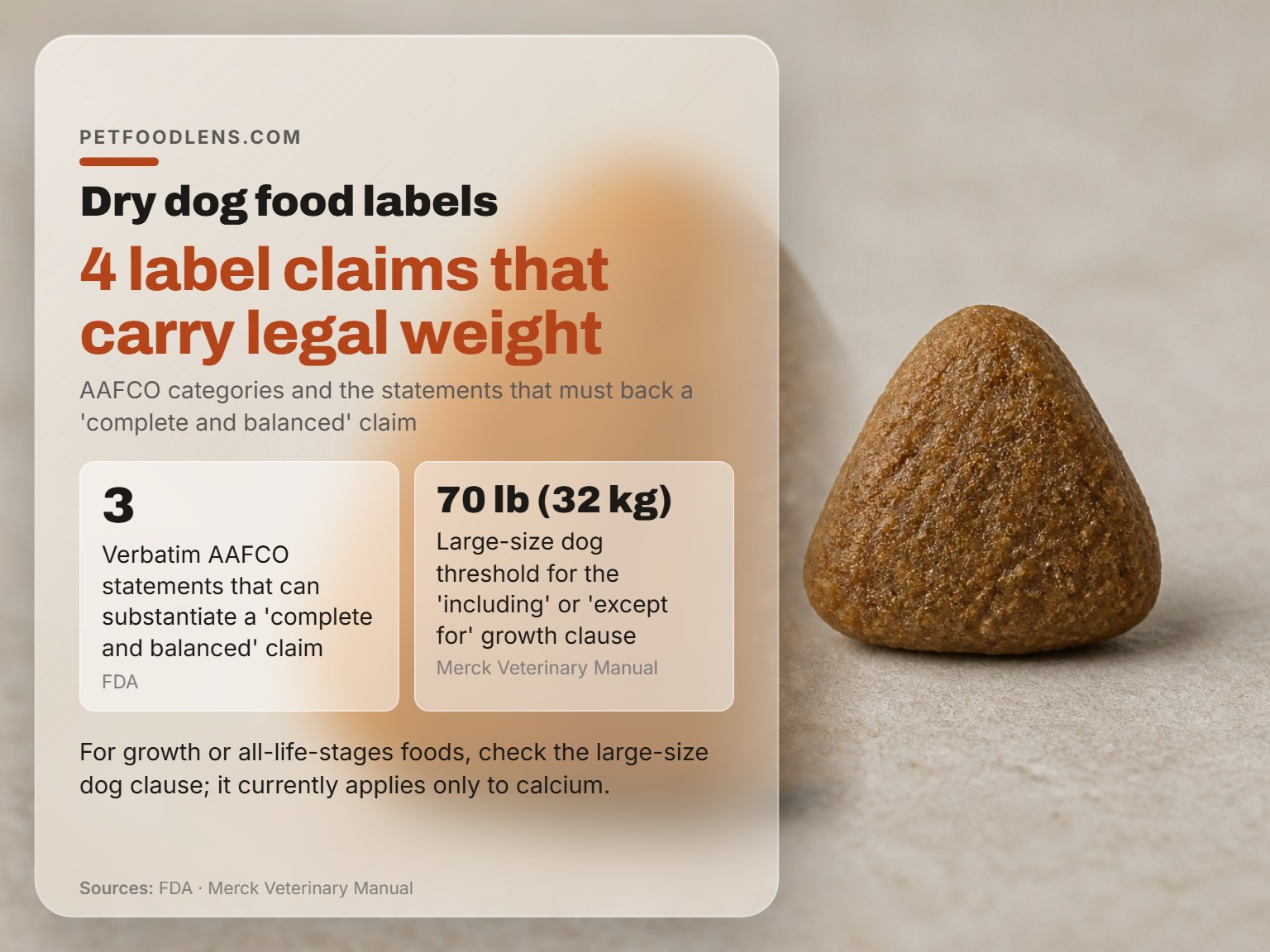
Four things on a pet food label are legally defined. Everything else is a story told by the front panel.
AAFCO recognizes four nutritional adequacy categories: growth, maintenance, gestation/lactation, and all life stages. A “complete and balanced” claim has to be substantiated by one of three verbatim statements.
The Three AAFCO Statements
The first says the product is formulated to meet the AAFCO nutrient profiles for a named life stage. The second says animal feeding tests using AAFCO procedures substantiate the claim. The third says the product is comparable in nutritional adequacy to a product substantiated by feeding tests.
For growth or all-life-stages dog foods, the label must also state either “including growth of large-size dogs (70 lb [32 kg] or more as an adult)” or “except for growth of large-size dogs (70 lb [32 kg] or more as an adult)”. That clause currently applies only to calcium.
| Claim on the bag | What has to back it | What to do |
|---|---|---|
| “Complete and balanced” | One of three verbatim AAFCO statements | Find the statement on the back panel |
| “Growth” or “All life stages” | Large-size dog clause at 70 lb (32 kg) | Check “including” vs “except for” |
| “Less” or “reduced calories” | Named comparison product and percentage | Read the comparison, not the word |
| Calorie content | kcal/kg plus kcal per household measure | Use the per-cup figure for portioning |
Here’s the sequence I’d use in the aisle.
- Find the calorie content in kcal per cup. Merck requires both kcal/kg and a per-household-measure figure. Skip this and you’re portioning off the bag’s scoop suggestion, which Merck itself calls a general recommendation at best.
- Locate the AAFCO nutritional adequacy statement. Without it you cannot tell a complete diet from a complementary topper that will leave gaps over months.
- Convert the guaranteed analysis to dry matter. Divide the as-fed percentage by the dry matter fraction. A food at 10% moisture is 90% dry matter, so 25% protein as-fed becomes 27.8% on a dry matter basis. Skip the conversion and a canned food at 70% water looks weaker than it is.
- Check the large-size dog clause if you have a big-breed puppy. The calcium wording is the only place that distinction shows up on the label.
- Read the front last. By then you’ll know whether the story matches the panel.
Once you know which statements to check, a best dry dog food list becomes readable instead of persuasive.
The Dry Dog Food Pros and Cons That Actually Hold Up
Kibble’s real advantages are unglamorous. Merck lists lower cost than canned or semimoist food and the ability to store unused portions at room temperature. PetsRadar adds that dogs rarely get bored of the same food.
Picky eaters are a genuine kibble win, oddly. Every piece is identical and carries the same nutrients, so a dog can’t pick out the bits it prefers and unbalance the diet.
Water Intake and Weight Control
This is where the format argument gets real. A dog eating canned food at 68%-78% water takes in a meaningful share of its water from the bowl. A dog on kibble at roughly 10% water does not.
The dog owners I talk to almost never ask about water until something goes wrong. A dog on kibble drinks from a bowl; a dog on canned gets a good share of the water in the food. If your dog is a reluctant drinker, that difference is the whole argument for mixing formats.
Mixed feeding is the underrated answer here. A freeze-dried dog food topper rehydrated with warm water adds moisture without changing the whole bowl. Air-dried dog food is worth reading on the same dry-matter basis as kibble before you pay a premium for it.
Are Dry Dog Food Recalls a Reason to Switch Formats?
The FDA’s 2018 vitamin D alert is the cleanest example of how a formulation error scales. State and private lab results found several dry pet foods containing as much as approximately 70 times the intended amount of vitamin D.
The follow-on detail is the instructive part. Sunshine Mills’ Old Glory recall on December 18, 2018 contained about three times the intended level. The FDA ruled it not an acute health hazard that would qualify as a Class I recall, so no public notification was issued. That recall ran until the FDA terminated it on July 17, 2020.
Salmonella tells a different story. TFP Nutrition issued a limited recall on October 20, 2023 covering 50-lb bags of Retriever Mini Chunk Chicken Recipe, manufacturing codes 3277 TFP to 3278 TFP, distributed across ten states. On November 16, 2023 the company expanded that recall to all dry dog, dry cat, and catfish formulas made at its Nacogdoches, Texas facility.
Now put that next to the testing data. A peer-reviewed microbiological safety in commercial dog food study looked at 36 Polish dry dog foods. All met FEDIAF minimums for total protein and fat. No Enterobacteriaceae, Salmonella, Listeria, Clostridium, or yeasts were detected. Mold turned up in one cereal-free food and six cereal-containing foods.
Total aerobic microbial count ranged from 2.7 × 10² to more than 3.0 × 10⁷ cfu/g, and the authors note that no European Commission standard exists for permissible microorganism levels in pet food.
That’s the disagreement in one paragraph. One body of evidence says routine testing finds nothing pathogenic. The other is a government recall record showing it does happen. Different scopes, opposite reassurance.
Easy to miss: A “complete and balanced” statement says nothing about contaminant testing. Absence of a legal limit means a product passing its own checks is not evidence of safety, only evidence that no standard was breached.
Grain-free is a separate question from format, and an updated review of grain-free pet food covers the nutritional and health considerations in detail. If you’re weighing that category, the grain-free dog food evidence is worth reading before the marketing.
How to Store Kibble Without Ruining It
I emptied a pantry bin once and found a yellowish, tacky film on the walls and a smell like crayons and paint. Months of fresh kibble had been poured straight on top of that residue. Every new bag met old oxidized fat on day one.
That’s the failure nobody photographs. The bin looks clean because the top layer is clean.
- Empty the bin completely between bags. Pouring fresh over old residue seeds the new batch with rancid fat.
- Wash with hot soapy water and dry it fully. Damp plastic plus fat residue is a bad pairing, and full drying takes longer than people expect.
- Keep the original bag if you can. Merck lists room-temperature storage as a dry food advantage, and the bag is designed for it.
- Don’t top off. It’s the same mistake as the bin, just smaller.
When Dry Food Is the Wrong Call
Some dogs should not run on kibble alone, and the reasons are specific rather than philosophical.
- Suspected food allergy or intolerance. Merck notes that an over-the-counter diet made in a plant using other ingredients can contain trace amounts of unlisted ingredients, so ruling out an allergy may need a therapeutic diet or a homemade diet formulated by a boarded veterinary nutritionist.
- Regular stomach upsets. PetsRadar’s guidance is to consider a diet switch when upsets keep recurring.
- A dog that won’t drink. The water arithmetic above does the arguing for you.
- A dog on a precise weight plan. The kcal per cup figure is the tool, and it works better when you’re not guessing at moisture.
One more trap. “Complementary” foods do not contain all the nutrients a dog needs, and they’re increasingly sold alongside complete diets as toppers. Feeding one as the main diet leaves gaps that show up over months, not days.
The Bottom Line
Here’s the trigger. If your dog is a reluctant drinker, or has had two or more bouts of stomach upset in the past few months, stop shopping on the front of the bag. Start with the AAFCO statement and the kcal per cup. That’s a ten-minute job in the aisle.
None of this makes dry food the wrong choice. It makes the front of the bag the wrong place to make the choice.
I’ll be straight about my own limits: my hands-on formulation work has been concentrated in commercial cat food, and I’m less confident on dog nutrition than I am on cat diets. What transfers cleanly is the label mechanics and the dry-matter math, which is why I’ve leaned on Merck and the FDA records rather than my own experience here.
So the dry dog food pros and cons question resolves the same way it does for cats. Pick a complete and balanced diet, compare it on dry matter, watch the water, and read the back panel. The wolf on the front is not a nutrient.
Frequently Asked Questions
Is dry dog food worse than canned?
Not automatically. Merck puts dry food at roughly 90% dry matter and 10% water, and canned at 68%-78% water. The formats differ in water and cost more than in nutrient quality. Formulation decides which food is better for your dog.
Does dry dog food clean a dog’s teeth?
Only specially formulated dental diets have real support behind them. Merck says certain specially formulated dry foods may provide beneficial massage of the teeth and gums. PetsRadar says evidence for ordinary kibble is thin and points to Veterinary Oral Health Council accepted foods.
How do I compare two dog foods with different moisture levels?
Convert both to a dry matter basis. Divide the as-fed percentage by the dry matter fraction. A food at 10% moisture is 90% dry matter, so 25% protein as-fed becomes 27.8% on a dry matter basis.
What does “complete and balanced” actually mean on a dog food label?
It means the food contains all nutrients known to be required for a named life stage, properly balanced to the diet’s energy density. It has to be substantiated by one of three verbatim AAFCO statements printed on the label.
Is kibble safe from Salmonella?
The record is mixed. A study of 36 commercial dry dog foods found no Salmonella, Listeria, or Enterobacteriaceae, but the authors note no European Commission limit exists for microorganisms in pet food. The FDA has recorded Salmonella-driven dry food recalls, including the 2023 TFP Nutrition expansion.
How should I store dry dog food?
Keep it at room temperature and don’t top off an old batch with a new one. Empty the container completely between bags, wash it with hot soapy water, and let it dry fully. Old fat residue on the walls will start oxidizing the fresh food immediately.
