
Air-Dried Dog Food Pros and Cons: Read the Label First
This post contains affiliate links. As an Amazon Associate, we earn from qualifying purchases.
Air-dried dog food pros and cons come down to processing and moisture. Air-drying removes water at low heat, which preserves more nutrients and enzymes than extruded kibble, and it needs no refrigeration. The trade-offs: it’s calorie-dense, low in moisture, and carries a bacterial contamination concern some veterinarians flag.
That nutrient-preservation claim is where the marketing gets ahead of the chemistry. How much a drying method protects depends on the temperature it runs at, and research on extruded diets shows real nutrient loss kicks in at high drying heat. The air-dried dog food pros and cons question comes down to what temperature this bag was dried at, and what the label actually promises.
What follows walks the real pros and cons, the places where the sources flatly disagree, and the feeding adjustments that keep a calorie-dense food from turning into a weight problem.
Key Takeaways
- Chewy and AKC say air-drying preserves more nutrients than high-heat extrusion, but the FAO AGRIS study shows high drying temperatures can reduce nutrients, so it depends on the drying temperature. High-heat drying can strip lysine and fatty acids.
- Chewy lists it as calorie-dense and low in moisture, so weigh the portion and keep fresh water down at all times.
- Bacterial contamination is a concern some veterinarians flag, though the AKC says removing moisture helps eliminate pathogens. Air-dried is not a sterile product.
- Large-breed puppies need a formula labeled for them, because calcium and phosphorus must stay balanced for growth.
- An AAFCO adequacy statement and named whole proteins are the two label checks that matter most.
What Air-Dried Dog Food Actually Is
Air-dried dog food starts as raw meat, organs, and sometimes fish or produce, then loses its water slowly at low temperature instead of being cooked under high heat.
Air-dried dog food is produced by evaporating moisture from raw ingredients at low temperatures over an extended period. The process leaves a shelf-stable, jerky-like product with no refrigeration requirement. Because the ingredients never reach extrusion heat, the format sits between raw and kibble on the processing spectrum.
That low heat is the whole mechanism. Heat denatures proteins and deactivates the enzymes that survive a gentler dry, which is why the format’s backers point to nutrient retention. It’s similar to raw in that neither undergoes high-heat cooking, but air-dried is shelf-stable and doesn’t need freezing.
The raw dog food comparison is the natural starting point, since air-dried sits closest to raw on the processing scale.
The Pros: Where Air-Drying Genuinely Helps
The pros are real, and they’re narrower than the front of the bag implies.
- Nutrient and enzyme retention compared with high-heat extrusion, per the vet-reviewed sources.
- Digestibility, air-drying preserves enzymes that support digestion, which may be easier on a sensitive gut than heavily processed kibble.
- Palatability, it works as a topper to get a picky dog interested in a plain bowl.
- Convenience, no refrigeration, thawing, or prep, which is not nothing on a busy week.
- Smaller portions than kibble, because the food is nutrient-dense.
The pieces have a firm, jerky-like texture that holds together in the bowl better than freeze-dried crumbles, one point in favor when you weigh the air-dried dog food pros and cons.
I trust the convenience claim more than the nutrition claim. A bag that stores on a shelf and portions without a scoop is genuinely easier. The “gentler processing” line needs a stated temperature to back it up, and most bags won’t give you one.
If you want a shortlist of what’s actually on shelves, the air-dried dog food picks are a reasonable starting point. For a straight comparison against the everyday option, the dry dog food breakdown covers the kibble side of the argument.
The Cons: Calorie Density, Moisture, and the Contamination Question
Research on dried meat dog treats has found Salmonella contamination and antimicrobial resistance among isolates.
That’s treats, not complete air-dried food, so don’t over-read it. But it undercuts the idea that drying equals sterile. The Salmonella dried meat dog treats study is worth reading before you assume a shelf-stable bag is automatically safe.
Here’s where the sources disagree, and you should know it. The AKC says removing moisture helps eliminate pathogens that cause illness. Chewy, citing Dr. Jennifer Larsen of UC Davis, says air-drying doesn’t fully kill pathogens and raises contamination risk versus kibble or wet food. Both can be true at once: drying reduces moisture, and it doesn’t sterilize.
The other two cons are mechanical. Air-dried food is calorie-dense, and Chewy lists it as low in moisture, though the AKC notes it still has higher moisture than kibble. Less water per gram means more calories per gram, and a dog eating the same volume gets more energy than it did on kibble.
Common mistake: Portioning air-dried food by volume the way you’d scoop kibble. The same cup delivers more calories, and the dog is a little rounder within a few weeks.
Research into how differently processed diets affect dogs is still developing, and the processed diet advanced glycation study is one example of that work in progress.
Air-Dried vs Kibble vs Freeze-Dried: Which Format Wins?
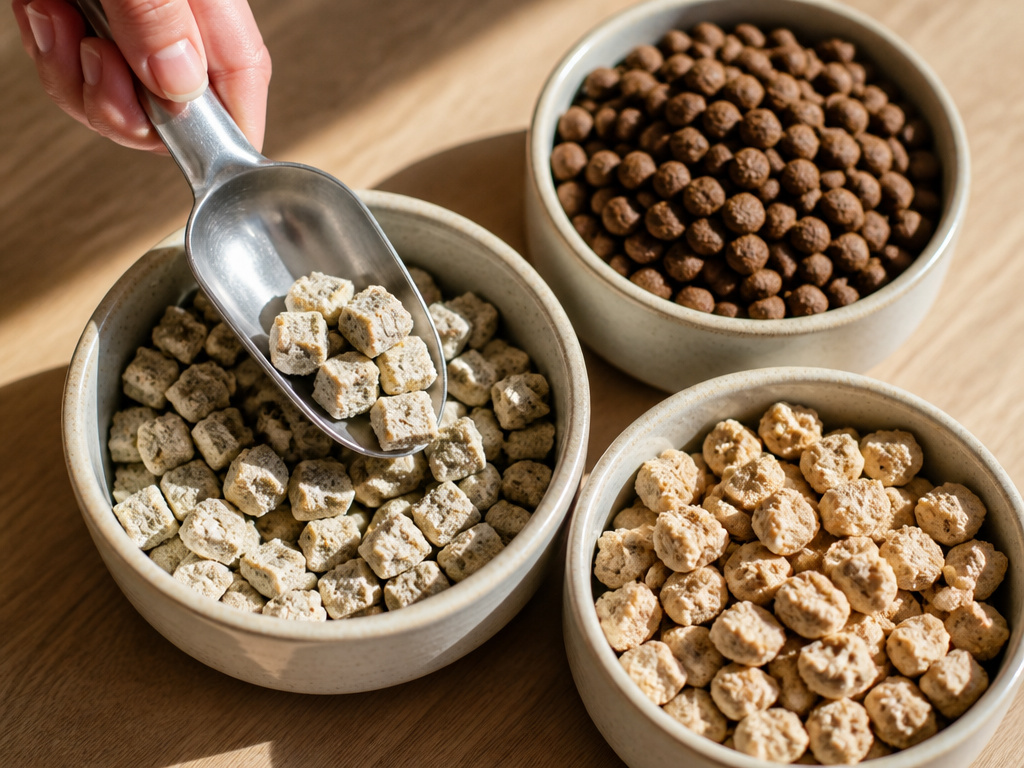
Three formats, three trade-offs: air-dried sits between kibble and freeze-dried on processing, moisture, and cost.
| Format | Processing | Best For | Main Risk |
|---|---|---|---|
| Air-dried | Low-heat moisture removal | Shelf-stable feeding, toppers | Calorie density, bacterial risk |
| Extruded kibble | High-heat extrusion | Budget, everyday feeding | Lower nutrient retention at high heat |
| Freeze-dried | Frozen moisture removal | Raw-like nutrition, light weight | Cost, crumbles easily |
Air-Dried vs Kibble
Kibble wins on cost and shelf life. Chewy and AKC credit air-dried with nutrient retention and palatability, while the FAO AGRIS study shows nutrient loss depends on drying temperature; it costs more and demands portion control. For a healthy adult dog on a budget, kibble is the practical default.
Air-Dried vs Freeze-Dried
Freeze-dried holds its shape less and crumbles more, but it’s lighter and travels well. Air-dried is more resistant to crumbling, per the AKC. If you’re feeding at home, air-dried holds up better in the bowl. The freeze-dried dog food comparison covers the other side in detail.
There’s a third shelf-stable option most people forget. The dehydrated dog food route uses low heat over a long period, and it lands in a similar place.
My call: for a healthy adult dog, air-dried as a topper over kibble beats a full air-dried diet on cost. For a picky eater, a full air-dried bowl is worth the step up.
Does Air-Drying Actually Preserve More Nutrients?
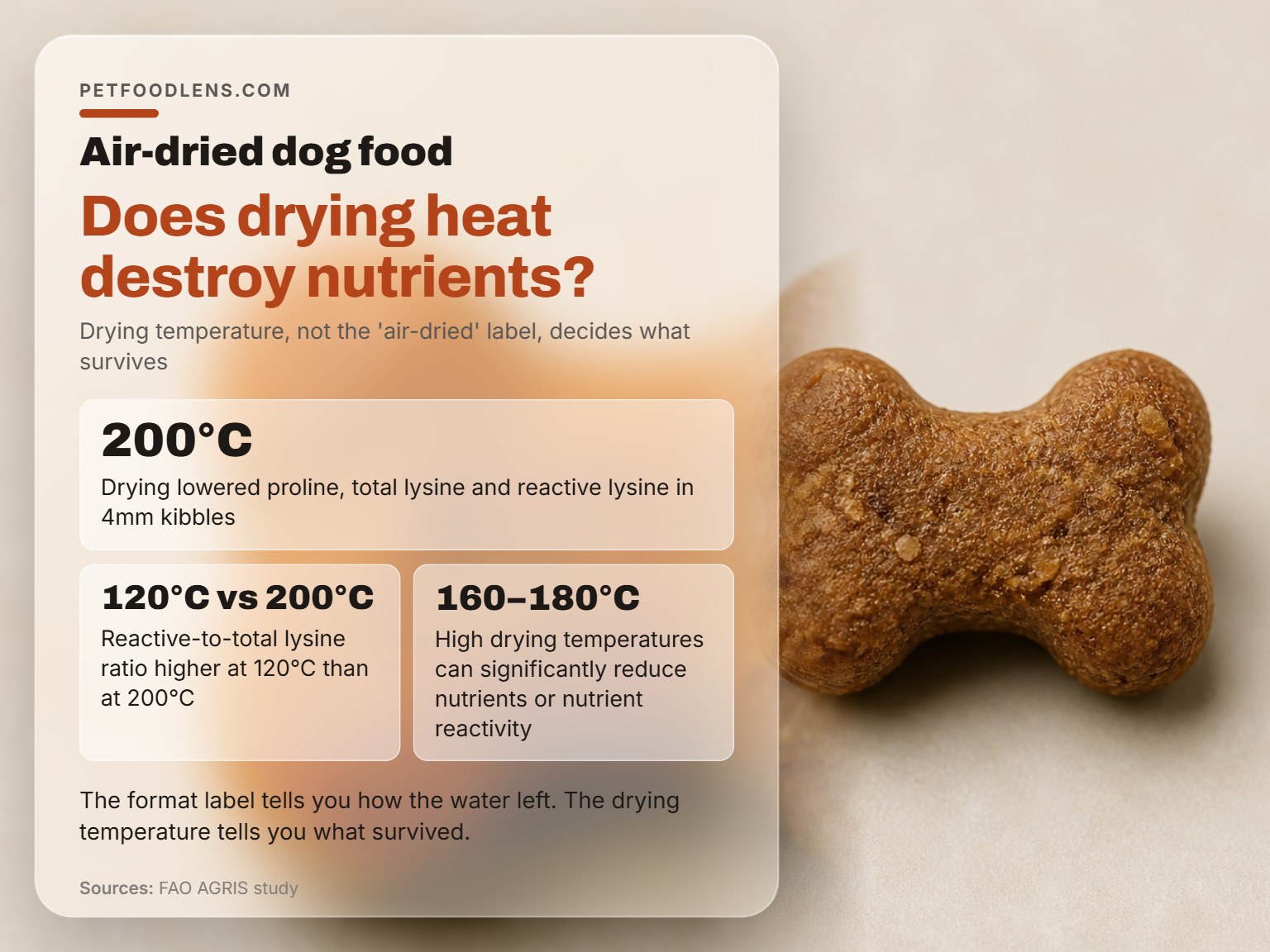
The honest answer is that it depends on the drying temperature, and the research cuts against treating “air-dried” as a guarantee.
A study indexed by FAO drying temperature canine diet study extruded a canine diet at 130°C and then dried it at 80, 120, 160, and 200°C. Drying at 200°C lowered proline, total lysine, and reactive lysine in 4mm kibbles. It also cut linolenic and linoleic acid and raised oleic acid, a pattern the authors read as possible lipid oxidation.
The takeaway: high drying temperatures (160–180°C) can significantly reduce nutrients or nutrient reactivity. The reactive-to-total lysine ratio was higher at 120°C than at 200°C.
Why does lysine suffer? It’s the amino acid most vulnerable to the Maillard reaction, where heat binds it to sugars so the body can’t use it. Work on Maillard reaction product concentrations in commercial pet foods tracks exactly this kind of heat damage.
The format label tells you how the water left. The drying temperature tells you what survived. Ask for the temperature before you trust the nutrient panel.
This is the nuance the marketing skips. “Air-dried” describes a method, and a method run hot can lose nutrients just like extrusion.
How Do You Feed Air-Dried Food Without Overfeeding?
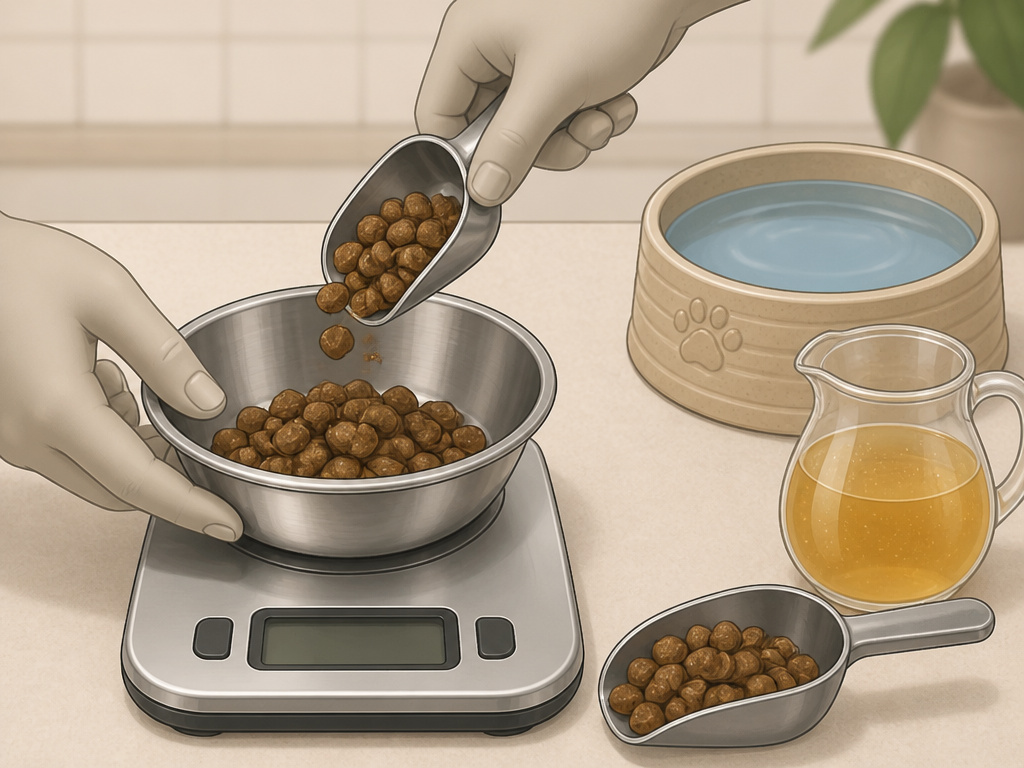
You fill the bowl with the same scoop you used for kibble, and three weeks later the dog is a little rounder. That’s the calorie-density trap in one sentence.
- Weigh the portion, don’t scoop it. Calorie density means volume lies. Skipping the scale is how a dog gains weight on a “better” food.
- Transition gradually, mixing with the old food. A sudden switch hits an unprepared gut and can cause loose stool.
- Keep fresh water available. Chewy lists air-dried as low in moisture, and the dog will drink more than it did on wet food.
- Consider rehydrating. Some brands recommend it, others say it’s optional. Adding bone broth or water is a reasonable move since moisture aids digestion.
| What you notice | Likely cause | Fix |
|---|---|---|
| Dog gains weight | Portioned by volume | Weigh to the label’s calorie guide |
| Dog drinks more | Chewy lists low moisture content | Keep water down; rehydrate if the brand allows |
| Loose stool after switch | Too-fast transition | Slow the switch down |
| Picky dog refuses | Texture or smell | Use as a topper over kibble first |
After the switch, the water bowl empties faster than it used to.
Where this goes sideways: Switching cold-turkey from kibble to air-dried. The calorie density and fat load hit an unprepared gut, and you may see loose stool.
Which Dogs Should Skip Air-Dried Food?
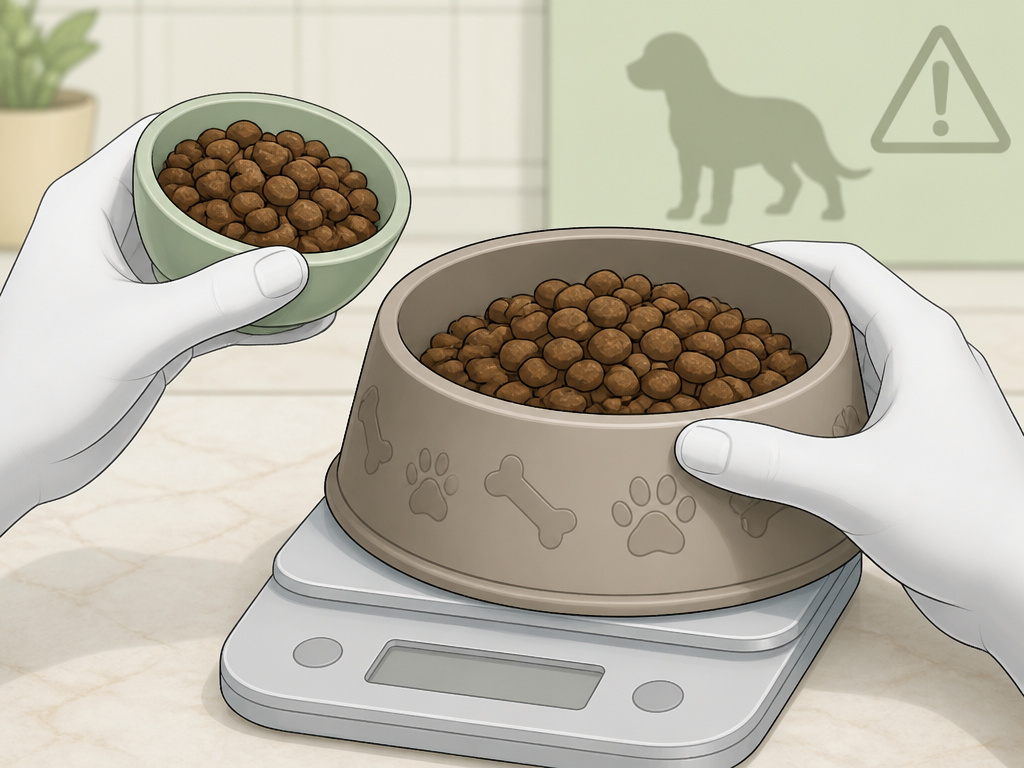
Most healthy adult dogs can eat air-dried food. A few shouldn’t, and the label won’t always tell you.
- Large-breed puppies, they need carefully balanced calcium and phosphorus for growth, and air-dried foods not labeled for large-breed puppies may not deliver it.
- Immunocompromised dogs, or homes with young children or the elderly, bacterial risk is elevated, and this is where a vet’s input matters most.
- Dogs that need high moisture, kidney or urinary cases may do better on wet or fresh food.
- Dogs prone to weight gain, calorie density makes overfeeding easy.
Large-Breed Puppies
This is the edge case that breaks the standard advice. A food can be “complete and balanced” for adults and still be wrong for a growing large-breed puppy. If you’re feeding one, look for the large breed air-dried food that carries a puppy-specific statement.
Small breeds have the opposite problem: calorie density bites harder on a tiny dog. The air-dried dog food for small breeds guidance covers portioning at that scale.
How to Read an Air-Dried Label
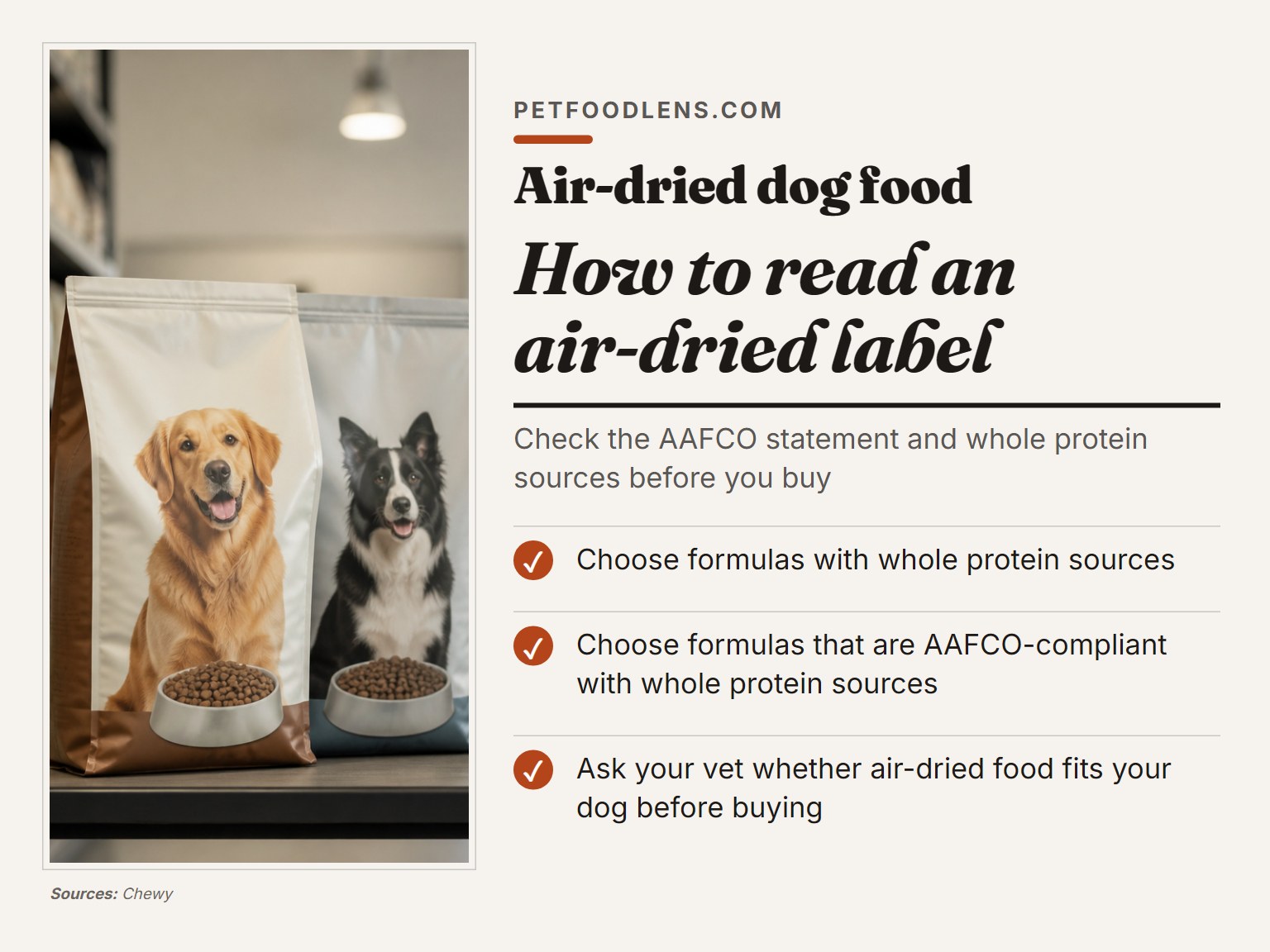
You’re standing in the aisle with two bags, both promising “gently air-dried,” and neither one telling you the drying temperature.
I put two labels side by side on one screen whenever I compare foods. Differences in protein sources, fillers, and additives jump out in a way they don’t when I look at labels one at a time.
The AAFCO Statement
Find the adequacy statement first. It tells you whether the food is complete and balanced for a life stage, and it’s the one line that’s actually regulated. No statement, no sale.
The First Five Ingredients
Read them in order. Named whole proteins like beef, chicken, or fish should lead. A bag that opens with a vague “meat” and follows with peas and potato is a starch-heavy bag with a nice photo.
A few labels worth comparing on those checks are ones that publish named protein sources up front. Using air-dried food as a topper is a reasonable way to test palatability before committing to a full bag.
For the broader shelf, the air-dry dog food roundup and the AKC non-kibble dry food guide both help you sort what’s worth the step up.
Frequently Asked Questions
Is air-dried dog food better than kibble?
It depends on the drying temperature. Chewy and AKC say low-heat air-drying preserves more nutrients and enzymes than high-heat extrusion, while the FAO AGRIS study shows high drying temperatures can reduce nutrients. But a hot-dried product can lose nutrients the same way kibble does. Check for a stated temperature and an AAFCO statement before assuming air-dried is better.
Does air-dried dog food need to be refrigerated?
No. Air-dried food is shelf-stable and needs no refrigeration, thawing, or prep. That’s one of its main selling points. Keep the bag sealed and store it somewhere cool and dry.
Can puppies eat air-dried dog food?
Large-breed puppies should only eat air-dried food labeled for large-breed puppies. They need carefully balanced calcium and phosphorus for growth, and a food not labeled for them may not deliver it. Ask your vet before switching a puppy.
Is air-dried dog food safe from bacteria?
Not guaranteed. The AKC says removing moisture helps eliminate pathogens, while Chewy, citing Dr. Larsen, says air-drying doesn’t fully kill them. Treat air-dried food as a raw-adjacent product and handle it accordingly, especially around immunocompromised people.
Do you need to add water to air-dried dog food?
It’s optional. Some brands recommend rehydrating, others say it isn’t necessary. Adding bone broth or water is a reasonable move since moisture aids digestion, and Chewy lists air-dried food as low in moisture, though the AKC notes it still has higher moisture than kibble.
The Bottom Line
Here’s the threshold I’d use. If a bag doesn’t state a drying temperature and an AAFCO adequacy statement, treat the “gentle processing” line as decoration and move on. Those two facts do more work than any photo of a wolf on a hillside.
For a healthy adult dog, air-dried as a topper over kibble is the value play. A full air-dried diet is worth it if your dog is picky or you want the convenience, as long as you weigh the portion.
This all changes for a large-breed puppy or an immunocompromised dog. In those cases the calcium-phosphorus balance and the bacterial risk move to the front, and a vet’s read on your specific dog beats any label comparison I can run. I work from labels and published data, not from your dog’s bloodwork.
