
Dehydrated Dog Food vs Freeze-Dried Dog Food: Which Wins?
This post contains affiliate links. As an Amazon Associate, we earn from qualifying purchases.
Dehydrated dog food vs freeze-dried dog food differs in how the water leaves: dehydration uses low heat and moving air, freeze-drying uses a frozen vacuum. Dehydrated food is denser and cheaper. Freeze-dried food is lighter, rehydrates faster, and costs more. Neither is a complete meal unless the bag says so.
That last point is the one worth chasing. A bag can be dehydrated, freeze-dried, air-dried, or raw and still miss a dog’s nutrient needs, because the drying method says nothing about whether the formula was balanced to begin with. The label is where that gets settled.
What follows covers the process difference in plain terms, the shelf-life figures that three sources can’t agree on, the pathogen question that splits them further, and a label check you can run in the aisle.
Key Takeaways
- Low heat and airflow do the work in dehydration; freeze-drying uses a frozen vacuum instead. Both leave a shelf-stable product; Chewy says both should be rehydrated before eating, while Puptection says freeze-dried food can be served dry or rehydrated.
- Unopened dehydrated food lasts 12 months to 2 years depending on which source you trust, and opened bags go stale in 4 to 6 weeks.
- Freeze-dried food rehydrates in a few minutes; dehydrated food takes several. That gap matters on a rushed morning.
- Neither process guarantees a complete diet. Look for an AAFCO complete and balanced statement for your dog’s life stage.
- Dehydrated costs less than freeze-dried, and dehydrated food costs more than kibble.
Dehydrated Dog Food vs Freeze-Dried Dog Food: What Actually Differs
Heat and moving air do the work in one process; a vacuum and frozen water do it in the other. Everything else about dehydrated dog food vs freeze-dried dog food follows from that split.
Dehydration removes moisture through low heat and pressure over an extended period. Freeze-drying flash-freezes the ingredients first, then pulls the moisture out under vacuum. Both methods leave a shelf-stable product with very little water remaining; Chewy says both formats should be rehydrated before eating, while Puptection says freeze-dried food can be served dry or rehydrated.
Chewy’s education page describes dehydration as a slow, low-heat process that strips most of the moisture out. Freeze-drying is a flash-freeze followed by vacuum drying. The practical difference shows up in texture well before it shows up in nutrition.
Dehydrated food comes out dense and leathery, closer to jerky than to kibble. Freeze-dried food comes out light and porous, and a patty crumbles between your fingers if you press it. Weight is the easy win. Freeze-dried product is far lighter per serving, which is why a bag feels half empty when you pick it up.
Easy to miss: Both formats are sold as complete meals and as treats in near-identical bags. A freeze-dried dinner patty and a freeze-dried liver cube can sit on the same shelf, and only one of them is dinner.
If you want a shortlist instead of a chemistry lesson, the best freeze-dried dog food brands tend to be the ones printing a full nutrient profile rather than a protein percentage.
The Shelf Life Numbers Don’t Agree, So Store It Like It Matters
Three sources give three different shelf lives for the same category of product.
| State of the food | Chewy | productdif.com | Puptection |
|---|---|---|---|
| Unopened, dehydrated | 1 to 2 years | 12 to 18 months | 12 to 24 months |
| Opened, dehydrated | 4 to 6 weeks | Not stated | Not stated |
| Rehydrated, dehydrated | Use in a couple of days | Not stated | Serve immediately |
| Unopened, freeze-dried | Not stated | Up to 25 years, vacuum-sealed | Not stated |
That spread is wide enough to change how you buy. Chewy puts unopened dehydrated food at one to two years, productdif.com says 12 to 18 months, and Puptection says 12 to 24 months. All three tie the number to formulation, packaging, and storage, which is the nearest thing to agreement in the group.
The opened-bag figure is the one that bites. Chewy puts opened dehydrated food at four to six weeks. GCL warns that shelf life varies enough between products that you shouldn’t assume a shared clock.
Every new batch met old oxidized fat on day one.
Damp plastic plus fat residue is a bad pairing.
Both formats want the same three things:
- An airtight container. A rolled bag with a chip clip doesn’t count.
- A cool, dry spot, away from the stove and the dishwasher.
- A date on the lid, so you know when the four-to-six-week clock started.
Freeze-dried product needs tighter temperature control than dehydrated to hold quality over long storage, per productdif.com. Humidity is the shared enemy. Storage is where this gets practical.
Does Freeze-Drying Kill Bacteria? The Sources Split
Oklahoma State University researchers and a pet-food manufacturer are saying different things about the same bag.
Chewy cites OSU researchers who note that raw diets can introduce dangerous bacteria, while dehydrated or freeze-dried foods eliminate those pathogens during preparation, though GCL warns that some freeze-dried products contain raw animal ingredients and buyers should not assume the process eliminates every pathogen. GCL’s take on dehydrated food counters that some freeze-dried products contain raw animal ingredients, so buyers should not assume the process eliminates every pathogen. GCL adds that safety depends on validated procedures and proper handling.
Those two claims can both hold at once. One describes a validated process run correctly. The other describes products made with raw ingredients where the process hasn’t been validated. Which one covers your bag depends on the manufacturer, and the bag won’t say.
I don’t read “freeze-dried” as a safety certification. It describes a drying method. Whether the finished product is safe depends on what went into it and how the plant handled it, so I read the ingredient list before I trust the process claim.
The same question runs through any freeze-dried raw vs frozen raw comparison, because raw handling rules don’t disappear when the water does.
How Do You Rehydrate Each One?
You tip the scoop into the bowl, add warm water, and wait.
Productdif.com puts dehydrated food at several minutes with warm water. Freeze-dried food rehydrates in a few minutes with cold or warm water. Chewy’s position is that both formats are low in moisture and should be rehydrated before eating, while Puptection says freeze-dried food can be served dry or with water. Puptection’s guide says freeze-dried food can be served dry or with water.
Both are describing the same product, which tells you the answer depends on the dog and the brand’s feeding chart.
Learning to rehydrate freeze-dried dog food takes one try. The patty either soaks up the water or sits in a puddle, and you’ll know which within a minute.
Rehydrating dehydrated food
- Add warm water and stir. Skipping the stir leaves dry pockets that a dog will pick around and leave in the bowl.
- Let it stand several minutes. Pulling it early gives you crunchy centers and a dog that walks away.
- Serve it right away. Chewy says use it within a couple of days once water is added; Puptection says serve immediately. The cautious read is the same either way.
Rehydrating freeze-dried food
Warm water speeds things up and pushes more aroma out of the meat. A rehydrated patty smells like the meat it’s made from, which is more than you can say for most kibble.
Rehydrated food is perishable. The moment water goes in, the bag’s shelf life stops applying and a different clock starts.
Reading the Label Instead of the Front of the Bag
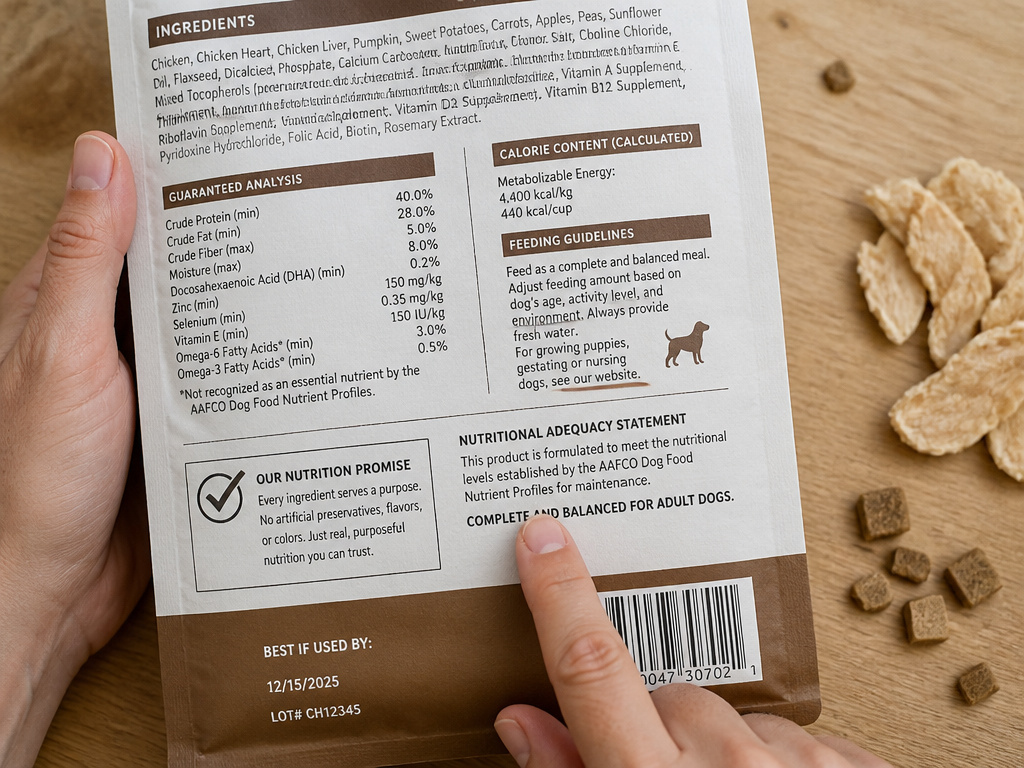
Four lines on the back of a bag decide whether it’s a meal or a snack. Read the back first.
Chicken, chicken meal, a couple of grains, nothing that would sell a bag. I’ve tried to finish the arithmetic before forming an opinion since then.
GCL’s guidance is blunt on this: evaluate the finished food rather than judging quality by the processing method alone. A dehydrated food is not automatically nutritionally superior, and a well-formulated kibble can beat an incomplete dehydrated product.
The nutritional adequacy statement
AAFCO publishes the nutrient profiles that pet foods are measured against, and the statement on the bag is where a manufacturer says which profile it meets. Read the nutritional adequacy statement for a named life stage and the words complete and balanced. Phrases like natural, premium, and high protein carry no regulatory weight here.
Complete, complementary, treat, or supplement
GCL suggests checking which of these four labels a product carries before you buy it.
- Complete food: meets a nutrient profile for a stated life stage. This is the only one that replaces a meal.
- Complementary food: meant to be fed alongside something else. Dehydrated duck necks live here.
- Treat: not nutritionally complete, and not pretending to be.
- Supplement: adds a specific nutrient; it isn’t a diet.
The freeze-dried dog food pros and cons lists that circulate online usually lead with nutrient retention, which is a different question from nutritional completeness.
What most people get wrong: Assuming a bag labeled for adult maintenance will work for a puppy. GCL notes a product formulated for adult maintenance may not provide the nutrient balance required for growth.
The category I trust least is the one that markets hardest on simplicity.
Which Format Fits Which Dog?
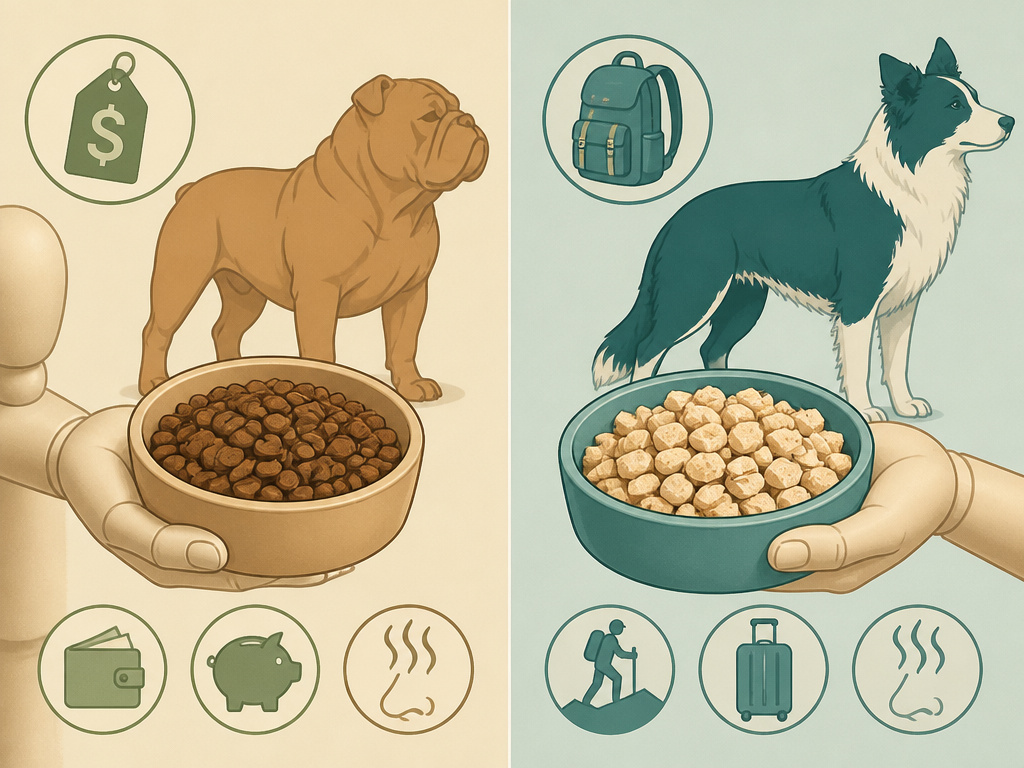
Three things decide this: activity level, what the dog will actually eat, and whether you’ll keep up with the prep.
Productdif.com positions dehydrated food for low-activity breeds such as Bulldogs and Basset Hounds, and freeze-dried food for high-energy breeds such as Border Collies and Australian Shepherds. That is an editorial position, and there’s no test data behind it.
| Your situation | Format that fits | Why |
|---|---|---|
| Picky eater who needs aroma | Freeze-dried | Faster rehydration, stronger meat smell |
| Travel or hiking | Freeze-dried | Lighter per serving, no fridge |
| Tight budget | Dehydrated | Simpler processing, lower cost |
| Sensitive stomach | Either, if complete | Simpler ingredient panels, per Chewy |
| Longest unopened storage | Freeze-dried | Up to 25 years, vacuum-sealed |
Dehydrated food brands worth keeping on a shortlist all print a complete and balanced statement for a stated life stage.
Dehydrated raw dog food sits in an odd middle ground: raw ingredients, dried, sold as food. Read the adequacy statement on those bags as carefully as you would on a kibble.
That’s the whole decision.
Switching Over Without a Strike
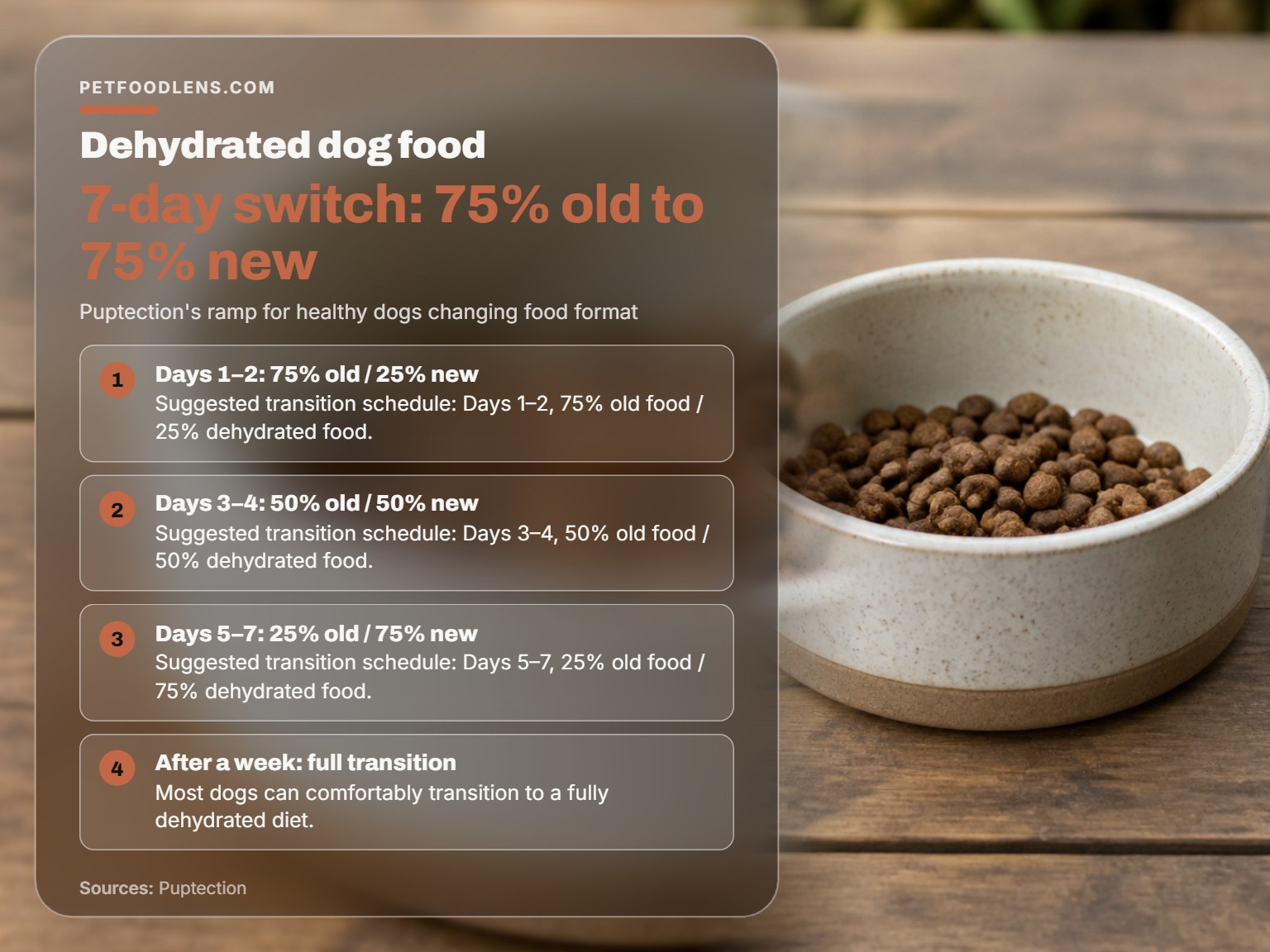
Day one is where most switches fall apart. Start slow.
Puptection’s guide lays out a seven-day ramp. Rushing the first two days is the most common way to get a refusal, and a refusal costs more time than the schedule would have.
- Days 1 and 2: 75% old food, 25% new. Skipping the small starting ratio is how you get a dog that turns its nose up on night one.
- Days 3 and 4: 50/50. This is the stage where a sensitive dog shows you whether the new food agrees with it.
- Days 5 to 7: 25% old, 75% new. Most dogs are eating three-quarters new food by the end of this stretch.
- After a week: a full transition for most dogs, per Puptection.
Skip this if: Your dog has a diagnosed medical condition and your vet has already set a diet. A seven-day ramp is for healthy dogs changing formats, not for clinical cases.
Frequently Asked Questions
Is freeze-dried dog food safer than dehydrated?
The sources don’t settle it. Chewy, citing Oklahoma State University researchers, says dehydrated and freeze-dried foods eliminate dangerous pathogens during preparation, while GCL warns that some freeze-dried products contain raw animal ingredients and the process alone doesn’t guarantee safety. GCL warns that some freeze-dried products contain raw animal ingredients, so the process alone doesn’t guarantee safety. Treat the manufacturer’s food-safety controls as the deciding factor.
Can I serve freeze-dried dog food dry?
Puptection’s guide says yes. Chewy’s guidance is that both formats are low in moisture and should be rehydrated before eating, while Puptection says freeze-dried food can be served dry or with water. Serving it dry is common for toppers and treats; for a full meal, water is the safer default.
How long does dehydrated dog food last after opening?
Chewy puts it at four to six weeks. GCL cautions that shelf life varies by formulation and packaging, so the bag’s own date is the better guide.
Do either of these need refrigeration?
Not before opening. Both want an airtight container in a cool, dry place, protected from humidity. Once water is added, the food is perishable and the shelf life no longer applies.
Is dehydrated dog food better than kibble?
Not automatically. GCL’s position is that processing method doesn’t determine nutritional quality, and a well-formulated kibble can beat an incomplete dehydrated product. Puptection argues dehydrated food is easier to digest because it carries fewer fillers. Both agree the adequacy statement decides it.
The Bottom Line
If you’re standing in the aisle right now, flip the bag over and read the nutritional adequacy statement before anything else. If it doesn’t name a life stage and a complete and balanced claim, put it back, whichever drying method is printed on the front.
That one check outranks everything in this comparison. The dehydrated dog food vs freeze-dried dog food decision only matters once you’ve confirmed both candidates are actual complete diets.
One concession: if your dog has a medical issue, none of this applies. GCL’s guidance is to let a veterinarian pick the formulation, and that’s the right call. Label reading tells you what’s in the bag. It doesn’t tell you what your dog’s kidneys need.
