
Freeze-Dried Dog Food Pros and Cons: What Holds Up
This post contains affiliate links. As an Amazon Associate, we earn from qualifying purchases.
Freeze-dried dog food pros and cons break into four parts: a minimally processed raw diet that keeps nutrients and needs no fridge, a higher cost than kibble, a real Salmonella handling risk, and bags that aren’t always a complete diet. Check the packaging for an AAFCO complete-and-balanced statement.
That AAFCO line is the one piece of the bag you can check in a few seconds, and the freeze-dried dog food pros and cons question it settles is whether the product is dinner or a topper. The word “raw” on the front describes the process. The AAFCO statement describes whether the food can carry a dog’s whole diet.
What follows: the three-step process in plain English, the pros that survive a label check, the cons ranked by what actually costs you, and the pathogen evidence from both a veterinary publisher and the FDA’s own lab.
Key Takeaways
- Handling is the bigger risk: PetMD warns owners can pick up Salmonella from freeze-dried food even with good hygiene, and dogs can shed it in stool.
- Check for AAFCO’s complete-and-balanced statement; PetMD notes some freeze-dried diets aren’t formulated to that standard.
- No research shows freeze-dried beats kibble on health outcomes, per PetMD’s own review of the literature.
- Rehydration is optional and brand-dependent, per the AKC, and dogs on dry formats drink more water.
- Cost runs higher than kibble by PetMD’s account, and higher than traditional raw by the AKC’s.
What Freeze-Dried Dog Food Actually Is
Freeze-drying runs in three steps, and the order does the work.
Freeze-drying freezes raw ingredients solid, removes the water while the food stays frozen, then raises the temperature for a second drying pass. The finished product is shelf-stable and keeps most of the original structure intact. Because the ingredients are never cooked, the food still counts as a raw diet.
PetMD draws the contrast with kibble in one line: freeze-dried food is minimally processed at low heat, while kibble is highly processed at high heat with cooked ingredients. That difference is the whole basis for every nutrient-retention claim on the bag.
Two label details follow from the process. Most freeze-dried foods contain no grains or starches, because the high protein content carries energy and digestibility without them, per PetMD. Some formulas add bone as a calcium and phosphorus source.
Pick up a nugget and the texture tells you what the vacuum did. It feels like dense foam, weighs almost nothing, and crumbles to a fine powder between two fingers.
Moisture lands between the two extremes. The AKC notes that freeze-dried, air-dried and dehydrated foods all still carry more moisture than kibble, even after drying.
The aisle gets confusing here. Dehydrated dog food uses low heat over a long stretch rather than a vacuum, and air-dried dog food slowly evaporates moisture without freezing anything.
The Pros That Hold Up Under a Label Check
Three pros survive a label check, and the strongest evidence sits with nutrient quality rather than long-term health outcomes.
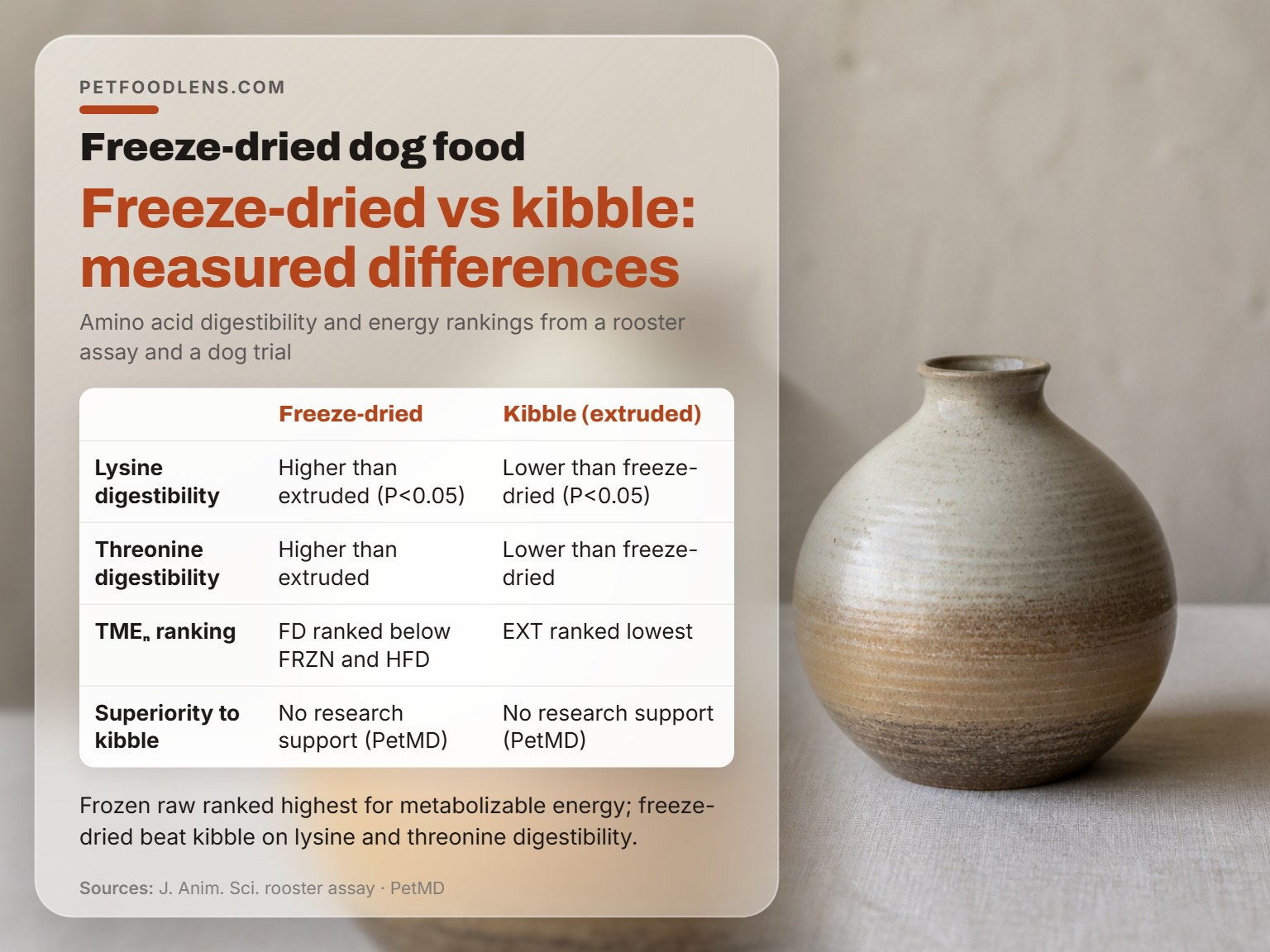
The protein side has numbers behind it. A precision-fed rooster assay in the Journal of Animal Science measured standardized amino acid digestibility of freeze-dried dog foods against extruded kibble and found lysine digestibility higher in the freeze-dried and frozen raw diets than in the extruded diet (P<0.05). Threonine came out higher in the freeze-dried diet than in extruded.
Reactive lysine ratios landed close together across the five diets tested: 0.94 for extruded, 0.96 for fresh, 0.93 for frozen raw, 0.93 for the hybrid freeze-dried, and 0.95 for the freeze-dried diet.
A separate trial with 10 beagles, run as a replicated 5×5 Latin square across five 35-day periods, put five diets through full digestibility testing. The lineup was Hill’s Science Diet extruded, Just Food for Dogs fresh, Primal frozen raw, a Primal freeze-dried hybrid, and Stella & Chewy’s freeze-dried. The freeze-dried raw dog food digestibility study carries the fecal and serum data if you want the detail.
The pros that hold up:
- Nutrient retention. Freeze-drying preserves the food’s structure, so nutritional content isn’t lost during processing, per PetMD.
- Digestibility. PetMD notes the process leaves enzymes intact, which may make the food easier for dogs to break down.
- Convenience. Shelf-stable, light, no refrigeration. It travels better than anything in the freezer aisle.
- Palatability. High meat content and a strong smell. Picky dogs tend to eat it.
One more front-panel word deserves a hard look: grain-free. Most freeze-dried foods contain no grains or starches, per PetMD, and that’s a fact about the format rather than a nutritional upgrade. Grain-free dry foods often swap corn for peas, potato or tapioca, so the carbohydrate load barely moves. A bag with a wolf on the front and a starch-heavy ingredient list is still a starch-heavy bag.
The Cons, Ranked by What Actually Costs You
Ranked by real cost, the freeze-dried dog food pros and cons stack up in a different order than the front of the bag suggests. Handling comes first, incomplete nutrition second, money third.
- Handling risk. PetMD states that owners handling freeze-dried food can be exposed to food-borne illness, particularly Salmonella, even with good hygiene. Dogs fed a contaminated diet can shed the bacteria in stool, which puts the rest of the household in the path.
- Incomplete nutrition. Some freeze-dried diets aren’t formulated to meet AAFCO’s complete and balanced recommendations. The AAFCO statement should appear on the packaging, and when it’s missing, the product isn’t a sole diet.
- Cost. PetMD puts freeze-dried food above standard kibble because the process is expensive. The AKC compares it to traditional raw diets and lands in the same place for the same reason.
- No proven edge. PetMD is direct that research lacks support for freeze-dried food being superior to commercially produced kibble.
Where this goes sideways: Feeding a freeze-dried topper as the whole diet. PetMD notes some freeze-dried foods aren’t formulated to AAFCO’s complete and balanced standard, and the packaging is where that gets stated, usually in small type under the guaranteed analysis.
Notice the cost claims don’t share a benchmark. PetMD measures against kibble; the AKC measures against traditional raw. Both say freeze-dried costs more, and the comparison you should carry in your head depends on what you’re feeding now.
If you’re shopping the category, the best freeze-dried dog food shortlist is where to compare complete diets against toppers. Owners weighing a full raw switch usually end up reading about freeze-dried raw dog food and general raw dog food risks in the same sitting, because the two formats share a handling profile.
Is Freeze-Dried Dog Food Safe? What the Evidence Actually Shows
The FDA’s Center for Veterinary Medicine found no Salmonella, Campylobacter or Listeria above 1.0% in any freeze-dried or frozen raw product it tested.
That work used metagenomic sequencing, which reads all the DNA in a sample at once instead of culturing one organism at a time. The sample was small: 8 freeze-dried products, 8 frozen raw, and 5 conventional dry, each processed in triplicate.
Three sources frame the risk three different ways, and the honest answer is that they don’t reconcile.
| Source | Position on pathogens | What it covers |
|---|---|---|
| PetMD | Freeze-drying doesn’t eliminate all pathogens; handlers can be exposed to Salmonella | Precautionary guidance, no sampling data |
| AKC | Removing moisture helps eliminate illness-causing pathogens | Format explainer |
| FDA CVM study | No Salmonella, Campylobacter or Listeria above 1.0% in tested products | 8 freeze-dried, 8 frozen, 5 dry samples |
The FDA metagenomic study of pet food microbiomes is the strongest single document in this pile, and it’s also the narrowest. Absence above a threshold in eight samples is not a guarantee for the bag in your cupboard.
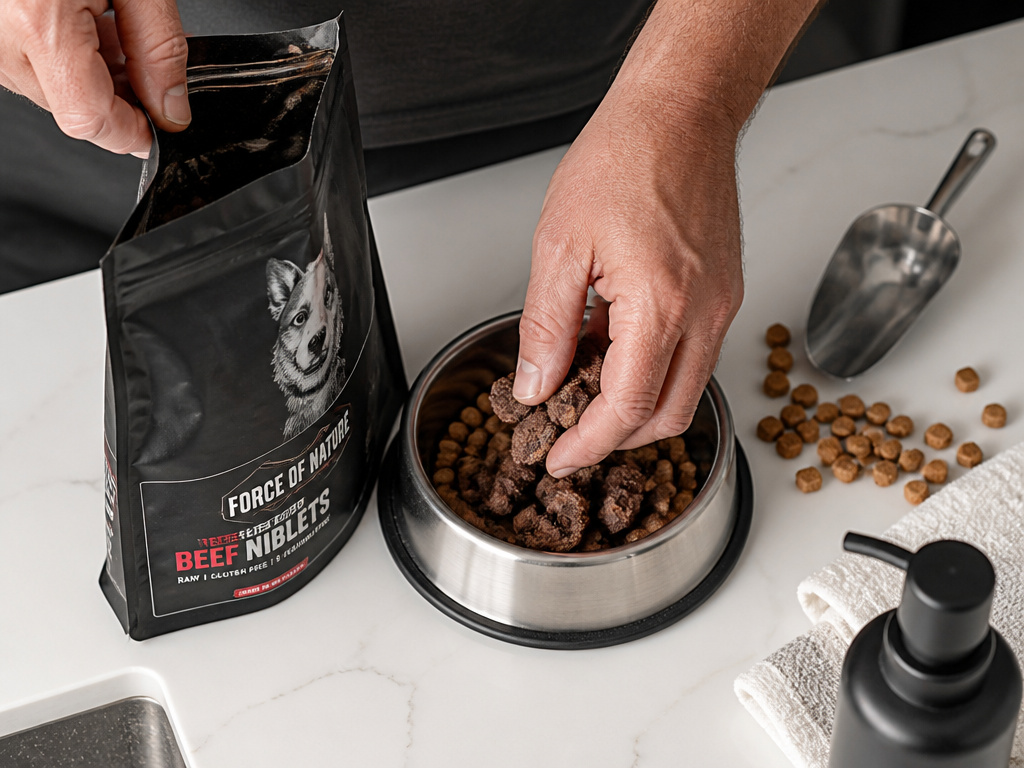
Recalls happen anyway. Carnivore Meat Company voluntarily recalled 73 cases of Vital Essentials Freeze-Dried Beef Nibblets Entrée for Dogs over potential Salmonella contamination, limited to Lot #13753 in 1 lb bags sold through independent retailers, Chewy.com and Amazon.com. The FDA recall of Vital Essentials freeze-dried beef entrée is worth reading for the symptom list alone: lethargy, diarrhea, fever, vomiting, and in some dogs just a dropped appetite.
Two findings in the FDA data cut against a blanket “raw is raw” rule. Poultry-primary products carried E. Coli at 1.54 plus or minus 1.03 percent of reads, against 0.08 plus or minus 0.15 percent for non-poultry products (P<0.01). And freeze-dried communities were dominated by Bacillus, Pediococcus and Lactobacillus, distinct from the Firmicutes, Actinobacteria, Proteobacteria and Bacteroidetes mix in frozen raw.
The antimicrobial resistance finding runs the other way from intuition. The FDA found greater diversity and abundance of AMR genes in frozen products than in freeze-dried ones. On that measure, freeze-dried is the lighter format.
One methodological catch matters. Enterococcus read at roughly 0.02 to 1.1 percent of reads in culture-independent samples and roughly 3 to 99 percent in enriched samples. A clean sequencing result is not proof of absence, which is why the microbiological hazards in dry dog chews and feeds review still logs Salmonella notifications in dried products from 2017 to 2020.
Before you start: Freeze-dried food is a raw product, so treat the scoop like raw meat. Wash hands after portioning, keep the bag off the counter where you prep human food, and don’t hand the job to a child or an immunocompromised adult. PetMD notes handler exposure to Salmonella happens even with good hygiene.
Handling rules that actually reduce exposure:
- Wash hands with soap after every scoop, not just the first one of the day.
- Keep a dedicated scoop in the bag and stop using the bowl as a measuring cup.
- Store the bag sealed and off food-prep surfaces, and wipe the counter after.
- Pick up the bowl promptly. A dog that walks away and comes back later is spreading crumbs.
Freeze-Dried vs Kibble vs Frozen Raw: Which Format Wins Where
Each format wins a different job, and the winner changes once you weigh handling against convenience.
| Format | Strength | Weakness | Best for |
|---|---|---|---|
| Freeze-dried | Shelf-stable raw, light, travels well | Handling risk, higher cost | Toppers and travel |
| Kibble (extruded) | Complete diet with no handling risk | High-heat processing | Everyday feeding on a budget |
| Frozen raw | Highest metabolizable energy in the trial | Freezer space, thawing | Owners with freezer room |
| Air-dried | Resists crumbling better than freeze-dried | Still a raw-style diet | Training and travel |
Where Freeze-Dried Beats Kibble
On amino acid digestibility, freeze-dried beat extruded on lysine and threonine in the rooster assay. That’s a real, measured difference and it’s the one I’d point to if someone asks why the format costs more.
It doesn’t extend to health outcomes. PetMD says the research doesn’t support freeze-dried as superior to kibble, and that’s the sentence to remember when a bag implies otherwise.
Where Frozen Raw Beats Freeze-Dried
Nitrogen-corrected true metabolizable energy ranked frozen raw highest, then the hybrid freeze-dried, then freeze-dried, then extruded. Frozen raw came out significantly higher than the freeze-dried, fresh and extruded diets (P<0.05).
So the format that measured best on energy was Primal’s frozen raw, not either freeze-dried product. That’s a useful correction to the assumption that the newest format wins by default.
Where Air-Dried Fits
The AKC notes air-dried food is more resistant to crumbling than freeze-dried, which matters if the bag rides in a car or a training pouch. It’s still a raw-style diet with the same handling conversation attached.
For the direct head-to-head, the freeze-dried vs frozen raw comparison covers the freezer-space tradeoff, and the kibble side is where most owners start before they price anything up.
How Do You Read a Freeze-Dried Label Without Getting Fooled?
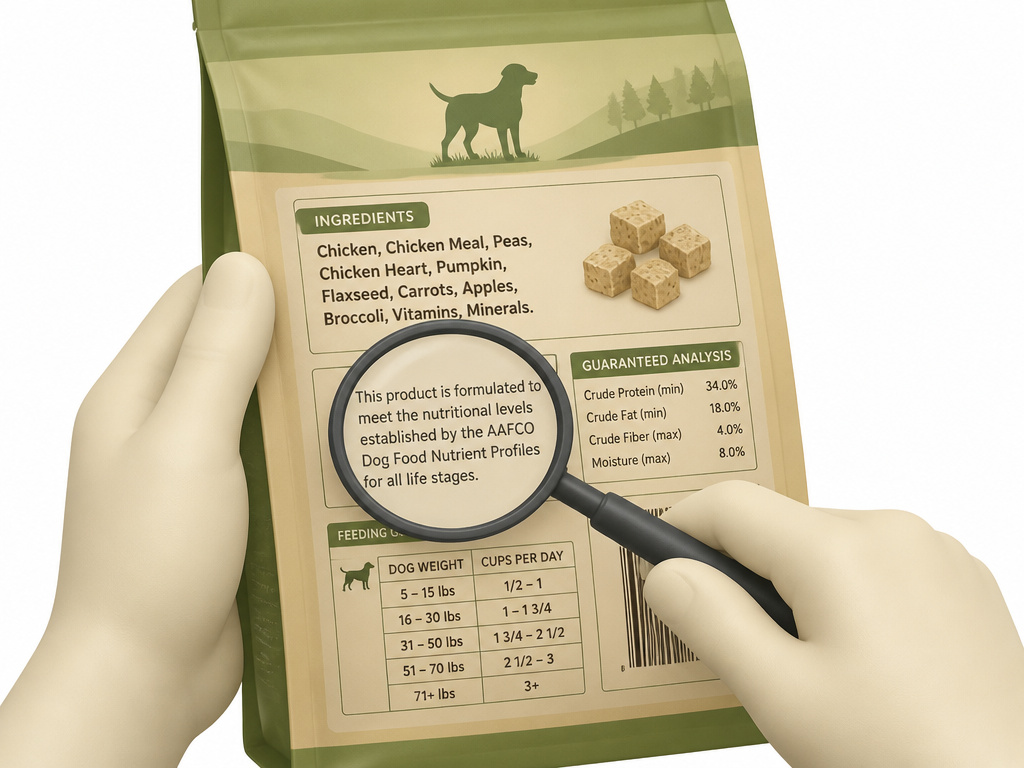
Flip the bag over. Somewhere under the marketing panel is a sentence that decides whether this is dinner or a garnish.
Start with the label, not the slogan. Work through these in order:
- Find the AAFCO statement. “Complete and balanced” for a named life stage means it’s a diet. “For supplemental feeding only” or “intermittent feeding” means it’s a topper. Skip this check and a dog can run on an incomplete diet for months before anything shows.
- Read the first five ingredients in order. Named meats and named meals tell you more than any front-panel word. Chicken, chicken meal, peas is a readable recipe card; meat by-products and “natural flavor” is not.
- Check whether the lead ingredient is fresh meat or a meal. Fresh chicken carries a lot of water before cooking, so a bag that leads with it isn’t leading with as much protein as the order implies. A named meal is concentrated.
- Check whether the bag names a kill step. PetMD notes high pressure processing may reduce pathogens but doesn’t fully eliminate them. A bag that names its process is telling you something; a bag that doesn’t is telling you something too.
- Check the protein count. A single-protein bag is easier to troubleshoot than a blend if you’re sorting out a reaction.
Easy to miss: The word “raw” on a freeze-dried bag describes the process, not the nutrient profile. A raw product without an AAFCO statement is a raw topper, and the front panel won’t be the part that says so.
I did this once on the cat side, reading the fronts of over-the-counter “urinary health” bags. Every one said “supports” or “promotes.” None said “dissolves.” The verb on the front tells you what a company is willing to claim, and that trick transfers to dog bags without modification.
Switching Formats Without a Hunger Strike
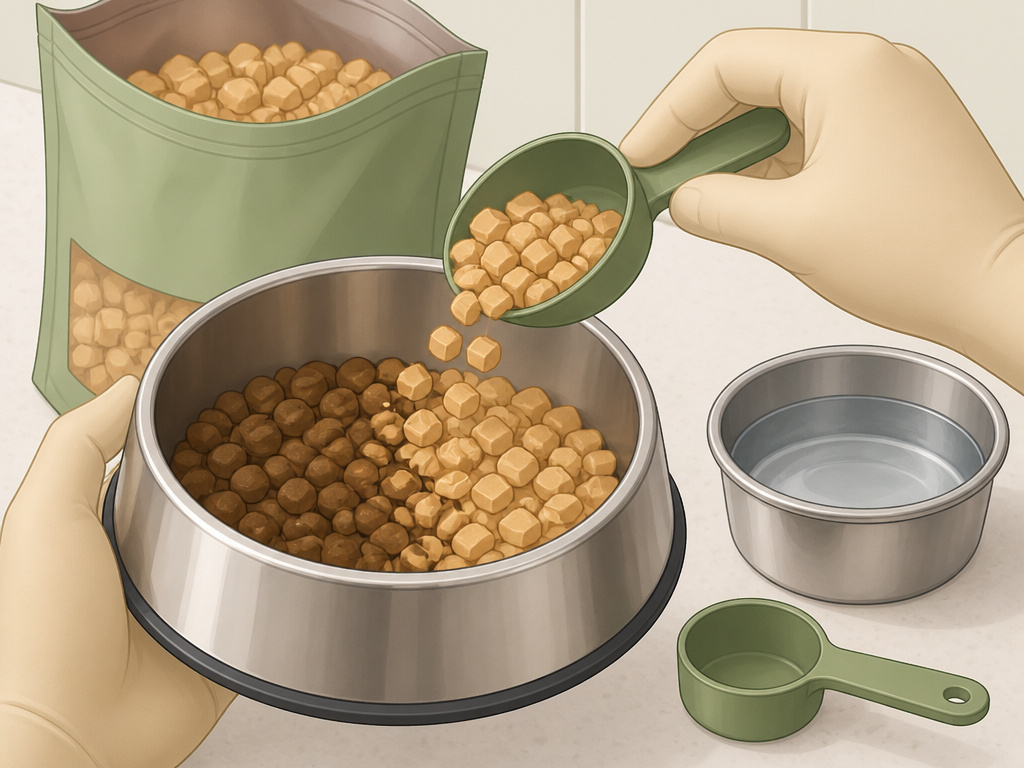
Clients ask me constantly whether they can just swap the bowl overnight and save a week of mixing. I’ve watched that go wrong more than once: refused meals, a hungry animal, and an owner who concludes the new food is the problem. Now I recommend a gradual transition, and I say it before anyone asks.
The mechanics are simple. Start with a small proportion of the new food and raise it every few days. A dog that gets a sudden jump in fat and protein often answers with loose stool, and then the food gets blamed for a transition that was too fast.
Rehydration is the other decision, and the sources split on it. The AKC notes some companies recommend rehydrating while others say the step isn’t necessary, and adding bone broth or distilled water is a reasonable option since moisture aids digestion. PetMD describes freeze-dried food as a dry, shelf-stable diet with no rehydration step built in.
If you go the wet route, the rehydrate freeze-dried food guide covers ratios. Either way, keep water available.
You’ll refill the water bowl more often on a dry format. That’s the AKC’s point about dogs on dry diets drinking more than on wet food, and it’s the format working as designed rather than a warning sign.
If a freeze-dried bag doesn’t carry an AAFCO complete-and-balanced statement, treat it as a topper and budget for the food it’s topping. That one line decides how the product gets used.
Frequently Asked Questions
Is freeze-dried dog food better than kibble?
PetMD states that research lacks support for freeze-dried food being superior to commercially produced kibble. The formats differ in process, with freeze-dried made at low heat and kibble cooked at high heat. Freeze-dried did measure higher on lysine and threonine digestibility than extruded in a rooster assay.
Can I feed freeze-dried dog food as a complete meal?
Only if the packaging carries an AAFCO complete-and-balanced statement for the right life stage. PetMD notes some freeze-dried diets aren’t formulated to that standard, and those products work as toppers rather than sole diets.
Does freeze-dried dog food need water added?
It depends on the brand. The AKC reports some companies recommend rehydrating and others say it isn’t necessary. Dogs on dry formats drink more than dogs on wet food, so fresh water needs to be available either way.
Is freeze-dried dog food actually raw?
Yes. PetMD classifies it as a commercially made raw meat-based diet that’s minimally processed at low heat. That’s why the handling advice for raw meat applies to the scoop and the bowl.
How should I handle freeze-dried dog food safely?
Wash hands after portioning, keep the bag off food-prep surfaces, and keep children away from the scoop. PetMD notes that handler exposure to Salmonella happens even with good hygiene, and dogs fed a contaminated diet can shed bacteria in stool.
Has freeze-dried dog food ever been recalled?
Yes. Carnivore Meat Company recalled 73 cases of Vital Essentials Freeze-Dried Beef Nibblets Entrée for Dogs over potential Salmonella, limited to Lot #13753 in 1 lb bags. The FDA notice lists the distribution channels and the symptoms to watch for.
The Bottom Line
Here’s the trigger to act on: if the bag in your hand doesn’t carry an AAFCO complete-and-balanced statement, don’t build a diet around it. That single line separates a food from a garnish, and it’s printed on every legitimate product in the category.
The honest concession is that none of this settles whether freeze-dried is better for a specific dog. PetMD says the research doesn’t support superiority over kibble, and the FDA’s sampling covered eight freeze-dried products, which is a starting point rather than a verdict.
So here’s the stance I’d defend. If convenience is the appeal, a complete kibble with a freeze-dried topper gets you most of the palatability and skips most of the handling risk. If you want the format as the whole diet, buy the bag with the AAFCO statement and treat the scoop like raw meat.
Your first step is simple. Pick up whatever bag you’re feeding now and find the AAFCO line. If you can’t find it, you’ve just learned something the front panel wasn’t going to tell you.
