
Raw Dog Food Pros and Cons: What the Evidence Shows
This post contains affiliate links. As an Amazon Associate, we earn from qualifying purchases.
The raw dog food pros and cons split into two separate questions: pathogens and nutrition. In FDA testing of 196 raw pet food samples, 15 carried Salmonella and 32 carried Listeria; dry dog food carried none. Raw diets are not automatically balanced, and freeze-dried is not cooked.
The raw dog food pros and cons split pathogen risk and nutritional adequacy, which get measured in different ways, and they don’t rise or fall together. A frozen raw pack and a freeze-dried treat both say raw on the label, yet each behaves differently in a freezer, a bowl, and a lab sample.
What follows runs the evidence source by source, compares the formats side by side, then covers the handling and label checks that actually change the risk.
Key Takeaways
- 15 of 196 raw samples carried Salmonella in FDA’s two-year screening, and 32 carried Listeria monocytogenes.
- Freeze-drying doesn’t kill bacteria, so a shelf-stable raw treat still carries bacterial and parasite risk.
- Dry dog food, jerky treats, and semi-moist products returned no Salmonella positives in that same screen, which complicates the simple version of this story.
- Commercial raw showed no elevated GI, renal, or hepatic odds in a 27,478-dog cohort; home-cooked diets did.
- A child under 5, an adult over 65, a pregnant person, or an immunocompromised household member is the group CDC flags first.
What the FDA Found in 196 Raw Pet Food Samples
Fifteen of 196 raw pet food samples tested positive for Salmonella in FDA’s two-year screening, and 32 tested positive for Listeria monocytogenes.
Between October 2010 and July 2012, FDA’s Center for Veterinary Medicine screened 196 raw pet food samples for pathogens. Fifteen tested positive for Salmonella and 32 for Listeria monocytogenes. Dry dog food, jerky treats, and semi-moist products returned no Salmonella positives; canned pet food was never tested, so the comparison has a gap.
Those two numbers come from a screening window that ran from October 2010 to July 2012. The same project also tested dry dog food, dry cat food, jerky treats, semi-moist dog and cat food, and dry exotic pet food.
| Product type | Samples tested | Salmonella positive | Listeria positive |
|---|---|---|---|
| Raw pet food | 196 | 15 | 32 |
| Dry dog food | Not stated | 0 | 0 |
| Dry cat food | Not stated | 0 | 1 |
| Jerky treats | Not stated | 0 | 0 |
| Canned pet food | Not tested | Not tested | Not tested |
Read the raw row against the others. Raw samples were the only category with Salmonella positives, and the only one with double-digit Listeria positives. Dry cat food returned a single Listeria positive.
Canned pet food wasn’t tested at all. This table can’t be used to argue canned is safer than raw; it only shows what the screen covered.
The practical read of the raw dog food pros and cons is narrower than the headlines. Raw product is a documented carrier of pathogens, which makes raw food safety a handling question more than a debate question. The agency’s public summary, the FDA raw pet food warning, reports the pathogen findings from its raw pet food screening.
Why “Raw” Covers Four Different Formats
CDC lists four forms under the raw umbrella, and they don’t carry the same handling burden.
- Raw: uncooked muscle meat, organ meat, bones, eggs, or unpasteurized milk, straight from the store case.
- Raw frozen: the same material sold frozen, thawed in the refrigerator before serving.
- Freeze-dried: frozen and then dried in a vacuum, sold shelf-stable.
- Dehydrated: dried with warm air, a slower process that produces a chewier, denser product.
Cornell’s veterinary team makes a point that gets lost in format marketing. Raw meat also shows up as dried or freeze-dried treats and as freeze-dried coated kibble, so an owner who would never buy a frozen chub may still be feeding raw.
That texture is exactly why it reads as a biscuit instead of as meat. The Cornell Riney raw foods advice page spells out why that matters.
Bones sit inside the same umbrella. Raw bones for dogs carry mechanical risks on top of the bacterial ones, and they deserve their own read.
Freeze-Dried and Dehydrated: Drying Is Not Cooking
Cornell states plainly that freeze-drying does not kill bacteria and parasites the way cooking does. Their researchers preserve bacteria for study by drying them out, and those cultures survive in a dried state for decades.
Drying is a preservation method, and bacteria are very good at being preserved. Cornell’s lab keeps cultures alive for decades by drying them, which is the opposite of a safety step.
HPP: Lower Pathogens, Not Zero
High-pressure pasteurization, usually shortened to HPP, is a processing step that knocks pathogen levels down. CVMA’s position is careful here. HPP raw may have reduced pathogen levels compared with uncooked diets, but it should not be considered pathogen-free.
Do Raw Diets Actually Deliver Better Nutrition?
The strongest nutritional case for raw feeding comes from a review that also undercuts most of the marketing built on top of it.
A peer-reviewed raw meat diet evidence review argues that current evidence suggests raw diets may lead to healthy body weight and condition, improved stool quality, changes in the gut microbiome, and upregulated protein metabolism. That’s the pro side stated at its strongest.
CVMA reads the same literature and lands elsewhere. Its position statement holds that there are limited data supporting clinically relevant beneficial impacts in dogs fed raw meat-based diets over appropriate conventional cooked diets.
The AVMA raw meat diet risks review went further on study quality, describing an evidence base dominated by testimonials, case series, and poor-quality cohort and case-controlled studies.
Three positions, three holders. The review says the signal points toward benefit. The veterinary bodies say the signal is too weak to call a benefit. The journal review says the studies generating the signal are mostly weak designs. I’d take that last critique seriously, because study design is the part owners never get to see.
The digestibility argument splits the same way. The BSAVA nutrition guide concedes that raw-meat diets are typically more digestible than dry proprietary food, but not necessarily more digestible than wet proprietary food. CVMA’s statement doesn’t acknowledge any digestibility advantage at all.
Nutrient adequacy is the third split: the 2026 Discover Animals review holds that nutrient deviations are product-specific and not attributable to raw processing, while CVMA frames imbalance as a property of the RMBD category. A 2026 review in Discover Animals argues that analytical studies show product-specific nutrient deviations in both commercial and home-prepared diets, and that those deviations should not be attributed to raw processing itself. CVMA frames imbalance as a property of the category instead, noting that raw diets may or may not be balanced with all essential nutrients.
Whichever side you land on, balancing a raw diet is the practical question, and it can be answered without settling the argument.
What Does the Dog Aging Project Data Actually Show?
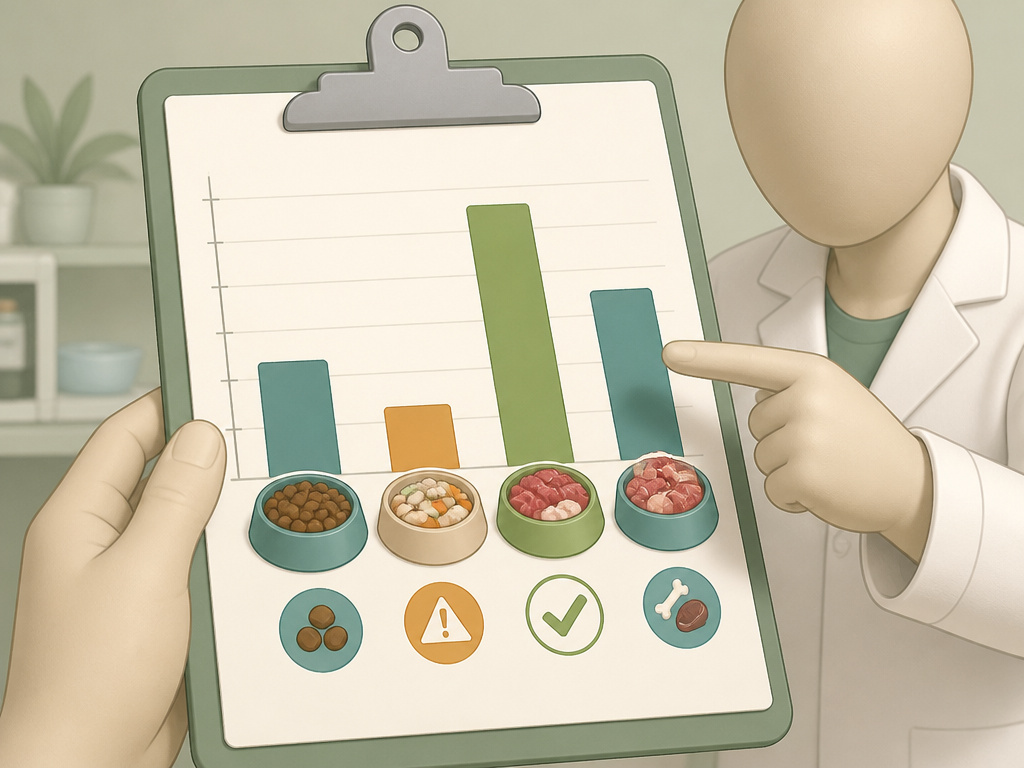
In a cohort of 27,478 dogs, commercial raw feeders showed no elevated odds of gastrointestinal, renal, or hepatic disease.
The breakdown matters more than the headline. Of those dogs, 24,974 ate extruded kibble, 1,214 ate homemade cooked food, 961 ate commercial raw, and 329 ate homemade raw.
Home-cooked diets carried the elevated odds rather than raw. Gastrointestinal disease came in at an adjusted odds ratio of 1.4, renal disease at 1.3, and hepatic disease at 1.6. Commercial raw showed a respiratory association at 1.7 and nothing significant for GI, renal, or hepatic disease.
That cuts against a category-level warning, and the authors say so themselves. Cross-sectional data can only suggest effects, not prove them.
CVMA’s position is category-level, and it holds that the scientific evidence of animal and human health risks outweighs any purported benefits. Both findings can sit side by side if the risk concentrates in handling and in specific formats rather than in the commercial raw row as a whole.
The 2026 Discover Animals review pushes the same point from a different angle. Commercial complete raw diets, home-prepared raw diets, raw meaty bones, freeze-dried products, and mixed dog-and-cat surveys should be treated as distinct exposure categories rather than assumed equivalent.
The raw vs kibble comparison gets flattened by exactly this problem, because kibble is one category and raw is four.
The Handling Rules That Actually Cut Risk
Handling is where the documented risk concentrates, and the rules are unglamorous.
Before you start: Raw pet food stays frozen until you’re ready to use it, and it never touches a counter you eat off. Thaw it in the refrigerator, keep it in a sealed container separate from other food, and wash your hands with soap and water before and after handling. Leftovers that sat out at room temperature go in the bin, not back in the fridge.
- Keep it frozen until you’re ready to use it.
- Thaw it in the refrigerator. Counter thawing warms the outside of the pack hours before the center gives, and that outer layer is the risk.
- Store it sealed and separate from other foods, in both the freezer and the refrigerator.
- Wash your hands with soap and water before and after handling. The before matters as much as the after, because clean hands don’t cross-contaminate the pack.
- Clean every item and surface that touched the raw food. Skip the knife handle or the scale plate and you’ve left the contamination exactly where a hand will land.
- Throw out leftovers that sat out at room temperature. Re-chilling doesn’t undo the time already spent warm.
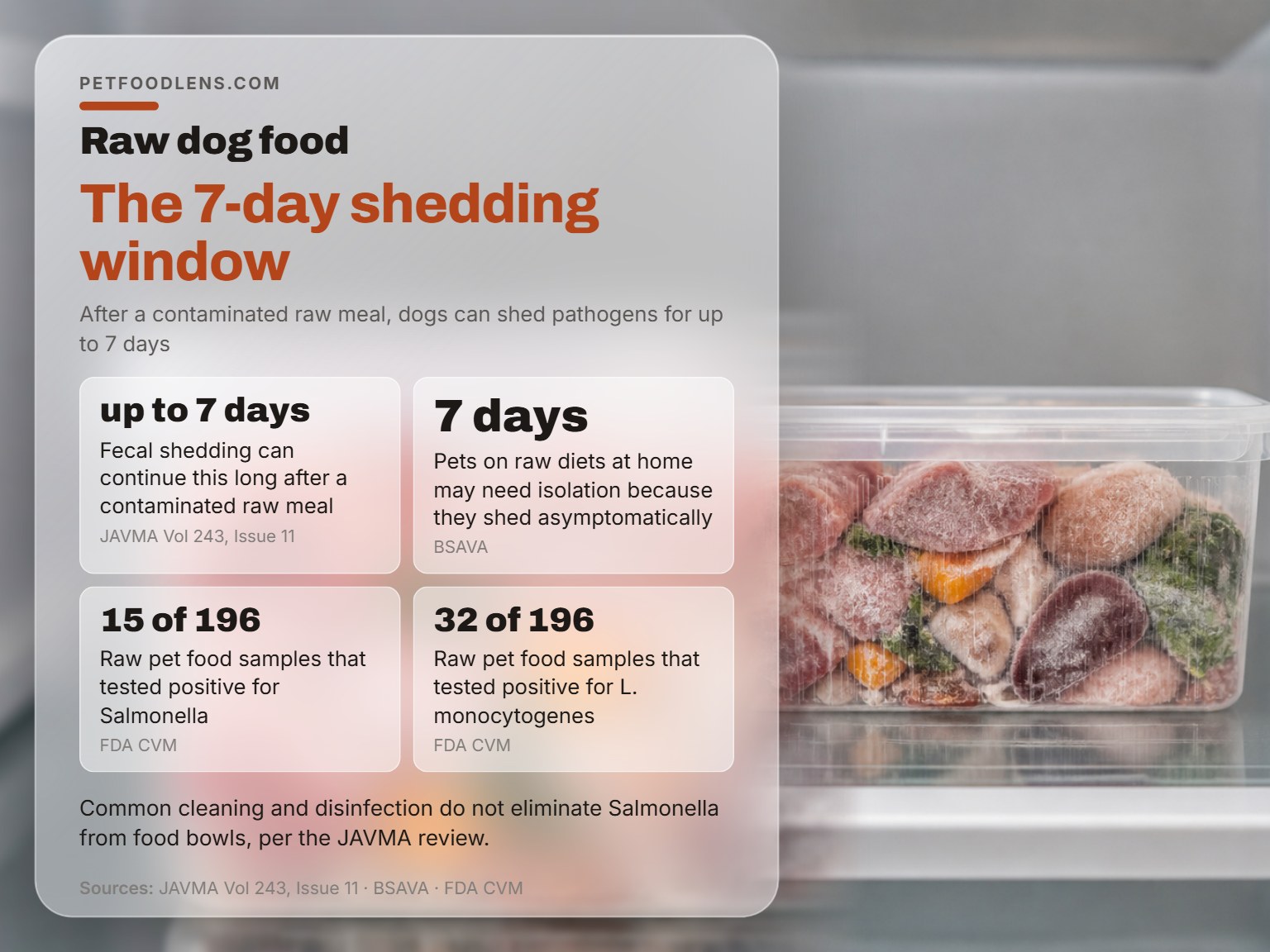
One finding undercuts the bowl-and-bleach routine. Common cleaning and disinfection practices do not eliminate Salmonella contamination from food bowls, according to the JAVMA review. A bowl that looks clean isn’t a guarantee. The safe handling practices worth building a routine around are the ones above.
That film is what gets missed during cleanup.
Where this goes sideways: Thawing on the counter overnight. The outside of the pack reaches room temperature hours before the center thaws, and that window is when bacteria multiply fastest.
The 7-Day Shedding Window
After a dog eats a contaminated raw meal, fecal shedding can continue for up to 7 days, per the JAVMA review. The BSAVA guide repeats the same figure and draws the hospital consequence from it: pets on raw diets at home may need isolation because they can shed pathogens asymptomatically.
The CDC raw pet food fact sheet lists the same handling steps in plain language, including the sealed-container rule and the refrigerator thaw.
Which Households Should Skip Raw Entirely?
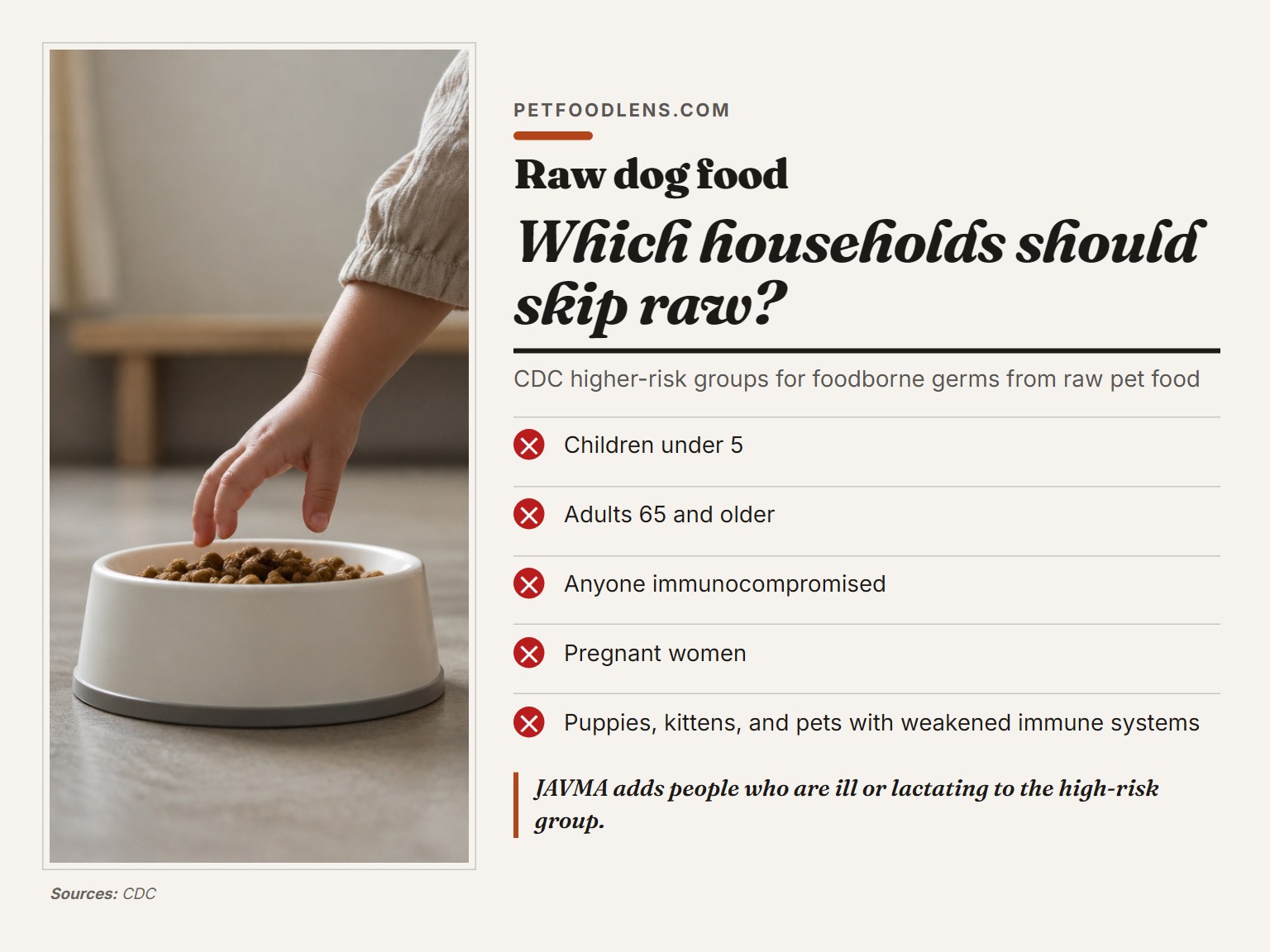
Some households shouldn’t keep raw pet food in the house at all, and the list is shorter than the debate suggests.
- Children under 5. CDC puts them in the higher-risk group for foodborne germs.
- Adults 65 and older, for the same reason.
- Anyone immunocompromised, including people whose treatment suppresses immune function.
- Pregnant women. CDC lists pregnancy as a higher-risk condition.
- Puppies and kittens, plus pets with a weakened immune system or other health conditions.
The JAVMA review widens the list slightly, adding people who are ill or lactating to the high-risk group.
Hospitals have already made the call. Many large hospitals and referral centres allow no raw diets into the hospital at all, to reduce risk to immunocompromised patients and cut cross-contamination between animals. That’s a policy decision made by institutions, not a verdict on your kitchen.
CVMA recommends that veterinarians counsel owners on the risks to themselves, to vulnerable household members, and to their pets, and document that conversation in the medical record.
Skip this if: a child under 5 shares the kitchen floor with the dog’s bowl.
The household math is the same for cats. Raw cat food carries the same exclusions and the same handling rules.
I’d draw the line at the household rather than at the species. A household with a child under 5 is making a different one entirely.
How to Read a Raw Label Before You Buy
Then I learned that fresh meat is mostly water, and water cooks off during processing, so a list can open with chicken and still be built mostly on something further down.
Raw product behaves differently, because the water stays in the food all the way to the bowl. The label math still matters, though, and the format question gets answered on the back panel. If you want a starting point for raw dog food brands, read the checks below before you compare anything else.
I once counted the front panels of a shelf of bags in a single health category.
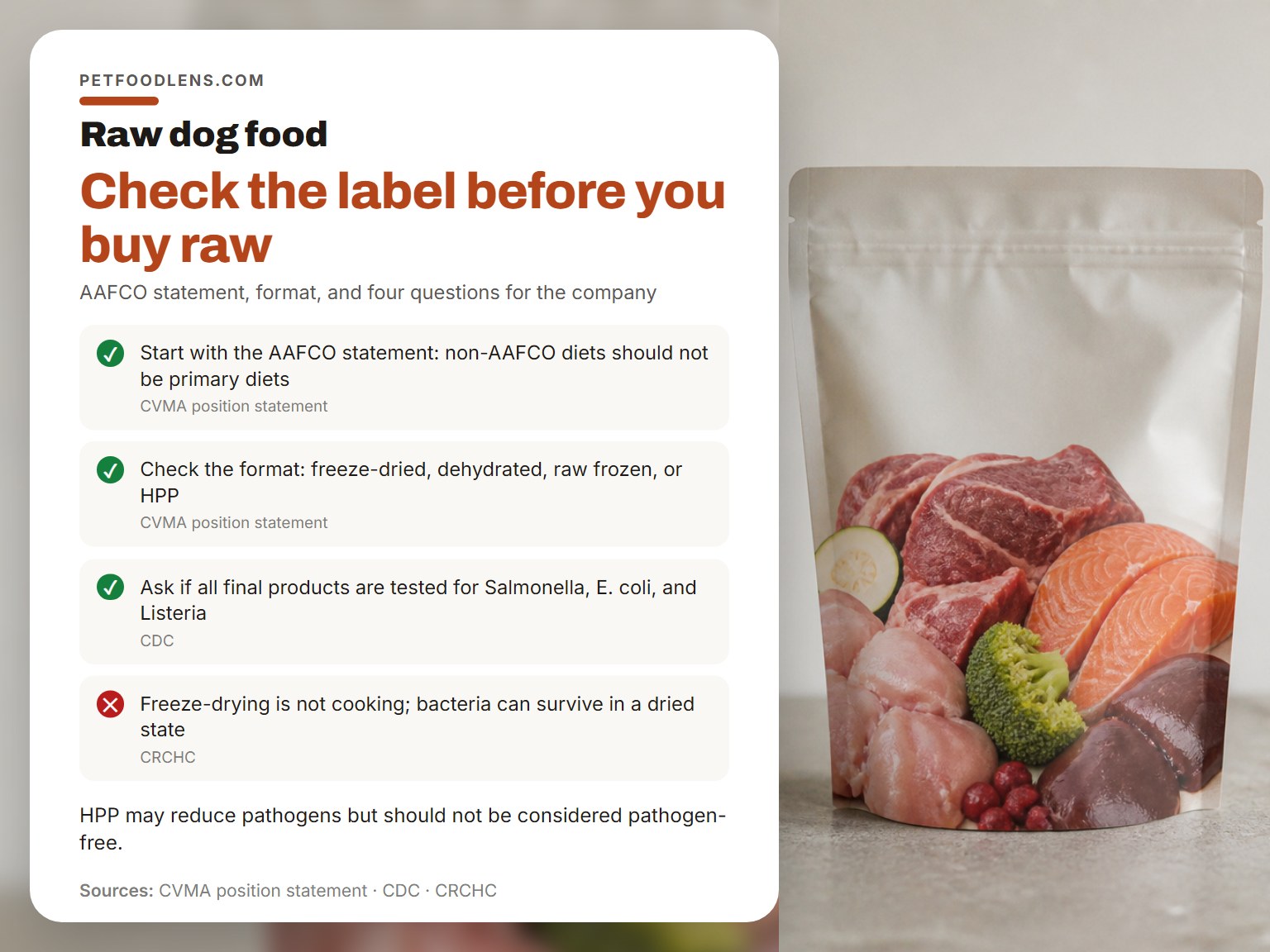
Start with the AAFCO statement. CVMA is direct on this: non-AAFCO-designated diets should not be fed as primary diets, because they may not be properly balanced and could produce serious nutritional deficiencies. Raw and complete-and-balanced are two separate axes.
Then check the format on the pack. Freeze-dried, dehydrated, raw frozen, and HPP all fall under the raw umbrella, and Cornell’s point about drying preserving bacteria applies to the first two.
The Three Questions to Ask the Company
CDC suggests asking suppliers a short list of questions, and the answers separate one company from another far more than the bag design does.
- Does the company test all final products for Salmonella, E. Coli, and Listeria?
- What does the company do to kill germs in its raw products?
- How often does it clean and disinfect the manufacturing facility?
- Does it employ veterinary nutritionists?
Those are format examples. The testing answer is the part that separates one supplier from another.
Sourcing matters as much as format, and choosing raw food suppliers is where the testing question actually gets asked.
Frequently Asked Questions
Is raw dog food better than kibble?
The evidence doesn’t settle it. One peer-reviewed review argues raw diets may support healthy body weight, stool quality, and microbiome changes. CVMA counters that there are limited data showing clinically relevant benefits over conventional cooked diets, and a JAVMA review describes the supporting evidence base as dominated by testimonials and weak study designs. The Dog Aging Project found no elevated GI, renal, or hepatic odds for commercial raw, which complicates the category-level warning without overturning it.
Can I feed raw food if I have a toddler in the house?
CDC lists children under 5 as a higher-risk group for foodborne germs, alongside adults 65 and older, immunocompromised people, and pregnant women. That’s a household-composition question rather than a product question. If a child under 5, an adult 65 or older, an immunocompromised person, or a pregnant woman shares the kitchen, the risk calculation shifts.
Does freeze-dried raw need the same handling as frozen raw?
Cornell is explicit that freeze-drying is not equivalent to cooking for bacterial and parasite risk, and that dried bacteria can survive in a dried state for decades. Treat a freeze-dried raw treat as raw meat with a longer shelf life. Wash hands after handling it and clean the surfaces it touched.
How long can a dog shed bacteria after eating contaminated raw food?
Up to 7 days, according to the JAVMA review, which cites that window when discussing clinic policies. The BSAVA guide repeats the same figure and notes that pets may shed pathogens without showing symptoms, which is why some hospitals isolate raw-fed patients.
Is HPP raw food pathogen-free?
No. CVMA’s position is that raw diets prepared with high-pressure pasteurization may have reduced pathogen levels compared with uncooked diets, but HPP products should not be considered pathogen-free.
Should I cook raw dog food before feeding it?
Cornell states that raw product should be cooked to an internal temperature of 165°F before feeding. That converts the diet into a cooked diet, which changes the nutritional profile and puts you back into the balancing question.
The Bottom Line
If your household includes a child under 5, an adult over 65, a pregnant person, or anyone with a suppressed immune system, the raw question already has an answer. Skip it, and don’t spend long deciding. CDC lists those groups first for a reason, and no format swap removes the handling route.
If none of those apply, two checks do most of the work. Does the product carry an AAFCO nutritional adequacy statement, and will the company tell you whether it tests every final batch for Salmonella, E. Coli, and Listeria?
One concession worth stating plainly: this is a label-and-literature view, not a clinical one. A dog with a health condition needs a veterinarian’s input, and the format debate doesn’t touch that.
The format point is the one I’d defend hardest. A freeze-dried raw treat and a frozen raw chub get discussed as if they were the same product. They aren’t, and Cornell’s note that drying preserves bacteria is why I’d rather see a household run a careful frozen raw routine than keep a cupboard of shelf-stable raw treats nobody washes their hands after.
