
Raw Feeding Safety for Dogs: What the Evidence Shows
This post contains affiliate links. As an Amazon Associate, we earn from qualifying purchases.
Raw feeding safety for dogs starts with a single sample set: of 196 raw pet food samples FDA tested, 15 carried Salmonella and 32 carried Listeria monocytogenes. That’s the highest contamination rate in the agency’s two-year pet food survey. The meat carries the risk. Your handling carries the rest.
FDA’s Center for Veterinary Medicine left raw food out of the first year of that study entirely, then added 196 raw dog and cat food samples in the second year. What came back is why the agency still flags raw diets as a public health concern.
What follows is the sample data, what freezing and freeze-drying actually do to bacteria, the handling routine that measurably lowers risk, and the households that should skip raw entirely.
Key Takeaways
- 15 of 196 raw pet food samples carried Salmonella in FDA’s two-year survey; 32 carried Listeria monocytogenes.
- Freezing, freeze-drying, and dehydrating reduce germs but don’t kill all of them, per CDC.
- HPP and irradiation products still count as raw under CDC’s definition, whatever the package implies.
- Wash hands at least 20 seconds, then clean with hot soapy water, then disinfect with 1 tablespoon bleach per quart of water.
- Children under 5, adults 65+, pregnant women, and immunocompromised people are at higher risk of severe foodborne illness from raw pet food.
What the Testing Actually Found in Raw Dog Food
Fifteen of 196. That’s the Salmonella rate FDA’s Center for Veterinary Medicine found when it added raw pet food to a two-year survey of more than 1,000 pet food samples.
Across two separate sample sets, raw dog and cat foods carried Salmonella at 5.9 percent in the JAVMA 2006 study and 15 of 196 samples in the FDA CVM survey, while the fact sheet does not report comparable rates for other categories. The gap between those categories is the finding.
Thirty-two of those same 196 samples carried Listeria monocytogenes. Raw came back dirtier than every other category the agency tested.
The survey wasn’t designed around raw food. CVM left it out of year one, then added 196 raw dog and cat food samples in year two.
| Sample set | What was tested | Finding |
|---|---|---|
| FDA CVM, 2010-2012 | 196 raw dog and cat foods | 15 Salmonella, 32 Listeria |
| Strohmeyer et al., JAVMA 2006 | 288 samples from 20 raw diets | 53% E. Coli; 5.9% Salmonella, all raw |
| German raw diet study | 44 raw products | Every one had a nutrient concern |
The 2006 JAVMA study is the one to read if you want the method. It tested 288 samples from 20 raw diets plus two dry and two canned diets. Fifty-three percent came back positive for non-type-specific E. Coli, and Salmonella enterica turned up in 17 samples, all of them raw.
That’s the same pattern the salmonella risk in raw pet food data shows across every study I’ve read.
An earlier study cited in that same paper found 30% of fecal samples from dogs on a homemade BARF diet carried Salmonella serovars. That’s the piece owners consistently underestimate: the dog sheds it.
Whole-genome sequencing closed the loop later. A genomic tracing of raw pet food pathogens matched the strain recovered from a sick person to the strain in the pet food itself. That’s about as direct as foodborne evidence gets.
FDA’s own raw pet food safety facts page puts the conclusion plainly: owners who feed a raw diet may have a higher risk of infection with Salmonella and Listeria monocytogenes.
Does Freezing or Freeze-Drying Make Raw Food Safe?
CDC states it directly: freeze-drying, dehydrating, or freezing raw protein only reduces the amount of germs and does not kill all of them, while consumer-facing raw brands commonly imply that frozen means safe.
That’s a real disagreement with how the category is sold. Consumer-facing raw brands commonly imply that frozen means safe. CDC’s position is that freezing reduces germs without killing them all, and the difference matters when the product goes into your fridge next to everything else.
Cornell’s Riney Canine Health Center makes a sharper version of the same point about drying. Freeze-drying is the opposite of cooking. Their researchers preserve bacteria for study by drying them out, and those cultures survive in a dried state for decades.
Cornell’s raw foods for dogs guidance is worth reading in full. The CDC raw pet food fact sheet has the shorter version.
What Freezing Actually Does
A frozen raw tube comes out of the freezer furred with ice crystals along the seam. Thaw it on the counter and the outside hits room temperature hours before the core does, which is the window bacteria use.
FDA’s instruction is to thaw in the refrigerator or microwave, not on the countertop or in the sink. CDC says refrigerator. Both are telling you to keep the product cold while it thaws.
If you’re portioning, safe thawing starts with smaller pieces, because a thin portion reaches refrigerator temperature far faster than a solid block.
Why Freeze-Dried Treats Catch People Out
Freeze-dried raw treats and raw-coated kibble sit on grocery shelves, not in a freezer case, and they read as shelf-stable. CDC counts both as raw pet food.
The easiest way to identify one is the word “raw” on the packaging. Cornell adds that raw meat can also reach you as dried or freeze-dried treats and as freeze-dried coated kibble, which is easy to buy without registering that it’s raw.
Where this goes sideways: Thawing a raw tube in the sink. The outside of the product sits at room temperature while the core is still frozen, and that’s the exact condition the freezer was preventing.
Raw Feeding Safety for Dogs Starts at the Kitchen Sink
The routine is five steps.
Before you start: Mix the disinfectant at 1 tablespoon of bleach per quart of water, or 1/4 cup per gallon for a bigger batch. Going stronger pits stainless steel and destroys cutting boards without killing anything faster. Keep a board that only touches raw pet food, and send it straight to the dishwasher.
Twenty seconds is longer than it sounds. Count it once and you’ll find you’ve been washing for six.
- Wash hands for at least 20 seconds with soap and water, before and after handling, and again after touching anything the food touched. FDA’s number is 20 seconds. Skipping the second wash is how contamination gets from the bowl to the door handle.
- Don’t rinse the meat. FDA is direct: rinsing raw meat, poultry, fish, or seafood splashes bacteria onto nearby food and surfaces. The rinse does nothing and spreads everything.
- Clean first, then disinfect. Hot soapy water on visible residue, then the bleach solution. Disinfectant over a film of food residue doesn’t reach the surface underneath.
- Run bowls, scoops, treat toys, and mats through the dishwasher after each use. CDC lists all four. A bowl rinsed under the tap and set back down is still contaminated, and the next meal goes into it within hours.
- Keep the dog’s mouth off your face. FDA says don’t kiss your pet around the mouth and don’t let the pet lick your face, especially right after a raw meal.
The surface list is longer than most owners expect. Countertops, the inside of the refrigerator, the inside of the microwave, utensils, feeding bowls, cutting boards. FDA names all of them.
The full sequence matters more than any single step. Handling raw dog food properly means treating the counter, the sink, and the fridge shelf as one continuous surface, because bacteria don’t stop at the edge of the board.
The sanitizing surfaces step is two stages, soap then bleach, and a single wipe with disinfectant is not the same thing.
Storage is the other half. Raw pet food storage has to keep the product sealed and separate from everything else in both the fridge and the freezer, per CDC.
Put it on the bottom shelf. Drips go down.
Raw Bistro Lot 239 and What a Recall Timeline Tells You
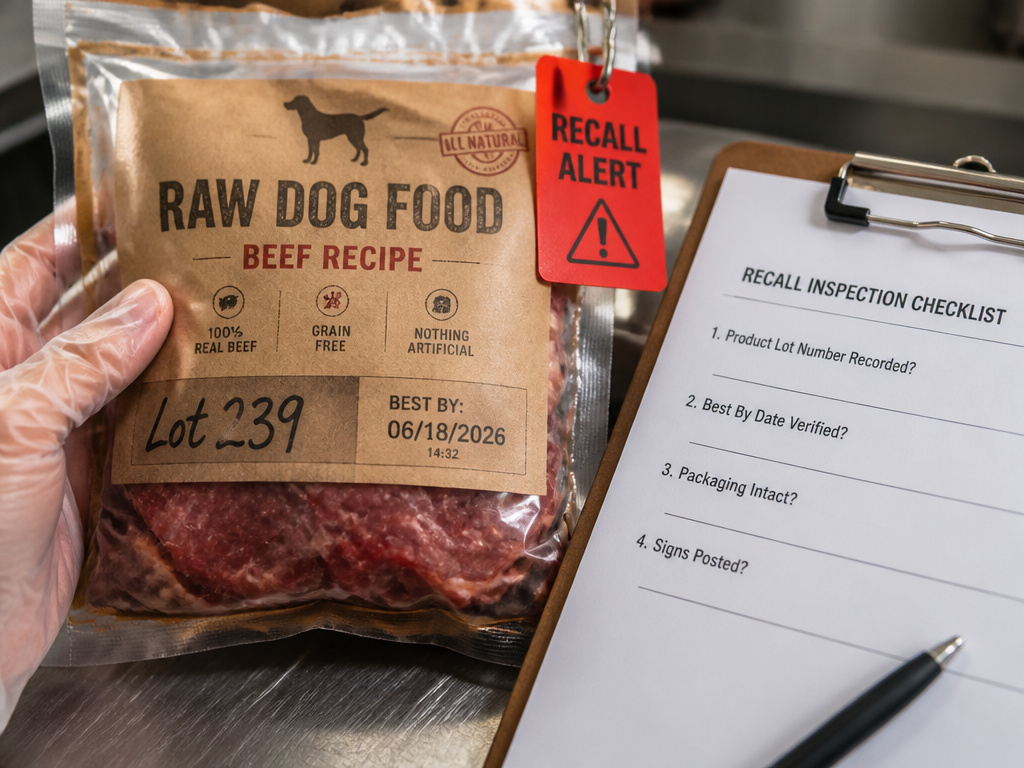
Lot 239 is the number on a bag of Raw Bistro “Dog Fare Grass-Fed Beef Entrée” with a best-by date of 08/27/2026.
FDA sampled that lot on 09/24/2025 and found Salmonella Paratyphi. The company ran a Class I recall on 10/10/2025. FDA issued a warning letter on 02/17/2026.
The sample came off a shelf at a third-party retailer, not out of the manufacturing plant. That detail matters more than it looks. It puts the distribution chain inside the risk surface, which means the plant’s own testing isn’t the whole story.
CDC suggests four questions before you buy from any raw company:
- Does the company test all finished products for Salmonella, E. Coli, and Listeria?
- What does it do to kill germs in the raw product?
- How often does it clean and disinfect the manufacturing facility?
- Does it have veterinary nutritionists on staff?
Those four answers separate a company that has thought about this from one that hasn’t. Ask them in writing.
The safe raw food sourcing question is really those four answers plus one more: is the product complete and balanced, or is it a grind you’re expected to balance yourself?
HPP and Irradiation: Still Raw, Whatever the Label Says
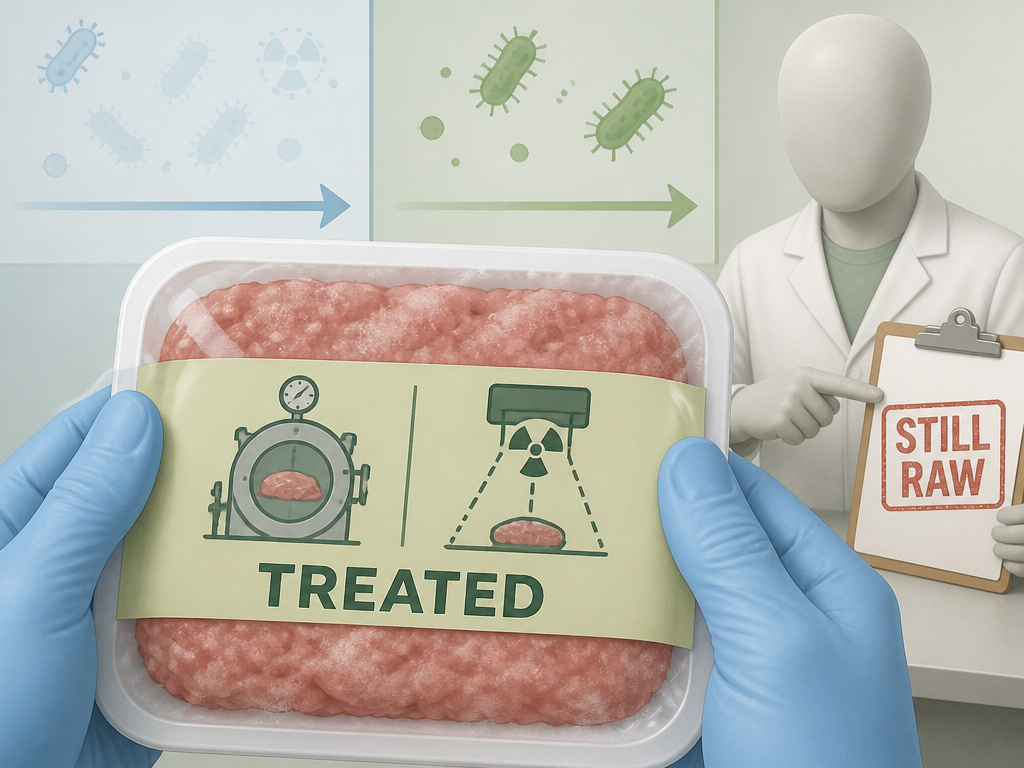
CDC does not accept the industry’s framing on high-pressure processing, while industry framing markets HPP and irradiation products as ‘treated’ or ‘pathogen-reduced’ and therefore distinct from raw.
HPP kills bacteria with pressure instead of heat. Irradiation uses high-energy beams. Industry framing markets both as “treated” or “pathogen-reduced” and therefore distinct from raw.
CDC’s counter is procedural: “we currently don’t have enough information about how well pet food processing facilities are using these processes. Therefore, these products are still considered to be raw pet food.”
So there are two positions, and both have a basis. CDC classifies HPP and irradiation products as raw because it can’t verify the process at every facility. The industry markets them as treated because the process does reduce pathogens when it’s run correctly. The classification and the reduction are separate questions.
| Common claim | What the record shows | Source |
|---|---|---|
| Freezing makes it safe | Freezing only reduces germs; it doesn’t kill all | CDC |
| HPP means it’s not raw | Still classified as raw; process verification is insufficient | CDC |
| Freeze-dried is basically cooked | The opposite; dried bacteria survive for decades | Cornell |
| Raw is automatically healthier | Both raw and cooked can be balanced or inadequate | CDC |
I’d still take an HPP product over a DIY grind. Pressure treatment is a real reduction step. It just doesn’t move the product out of the raw category, and it doesn’t shorten your handling routine by a single step.
The word “treated” on a package is a reduction claim.
Is Raw Feeding Actually More Nutritious?
The nutrition case for raw is the weakest part of the argument, and it’s the part almost nobody tests.
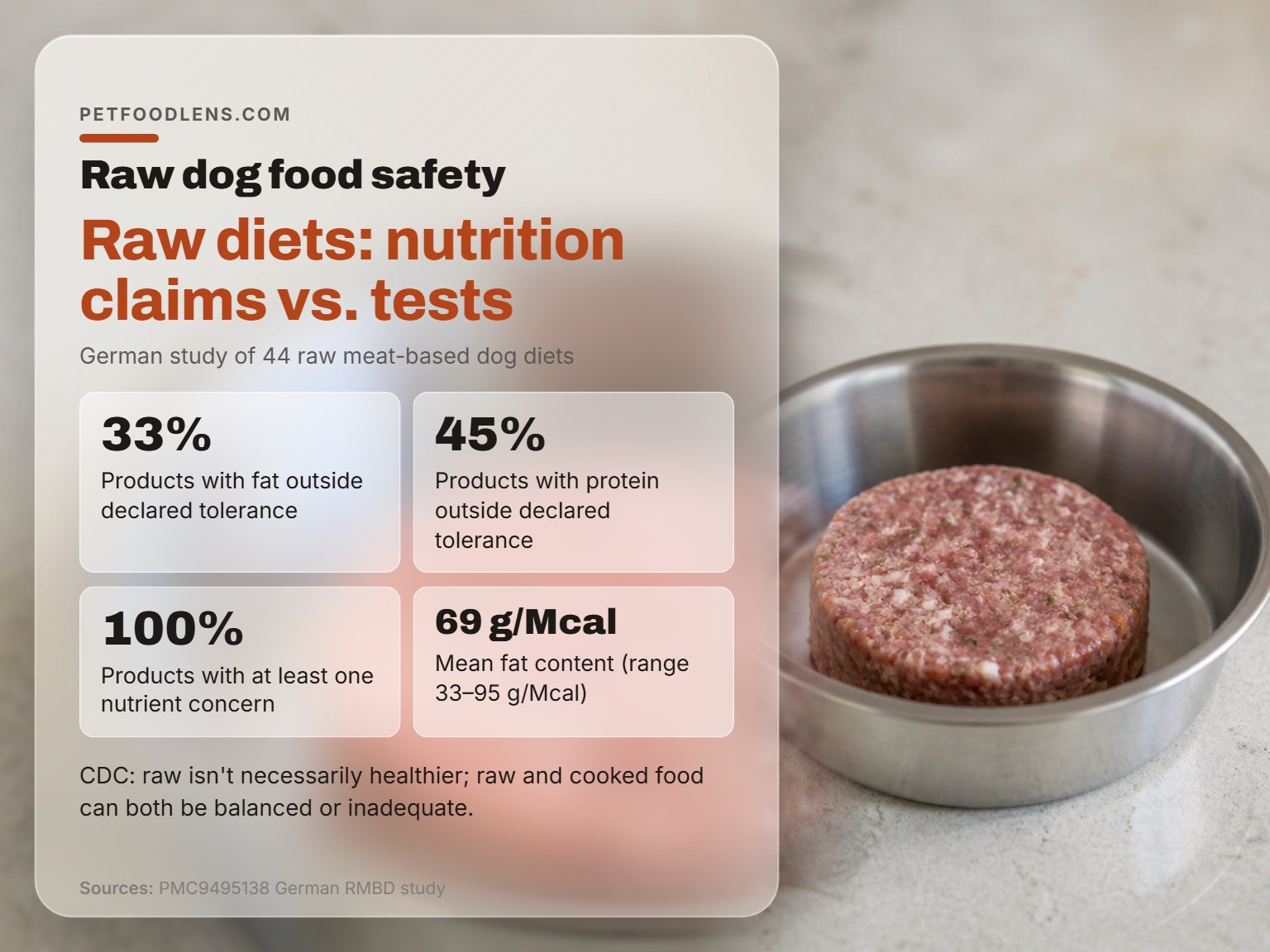
A German assessment of 44 raw meat-based diets found fat outside the declared tolerance in 33% of products and protein outside tolerance in 45%. Every single product had at least one nutrient concern.
Mean fat content ran 69 g/Mcal, with a range of 33 to 95. That spread is wide enough that two products in the same freezer could be feeding your dog very different diets.
CDC’s position is blunter: raw isn’t necessarily healthier, and both raw and cooked pet food can be made with high-quality or low-quality ingredients and can be nutritionally balanced or inadequate, while BARF proponents claim raw diets support ‘supreme wellness,’ increase energy and lean body mass, and resolve health problems.
The benefit claims are the older problem. A 2006 JAVMA paper noted that BARF proponents claim raw diets support “supreme wellness,” increase energy and lean body mass, and resolve health problems. The paper’s conclusion: those claims have not been objectively supported with scientifically valid data.
Here’s where the sources genuinely split, and I’d rather show you the split than pick a side for you. The 2013 JAVMA review says the infectious-disease evidence for raw diets is stronger than the nutritional evidence, which rests largely on testimonials and case series. The German study points the other direction: every product it tested had a nutrient problem, which suggests nutritional risk is under-weighted in the literature rather than over-weighted.
The JAVMA raw meat diet risk review lays out that evidence-quality gap in detail.
Both things can be true. The microbiological case is better documented, and the nutritional case is thinner but not empty.
The raw dog food pros and cons comparison is where I’d start if you’re weighing the two sides for a specific dog.
I formulate cat food for a living. Dog raw diets are the one corner of this field where I hand off to people with more hands-on experience than I have, and I’d rather say that than pretend otherwise.
Who Should Not Feed Raw at All
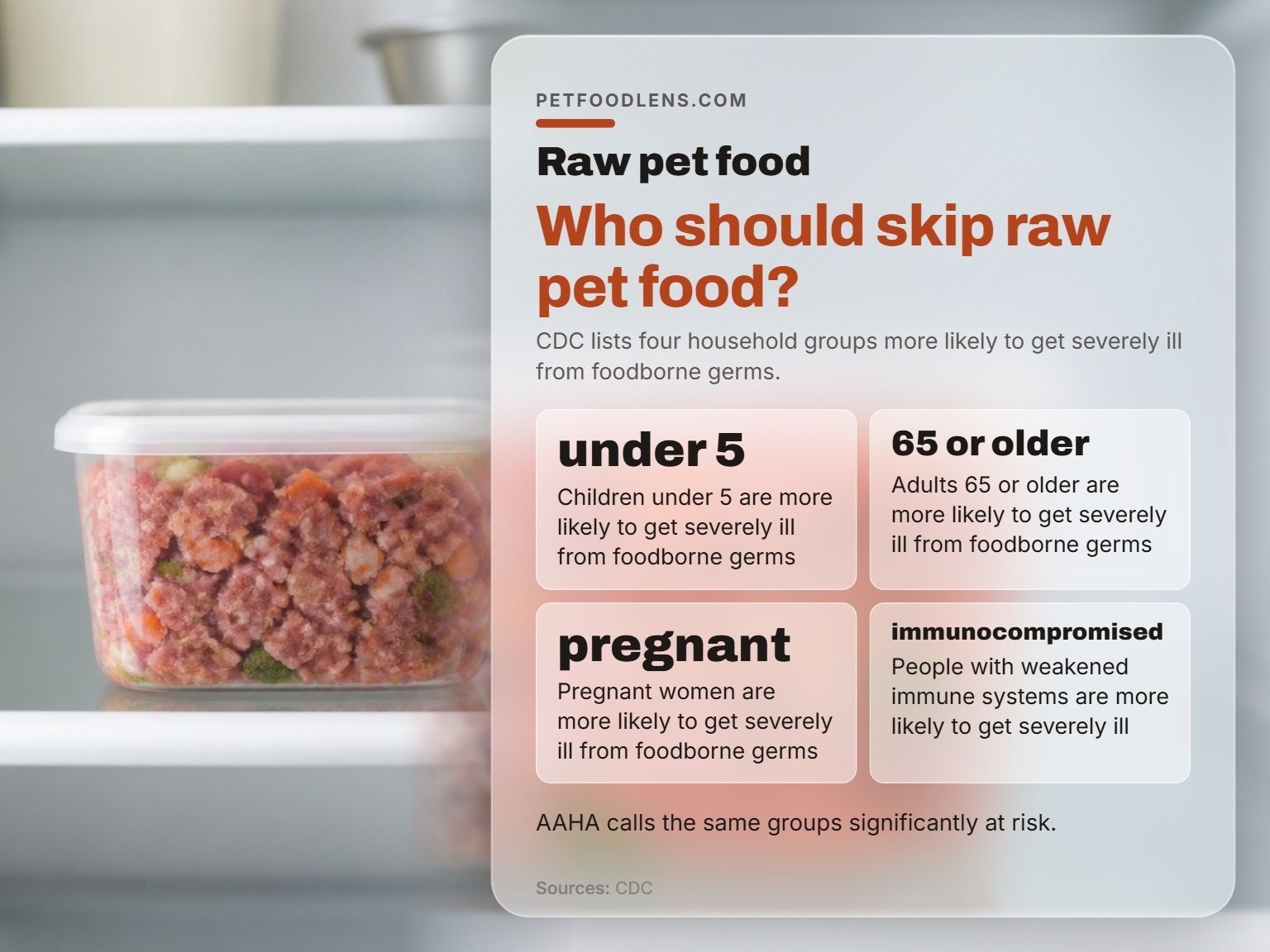
Some households shouldn’t feed raw at all, and the list is shorter than most people expect.
CDC names four groups of people at higher risk of severe foodborne illness:
- Children under 5
- Adults 65 or older
- People with weakened immune systems
- Pregnant women
And three groups of pets:
- Puppies
- Kittens
- Pets with a weakened immune system or other health conditions
If any of those apply, the calculation changes. A dog on raw food sheds the bacteria, and the shedding continues long after the bowl is clean.
If your household clears all of that and you’re going ahead anyway, change one variable at a time. I only change one thing at a time when I’m working through a feeding problem, and I learned that the hard way. When I changed several things at once, I could never tell what had helped and what had caused trouble.
Same rule here. Don’t switch the protein, the amount, and the format in the same week. You’ll have no idea which change caused the loose stool, and neither will your vet.
The raw feeding guide for beginners covers the transition sequence in order.
Frequently Asked Questions
Can I feed raw dog food if I’m pregnant?
No. CDC lists pregnant women among the groups at higher risk of severe foodborne illness, and raw pet food can carry Salmonella and Listeria monocytogenes. Someone else in the household should handle the food, the bowls, and the cleanup for the duration.
Does freezing raw dog food kill Salmonella?
No. CDC states that freezing raw protein only reduces the amount of germs and does not kill all of them. Freezing buys you storage time and nothing else. The handling routine still applies after thawing.
Is freeze-dried raw dog food safer than frozen raw?
Not by CDC’s definition. Freeze-dried products are still classified as raw pet food, and Cornell notes that bacteria can survive in a dried state for decades. The advantage of freeze-dried is shelf stability, not pathogen elimination.
How long can raw dog food sit out?
Don’t let it sit out at all. FDA’s instruction is to thaw in the refrigerator or microwave, not on the countertop or in the sink.
What’s the difference between HPP and cooked?
HPP uses pressure instead of heat, and CDC still classifies the resulting product as raw pet food because it can’t verify how well each facility runs the process. Cooking kills bacteria with heat and moves the product out of the raw category entirely.
Do I need to wash my dog’s bowl if it only had raw food?
Yes, after every use. CDC lists bowls, scoops, treat toys, feeding mats, and placemats as items to clean frequently, and FDA recommends the dishwasher after each use.
The Bottom Line
Raw feeding safety for dogs is a decision most owners make once and then stop revisiting. The evidence says revisit it.
If there’s a child under five, a pregnant adult, or anyone over 65 in the house, stop here. That’s the threshold, and it isn’t close.
If your household clears that bar and you’re feeding raw anyway, do one thing this week: call the company and ask whether it tests every finished batch for Salmonella, E. Coli, and Listeria. A yes with a specific answer is worth more than any claim on the front of the bag.
And if the answer is vague, that’s your answer.
None of this changes if a veterinary nutritionist has formulated a specific diet for a specific condition. That’s a different conversation with a different professional, and I’m not the one to have it with you.
