
Which Human Foods Are Toxic to Cats? What to Do First
This post contains affiliate links. As an Amazon Associate, we earn from qualifying purchases.
The answer to which human foods are toxic to cats starts with onion and garlic (Allium), then chocolate, grapes and raisins, xylitol, alcohol, caffeine, and raw yeast dough. Onion toxicosis starts at 5 g/kg in cats, well below the 15 to 30 g/kg dog range, and cooking does not reduce it.
The 5 g/kg number is the one to sit with when you ask which human foods are toxic to cats. A cat can cross it on a portion that would barely register for a dog. The Veterinary Poisons Information Service recorded one cat that stayed asymptomatic with no treatment while another died of hemorrhage into the chest and abdomen.
What follows is the list, the dose math where it exists, and the places where the sources genuinely disagree about cats.
Key Takeaways
- Onion and garlic are the highest-risk everyday food for cats, with a toxic threshold of 5 g/kg.
- Cooking, drying, and baking do not reduce Allium toxicity. Documented poisonings followed baked garlic, onion souffle, and steamed dumplings with chives.
- Grapes and raisins are the item the sources disagree on. Cornell lists dogs only, WSAVA lists cats, and a 13-cat cohort found zero kidney injury.
- Decontamination works best within 2 to 4 hours for chocolate and methylxanthines.
- Call Pet Poison Helpline at 855-764-7661 or ASPCA APCC at 888-426-4435 rather than waiting for symptoms.
Which Human Foods Are Toxic to Cats? The Nine That Show Up Most
Nine food groups appear across the FDA list, the WSAVA treat guidance, and the peer-reviewed review by Cortinovis and Caloni. The table below is the short version.
Allium species damage feline red blood cells through oxidative hemolysis. The toxic threshold for onion in cats is 5 g/kg, compared with 15 to 30 g/kg in dogs. Cooking, drying, and dehydration do not eliminate the reactive compounds, and documented poisonings have followed baked garlic, onion souffle, and steamed dumplings with chives.
| Food group | Active agent | Species note |
|---|---|---|
| Onion, garlic, leek, shallot, chive | Allium organosulfoxides | 5 g/kg threshold in cats; 15 to 30 g/kg in dogs |
| Chocolate | Theobromine, caffeine | Baking chocolate above 14 mg/g; milk chocolate around 2 mg/g |
| Grapes, raisins, currants, sultanas | Unidentified | Cornell lists dogs only; WSAVA lists cats |
| Xylitol | Sugar alcohol | Cornell: toxic to dogs, cats, and ferrets |
| Alcohol and raw yeast dough | Ethanol | WSAVA lists both for cats |
| Milk and dairy | Lactose | WSAVA lists as toxic; FDA and Cornell do not |
The table is a starting point, not a diagnosis. The risk inside that list is not flat, and the next six sections go group by group.
Why Onion and Garlic Hit Cats Harder Than Dogs
The rotisserie chicken skin is where I see this go wrong most often. An owner pulls the skin off a store-bought bird, gives it to the cat as a treat, and never reads the seasoning. Onion and garlic powder are in there.
That is the pattern with Allium. The dose is small, the food looks like a treat, and the owner thinks they are being generous. Allium organosulfoxides attack the red blood cell membrane, and feline cells have less capacity to repair the oxidative damage.
Cooking Does Not Neutralize Allium
The Cortinovis review documents poisonings from baked garlic, onion souffle, butter-cooked onions, and Chinese steamed dumplings with chives. Heat does not eliminate the reactive compounds. Two hidden vehicles are worth naming: Catalan spring onion, called calcot, and Chinese chives (Allium tuberosum). Owners in the documented cases did not recognize either one as an Allium.
The Veterinary Poisons Information Service recorded 69 canine and 4 feline Allium cases between 1994 and 2008. Two dogs died, two were euthanized, and one cat died of hemorrhage into the pleural and abdominal cavities. One cat in the same dataset stayed asymptomatic with no treatment at all, so you cannot read the severity off the behavior.
Breed susceptibility is documented in dogs. Akita, Shiba, and Jindo carry hereditary high erythrocyte-reduced-glutathione and potassium concentrations, which makes onion-induced oxidative hemolysis worse. No equivalent feline breed data exists.
The practical rule is to read the seasoning on anything that comes out of a deli case, and the onion and garlic toxicity write-up covers the full ingredient list. The household food items toxic to dogs and cats review is the source for the thresholds above.
I would rather see an owner call poison control over a teaspoon of onion powder than wait for a symptom that may never show. The asymptomatic cat in the VPIS dataset is the reason.
Do Grapes and Raisins Belong on the Cat List?
The honest answer is that the sources do not agree, and the disagreement is bigger for cats than for dogs.
| Source | Position on grapes and raisins in cats |
|---|---|
| Cornell University College of Veterinary Medicine | Toxic to dogs only |
| WSAVA | Toxic to cats (grapes, raisins, currants, sultanas) |
| PetMD | Feline kidney-failure risk; can be fatal |
| Dutch Poisons Information Center (2022) | 0 of 13 cats developed AKI; 15.4% showed clinical signs |
Cornell lists Vitis toxicity as toxic to dogs only. WSAVA lists grapes, raisins, currants, and sultanas as toxic food ingredients for cats. PetMD groups them as a feline kidney-failure risk and says kidney failure can develop quickly and be fatal.
The only prospective data in this set points the other way. The Dutch Poisons Information Center followed 95 dogs and 13 cats with proven Vitis ingestion in 2018. One dog in 95 developed acute kidney injury. None of the 13 cats did. Clinical signs still appeared in 14.7% of dogs and 15.4% of cats, mostly gastrointestinal.
So the cat risk is real enough to avoid the food. The kidney-failure claim is not supported by the one prospective cohort that looked for it, though the sample is 13 cats and that is a small number.
Owners toss grapes as a healthy treat more than they should. The toxic dose in dogs is unpredictable, so skipping the grape is cheaper than gambling on it.
The dog side of the question is better documented, and the toxic foods for dogs list carries the case data. Cornell’s veterinary clinical care toxin guidelines are the source for the dogs-only position.
Where this goes sideways: Treating the PetMD warning as settled fact. The 13-cat cohort found zero kidney injury, and the WSAVA listing is a precaution without a published dose threshold.
Chocolate: The Dose Math Nobody Runs
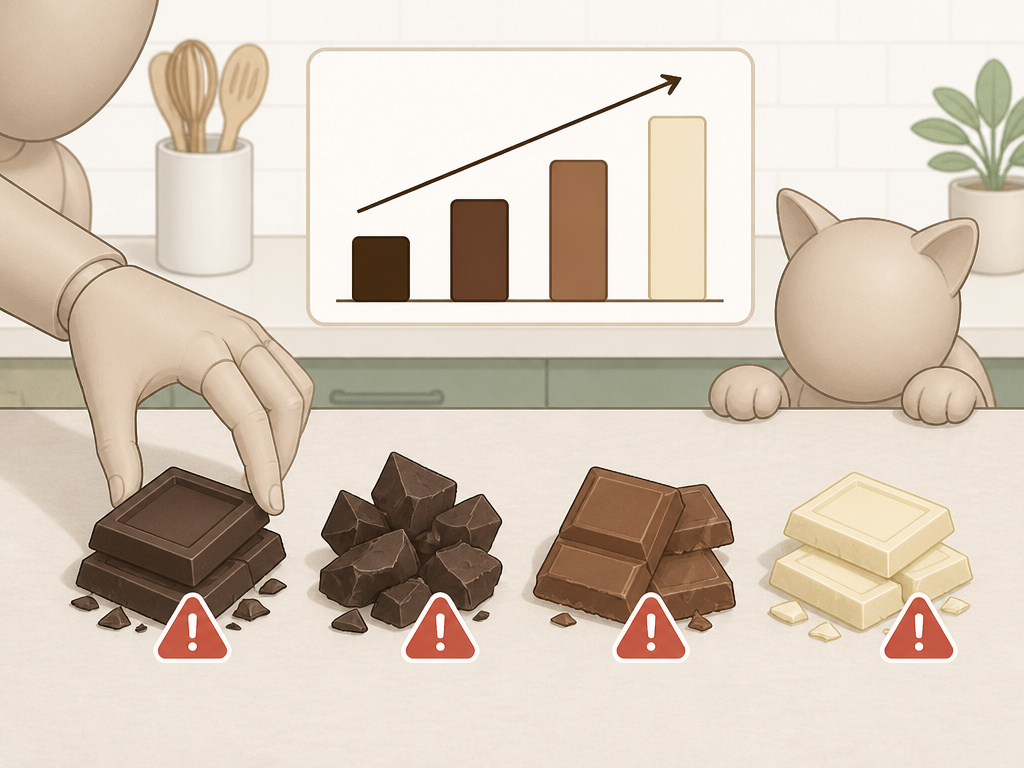
Chocolate is the food owners panic about first and measure last. Here is what the numbers actually say. The theobromine content varies by a factor of seven across the chocolate types in the Cortinovis review.
Theobromine by Chocolate Type
- Unsweetened baking chocolate and cocoa powder: more than 14 mg per gram
- Semisweet dark chocolate: around 5 mg per gram
- Milk chocolate: around 2 mg per gram
- White chocolate: an insignificant source
The dog thresholds from ASPCA APCC data are 20 mg/kg for mild signs, 40 to 50 mg/kg for severe signs, and 60 mg/kg for seizures. There is no feline-specific mg/kg figure in these sources, which is a real gap.
Absorption is the part that catches people. In dogs, theobromine is absorbed 10 times slower than caffeine and reaches peak plasma levels at about 10 hours. Signs usually appear within 2 to 4 hours, and decontamination inside that window gives the best prognosis.
So a dog that looks fine at hour two is still climbing. A cat is a different animal with thinner data, and the safe move is the same: call.
Chocolate also carries caffeine, and the caffeine toxicity page covers the methylxanthine side separately. The journal article on hidden pet food dangers covers the same food groups from a clinical angle.
Xylitol, Alcohol, and Raw Dough: The Ones People Miss
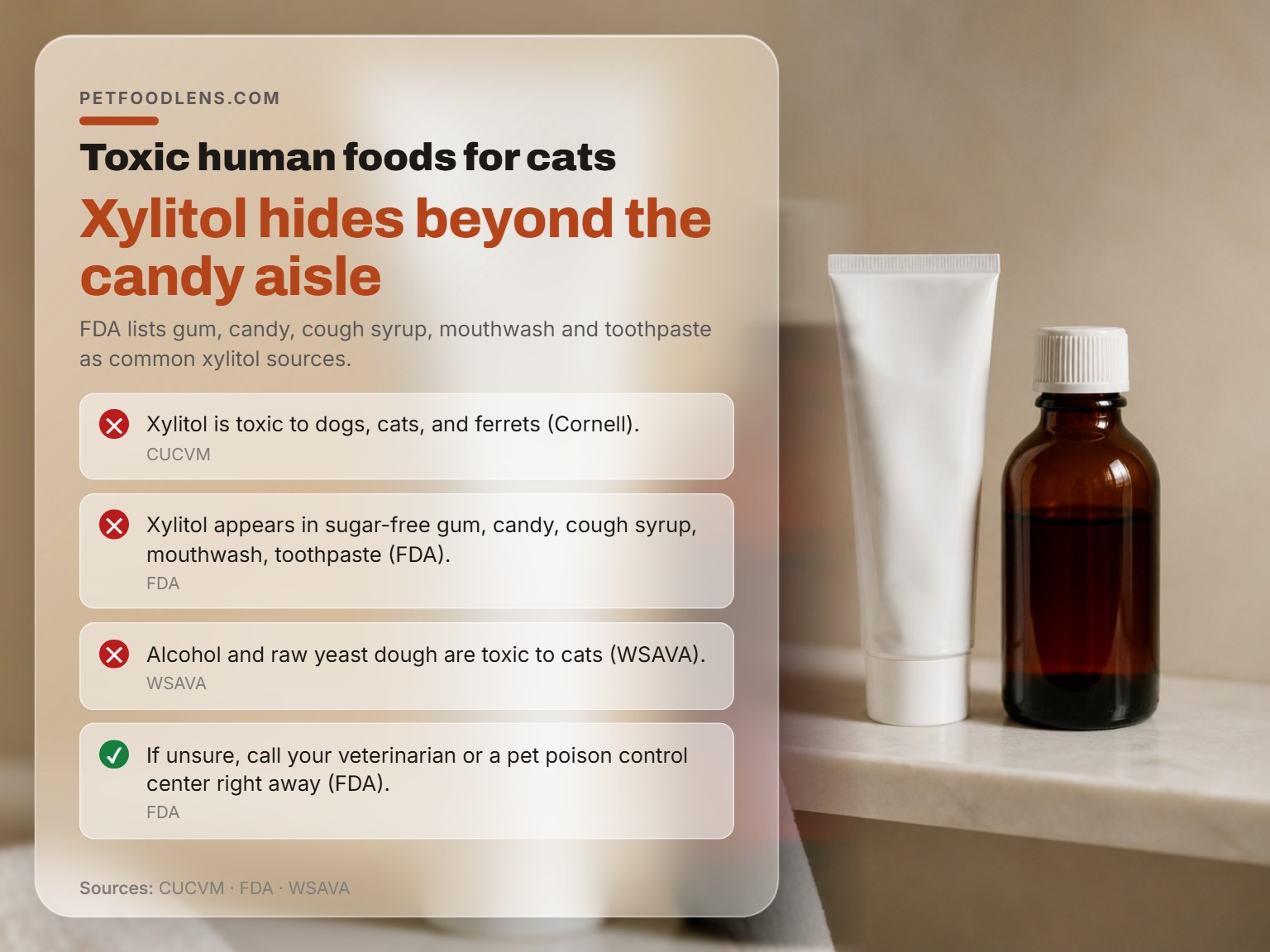
Xylitol hides in products nobody thinks of as food. The FDA lists sugar-free chewing gum, sugar-free candy, cough syrup, mouthwash, and toothpaste as the common vehicles. Cornell lists xylitol as toxic to dogs, cats, and ferrets.
Where Xylitol Hides
- Sugar-free gum and breath mints. The pack on the counter is the classic exposure.
- Cough syrup and mouthwash. Both get swallowed in small amounts, and both can carry xylitol.
- Toothpaste. Cats do not usually eat it, but a tube left out is a chew toy.
Alcohol and raw yeast dough are the other two. WSAVA lists both for cats. The FDA lists alcoholic drinks and alcohol-containing foods, and flags yeast products like raw bread dough. Raw dough is a double problem: the dough expands in the stomach, and fermenting yeast produces ethanol.
The alcohol toxicity page covers the ethanol dose, and the moldy food poisoning page covers the mycotoxin side of spoiled leftovers.
The part nobody mentions: Xylitol appears in toothpaste and cough syrup, not just gum. Owners check the candy aisle and miss the medicine cabinet.
Caffeine, Dairy, and Avocado: Where the Risk Is Smaller Than the List Suggests
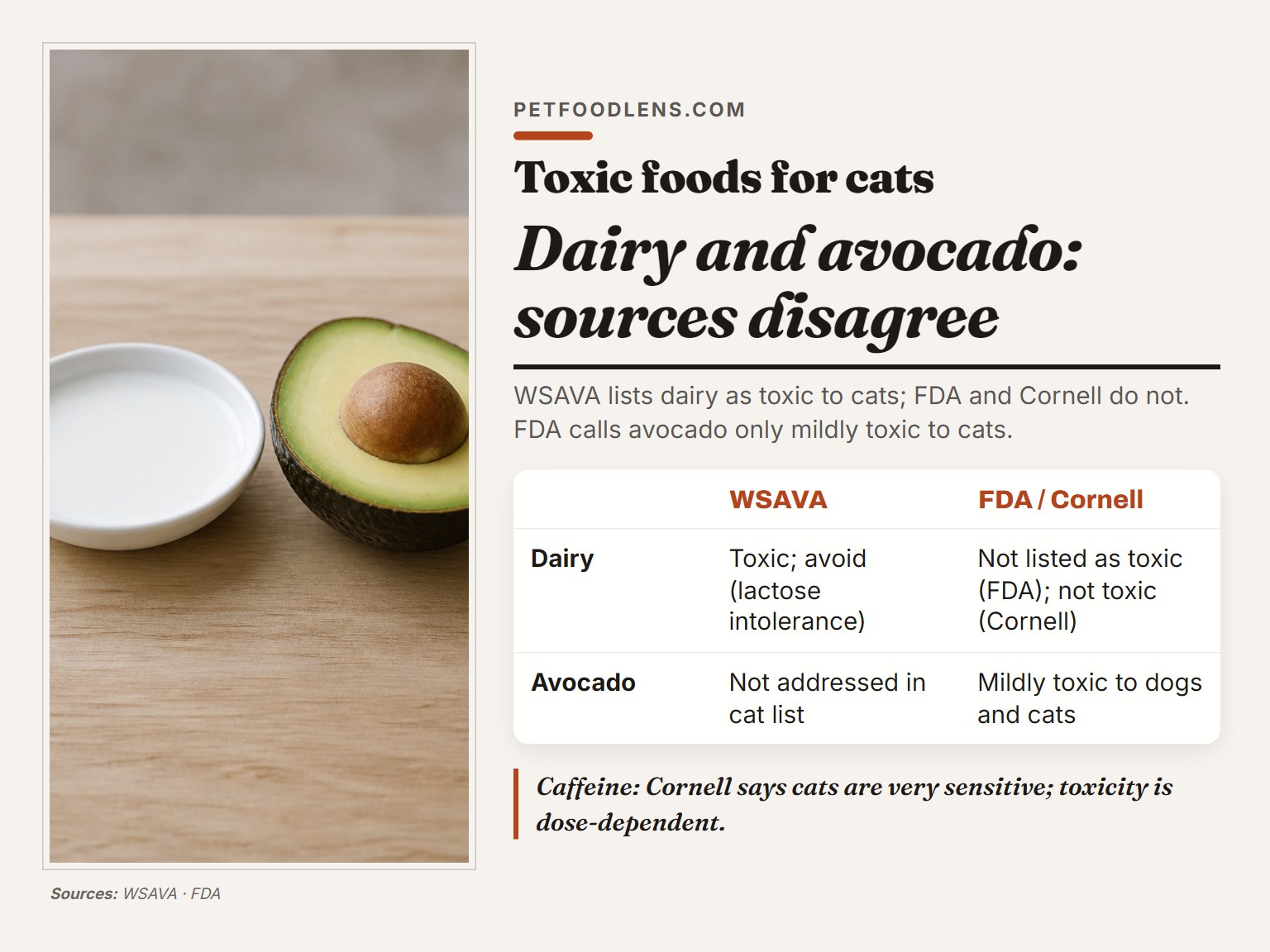
Caffeine is dose-dependent in cats, and Cornell notes that cats are very sensitive to it. WSAVA lists caffeinated drinks, including coffee, tea, and energy drinks.
Dairy is where the list splits. WSAVA lists milk and dairy products as a toxic food ingredient for cats because many cats are lactose intolerant. The FDA does not list dairy among hazardous edible items. Cornell does not classify it as toxic. The disagreement is about category. Nobody in this set publishes a dairy dose threshold.
A saucer of milk is a bad idea for a lactose-intolerant cat and a non-event for a cat that tolerates it. The WSAVA position is the cautious one. Lactose intolerance is different from an immune reaction, and the common food allergens in cats page covers that side.
Avocado is the other split. The FDA calls it only mildly toxic to dogs and cats, but severely toxic, even deadly, to birds, rabbits, horses, and ruminants. Cat-focused lists often drop the species split and treat avocado as a flat hazard. The avocado toxicity in pets page covers the full species breakdown.
WSAVA’s cat treat safety PDF is the source for the dairy listing.
A food that is mildly toxic to a cat can be lethal to a bird. Species matters more than the food.
What to Do in the First Two Hours
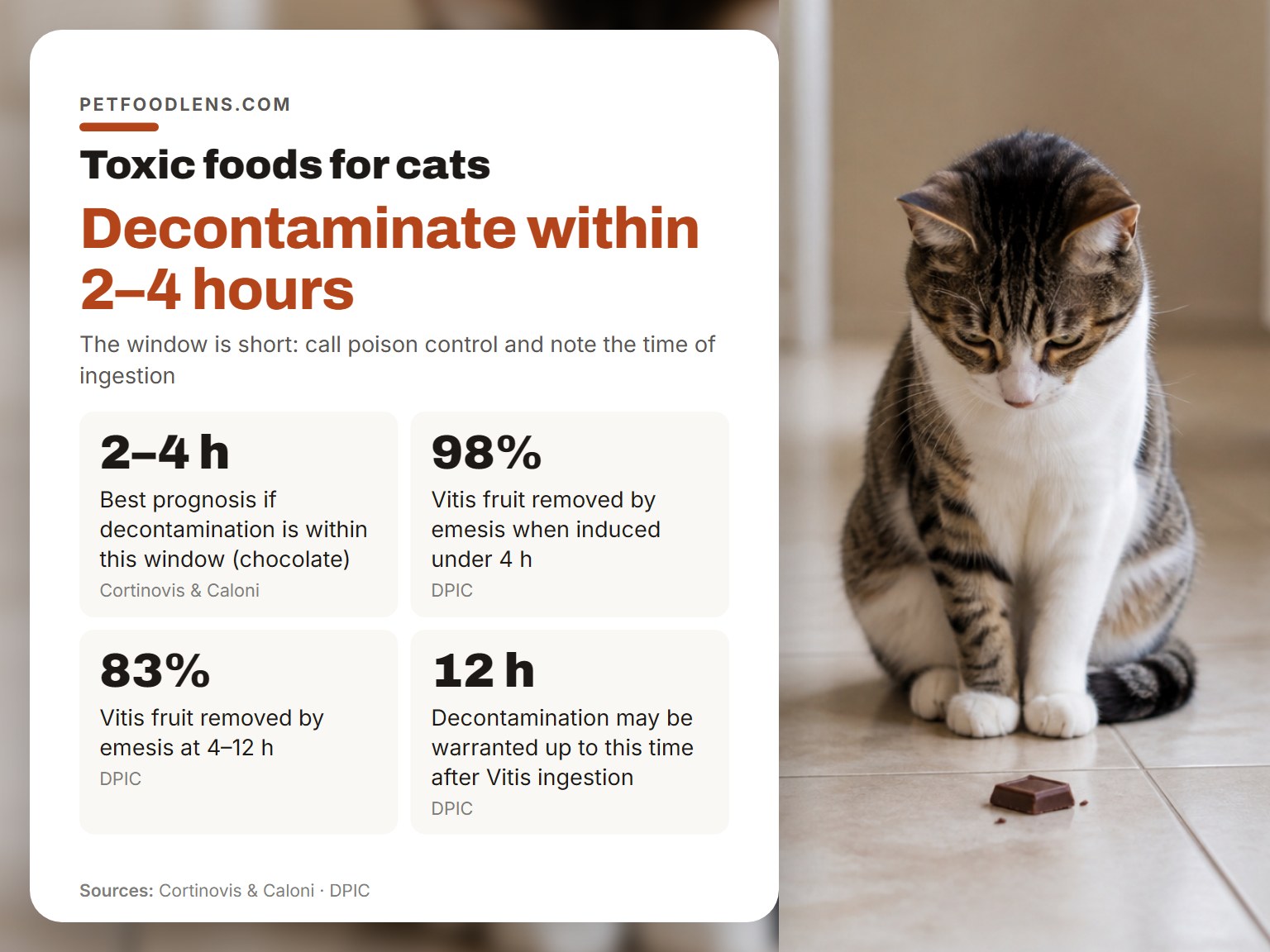
Waiting to see if symptoms appear is the wrong move. The window for decontamination is short. For chocolate and methylxanthines, the Cortinovis review puts the best prognosis at decontamination within 2 to 4 hours of ingestion. For Vitis, the Dutch cohort found emesis removed the fruit in 98% of cases when induced under 4 hours and 83% at 4 to 12 hours.
Before you start: Do not induce vomiting unless a veterinarian or poison control tells you to. Do not wait for symptoms, because the asymptomatic cat in the VPIS dataset is the reason. Keep the packaging or the vomit, since both help identify the dose.
- Call Pet Poison Helpline at 855-764-7661 or ASPCA APCC at 888-426-4435. Both are staffed around the clock, and both will ask what was eaten and how much.
- Write down the time of ingestion. The 2 to 4 hour window is measured from that time, not from when you noticed.
- Keep the packaging. Theobromine content varies by a factor of seven across chocolate types, and the label is the fastest way to estimate the dose.
- Do not feed the cat to “dilute” the food. It adds a second variable to the history the vet needs.
- Watch for vomiting, restlessness, and stumbling. Those are the signs the sources list for chocolate and methylxanthines.
Once the acute phase is over and the vet has cleared the cat, ask your veterinarian whether a probiotic is appropriate to help settle the gut after a bout of vomiting. It does not treat the toxin itself.
The FDA’s list of dangerous pet items is the source for the poison control numbers above. Once the emergency is over, the human foods safe for cats list is the one to keep on the fridge.
Frequently Asked Questions
How much onion is toxic to a cat?
5 g/kg of onion, per the Cortinovis and Caloni review. That is well below the 15 to 30 g/kg threshold in dogs. Cooking, drying, and baking do not reduce it.
Are grapes toxic to cats or only dogs?
The sources disagree. Cornell lists Vitis toxicity as toxic to dogs only. WSAVA lists grapes, raisins, currants, and sultanas as toxic to cats. A 2018 Dutch cohort of 13 cats with proven ingestion found zero acute kidney injury, though 15.4% showed clinical signs.
Does cooking remove onion toxicity for cats?
No. The Cortinovis review documents poisonings from baked garlic, onion souffle, butter-cooked onions, and Chinese steamed dumplings with chives. Heat does not eliminate the reactive compounds.
What should I do if my cat ate chocolate?
Call Pet Poison Helpline at 855-764-7661 or ASPCA APCC at 888-426-4435. Decontamination within 2 to 4 hours gives the best prognosis. Do not wait for symptoms, because theobromine peaks at about 10 hours in dogs and the feline data is thinner.
Is milk bad for cats?
WSAVA lists milk and dairy as a toxic food ingredient for cats because many cats are lactose intolerant. The FDA and Cornell do not classify dairy as toxic. The cautious position is to skip it.
Are avocados toxic to cats?
The FDA calls avocado only mildly toxic to dogs and cats, but severely toxic, even deadly, to birds, rabbits, horses, and ruminants. The species split matters more than the food.
The Bottom Line
This all assumes a cat that ate something once and is still acting normal. If your cat is already vomiting, drooling, or stumbling, skip the list and call Pet Poison Helpline at 855-764-7661 or ASPCA APCC at 888-426-4435.
The honest limit of this article is that most of the dose data comes from dogs. Cats are not small dogs, and the feline numbers are thinner than the canine ones. The 5 g/kg Allium threshold is the exception, and it is the one figure I would trust without a caveat.
So the first step this week is not a shopping change. It is a phone number in your contacts and a habit of reading the seasoning on anything that comes out of a deli case.
