
Common Food Allergens in Cats: What Studies Show
This post contains affiliate links. As an Amazon Associate, we earn from qualifying purchases.
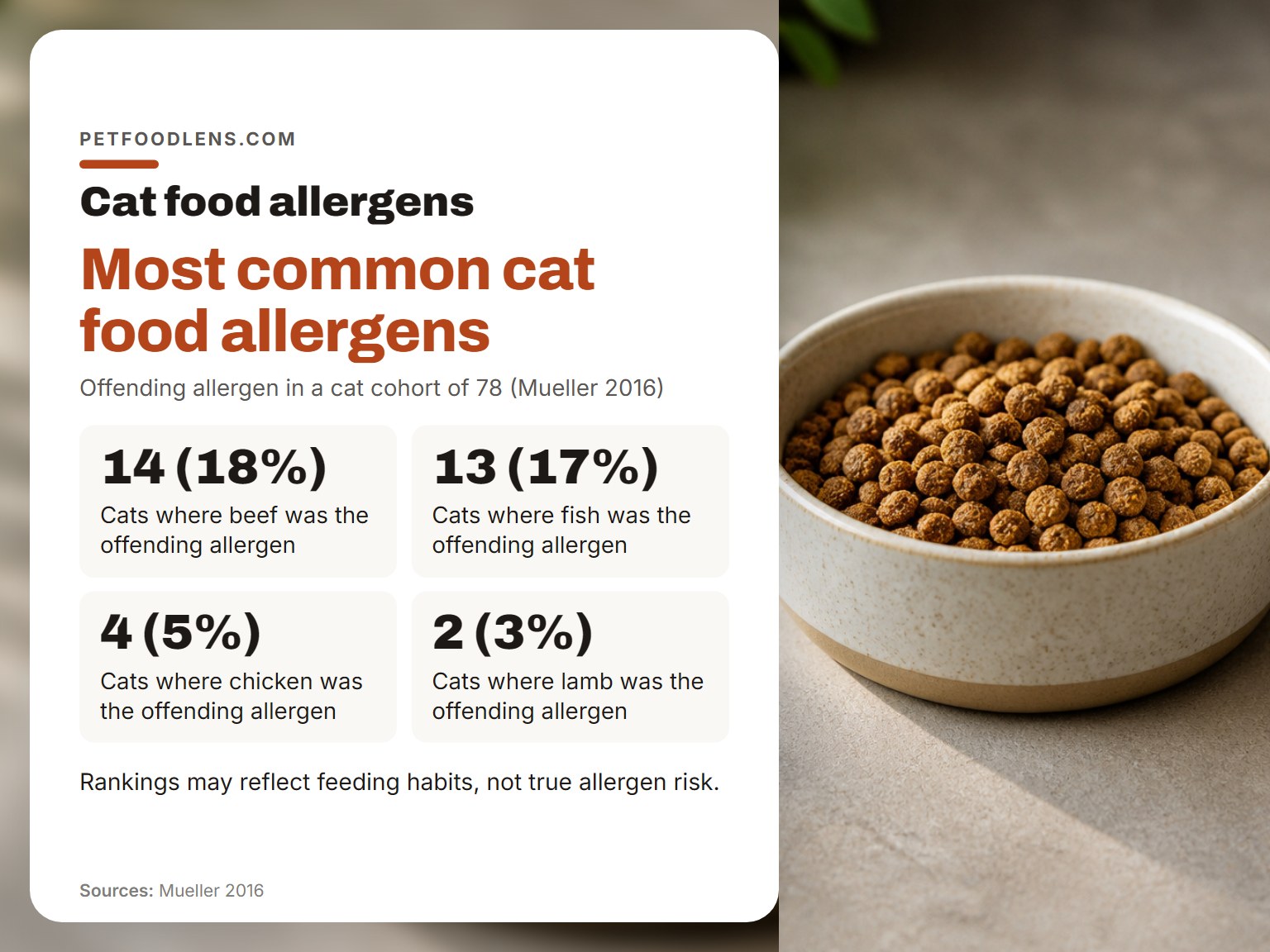
The most common food allergens in cats are beef, fish, and chicken, in that order in a 78-cat review by Mueller and colleagues, where beef accounted for 14 cases (18%) and fish 13 (17%). Chicken trailed at 4 cases (5%). Rankings shift by region and by what owners actually feed.
Size is the part that explains the pattern. A 2023 review in JAVMA puts the allergenic protein fractions at roughly 15 to 40 kDa, and notes they hold up through cooking, stomach acid, and digestive enzymes. Purina’s technical sheet gives a wider 20 to 80 kDa window, so even the basic measurement is contested.
What follows is the evidence behind that ranking, the studies that contradict it, and the trial protocol that settles the question for one cat.
Key Takeaways
- Beef, fish, and chicken lead the pooled cat data, but a New Zealand clinic cohort put lamb ahead of both chicken and fish.
- True food allergy is uncommon. Purina puts overall feline prevalence at less than 1% (0.2%), rising to 3 to 6% among cats with skin disease.
- Eight weeks is the trial length in the peer-reviewed protocols. Shorter designs exist and they miss cases.
- Hydrolysed food is not a guarantee. Nine of 17 cats that improved on a hydrolysed fish and rice diet reacted again on challenge.
- Weigh the saliva panel carefully. Carlotti’s group reports in vitro testing is unreliable for diagnosing feline AFR, while a saliva study calls the test reliable and clinically predictive; the elimination trial remains the standard confirmation.
Which Foods Are the Most Common Food Allergens in Cats?
Mueller, Olivry, and Prélaud pooled the feline literature available as of 16 January 2015 and ranked the offenders by confirmed rechallenge rather than by owner suspicion.
Beef, fish, and chicken account for the largest share of confirmed feline food reactions in the pooled literature, with beef at 18 percent and fish at 17 percent of 78 reviewed cases. Wheat, corn, and dairy each appear at 4 percent, lamb at 3 percent, and egg, barley, and rabbit in single cats.
That ranking gets repeated everywhere, and it holds up as a starting point. It also rests on decades of clinic records and owner reports, which is a thinner base than the confident tone suggests.
| Source | Cats studied | Top allergens reported |
|---|---|---|
| Mueller 2016 review | 78 cats, pooled literature | Beef 18%, fish 17%, chicken 5% |
| Vogelnest & Cheng | 128 cats, New Zealand clinic | Beef 5 cases, lamb 3, chicken 1, fish 1 |
| White & Sequoia, cited in review | United States | Fish 42%, dairy 14% |
| Saliva panel study | Commercial test | Rice highest, wheat lowest |
Read those rows in order and the disagreement is plain. Mueller’s pooled review puts fish second. The New Zealand cohort has fish at a single case. The 1989 US series has fish at 42%, which is part of why a fish allergy gets so much attention in American clinics.
Mueller names the reason in the paper itself: allergen rankings may merely reflect pet feeding habits and regional diet history. Change what people feed, and the list changes with it.
The Cornell Feline Health Center food allergies page adds a useful frame. Food allergy is the third most common feline allergy, behind flea bite and inhaled-substance allergy. It also notes that the itchy eruptions land mostly on the head and neck.
A 1994 review cited in the newer literature stretches the list further, naming fish, beef, eggs, chicken, pork, cow’s milk, rabbit, and whale meat. That’s a museum piece of a list, and it’s a reminder that “most common” has always meant “most common where someone was looking.”
Why the Rankings Shift Between Studies
In a New Zealand clinic population of 128 cats with chronic itching, vomiting, or diarrhea, 22 cats (17%) were confirmed food-sensitive by Vogelnest and Cheng.
The responsible foods in that cohort were dry food (6 cats), canned food (4), beef (5), lamb (3), chicken (1), milk (1), fish (1), viscera (2), gluten (1), and additives (1). Lamb outranked both chicken and fish. Three cats reacted to two foods, and two of the sensitivities resolved on their own over 2 to 3 months.
Compare that to Mueller’s pooled list and the beef-fish-chicken triad starts to look regional rather than universal.
Sorting cats by allergen is like sorting drivers by what car they crashed. You learn what people were exposed to, not what the road did.
The sign a cat arrives with changes the odds of finding an answer. Vogelnest and Cheng broke their confirmation rates down by presentation, and the spread is wide enough to plan around.
| Sign at presentation | Confirmed food-sensitive | What it suggests |
|---|---|---|
| Pruritus only | 10 of 61 (16%) | Itching alone is a weak pointer |
| Vomiting only | 3 of 29 (10%) | Gut signs alone are weaker still |
| Diarrhea only | 4 of 26 (15%) | Similar to vomiting |
| Pruritus plus GI signs | 5 of 12 (42%) | Skin and gut together is the strongest signal |
That 42% cell is the one worth remembering. A cat with both skin and gut signs is more likely to confirm than a cat with itching alone, and that changes how hard you push for a trial.
Sixteen more cats in that cohort improved on the canned elimination diet and then failed to relapse when the original diet came back. They were excluded from the confirmed cases. A cat can improve on a trial diet for reasons that have nothing to do with allergy, and the signs of food allergies alone won’t separate the two groups.
Only one cat study in the reviewed literature used a uniform provocation sequence. The rest list the positive rechallenges and leave the negatives out, which inflates how common each allergen looks.
The prevalence of food sensitivity in cats is the part most write-ups skip. In a clinic full of itchy cats, 17% confirmed is a high number. Purina’s sheet puts the figure at 12 to 21% in cats with pruritus and 5 to 13% in cats with allergic skin disease, against under 1% across the whole cat population.
What the Label Says vs. What the Cat Reacts To
That gap between the front panel and the ingredient list is where most home elimination trials quietly fail.
Where Chicken and Fish Hide Below the First Five Ingredients
- Chicken fat. Rendered fat carries protein residue, and it turns up in foods marketed for sensitive cats.
- Poultry digest. A flavor coating, listed near the end, and easy to miss on a fast read.
- Fish oil and fish meal. Two separate ingredients, both relevant when fish is the suspect.
- Egg product. Cornell lists eggs among the proteins used most often in cat food.
Read the list in order and count animal proteins. If the bag claims one and the list shows three, you don’t have an elimination diet.
What the Label Cannot Tell You
Nothing on the packaging says whether the plant that ran your cat’s food also ran a chicken line an hour earlier. Cross-contact controls live in the manufacturing agreement. The ingredient statement doesn’t cover them.
That’s the reason a veterinary diet beats an over-the-counter bag for a diagnostic trial, even when the two ingredient lists look similar on paper.
Where this goes sideways: Switching to a “chicken-free” food that lists chicken fat or poultry digest, then judging the result after four days. The cat keeps scratching, you conclude food wasn’t the problem, and the actual allergen never leaves the bowl.
For a real trial I want one protein and one carbohydrate, from a manufacturer that will answer a question about its plant. The limited ingredient cat food category is worth understanding precisely because the label is doing so little work for you.
How Long Does an Elimination Diet Need to Run?
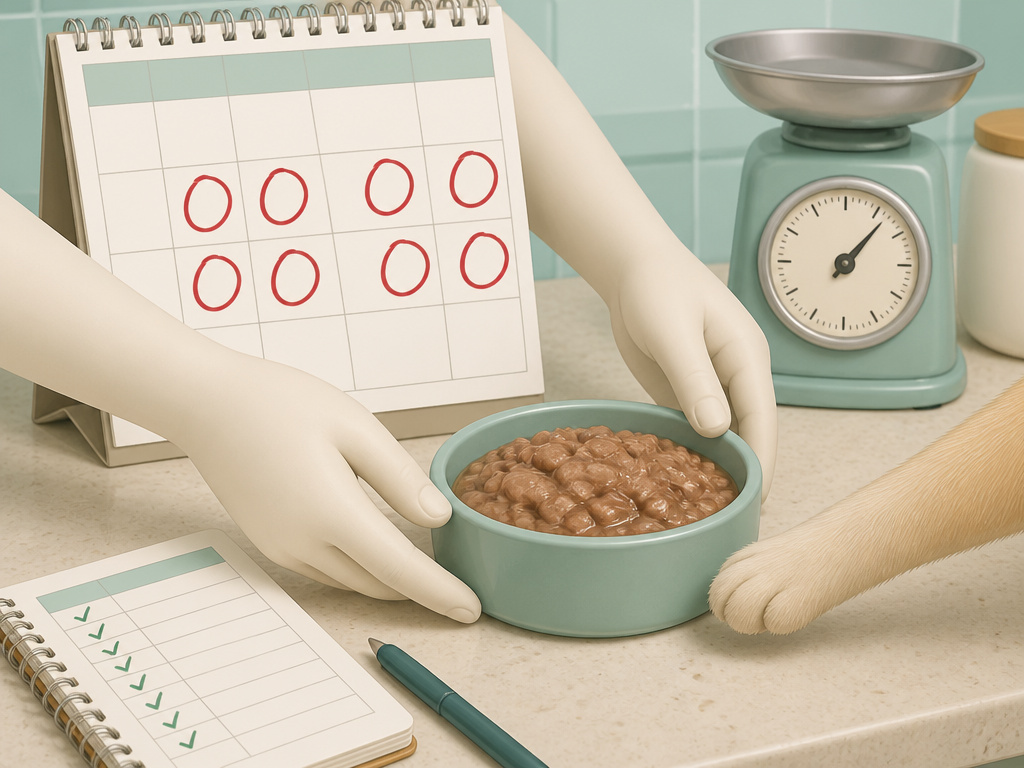
Eight weeks for a full diagnostic trial, not three.
Carlotti and colleagues describe the diagnostic standard plainly: an elimination diet for at least eight weeks, confirmed by relapse on re-challenge. The Cat Clinic of Seattle gives the same figure and adds the rule that goes with it. During the trial the cat eats only what the vet recommends, with no treats, supplements, or edible chews.
The shorter number floating around comes from a different design. In one double-blind study, each of two commercial canned test diets was fed for a maximum of three weeks. That design compares two foods over three weeks. A full diagnostic trial runs eight.
Before you start: A cat that stops eating during a diet change can get into trouble fast, and a cat already losing weight needs a vet involved before any restriction begins. Weigh the cat at the start and once a week after that.
Here’s the sequence I’d run:
- Pick one protein and one carbohydrate the cat has never eaten. Cornell suggests venison or kangaroo, with potato replacing wheat, barley, or corn. Skip this and you’re testing a food the cat already knows.
- Feed only that for eight weeks. One treat breaks the trial, and you won’t know it broke until week six.
- Log itching and litter box output daily. Memory rewrites a month of scratching. The log is what you’ll compare against later.
- Reintroduce the old diet and watch for relapse. The Cat Clinic of Seattle puts the window at one week. No relapse inside that window means food probably isn’t your answer.
- If nothing improves, change the protein and start again. A failed trial on one diet tells you almost nothing about the next one.
A trial the cat won’t eat is a trial that never started.
The Challenge Order Two Research Groups Disagree On
Once the cat is stable, someone has to decide what to reintroduce first.
Mueller’s group recommends starting food challenges with beef and dairy products, for dogs and cats alike, while Carlotti’s protocol added home-cooked rice, fish, and the prior diet individually. Their own cat table complicates that advice. Dairy sits at 4% in the feline data while fish sits at 17%.
Carlotti’s protocol went a different route. Owners added home-cooked rice, then fish (usually canned tuna or boiled cod), then the prior diet, one after another, for a maximum of 14 days each.
Both approaches confirm a reaction. They disagree on which food to try first, and the cat-specific numbers favor fish over dairy.
The elimination diet for cats is the only diagnostic tool in this field that produces a yes or no you can act on.
Hydrolysed Diets Are Not Allergen-Proof
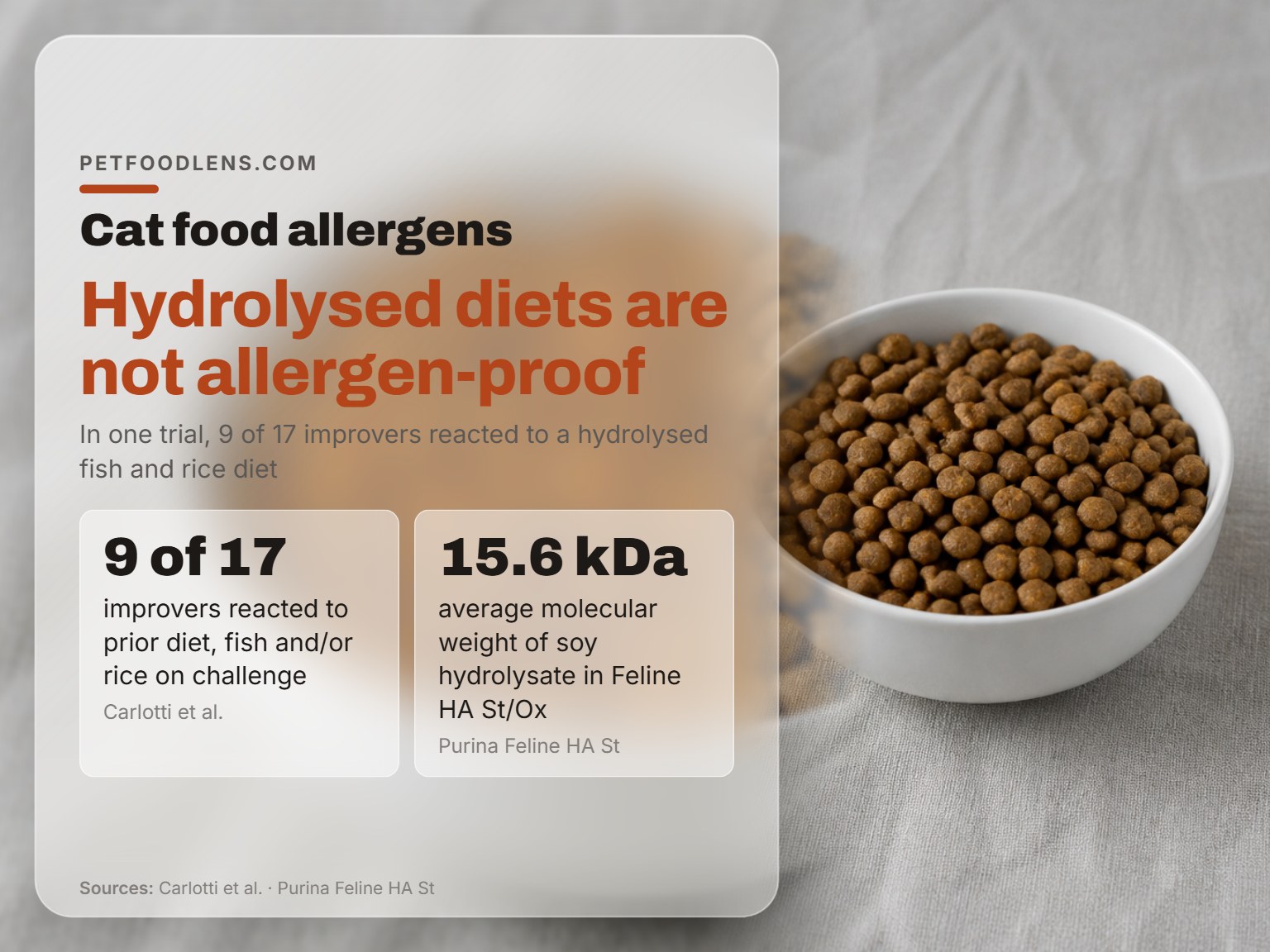
Purina’s technical sheet calls protein hydrolysis the most reliable way to produce a hypoallergenic diet, while Carlotti’s group found cats reacting within a hydrolysed fish and rice diet. Carlotti’s open clinical trial found cats reacting inside one.
The mechanism is straightforward. Most proteins that trigger a reaction sit in the 20 to 80 kDa range per Purina, or 15 to 40 kDa per the JAVMA review. Hydrolysis chops those proteins into smaller fragments, and the average molecular weight of the soy hydrolysate in Feline HA St/Ox is 15.6 kDa. Fewer intact antigenic shapes means less for the immune system to recognize.
The Carlotti numbers are the ones to hold onto. Thirty-two nonseasonal pruritic cats enrolled, 25 completed, and 17 improved by more than 50%. Of those 17, nine reacted to the prior diet, fish, or rice on challenge, confirming a food reaction. Eight did not relapse. Four cats dropped out for vomiting or diarrhea, one for palatability, and two were lost to follow-up.
Nine of 17 improvers reacting inside a hydrolysed fish and rice diet is the whole argument in one line. Hydrolysed diets lower the risk without removing it.
Easy to miss: A hydrolysed diet built on fish protein still contains fish protein fragments. If your cat’s trigger is fish, a hydrolysed fish diet can fail and look like a treatment failure when it’s actually a diet-selection failure.
For a diagnostic trial I reach for Purina Pro Plan Veterinary Diets HA Feline St/Ox Hypoallergenic, sold through veterinary channels. A hydrolysed fish and rice starch diet is the type Carlotti’s group actually evaluated, which makes it a sensible pick when fish isn’t the suspect.
Choosing hypoallergenic cat food comes down to reading which protein was hydrolysed, not whether the bag uses the word.
Do Blood and Saliva Tests Diagnose a Food Allergy?
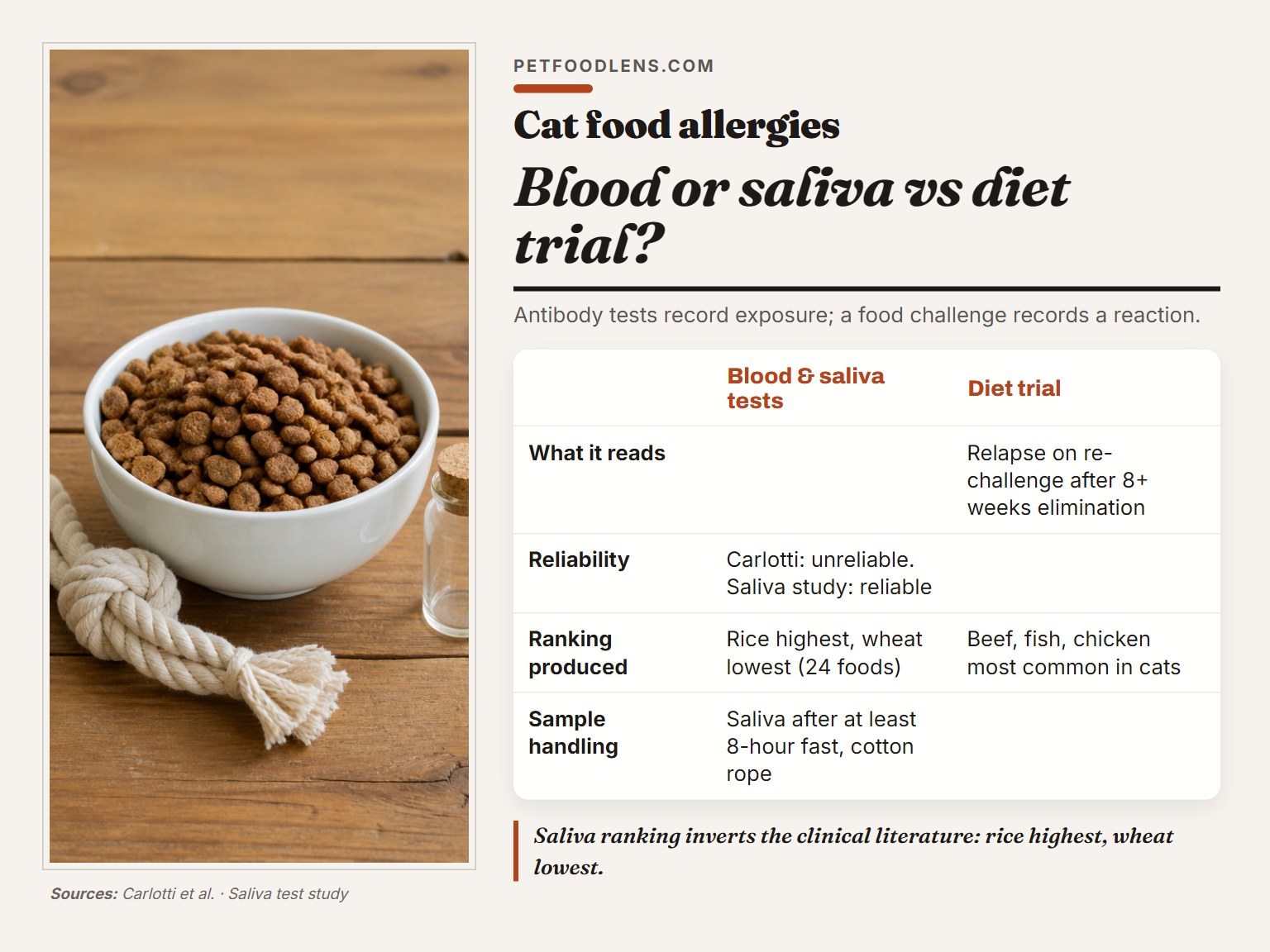
Carlotti’s group states that in vitro testing is unreliable for diagnosing feline adverse food reactions, while a separate saliva study calls the test reliable and clinically predictive. A separate saliva study reaches the opposite conclusion, calling the test reliable and clinically predictive.
Look at what each one measures. The saliva test reads anti-IgA, which reflects secretory immunity over the prior two years, and anti-IgM, which reflects the primary immune response over the prior two to six months. Samples were collected after at least an 8-hour fast using a dental cotton rope, and reactions to 24 common foods were measured.
Those antibodies record exposure. A food challenge records a reaction.
The saliva study also produced a ranking that inverts the clinical literature, with rice highest and wheat lowest. That’s hard to square with wheat and corn sitting at 4% each in Mueller’s confirmed cases, and with fish at 42% in the older US series.
If you want a test that changes what you feed, testing for food allergies means a diet trial, not a blood draw.
The Novel Protein Trap
Venison and kangaroo show up in every article on this topic, and Cornell names both as examples of a protein a cat has not previously met.
The logic holds only if the cat genuinely hasn’t eaten it. A novel protein stops being novel the moment it enters the bowl, and cross-reactivity between related proteins can undercut the whole plan.
When a Novel Protein Stops Being Novel
Ask four questions before you trust a bag:
- Has the cat eaten this protein before, in any form? Check treats and the old food’s ingredient list, not just the current bag.
- Is there one animal protein or several? “Venison” on the front and “poultry digest” on the back is a two-protein food.
- Does the manufacturer control cross-contact? A shared line with a chicken run is a real risk during a trial.
- Is the protein actually the problem? Additives caused one confirmed feline case in the Vogelnest cohort, and non-protein allergens include preservatives and colorings.
The novel protein cat food aisle looks like a solution because the packaging says so.
Cross-reactivity is the quiet failure mode here.
Frequently Asked Questions
What are the most common food allergens in cats?
Beef, fish, and chicken, in that order in Mueller’s pooled review of 78 cats. Beef accounted for 18% of confirmed cases, fish 17%, and chicken 5%. Regional feeding habits shift the order, and a New Zealand cohort put lamb ahead of both chicken and fish.
How common is a true food allergy in cats?
Purina’s technical sheet puts overall feline prevalence at less than 1% (0.2%). Among cats with skin disease the figure rises to 3 to 6%, and up to 30 to 50% of cats with chronic non-specific diarrhea may have a food allergy or sensitivity.
Can a cat suddenly react to a food it has eaten for years?
Yes. Cornell notes that a cat of any age can be affected, including one on the same diet for years, and that signs build over months rather than appearing overnight. Reported feline cases range from 3 months to 11 years, with a mean age of 4 to 5 years.
Is grain the problem?
Rarely the main one. Wheat, corn, and dairy each accounted for 3 cats (4%) in Mueller’s cat cohort, well behind beef and fish. Cornell still excludes wheat, barley, and corn from a novel diet and replaces them with something like potato, because a trial needs every variable controlled.
How long before I see improvement?
Eight weeks is the standard trial length in the peer-reviewed protocols. Some cats improve sooner, and two sensitivities in the Vogelnest cohort resolved on their own over 2 to 3 months. Judging at two weeks is too early.
Are hypoallergenic diets guaranteed to work?
No. Nine of 17 cats that improved on a hydrolysed fish and rice diet reacted again on challenge, which means the diet reduced the reaction without eliminating it. Hydrolysis lowers antigenicity. It doesn’t zero it out.
The Bottom Line
If your cat’s itching sits on the head and neck and has been building for months, that pattern is worth an eight-week trial.
One threshold decides most of these cases. The Cat Clinic of Seattle blog states that a cat that improves on a restricted diet and relapses within a week of returning to the old food is diagnosed with a food allergy. A cat that improves and then stays improved on the old diet has something else going on, and the trial just told you so.
The common food allergens in cats get the headlines, but the trial is what identifies yours.
The concession worth making: this whole approach assumes a cat stable enough to restrict. A cat with a concurrent illness, rapid weight loss, or daily medication needs a vet driving the plan, and my read on commercial formulations doesn’t extend into clinical management.
Start with the bag you already own. Count the animal proteins. If there are more than one and the front claims otherwise, you’ve found your first problem without buying anything.
