
How to Spot Food Allergies in Cats: 7 Signs to Check
This post contains affiliate links. As an Amazon Associate, we earn from qualifying purchases.
To spot food allergies in cats, look for year-round itching on the face, ears, belly, groin, armpits, legs, and paws, plus repeat ear infections or loose stools, then confirm it with an elimination diet trial of at least eight weeks. Blood and saliva tests cannot do this job.
The eight-week figure is where most home diagnoses fall apart. A cat can improve for reasons that have nothing to do with the food, and itching naturally waxes and wanes over weeks. A very short experiment tells you almost nothing. Knowing how to spot food allergies in cats matters because an elimination diet trial takes at least eight weeks.
What follows: seven signs worth writing down, the tests that keep getting sold to owners, and the cross-contact traps that quietly wreck a trial.
Key Takeaways
- Year-round itching is the flag. Itch that arrives in spring and fades in fall points away from food and toward something in the environment.
- At least eight weeks. About 80% of cats improve by week six, and over 90% by week eight.
- Blood and saliva panels can’t diagnose this. In cats, the accuracy of testing for food-specific IgE was low.
- Hydrolyzed diets often come first. VCA Animal Hospitals lists hydrolyzed protein diets and novel protein diets as alternative trial options without ordering them, while the JAVMA review notes that hydrolyzed diets are used precisely because novel protein sourcing is unreliable.
- One treat resets the clock. Some cats react to trace amounts, so a single flavored pill pocket can undo weeks of work.
What a Food Allergy Actually Looks Like on a Cat
The cat is bald on its belly and the insides of its back legs. The skin there feels thick and slightly greasy under your hand, and the owner has already tried three brands.
That picture is common enough to be worth learning how to spot food allergies in cats. Food allergies in cats produce chronic, year-round itching, and the distribution is fairly consistent from cat to cat.
Feline food allergy produces chronic, year-round pruritus concentrated on the face, ears, belly, groin, armpits, legs, and paws. Recurrent skin and ear infections can be the only visible sign. Diagnosis rests on an elimination diet trial of at least eight weeks, because no commercially available blood or saliva test reliably predicts clinical food allergy.
Cats with this problem itch hard enough to damage themselves. They over-groom to the point of open wounds and hair loss, and the damage is often worse than the owner realizes because cats groom in private.
The list of culprits is short and unglamorous. The common food allergens in cats come down to beef, fish, chicken, wheat, corn, dairy, and lamb. Beef, fish, and chicken top the list.
Flip the bag over on whatever you’re feeding now. If chicken or fish sits in the first three ingredients, you’ve found your first suspect.
The 7 Signs Worth Writing Down
- Year-round scratching on the face, ears, belly, groin, armpits, legs, or paws
- Bald patches and broken skin from over-grooming
- Repeat ear infections, which in some cats are the only sign at all
- Skin infections that clear up on antibiotics and come straight back
- Vomiting or diarrhea running alongside the skin trouble
- Scooting across the floor from itchy skin around the rectum
- Frequent bowel movements or straining to pass stool
Two things on that list surprise owners. The gut signs get filed as a separate problem, and the scooting gets blamed on worms.
When an Ear Infection Is the Only Sign
Some cats never develop the bald belly. They get one ear infection after another, and the skin trouble stays hidden in the canal.
There’s a smell to it. A cat with a long-standing ear problem carries a faintly yeasty, sour odor around the head, and owners stop noticing it after a few weeks because it fades in gradually.
If your cat has repeat ear infections and the cytology keeps coming back mixed, food belongs on the differential list.
Why “Year-Round” Is the Word That Matters Most
Seasonal itching is a different animal.
A cat that scratches from April to October and settles in winter is showing you an environmental pattern. A cat that scratches in February with snow on the ground is showing you something else.
Food allergy itching doesn’t take a season off. Neither does atopy, mind you, which is the catch. Many cats react to both food and environmental allergens at once, and the two look identical on the surface.
That overlap is exactly why the elimination trial exists. You can’t sort them by eye.
Your own notes beat your memory here when you compare a how to spot food allergies in cats. Log the itch level once a week, and note whether the ears or the gut are involved. A few weeks of that log is worth more to your vet than any description you can give from memory.
How Do You Tell a Food Allergy From an Intolerance?
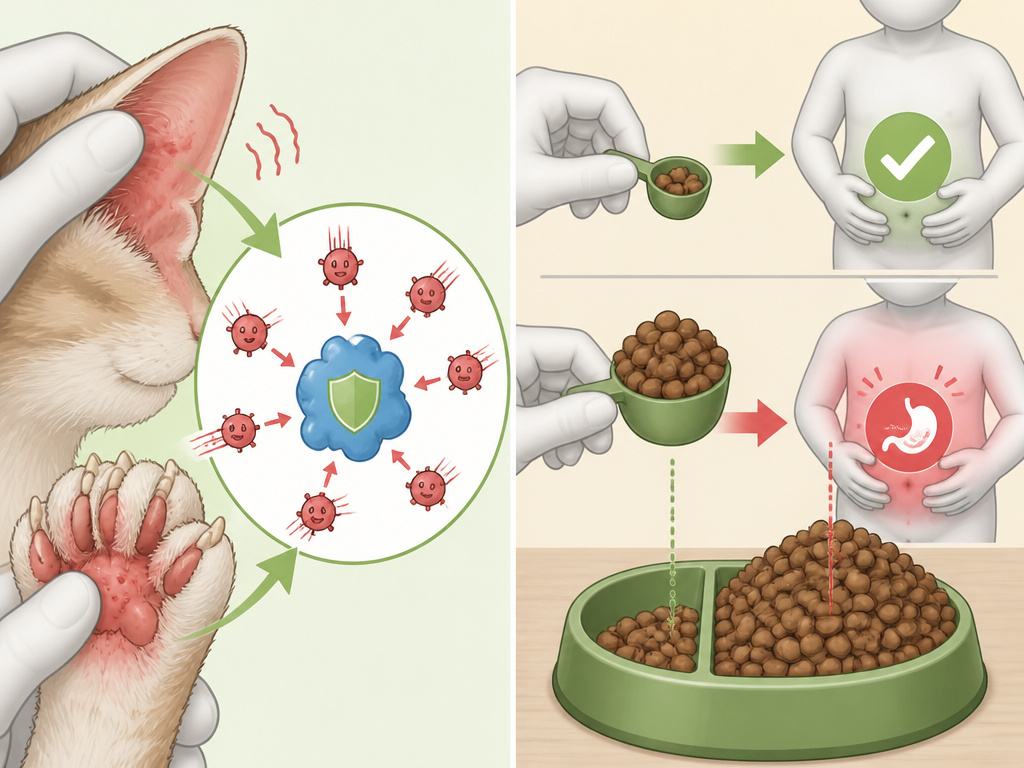
The immune system is the dividing line. A true food allergy involves an immune reaction to a protein, while an intolerance is mostly a digestive problem that scales with how much was eaten.
Owners use the two terms interchangeably. The cat doesn’t care either way, but the diagnostic path is completely different.
| Feature | Food allergy | Food intolerance | Environmental allergy |
|---|---|---|---|
| Immune system involved | Yes | No | Yes |
| Typical signs | Itchy skin, ears, sometimes gut | Vomiting, diarrhea, gas | Itchy face, paws, chin |
| Timing | Year-round | Within hours of eating | Seasonal or indoor-linked |
| Confirmed by | Elimination diet trial | Removing the trigger | Allergy workup |
An intolerance usually shows a dose response. A small amount of the offending food gets tolerated, and a large amount doesn’t.
A true allergy doesn’t bargain like that. Some cats react to trace levels of the offending protein and need tightly controlled diets for life.
The Blood and Saliva Tests That Keep Getting Sold
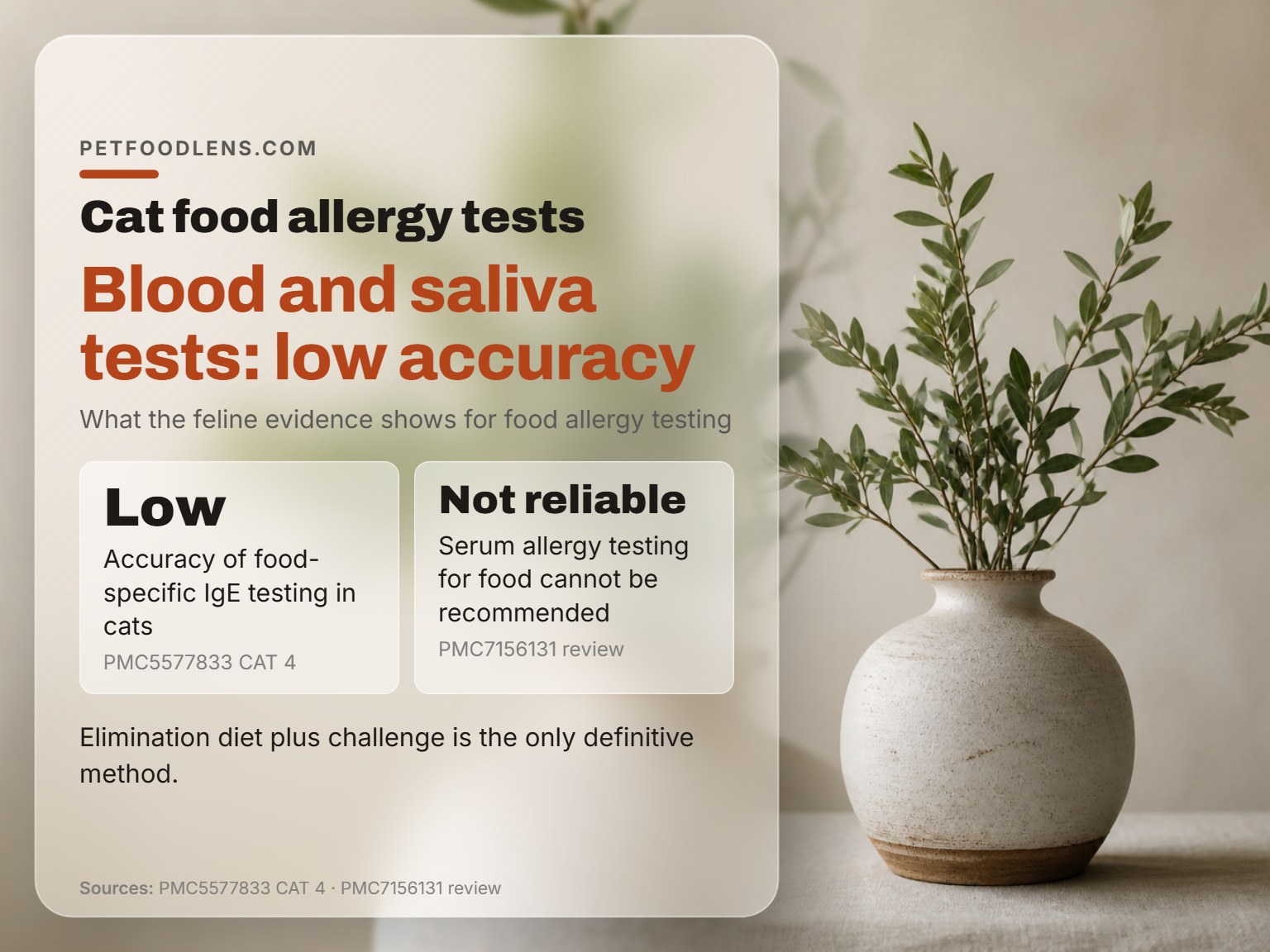
In cats, the accuracy of testing for food-specific IgE was low.
Read that positive predictability number again. Zero.
Here is what the numbers actually say. A test that never produces a true positive on a confirmed allergic cat is not a screening tool. It’s a bill.
I’ve watched owners spend money on saliva or blood panels that flagged many “reactive” foods, including several the cat had never eaten in its life. Ask which of those flagged ingredients your cat has actually consumed and the conversation gets quiet fast.
The veterinary literature isn’t unanimous, and it’s worth saying so plainly. One trade publication’s continuing-education material notes that serum IgE results for food antigens can come out similar to a diet challenge using the same protein. The JAVMA food allergy review calls commercially available serum allergy tests an unreliable predictor of clinical allergy. A systematic review of food allergy diagnosis states serum allergy testing for food is widely available but not reliable and cannot be recommended.
Where the sources split, weigh the study design. The reviews that compared test results against a positive food challenge are the ones that matter, and those are the ones reporting the low numbers.
| Test | What it claims to do | What the feline evidence shows |
|---|---|---|
| Serum food-specific IgE | Screen for reactive foods | Low accuracy in cats |
| Intradermal skin testing | Inject allergens under the skin | Not recommended for diagnosis |
| Lymphocyte proliferation | Measure cell response to food | 80% accuracy, research tool only |
| Patch testing | Skin patch reaction to food | Dogs only; guides diet choice, not diagnosis |
| Elimination diet plus challenge | Control the diet, then re-challenge | The only definitive method |
That 80% figure for lymphocyte proliferation is a trap. The same in vivo and in vitro allergy testing review that reports it also concludes the test remains a research tool, limited by sample volatility and offered only in research facilities. Don’t chase it.
Patch testing deserves the same caution. The high negative predictability was demonstrated in dogs. Nobody has made the equivalent feline claim.
If you want the full breakdown of what food allergy testing actually involves in a clinical setting, that’s a separate conversation from the marketing on the test kit.
How Long Does an Elimination Diet Trial Take?
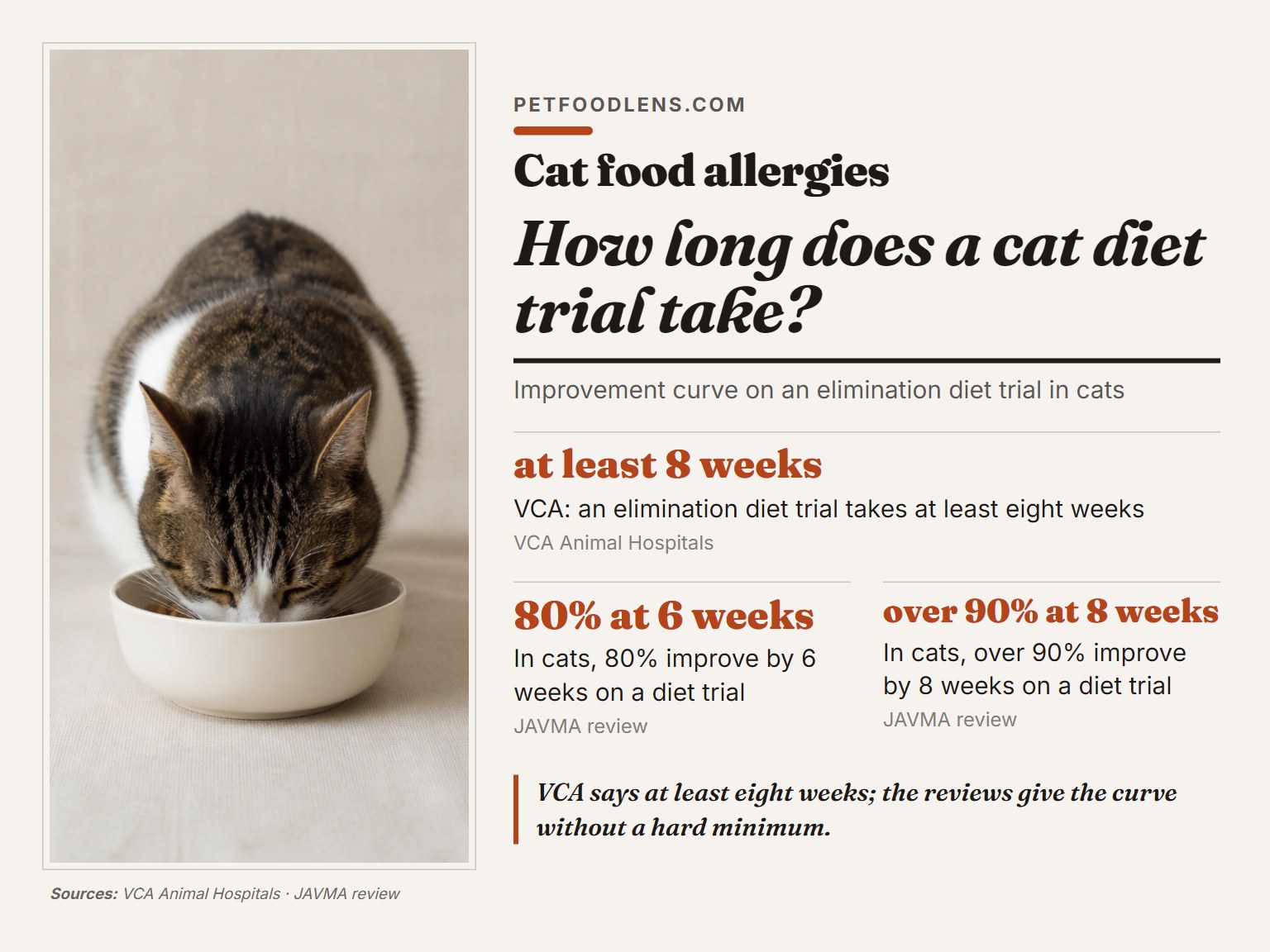
At least eight weeks, per VCA Animal Hospitals, and that’s the shortest figure any clinical source here endorses.
The improvement curve explains why. In cats, roughly 80% improve by six weeks and over 90% by eight. The successful diet trial protocol published in Veterinary Dermatology describes the diet-and-challenge sequence without fixing a hard minimum, and the JAVMA review reports the same 80% and 90% figures without declaring eight weeks mandatory.
So there’s a real gap in the literature. VCA says at least eight weeks. The reviews give you the curve and let you draw the line.
I plan for at least eight weeks, and cats that improve slowly need the extra room.
Before you start: A trial only works if the cat eats nothing else. One flavored pill pocket, one lick of gravy from another cat’s bowl, or a bite of rotisserie chicken skin carries enough protein to trigger a flare within days. Clear the house before day one, not on day ten.
Here’s the sequence that actually works.
- Pick the diet with your vet before you shop. Skip this and you end up with a “limited ingredient” bag that shares a production line with chicken.
- Clear every other food, treat, and flavored medication out of the house. A single lapse sends you back to day one, and you won’t know it happened.
- Feed only the trial diet and water for at least eight weeks. Mixing in anything else invalidates the whole result.
- Score the itch weekly and photograph the bald patches. Memory is unreliable over two months, and photos settle arguments.
- Plan the challenge before you start, not after. A trial with no re-challenge proves nothing except that the cat ate something different.
If you want the step-by-step version, the full walkthrough on how to run an elimination diet trial covers the logistics in more detail.
Common mistake: Switching to a “chicken-free” kibble that lists chicken fat or poultry digest four ingredients down. Those fractions can carry enough protein to keep the reaction going, and you’ll conclude the diet failed when it never really started.
Hydrolyzed Protein vs Novel Protein: Which Comes First?
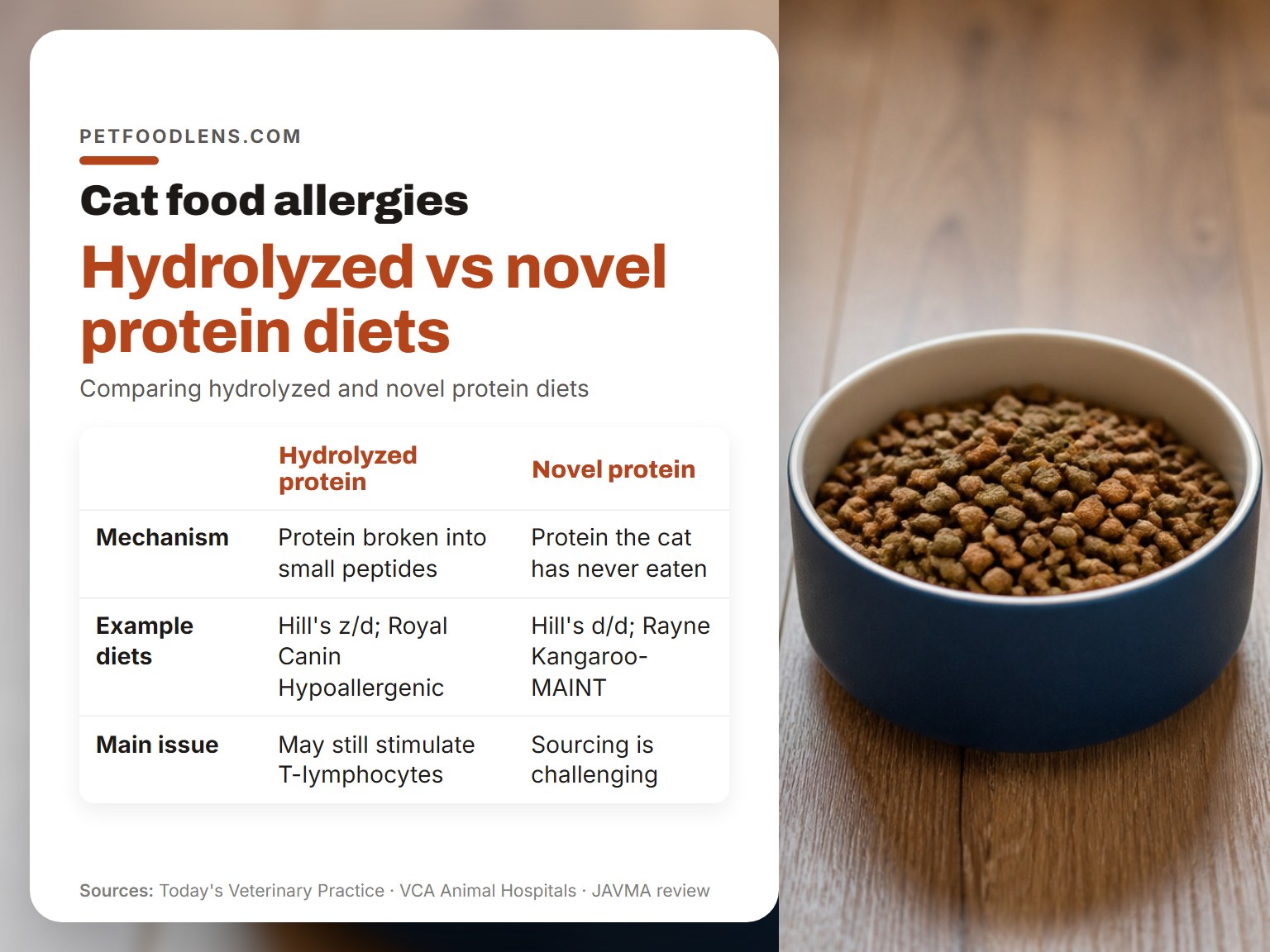
Hill’s Prescription Diet z/d and Royal Canin Hypoallergenic Hydrolyzed Protein both work on the same principle. The protein is broken into fragments small enough that the immune system doesn’t recognize them.
That’s the mechanism, and it’s why the JAVMA review notes hydrolyzed diets are used precisely because novel protein sourcing is unreliable, while VCA Animal Hospitals lists hydrolyzed and novel protein diets as alternative trial options without ordering them. Not because they’re better food. Because the alternative is harder to guarantee.
Hydrolyzed Protein Diets
The protein molecules are chopped into small peptides, small enough to slip past immune surveillance. Named options include Hill’s Prescription Diet z/d, Royal Canin Hypoallergenic Hydrolyzed Protein, and Purina Pro Plan Veterinary Diets HA Hydrolyzed.
There’s a wrinkle worth knowing. The JAVMA review notes that hydrolyzed proteins can still stimulate T-lymphocytes in dogs with suspected food allergy, which suggests these diets aren’t uniformly reliable. That’s a cell-mediated pathway, and it means a hydrolyzed diet can fail for reasons that have nothing to do with the cat sneaking food.
Novel Protein Diets
A novel protein is one the cat has never eaten. Hill’s Prescription Diet d/d, Royal Canin Selected Protein PD or VR, and Rayne Nutrition Kangaroo-MAINT or Rabbit-MAINT all fit this category.
The problem is sourcing. The JAVMA review describes genuinely novel protein sourcing as challenging and complicated by cross-reactivity with apparently unrelated foods. That’s the reason the JAVMA review gives for using hydrolyzed diets, and it runs opposite to the intuition that a “new” protein is the safer bet, while VCA Animal Hospitals lists hydrolyzed and novel protein diets as alternative trial options without ordering them.
This is also where the boutique exotic-protein market earns its skepticism. A kangaroo or venison formula is only useful if the manufacturing chain actually keeps it clean. Most don’t publish enough to prove it.
If you’re weighing the two paths, the guide to hypoallergenic cat food covers what to look for on the label, and the novel protein guide goes deeper on sourcing questions worth asking a manufacturer.
Home-Prepared Diets
A home-cooked novel protein diet has to be formulated by a veterinary nutritionist. It typically needs a balancing supplement such as Hilary’s Blend for Cats or Balance IT.
These are work-intensive and time-consuming, and owner compliance is variable. That’s the honest trade-off. You get full control over the ingredients and you take on the recipe risk yourself.
The Cross-Contact Traps That Wreck a Trial
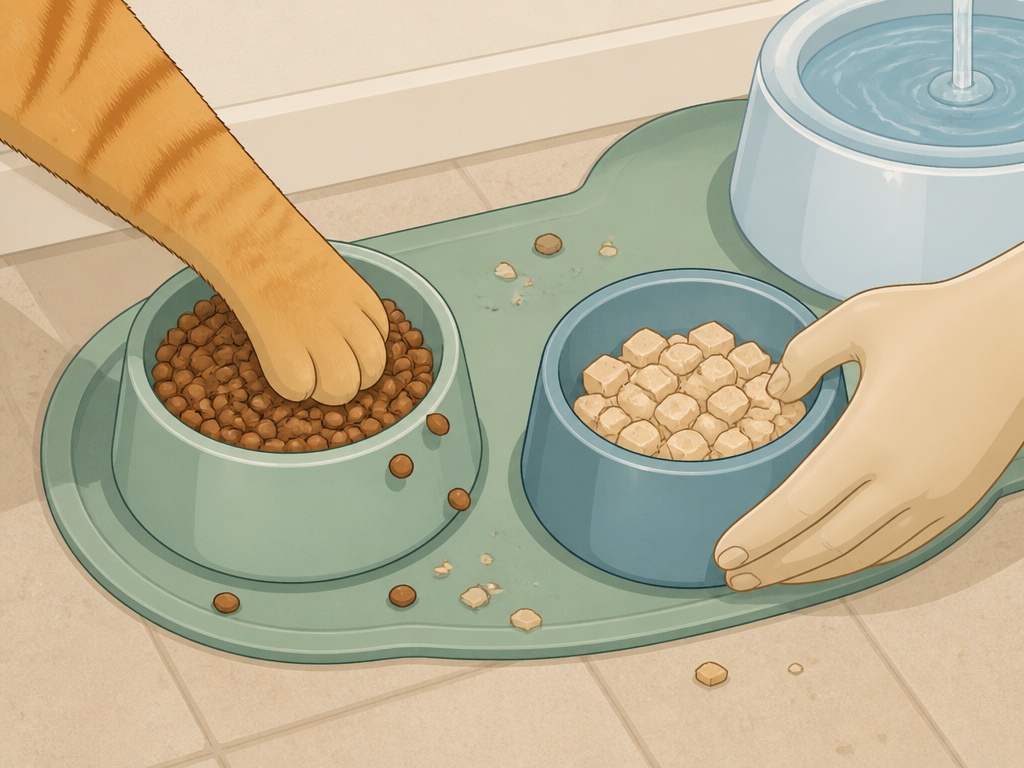
The most common reason a diet trial fails has nothing to do with the food.
In multi-cat households I keep running into the same thing. One cat eats the other cat’s food, or the bowls get swapped, or a well-meaning family member puts down a shared plate. The diets get muddled and nobody notices for a week.
Separate feeding spots and separate times fixes most of it. It also taught me to ask about the household before I ask about the label.
Where this goes sideways: Feeding the trial diet while another cat free-feeds a chicken-based kibble in the same room. Shared bowls, shared water fountains, and dropped crumbs all count as exposure, and the trial quietly fails at week five with no obvious culprit.
Read the ingredient panel for these, in order, every single time:
- Chicken fat, poultry fat, and poultry digest on a “chicken-free” formula
- Flavored medications, including chewable preventatives and pill pockets
- Fish oil and egg in a diet built around a novel protein
- Treats from the training pouch, which are the single most common lapse
- Dental chews and toothpastes, which almost never get checked
Over-the-counter diets are not encouraged during a trial because of potential contamination with undeclared allergens. That’s the reason a veterinary diet matters here. Not prestige. Documentation.
What to Do When the Trial Ends
A diagnosis is confirmed by a specific three-part sequence. The signs resolve on the elimination diet, relapse when the offending diet is fed, and resolve again when the elimination diet is reintroduced.
Miss the middle step and you don’t have a diagnosis. You have a suspicion.
The challenge is where the timeline surprises people. In a retrospective review of published cases from 1990 to 2019, only 27% of cats flared within 24 hours of a challenge. Half flared by day four, and 90% by day seven.
| Measure | Cats | Dogs |
|---|---|---|
| Flare within 24 hours | 27% | Not stated |
| Time to flare, 50% of cases | 4 days | 5 days |
| Time to flare, 90% of cases | 7 days | 14 days |
| Expected for IgE-mediated reaction | Hours | Hours |
The variation across studies comes down to owner observation, the specific protein, how much was fed, individual variability, and the type of immune reaction involved. An IgE-mediated reaction shows up within hours. A mixed or cell-mediated reaction can take considerably longer.
So when you reintroduce foods, give it time before you call it clear.
Once you have your answer, the diet continues long term. Food allergies can’t be cured, only managed by avoiding the trigger. Some cats tolerate the offending food later in life, but that’s a clinical observation without good long-term studies behind it. Don’t plan around it.
If the trial worked and you need to find something the cat can stay on, the rundown on the best cat food for cats with allergies covers what holds up after diagnosis.
Dietary slips after diagnosis get handled with short-term antipruritic and anti-inflammatory therapy. That’s a bridge, not a solution.
Frequently Asked Questions
How long does it take to see results from a cat food trial?
About 80% of cats improve by six weeks and over 90% by eight weeks. VCA Animal Hospitals puts the minimum trial at eight weeks. Cats that improve slowly need the full window of at least eight weeks.
Can my vet just run a blood test instead?
Not for food allergy. In cats, the accuracy of testing for food-specific IgE was low. The JAVMA review and both systematic reviews conclude commercially available serum tests can’t be recommended for diagnosis, while Today’s Veterinary Practice notes that serum IgE results for food antigens can come out similar to a diet challenge using the same protein. Patch testing has a narrow role in dogs for choosing diet ingredients, not for confirming allergy.
What are the most common food allergens in cats?
Beef, fish, chicken, wheat, corn, dairy, and lamb, in roughly that order of frequency. Beef, fish, and chicken are the most likely triggers. A cat has to have eaten an ingredient before it can become allergic to it, which is why the usual suspects are the usual suspects.
Can a cat suddenly become allergic to food it has eaten for years?
Yes. A long-fed ingredient can trigger an allergy at some point in the cat’s life. Allergies can develop any time after three months of age, and male and female cats are equally likely to develop them.
Is grain-free food safe for a cat with allergies?
Grain-free is a marketing category, and it swaps one carbohydrate source for another. It doesn’t address a protein allergy, which is what most feline food allergies are. If your cat reacts to chicken, a grain-free chicken formula changes nothing.
The Bottom Line
One rule decides whether this whole exercise works: if the itch doesn’t budge after at least eight weeks of a strict trial, stop and check your compliance before you change the diet. Often the cat got into something, and the food was fine.
Your first step this week is boring. Write down every single thing that goes into your cat’s mouth for a week, including treats, chews, and anything the kids hand over. You’ll usually find the answer within the first few days.
One concession, though. If your cat has other medical conditions in play, kidney disease or diabetes, the diet math gets complicated fast and my label-reading approach only takes you so far. That’s a conversation for your vet, not a blog post.
The good news is that with careful dietary control, the prognosis for a cat with a food allergy is generally good.
