
Onion and Garlic Toxicity in Pets: Signs and Timelines
This post contains affiliate links. As an Amazon Associate, we earn from qualifying purchases.
Onion and garlic toxicity in pets works through the red blood cells: sulfur compounds in alliums cause oxidative damage that destroys them, and garlic is 3 to 5 times more toxic than onion. Cats are the most susceptible species, followed by dogs, and signs usually appear a few days later.
The damage starts inside the first 24 hours, while the animal still looks completely normal. Heinz bodies form, methemoglobin builds, and the red cells that carry oxygen start coming apart 3 to 5 days after the meal. That lag is what catches owners out.
What follows covers the dose numbers for cats and dogs, why the form of the allium changes the risk, which breeds get hit harder, and what to do in the first hour versus the third day.
Key Takeaways
- Garlic is 3 to 5 times more toxic than onion, per the Merck Veterinary Manual, so a small amount of garlic powder is not a small exposure.
- Cats go down on less than a teaspoon of cooked onion. Dogs need roughly 15 to 30 g/kg of raw onion before clinical signs show.
- Blood changes begin within 24 hours and peak near 72, but the anemia that actually makes a pet sick shows up 3 to 5 days out.
- Cooking and drying do not neutralize alliums. Dehydrated flakes, powders, and dry soup mixes are the concentrated forms vets see most.
- Call a vet or poison service the same hour. Do not wait for symptoms, and do not induce vomiting at home.
How Much Onion or Garlic Does It Take?
Two numbers do most of the work here, and they sit far apart.
Allium sulfur compounds are released when plant cells are crushed by chopping, chewing, or cooking. Absorption follows, and the resulting oxidative attack on red blood cells produces Heinz bodies and methemoglobinemia within 24 hours, peaking near 72 hours. Hemolysis trails behind that peak, typically 3 to 5 days after the exposure. Hemoglobinuria may then cause secondary kidney damage.
Cats are the most susceptible species, and Merck puts the threshold shockingly low. Toxicosis has been reported after less than a teaspoon of cooked onions. The same reference lists 5 g/kg of raw onion as a dose that causes trouble in cats, and a peer-reviewed review indexed in PMC cites that same 5 g/kg figure for clinically important blood changes.
Dogs need more. Ingestion of 15 to 30 g/kg of raw onion has produced clinical signs in dogs, and the PMC review uses the same range.
The Cat Threshold Is Startlingly Small
Nobody measures a teaspoon of stew. A cat that licks out the takeaway container has already crossed the line.
That’s the practical problem with cat dosing. The margin is thin enough that a shared forkful of onion-heavy leftovers lands inside the range Merck describes, and cats sit at the top of the susceptibility ranking for a reason.
The Dog Threshold Is Bigger Than You Think
Fifteen grams per kilogram is a real quantity of onion. A 20 kg dog would need about 300 g of raw onion, roughly a large onion, to reach the bottom of that range.
So a single slice of onion in a bowl of rice is a different event from a bowl of French onion soup. Dose separates them. Concentrated forms shift the math again, which is where most kitchen accidents actually happen.
| Species | Dose linked to harm | What the source reports |
|---|---|---|
| Cat | Under 1 tsp cooked onion | Toxicosis reported at this level |
| Cat | 5 g/kg raw onion | Clinically important blood changes |
| Dog | 15-30 g/kg raw onion | Clinical signs reported |
Why Onion and Garlic Toxicity in Pets Shows Up Late
Day one, the dog eats dinner, drinks, and begs for more.
That’s the part that makes this hard. Heinz body formation (clumps of damaged hemoglobin inside the red cell) and methemoglobinemia (a form of hemoglobin that can’t carry oxygen) begin within 24 hours of ingestion and peak at roughly 72 hours. Hemolysis, the actual rupturing of red cells, follows 3 to 5 days after exposure.
Merck is blunt about the clinical picture: signs generally aren’t noted until substantial hemolysis has occurred, usually a few days after exposure. PDSA gives a slightly wider window, saying symptoms can start within 24 hours but more commonly take a few days, with anemia signs at 1 to 5 days.
Both are describing the same curve from different angles. Early pet food poisoning symptoms like vomiting and a dropped appetite can show up first. The ones that matter, pale gums and collapse, come later.
| Stage | Timing | What’s happening |
|---|---|---|
| Oxidative damage begins | Within 24 hours | Heinz bodies and methemoglobin form |
| Peak | Around 72 hours | Heinz body levels at their highest |
| Hemolysis | 3 to 5 days | Red cells rupture, anemia develops |
| Signs appear | A few days out | Pallor, weakness, collapse |
I’ve stopped telling owners to “watch and see.” The watching is the problem. By the time a dog looks pale or tired, the exposure is three days old and the decontamination window closed on day one.
Hemoglobinuria may cause secondary nephrosis after hemolysis, which is why IV fluid therapy gets pushed hard in a hospital. Merck recommends it specifically to protect the kidneys against that filtered-hemoglobin damage.
Does Cooking or Drying Make Alliums Safe?
No. The onion and garlic pet toxicity review states plainly that cooking, drying, and processing do not eliminate the toxic effect of Allium species.
Then the nuance gets interesting. A 2025 in vitro study in the journal Animals tested garlic forms against canine red cells and found a different order: granulated garlic produced 15.0 +/- 2.5% Heinz bodies at 0.2 g/mL, fresh garlic produced 5.0 +/- 1.7%, and dried garlic came in near control levels.
| Garlic form | Heinz bodies in vitro | Practical read |
|---|---|---|
| Granulated, 0.2 g/mL | 15.0 +/- 2.5% | Highest of the three tested |
| Fresh, 0.2 g/mL | 5.0 +/- 1.7% | About a third of granulated |
| Dried | Near control | Lowest in this lab setup |
That conflicts with the standard line, and the authors flag the limits themselves. The study used blood from 5 donor dogs and ran in a lab dish, not in a living animal.
Merck takes the other side on practical risk, naming dehydrated flakes, powders, and dry onion soup mixes as the concentrated forms most commonly tied to toxicosis in cats and dogs. VCA Animal Hospitals explains why: dried and powdered forms carry a higher concentration of the active substance because the water has been removed.
The two findings measure different things. One counts Heinz bodies in a dish. The other counts poisonings in clinics.
One teaspoon of garlic powder carries the equivalent of eight cloves of fresh garlic, according to VCA Animal Hospitals. Treat the powder as the concentrated form it is.
The anemia question is messier still. The AVMA garlic extract dog study gave dogs 1.25 mL of garlic extract per kilogram, equal to 5 g of whole garlic per kilogram, daily for seven days. Red cell counts, hematocrit, and hemoglobin bottomed out on days 9 to 11, and Heinz bodies and eccentrocytes (red cells with hemoglobin pushed to one side) both appeared. No dog developed hemolytic anemia at that dose.
Merck describes garlic toxicosis as producing acute hemolytic anemia. One reading is that the experimental dose was high enough to oxidize red cells without being high enough to destroy them. The study’s own conclusion was flat regardless: foods containing garlic should not be fed to dogs.
Which Pets Get Hit Hardest?
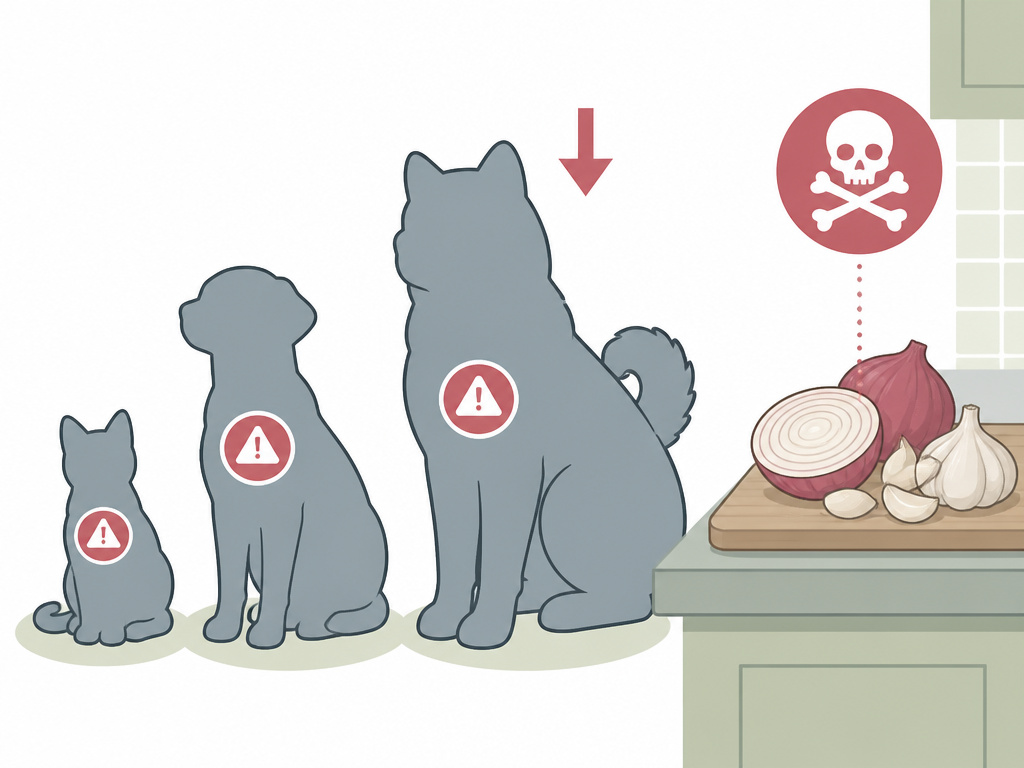
Akita, Shiba, and Jindo blood carries a quirk that makes oxidative damage worse.
The PMC review notes these breeds have hereditary high erythrocyte-reduced glutathione and potassium, which confers greater susceptibility to onion-induced oxidative damage. That’s a breed-level exception to weight-based dosing, and it means the dog-dose math above runs optimistic for those three.
Merck ranks cats first and dogs second. Among production animals, goats and sheep appear more resistant than cattle or pigs, and ruminants can build tolerance when allium concentration in feed rises gradually. A separate review in SciELO lists sheep, goats, rats, and mice as more resistant, which matches the ranking but drops the tolerance nuance.
- Cats: smallest margin, worst outcome, top of the list.
- Dogs: need a bigger dose, still well inside a kitchen accident.
- Akita, Shiba, Jindo: hereditary susceptibility that shifts the math downward.
- Cattle and pigs: more susceptible than goats and sheep.
- Goats and sheep: can adapt to gradual exposure in feed, which is not a green light for a house pet.
Alliums are one entry on a longer toxic foods for cats list, and cats sit at the top of the susceptibility ranking for this particular one. Dogs have their own foods toxic to dogs rundown, which covers the rest of the kitchen.
Bird owners ask the same question about their own kitchens, and the details differ enough that it’s worth checking onions for birds and garlic for birds separately, along with the wider foods toxic to birds list.
What to Do in the First Four Hours
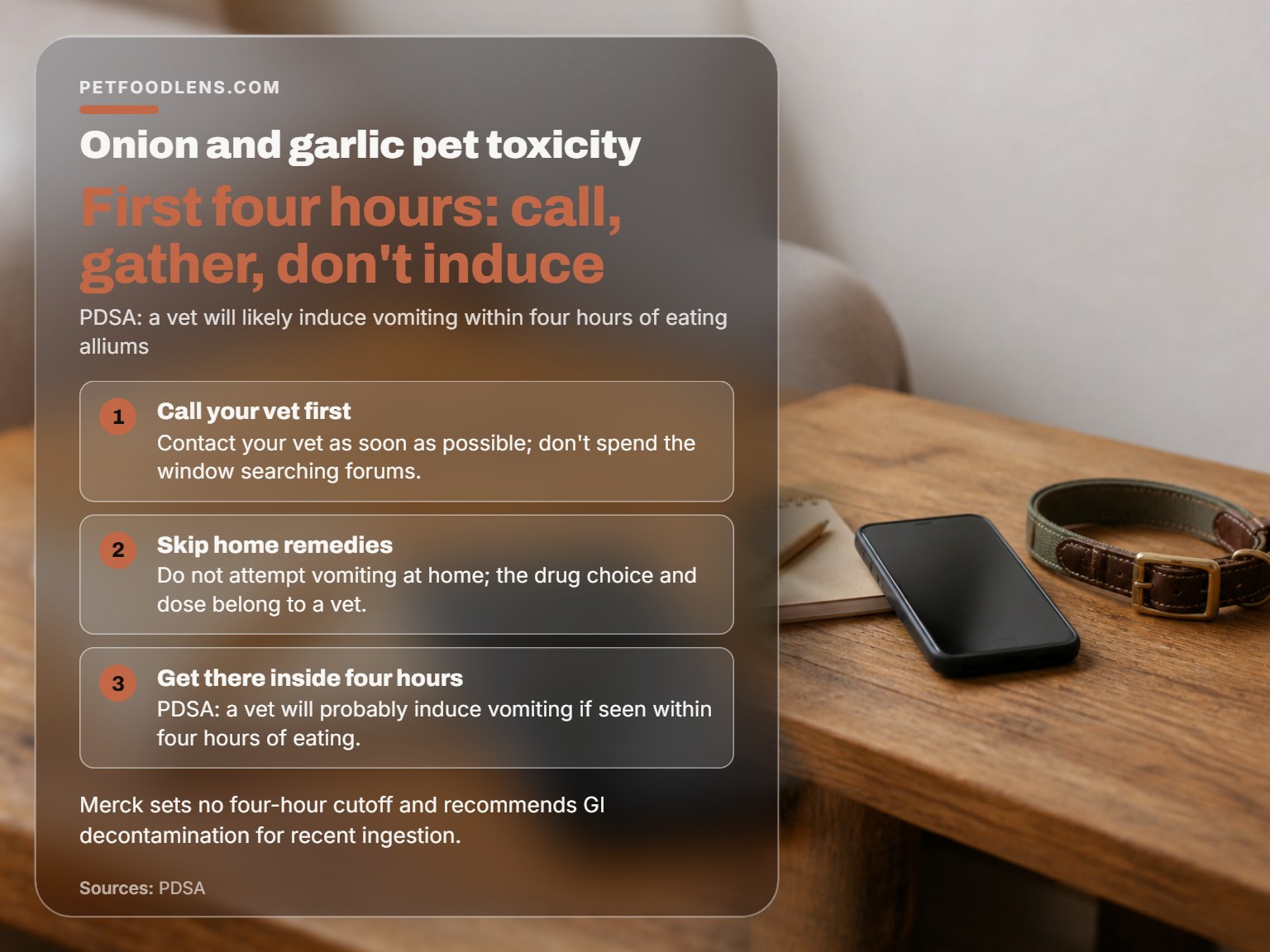
Three things happen in order: you call, you gather the details, and you keep your hands off the hydrogen peroxide.
Before you start: Do not induce vomiting at home. PDSA is explicit on that point, and the drug choice and dose belong to a vet. Have the pet’s weight, the food involved, and a rough amount eaten ready before you dial.
- Call before you drive. PDSA advises contacting your vet as soon as possible. An hour spent searching forums is an hour off the window when decontamination still works.
- Write down the dose. Pet weight, the food, and how much went missing. Without a number, the vet can’t tell a wait-and-watch from an admit.
- Skip the home remedies. PDSA says not to attempt vomiting at home. The Merck emetic list is prescription territory: ropinirole, apomorphine, 3% hydrogen peroxide at 1-2 mL/kg with a 45 mL ceiling, or dexmedetomidine for cats.
- Get there inside four hours if you can. PDSA says a vet will probably induce vomiting if the pet is seen within four hours of eating. Merck sets no four-hour cutoff and simply recommends GI decontamination for recent ingestion. Treat four hours as the target and don’t assume hour five means nothing can be done.
- Expect bloodwork, not a quick answer. Heinz bodies peak near 72 hours, so a normal panel on day one rules nothing out.
Merck also notes that emetics licensed for dogs should be prioritized over extra-label use of other drugs. Activated charcoal may be considered, though whether it adsorbs or prevents sulfide production is unknown.
If your vet sends you home with a bland therapeutic diet for the recovery week, ask which diet they recommend for your pet. A probiotic is sometimes added. Ask before starting either.
Reading the Label for Hidden Alliums
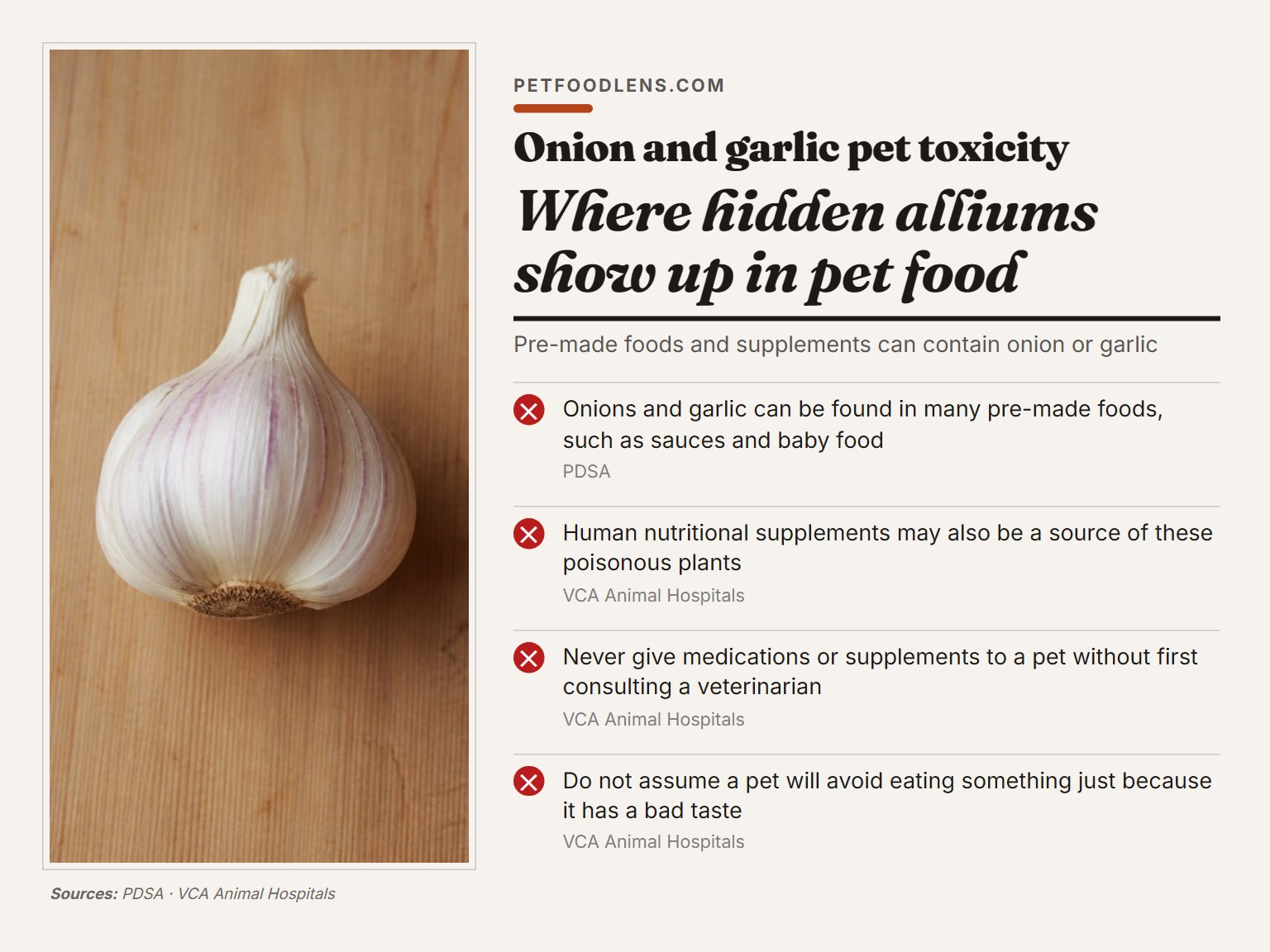
Pre-made food and supplements are a documented route of exposure, and neither one looks like an onion.
PDSA notes that onions and garlic turn up in many pre-made foods, including sauces and baby food. A 2011 review in SciELO goes further, observing that several baby-food manufacturers add onion or onion powder for palatability. VCA adds human nutritional supplements to the list.
I once spent a session with a client who had never read a pet food label in her life. We walked one ingredient panel together, and by the end she could separate a named meat meal from a vague by-product line without help. Two weeks later she was asking sharper questions about protein sourcing than owners who’d been at it for years. A motivated beginner catches up fast, and the same skill transfers straight to alliums: once you know to scan for “onion powder” and “garlic extract,” you stop missing them.
Here’s where they hide:
- Dry soup mixes and stock cubes. The concentrated forms Merck names most often, and the ones most likely to sit in a cupboard for years.
- Gravies, sauces, and marinades. PDSA flags these specifically.
- Baby food. Onion powder gets added for palatability, which makes it an easy spoon to leave down.
- Human supplements. Garlic capsules are a concentrated dose in a form that looks like medicine.
- Whatever hits the floor. VCA warns against assuming a pet will refuse something because it tastes bad.
Easy to miss: Garlic capsules sold as human supplements. VCA lists human nutritional supplements as a source of allium exposure, and a capsule delivers a concentrated dose in something that looks like a pill, not a vegetable.
The kitchen holds more than alliums, and avocado toxicity is a separate conversation with its own rules. VCA also suggests fencing off garden beds with onions, garlic, chives, or leeks, and confining pets to another room until a dropped bulb is fully picked up.
Garlic for Fleas and Other Advice to Ignore
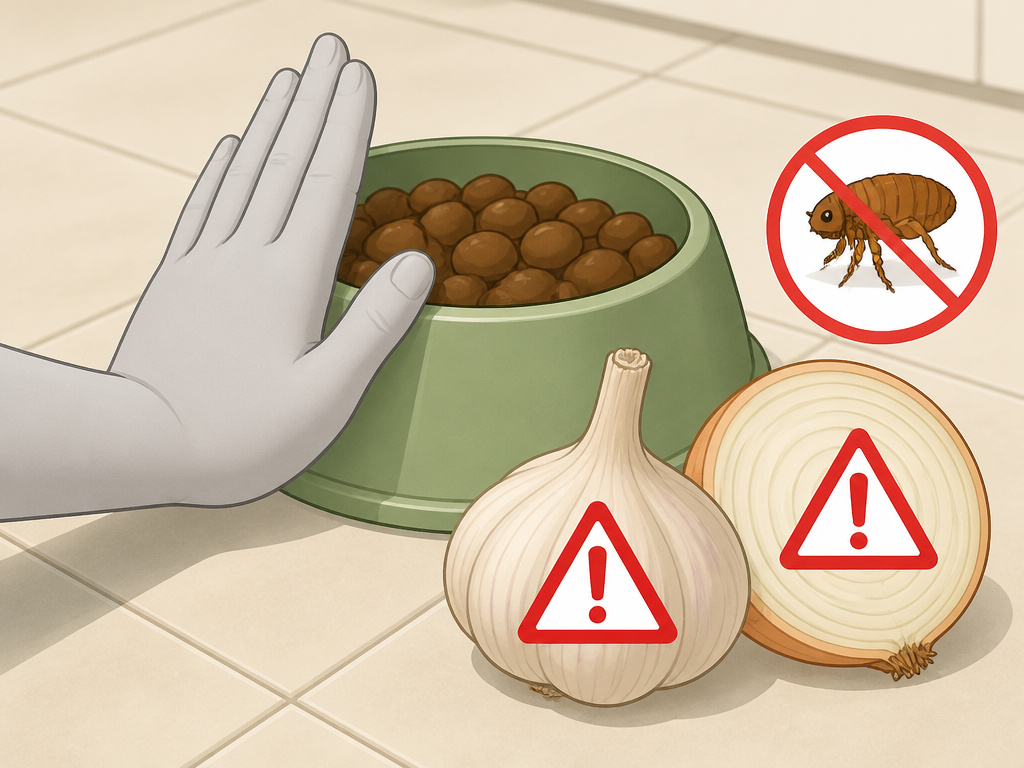
Garlic does not treat fleas.
PDSA states there’s no evidence garlic works against fleas and that it should never be given to dogs, even in small doses. That’s about as flat a statement as a veterinary charity publishes, and it closes the door on the most common home-remedy argument for feeding it.
The opposite error is just as common. Owners who’ve had one scare start treating a crumb of onion in the same category as a full bowl of soup, and the anxiety stops being useful. Dose and species are what separate a shrug from a vet visit.
A dog that eats onion and looks fine for two days is not fine. The look is the delay, not the all-clear.
The outlook is better than the anxiety suggests. PDSA reports that with treatment most dogs recover well, and that ongoing severe problems or death from onion, garlic, or leek poisoning are very rare.
Frequently Asked Questions
How much garlic is toxic to a dog?
There’s no established safe dose. Merck rates garlic 3 to 5 times more toxic than onion. The AVMA study fed 5 g of whole garlic per kilogram daily for seven days and saw red cell counts bottom out on days 9 to 11, though no dog developed hemolytic anemia at that level. VCA’s conversion is the practical one: a teaspoon of garlic powder equals eight cloves.
How long after eating onion will a dog show symptoms?
PDSA says symptoms can start within 24 hours but more commonly take a few days, with anemia signs at 1 to 5 days. Merck puts the onset of Heinz body formation and methemoglobinemia within 24 hours, peaking near 72 hours, with hemolysis at 3 to 5 days.
Does cooking destroy the toxin in onions?
No. The PMC review states that cooking, drying, and processing do not eliminate the toxic effect of Allium species. A 2025 in vitro study did find dried garlic produced Heinz bodies near control levels, but that was a lab-dish result with blood from 5 donor dogs, and it conflicts with clinical reports naming dehydrated forms as the usual culprits.
Is garlic powder worse than fresh garlic?
By weight, yes. VCA says dried and powdered forms carry a higher concentration because the water has been removed, and one teaspoon of powder equals eight cloves. The 2025 in vitro study found granulated garlic produced 15.0 +/- 2.5% Heinz bodies against 5.0 +/- 1.7% for fresh at the same concentration.
Can cats eat food cooked with onions?
No. Merck reports toxicosis in cats after less than a teaspoon of cooked onions, and cats are the most susceptible species. A shared forkful of stew is inside the range that has caused harm.
What if my dog ate a small amount of onion and seems fine?
Call your vet or a poison service the same day. PDSA advises contacting a vet as soon as possible and warns against inducing vomiting at home. The absence of symptoms on day one tells you nothing, because the blood changes peak around 72 hours.
The Bottom Line
One practical rule: if the exposure happened within four hours and you know roughly how much was eaten, call and drive. That’s the window where a vet can still empty the stomach, and it’s the only part of this you control.
After four hours, the job changes to monitoring and bloodwork. The numbers that matter are the ones that bottom out days after exposure in the research, not the ones on the first panel.
Onion and garlic toxicity in pets is a slow clock, and slow clocks are the ones owners misread. Waiting for a symptom feels like caution. Here it’s the one move that costs you the window.
