
Which Human Foods Are Toxic to Dogs? What the Dose Says
This post contains affiliate links. As an Amazon Associate, we earn from qualifying purchases.
Which human foods are toxic to dogs is a dose question first. Onions and garlic damage red blood cells at 15-30 g/kg in dogs and 5 g/kg in cats, and cooking doesn’t neutralize them. Chocolate, grapes, raisins, xylitol, and alcohol are the other high-risk items.
The 15-30 g/kg figure comes from a peer-reviewed review of which human foods are toxic to dogs, and it marks the dose where clinically important blood changes appear. A single slice of onion on a plate is nowhere near that. A dog that cleans out a pot of onion-rich stew is in a different category entirely.
What follows covers the four mechanisms behind most dog poisonings, the foods that block the gut instead of poisoning it, and the places where the official lists contradict each other. It ends with the two-hour window that decides most outcomes.
Key Takeaways
- Cooking and drying don’t neutralize Allium. Onion powder baked into a rotisserie chicken skin carries the same risk as raw onion, at 15-30 g/kg for dogs and 5 g/kg for cats.
- Grape dose isn’t predictive. In VPIS data covering 180 reports from 1994 to 2007, some dogs stayed asymptomatic after up to 1 kg of raisins while others died after a handful.
- Chocolate risk scales with theobromine per gram, not with how much chocolate disappeared. Baking chocolate and cocoa powder exceed 14 mg/g; milk chocolate sits near 2 mg/g.
- Decontamination inside 2-4 hours gives a good prognosis in most chocolate cases, and clinical signs usually start in that same window.
- Call poison control before you wait for symptoms. ASPCA APCC is 888-426-4435; Pet Poison Helpline is 855-764-7661.
The Allium Threshold: 5 g/kg for Cats, 15-30 g/kg for Dogs
Five grams per kilogram is the onion dose that produces clinically important blood changes in cats. For dogs the same review puts the range at 15-30 g/kg.
Allium toxicity works through oxidative haemolysis. Onion, garlic, leek and chives damage red blood cell membranes, producing Heinz bodies and methaemoglobinaemia. Cooking, drying and processing do not remove the effect, so onion powder in a prepared food carries the same risk as raw onion. Cats are more susceptible than dogs, but dogs are affected at higher doses.
Run the which human foods are toxic to dogs arithmetic and it gets concrete fast. A 20 kg dog needs roughly 300-600 g of raw onion to reach that band. That’s a whole bag of onions, not a garnish. It’s also about one large takeaway container of onion-heavy stew, which is how this actually happens in a kitchen.
I work mainly in cat formulations, so I’ll flag where the dog data is thinner than the cat data. The Allium numbers are the exception. That review gives clean per-species figures, and most consumer lists don’t.
The most common version of this I run into is leftover meat handed over as a treat without anyone checking the seasoning. Rotisserie chicken skin is the usual offender. The onion and garlic powder in it is still Allium, still at full strength, and the owner genuinely believes they’re being generous.
Foods that count as Allium, which surprises people more often than it should:
- Onion, raw, cooked, powdered, or dehydrated
- Garlic, including garlic salt and garlic oil
- Leek and shallot
- Chives and spring onion
- Prepared stocks, gravies, and rotisserie seasoning — the hidden route
Cooking Does Not Neutralize Allium
The review is explicit that cooking, drying and processing don’t eliminate the toxicity. That single sentence kills the most common reassurance in this whole topic: that a little cooked onion is fine because the heat “burns it off.” Heat doesn’t touch it.
So the onion toxicity question isn’t about raw versus cooked. It’s about total grams of Allium tissue against body weight, and a dehydrated onion flake is more concentrated per gram than the fresh bulb it came from.
Why Grapes and Raisins Break Every Dose Rule
Every other food on this page has a dose you can work with. Grapes don’t.
The VPIS surveillance dataset runs from August 1994 to September 2007 and covers 180 reports. Inside that same set, some dogs stayed asymptomatic after eating up to 1 kg of raisins. Others died after a handful. Same species, same food, opposite outcomes.
Nobody can currently explain the split. The grape toxicity picture is further complicated by the fact that the toxic principle itself is contested, which I’ll come back to.
Raisins get handed out as a healthy treat more often than they should. Because there’s no predictable dose in dogs, my advice is to skip them entirely rather than take a small-amount gamble.
A food with no known toxic dose and no known mechanism isn’t a food you can reason about. With grapes, the only safe quantity is none.
What the Numbers Can’t Tell You
The 180-report dataset tells you the range of outcomes. It doesn’t tell you which dog you have. That’s the honest limit of the evidence, and anyone who quotes a “safe grape dose” is inventing one.
There’s a cat footnote worth knowing. Merck’s veterinary manual records renal failure from grapes or raisins in exactly one cat. One case is not a species-wide rule, but it does mean the dog-only framing is slightly too tidy.
Chocolate Toxicity Is Theobromine Math, Not a Chocolate Rule
Theobromine content per gram is what separates a stomach ache from a seizure, and it varies widely across chocolate types.
| Chocolate type | Theobromine per gram | What it means |
|---|---|---|
| Unsweetened baking chocolate, cocoa powder | More than 14 mg | Highest concentration, smallest dangerous weight |
| Semisweet dark chocolate | Around 5 mg | Moderate risk for a small dog |
| Milk chocolate | Around 2 mg | Lower risk, large amounts still matter |
| White chocolate | Insignificant source | Lowest methylxanthine content of the four |
Against those concentrations, the ASPCA APCC thresholds are the ones to hold in your head. Mild clinical signs appear at 20 mg/kg of combined theobromine and caffeine. Severe signs show up at 40-50 mg/kg. Seizures occur at 60 mg/kg.
Chocolate also contains more theobromine than caffeine, and the caffeine fraction is much smaller. So the theobromine number is doing most of the work in that calculation, which is why the chocolate poisoning conversation starts with chocolate type before it starts with quantity.
The Absorption Gap That Buys You Time
Here’s the mechanism that catches owners out. In dogs, caffeine is absorbed rapidly, but theobromine is absorbed about ten times slower and reaches peak plasma levels at roughly 10 hours.
That gap is why a dog can look completely normal at hour two and be trembling by hour eight. Initial clinical signs generally appear within 2-4 hours, but the peak is still climbing long after that.
There’s a genetic wrinkle too. Dogs carrying the CYP1A2 deficiency polymorphism 1117C > T may be at higher risk because they metabolize methylxanthines more slowly. You can’t test for that in your kitchen, so it’s a reason to treat any chocolate exposure as unpredictable rather than a reason to relax.
Which Foods Are Obstruction Hazards Rather Than Poisons?
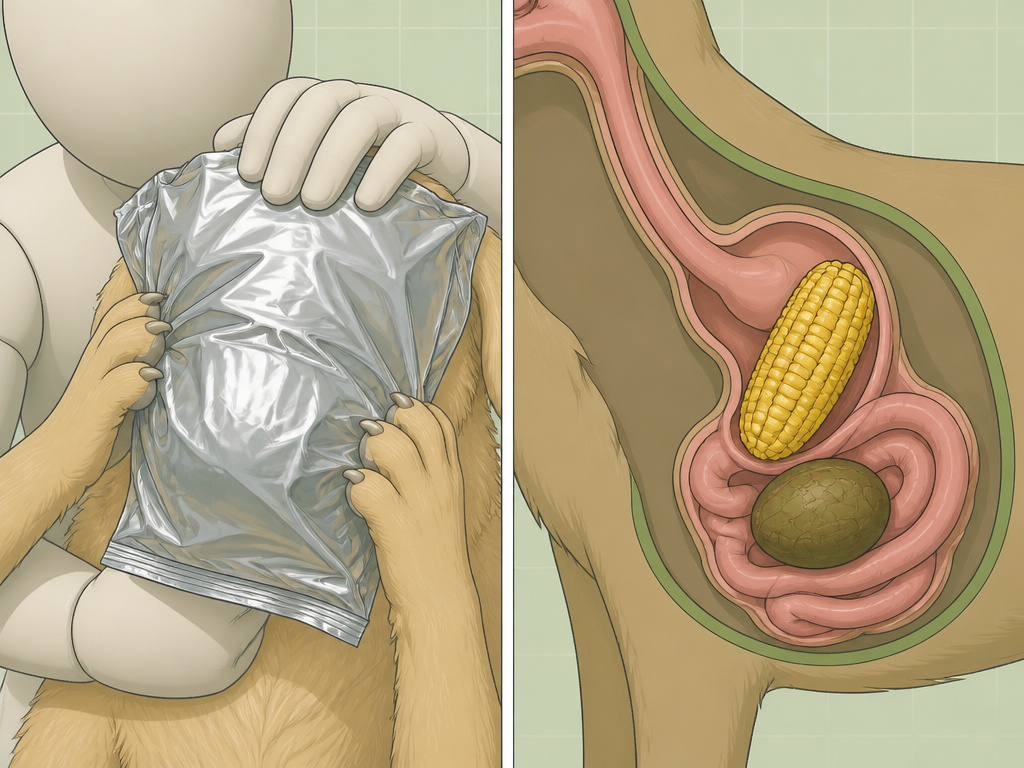
Avocado pits, corn cobs and bones cause their damage mechanically. They lodge in the esophagus, stomach or intestine, and the fix is often surgery.
The FDA draws this line explicitly, separating toxic items from obstruction hazards. It’s a distinction most toxic-food lists flatten, and flattening it changes what you do. A dog that swallowed a corn cob doesn’t need a poison control consultation. It needs a vet who can image the gut.
Prunus fruit pits are the interesting middle case. Cherry, nectarine, peach and plum pits contain cyanide, but cyanide poisoning is rare unless the animal eats a lot of pits and chews them up. The pit has to be crushed or ground to release it. For most dogs the obstruction risk is the bigger one.
Then there’s the item that isn’t food at all. Mylar-type potato chip bags, cereal bags and snack bags can suffocate a dog that puts its head inside and breathes in. The bag tightens around the muzzle like shrink wrap, and the dog can’t paw it off because it’s stuck flat against the face.
The Bag That Suffocates
This one has no toxin involved and kills faster than most of the foods on this page. The sound is the tell: a wet, sucking rustle that stops. If you hear a chip bag go quiet in the next room, go look.
Where the Official Lists Disagree With Each Other
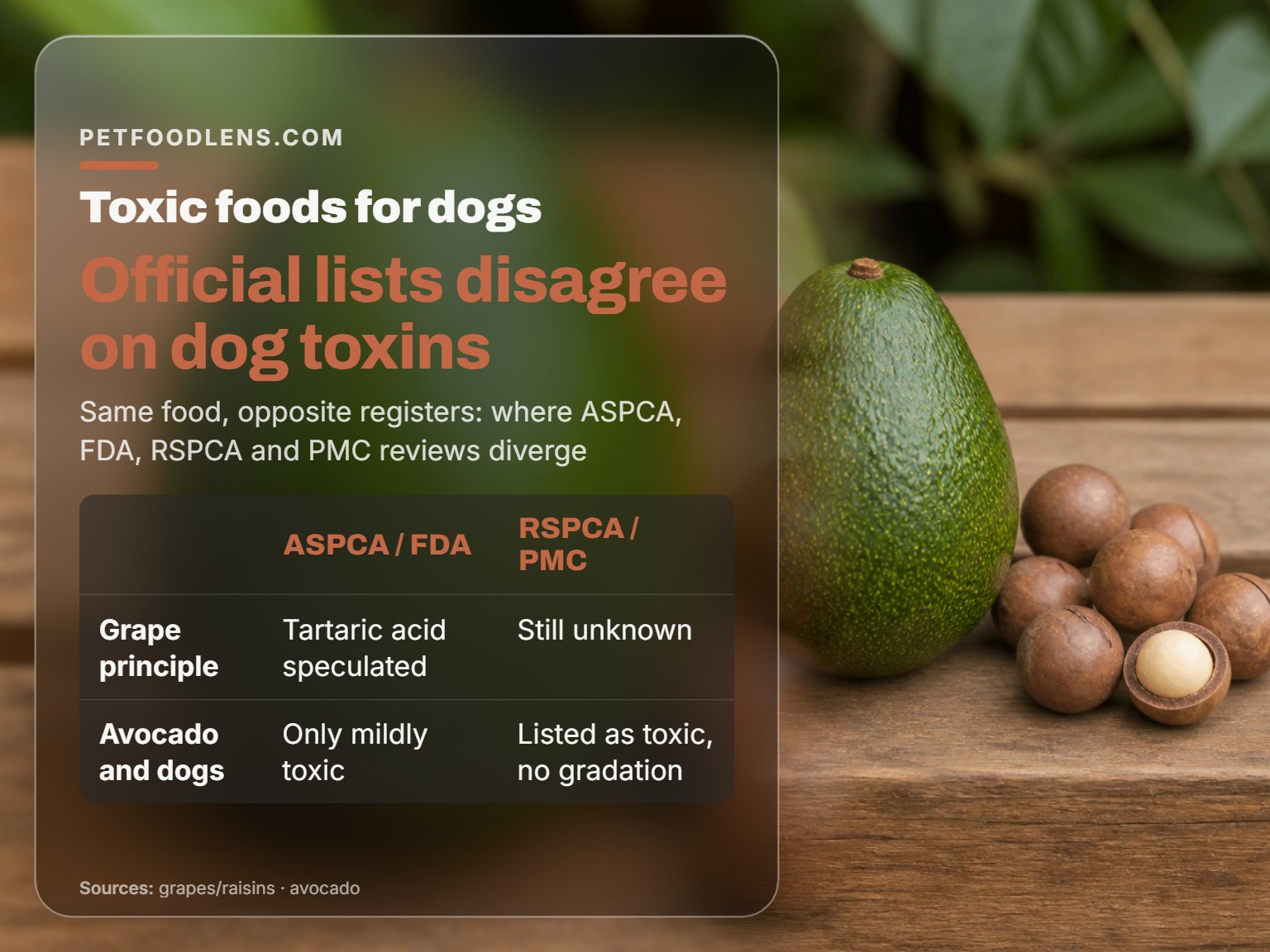
The ASPCA names tartaric acid as the suspected toxic component in grapes. A peer-reviewed review in PMC says the toxic principle and exact mechanism are still unknown.
Those aren’t the same claim, and the gap matters. When the agencies can’t agree on the mechanism, no one can hand you a safe dose.
| Question | One position | Another position |
|---|---|---|
| Grape toxic principle | ASPCA: tartaric acid speculated, dogs can’t process it | PMC review: still unknown |
| Avocado and dogs | FDA: only mildly toxic to dogs and cats | RSPCA: listed as toxic, no gradation |
| Nuts as a category | RSPCA: nuts including macadamia listed as toxic | ASPCA: macadamia toxic, others a fat risk |
The avocado row is the one that changes advice. The FDA is specific that avocado is only mildly toxic to dogs and cats but can be severely toxic, even deadly, to birds, rabbits, horses and ruminants. The RSPCA lists avocado flatly under foods toxic to dogs with no mild-severe split. Both are official. They’re describing the same fruit for the same species in opposite registers.
Nuts split the same way. The RSPCA treats “nuts (including macadamia nuts)” as a toxic category. The ASPCA separates macadamia, which causes weakness, incoordination, depression, vomiting, tremors and hyperthermia, from almonds, pecans and walnuts, which are a fat and pancreatitis risk rather than a toxin.
On macadamia nuts the ASPCA timeline is useful: symptoms usually appear within 12 hours, and recovery is expected within 24-72 hours. Uncomfortable, rarely fatal.
Where the lists do agree, they agree hard. Xylitol poisoning drives insulin release, causing hypoglycemia and potentially liver damage, with vomiting, lethargy and loss of coordination progressing to seizures. Liver damage can land within 12-24 hours. Agriculture Victoria and the ASPCA describe the same cascade.
Raw dough is a dual hazard nobody expects. The dough rises and produces gas in the stomach, which can bloat and potentially twist it, and the yeast produces alcohol as a by-product in the same space. One ingestion, two problems.
Where this goes sideways: Treating “nuts” as one category. A dog that ate a handful of almonds has a fat load and a pancreatitis risk. A dog that ate macadamias has a neurological presentation. Same word on the packet, different call to the vet.
What Should You Do in the First Two Hours?
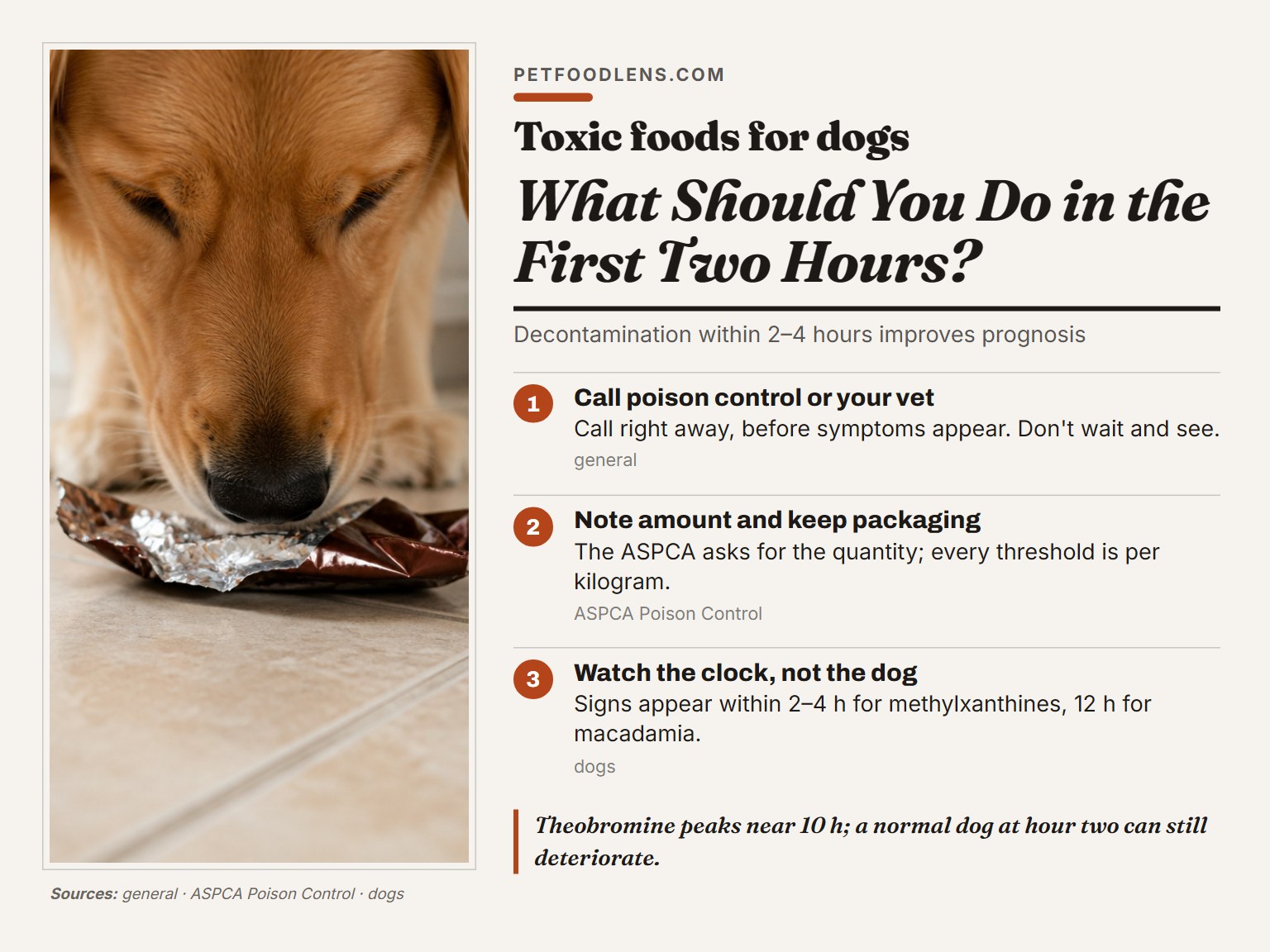
Do you know what your dog ate, how much, and when? Those three answers drive everything the vet does next.
Before you start: The 2-4 hour decontamination window decides most outcomes, so don’t spend it watching for symptoms. Theobromine peaks near 10 hours, which means a dog that looks normal at hour two can still deteriorate. Call ASPCA APCC on 888-426-4435 or Pet Poison Helpline on 855-764-7661 while you’re still gathering the wrapper, not after.
- Call poison control or your vet immediately, before symptoms appear. The FDA’s guidance is to call right away rather than wait and see, and the prognosis for chocolate cases is usually good when effective decontamination happens within 2-4 hours. Skip the call and you’ve spent the window.
- Note the amount ingested and keep the packaging. The ASPCA asks for the quantity specifically, because every threshold on this page is a per-kilogram calculation. “A bit of chocolate” gives the vet nothing to work with.
- Don’t induce vomiting on your own. Decontamination in the literature means emesis or gastric lavage under veterinary direction, plus activated charcoal and supportive care. A home attempt on the wrong item can do more damage than the item did.
- Watch the clock, not the dog. Signs appear within 2-4 hours for methylxanthines, within 12 hours for macadamia, and within 12-24 hours for xylitol liver damage. A quiet dog at hour one proves nothing.
Once the dog is stable, the question flips to what you can actually put in the bowl. The list of foods safe for dogs is shorter than most owners expect, and it’s worth reading before the next barbecue rather than after.
A vet may send you home with a probiotic once the gut settles. For a dog that’s had a rough recovery, a bland gastrointestinal formula may be suggested. None of those treat the poisoning. They’re recovery support after the acute phase is handled.
Frequently Asked Questions
How much onion is actually dangerous to a dog?
The peer-reviewed threshold is 15-30 g/kg of ingested onion for clinically important haematologic changes. For a 20 kg dog that’s roughly 300-600 g of raw onion. Cats are more susceptible at 5 g/kg, so a much smaller amount matters.
Can a dog survive eating grapes?
Yes, some do. In VPIS data covering 180 reports between 1994 and 2007, some dogs remained asymptomatic after up to 1 kg of raisins. Others died after a handful. Because the toxic principle is still unidentified, there’s no dose you can safely reason from.
Is white chocolate safe for dogs?
White chocolate is considered an insignificant source of theobromine, so it carries the lowest risk of the four main chocolate types. That doesn’t make it a good treat. The fat and sugar load is still a problem, and a large enough quantity of anything can upset the gut.
How fast do chocolate poisoning signs appear?
Initial clinical signs are generally observed within 2-4 hours of ingestion. Theobromine is absorbed about ten times slower than caffeine and peaks at roughly 10 hours, so a dog can worsen well after the first signs appear.
Are macadamia nuts fatal to dogs?
Rarely. Symptoms usually appear within 12 hours and include weakness, incoordination, depression, vomiting, tremors and hyperthermia. Recovery is expected within 24-72 hours. The presentation looks alarming and usually resolves.
Should I make my dog vomit at home?
Not without veterinary direction. The published treatment approach is emesis or gastric lavage under supervision, followed by activated charcoal and supportive care. Whether vomiting is appropriate depends entirely on what was eaten, and that’s a call for a vet or poison control.
The Bottom Line
One rule covers most of this page: if you can’t state the dose in grams per kilogram of body weight, you don’t have a dose, and you should call rather than calculate. That’s the whole reason grapes sit in the same risk bucket as xylitol despite having no identified toxin.
Here’s the concession. This article leans on dog data because that’s where the numbers are, and I’ve said so where the cat evidence is thinner. If your household has both species, don’t transfer the dog thresholds across. The Allium figures alone differ by a factor of three to six.
The specific step for this week: find the chocolate in your house and read the cacao percentage on the wrapper. Baking chocolate above 14 mg of theobromine per gram and a bar of milk chocolate at around 2 mg/g are not the same emergency, and knowing which one is in the cupboard takes about thirty seconds.
Then put the two poison control numbers somewhere you’ll find them at 11pm. ASPCA APCC on 888-426-4435, Pet Poison Helpline on 855-764-7661. The two-to-four-hour window doesn’t care whether you were organised.
