
Xylitol Poisoning in Dogs: Dose Thresholds and Timelines
This post contains affiliate links. As an Amazon Associate, we earn from qualifying purchases.
Xylitol poisoning in dogs starts with a massive insulin release: doses above 100 mg/kg (45 mg/lb) drop blood sugar within 30 minutes, and doses above 500 mg/kg (227 mg/lb) can cause severe hepatic insufficiency or failure, with clinical signs of liver injury possibly not appearing until 24 to 48 hours. Both outcomes are survivable with fast veterinary care.
The xylitol poisoning in dogs insulin spike is 3 to 7 times what a dog would release to process regular sugar, per Cornell’s Riney Canine Health Center. That’s why a small amount of xylitol can crash a small dog’s blood glucose before an owner finishes reading the label.
What follows walks through the dose thresholds, the timeline that decides survival, and the places where the veterinary sources disagree with each other.
Key Takeaways
- Above 100 mg/kg, blood sugar drops within 30 minutes; above 500 mg/kg, clinical signs of liver injury may not appear until 24 to 48 hours.
- Gum is the sneaky one because it delays hypoglycemia 12 to 18 hours, so a 12-hour observation window is not enough.
- No test confirms xylitol after the fact; diagnosis runs on exposure history, signs, and blood work.
- Call poison control before you do anything else; emesis is a vet call, not a home remedy.
- The 72-hour liver check is the floor, not the ceiling, and Cornell’s three-day recheck lines up with that same 72-hour floor.
Why Does Xylitol Crash a Dog’s Blood Sugar So Fast?
Dogs lack the feedback mechanism that keeps xylitol from triggering insulin release in humans and most other mammals. In dogs, xylitol stimulates a rapid, dose-dependent insulin release that can drop blood glucose to seizure-level lows within half an hour.
Xylitol triggers a rapid, dose-dependent insulin release in dogs that does not occur in most other mammals. The resulting hypoglycemia can be profound, and in some cases the same ingestion also produces hepatic necrosis through a mechanism that remains unclear but is hypothesized to involve ATP depletion or reactive oxygen species.
The liver does most of the work. Xylitol is metabolized 70 to 80 percent in the liver by oxidation to d-xylulose, which is why the organ takes the hit when the dose climbs.
Watch the gums. A dog heading into hypoglycemia goes pale at the gum line before the weakness shows up in the legs, and that color change is the visual cue most owners miss.
Cats are not at risk. Merck is explicit on this: dogs are the only domestic species in which xylitol toxicosis has been reported, and toxic foods for cats follow a different list entirely.
I work mostly with cats, so dog toxicology isn’t my daily bread. When a xylitol question lands, I go straight to Merck and the JAVMA case series.
The clinical version of this mechanism is documented in the Cornell xylitol toxicities guide, which is where I’d start if you want the deeper physiology.
The 100 mg/kg Line and the 500 mg/kg Cliff
Merck sets the hypoglycemia threshold at doses above 100 mg/kg (45 mg/lb). For hepatic injury, Merck cites doses above 500 mg/kg (227 mg/lb), while JAVMA 2006 reported hepatic-failure cases from 1.4 to 16 g/kg and the PMC case report notes hepatic necrosis is possible at 0.5 g/kg (500 mg/kg).
| Dose | Outcome | Typical Timing |
|---|---|---|
| Above 100 mg/kg | Hypoglycemia | 30 min to 12-18 h |
| Above 500 mg/kg | Liver enzyme rise | 4 to 12 h |
| Above 500 mg/kg | Clinical liver injury | 24 to 48 h |
| 1,400 to 16,000 mg/kg | Hepatic failure (case range) | 24 to 48 h for clinical signs of liver injury |
The last row comes from the xylitol coagulopathy in eight dogs case series, and it’s a wide spread. The lowest hepatic-failure dose in those eight dogs was 1.4 g/kg. The highest was 16 g/kg, and that dog was the one that survived.
The liver injury mechanism is still unclear. Merck hypothesizes ATP depletion or reactive oxygen species secondary to xylitol metabolism, which is the technical way of saying the liver cells run out of energy or get chewed up by their own metabolic byproducts.
Here’s a detail that matters for label reading: xylitol is a five-carbon sugar alcohol, and the sugar in pet food conversation usually misses it because it’s filed under “sugar-free” rather than “sugar.” Same family, different toxicology.
How Does Xylitol Poisoning in Dogs Unfold?
A dog eats gum and looks fine for hours, then becomes wobbly and won’t eat. That delayed gap is the slow-absorption gum scenario Merck describes, and it’s the reason a 12-hour observation window is not enough.
Cornell puts hypoglycemia onset at 30 to 60 minutes after ingestion for fast-absorbing forms, while Merck says clinical signs can develop within 30 minutes and may be delayed up to 12 to 18 hours when the xylitol is bound in a substrate like gum that slows absorption.
Liver signs run on a separate clock. Merck notes that liver enzyme increases are often detectable within 4 to 12 hours, but clinical signs of liver injury may not appear until 24 to 48 hours after ingestion.
Rule of thumb: If the ingestion was gum, candy, or anything chewy, treat the 12-hour mark as the start of the monitoring window, not the end. The delayed hypoglycemia cases are the ones that get sent home too early.
The FDA xylitol dog warning puts it plainly: serious effects may not occur for up to 12 to 24 hours, so the dog may need to be hospitalized for monitoring even if it looks fine at intake.
The case I keep coming back to is the Standard Poodle in the 2006 JAVMA series. A 31.8 kg dog ate cookies with an estimated 1.4 to 2.0 g/kg of xylitol, showed clinical signs at roughly 24 hours, and died about 2 days after ingestion. That’s a dog that looked fine at dinner and was gone by the weekend.
Where the Sources Disagree on Dose and Onset
The disagreements are real, and they matter for how you read the numbers. Four sources give four different onset windows, and the dose thresholds don’t line up cleanly either.
- Onset of hypoglycemia: Merck says within 30 minutes; JAVMA 2006 and Cornell both say 30 to 60 minutes; the PMC case report documented 1 to 2 hours in a Chihuahua.
- Hypoglycemia threshold: Merck says above 100 mg/kg; JAVMA says 0.15 g/kg (150 mg/kg) has caused it in the authors’ experience; PMC says 0.1 g/kg (100 mg/kg).
- Hepatic threshold: Merck says above 500 mg/kg; JAVMA’s actual hepatic-failure cases ranged from 1.4 to 16 g/kg; PMC says hepatic necrosis is possible at 0.5 g/kg (500 mg/kg).
- Dose-hepatopathy association: Merck treats hepatic injury as dose-dependent (doses >500 mg/kg), while a 2018-2022 retrospective found the ingested dose was not associated with development of hepatopathy.
- Emesis value: Merck advises emesis only under vet supervision in clinically normal patients, while the 2018-2022 study found emesis induction in 77 percent of dogs was associated with lower hepatopathy risk (p = 0.01), a stronger endorsement of decontamination than Merck’s cautious framing.
- Prognosis: The 2006 JAVMA series had 3 of 8 dogs dead or euthanized; a 192-case xylitol ingestion retrospective from 2007-2012 reported 100 percent survival to discharge; the 2018-2022 series had zero dogs develop hepatic failure.
The prognosis gap is the one that trips people up. Three study eras, three different fatality pictures. The likely explanation is referral bias, but the sources don’t reconcile it, and anyone who tells you the case fatality rate is settled is overselling.
If your dog is diabetic, the diabetic dog treats conversation overlaps here in an uncomfortable way. A dog with existing glucose regulation issues has less margin when xylitol hits, and the monitoring window should be treated as longer, not shorter.
What Should You Do in the First 30 Minutes?
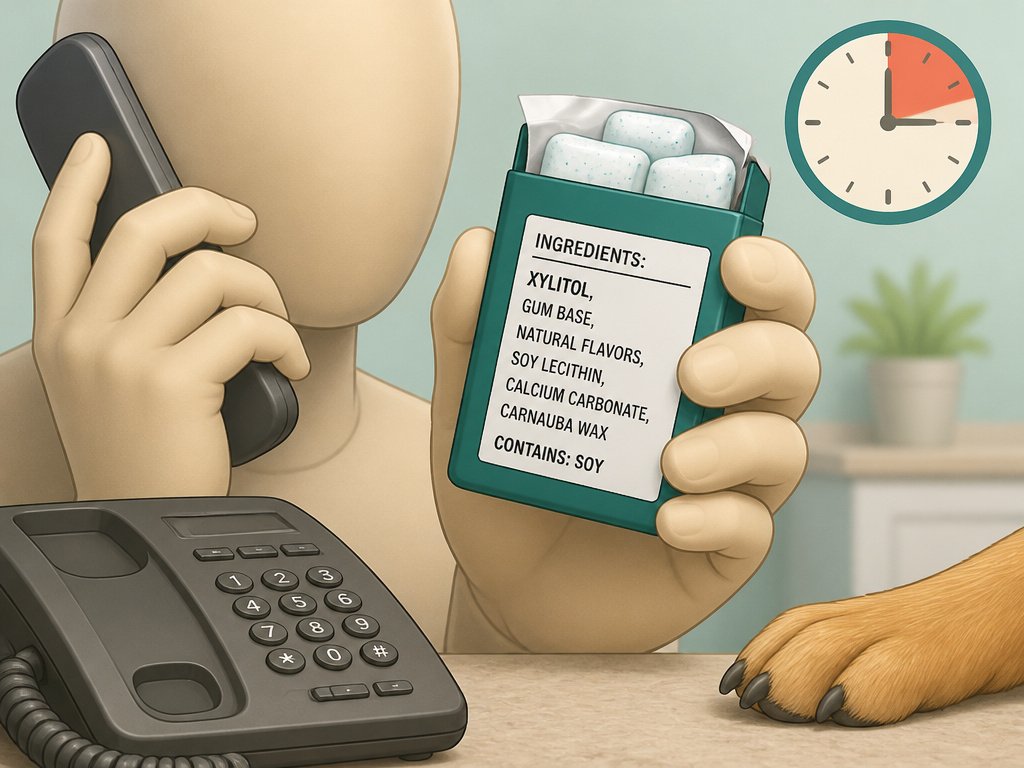
Call first. That’s the whole first minute. The rest of the sequence depends on what the vet or poison control tells you.
Before you start: Do not induce vomiting at home unless a vet or poison control tells you to. Xylitol absorbs fast, and a dog that’s already hypoglycemic can aspirate during emesis. Have the packaging in hand when you call, because the amount of xylitol varies wildly between products and even between flavors of the same brand.
- Call the ASPCA Animal Poison Control Center or Pet Poison Helpline immediately. Both keep veterinary toxicologists on staff, and both can do dose math from the packaging. Skipping this step and driving straight to the ER works too, but you lose the phone triage that tells you whether to drive at all.
- Bring the packaging. Cornell is direct on this: the exact amount of xylitol varies wildly between products, and the label is the only way the vet can estimate the dose. Without it, you’re guessing at mg/kg.
- Do not wait for symptoms. The FDA’s guidance is to take the dog to a vet or emergency hospital immediately. Waiting for vomiting or weakness costs you the window when treatment works best.
- Expect blood work, not a specific test. Cornell notes there is no test that detects xylitol after ingestion. Diagnosis runs on exposure history, clinical signs, and blood sugar plus liver enzyme values.
- Plan for hospitalization. Merck’s monitoring schedule is blood glucose every 1 to 2 hours for at least 12 hours, and liver enzymes every 24 hours for at least 72 hours. Cornell puts the minimum hospital stay at 12 to 24 hours.
The experimental xylitol toxicity in dogs work in Pekingese is what established the insulin curve behind the ‘call first’ instruction. That’s the physiology behind the “call first” instruction.
Which Products Actually Contain Xylitol?
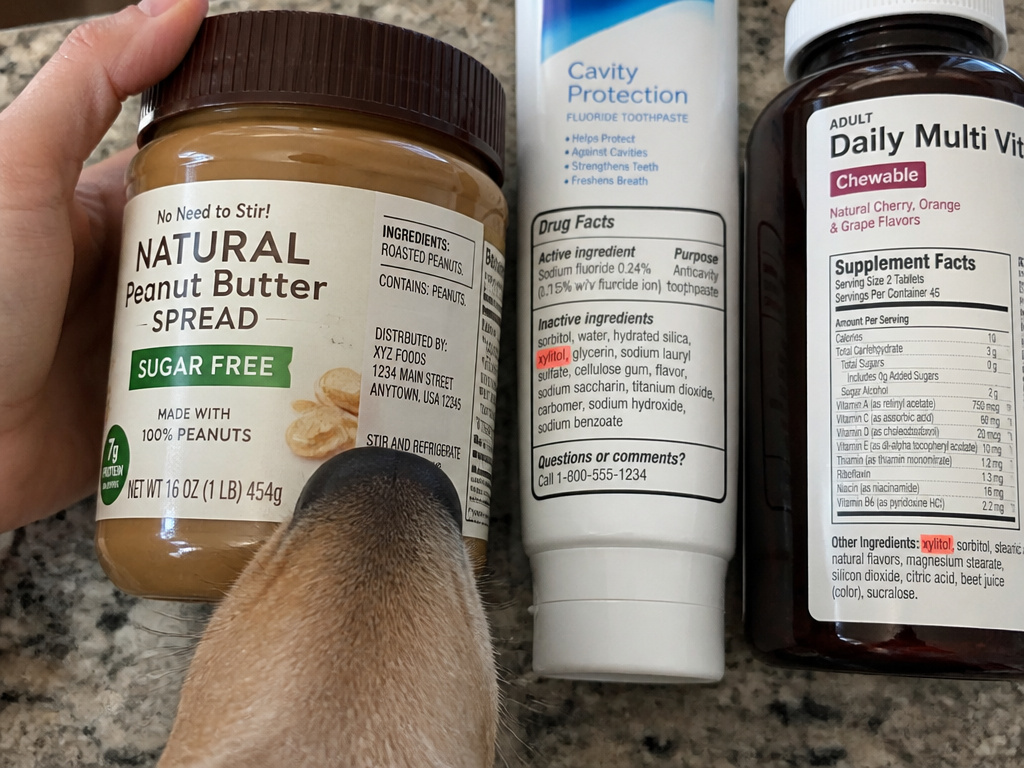
Xylitol shows up in places most owners never check. The obvious ones are sugar-free gum, candy, mints, and baked goods. The non-obvious ones are where the real risk lives.
- Toothpaste. Human toothpaste is a common xylitol source, and the FDA’s guidance is blunt: only use pet toothpaste for pets, never human toothpaste.
- Peanut butter. Some sugar-free peanut butters now contain xylitol, and the FDA specifically flags nut butter used as a pill vehicle. If you make xylitol-free peanut butter at home, you control the ingredient list.
- Chewable vitamins and supplements. These are among the non-food items owners should check, along with liquid medications that may use xylitol as a sweetener base.
- Oral care products, cosmetics, deodorants, hair care. Yes, really. The range of non-food products containing xylitol is broader than most owners expect.
- Baked goods. Sugar-free cookies, muffins, and cakes are a common exposure route. A dog-safe birthday cake recipe sidesteps the issue by skipping the sweetener entirely.
Where this goes sideways: Assuming “sugar-free” means “xylitol-free.” It doesn’t. Merck’s guidance is to check the ingredient list on any product labeled sugar-free, because xylitol is one of several sugar alcohols and the label doesn’t always call it out on the front.
The broader toxic human foods list is worth keeping on the fridge, and the safe human foods list is worth keeping next to it. Xylitol sits on the first list, not the second, and it’s one of the few items where a small amount is enough to matter.
What Does the Monitoring Window Really Require?
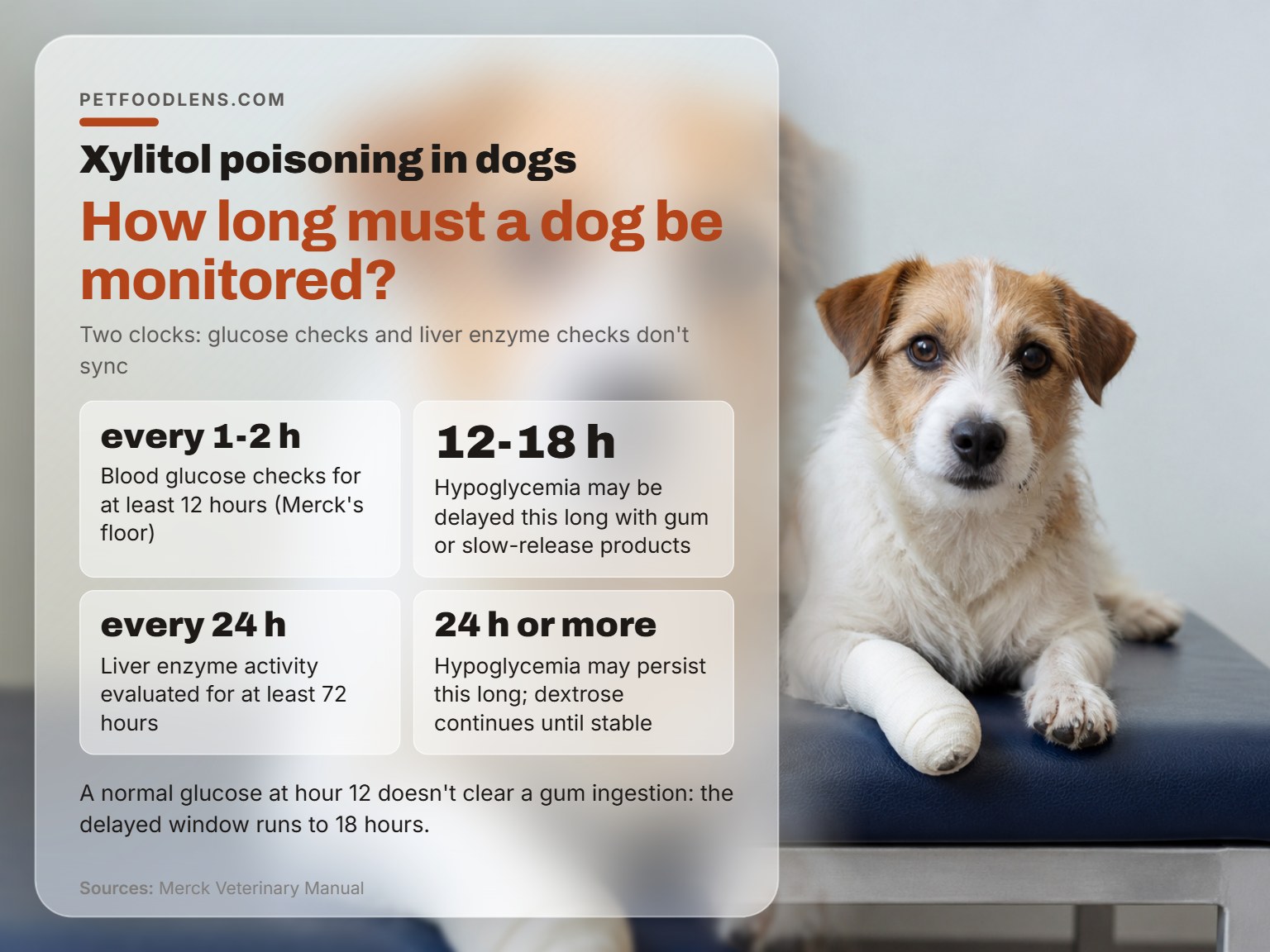
The monitoring window is set by the slowest-moving risk, not the fastest. Blood sugar crashes fast, but liver enzymes climb slowly, and the two clocks don’t sync.
The 12-Hour Glucose Check
Merck’s schedule is blood glucose every 1 to 2 hours for at least 12 hours. That’s the floor for fast-absorbing forms. For gum and other slow-release substrates, the 12-hour mark is when the delayed hypoglycemia window opens, not when it closes.
Hypoglycemia may persist for 24 hours or more, per Merck, so dextrose treatment continues until a normal blood glucose can be maintained without supplemental dextrose.
The 72-Hour Liver Enzyme Check
Liver enzyme activity should be evaluated every 24 hours for at least 72 hours, per Merck. Cornell rechecks liver values three days after exposure, which lines up with the same 72-hour floor.
That’s the failure mode the 72-hour check is looking for.
When Gum Changes the Math
The delayed-absorption problem is specific to substrates that slow xylitol release. Merck’s 12 to 18 hour delayed window applies to gum and similar products, and it’s the reason a dog that looks normal at hour 12 isn’t cleared yet.
Common mistake: Discharging a dog after 12 hours of normal glucose when the ingestion was gum. A normal reading at hour 12 doesn’t clear the dog, because the delayed window runs to 18 hours and the liver enzymes haven’t been rechecked yet.
One more wrinkle from Merck: not all dogs that develop xylitol-induced liver injury develop hypoglycemia. The proposed mechanism is a rebound increase in serum glucose (a Somogyi response), which means glucose monitoring alone will miss the liver cases.
If the dog is already on a managed diet, ask the vet whether a probiotic makes sense during recovery. It’s not a xylitol treatment, and it won’t touch the hypoglycemia, but it’s a reasonable question to raise once the acute phase is over.
Frequently Asked Questions
How long after eating xylitol will a dog show symptoms?
Merck says clinical signs of hypoglycemia can develop within 30 minutes, or be delayed up to 12 to 18 hours if the xylitol is in a slow-absorption substrate like gum. Cornell and JAVMA 2006 both put the fast-onset window at 30 to 60 minutes. Liver signs run later, typically 24 to 48 hours after ingestion.
Can a dog survive xylitol poisoning?
Yes, with fast treatment. The 2007-2012 retrospective of 192 cases reported 100 percent survival to discharge, and the 2018-2022 series had zero cases of hepatic failure. The 2006 JAVMA series was grimmer, with 3 of 8 dogs dead or euthanized. The gap is likely referral bias, but the sources don’t reconcile it.
Is a small amount of xylitol dangerous?
It depends on the dog’s weight and the form. Merck sets the hypoglycemia threshold at doses above 100 mg/kg (45 mg/lb). The PMC case report notes hypoglycemia has been reported at 0.1 g/kg, so the practical answer is that any confirmed xylitol ingestion warrants a call to poison control.
Should I make my dog vomit after xylitol?
Only if a vet or poison control tells you to. Merck advises emesis only under veterinary supervision and in patients that remain clinically normal. Cornell notes vets likely won’t induce vomiting unless the ingestion was less than 30 minutes prior and no signs of low blood sugar have started. Home induction risks aspiration in a dog that’s already hypoglycemic.
What foods contain xylitol?
Sugar-free gum, candy, mints, baked goods, and some peanut butters are the common food sources. Merck also lists non-food items: toothpaste, chewable vitamins, liquid medications, cosmetics, deodorants, and hair care products. Check the ingredient list on anything labeled sugar-free.
The Bottom Line
If your dog ate gum and it’s been more than 30 minutes, skip the emesis debate and drive to the ER. The 12 to 18 hour delayed window for gum means the dog can look fine at hour 12 and crash later within that window, and the only way to catch that is monitoring you can’t do at home.
Save one number in your phone tonight: the ASPCA Animal Poison Control Center. It’s the one I’d call first, and it’s the one that can do dose math from the packaging while you’re still finding your keys.
Fair warning on the dose math: everything above assumes a food or gum ingestion. If the exposure was granulated xylitol powder, the numbers shift by an order of magnitude. That’s the outlier end of the range, and it’s a reminder that the case fatality rate is a population statistic, not a prediction for your dog.
The one thing I’d change about how most owners handle this: they wait to see if symptoms appear. That’s the mistake I see most often, and it costs the window when treatment works best. Call first, drive second, and let the vet decide what happens third.
