
Grape and Raisin Toxicity in Dogs: What the Evidence Shows
This post contains affiliate links. As an Amazon Associate, we earn from qualifying purchases.
Grape and raisin toxicity in dogs is driven by tartaric acid. More than one grape or raisin per 4.5 kg (10 pounds) of body weight may hold enough of it to injure the kidneys, and vomiting often starts within 6 to 12 hours. Cornell treats any ingestion as an emergency because the harmful amount varies.
The tartaric acid explanation behind grape and raisin toxicity in dogs is newer than the fear it explains. Merck’s manual points to organic acid transporters that dogs lack, which lets the compound build up in proximal tubule cells instead of being cleared. That single transport gap is why a fruit other species eat without incident lands differently in a dog’s kidneys.
What follows: the numbers four sources give for a dangerous dose, what actually happens in the first 72 hours, and the one study result that should change how you think about “a couple of grapes.”
Key Takeaways
- Any ingestion is an emergency according to Cornell, because the harmful amount cannot be predicted from the dog’s size or the fruit count.
- Vomiting at 6 to 12 hours is the earliest sign per Merck, and a dog that looks normal at hour two has not cleared the risk.
- Decontamination was the strongest predictor of survival in the 2026 multicenter data, ahead of age, weight, and quantity eaten.
- Processed fruit accounted for 61.6% of canine cases versus 31.2% for fresh grapes, so the baking cupboard is the higher-traffic hazard.
- December carries 22.0% of canine cases, which is a fruit-cake problem more than a fruit-bowl problem.
How Much Grape Is Dangerous? The Sources Don’t Agree
Merck’s veterinary manual draws a risk line at more than one grape or raisin per 4.5 kg (10 pounds) of body weight. That figure assumes enough tartaric acid to matter for the kidneys.
Published guidance on a dangerous dose varies by source. The Merck Veterinary Manual sets a risk line at more than one grape or raisin per 4.5 kg (10 pounds) of body weight. The Cornell Riney Canine Health Center treats every ingestion as an emergency because the harmful amount cannot be predicted.
Four credible sources, four different answers. Here is how they line up.
| Source | Stated threshold | Practical meaning |
|---|---|---|
| Merck Veterinary Manual | More than 1 grape or raisin per 4.5 kg body weight | A weight-based risk line, not a safe floor |
| Cornell Riney Canine Health Center | Any ingestion is an emergency | No predictable threshold exists |
| Dutch Poisons Information Center | No dose-response relationship observed | 4-5 grapes caused AKI in one dog |
| Frontiers 2026 multicenter study | Minimum toxic dose, if any, unknown | Fresh and processed risk may differ |
Merck’s figure is a risk line, but Cornell treats any ingestion as an emergency because the harmful amount cannot be predicted. The Cornell College of Veterinary Medicine guidance goes further and says the harmful amount is unknown and cannot be predicted, so any ingestion counts as an emergency.
The Dutch cohort is the one that breaks the arithmetic. In the Vitis fruit clinical signs incidence paper, four to five grapes triggered acute kidney injury in a dachshund while other dogs stayed asymptomatic after eating up to 1 kg of raisins. The Multicenter grape ingestion cross-sectional study states that the minimum toxic dose, if one exists, remains unknown.
Grapes sit in the small group of foods toxic to dogs where a single exposure justifies a phone call instead of a wait-and-see.
What most people get wrong: Counting grapes and deciding the dog is fine. The Dutch dachshund went into kidney injury on four or five grapes, which is fewer than most owners would notice were missing from the bowl.
Why Tartaric Acid Hits Dogs Harder Than Other Species
Tartaric acid is the leading suspect in grape and raisin toxicity in dogs, and the reason a dog reacts differently than a person is a transport problem rather than a dose problem.
Merck describes the mechanism directly: dogs poorly excrete organic acids because they lack the transporters other species have, so tartaric acid accumulates in proximal renal tubular cells. The Frontiers authors add a sharper detail. Canines lack renal expression of the efflux transporter OAT-4, and blocking OAT-1 with probenecid significantly reduces tartaric acid-induced cytotoxicity in canine kidney cells.
That is the closest thing to a published mechanism anyone has. It also explains why the dose question stays open. A dog that clears less acid at the same exposure is not eating a smaller dose.
Three things follow from that:
- The mechanism is still unproven. Cornell calls tartaric acid and potassium bitartrate the most likely cause; the Dutch cohort paper states the pathogenesis is not known.
- Cream of tartar counts. It is potassium bitartrate, the same salt, and Cornell lists it beside the fruit.
- Tamarind belongs in the same bucket. Merck reports that tamarind ingestions have also caused renal failure in dogs.
No antidote exists for grape or raisin toxicosis. Every effective move is either removing fruit that has not been absorbed yet or supporting kidney output afterward, which is why the clock matters more than the count.
I am a nutritionist, not a vet, and this is the section where I hand off fastest. Formulation work tells you what is in a food. It does not tell you what a dog’s tubules are doing at hour nine, and I would not pretend otherwise.
What Happens at the Vet, and Why Timing Beats Dose
It is 11pm, there is a torn bag of raisins by the sofa, and the dog is acting completely normal. That last part is the problem.
Cornell’s guidance is blunt about recent ingestion with no clinical signs: the vet induces vomiting. Even several hours later this can still work, because fruit stays in the stomach long enough to be visible in vomit up to 12 hours after ingestion.
Before you start: Never induce vomiting at home on a guess. Merck’s 3% hydrogen peroxide protocol is 1 to 2 mL/kg with a maximum of 45 mL, and a miscalculated volume adds a second problem to the first. Call Pet Poison Helpline or the ASPCA Animal Poison Control Center and let them run the numbers.
Here is the sequence a vet typically works through.
- Decontamination first. Emesis can be induced with ropinirole at 2.7 to 5.4 mg/m2 in the conjunctival sac, repeated in 20 minutes, or apomorphine at 0.03 to 0.04 mg/kg with IV preferred. Skipping this step leaves fruit in a gut that is still absorbing tartaric acid.
- Activated charcoal, with a caveat. It went to 60.4% of canine cases in the 2026 data. Merck states the efficacy is unknown; the VPIS recommends it anyway. Skipping it is defensible, and giving it is common.
- IV fluid diuresis. For a large ingestion, or diarrhea within 12 hours, Merck recommends aggressive IV fluids for a minimum of 48 hours. Under-fluidizing leaves the tubules sitting in the same concentrated acid.
- Hospitalization and monitoring. Cornell describes at least two days of IV fluids with frequent rechecks of kidney values, electrolytes, urine output, and blood pressure. Sending the dog home early means a creatinine rise gets caught late or not at all.
- Repeat kidney testing. Blood values can look normal in the first few hours, so repeat testing over two to three days is the only way to know. A single clean panel at hour four tells you almost nothing.
Dogs are not reliable narrators of their own condition. The timeline below is what the two clinical sources actually describe.
| Sign | When it appears | What it suggests |
|---|---|---|
| Vomiting or diarrhea | 6-12 h (Merck); 6-24 h (Cornell) | Earliest sign, GI irritation |
| Lethargy, drooling, no appetite | 6-24 h | Developing toxicosis |
| Increased thirst and urination | 1-3 days | Kidney function slipping |
| Weakness, incoordination, tremors | 1-3 days | Reported, mechanism unclear |
| Inability to urinate | 1-3 days | Anuric failure, guarded outlook |
Where this goes sideways: Waiting for symptoms. Vomiting usually starts 6 to 12 hours after ingestion, which means a dog that looks normal at hour two has already spent the best treatment window doing nothing.
The same urgency applies to xylitol poisoning: the dog’s appearance is not a reliable guide to what is happening inside.
Raisins, Sultanas, and Zante Currants: Same Fruit, Different Label
Zante currants are grapes. Dried, small, and sold next to the raisins, but still Vitis.
Merck groups grapes, raisins, and Zante currants together as members of the Vitis genus. True currants of the genus Ribes have not been associated with renal injury. That distinction matters, because “currant” on a baking label and “currant” on a plant label are two different fruits.
Here is what counts and what does not:
- Fresh grapes, red, green, seedless, organic. VCA notes poisoning occurs across all variants; tartaric acid content varies but cultivar does not eliminate it.
- Raisins, sultanas, Zante currants. All Vitis, all covered.
- Tamarind. Merck reports renal failure in dogs after tamarind ingestion.
- Cream of tartar. Potassium bitartrate, listed by Cornell as a source.
- True Ribes currants. Not linked to kidney injury, per Merck.
Flip the bag over on a box of currant scones and you will usually find Zante currants, which are dried grapes. The front of the package is doing the same job a glossy paint job does on a used truck.
Fresh grapes vs raisins: which is worse?
The 2026 multicenter data answers this in a way that cuts both directions. Processed fruit accounted for 61.6% of canine cases versus 31.2% for fresh, so raisins drive the case volume. But fresh fruit ingestion carried higher mortality, with a canine relative risk of 3.47.
Merck treats grapes, raisins, and Zante currants equivalently, without separating fresh from processed risk. For a worried owner, the practical read is that neither form is the safe one.
Grapes are not the only kitchen item in this category, and onion and garlic toxicity in pets runs on a different mechanism with a different threshold.
The December Spike: Why Processed Fruit Dominates the Case Load
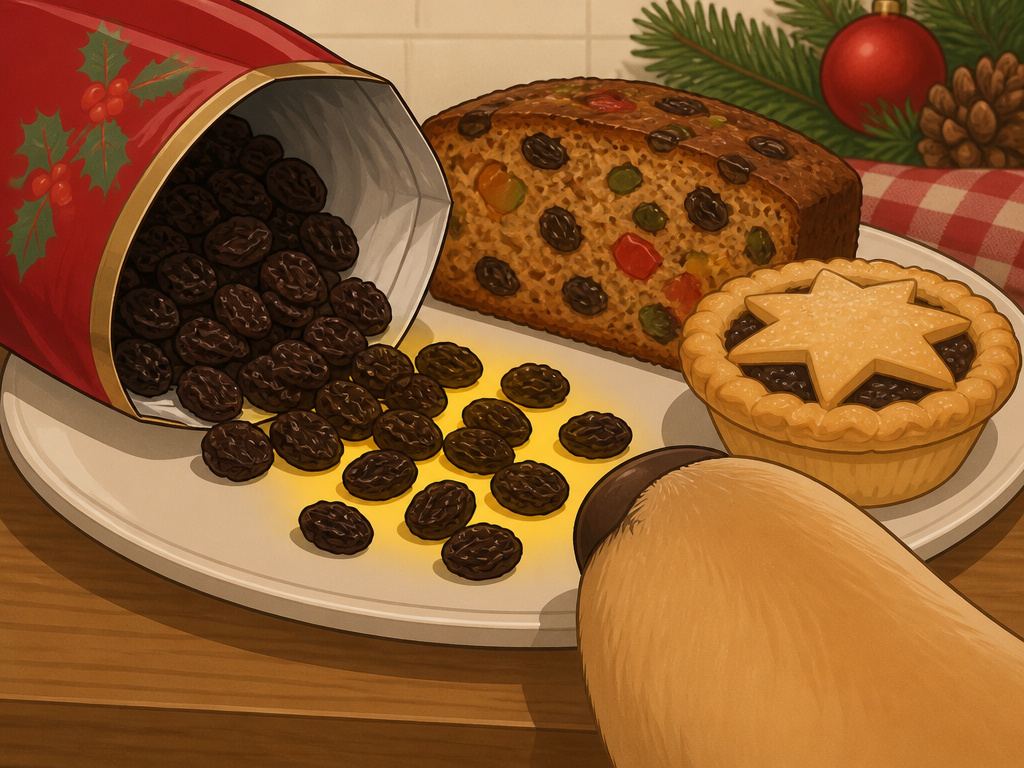
December accounts for 22.0% of canine cases in the 2026 multicenter data.
The Frontiers dataset defines processed fruit as raisins, currants, sultanas, and foods containing them, with fruit cake named among the examples. That lines up with the calendar. Christmas cake, mince pies, a bag of raisins left open on the counter.
Chocolate co-ingestion was not associated with increased mortality in that analysis. That is worth knowing before you fixate on the chocolate poisoning in dogs angle and walk past the raisins.
The December number is the one I would tape to the inside of a kitchen cupboard. December stands out sharply, because dried fruit moves from the pantry to the coffee table.
How Often Does a Grape Actually Cause Kidney Failure?
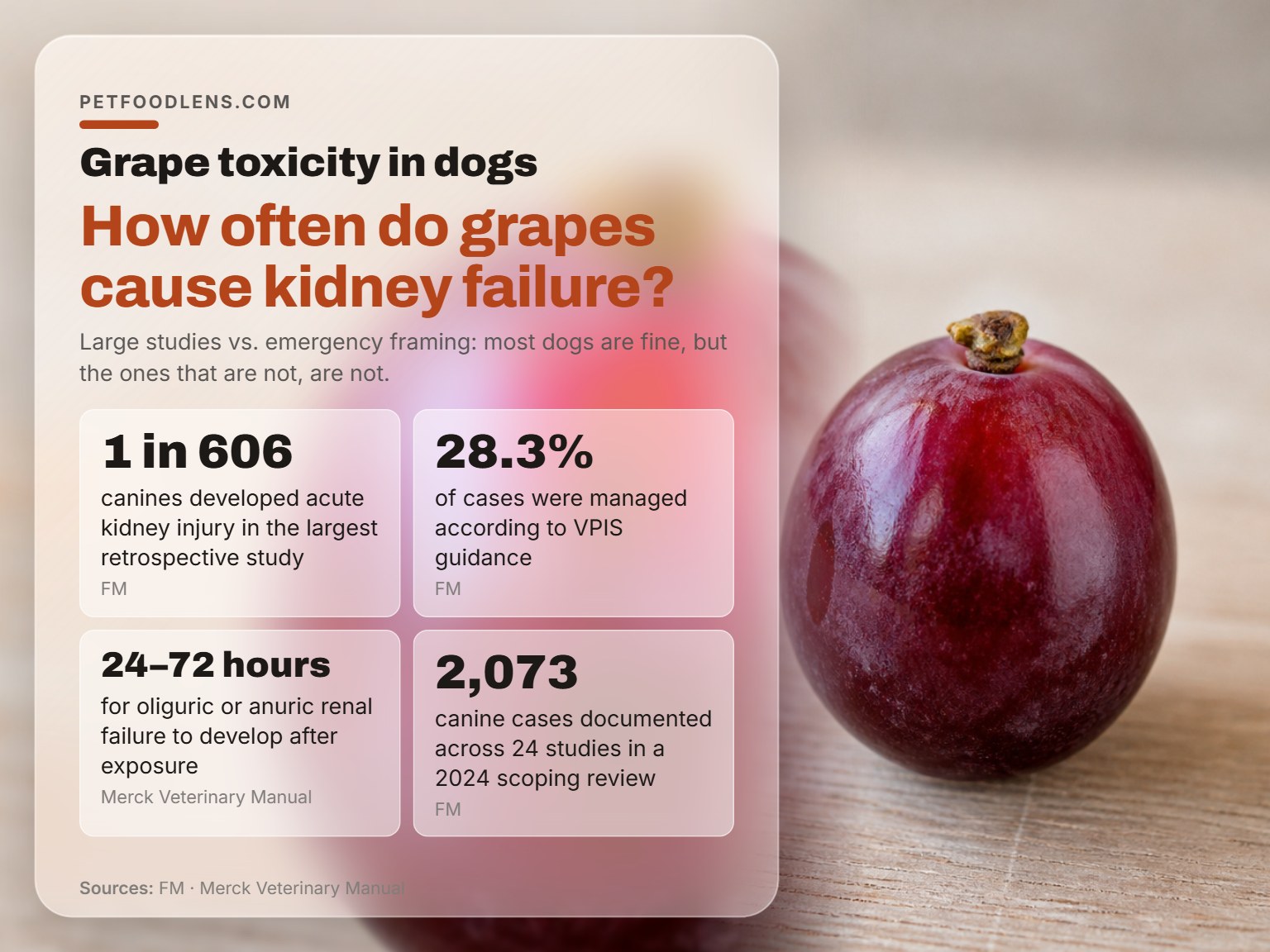
How often does a grape actually cause kidney failure? Less often than the emergency framing implies, and more often than you would want to bet a kidney on.
The largest retrospective study, published in 2021, reported that just 1 in 606 canines developed acute kidney injury, despite only 28.3% of cases being managed according to VPIS guidance. The Dutch cohort found one dog of the group developed signs consistent with AKI. A 2024 scoping review counted 24 studies covering 2,073 canine cases.
Against that, Merck describes oliguric or anuric renal failure developing within 24 to 72 hours, and notes that once anuric failure develops, most dogs die or are euthanized.
Both things are true at once. Most dogs are fine. The ones that are not, are not.
The 4-5 grape dachshund and the 1 kg raisin dog
Those two cases sit side by side in the same paper. One dog went into kidney injury on four or five grapes. Another ate up to 1 kg of raisins and stayed asymptomatic.
That is the whole problem in one paragraph. You cannot use the first dog to reassure yourself about the second, or the reverse.
Case series like this Retrospective grape ingestion case review keep hitting the same wall. Without a mechanism, there is no dose to calculate, and without a dose, triage runs on exposure history rather than arithmetic.
Dogs that survive kidney injury may still develop long-term kidney problems, per Cornell. Those dogs often end up on a prescription renal diet, and owners ask me about probiotics after a hospital stay. Neither has any role in clearing tartaric acid. The case for them is gut recovery after vomiting and fluids.
Grape-Proofing a House With a Dog (and What to Do About Cats)
Prevention for this one is mostly about storage.
Cornell’s list is short and unglamorous:
- Never feed grapes, raisins, sultanas, Zante currants, or foods containing them.
- Store food securely, out of reach.
- Secure trash bins and compost so a dog cannot get in.
- Remove grape vines from areas the dog can access.
Cats are a smaller but stranger part of the picture. Merck notes that reported cases have been in dogs, with only anecdotal reports of renal failure in cats. The 2026 data complicates that: feline cases were far less frequent but considerably more fatal, at 11.8% mortality against 0.9% in dogs. The Dutch cohort exposed 13 cats, two developed clinical signs, and none developed AKI.
So the feline evidence is thin, contradictory, and not a reason to relax. If you want the broader list, the which human foods are toxic to cats breakdown covers where the real feline risk concentrates.
And if there are cats in the house, the flowers on the windowsill deserve more of your attention than the fruit bowl does. A gift bouquet is a far more common household hazard than a grape, and it gets far less airtime.
The short version: dried fruit out of reach, bins with lids, and a poison control number saved before you need it.
Frequently Asked Questions
How long after eating grapes will a dog show symptoms?
Merck puts vomiting or diarrhea at 6 to 12 hours after ingestion. Cornell’s range is wider, at 6 to 24 hours, and notes that some dogs show nothing early on. Kidney failure can develop within 24 to 72 hours, so a quiet first day is not a clearance.
Is one grape enough to hurt a dog?
Merck’s risk line is more than one grape or raisin per 4.5 kg of body weight, so a single grape in a small dog sits near that threshold, though Cornell and the Dutch cohort both argue against relying on a count at all. Cornell and the Dutch cohort both argue against relying on a count at all, since four to five grapes caused kidney injury in one documented case.
Are seedless or organic grapes safer for dogs?
No. VCA notes that poisoning occurs across all grape variants, including seedless, organic, red, and green. Tartaric acid content varies between fruits, but cultivar does not remove it.
Do raisins cause the same problem as grapes?
Yes. Merck groups grapes, raisins, and Zante currants together as Vitis. The 2026 data shows processed fruit causing more canine cases (61.6% versus 31.2%), while fresh fruit carried higher mortality with a relative risk of 3.47.
Can cats get grape or raisin toxicity?
Merck reports only anecdotal feline cases, and the Dutch cohort saw 13 exposed cats with no AKI. The 2026 multicenter data found feline cases less frequent but more fatal, at 11.8% mortality versus 0.9% in dogs.
Does activated charcoal actually help?
Merck states the efficacy is unknown. The VPIS recommends it as part of decontamination for all exposures, and it was given to 60.4% of canine cases in the 2026 data. Decontamination overall was the strongest predictor of survival in that analysis.
The Bottom Line
The uncomfortable part of this data is that most dogs do fine. One in 606 developed kidney injury in the largest retrospective, and the Dutch cohort saw a single dog of the group develop AKI-consistent signs. That low base rate is exactly what makes waiting feel reasonable at 11pm.
Age is the variable that should move you fastest, so if your dog is old, the call happens sooner rather than later. If your dog is old, or you cannot establish how much was eaten, the call happens sooner rather than later.
Here is the practical takeaway, and it is not about grapes. Save Pet Poison Helpline and the ASPCA Animal Poison Control Center in your phone tonight, before anything happens. At 11pm with a torn bag on the floor, you will not want to be searching for a number.
Everything above assumes you can reach a vet. If you cannot, the honest answer is that this is a case where the drive is worth it, and no amount of label reading on my part changes that.
