
How to Feed Bottom Feeder Fish: Step-by-Step
This post contains affiliate links. As an Amazon Associate, we earn from qualifying purchases.
To feed bottom feeder fish, use a sinking pellet, wafer, or tablet that reaches the bottom intact, and offer once or twice a day only what the group clears within 3 minutes. Manufacturer consumption windows run from 3 to 30 minutes, and the short end keeps water cleaner.
That 3-to-30-minute spread comes from one brand’s own product page. The number on the label is a guess dressed up as a rule, and the tank pays for it when the guess runs long. The same uncertainty applies to how to feed bottom feeder fish.
Uneaten food doesn’t vanish. It sits on the substrate, breaks down, and pushes ammonia up, which is why the feeding window matters more than the slogan on the front of the bag.
Below: which fish actually need food to reach the bottom, what the competing labels really say, how to read a guaranteed analysis, and the cold-water rule that flips the whole routine.
Key Takeaways
- Feeding frequency is disputed. API says feed twice a day, Marineland says 1-3 times daily, and MAFES Bulletin 1230 found once daily to apparent satiation is satisfactory and that twice-daily feeding didn’t increase production and likely wasted feed.
- The consumption window is the real control. API’s own page says 30 minutes in one place and 3 minutes in another; Marineland says a couple of minutes.
- Protein minimums separate products more than packaging does. Zeigler Aqua Stable lists 40.0% minimum crude protein; Marineland Algae Wafer XL lists 29.0%.
- Below 65°F (18°C), switch to sinking food while fish are still actively feeding. SRAC Publication No. 181 warns the transition gets hard once feeding activity drops.
- Oxygen demand peaks 6 to 12 hours after a feed, so the damage from a heavy meal lands long after you’ve walked away from the tank.
Which Fish Actually Need Food to Hit the Bottom?
Plecostomus, loaches, cory cats, and most shrimp feed at the substrate. They won’t out-compete a mid-water fish for a floating flake, which is the whole reason how to feed bottom feeder fish comes down to sinking food as a category.
Bottom feeders take food at the substrate, not at the surface, so the food has to sink and hold shape. Sinking pellets, wafers, and tablets are built to reach the bottom and stay intact long enough for grazing species to locate. Water stability, particle size, and guaranteed protein content separate one product from another.
Zeigler’s technical sheet names catfish, plecostomus, and Grass Shrimp among the species that eat from the bottom, and describes the diet as sinking for exactly that reason. The bottom feeder fish label covers a wider range than that, though, and feeding style varies more than the packaging admits.
- Plecostomus and armored catfish: graze over long stretches, so a wafer that holds shape for hours suits them better than a pellet that goes soft fast.
- Loaches: many do their heaviest feeding after the lights go out, which changes when you should drop the food.
- Cory cats: small, social, and easily pushed off a food source by anything larger.
- Shrimp: slow enough that they lose to nearly every fish in the tank, including each other.
The Fish That Get Shut Out
Loach feeding and cory cat food both run into the same problem: the timid fish eat last, and sometimes not at all. MAFES Bulletin 1230 makes a point that carries from ponds into tanks. When fish of different sizes share a space, feeding to satiation lets the smaller, less aggressive fish get a share. A fixed ration doesn’t.
Not every fish sold as a bottom feeder stays on the bottom.
The Same Product Page Gives Two Different Feeding Windows
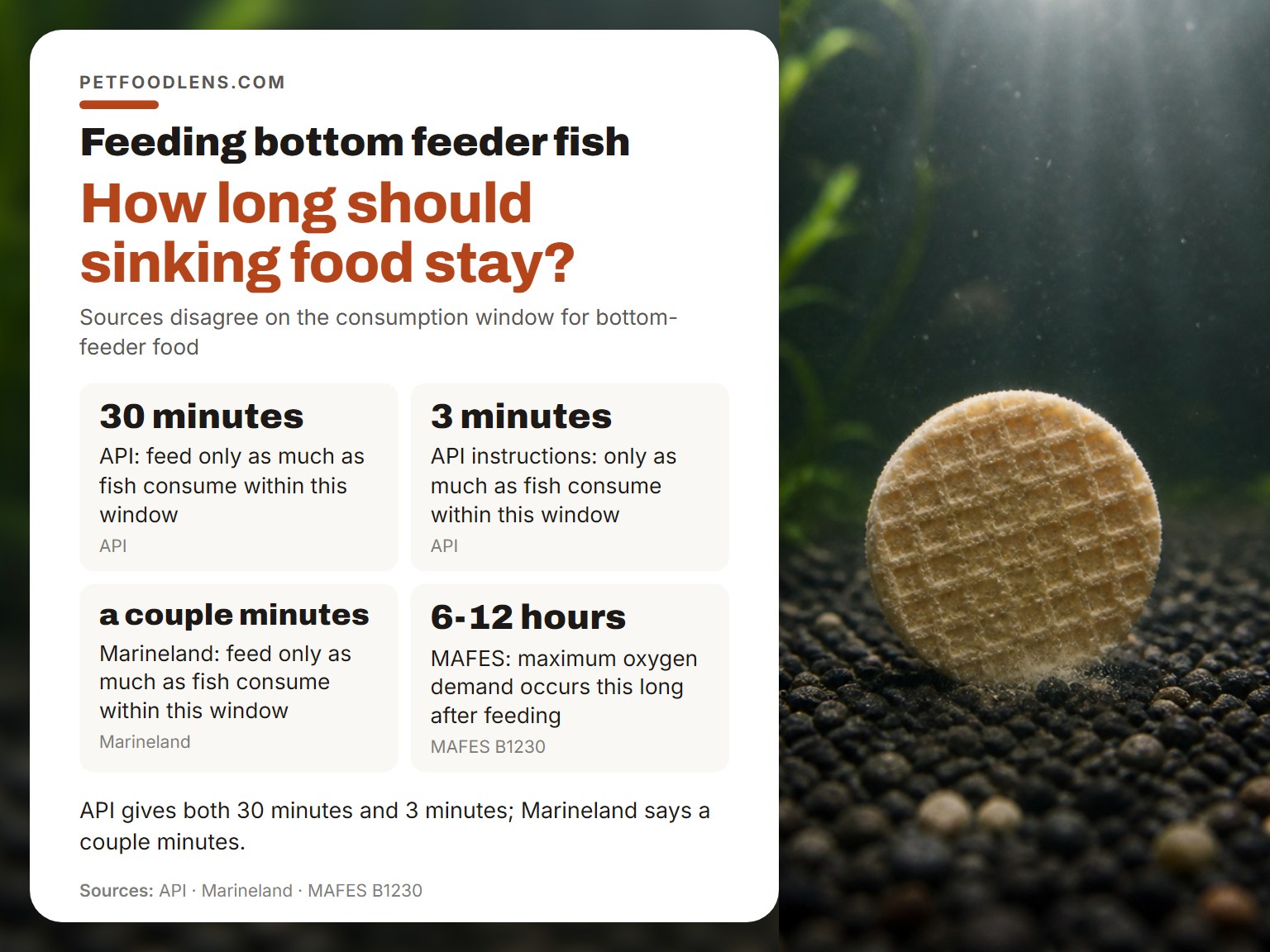
Thirty minutes. Three minutes. Both numbers sit on the same API product page, for the same food, in the same sitting.
The product description reads: “Feed twice a day, and provide only as much as your fish will consume within 30 minutes.” The instructions of use on that same page, covering how to feed bottom feeder fish, read: “Feed twice a day, only as much as fish will consume within 3 minutes.”
Ten times the soak time, from one brand, on one page. Marineland’s wafer page goes shorter still, telling owners to feed lightly 1 to 3 times daily and only as much as the fish clear within a couple of minutes.
| Source | Frequency | Consumption window |
|---|---|---|
| API Bottom Feeder Pellets (description) | Twice a day | 30 minutes |
| API Bottom Feeder Pellets (instructions) | Twice a day | 3 minutes |
| Marineland Algae Wafer XL | 1-3 times daily, lightly | A couple of minutes |
| MAFES Bulletin 1230 (catfish) | Once daily to apparent satiation | Not time-based |
MAFES adds a third position. Feeding once daily to apparent satiation is satisfactory for food fish grow-out, and feeding twice daily is not necessarily beneficial, at least in a single-batch system. More feed is likely wasted.
Three cadences, three organizations, no agreement. Nobody is lying here. They’re answering different questions with the same confident tone.
Treat the feeding guide on the bag as a starting point and adjust by watching the fish. That advice holds harder for fish food, where a single page can’t settle on a number.
Sources disagree on the consumption window: API’s page says 30 minutes in one place and 3 minutes in another, while Marineland says a couple of minutes. Feeding to the shortest window any credible source gives you is the safer choice; a fish still hungry will forage through the substrate, and leftover food just decays.
If you keep bottom feeders and top feeders together, the window matters more, not less. The fast fish eat first, and whatever sinks is the remainder.
What Actually Raises Ammonia 6 to 12 Hours After a Feed
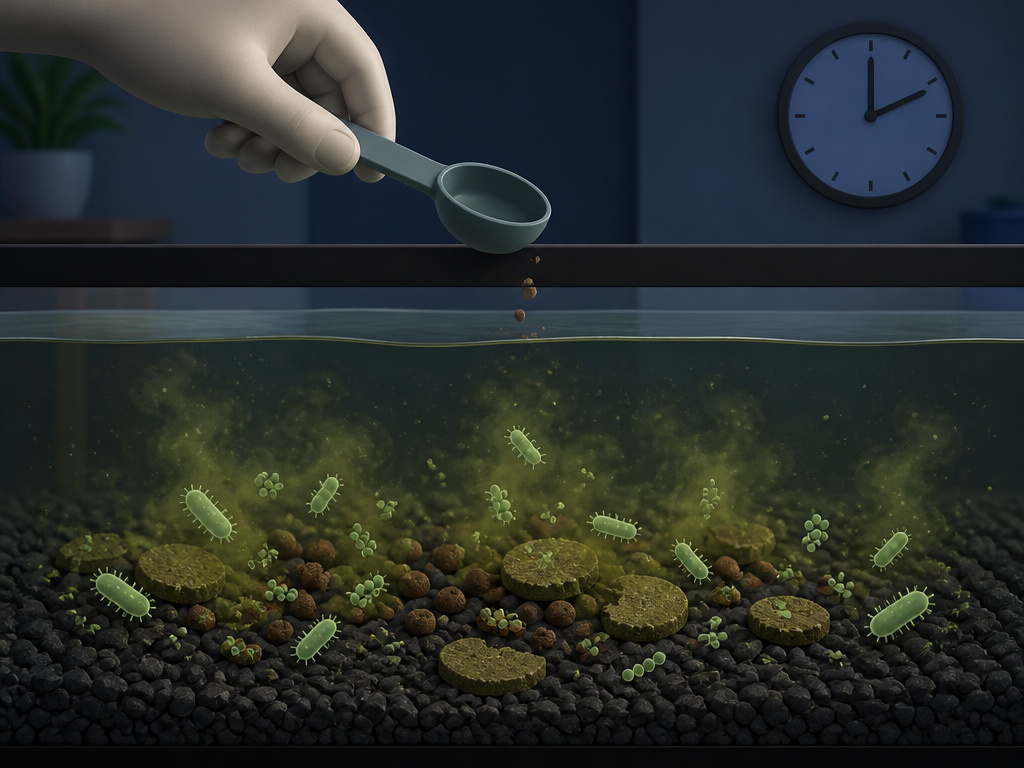
API sells its bottom feeder pellets on a claim of up to 30% less ammonia than leading competitor foods. The page cites no study for that figure, and the extension research points at a different variable entirely.
MAFES Bulletin 1230 puts the emphasis on quantity and timing. Maximum oxygen demand generally occurs about 6 to 12 hours after feeding, which means the damage from a heavy meal lands overnight, long after you’ve walked away from the tank.
Here’s the mechanism, because it explains why the brand argument is a sideshow. Food that isn’t eaten, or isn’t digested, becomes waste. Bacteria break that waste down, the breakdown consumes oxygen, and ammonia comes out the other end. API’s own page states it plainly: overfeeding and poorly digested food raise ammonia, and high ammonia causes gill damage, stress, illness, and death.
That’s the part worth sitting with. The brand on the bag matters less than how much of it you put in.
Where this goes sideways: A tank fed to the 30-minute window instead of the 3-minute one leaves food soaking ten times as long. The uneaten portion starts breaking down within hours, and oxygen demand peaks 6 to 12 hours later, well after you’ve gone to bed.
For anyone running something bigger than a tank, the MAFES Practical Guide to Catfish Nutrition caps long-term average daily feeding at about 120 lb/acre in regular ponds, 200 lb/acre in intensively aerated ponds, and 250 lb/acre in split ponds. The catfish feeding numbers scale with aeration, not with how hungry the fish look.
Pellets, Wafers, or Tablets: Read the Guaranteed Analysis
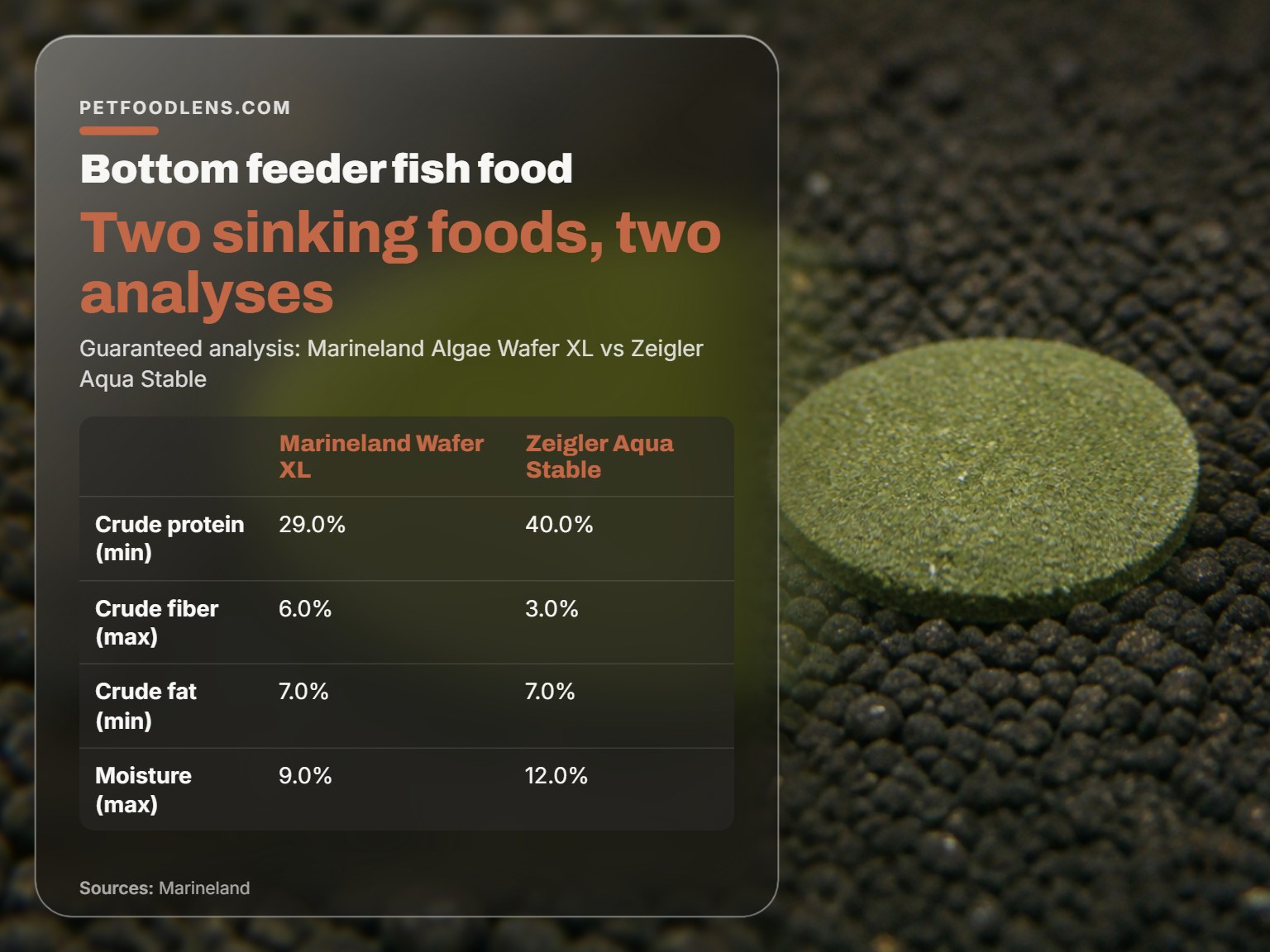
The guaranteed analysis is the only part of the package written in numbers instead of adjectives.
| Spec | Marineland Algae Wafer XL | Zeigler Aqua Stable |
|---|---|---|
| Crude protein (min) | 29.0% | 40.0% |
| Crude fat (min) | 7.0% | 7.0% |
| Crude fiber (max) | 6.0% | 3.0% |
| Moisture (max) | 9.0% | 12.0% |
| Phosphorus (min) | 0.8% | 1.1% |
| Form | 16-19 mm sinking wafer | 3/8 inch sinking pellet |
Marineland Algae Wafer XL runs 16 to 19 mm across, which suits a grown pleco and buries a cory cat. Aqueon Bottom Feeder Tablets come in at about 11 mm, and Aqueon’s own guidance says to break them into pieces if you need to prevent overfeeding. Match the size to the mouth in front of it.
I read the guaranteed analysis before I read the front of the bag. On fish food that habit pays off faster than it does on cat food, because the protein spread between products is wider than the packaging lets on.
What the Protein Number Does and Doesn’t Tell You
Zeigler Aqua Stable lists 40.0% minimum crude protein against Marineland’s 29.0%. That gap is real, and it doesn’t automatically make Zeigler the right call for a community tank. A minimum is a floor printed on a bag, not a measurement of what your fish can actually digest.
Fiber runs the other direction. Marineland caps crude fiber at 6.0% and builds the wafer around fiber-rich cellulose, which fits a grazing pleco. Zeigler caps fiber at 3.0% and puts the emphasis on water stability instead.
That’s the pattern across fish food types generally.
Match the Size to the Mouth
Zeigler Aqua Stable is a 3/8 inch sinking pellet. Zeigler’s sheet describes the pellet softening into a doughy consistency after 24 hours in the water, which is deliberate: it’s built for species that graze over a long period.
Algae wafers work on the same principle at a smaller scale. Aqueon’s tablets sink and dissolve more slowly than a standard pellet, which spreads the feeding over time rather than dumping it all at once.
Easy to miss: A wafer still sitting on the gravel after 24 hours has been soaked, not eaten. Zeigler’s own spec puts the doughy stage at the 24-hour mark.
When the Water Drops Below 65°F, the Food Has to Change
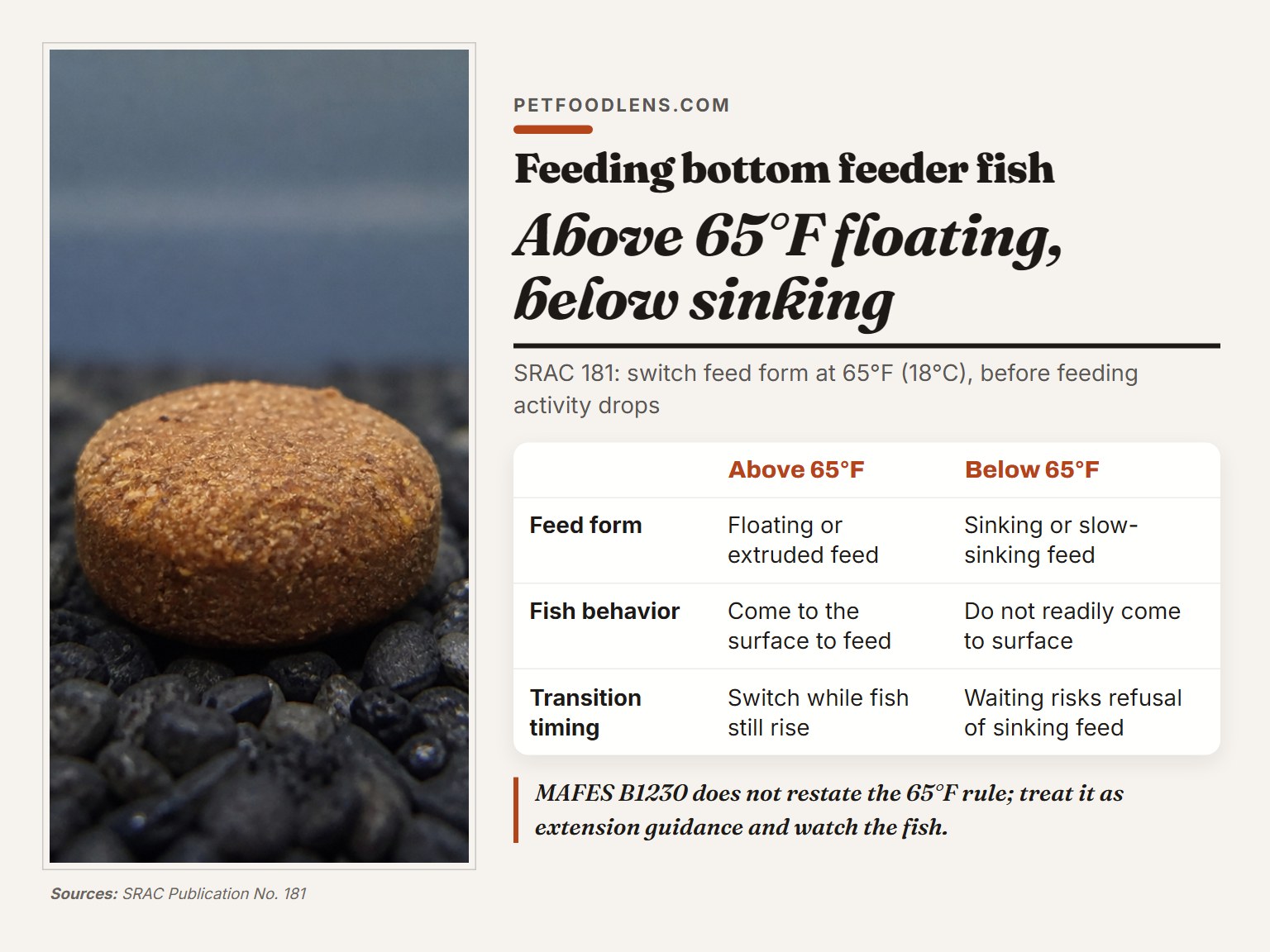
Cold water changes the job description.
SRAC Publication No. 181 draws the line at 65°F (18°C): floating or extruded feed above it, sinking or slow-sinking feed below. The reason is behavioral rather than nutritional. Below that threshold, fish stop coming to the surface readily, so a floating pellet sits there getting waterlogged.
The transition warning matters more than the threshold itself. SRAC warns that if you wait until feeding activity drops, getting fish to accept sinking feed becomes difficult. Start the switch while they’re still rising.
That’s the practical version of the sinking pellets argument. Sinking food isn’t a niche product for bottom dwellers. It’s the seasonal default for everyone once the water cools.
MAFES Bulletin 1230 doesn’t restate the 65°F rule at all. It frames limits by pond type instead. Treat the temperature switch as extension guidance rather than settled consensus, and watch the fish rather than the calendar.
How Do You Feed Bottom Feeders Without Clouding the Water?
Lights out, a wafer drops, and by morning there’s a pale haze against the back glass.
- Count the portion before it goes in. A fixed number of wafers or pellets makes every later decision possible. Eyeballing a scoop is how tanks get overfed.
- Drop food in two places, not one. A single pile lets the dominant fish guard it, and the shy ones get nothing.
- Come back within the shortest consumption window and net out what’s left. This is the step that prevents the 30-minute window from turning into an all-night soak.
- Feed at the same time each day. Feed at the same time each day.
Zeigler’s technical sheet describes a technique built for ponds. Pellets go into a 1/8 inch mesh bag with a small piece of styrofoam attached. When the bag floats, the food is gone.
The part nobody mentions: Cloudy water can show up after the mistake that caused it, not the same evening. By the time the haze appears, the food has already broken down and the oxygen dip has already happened.
If clarity is the recurring problem, the fix usually sits in the cloudy water routine rather than in a new filter pad. Portion control beats filtration every time.
A feeding schedule that accounts for both the top feeders and the substrate grazers is the difference between a tank that stays clear and one that needs frequent water changes.
Frequently Asked Questions
How often should I feed bottom feeder fish?
Sources disagree. API says twice a day, Marineland says 1 to 3 times daily, and MAFES Bulletin 1230 found that once daily to apparent satiation is satisfactory and that a second daily feed is likely wasted. Pick a cadence and hold it.
Do bottom feeders need their own food, or will they eat leftovers?
They’ll eat leftovers, but a leftover isn’t a diet. API describes its sinking pellets as a complete and balanced diet for catfish, plecostomus, and loaches. Scavenged scraps don’t reliably deliver that, especially in a tank where the faster fish get first pick.
Can I feed bottom feeders at the same time as the other fish?
Yes, and it’s usually easier. Drop the sinking food first so it starts its descent, then feed the surface. That gives the substrate feeders a head start before the mid-water fish start hunting anything that moves.
How long can bottom feeders go without food?
Longer than most owners expect. MAFES found catfish fed once a week to satiation over short periods generally maintain body weight, with a 7% gain at two months and 29% at four months. That’s pond research on catfish, so treat it as a short-term observation, not a recommended schedule.
Do I need to remove uneaten wafers?
Yes, within a few minutes of the feed. Aqueon’s own guidance suggests breaking tablets into pieces to prevent overfeeding in the first place, which is easier than netting out the remainder afterward.
Before You Go
One number is worth carrying out of this article: the shortest consumption window any credible source gives you. That’s 3 minutes from API’s own instructions and “a couple of minutes” from Marineland. Feed to the short end and you’ve solved most of the water-quality problems before they start.
The first step this week is small. Count the wafers instead of scooping, and time the next feed with your phone. If food is still on the gravel at the shortest consumption window, you’ve found your portion problem without spending anything.
All of this assumes a tank at normal tropical temperature. Below 65°F (18°C) the whole schedule changes, and the feed itself has to change with it.
An overfed tank spends the hours after the meal converting your money into ammonia.
