
Low-Fat Dog Treats Guide: How to Choose
This post contains affiliate links. As an Amazon Associate, we earn from qualifying purchases.
Low-fat dog treats fit inside a hard ceiling: treats should make up no more than 10% of a dog’s daily calorie intake, per the WSAVA guide to feeding treats. For a 4 kg dog that ceiling is 24 kcal a day, which is less than a third of one large Milk-Bone biscuit at about 85 kcal.
Run that arithmetic across a full day and the treat budget stops being a rounding error. A 4 kg dog’s entire allowance disappears into a quarter of one biscuit. The rest of the day’s rewards have to come from something else, which is where a low-fat dog treats guide can help.
What follows is the working method: how the 10% ceiling scales by body weight, why “low-fat” has no legal definition on a treat bag, which single-ingredient treats clear a fat-restricted diet, and where the label numbers quietly lie.
Key Takeaways
- 10% of daily calories is the ceiling for everything a dog chews, including chews, supplements, and food used to hide a pill.
- A 4 kg dog’s daily treat allowance is 24 kcal. One large Milk-Bone biscuit is about 85.
- “Low-fat” has no legal cutoff for dog treats, and three credible sources use three different numbers.
- Fat on the label is a minimum, so per DogAware the bag can understate what is actually inside it, though state labeling rules require Crude Fat (Min) as a label element.
- Bones caused 77% of esophageal foreign bodies in one review of 349 cases.
What Does the 10% Treat Rule Actually Allow?
The 10% figure is a ceiling on calories, not a count of biscuits. It covers everything a dog takes in outside the main diet.
Treats, chews, supplements, and food used to hide a pill all count toward the same daily allowance. The allowance is set at 10% of a dog’s total calorie intake, with the remaining 90% coming from a complete and balanced diet. The figure appears in WSAVA guidance, veterinary hospital handouts, and European industry fact sheets.
That last point matters because the rule is not really about weight. Treats are exempt from meeting nutritional adequacy requirements for complete and balanced food, which is why AAFCO requires the words “snack” or “treat” on the front panel. The 10% is what protects the other 90% from being diluted.
The WSAVA numbers convert the percentage into something you can actually use.
| Dog’s weight | Maximum calories from treats per day |
|---|---|
| 2 kg | 14 kcal |
| 4 kg | 24 kcal |
| 6 kg to 45 kg | 32 kcal |
| 45 kg | 146 kcal |
The published table holds at 32 kcal across a wide middle range and then jumps to 146 kcal at 45 kg. Take the numbers as printed and ask your veterinary team for your own dog’s daily energy requirement, because these are based on an average healthy adult dog in ideal body condition.
Which is why the 10% calorie rule is easier to hold when you count a chew as food rather than as furniture.
How Many Calories Are Hiding in Ordinary Treats?
One large Milk-Bone biscuit carries about 85 calories. That single number reframes most treat advice you will read.
| Item | Portion | Calories |
|---|---|---|
| Lean cooked chicken breast, no skin | 1 oz / 28 g | 47 |
| Lean cooked beef | 1 oz / 28 g | 64 |
| Cheddar cheese | 1 oz / 28 g | 120 |
| Peanut butter | 1 tbsp | 81 |
| Dried pig’s ear | 2 oz / 56 g | 242 |
| Rawhide bone | 6.7 oz / 190 g | 700 |
A dried pig’s ear comes out of the bag smelling like a smokehouse and feels like a strip of hard leather. It also carries 242 calories, which is more than seven days of a 32 kcal daily treat allowance in one item.
Biscuits are their own problem. A published dog treat nutrition study of commercial treats, summarized in a 2024 review, put biscuit caloric density at roughly 329 kcal metabolizable energy per 100 g, with individual biscuits weighing 6.5 to 11.8 g and averaging about 21.7 kcal each. Sugar content ran as high as 51.7 g per 1000 kcal in one product, and the review recommends avoiding high-sucrose biscuits for dogs with diabetes.
Common mistake: Treating a chew as furniture rather than food. A 6.7 oz rawhide bone runs about 700 calories, which is far more than a 45 kg dog’s entire daily treat allowance of 146 kcal, and the surplus lands on the ribs long before it lands on a scale.
If you want the calorie count to do any work, start with a low-fat dog treats guide rather than the ones sold on dental claims.
Why “Low-Fat” on a Treat Bag Has No Fixed Meaning
Ever tried to find a legal definition of low-fat for dog treats? There isn’t one that everyone uses.
| Source | What it calls low-fat | Basis |
|---|---|---|
| Rover guide | Under 15% fat | Dry matter |
| DogAware | 8% or less | As-fed label figure |
| Frontiers review | No fixed cutoff | Reports fat as composition only |
Those are not minor variations. A treat at 12% fat on a dry matter basis clears one definition and fails another, and the Frontiers review declines to set a threshold at all.
What the Guaranteed Analysis Order Tells You
State labeling rules require the Guaranteed Analysis in a fixed order: crude protein (min), crude fat (min), crude fiber (max), moisture (min). Notice the word minimum. Crude fat on a bag is the least fat the product is guaranteed to contain, not a measurement of what it does contain.
DogAware documented how far that gap can run. Nature’s Variety raw diets printed 6% to 8% fat on the label while a calculation from the product’s own calorie figures put the real value above 18% on a dry matter basis. Wellness reported its Senior Recipe canned food at 6.1% fat against 3% on the label. Merrick reported Grammy’s Pot Pie at 5.75% and Thanksgiving Day Dinner at 5.97%, both against a printed 4%.
The same minimum-not-actual problem runs through low-fat dog food as well, so the habit is worth building on the whole bowl, not just the treats.
Why the Calorie Number Is Often Missing
Treats are not required to carry full pet food labeling unless they make a claim such as “nutritious,” “low-fat,” or “complete and balanced.” Many carry no calorie statement and no guaranteed analysis at all. The products most in need of a number are the ones least likely to print one.
Where this goes sideways: Trusting the fat minimum as a maximum. A raw diet printed 6% to 8% fat on the label; a calculation from its own calorie figures put the real number above 18% on a dry matter basis.
The “light” and “lower calorie” claims deserve scrutiny: VCA says such treats are not significantly lower in calories, while Rover treats low-fat and low-calorie as a meaningful category. VCA states plainly that treats labeled light or lower calorie are not significantly lower in calories than other treats. Rover, by contrast, treats low-fat and low-calorie as a meaningful shopping category for weight management. Both positions are on the record, and only one of them is telling you to check the actual number.
Which Low-Fat Dog Treats Actually Clear the Bar?
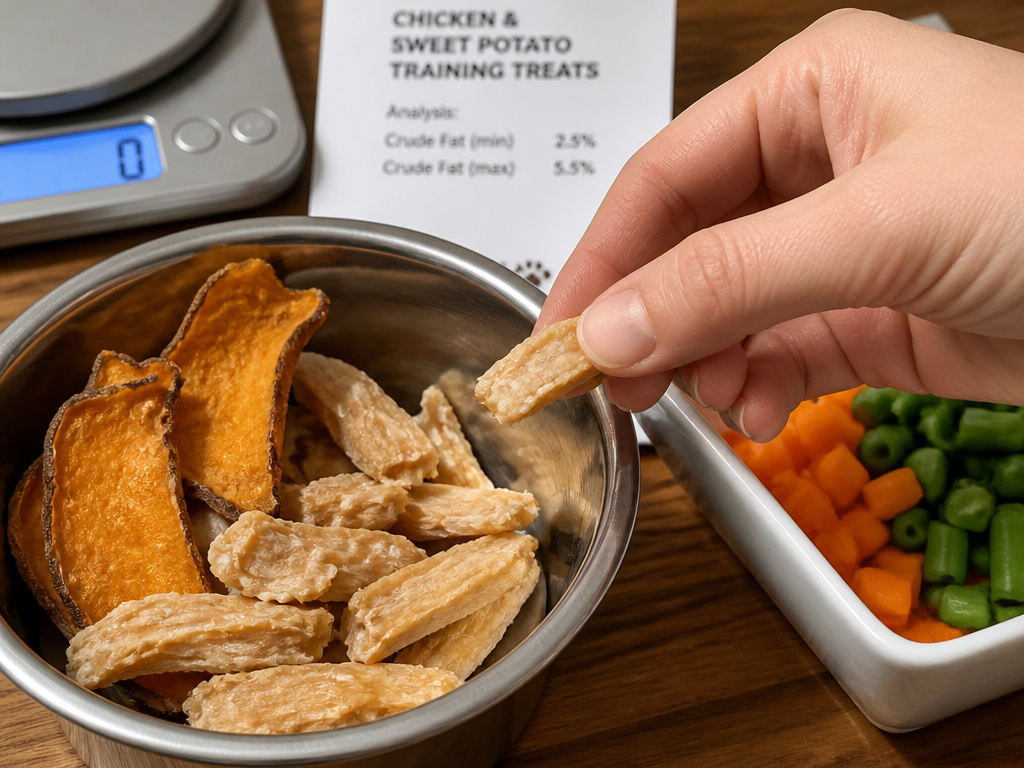
JustFoodForDogs builds its low-fat line on single proteins, and the fat figures are published rather than implied.
Their dehydrated chicken breast treats list at 6% fat, the beef liver bark at 5%, and the salmon bark at 14%. Dehydrated chicken breast pieces come in at 3% fat and about 3 kcal per piece, a number that lets you hand out six rewards in a training session without wrecking the day. Himalayan dog chews, made from yak and cow milk, come in under 1% fat.
The low-fat dog treats guide worth keeping in the cupboard tend to share that shape: one named protein, a published fat figure, and a calorie count you can divide by.
Non-meat options work too. Carrot, apple, banana pieces, and green beans all serve as low-fat treats if the dog will eat them. Dried sweet potato slices and plain rice cakes show up repeatedly among owners managing pancreatitis.
The Single-Ingredient Trap
A short ingredient list is not automatically a good one. DogAware flags dehydrated chicken jerky specifically, noting that most is imported from China and that the AVMA and FDA have warned these treats have been linked to kidney failure in dogs. One ingredient, and still a bad buy.
I would take a 3% fat chicken piece over a 1% fat antler every time. The fat number is the easy part; the fracture risk is the part that costs you a dental visit.
Two genuine disagreements are worth knowing before you shop. On raw and freeze-dried treats, VCA warns that freeze-dried or dehydrated raw products pose a bacterial contamination risk spread through saliva and feces to other pets and humans, while Rover recommends freeze-dried raw single-ingredient treats as a good low-fat choice. The fat content and the safety question are two separate conversations.
Which Treats Cause the Most Serious Harm?
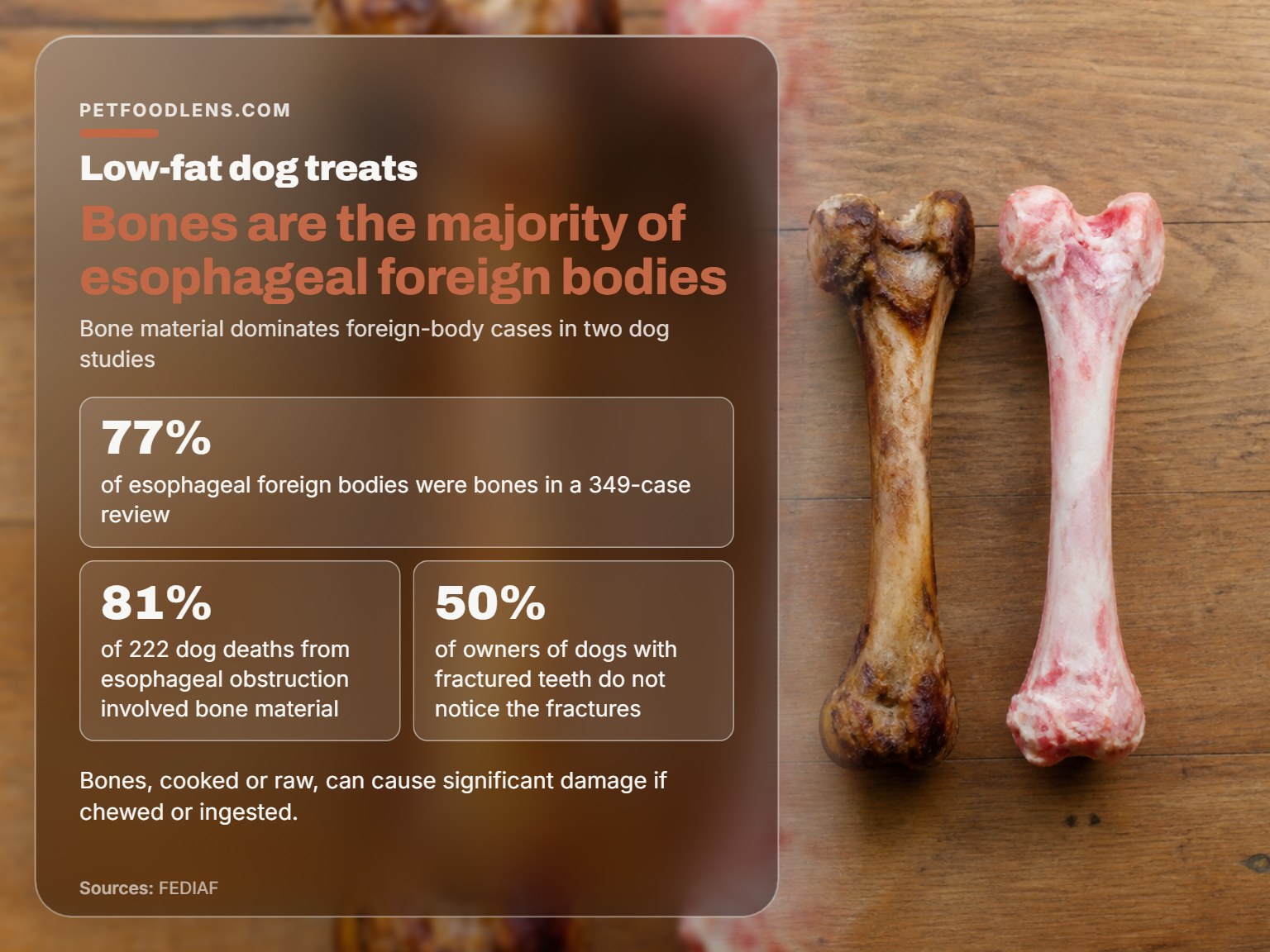
Bones accounted for 77% of the foreign bodies in one review of 349 esophageal cases. In a separate retrospective study of 222 dog deaths following esophageal foreign body obstruction, bone material was the foreign body in 81% of cases.
Before you start: Bones, cooked or raw, caused 77% of the esophageal foreign bodies in one 349-case review, and hard chews that do not soften can fracture a tooth. Feed chews only while you are watching, and match the size and shape to the dog’s body weight so a whole piece cannot go down.
The rest of the avoid list is short and specific:
- Bones, cooked and raw. WSAVA states both can cause significant damage if chewed or ingested.
- Antlers, hooves, and anything with sharp edges. Named directly as excessively hard.
- Unprocessed raw animal-based treats, such as contaminated pigs’ ears, which carry a pathogen transmission risk.
- Human food and table scraps, which FEDIAF notes can be too high in fat, salt, sugar, and energy, or contain toxic ingredients.
The toxic list is worth memorizing: chocolate, macadamia nuts, onions, leeks, shallots, garlic and chives, grapes, raisins, currants and sultanas, xylitol, alcohol and raw yeast dough, and caffeinated drinks.
The Finger Test for Hardness
There is currently no legal standard for hardness in dog chews, which leaves the judgment to you. FEDIAF’s guidance is that a chew should be bendy and malleable, or soften quickly once chewed, because a chew that resists causes a painful tooth fracture.
A biscuit broken between your fingers makes a short, dry snap. A chew that refuses to give at all under the same pressure is the one to put back on the shelf. Half of owners of dogs with fractured teeth never notice the fractures, according to a 2005 study cited by FEDIAF, so the finger test is doing more work than the dog’s behavior will.
How Do You Build a Treat Budget Without Weighing Everything?
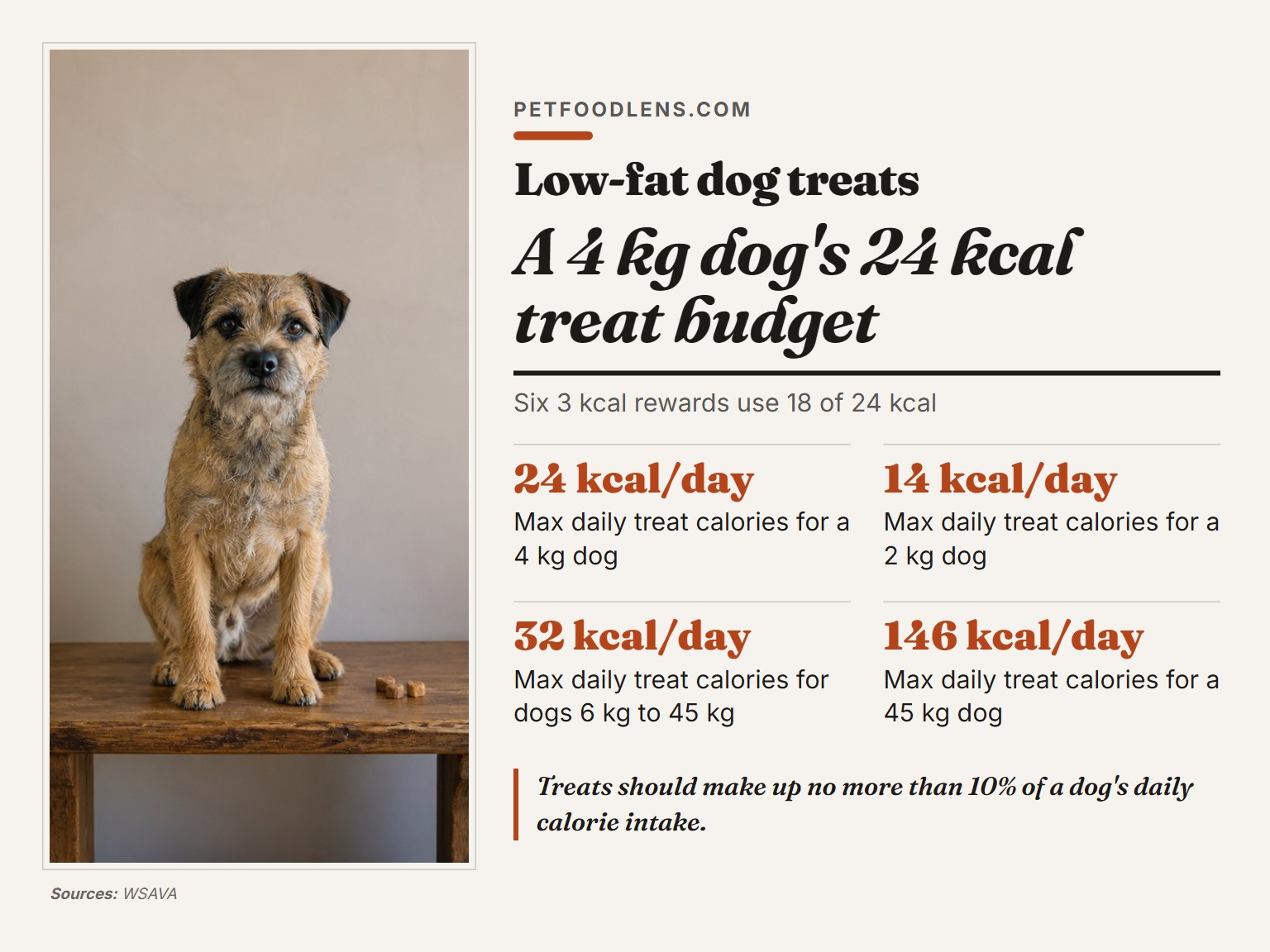
A 4 kg terrier finishes a five-minute sit-stay drill and has earned six rewards. At 3 kcal apiece that is 18 of a 24 kcal daily allowance gone before lunch.
- Get the daily calorie requirement from your vet first. Guessing sets the entire budget on a wrong base, and every treat after that is a rounding error on a bad number.
- Take 10% of that figure and write it on the treat bin. A number you can see is a number you will respect.
- Subtract the treat calories from the meal, not from the target. Cut the kibble by the same amount and the dog stays at maintenance.
- Count the invisible items: pill-hiding food, dental chews, training rewards, and anything a visitor hands over. These are the calories nobody logs.
- Weigh or count for one week before you trust your eye. A “small piece” of cheddar at 120 kcal per ounce is not small.
Training sessions are where the budget dies, which is why low-calorie training treats exist as a category rather than as a marketing angle.
The Cambridge weight management handbook offers a different route to the same place: measure the daily ration, then use part of that measured ration as the treats, so nothing gets added at all. That method skips calorie counting entirely, and it conflicts with the more common advice to follow the feeding guidelines printed on the pack. A 2018 analysis of commercial treats found that following producers’ feeding instructions delivered the highest percentage of maintenance energy requirement to small dogs, which is a polite way of saying the bag overfeeds the little ones.
What Changes for a Dog on a Prescription Diet?
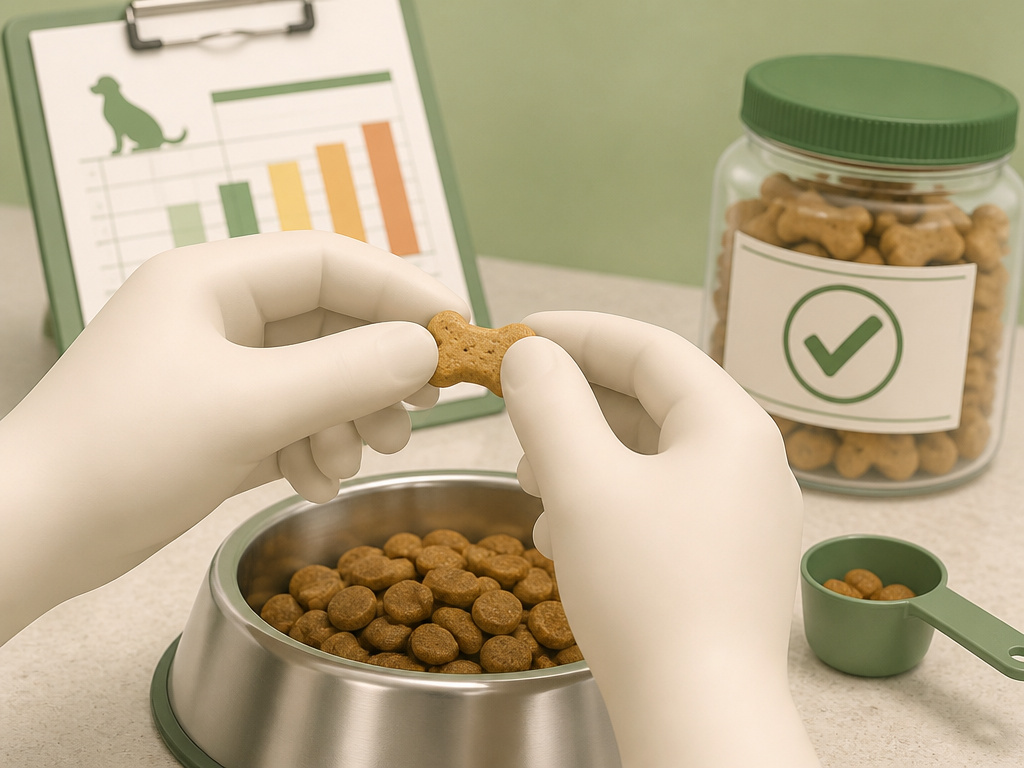
Prescription diets change the arithmetic, and the treat decision stops being yours alone. VCA’s position is that for a dog on a special diet, you stick to treats the veterinarian deems safe, and that a canned option paired with the food can be baked into small treats when you need variety.
For a dog with chronic pancreatitis on a low-fat diet, high-fat treats are the thing to avoid. If your dog has had pancreatitis, the treats for pancreatitis question is a veterinary one first and a shopping one second.
There is also a useful caution against over-restricting. DogAware cites a study in which severe fat restriction at 13% of calories from fat failed to show any significant benefit for dogs with exocrine pancreatic insufficiency. Fat restriction is a tool with a target, not a virtue.
I will be straight about my own limits here. My working background is commercial cat food and ingredient panels, and my dog-side knowledge is thinner, particularly on therapeutic diets for kidney, urinary, and diabetic cases. Read the panel with me, then let your vet set the number.
Most homemade dog treats I get asked about are fine as treats and a disaster as meals. The rule I give is boring and it works: keep the complete food as the base, keep treats under that 10% ceiling, and use the homemade batch as a topper rather than a replacement.
Frequently Asked Questions
Are low-fat dog treats safe for every dog?
No. A low-fat treat is still a treat, and it still counts against the 10% ceiling. Dogs on prescription diets, dogs with pancreatitis, and dogs with food allergies need veterinarian-approved treats rather than whatever carries a low-fat claim on the bag.
How many low-fat treats can a small dog have?
Work from calories, not from pieces. A 2 kg dog has 14 kcal a day for treats and a 4 kg dog has 24 kcal. At 3 kcal per dehydrated chicken piece, that is roughly four to eight pieces a day, and nothing else.
Is a freeze-dried raw treat lower in fat?
Often yes, and that is not the whole question. Rover lists single-ingredient freeze-dried raw treats, mostly organ meats, at under 10% fat. VCA separately warns that freeze-dried and dehydrated raw products carry a bacterial contamination risk that can spread to other pets and to people in the house.
Do “light” or “lower calorie” labels mean fewer calories?
VCA states that treats labeled light or lower calorie are not significantly lower in calories than other treats. Treat the claim as marketing until the package gives you a calorie figure per piece.
Can I use my dog’s regular food as treats?
Yes, and it is one of the cleaner solutions. VCA suggests using a portion of the regular food as treats, and the Cambridge handbook builds a whole method around it. Take the calories out of the measured daily ration rather than adding them on top.
The Bottom Line
The trigger I would give anyone: if the treats in your house add up to more than a tenth of what goes in the bowl, the treats are the problem and the food is fine. Fix that before you change diets.
This all assumes a healthy adult dog at ideal body weight. For a dog with pancreatitis, kidney disease, or a urinary prescription diet, the 10% ceiling is a starting point and your vet sets the real number. That concession is not hedging; it is where most of the actual risk lives.
And if I had to pick one habit to keep, it would be the boring one. I would rather see a dog earn three pieces of its own kibble than a “low-fat” biscuit that prints a fat minimum and no calorie statement at all. One of those is food. The other is a brochure.
