
Low-Fat Dog Food Guide: What Labels Really Say
This post contains affiliate links. As an Amazon Associate, we earn from qualifying purchases.
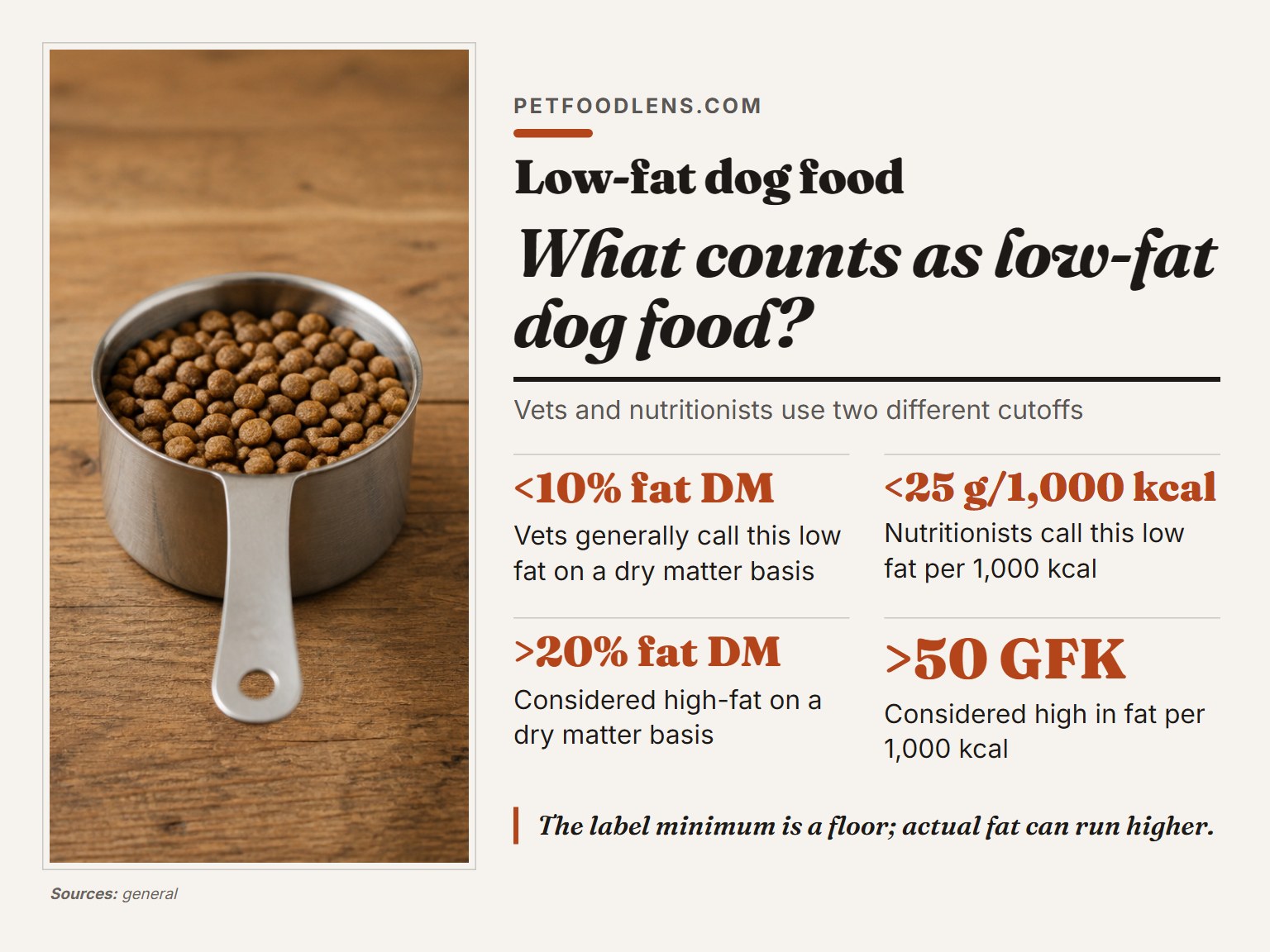
Low-fat dog food guide math starts with dry matter: under 10 percent fat on a dry matter basis is low fat, 10 to 15 percent is moderate, and anything over 20 percent is high. Veterinary nutritionists use a second scale, under 25 grams of fat per 1,000 calories.
The low-fat dog food guide math strips the water out, which is the whole reason a canned food and a bag of kibble can print the same fat percentage and behave nothing alike. Moisture is the variable doing the damage. The wetter the food, the more the as-fed number flatters it.
What follows is the arithmetic, the label traps, the dogs who genuinely benefit from fat restriction, and the ones who get hurt by it.
Key Takeaways
- Under 10 percent fat on a dry matter basis is the low-fat line most veterinarians use; 10 to 15 percent is moderate and past 20 percent is high.
- The guaranteed analysis minimum is a floor, and several manufacturers have confirmed their real fat content runs well above it.
- Under 25 grams of fat per 1,000 calories is the nutritionist cutoff, and it does not map cleanly onto dry matter percentages.
- Not every pancreatitis or EPI dog needs lifelong fat restriction; severe restriction showed no significant benefit in one EPI study.
- Low-fat rules are for adult maintenance only, never for puppies or pregnant and nursing females.
What Counts as Low Fat on a Dry Matter Basis?
Ten percent is the line most veterinarians draw. A diet under 10 percent fat on a dry matter basis reads as low fat, 10 to 15 percent reads as moderate, and anything past 20 percent reads as high.
Dry matter basis removes water from the calculation before fat gets measured, so a canned diet and a dry diet are compared on the same footing regardless of how wet either one is. Grams of fat per 1,000 kcal does the same job from the energy side instead of the weight side.
The low-fat dog food guide dry matter figure simply means the food with its water taken out. A canned diet that looks lean because it’s mostly moisture gets recalculated as if that moisture weren’t there, which is the only way to set it beside a bag of kibble.
The Two Scales Vets Actually Use
Both scales are in circulation, and they don’t convert into each other.
| Basis | Cutoff | Who uses it |
|---|---|---|
| Dry matter, low fat | Under 10% fat DM | Veterinary convention |
| Dry matter, moderate | 10-15% fat DM | Veterinary convention |
| Dry matter, high fat | Over 20% fat DM | Veterinary convention |
| Grams per 1,000 kcal, low fat | Under 25 g | Veterinary nutritionists |
| Grams per 1,000 kcal, high fat | Over 50 g | Reference cutoff |
| Therapeutic low-fat diets | 18-23 g per 1,000 kcal | Commercial veterinary formulas |
The nutritionist scale exists because calories drive how much a dog actually eats. A food with a lot of moisture can post a modest as-fed fat percentage and still deliver a hefty fat dose per calorie.
Royal Canin’s own technical paper on GI diets concedes the ground here: the definition of a low fat veterinary diet is “somewhat arbitrary,” and fat content can be represented in a variety of ways. That’s a manufacturer saying the label convention is loose.
Why the Guaranteed Analysis Minimum Is Not the Fat Content
A guaranteed analysis reports the minimum fat a batch is legally allowed to contain. It says nothing about what’s sitting in the can you’re holding.
DogAware’s long-running diet reference documents the gap product by product. Nature’s Variety raw diets print 6 to 8 percent fat on the label, but the site’s author calculates the actual figure may run above 18 percent, roughly 50 percent on a dry matter basis. She does not consider that food safe for a dog that needs low fat.
Wellness reports its Senior Recipe canned food carries 6.1 percent fat against the 3 percent on the label. Merrick reports Grammy’s Pot Pie at 5.75 percent and Thanksgiving Day Dinner at 5.97 percent, both against a 4 percent label.
| Product | Label fat | Reported actual fat |
|---|---|---|
| Nature’s Variety raw diets | 6-8% | Possibly over 18% (about 50% DM) |
| Wellness Senior Recipe canned | 3% | 6.1% |
| Merrick Grammy’s Pot Pie canned | 4% | 5.75% |
| Merrick Thanksgiving Day Dinner canned | 4% | 5.97% |
| Canidae Platinum Formula | Dry version baseline | Canned carries almost twice the fat |
That last row is the one that catches people. Canidae Platinum Formula’s canned version has almost twice the fat of its dry version, so a dog doing fine on the kibble can slide backward on the identical recipe in a can.
A minimum fat guarantee is the lowest number a company will defend, not the number in the bowl. When the margin matters, ask the manufacturer for the actual as-fed fat percentage.
How Do You Convert a Label Into Grams of Fat per 1,000 Calories?
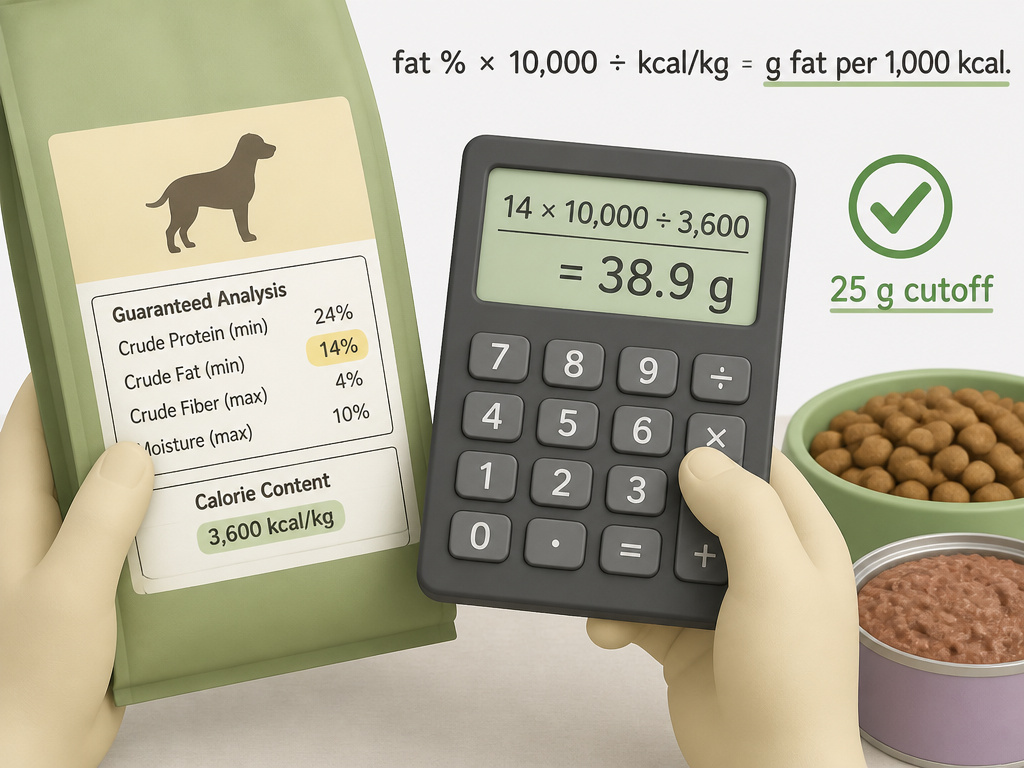
Grams of fat per 1,000 kcal is the unit veterinary nutritionists reach for, and it’s the only one that puts a can and a bag in the same comparison.
Show me the numbers. The arithmetic is short.
Take the fat percentage as fed, multiply by 10,000, and divide by the kilocalories per kilogram figure usually printed with the guaranteed analysis. The result is grams of fat per 1,000 kcal, and you can hold it against the 25-gram cutoff directly.
For scale, commercially available veterinary therapeutic low-fat diets land between 18 and 23 grams of fat per 1,000 kcal. DogAware’s sample homemade low-fat recipe comes in at 25 grams per 1,000 calories, which sits exactly on the nutritionist line rather than under it.
The two scales don’t reconcile. Energy density varies between formulas, so a diet that reads low fat on a dry matter label can still exceed a grams-per-calorie threshold depending on how concentrated the calories are.
Which Dogs Actually Need a Low-Fat Diet?
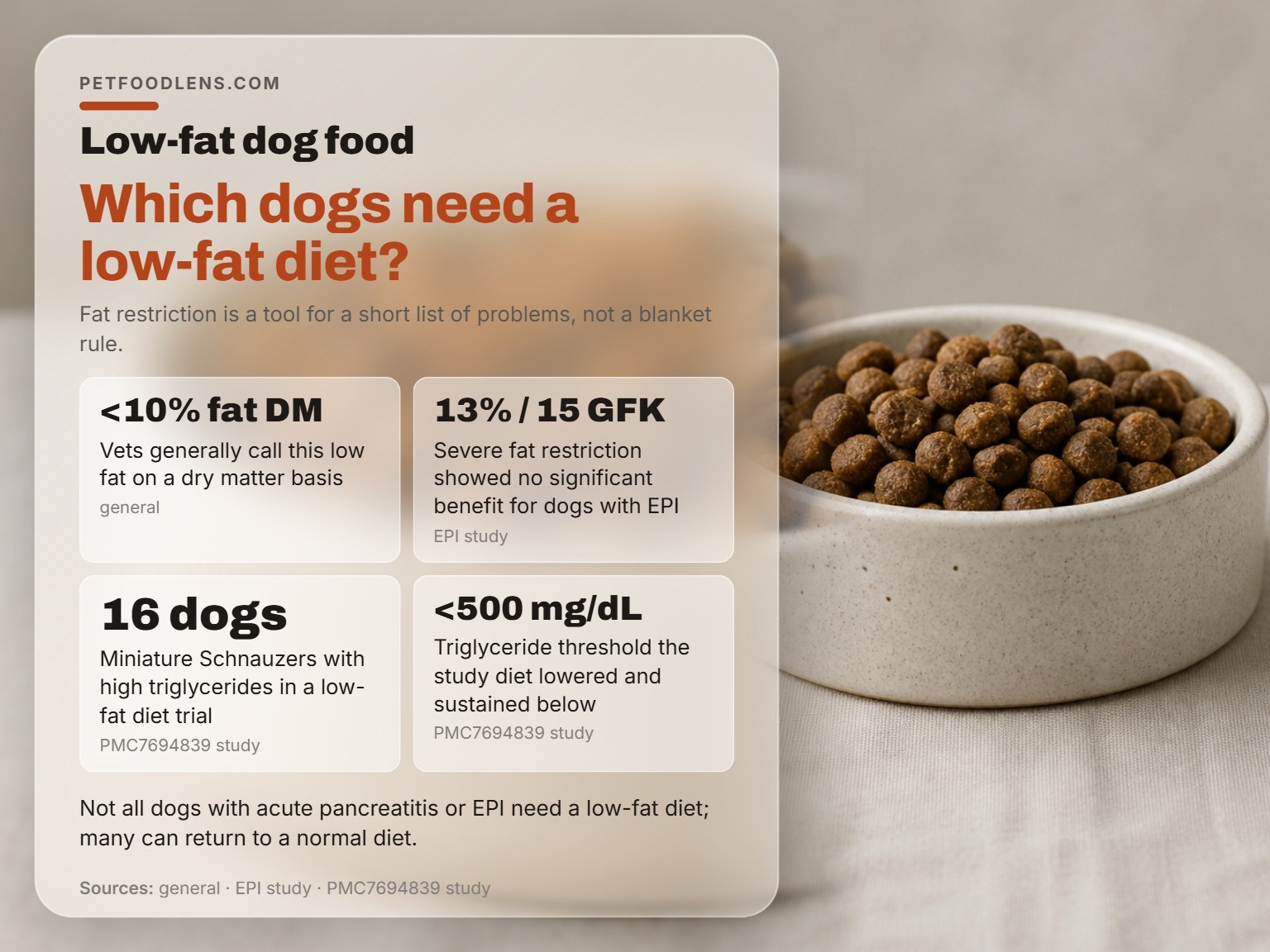
Fat restriction is a tool for a short list of problems. It gets applied far more broadly than the evidence supports.
Pancreatitis: Where the Advice Splits
DogAware is blunt about this one: not all dogs who have had acute pancreatitis need a low-fat diet, and many dogs who experienced an acute episode can return to a normal diet with no problem.
Royal Canin’s GI paper takes the other side of the room. It argues it would appear sensible to have GERD patients on a low fat GI diet, and makes a similar argument for chronic vomiting, regurgitation, GDV, and bloat, on the logic that faster gastric emptying helps.
Both positions are held by people who treat dogs for a living. If your dog has pancreatitis, the honest answer is that the diet decision is clinical, and the pancreatitis dog food question depends on which of those two camps your vet sits in.
Hyperlipidemia: Where the Evidence Is Strongest
The clearest evidence comes from a prospective trial in Miniature Schnauzers with high triglycerides. Sixteen dogs went onto a commercially available low-fat diet after a 7-day transition, with four blood samples taken across the study.
The diet significantly reduced both serum triglycerides and cholesterol in the majority of dogs within 2 months. Triglycerides dropped below the 500 mg/dL threshold associated with disease risk and stayed there, and more than half the dogs were classified as normal on lipoprotein analysis by the 2-month mark.
Two caveats matter. The cholesterol reduction was less impressive than the triglyceride result and possibly not as reliably sustained at 12 weeks. And triglyceride values swung wildly inside individual dogs on the same diet, with one dog moving from 300 mg/dL to almost 1,400 mg/dL between samples.
That last finding is why the authors recommend at least two samples at different time points before anyone diagnoses hypertriglyceridemia. One number is not a diagnosis. The Miniature Schnauzer hypertriglyceridemia diet research is worth reading in full if this is your dog.
EPI: The Case Against Blanket Restriction
Exocrine pancreatic insufficiency gets swept into low-fat advice constantly, and the support is thinner than it looks.
DogAware cites a study where severe fat restriction, at 13 percent of calories from fat or 15 grams per 1,000 kcal, failed to show any significant benefit for dogs with EPI. Older work on low dietary fat in pancreatic insufficiency studied the approach directly, which is where the practice came from in the first place.
So the practice has a history and the modern test of it came back flat. That’s an uncomfortable combination, and it’s exactly the kind of thing a bag of “pancreatic support” kibble won’t tell you.
Where Fat Restriction Backfires
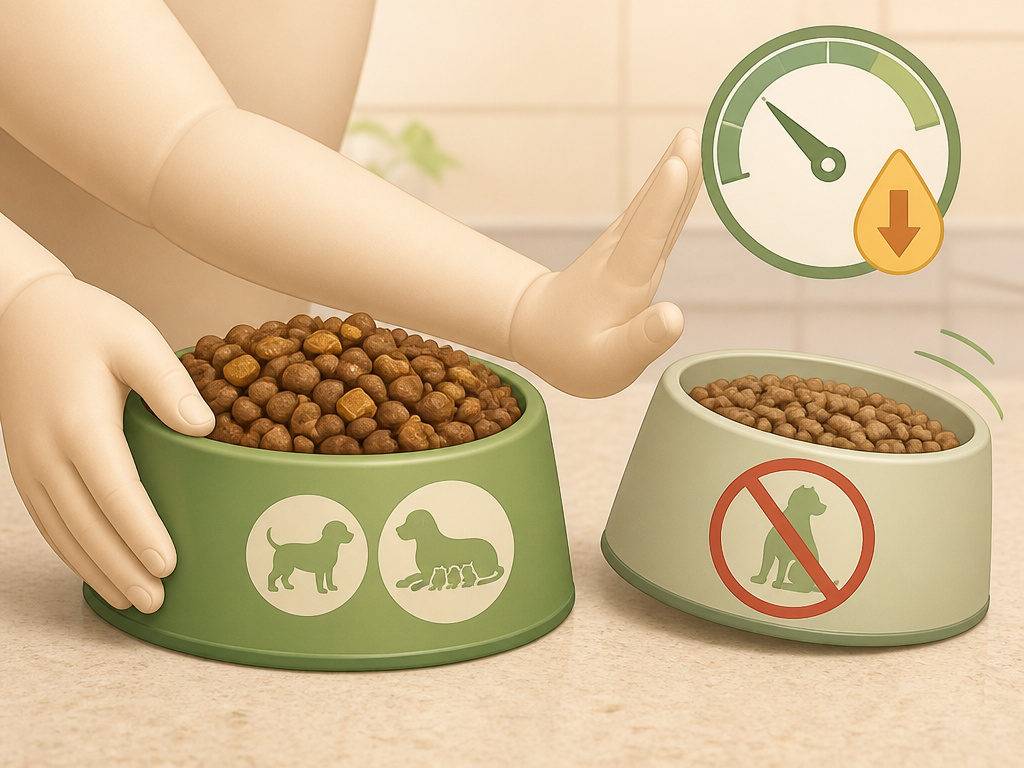
Low-fat guidelines are written for adult maintenance. That’s the scope, and it’s narrower than most owners assume.
DogAware states it plainly: the guidelines are not meant for puppies, or for females who are pregnant or nursing, because their requirements are different. Growing and reproducing animals need fat, and cutting it does damage that shows up later.
- Puppies. Fat supplies the energy density a growing body needs, and a restricted diet shortchanges development.
- Pregnant and nursing females. Needs climb during late gestation and peak during lactation.
- Underweight dogs. A low-fat diet is the most effective way to cut calories, which is the opposite of what a thin dog needs.
- Dogs with a high energy requirement from another condition. When two problems coexist, the diet has to serve the more serious one.
Skip this if: your dog is under a year old or a nursing mother. Fat restriction in that group costs growth and milk production, and the shortfall won’t show on the scale for weeks.
That calorie point cuts both ways. Royal Canin notes that reducing fat is the most effective way to reduce a diet’s calorie content, which is why low-fat formulas get used for weight loss even when fat itself isn’t the problem.
The Purina EN Low Fat Recall and the Texture Tell That Caught It
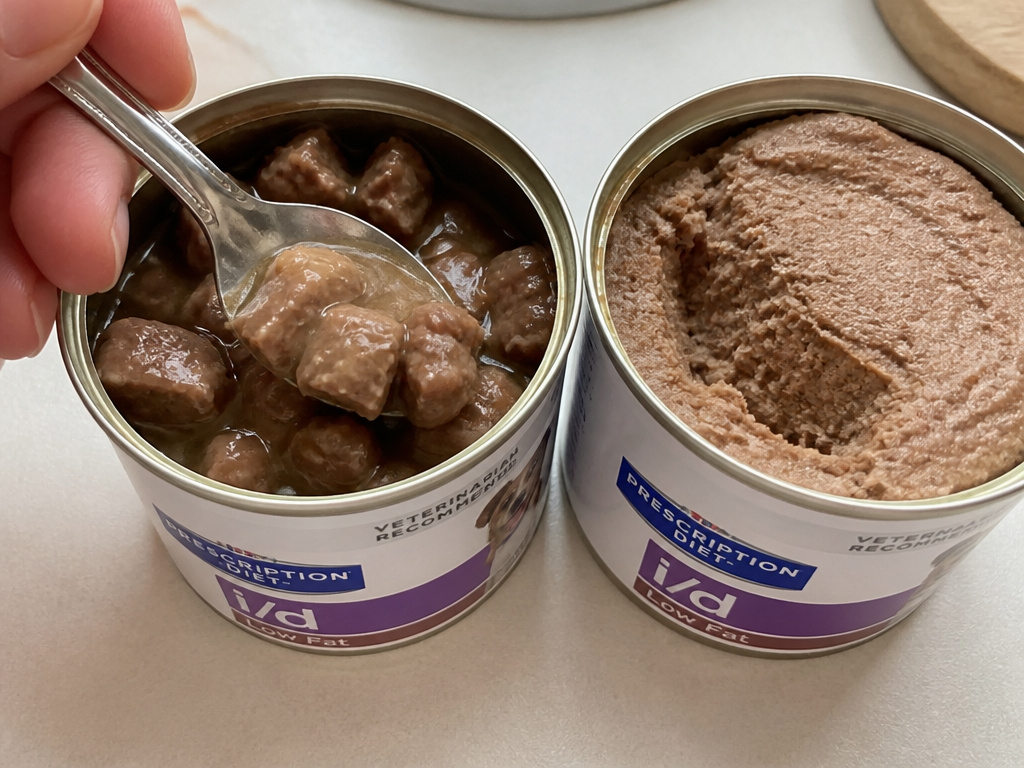
For a brief period on September 15, 2022, one Purina factory labeled cans of Purina ONE True Instinct Tender Cuts In Gravy With Real Turkey & Venison as PPVD EN Low Fat. Cans of Purina ONE True Instinct Tender Cuts In Gravy With Real Turkey & Venison went out labeled as Purina Pro Plan Veterinary Diets EN Gastroenteric Low Fat.
The mislabeled diet was safe to feed in the ordinary sense. It simply wasn’t the formula for a dog on a prescription low-fat diet, which is a real problem for a dog with sensitivities or trouble digesting fat.
What surfaced it was texture. Owners contacted the company because the food in their PPVD EN Low Fat cans didn’t feel like previous meals. The mislabeled product holds chunks in gravy. The correct product looks closer to a pate.
Where this goes sideways: a prescription diet that changes texture between cans is a labeling signal, not a batch quirk. Report it, and stop feeding that lot while you wait for an answer.
Nestlé Purina announced the voluntary recall on November 30, 2022, and the FDA posted it on December 2. The affected cans carry UPC 38100 17599, production code 22581159 L4TR6, and a “Best Before Sept 2024” date on the bottom. No illness or injury reports had come in at the time of the recall, and the company asked owners to discard any affected product.
Note the distribution detail. This was prescription-only product moving through clinics and retailers able to validate a script, so the mislabeled cans reached owners through a controlled channel and still got through. The full FDA Purina Pro Plan low-fat recall notice is worth reading if you still have cans from that window.
Six Label Checks Before You Buy Another Bag
Six checks, in this order. Each one takes a minute and each one has a failure mode if you skip it.
- Find the moisture percentage. Without it you can’t convert anything to dry matter, and the as-fed fat number stays meaningless.
- Convert fat to dry matter. Divide the fat percentage by 100 minus the moisture percentage, then multiply by 100. Skip this and a wet food can look leaner than a dry food when the reverse is true.
- Pull the kcal/kg figure. It’s usually printed with the guaranteed analysis. If it’s missing, ask the company, because without it you can’t reach grams per 1,000 kcal at all.
- Run the per-calorie math. Fat percentage times 10,000, divided by kcal per kilogram. Compare the result against 25 grams per 1,000 kcal.
- Ask for the actual as-fed fat. The label minimum is a floor. Wellness and Merrick both publish real figures above their labels, and a short email gets you the same answer for whatever you’re feeding.
- Check the storage, not just the bag.
Body condition belongs in the same check. The 2021 AAHA canine nutrition guidelines use a 9-point body condition score validated against body fat percentage, where each incremental score equals roughly a 5 percent jump in body fat and a score of 5/9 or higher means the dog is about 10 percent overweight.
Dry, Wet, or Homemade: Comparing Low-Fat Options
Dry, wet, and homemade low-fat diets fail in different ways, and the failure mode matters more than the format.
Therapeutic dry formulas are the most predictable route. If your vet prescribes one, you’ll likely meet Purina Pro Plan Veterinary Diets EN Gastroenteric Low Fat or a Royal Canin low-fat GI formula, both prescription-only. That consistency is the point of paying for a therapeutic diet.
Canned is where label understatement concentrates, because moisture makes the as-fed percentage look small. Ask for actual fat on any canned formula before you commit to it.
Dry Food vs Canned: The Moisture Problem
Canidae Platinum Formula is the clean illustration. The canned version carries almost twice the fat of the dry version of the same recipe. An owner who switches formats for palatability, without rechecking the numbers, has changed the diet without changing the bag.
Homemade is the third path, and it’s the one where the arithmetic is entirely on you. DogAware’s sample low-fat recipe lands at 25 grams of fat per 1,000 calories, right at the nutritionist cutoff, which shows how little room there is.
The part nobody mentions:
I’m skeptical of over-the-counter “limited ingredient” foods for a related reason.
Frequently Asked Questions
What percentage of fat counts as low fat in dog food?
Under 10 percent fat on a dry matter basis is the conventional low-fat line, with 10 to 15 percent considered moderate and anything above 20 percent considered high. Veterinary nutritionists use a separate cutoff of under 25 grams of fat per 1,000 calories, which does not convert cleanly from the dry matter percentage.
Is 10 percent fat too high for a dog with pancreatitis?
It depends on which clinical position your vet follows. One widely cited owner-facing reference states that many dogs who had acute pancreatitis can return to a normal diet with no problem, while a major manufacturer’s GI technical paper argues low-fat diets are sensible for GI cases. There’s no single number that settles it.
Can I just add water to kibble to make it low fat?
No. Adding water changes the as-fed percentage, not the fat content. The dry matter calculation already removes water, so wetting kibble leaves the fat per calorie exactly where it was.
How do I compare a canned food to a dry food?
Convert both to dry matter, then to grams of fat per 1,000 kcal. The dry matter step removes moisture so the two foods sit on equal footing, and the per-calorie step accounts for energy density. Comparing as-fed percentages directly will mislead you almost every time.
Are low-fat treats necessary?
Treats, table food, and supplements belong in a full diet history, and
Do low-fat diets help dogs with EPI?
The support is weaker than the practice suggests. Severe fat restriction at 13 percent of calories from fat failed to show any significant benefit for dogs with exocrine pancreatic insufficiency in the study cited by DogAware, even though low-fat feeding was studied in EPI specifically in earlier work.
The Bottom Line
Under 25 and you’re in low-fat territory by the nutritionist scale. Over 50 and you’re feeding a high-fat diet no matter what the front of the package claims.
One concession. Everything above assumes an adult dog at stable weight. A growing puppy, a pregnant bitch, or a nursing mother needs fat, and restricting it there does real harm. Put the calculator down.
For everyone else, the first step this week is a short email to the manufacturer asking for the actual as-fed fat percentage of the formula in your cupboard. Ask, and see what comes back. It’s frequently not the number on the label.
