
Low-Calorie Dog Training Treats Guide: Read the Label
This post contains affiliate links. As an Amazon Associate, we earn from qualifying purchases.
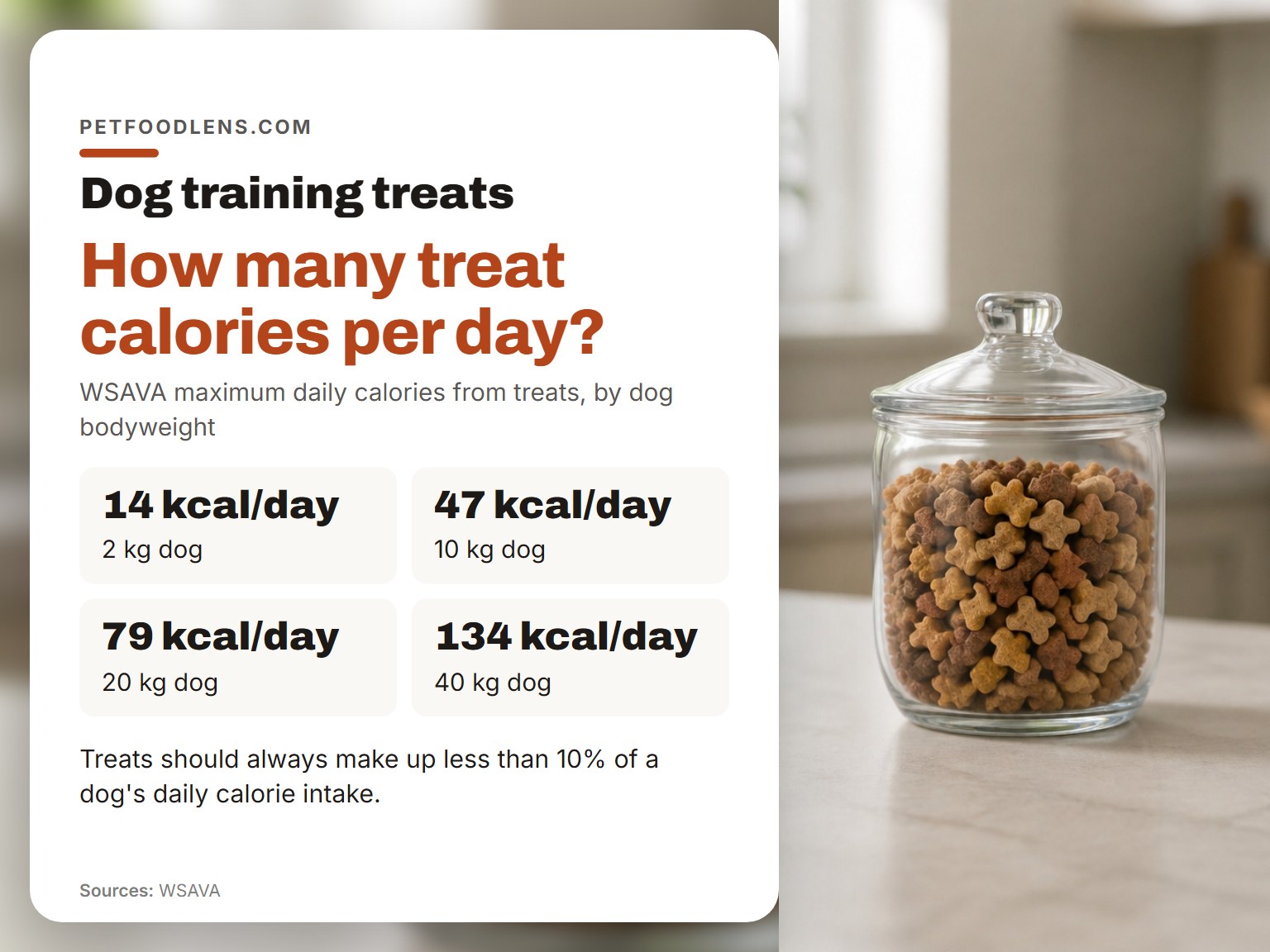
This low-calorie dog training treats guide starts with one number: treats should stay under 10% of your dog’s daily calories, per the WSAVA Global Nutrition Committee. A 10 kg dog gets 47 kcal of treats a day, and a 2 kcal training bite stretches that further than a 28 kcal fillet.
The low-calorie dog training treats guide gap between those two figures is where most treat plans fall apart. A 2 kcal piece lets you reward a dog twenty times inside the allowance. One dehydrated fish fillet eats a small dog’s entire day. Same aisle, wildly different arithmetic.
What follows: the calorie ceiling by bodyweight, how to read a bag that hides its own numbers, the named products that fit a 3 kcal repetition, and where the veterinary sources disagree about whether to feed treats at all.
Key Takeaways
- Treats stay under 10% of daily calories, and that ceiling covers chews, supplements, and the food you hide a pill in.
- A 10 kg dog gets 47 kcal of treats a day; a 2 kcal training bite buys far more repetitions than a 28 kcal fillet.
- Many treat bags carry no calorie statement, so the arithmetic needs the manufacturer, a kitchen scale, or both.
- Soft treats beat biscuits in a session because the dog finishes faster and resets for the next repetition.
- One chew can exceed a small dog’s whole allowance, so weigh it before you hand it over.
What Counts as a Treat Under the 10% Rule?
The definition is wider than the bag aisle suggests, and it comes from the WSAVA Global Nutrition Committee, the World Small Animal Veterinary Association.
Treats include any food given in addition to a complete and balanced diet: snacks, chews, supplements, and food used to administer medication. The 10% ceiling covers that combined total, not a separate allowance per product or per person in the household. A dental stick, a chew, and a piece of cheese draw from the same daily figure.
That last clause is where household math usually breaks. AAHA’s weight-management guidance counts treats, table foods, supplements, and food used for medication in the same daily total. The pill pocket at 8am is already spending from the same account as the training session at 6pm.
The low-calorie dog training treats guide rule I give people is short: treats stay under about 10% of daily calories and the complete food does the nutritional work, though Cambridge’s weight-management team advises stopping all treats and reducing the main ration if treats are essential. What falls inside the daily treat allowance for dogs?
- Kibble pulled from the measured ration and fed as a reward.
- Dental chews, bully-style chews, and anything marketed as long-lasting.
- Supplements, including the ones shaped like food.
- Table food. The carrot counts. So does the green bean.
- Anything used to get a pill down the throat.
Cambridge’s weight-management team puts it plainly: measure the daily allowance and take any treats out of that food. WSAVA’s line is shorter. Treats never replace a meal.
How Many Treat Calories Your Dog Actually Gets
A 10 kg dog gets 47 kcal of treats a day. That figure comes from the WSAVA feeding treats to your dog table, not from a bag.
| Dog’s bodyweight | Maximum treat calories per day |
|---|---|
| 2 kg | 14 kcal |
| 6 kg | 32 kcal |
| 10 kg | 47 kcal |
| 20 kg | 79 kcal |
| 30 kg | 108 kcal |
| 45 kg | 146 kcal |
The table assumes an average healthy adult dog in ideal body condition. A dog carrying extra weight, or one on a prescribed diet, needs a different number from the veterinary team. Use it as a ceiling.
Before you start: Match the piece to the dog’s throat, not its enthusiasm. Treat size and shape are a choking risk independent of calories, so cut anything round and hard. Supervise every chew and toy session, because a softened stub swallows faster than a whole chew. Skip hard frozen food packed into a rubber toy if the dog crunches it, since tooth fracture is the documented risk.
VCA’s worked example makes the split concrete: a dog needing about 550 kcal a day gets 495 from a complete and balanced diet and 55 from treats. UC Davis runs the same arithmetic at the small end, where a 100 kcal dog gets 10 kcal of treats and no more.
If you want the full method rather than a table lookup, calculate treat calories from the dog’s actual daily requirement instead of using a rounded bodyweight band.
Read the Label Before You Trust the Number
Grab a bag of treats and turn it over. Look for a calorie statement, and notice how often there isn’t one.
Under the AAFCO model regulations, written by the Association of American Feed Control Officials, a package labeled “treat” or “snack” on the front panel is not required to meet complete-and-balanced nutritional adequacy. Full pet-food labeling, including a calorie statement, is only triggered when the bag makes a claim such as “low fat” or “nutritious.”
The practical result, as Nelson and Burns note in Today’s Veterinary Nurse, is that many treat packages carry no calorie statement and no guaranteed analysis at all. You get four percentages on the back panel and nothing that converts to energy.
I learned the density lesson early. I compare on a per-calorie basis now, and I do the same with treats.
The kcal/kg Math, Step by Step
Some bags give calories per kilogram instead of per treat. The conversion is simple arithmetic.
- Divide the kcal/kg figure by 1,000 to get calories per gram.
- Weigh the portion you actually feed, in grams.
- Multiply grams by calories per gram.
A food listed at 3,000 kcal/kg works out to 3 kcal per gram, so a weighed 4 g portion is 12 kcal. That is an arithmetic example. Your bag will carry its own number.
A guaranteed analysis is not a calorie statement. Protein, fat, moisture, and fiber percentages do not add up to energy, and a bag can look precise while leaving you unable to budget a single repetition.
| On the bag | What it actually tells you |
|---|---|
| “Low calorie” | Nothing until you check the kcal against the allowance |
| “Natural” | A sourcing claim, no calorie information |
| “Low fat” | Fat content, not energy; a large low-fat biscuit can beat a tiny fatty treat |
| “Grain-free” | An ingredient claim; the bag can still be calorie-dense |
Cambridge warns that some treats marketed as low calorie really are, while others sit high enough to need factoring into the daily allowance. Webvet makes the companion point: natural, grain-free, and low fat do not tell you the calories in the serving. For the fat-specific version of this problem, the low-fat dog treats guide covers what a fat limit does and does not tell you.
Common mistake: Reading the guaranteed analysis as a calorie count. Four percentages on the back panel do not convert to energy, so the bag can look precise and still leave you unable to budget a single repetition.
Where the Experts Disagree on Cutting Treats Out
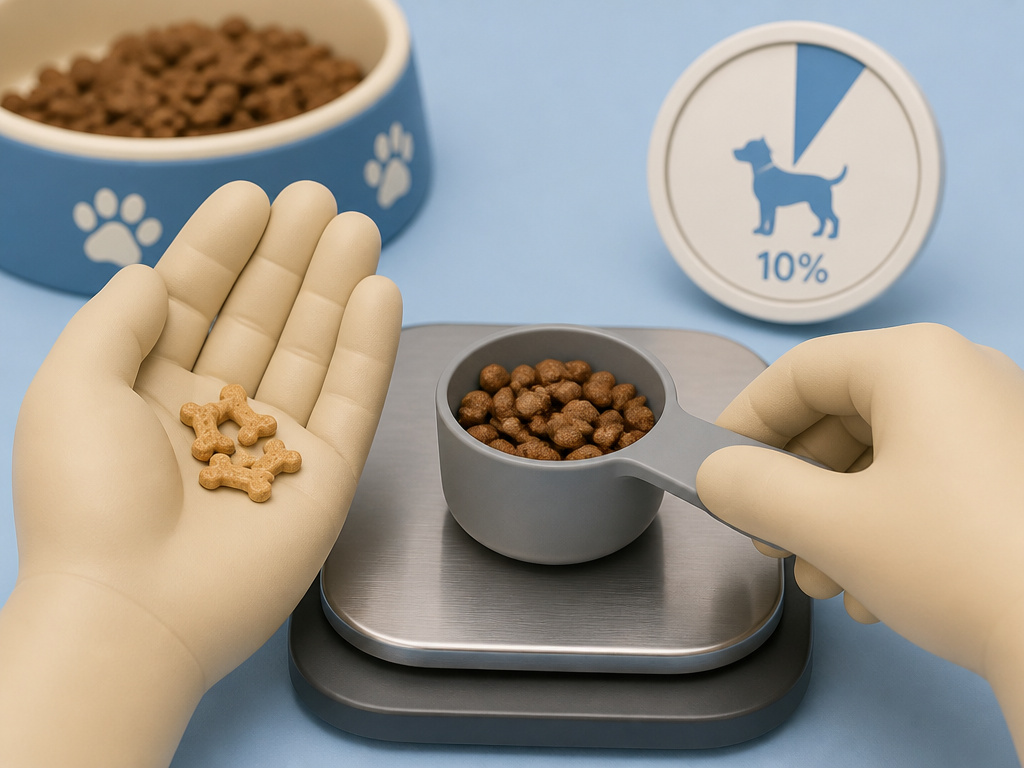
Cambridge says stop all treats. WSAVA says keep them under 10% of daily calories. Both are in print, and both are describing the same dog.
The Cambridge canine weight management treat guide is blunt: best advice is to stop all treats, and if treats are essential, reduce the main ration to compensate. WSAVA’s position is that treats are acceptable below 10% and can strengthen the bond and provide enrichment. The split is real.
I budget rather than ban. Cambridge’s advice is the cleaner route for a dog already on a weight plan, and I would follow it there without argument. For a dog in good body condition mid-training, the 10% budget does the same job with less friction.
The two sources also differ on where the treat calories come from. Cambridge takes them out of the measured daily ration. VCA sets them aside as a separate allowance inside the 10%, which is exactly what the 495 plus 55 example describes. Both keep the total honest; they just do the subtraction at different points.
If the dog is already gaining, the treat budget is the first place to look, and the guide to treats and weight gain walks through the subtraction in order.
Which Treats Actually Fit a Training Session
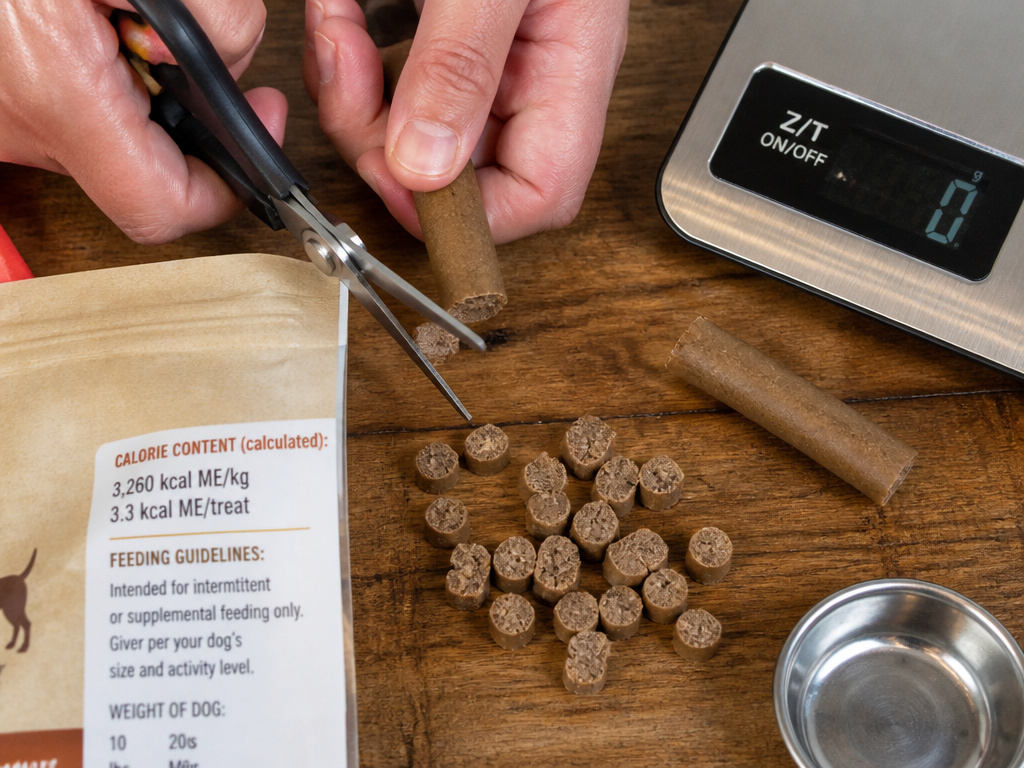
Some commercial treats are far too large for the job, and the AKC says so directly.
A pea-sized piece is plenty even for a large dog, and small dogs need something smaller still. That is the whole sizing argument, and it is why cutting treats to pea size does more for a session than a bigger reward the dog has to chew through.
Here is where the named products separate. Zuke’s Mini Naturals Peanut Butter & Oats run 2 kcal per piece. Pet Botanics Chicken Training Reward sits at 3 kcal per treat. Fruitables Skinny Minis Pumpkin Berry are 3 kcal per bite. The Honest Kitchen Purely One White Fish Filets run about 28 kcal per whole fillet, so break off a portion rather than handing over the fish.
At 2 kcal a repetition, a 10 kg dog’s 47 kcal allowance covers about 23 rewards in a day. At 3 kcal it covers 15. That is the difference between a full session and half of one, and it is why the list of low-calorie dog treats matters more than the flavor on the front of the bag.
Soft Versus Crunchy, and Why It Matters
The AKC guide to choosing training treats makes the case for soft: a soft treat is easier and faster for the dog to eat, so you get back to the next repetition sooner.
You notice it in the session. A soft piece disappears quickly and the dog is already looking at you again. A biscuit crumbles across the floor, and you spend time watching the dog hoover fragments instead of learning anything.
Soft treats also smell stronger, which is why the dog knows what is in the pouch before you open it. That smell is doing work in a distracting environment, and it explains why a plain biscuit loses to a smelly soft piece outdoors.
High-value rewards still have a place for new skills and heavy distractions, and the high-value treats guide covers where to spend them without blowing the budget. For most repetitions, the cheap 2 kcal piece does the job.
Kibble, Vegetables, and the Oxalate Catch
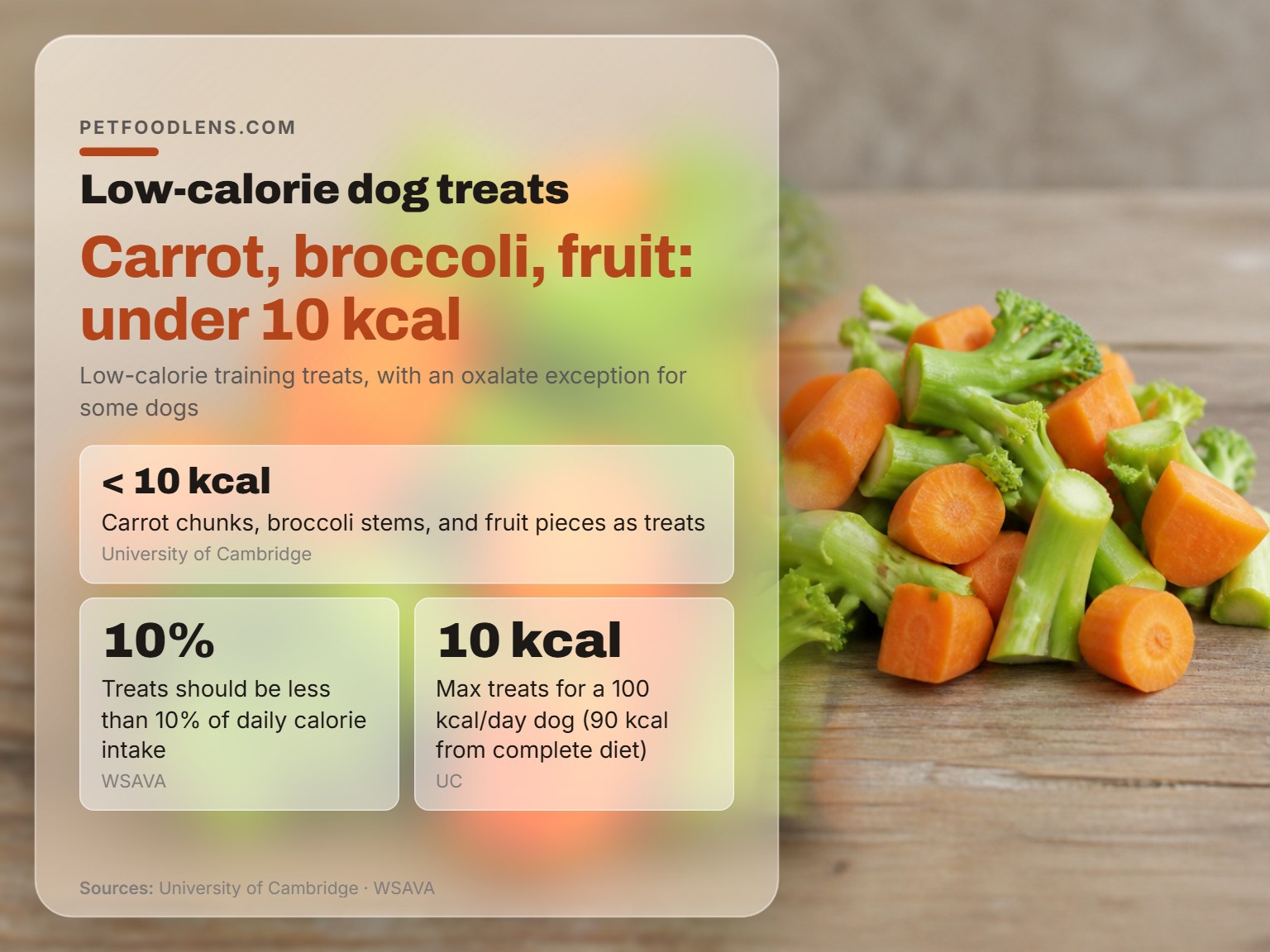
Kibble counts under WSAVA’s framing, which treats anything beyond the complete diet as a treat, while VCA notes kibble used as a treat is complete and balanced and helps prevent deficiencies. So does the carrot.
VCA argues that kibble works well as a training reward because it is complete and balanced, which helps prevent deficiencies on a treat-heavy day. WSAVA frames it differently: treats are anything beyond the complete diet, and even complete kibble is an addition to the balanced ration rather than a substitute for it. VCA treats kibble as a beneficial complete-and-balanced reward, while WSAVA counts anything beyond the complete diet as a treat; the two positions reconcile only if the kibble comes out of the 10% allowance, and neither source states that outright.
Most homemade treat recipes I get asked about are fine as treats and a disaster as meals. Keep the complete kibble or canned food as the base and use the homemade stuff as a topper. Boring, and it works every time.
On vegetables, the UC Davis treats guidelines for dogs call fruits and vegetables good options for many dogs because they are usually low in protein, fat, sodium, and phosphorus. Cambridge puts carrot chunks, broccoli stems, and fruit pieces at less than 10 kcal.
The Oxalate Exception
Vegetables are not universally safe, and the exception is specific. Nelson and Burns note that carrots, celery, green beans, parsnips, and summer squash contain oxalate, a building block for calcium oxalate, and should not be recommended to patients with a history of or prone to calcium oxalate uroliths, which are bladder stones.
Blueberries and cranberries are a low-calorie treat for most dogs in moderation, though Nelson and Burns note that oxalate-containing vegetables should be avoided in dogs prone to calcium oxalate uroliths. Avoid chocolate, macadamia nuts, garlic, onions, grapes, and raisins entirely, and check peanut butter for xylitol before it goes anywhere near a training pouch.
Where this goes sideways: Handing out the same vegetable all week without checking the dog’s history. Oxalate-containing vegetables are a reasonable low-calorie treat for a healthy dog and the wrong choice for one with a calcium oxalate history.
Why One Chew Can Blow the Whole Allowance
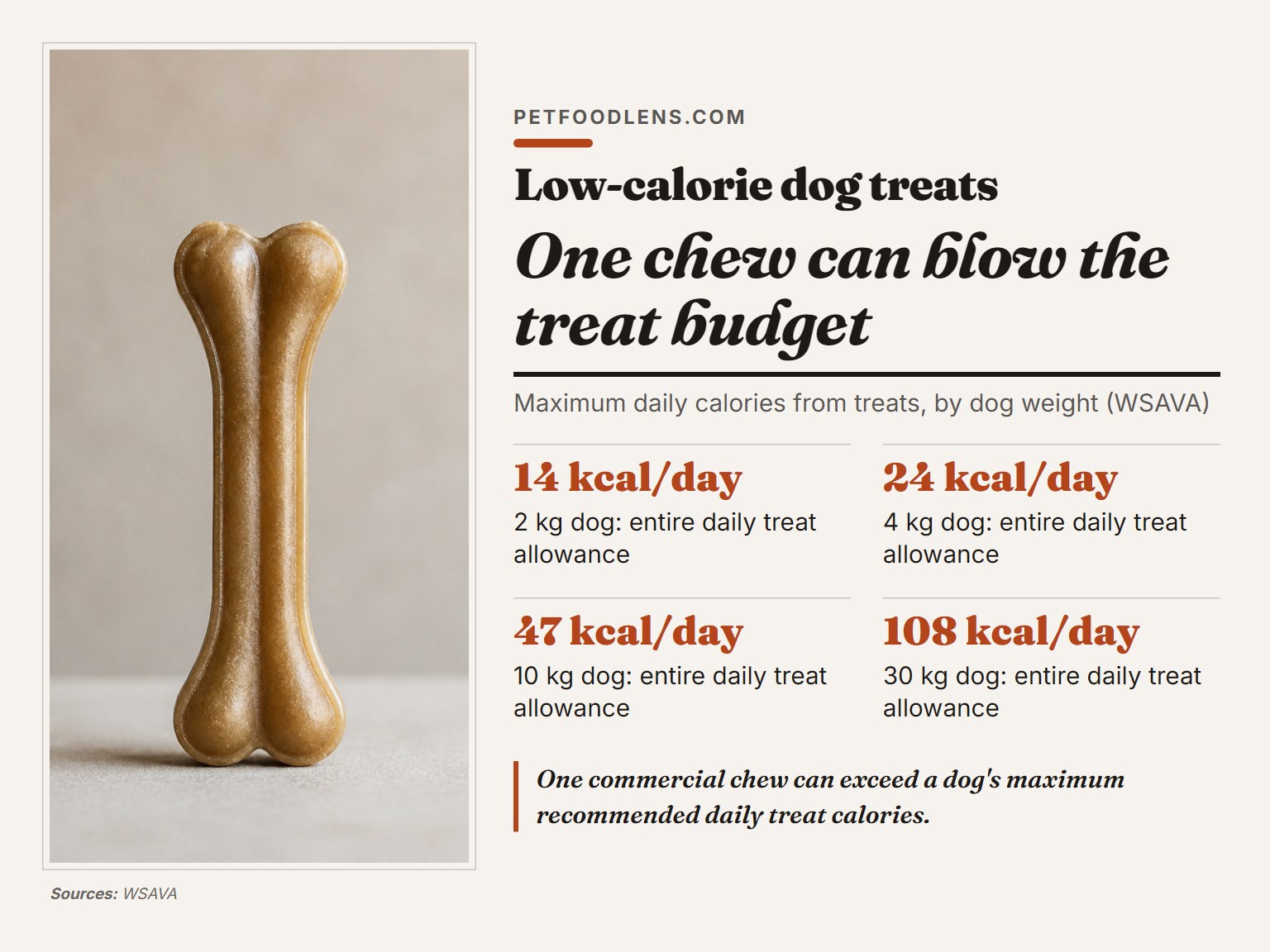
A single chew can clear a small dog’s entire daily treat allowance before the dog has settled into it.
WSAVA states that for some dogs, consuming just one commercial chew or human food in the specified quantity could exceed the maximum recommended daily calorie intake from treats. A 2 kg dog has 14 kcal of room. That is not a lot of chew.
Webvet adds the point that “long lasting” does not mean low calorie, and chewing time does not erase energy intake. A dental chew that keeps the dog busy for a long time still spends the calories.
Check three things before the chew goes down:
- Calories in the whole chew, not the stated serving size on the front.
- Whether the dog crunches or gulps, since both turn a chew into a swallow.
- Texture, because an excessively hard item is a fracture risk and a soft stub is a choking risk.
Pair the calorie check with a dog treat size check, because a softened stub is a hazard regardless of its calorie count. If you need the chew to last without spending the whole budget, the guide to making treats last longer covers the portioning tricks that do not add calories.
A Daily Routine That Keeps the Count Honest
One container. Everyone feeds from it.
Webvet recommends a single shared daily reward container so that every person in the house takes from the same supply rather than each offering a fresh allowance. Nelson and Burns describe the clinical version: hold 10% of the dog’s daily energy requirement in a dedicated treat bag and give it out across the day.
- Work out the daily calorie requirement with the veterinary team, or read a rough ceiling off the WSAVA table.
- Measure 10% of that figure and put it in one container.
- Take every treat, chew, and pill pocket from that container.
- Refill it the next morning, never mid-afternoon.
Once a behavior is solid, VCA suggests rotating in lower-value or lower-calorie rewards, or swapping food for praise and affection on some repetitions. Cambridge makes the same point from the other direction: research has shown that when owners think their dogs are asking for a treat, the dogs are often equally satisfied with extra attention.
What to Do When the Label Has No Calorie Statement
The sources prescribe two different workflows here. WSAVA says contact the manufacturer for calorie information if it is not stated on the label. VCA points owners to USDA FoodData Central for whole foods and human foods, then has them estimate against the 10% allowance.
Use both, in order. Call the manufacturer for the commercial bag, and look up the plain food in USDA FoodData Central. If the company will not give a per-treat figure, ask for calories per gram and weigh a portion on a kitchen scale.
The comparison of dog training treats covers which formats hand you a usable number and which ones leave you guessing.
Frequently Asked Questions
How many low-calorie training treats can a dog have in a day?
It depends on bodyweight. WSAVA’s table gives a 10 kg dog 47 kcal of treats a day and a 20 kg dog 79 kcal. At 2 kcal per piece, that is about 23 and 39 repetitions respectively. The 10% ceiling applies to the combined total of treats, chews, and table food, not to each category separately.
Are 2 calorie treats worth counting?
Yes, because the count is the only thing that keeps a session inside the allowance. Fifteen pieces at 2 kcal is 30 kcal, which is a large share of a 10 kg dog’s daily treat budget. Fifteen pieces at 3 kcal is 45 kcal, which is nearly all of a 10 kg dog’s daily treat budget.
Can I use my dog’s regular food as a training treat?
VCA supports it because kibble is complete and balanced and reduces deficiency risk on a heavy training day. WSAVA’s framing is stricter: treats are anything beyond the complete diet, so kibble used as a reward comes out of the 10% allowance rather than sitting on top of it.
What if the treat bag has no calorie information?
Contact the manufacturer, which is what WSAVA advises when the label is silent. Ask for calories per treat or per gram, then weigh the portion. A guaranteed analysis is not a calorie statement and will not get you there.
Are carrots safe as low-calorie dog treats?
For most healthy dogs, yes. Cambridge puts carrot chunks at less than 10 kcal. The exception is a dog with a history of calcium oxalate uroliths, where carrots, celery, green beans, parsnips, and summer squash should be avoided.
Do treats have to be complete and balanced?
No. Under the AAFCO model regulations, a package labeled “treat” or “snack” is not required to meet complete-and-balanced nutritional adequacy. That is why treats stay under 10% and the main diet carries the nutrition.
The Bottom Line
Weigh out 10% of your dog’s daily calories tonight and put it in one container. That single move fixes most treat problems before you change a single product.
The threshold to watch is the scale, not the bag. If the dog is gaining weight on a treat budget that already sits at 10%, the treats come down before the meal does, because the complete diet is doing the nutritional work and the treats are not.
One concession: none of this transfers cleanly to a dog on a prescription diet. WSAVA notes that conventional treats may not be appropriate for dogs on prescribed diets or with dietary sensitivities, and the 10% rule assumes a standard maintenance diet. That dog needs the veterinary team’s number, not this table.
