
High-Value Dog Treats Guide: What Actually Works
This post contains affiliate links. As an Amazon Associate, we earn from qualifying purchases.
A high-value dog treat is one your dog will work for: strong-smelling, small, and quick to eat. Every high-value dog treats guide should start with the same ceiling, and this one does: 10% of daily calories from treats, 90% or more from a complete and balanced food.
The 10% figure in any high-value dog treats guide is published by every major veterinary body, from WSAVA to UC Davis, though FEDIAF allows it to average over a week or a day while the others state it as a daily rule. It’s also the number most owners never calculate, which is why the treat habit becomes a slow weight problem.
What follows is the working version of that 10% rule: how to size a treat, how to run the math, which treats to skip, and what to do when your dog is on a prescription diet.
Key Takeaways
- 10% of daily calories is the treat ceiling; 90% or more comes from complete food.
- Pea-sized is the training treat target, not biscuit-sized.
- Call the manufacturer if the calorie count isn’t on the bag.
- Skip antlers, hooves, and bones per WSAVA and FEDIAF.
- Vet-approved treats only if your dog is on a prescription diet.
What Makes a Treat High-Value?
Palatability drives the response, and three things carry it: smell, moisture, and size. A high-value treat announces itself before the dog sees it. You smell it through the bag.
High-value treats earn their name through palatability, not calorie density. Strong odor, moisture, and small size drive the dog’s response. A freeze-dried liver cube and a plain biscuit can carry identical calories, and the dog will still choose the liver every time. That gap is preference, not nutrition.
PetMD defines high-value purely by dog preference: treats that have a strong smell and high palatability. Preventive Vet says high-value treats tend to have a higher caloric value. Both are true in different cases. A strong-smelling freeze-dried liver cube can be low in calories, and a bland biscuit can run about 85. The label on the bag is the only way to know which is which.
I’ve picked up bags labeled “high-value” where the first ingredient was wheat flour. The dog might still eat it. That doesn’t make it high-value.
The ingredient list, read in order of weight, is where quality dog treats earn their name. A treat with “beef” first is mostly beef by weight. A treat with “wheat flour” first is mostly flour by weight. That order is the same rule you’d use on a bag of dog food, and it applies to treats just as hard.
High-Value Dog Treats Guide: The 10% Rule
Ten percent is the ceiling every major veterinary body publishes, from WSAVA to UC Davis to VCA, though FEDIAF allows it to average over a week or a day. The other 90% or more comes from a complete and balanced food, which is the part most treat conversations skip.
The WSAVA dog treat guidelines put the ceiling at 10% of daily calories. UC Davis and VCA publish the same daily number, while FEDIAF allows the 10% to average over a week or a day. The one wrinkle is FEDIAF’s phrasing: it allows the 10% to average over a week or a day, where the other bodies state it as a daily rule. If your dog gets a handful of treats on Saturday and none on Tuesday, FEDIAF’s weekly averaging covers you. The other bodies would tell you to spread it out.
Here is the WSAVA daily treat ceiling by body weight:
| Dog weight | Max daily treat calories |
|---|---|
| 2 kg | 14 kcal |
| 4 kg | 24 kcal |
| 6-40 kg | 32 kcal |
| 45 kg | 146 kcal |
Read that table twice if you have a small dog.
A 6 kg dog gets 32 calories of treats per day. One large Milk-Bone runs about 85 calories per biscuit, per VCA. That single biscuit is far more than a 6 kg dog’s entire daily treat budget.
The 10% Rule in Practice: Running the Numbers
Picture a 20-pound terrier on 400 calories a day. The treat budget is 40 calories. That’s roughly half a large Milk-Bone.
The UC Davis treats guidelines for dogs use a 100-calorie-a-day dog as the worked example: no more than 10 calories from treats, 90 from complete food.
The math scales.
Run it in three steps:
- Find your dog’s daily calorie requirement. Ask your vet or use the feeding guide on your dog’s food bag. It’s a starting point, not a guarantee.
- Take 10% of that number. That’s the treat budget for the day, not per session.
- Subtract the treats from the meal. If your dog got 30 calories of treats and the daily food target is 400, the meal is 370. This is the step most owners skip, and it’s the one that keeps weight stable.
I’ve had clients tell me their dog gets “barely any treats” and then list four different biscuits a day. The math usually says otherwise. A handful of “small” biscuits can take a large share of the daily calorie budget.
The math is the same whether you’re buying healthy dog treats or making them at home. The bag tells you the calories per treat, and the rest is arithmetic.
Training Treats: Size, Texture, and the Pea Rule
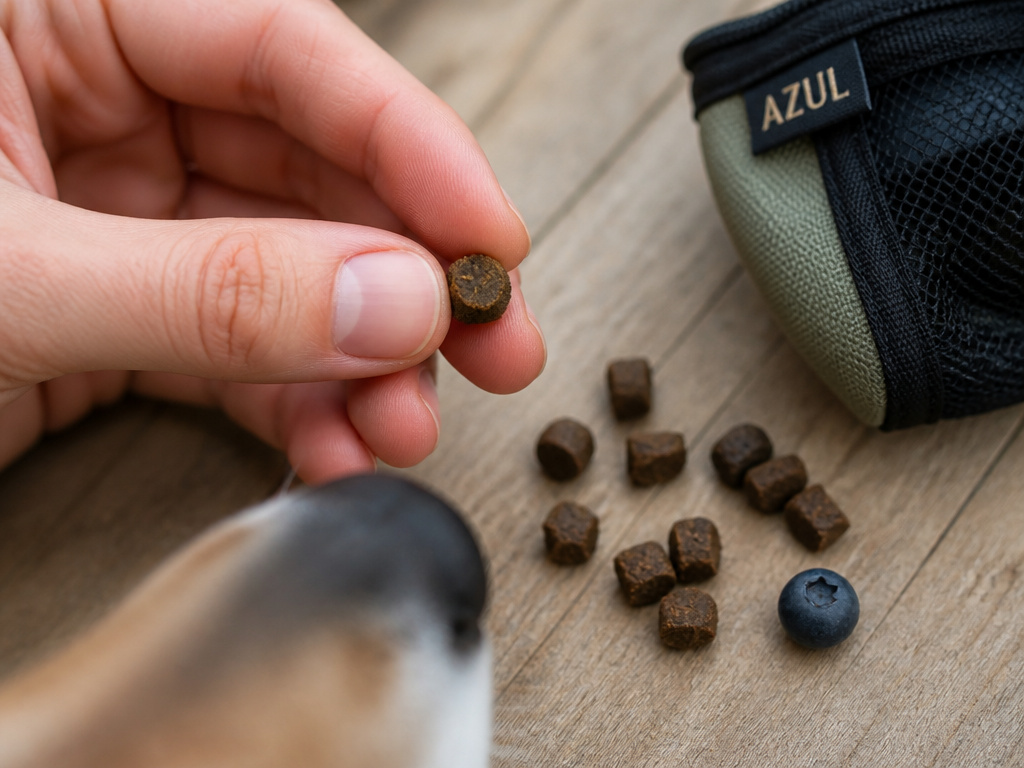
Training treats are a different animal from reward treats, and the size difference is the whole point. A training treat needs to disappear fast enough that the dog stays in the behavior, not stand there chewing while the moment passes.
A pea-sized soft treat disappears quickly. A large biscuit takes much longer and breaks the training rhythm.
That timing gap is why the size rule exists.
Chewy’s behavior consultant Laurel Saville puts the target at pea or blueberry size. PetMD adds the texture requirement: training treats need to be non-crumbly, low-calorie, and bite-size. A crumbly treat leaves a trail on the floor and pulls the dog’s nose away from you.
| Trait | High-value treat | Low-value treat |
|---|---|---|
| Smell | Strong, meaty | Faint, biscuit-like |
| Size | Pea to blueberry | Biscuit-sized |
| Texture | Soft or freeze-dried | Hard, crumbly |
| Best use | New skills, distractions | Routine rewards, kibble swap |
Soft vs. Crunchy: Which Texture Works Better?
Soft wins for training, and the reason is mechanical. A soft treat swallows in one motion, so the dog can reset for the next repetition. A hard biscuit requires chewing, which breaks eye contact and gives the dog time to lose focus.
They don’t belong in a training session where you need ten repetitions in five minutes.
Most training treats sold for the purpose are already pea-sized. Many soft, pea-sized training treats fit the bill. If you’re breaking a larger treat into pieces, keep the pieces under a blueberry and count each piece as a treat for calorie purposes.
The timing of using treats in training matters as much as the treat itself. A treat delivered too late after the behavior teaches the dog little. A treat delivered promptly after the behavior teaches the behavior.
I won’t feed a high-value treat for a behavior the dog already knows cold. Save the liver for the recall you’re still teaching. Routine sits get kibble.
Common mistake: Feeding a high-value treat for a behavior the dog already knows. The treat loses its edge and you burn calories on a skill that’s already solid.
Which Treats Are Actually Unsafe for Dogs?
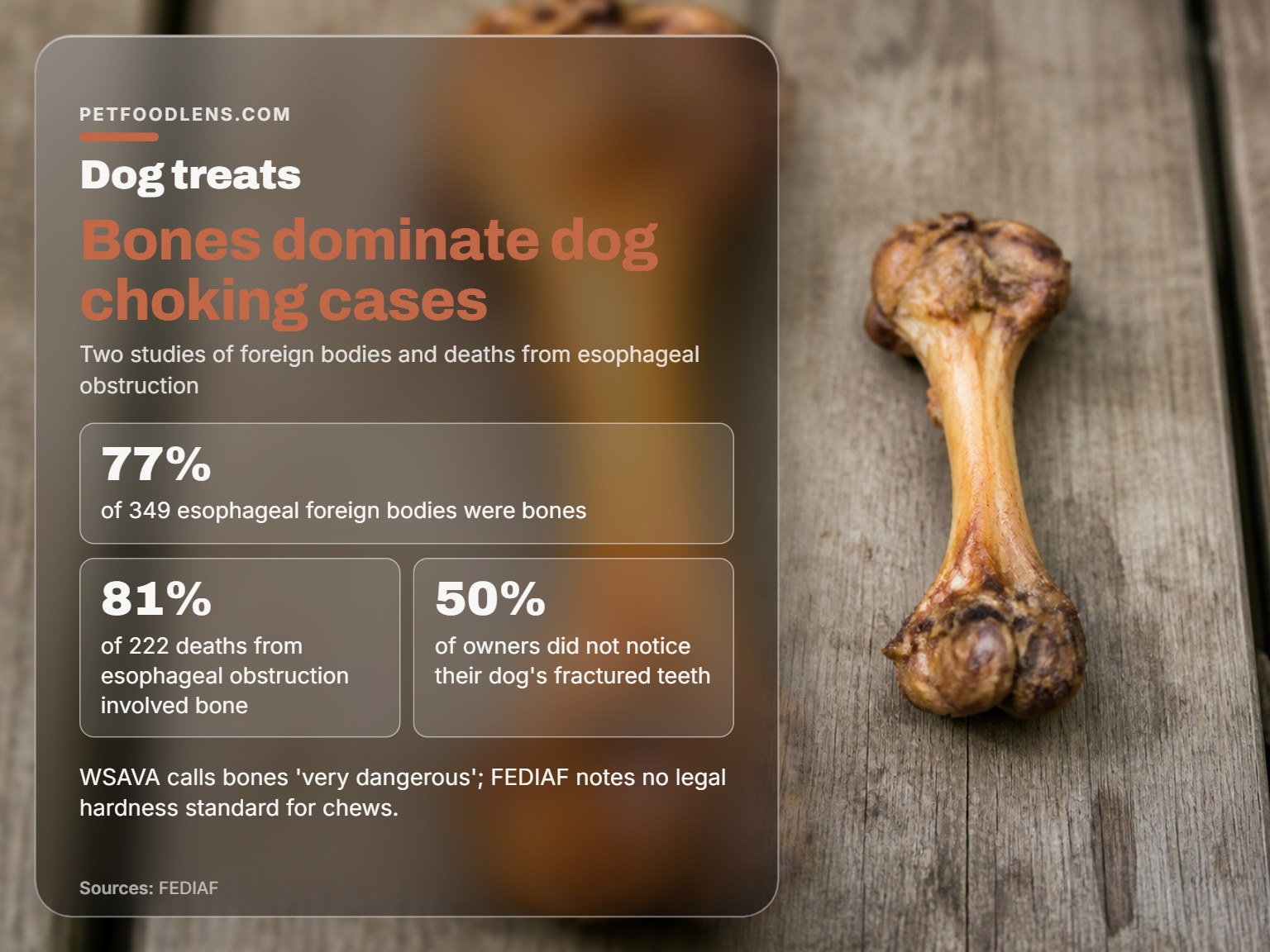
WSAVA and FEDIAF both advise avoiding excessively hard chews like antlers and hooves, though other sources are less absolute. Both name excessively hard chews as a tooth-fracture risk, and FEDIAF notes there’s no legal hardness standard for dog chews, which means the bag can say “safe” without anyone verifying it.
Before you start: Two hazards matter with any treat. Choking risk scales with treat size versus dog size, so match the two. VCA warns that raw or freeze-dried raw treats carry bacterial contamination risk spreadable to humans and other pets, while AKC considers freeze-dried treats a healthy option depending on ingredients.
The FEDIAF chews and treats fact sheet calls out non-bendy chews by name. A 2005 study it cites found half of owners of dogs with fractured teeth didn’t notice the fractures. The dog keeps eating, the tooth stays cracked, and the vet finds it at the next exam.
The ASPCA position statement on dog chews adds rawhide to the list of things to watch. Rawhide can be swallowed in large pieces, and obstruction is more likely in smaller dogs.
The Three Categories to Skip
- Bones, cooked or raw. WSAVA calls them “very dangerous.” A 2019 study of 349 esophageal foreign bodies found 77% were bones, and a 2017 study of 222 deaths from esophageal obstruction found bone material in 81% of cases.
- Antlers and hooves. WSAVA and FEDIAF warn these are hard enough to crack a tooth, and FEDIAF says there’s no standard to tell you which ones are too hard
Frequently Asked Questions
How many treats can I give my dog in a single training session?
There is no fixed count, because the limit is measured in calories, not pieces. Weigh or estimate your dog’s daily calorie need, set aside 10% of it for treats, and divide that budget by the calories in one treat. Pea-sized pieces of a moist, smelly treat usually let you hand out dozens of rewards in a session without breaking the ceiling.
Do high-value treats have to be store-bought?
No. Plain cooked chicken, a bit of string cheese, or a cube of freeze-dried meat often outranks anything on a shelf, and you control the ingredients. The catch is that people food still counts toward the 10% ceiling, so portion it the same way you would a packaged treat. Avoid seasoned, salty, or fatty table scraps, since those add sodium and fat your dog does not need.
Can I use high-value treats for a dog that is overweight?
Yes, but the treat budget has to come out of the weight-loss plan rather than sit on top of it. Ask your vet how many daily calories the diet allows, then carve the treat portion out of that number instead of adding it. Small, low-calorie, strong-smelling options such as a sliver of lean meat or a single freeze-dried liver piece work well here.
What should I do if the treat bag lists no calorie information?
Contact the manufacturer and ask for the metabolizable energy in kcal per treat or per ounce. Reputable companies keep this on file even when it is missing from the packaging. If no one can give you a number, treat that product as a guess and lean toward brands that publish clear calorie data.
