
How Many Treats Should a Dog Have a Day? Do the Math First
This post contains affiliate links. As an Amazon Associate, we earn from qualifying purchases.
A dog should have no more than 10% of daily calories from treats, with the other 90% from complete and balanced food. One large Milk-Bone biscuit is about 85 calories, so a small dog’s entire treat budget can vanish in a single biscuit.
The question of how many treats should a dog have a day is really a calorie question. A dog eating 182 calories a day has 18 calories of treat room. A single large Milk-Bone blows past that nearly five times over.
What follows is the calorie math, the weight signals that catch what the math misses, what actually counts as a treat, and which treats are worth the budget.
Key Takeaways
- 10% of daily calories, not 10% of the biscuit count. A large Milk-Bone is about 85 calories.
- Run the MER formula first: 95 times body weight in kilograms to the power of 0.75, then take 10%.
- Training treats, chews, and table scraps all count toward the same daily budget.
- A small dog’s entire treat allowance can be under 20 calories, so treat size matters more than treat frequency.
- Watch the weight, not just the biscuit jar. Weight gain, poor meal appetite, and digestive upset are the signals.
How Many Treats Should a Dog Have a Day? Start With the Math
The 10% rule is a common starting point across veterinary sources, though they differ on timeframe and scope, and it’s measured in calories. The biscuit count is a distraction.
The 10% treat ceiling is measured in calories, not in biscuits or volume. Daily calorie needs for a healthy adult dog are estimated with the formula 95 times body weight in kilograms to the power of 0.75, and the treat allowance is 10% of that result. The formula applies to healthy adult dogs only.
The 10 percent calorie rule for treats is the clearest starting point because it includes everything: meals, snacks, training treats, and table scraps. The AKC’s worked example is a dog eating four cups of food at 364 calories per cup. That’s 1,456 calories a day, so the treat ceiling is about 146 calories. That’s less than two large Milk-Bone biscuits for the whole day.
A small dog has far less room. A dog eating about 182 calories a day has roughly 18 calories available for treats, which is about one-fifth of one large Milk-Bone. This is where “a couple of biscuits” becomes a real problem.
The UC Davis veterinary treat guidelines put the same ceiling on it: 90% of calories from complete food, 10% or less from everything else. The University of Illinois dog treat options page adds the MER formula above and restricts the guidance to healthy adult dogs, which matters for puppies, seniors, and dogs with medical conditions.
The timeframe is where sources split. FEDIAF frames the 10% as a weekly or daily average, which allows a big treat day to be offset by lean days. The US university sources state it as a per-day limit.
How to Run the MER Formula
The formula is not hard, but the order matters. Run it in this sequence:
- Weigh your dog on a scale, not by eye. Guessing the weight throws the entire calculation off.
- Calculate MER: 95 times body weight in kilograms to the power of 0.75. Skipping this step means you’re guessing at the daily calorie total, which is where most treat budgets go wrong.
- Take 10% of that number. That’s the treat ceiling for the day, including training treats, chews, and table scraps.
- Pull that 10% out of the daily meal portion, not on top of it. Adding treats without reducing meals is how a dog gains weight on a “balanced” diet.
Working out the treat calories on a bag is not hard once you know where to look on the label.
Before you start: Xylitol, grapes, raisins, chocolate, and raw dough are toxic or dangerous to dogs and belong nowhere near the treat budget. Hard chews can fracture teeth, and bones caused 77% of esophageal foreign bodies in one 349-case study. Supervise every chew.
Why the Weight Scale Tells You Before the Math Does
The scale catches what the math misses. A dog that’s over the treat budget often shows it at the bowl first: the morning meal sits half-eaten, and the dog is back at the treat jar by noon.
The AKC lists three signs that treats are exceeding the 10% guideline:
- Weight gain over weeks, not days. The scale is the slowest signal, and the most reliable.
- Decreased appetite at mealtime. If the dog is skipping the bowl but begging at the jar, the calories are coming from the wrong place.
- Digestive upset or loose stools. A sudden change in stool quality often tracks with a sudden change in treat volume.
- Begging that escalates after treats. Does your dog actually need a biscuit every time you walk through the kitchen? The dog learns the routine fast.
The Cambridge canine weight management team goes further than most. Their best advice is to stop all treats, and if treats are essential, reduce the main ration to compensate. That’s a stricter position than the 10% ceiling, and it’s worth knowing that not every source agrees on whether treats should be part of the daily routine at all.
The disagreement is real. VCA Animal Hospitals treats the 10% ceiling as permission to give treats within that limit. Cambridge treats it as a fallback for owners who won’t stop. NC State says not every pet needs treats, but treats can be given in measured amounts as rewards. The practical answer for most owners sits in the middle: treats are fine, but they come out of the daily calorie total, not on top of it.
The treats and weight gain question is where the math and the scale have to agree. If the weight is climbing, the treats are the first place to look.
Common mistake: Counting the biscuit and forgetting the training treats. A training session with many small treats can use up a large share of a small dog’s daily treat budget, even if each treat is tiny.
What Counts as a Treat? More Than You Think
Four things land in the same budget: training treats, chews, table scraps, and the piece of cheese at lunch. The AKC is explicit that the 10% refers to calories, not volume or number of treats, and it includes meals, snacks, training treats, and table scraps.
That’s a wider net than most owners cast. Here’s how the major treat types compare:
| Treat Type | Calorie Load | Best For | Watch Out For |
|---|---|---|---|
| Large Milk-Bone biscuit | About 85 kcal | Occasional reward | Uses up a small dog’s daily budget |
| Rawhide | Calories usually unknown and highly variable | Long-lasting chew | Choking risk |
| Some chew bones | Calories vary and can be high | Heavy chewer | Can exceed a dog’s daily treat budget |
| Carrots, green beans | Low | Frequent, low-calorie reward | Oxalate risk for stone-prone dogs |
| Blueberries, cranberries | Low | Low-calorie reward | Moderation; sugar content |
The treat size guide matters more than the treat count. A large biscuit and a small training treat are not the same unit, and the calorie difference between them is the whole game.
Here’s what lands in the same budget:
- Training treats, even the tiny ones
- Dental chews and long-lasting chews
- Table scraps and human food
- Pieces of regular kibble used as rewards
- Vegetables and fruits used as treats
Training Treats Add Up Faster Than You Think
Training sessions are where the budget quietly disappears. A dog in a training session might get many small treats, and even at a few calories each that’s a meaningful chunk of a small dog’s daily allowance. Every time.
The fix is to cut treats into smaller pieces and use the dog’s regular kibble for high-frequency reinforcement. The training treats themselves don’t have to be different from the meal. A piece of the daily ration works as a reward and counts toward the same calorie total.
Which Treats Are Worth the Calories?
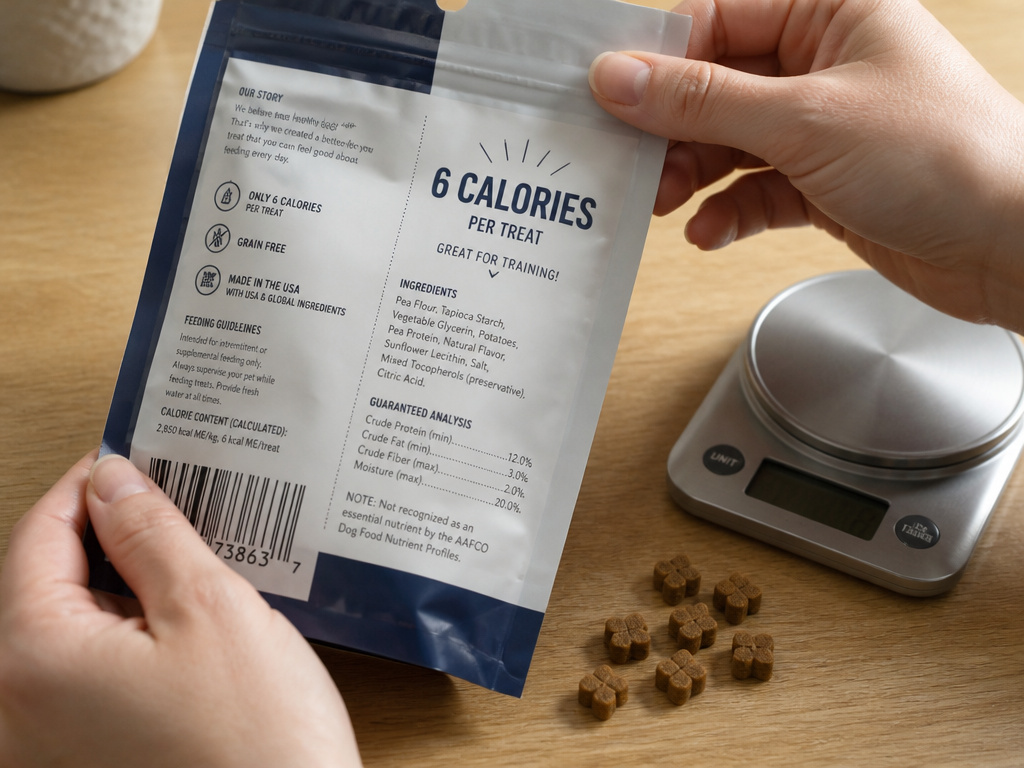
VCA’s position is that “light” and “lower calorie” treats are not significantly lower in calories than other treats, while manufacturer labeling implies a meaningful calorie reduction.
Flip the bag over. The calorie statement is usually on the back panel, and it’s the only number that matters for the treat budget. What’s the actual calorie count on the bag?
For training rewards, small low-calorie treats are common choices. For dental chews, choose one whose calorie count fits the daily allowance. Other commercial treats are another option if the calorie count fits the daily allowance. The low-calorie treats list is a better starting point than the “light” shelf.
Here’s the daily budget by weight, calculated from the MER formula:
| Dog Weight | Est. Daily MER | 10% Treat Budget |
|---|---|---|
| 11 lb (5 kg) | ~317 kcal | ~32 kcal |
| 22 lb (10 kg) | ~534 kcal | ~53 kcal |
| 44 lb (20 kg) | ~898 kcal | ~90 kcal |
| 66 lb (30 kg) | ~1,218 kcal | ~122 kcal |
| 88 lb (40 kg) | ~1,511 kcal | ~151 kcal |
I won’t buy a treat that doesn’t print calories on the bag. If the company can’t tell you what’s in it, the dog can’t afford it.
I’ve reviewed a lot of homemade treat recipes for clients, and most of them are fine as treats and a disaster as meals. The recipe itself is rarely the problem. The problem is the assumption that because it’s homemade, it doesn’t count toward the daily calorie total. My rule is simple: the complete commercial food does the nutritional work, the homemade treat is a topper, and the whole thing stays under about 10% of daily calories.
When the 10% Rule Breaks Down
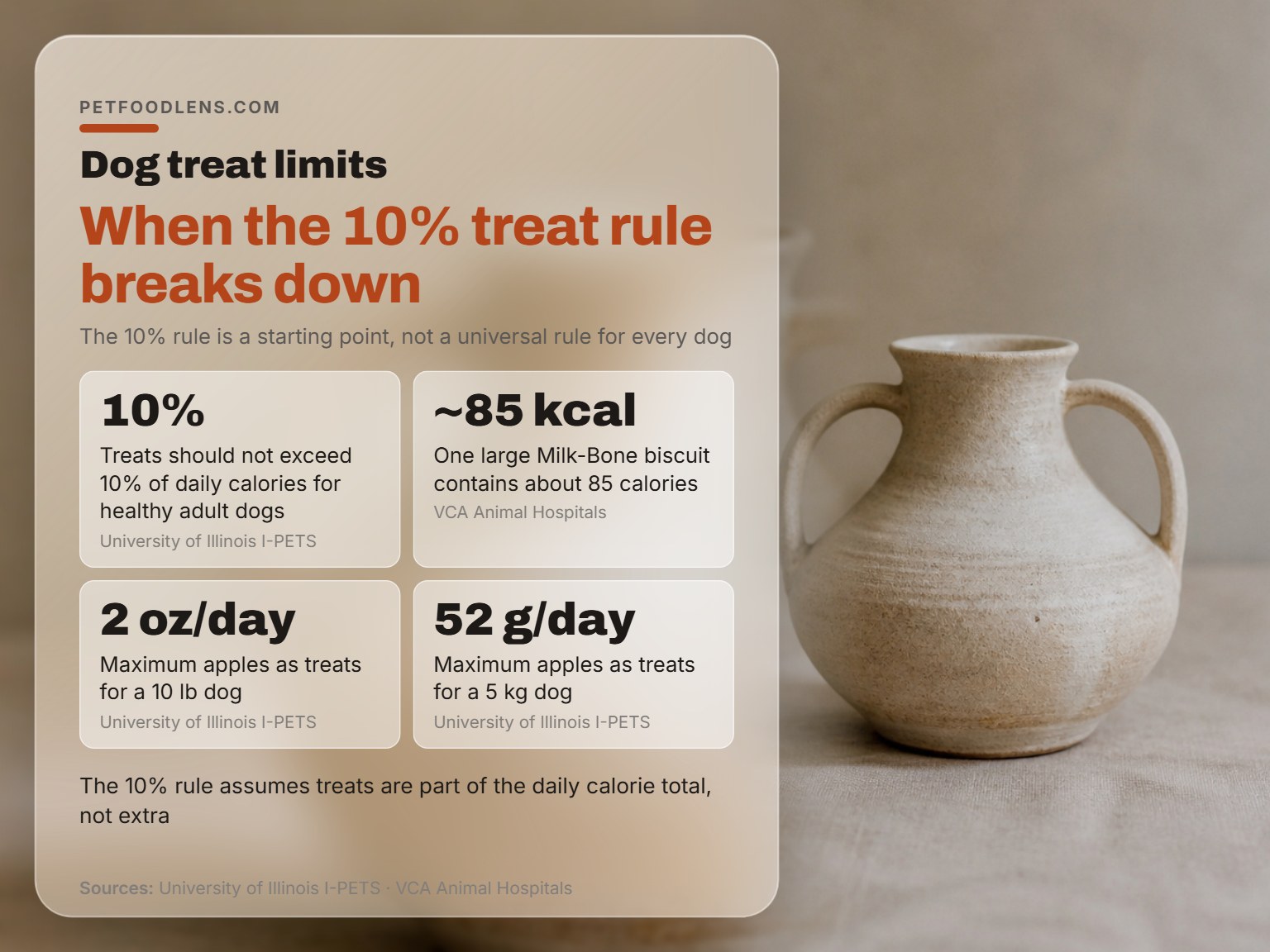
The 10% rule is stated generally by some sources, while the University of Illinois limits its guidance to healthy adult dogs. Plenty of dogs aren’t.
The University of Illinois is explicit that its guidance applies to healthy adult dogs, not puppies, seniors, or dogs with medical conditions. VCA adds condition-specific caveats rather than a healthy-adult-only carve-out. The practical takeaway is that the 10% number is a starting point, not a universal rule.
Therapeutic Diets Change the Math
Dogs on a prescription or therapeutic diet need a different approach. VCA advises that dogs on a special or therapeutic diet should have treats checked with the veterinary team first, and high-fat treats should be avoided for dogs on a low-fat diet for chronic pancreatitis. Today’s Veterinary Nurse notes that commercially manufactured treats aligned with the therapeutic food’s nutrient specifications can maintain the efficacy of the nutritional plan.
For dogs with chronic pancreatitis on a low-fat diet, high-fat treats are off the table. For dogs with food allergies, treats must be free of the suspected allergen. These are veterinarian calls, not label-reading calls.
The Oxalate Problem
Carrots, celery, green beans, parsnips, and summer squash contain oxalate, which is a building block for calcium oxalate. For dogs prone to calcium oxalate uroliths, these vegetables should not be recommended as treats. Blueberries and cranberries are a better low-calorie option for most dogs.
The feeding schedule matters here too. If treats are part of the daily routine, the meal portions need to come down slightly to keep the calorie total consistent.
Where this goes sideways: Adding treats on top of the regular meal instead of pulling them out of it. The 10% rule assumes the treats are part of the daily calorie total, not extra.
The NC State veterinary nutrition treats page is blunt about it: not every pet needs treats, and the ones that get them should get them as a reward immediately after a desired behavior.
My own work centers on cat food, so I defer to a veterinarian on dog-specific therapeutic diets and prescription treats. The calorie math and the label reading are the same. The clinical decisions are not.
The Treats That Can Hurt Your Dog
Xylitol is the one most owners miss. It’s a sugar substitute that can be hidden in peanut butter, baked goods, and sugar-free gum, and it’s extremely toxic to dogs. Even small amounts can cause hypoglycemia and liver damage, with signs ranging from lethargy to seizures and death.
These should never be fed:
- Xylitol (the sugar substitute that hides in peanut butter and sugar-free gum)
- Grapes and raisins
- Chocolate and foods containing caffeine
- Raw dough, which expands in the stomach
- Bones, which caused 77% of esophageal foreign bodies in one 349-case study
Peanut butter is high in fat and calories and should only be offered in small amounts. Avocado flesh is safe for dogs, but the pit is a choking hazard.
The Bones Problem
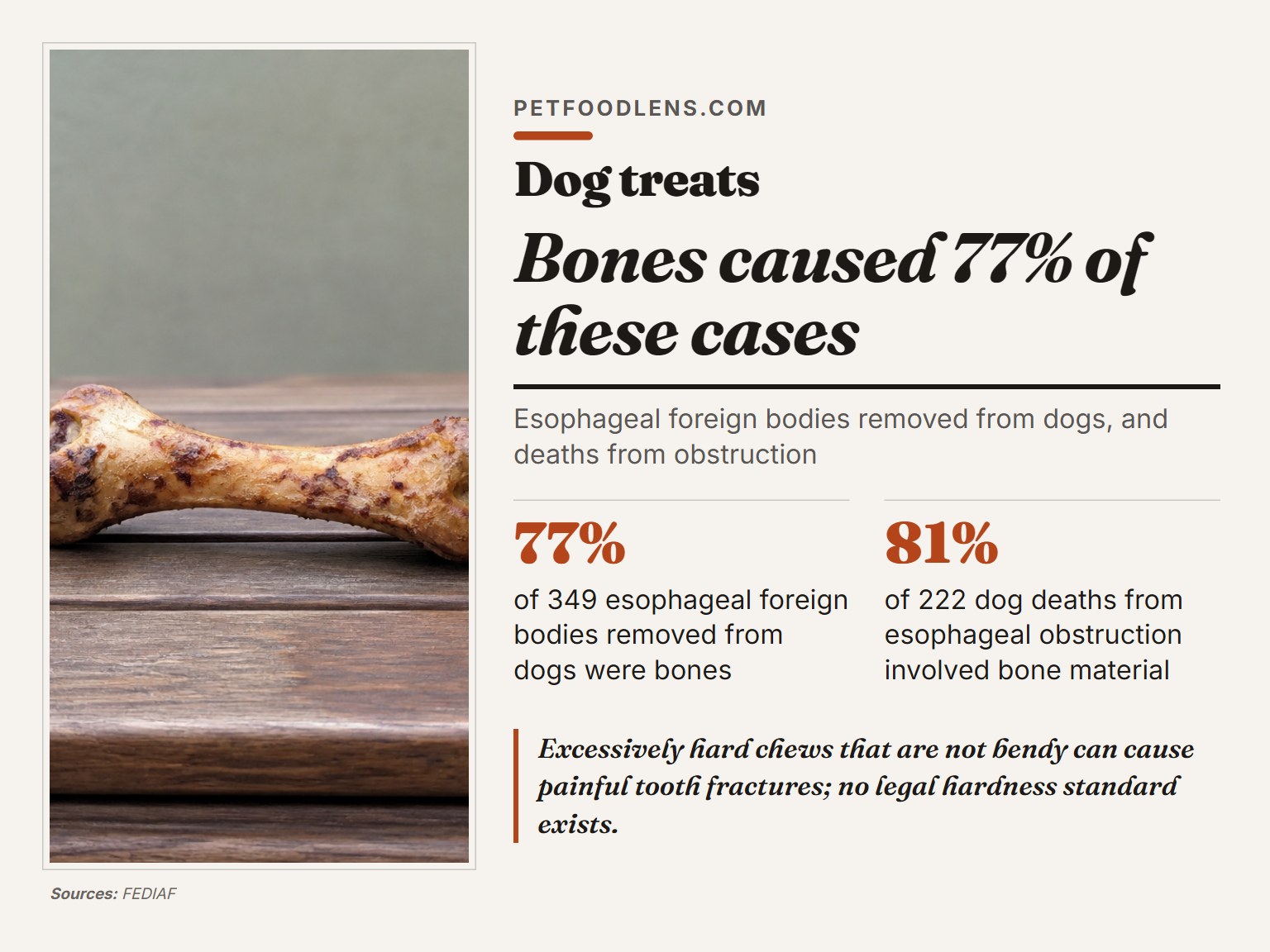
Bones deserve their own warning. FEDIAF cites a 2019 study of 349 clinical cases of esophageal foreign bodies removed from dogs, and 77% were bones. A 2017 retrospective study of 222 dog deaths from esophageal foreign body obstruction found bone material in 81% of cases.
Hard chews are a separate risk. FEDIAF notes that excessively hard chews that are not bendy or malleable can cause painful tooth fractures, and there is no specific legal standard for chew hardness. A 2005 study found that half of owners of dogs with fractured teeth did not notice the fractures.
The new treats rule applies here: introduce one new treat at a time, starting with a small piece. VCA also warns that freeze-dried or dehydrated raw treats pose a bacterial contamination risk to the dog, other pets, and humans.
Easy to miss: A dog that got into xylitol can develop signs ranging from lethargy to seizures and death. If you suspect xylitol ingestion, call your vet or an emergency clinic immediately.
Frequently Asked Questions
How many treats can a dog have a day?
Treats should make up no more than 10% of a dog’s daily calories. For a small dog eating about 182 calories a day, that’s roughly 18 calories of treat room. For a large dog eating 1,456 calories a day, it’s about 146 calories. The exact number depends on the dog’s weight and calorie needs.
Do training treats count toward the 10%?
Yes. The 10% ceiling includes all treats: training rewards, chews, table scraps, and anything else the dog eats outside the main meal. A training session with many small treats can use up a small dog’s entire daily allowance.
Is it OK to give my dog treats every day?
Some sources, including VCA Animal Hospitals, say yes as long as the treats stay within the 10% calorie ceiling and the main diet is complete and balanced, while the University of Cambridge recommends stopping treats entirely. Some sources, including the University of Cambridge, recommend stopping treats entirely for weight loss, but the 10% rule is the more common standard for healthy adult dogs.
What’s the lowest-calorie treat for a dog?
Vegetables like carrots and green beans are low in calories, but they contain oxalate and should be avoided for dogs prone to calcium oxalate stones. Blueberries and cranberries are a low-calorie option for most dogs. Small pieces of the dog’s regular kibble also work.
Can I give my dog human food as treats?
Some human foods are safe in small amounts, but many are not. Xylitol, grapes, raisins, chocolate, caffeine, and raw dough are dangerous. Peanut butter is high in fat and should be limited. FEDIAF advises against human scraps in general because they can be too high in fat, salt, sugar, and energy.
The Bottom Line
How many treats should a dog have a day depends on the dog’s weight and calorie needs, and many sources set the ceiling at 10% of daily calories, though some, like the University of Cambridge, advise stopping treats entirely. The math is the easy part. The hard part is remembering that the training treats, the dental chew, and the piece of cheese at lunch all come out of the same budget.
If your dog is at a healthy weight and the treats are within the 10% ceiling, the system is working. If the weight is climbing, the treats are the first place to look, not the last. Weigh the dog, run the MER formula, and pull the treat allowance out of the daily meal portion. That’s the whole system. The rest is label reading.
