
How to Cut Dog Treats for Training: Size Rules That Work
This post contains affiliate links. As an Amazon Associate, we earn from qualifying purchases.
To cut dog treats for training, halve or quarter each piece down to pea size, and go smaller again for small dogs. Keep every treat calorie inside 10% of the dog’s daily intake; for a dog eating about 550 calories a day, that leaves 55 calories for treats.
The pea is a ceiling, not a serving. A three-minute clicker session can burn through 30 or 40 of them, and a dog in daily training can clear 100 treats before dinner. Size and count have to be solved together, because a piece that is too big wrecks the calorie budget and a piece that is too slow wrecks the timing, which is why how to cut dog treats for training matters as much as what you buy.
What follows is the size chart, the calorie arithmetic, and the knife work: how to cut soft treats cleanly, what to do with biscuits that shatter, and where two well-regarded sources give you flatly opposite advice about what belongs in your hand.
Key Takeaways
- Pea-sized is the ceiling for medium and large dogs, roughly a blueberry. Small dogs go smaller: the AKC says ‘even tinier pieces’ without a measurement, while Karen Pryor Academy specifies half a pea.
- The 10% cap governs everything. A dog on about 550 calories a day gets 495 from complete food and 55 from treats, and that 55 covers every reward you hand out.
- Thirty or forty pieces can disappear in a three-minute session, which is why cutting matters more than choosing.
- Kibble counts as a legitimate reward because it is complete and balanced, but it does not exempt you from the calorie ceiling.
- Stopping mid-session to hack a treat in half costs you the repetition.
What Size Should a Training Treat Actually Be?
A pea. That is the benchmark the American Kennel Club lands on, and it holds even for large dogs. For small dogs, the AKC says to use tinier pieces still, without giving a measurement.
Training rewards work at pea size for medium and large dogs, roughly the size of a blueberry. Smaller dogs take pieces smaller than that. The piece has to be eaten in a second or two so the next repetition can start, and it has to be small enough that a hundred of them do not blow the daily calorie budget.
| Dog Size | Piece Size | Source |
|---|---|---|
| Medium and large dogs | Pea-sized, about a blueberry | AKC; Chewy (Laurel Saville, CPDT-KA) |
| Small dogs | Smaller than pea-sized, no figure given | AKC |
| Small dogs | Half a pea | Karen Pryor Academy course material |
| Any size, high-distraction work | Same small piece, higher-value food | Karen Pryor Academy |
The size rule exists for two reasons, and only one of them is about calories. The other is speed. A dog that takes too long to chew is a dog you cannot reward twice in that window, and the AKC is explicit that soft treats beat crunchy ones for exactly this reason.
Small Dogs: The One Number the Sources Argue About
The AKC says small dogs get “even tinier pieces” and stops there, while Karen Pryor Academy’s course material puts a figure on it: half a pea. Treat it as a starting point rather than a rule handed down.
A piece sized for a retriever will vanish in a terrier’s mouth, so the right treat size for the dog has to be judged against the dog in front of you. Hard pieces that can lodge are a separate problem from calories, and safe treat size matters far more for a gulper than for a slow eater.
The 10% Rule and the Treat Calorie Math
VCA Animal Hospitals, whose guidance is written by a board-certified veterinary nutritionist, puts the ceiling at 10% of a dog’s total daily calorie intake. The stated purpose is twofold: prevent excess calories and prevent nutrient deficiencies.
Here is the arithmetic on a dog that needs about 550 calories a day. VCA’s worked example splits it into 495 calories from a complete and balanced diet and 55 calories from treats. That 55 is the entire daily budget, and it has to cover every reward, every scatter, and every piece that falls on the floor.
Commercial treats print calories per piece, so check the number before you feed it. Whole foods need a lookup instead. VCA points owners to the USDA FoodData Central database for calorie counts, then asks you to estimate the treat total against the 10% allowance.
Once you know the per-piece figure, the treat calorie math is simple division, and how to cut dog treats for training becomes a matter of arithmetic rather than guesswork. It tells you whether today’s session fits inside the treat allowance.
Weigh out the day’s treats once, in the morning, into a separate container. When the container is empty, the training day is over, no matter how the session is going.
The low-calorie training treats that survive this filter tend to be small and soft. Sprayable cheese and peanut butter are the ones to watch. VCA calls both tasty and useful, then adds that they run high in calories and need cautious use.
How to Cut Dog Treats for Training Without Wasting the Session
Start with a firm, cold treat and a small sharp knife. Warm soft treats smear under the blade, and a chilled one cuts clean.
A soft treat that is properly set holds its shape through the cut. A stale one tears into a ragged edge and leaves a smear of crumbs under your thumbnail.
- Chill soft treats first. Chill soft treats first so the blade stops squashing them flat. Skip this and you get a sticky lump instead of four clean pieces.
- Cut lengthwise, then across. Cut lengthwise, then across, checking each piece against a pea.
- Check each piece against a pea. If it is bigger, cut again. Anything the dog cannot swallow in one motion is slowing the session down.
- Keep the pieces uniform. Uneven pieces mean uneven reward value, and dogs notice which handful was bigger.
- Bag the whole batch before you start. Cutting mid-session costs you the timing, and timing is the part the dog is actually learning.
Cutting Soft Treats
Soft commercial training bites are often already close to size, so one cut across the middle usually finishes the job. They also hold together in a pocket, which matters more than most people expect.
You can break treats into pieces with your fingers if the texture allows, but a knife gives you consistent pieces and consistent pieces give you a consistent reward.
Cutting Crunchy Biscuits
Biscuits shatter. The AKC notes that crumbs end up on the floor and the dog spends the next several seconds hoovering them up, which is time away from teaching.
Cut them over a bowl, not over the dog. And accept that the soft vs crunchy treats question has already been answered by the texture itself: a biscuit is a one-off reward, not a session reward.
Cut the whole bag before the session, not during it. Stopping to hack a treat in half while the dog waits turns a clean repetition into a sloppy one, and the dog learns the sloppy version.
Kibble, Cold Cuts, or Commercial Bites: Where the Sources Split
Most of the homemade treat recipes I get asked about are fine as treats and a disaster as meals. The rule I give people is the one VCA publishes: treats stay under about 10% of daily calories, and the complete food does the nutritional work. Keep the kibble or the canned food as the base and use the homemade stuff as a topper. It is boring, and it works every time.
That part is settled. What is not settled is what should be in your hand during the session, and two detailed sources give opposite answers.
| Treat Choice | What the Source Says | Best Fit |
|---|---|---|
| Regular kibble | Complete and balanced; prevents deficiencies on treat-heavy days (VCA) | High-volume sessions, tight calorie budgets |
| Perishable high-value food | Diced hot dogs, liverwurst, deli meat, cheese for new or distracting places (Karen Pryor Academy) | Vet visits, strange dogs, competition |
| Commercial soft training bites | Small, soft, eaten quickly (AKC) | Everyday repetition work |
| Whole or “people” foods | Acceptable with calorie tracking (VCA) | Owners already weighing food |
The Kibble Case
VCA’s argument for kibble is nutritional, not caloric. Because kibble is complete and balanced, a treat-heavy training day does not create a deficiency. That is a real advantage over a handful of cheese.
VCA also warns that even complete kibble can overshoot calories and cause weight gain. So kibble solves the nutrition problem. It does not solve the calorie problem, and the 10% ceiling still binds.
The Perishable Case
Karen Pryor Academy recommends diced hot dogs, liverwurst, deli meat, or cheese when the environment is new or challenging, such as a vet’s office, strange dogs, or a dog-sports competition. High-value food gets and holds attention where kibble will not.
The same source admits the drawback: slimy perishables are harder for a novice trainer to deliver swiftly. Fast delivery is the whole reason you cut small in the first place, so the advice carries its own tension.
Neither source reconciles the two positions. Read them as a split by context. VCA favors kibble for volume, while Karen Pryor Academy favors perishables for difficulty; commercial soft bites fit the ordinary middle. The AKC guide to training treats makes the same speed argument, and speed is what all three approaches are chasing.
If you want the longer version of that trade-off, the high-value dog treats breakdown covers which foods actually move a distracted dog. For most everyday work, a plain soft training treat option beats a fancy one, because the dog eats it faster and you get more repetitions per minute.
Where this goes sideways: buying perishable high-value treats for routine behaviors. Dice them for the vet visit, then go back to kibble for the kitchen. A dog fed hot dog pieces for “sit” in the living room learns to hold out for the good stuff.
If you bake your own, the OSU Extension dog treat recipes are one place to start. The calorie math is still on you, and a homemade biscuit is not automatically a low-calorie one.
When Cutting Smaller Stops Working
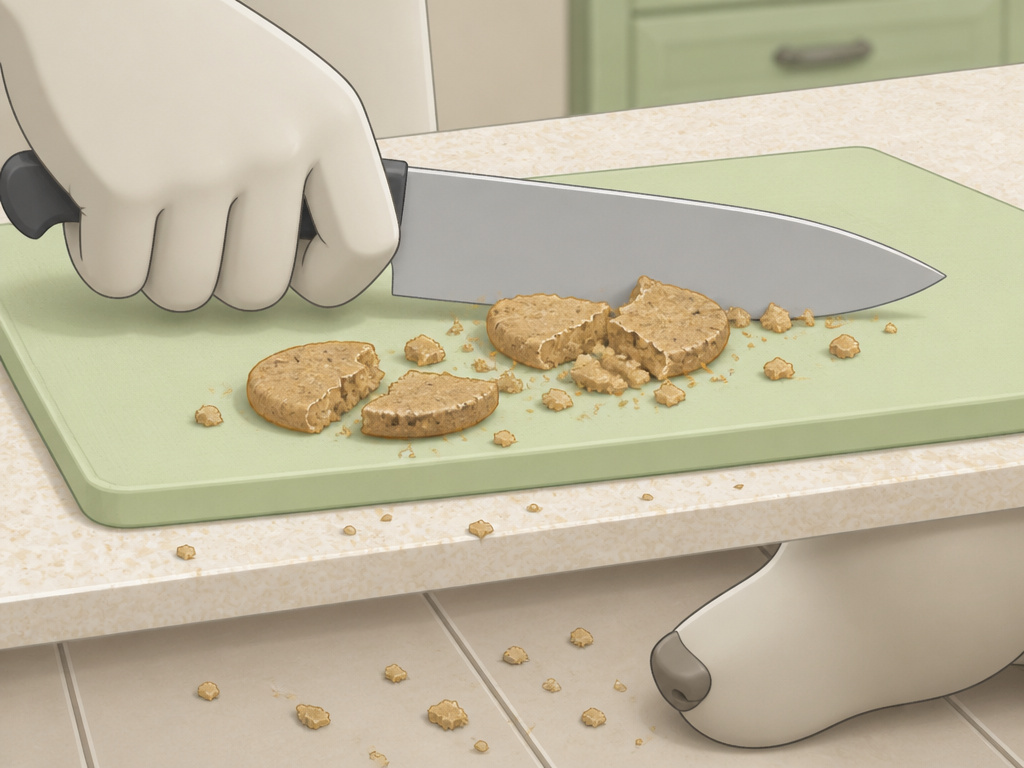
Crumbly biscuits beat the whole system. A biscuit cracks once under the knife and then scatters across the kitchen floor, and you hear it under your shoe before you see it. The dog spends time hoovering crumbs and the repetition is gone.
Cutting fixes size. It does not fix texture, and it does not fix every situation.
- Crumbly biscuits. The AKC’s point stands: crumbs cost training time. Use them as one-off rewards and keep soft food for sessions.
- Slimy perishables. Karen Pryor Academy flags diced hot dogs and liverwurst as harder for a novice to deliver fast, which undercuts the reason you cut small.
- High-distraction settings. The same source says switch to perishable high-value food at the vet’s office or around strange dogs, where kibble loses its pull.
- Dogs with kidney disease. VCA recommends low-phosphorus and low-protein treats such as fruits and vegetables.
- Dogs with heart disease. VCA says to avoid high-salt treats entirely.
Skip this if: your dog has a diagnosed condition like kidney or heart disease. The 10% ceiling still applies, but the treat type changes, and that call belongs to your vet rather than a cutting board.
Cutting a treat smaller buys you repetitions, but only if the reward lands inside a second or two of the behavior; reward timing with treats matters more than piece size once the dog already knows the cue.
How Many Treats Fit in a Three-Minute Session?
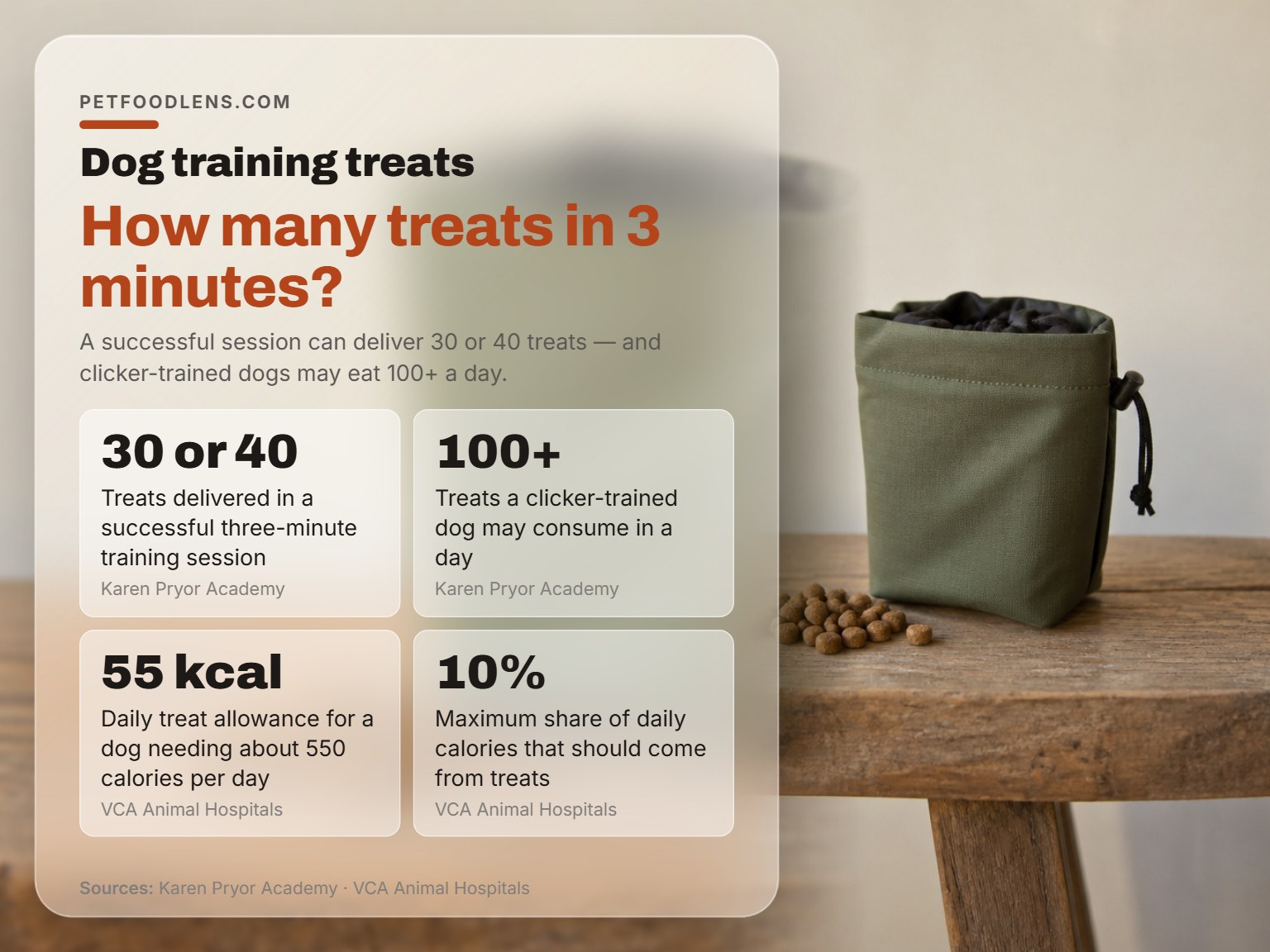
Thirty or forty treats in three minutes. That is the figure Karen Pryor Academy’s course material puts on a successful session, and it explains why piece size gets so much attention.
The same source notes that clicker-trained dogs can consume 100 or more treats in a day. Run that against a 55-calorie allowance and the arithmetic gets uncomfortable fast, which is the argument for cutting small rather than cutting sessions short.
- Count out the day’s allowance into one container before the first session, and stop when it is empty.
- Keep three or four different types on hand so you can switch the moment interest drops (Karen Pryor Academy).
- Carry non-perishables like freeze-dried liver or jerky cut small, which the AKC recommends for impromptu training because they travel without spoiling.
- Rotate the reward once a behavior is reliable: favorite treat one time, affection the next, a lower-value food after that (VCA).
Loading a dog treat pouch before you clip the leash on means the reward is in your hand the instant the behavior happens, not three seconds later while you dig through a jacket pocket.
The part nobody mentions: a hundred small treats is still a hundred treats. Small pieces limit the damage. They do not erase it.
Before You Go
The number worth remembering is 55. That is the treat budget for a dog eating about 550 calories a day, and it is smaller than almost anyone guesses before they run the arithmetic. If your sessions run long enough to blow past it, cut the pieces in half again before you cut the session.
Everything above assumes a healthy dog eating a complete diet. If your dog is on a therapeutic diet or carries a diagnosis, the treat type becomes a veterinary decision and the cutting advice only gets you halfway there.
Cutting dog treats for training is a two-minute job done before the session, not a running negotiation during it. Cut them all, count them, and put the rest away. The knife is the easy part. The counting is the part that decides whether the weight creeps on.
Frequently Asked Questions
How small should I cut treats for a puppy?
Pea-sized or smaller. The AKC’s benchmark of a pea-sized piece applies even to large dogs, and puppies are smaller than that. Cut a commercial training bite into quarters and check each piece against a pea before the session starts.
Can I use my dog’s regular kibble as a training reward?
Yes. VCA notes that kibble is complete and balanced, so a treat-heavy training day will not create a nutrient deficiency the way an all-treat day might. The catch is that kibble still carries calories, and VCA warns that even complete kibble can push a dog into weight gain if the volume goes unchecked.
How many treats is too many in one session?
Karen Pryor Academy’s course material puts a successful three-minute session at 30 or 40 treats, and notes that clicker-trained dogs can hit 100 or more in a day. The real limit is the 10% calorie ceiling, not a piece count. Cut smaller and you can reward more often inside the same budget.
Is peanut butter a good training treat?
VCA calls peanut butter and sprayable cheese tasty and useful for training, then adds that both run high in calories and should be used cautiously. A small amount goes a long way, and it counts against the daily treat allowance like anything else.
Do I need to cut soft treats differently from biscuits?
Yes. Soft treats cut cleanly and hold their shape, especially if you chill them for ten minutes first. Biscuits shatter, and the AKC notes the crumbs end up on the floor costing you training time. Use biscuits as one-off rewards rather than session rewards.
What if my dog has kidney or heart disease?
VCA recommends low-phosphorus and low-protein treats such as fruits and vegetables for dogs with kidney disease, and says dogs with heart disease should avoid high-salt treats. Discuss any treat with your veterinarian before changing the routine, because the standard cutting advice does not cover therapeutic diets.
