
How to Rotate Cat Food Textures: Step-by-Step
This post contains affiliate links. As an Amazon Associate, we earn from qualifying purchases.
To rotate cat food textures, mix a small amount of the new texture into the old and raise the ratio as your cat accepts it. Expect a slow ramp. The American Animal Hospital Association puts feline transitions at up to 40 days, and one to two months for a cat fixed on a single texture.
Texture is the part of that timeline that stretches it, which is why the how to rotate cat food textures question matters. A cat raised on pate reads shreds as a different food, not a variation on dinner, and AAHA notes that cats accustomed to a specific texture may refuse a different one outright.
What follows is the working order: which textures rotate easily, where the veterinary sources split on cadence, and the situations where you should not rotate at all.
Key Takeaways
- Wet rotates easiest. Fromm’s rotational feeding guide calls wet the format most easily rotated for cats, and it adds moisture while you’re at it.
- Sources split on texture-fixed cats. AAHA’s ceiling for a cat habituated to moist, dry, or semi-moist food is one to two months, while Royal Canin and Chewy publish 7-day plans.
- Never introduce a desired long-term food to a nauseous cat. AAHA warns this can build an aversion lasting up to 40 days.
- The sources split on whether to rotate at all. VCA advises sticking with a formulation once a cat has demonstrated a preference for it.
- Escalate to your vet if vomiting, loose stool, or refusal persists.
Which Cat Food Textures Actually Rotate Easily?
Wet food is the easiest of the three formats to rotate. That’s Fromm’s position, and it lines up with what the cans themselves do: wet food carries the moisture, so a texture change inside the wet category doesn’t also change hydration.
Canned cat food splits into three physical forms: pate, ground to a uniform paste; shredded or minced, which keeps muscle fibers intact in liquid; and chunks in gravy, which suspends set pieces in a thickened sauce. Moisture content and thickener load differ across all three. A cat’s acceptance hinges on all three variables at once.
Dry kibble is the hardest. You can’t change kibble texture without changing the entire product, and a cat that has spent years cracking the same kibble has a lot of practice to unlearn.
Why Pate Is the Easier Landing Spot
Pate is uniform. There’s nothing to pick around, nothing to lick clean and leave behind. That matters more than people think, because a cat eating chunks in gravy can eat the gravy and skip the meat entirely and still look like it finished the bowl.
Chunks in gravy that are mostly thickener pour out as one glossy block and leave the meat sitting in the middle. I check that now before I check anything else on the label.
If you want the full breakdown of how these forms differ, the guide to cat food textures covers the physical side, and the shredded vs pate comparison handles the two that get confused most often.
Why Texture Aversions Outlast Flavor Aversions
AAHA puts a number on the aversion window: up to 40 days. That’s the figure for a learned food aversion in cats, and it’s the reason a bad first attempt costs you more than a bad first meal.
Here’s the mechanism. A cat that eats something and then feels nauseous associates the food with the nausea, not with whatever actually caused it. AAHA’s guidance is blunt about the implication: don’t feed a food you want your cat on long-term to a cat who is currently nauseous. You’ll burn the food.
Texture habituation works differently but lands in the same place. AAHA notes that cats accustomed to a specific texture may refuse a different one outright, and that the transition timeline for those cats stretches to one to two months. Not a week. One to two months.
Do you know which texture your cat is actually habituated to? Most owners guess wet or dry. Semi-moist counts too, and it’s the one people forget, because the treats and the pouch foods sit in a different aisle.
The Transition Timeline the Sources Can’t Agree On
Seven days is the number Royal Canin and Chewy both publish. AAHA’s ceiling is 40 days. That’s the widest disagreement in this whole topic, and it isn’t a rounding error.
The reason is that they’re answering different questions, including how to rotate cat food textures. The 7-day tables assume a healthy adult cat moving between two similar foods. AAHA is describing the outer edge, including cats with a texture fixation and cats recovering from a nausea episode.
| Source | Recommended pace | Best fit |
|---|---|---|
| Royal Canin | 7 days, 25% steps | Healthy adult cats |
| Chewy (Coates) | 7 days, extended to 2 weeks | Sensitive stomachs |
| Fromm | Small amounts mixed in, raised over about a week | Rotational feeders |
| PetMD (Coates, 2013) | A few days of mixing | Brand switches |
| AAHA | Up to 40 days; 1 to 2 months for texture-fixed cats | Cats habituated to one texture |
When people ask how to rotate cat food textures, the timeline is the part that trips them up. The honest answer depends on the source: Royal Canin and Chewy publish a 7-day table, while AAHA allows up to 40 days and one to two months for texture-fixed cats. Use it for a cat that already eats more than one thing. Stretch it for a cat that doesn’t.
The AAHA guidance behind those figures is worth reading in full: AAHA pet food transition tips lays out the 25% starting ratio and the texture-habituation exception on one page.
How Do You Rotate Cat Food Textures Without a Hunger Strike?
Four conditions have to be true before the new texture goes in the bowl. The cat has to be healthy, the calories have to be adequate, the old food has to stay available, and the new food has to be served at a temperature the cat will accept.
Before you start: A cat that stops eating during a transition needs a vet, not more patience. Weigh the cat before you start so you have a baseline.
- Rule out a medical cause first. VCA’s guidance is to have the veterinary team check for an underlying condition before you label the cat picky. A cat refusing food because of dental pain or nausea won’t be won over by a better texture.
- Start at 25% new and 75% old. AAHA, Royal Canin, and Chewy all land on the same opening ratio. Going heavier on day one is how you get a refusal that sets you back.
- Hold the ratio until stools stay firm. Fromm’s rule is to wait for consistently firm stools as the signal that the gut has adjusted, then raise the proportion over the next week or so. Skipping this step means you’re guessing.
- Log what you fed and what came out. Fromm recommends a feeding journal, and VCA recommends a 3 to 5 day food diary that includes treats and any food used to give medication. Without it you can’t tell which change caused which problem.
- Serve it warm, not hot. More on temperature below, but this is the step that decides whether a pate gets eaten at all.
- Never withhold food to force the switch. Royal Canin is explicit: don’t starve a cat into changing food, and extend the transition if you need to. VCA notes a healthy cat can miss an occasional meal, but AAHA’s counterweight is that cats must take in adequate calories daily. When those two pull against each other, the calorie floor wins.
If you want the general version of this sequence rather than the texture-specific one, the guide on how to transition a cat walks the same steps without the format angle.
The Dry-to-Wet Switch Is the Hardest Rotation You’ll Make
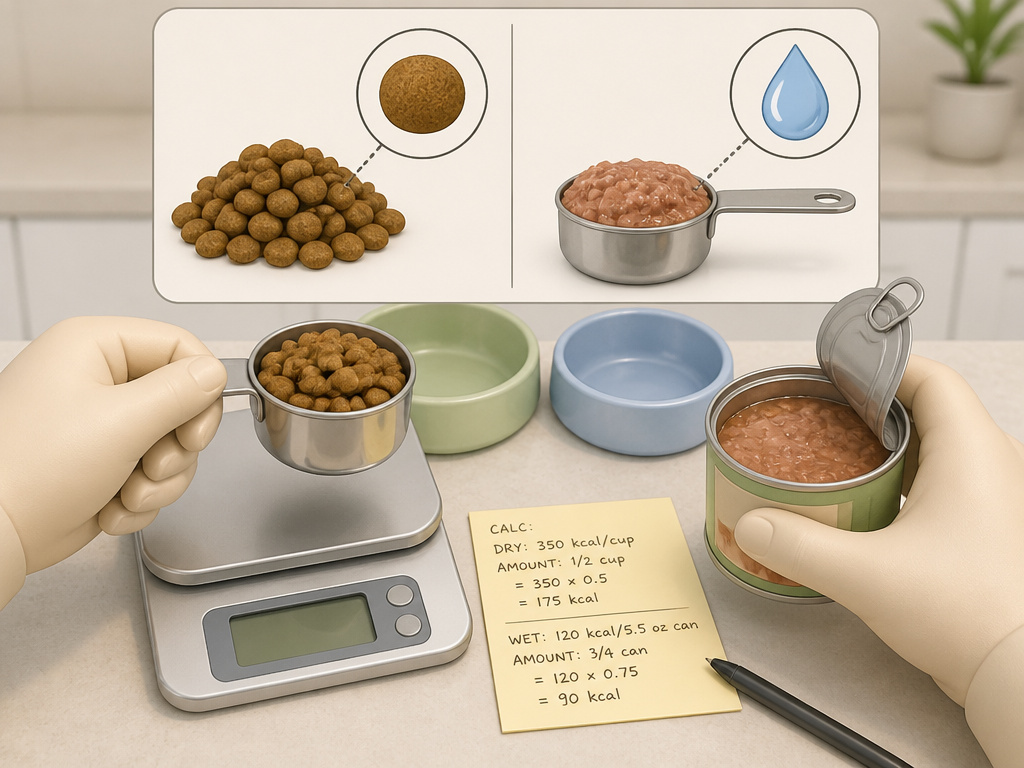
The dry-to-wet switch carries more failure modes than any other rotation. Two formats means two calorie densities, two moisture levels, and two completely different eating mechanics.
I learned the calorie trap the hard way. Early on I compared a canned food and a dry food using the printed protein percentages and concluded the dry one was far richer. The canned showed a much lower protein percentage than the dry. The moisture gap made the whole comparison meaningless, because one number was mostly water and the other wasn’t. Everything gets converted to a dry matter basis now, and I still do it on the back of the can out of habit.
Fromm makes the same point from the other direction: manage caloric density, not volume. A cup of one recipe and a cup of another are not the same amount of food, and the volume you scoop is a poor proxy for the calories your cat takes in.
Counting Calories Across Two Formats
Royal Canin’s advice for a dry-to-wet move is to mix the two together, sprinkling dry on top or crushing it into the wet food, and to count the calories from both. That last clause is the one people skip.
Run the numbers before the first bowl. If you’re adding a third of a can on top of a full dry portion without reducing the kibble, you’re not transitioning, you’re supplementing.
For the pace and the portion math on that specific switch, the dry to wet walkthrough covers it in more depth than I can here.
Where the Sources Tell You Not to Rotate at All
VCA’s veterinary nutrition team argues against the thing the rotational-feeding guides sell. Their position: for a cat with a demonstrated texture or flavor preference, once you identify what that cat likes, stick with that formulation for consistency.
Fromm takes the opposite view, calling format switching an essential piece of rotational feeding and noting that rotating textures in young cats can help prevent texture aversions from developing in the first place. Chewy sits in the middle, recommending rotation while conceding that a cat thriving on a single complete and balanced diet doesn’t need to change anything.
Nobody in that disagreement is being careless. They’re describing different cats.
The VCA caution about variety creating a cat that holds out for favorites is real, and it’s the same mechanism PetMD’s Jennifer Coates described in 2013 when she wrote that frequent flavor rotation has been implicated in finicky eating. Chewy’s own current guidance, from the same author, recommends switching within a product line every few days. Same veterinarian, years apart, opposite cadences. That’s worth knowing before you treat any single cadence as settled.
The Cats That Should Stay on One Texture
- Cats on a prescription diet. Chewy’s guidance is explicit veterinary oversight before any rotation.
- Kittens and senior cats. Same rule, same reason. Their nutritional margins are narrower.
- Cats with a diagnosed medical condition. Fromm notes that cats with chronic issues like sensitive stomachs or IBD may need a consistent, highly digestible diet that rotational feeding won’t provide.
- Cats that are already thriving. If the current food is complete and balanced for the life stage and the cat is doing well on it, the case for changing anything is thin.
Whatever you rotate to, each food in the rotation should carry an AAFCO complete-and-balanced statement for your cat’s life stage. That’s the one line on the label that’s actually regulated, and it’s the reason the cat food formats question matters less than the adequacy statement does.
The part nobody mentions: A cat that gets a new texture every few days learns that refusing dinner brings something better. That’s the mechanism VCA and PetMD are both describing, and it’s why “rotate often” and “don’t create a finicky cat” are the same advice pointed in opposite directions.
Serving Temperature and the Details That Decide Acceptance
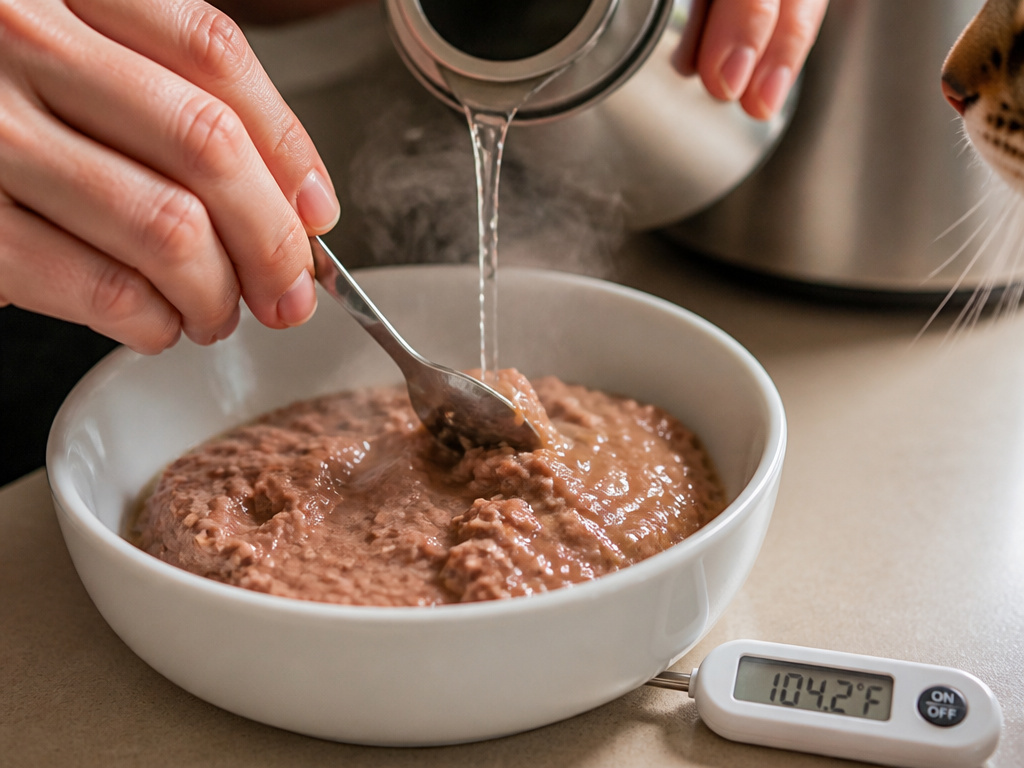
You set the bowl down at six in the morning. The cat sniffs it, looks up at you, and walks off. Often the food is fine and the temperature isn’t.
AAHA’s guidance is that cats don’t accept food served at temperature extremes and tend to prefer it near body temperature. Royal Canin’s advice for fussy cats is to warm wet food to make it more palatable. Those two aren’t in conflict; they’re the same instruction from a veterinary association and a manufacturer.
A pate straight from the fridge barely smells of anything. Warm it and the whole kitchen knows. That’s not sentiment, it’s the mechanism: warming drives off the volatile compounds that carry aroma, and aroma is most of what a cat is evaluating before it commits.
My habit is a small amount of warm, not hot, water stirred into the can. It costs nothing, it raises intake in most cats, and it fixes the temperature problem at the same time. If you use broth instead, read the ingredient list first. Plain poached chicken broth is fine only if there’s no onion, onion powder, garlic, or salt in it, and some homemade broth recipes floating around would be a genuine hazard for a cat.
Where this goes sideways: Rehydrating a freeze-dried food with hot water rather than warm destroys the point of the exercise. The food goes back to a pasty texture the cat already refused, and you’ve spent a portion finding out.
Freeze-dried formats are a third option worth knowing about, and the guide on how to rehydrate freeze-dried food covers the water ratio. If your cat is refusing textures generally rather than one specific texture, the material on feeding a picky cat is the better starting point, because the problem usually isn’t the food.
| What you see | Likely cause | What to do |
|---|---|---|
| Cat eats the old food, leaves the new | Texture refusal, not a hunger strike | Drop back to the last accepted ratio |
| Loose stool within 24 hours | Pace was too fast | Hold the ratio, extend the timeline |
| Vomiting or refusal past 24 to 48 hours | Something beyond pickiness | Call the vet |
| Cat eats only the topper | Topper outcompeting the base food | Cut the topper to a sprinkle |
Frequently Asked Questions
Can I rotate textures if my cat has a sensitive stomach?
Yes, but slower. Chewy’s guidance is to take a full two weeks to complete a transition for a cat with a sensitive stomach, rather than the standard seven days. If there’s a diagnosed condition behind the sensitivity, get veterinary guidance before you change anything.
How long should I wait before trying a different texture if the first one fails?
Go back to the last ratio your cat accepted and hold it for several days before you try again. AAHA’s warning about learned aversions is the reason not to push: an aversion can last up to 40 days, so a forced second attempt costs you far more than a patient one.
Is it bad to feed the same texture every day?
Not according to the sources that matter most here. Chewy states plainly that cats thriving on a single complete and balanced diet don’t need to change foods, and VCA recommends sticking with a formulation once a cat has shown a preference for it. Variety is a convenience and an insurance policy, not a requirement.
Should I warm wet food before offering a new texture?
Royal Canin recommends warming wet food for fussy cats, and AAHA notes cats prefer food near body temperature and reject temperature extremes. AAHA notes that cats reject food at temperature extremes and prefer it near body temperature, and Royal Canin recommends warming wet food for fussy cats. Don’t serve it hot, and don’t microwave it into uneven patches.
Does switching from pate to shredded count as a texture change?
It does. AAHA treats physical form as one of the things cats can become fixed on, alongside odor and taste, and lists moist, dry, and semi-moist as the categories a cat may refuse to leave. Pate to shredded is a smaller step than dry to wet, but it’s still a step.
The Bottom Line
One threshold decides most of this. If your cat has eaten the same texture for years and refuses everything else, plan for one to two months and stop measuring progress in days. If your cat already eats more than one format without complaint, the 7-day table is fine and you can start at 25% tomorrow.
The thing I’d tell you to do this week is smaller than either of those. Weigh your cat, or get a current weight from the vet, and write it down. Every decision after that depends on whether the cat is holding weight during the transition, and you can’t tell that from how the bowl looks.
Fair warning: the sources will not settle the rotation-frequency question for you. Chewy says every few days, Fromm says every seven days for protein and every four to eight weeks for format, and PetMD says every few months. That spread exists because the answer depends on the individual cat’s gut, and no manufacturer can measure yours. Start at the slow end, watch the stool, and let the cat set the pace from there.
