
How to Transition a Cat From Dry to Wet Food: Past 7 Days
This post contains affiliate links. As an Amazon Associate, we earn from qualifying purchases.
To transition a cat from dry to wet food, shift the ratio in stages: 75% old food and 25% wet for two days, then 50/50, then 25/75, then all wet on day 7. That schedule is a floor. The American Animal Hospital Association puts the ceiling at up to 40 days, and knowing how to transition a cat from dry to wet food helps you pace the change.
The gap between seven days and forty is where transitions quietly fall apart. A cat that picks at a 50/50 bowl for three days looks stubborn. A cat that picks at it for three days and then stops eating altogether is a different problem, and the fix for the first one makes the second one worse.
What follows: the ratio schedule, the one fat threshold that doubles it, the refusal playbook, and the red lines that mean a vet call rather than another week of patience.
Key Takeaways
- Mud Bay and Royal Canin land on a week, while PetMD gives seven to 10 days, Ohio State one to two weeks, and AAHA up to 40 days.
- Mud Bay’s Katy Patterson-Miller notes a fat jump of more than 3 percentage points on a dry matter basis means doubling or tripling every stage.
- PetMD notes wet food is mostly water, so you feed a bigger volume to hold the same calories.
- Ohio State recommends offering the new food beside the old one first, while Mud Bay, Royal Canin, and PetMD advise stirring them together.
- A cat that has not eaten in 24 hours needs a vet call per PetMD, though Mud Bay sets the line at 36 hours.
Why the 7-Day Chart Undersells the Job
I once changed a cat’s brand and its format in the same week. When the cat started refusing, I had no way to tell which change caused it. Now the ratio moves and nothing else does, which is the only reason a refusal tells me anything.
That rule matters more here than anywhere else, because how to transition a cat from dry to wet food is a format change by definition. You are already moving one big variable. Do not stack a brand change on top of it.
A dry-to-wet transition changes three things at once: moisture, calorie density, and texture. Canned food is mostly water, so a larger volume is needed to hold the same calories, and the texture shifts from crunch to pate, shred, or morsel. Each of those can stall a transition on its own.
Four credible sources give four different timelines, and nobody is wrong. The schedules differ because the cats differ.
| Source | Timeline given | Best suited to |
|---|---|---|
| Mud Bay (Katy Patterson-Miller, DVM) | At least 7 days; double or triple each stage for high-fat diets | Cats moving to a richer wet food |
| PetMD (Brittany Kleszynski, DVM) | 7 to 10 days | Straightforward switches |
| Ohio State Indoor Pet Initiative | 1 to 2 weeks, cutting old food by 1 tsp to 1 tbsp daily | Free-fed cats moving to meals |
| AAHA | Up to 40 days; 1 to 2 months for a texture change | Texture-locked or texture-averse cats |
Read that table as a range, not a menu. A young cat that has eaten a dozen different foods will clear a week. A ten-year-old cat that has eaten one kibble its entire life sits in the AAHA row, and rushing it buys you nothing.
The how to transition a cat from dry to wet food calorie trap is the other thing the chart hides. PetMD’s Brittany Kleszynski points out that wet food is mostly water while dry food is more calorie-dense, so the same calories arrive in a much bigger bowl. Owners see the volume go up and assume the cat is overeating. If you want the full breakdown, start with the dry matter math in this wet vs dry food guide.
Set the Mealtimes Before You Touch the Food
Before you start: A cat that stops eating can develop hepatic lipidosis (fatty liver disease), and overweight cats carry the highest risk. Mud Bay sets the vet-call line at more than 36 hours of refusal; PetMD sets it at 24 hours. Use the shorter number. Weigh the cat before day one, because weight loss hides in a long coat.
Riverside Cat Hospital’s Lisa Pierson starts with structure rather than food. Riverside Cat Hospital’s Lisa Pierson advises taking up free-choice food and building a schedule of two to three meals a day first, with twice daily preferred during a transition, while Mud Bay gives a 7-day ratio schedule without requiring that step. A cat that grazes all day never arrives at a meal hungry enough to be curious.
Ohio State’s Indoor Pet Initiative makes the same point from the behavior side: get the cat healthy, eating its usual diet normally, and living in an enriched environment before you change anything. Fixing dinner is a bad time to also fix the furniture.
Two meals beat three when you are switching
Twice-daily feeding gives you a clean twelve-hour window and a cat with a real appetite at each one. Three meals a day works fine once the cat is eating wet food reliably. During the switch, fewer meals means fewer chances to refuse.
- Weigh the cat and write the number down. Skip this and you have no baseline, so a cat losing weight on wet food looks identical to one doing fine.
- Take up free-choice kibble and set two mealtimes, roughly 12 hours apart. Pierson notes that a normal hunger response after 12 hours does a lot of the persuading.
- Use two identical containers, side by side. Ohio State recommends matching bowls because it makes the swap less strange. A cat choosing between two bowls in different rooms usually picks the room it already knows.
- Sources disagree on how long to leave food down: Riverside’s window is 20 to 30 minutes, while Ohio State allows a full hour. Pick one and hold it.
- Offer fresh wet food at the next mealtime. Do not re-offer the rejected portion, and do not leave it sitting there to be sniffed at all afternoon.
The low-stress diet changes for cats guidance from Ohio State is worth reading in full before you start, mostly because it treats the whole room as part of the transition.
The Fat Number That Quietly Doubles Your Timeline
Three percentage points. That is the whole threshold, and almost nobody checks it.
Here is the part the front never mentions: Mud Bay’s Katy Patterson-Miller sets the trigger at a new diet running more than three percentage points higher in fat on a dry matter basis than the current one. Cross that line and the pancreas needs considerably longer to ramp up enzyme production, so every stage in the schedule doubles or triples.
Dry matter basis means you strip the water out of both foods and compare what is left. A canned food and a kibble cannot be compared as printed, because one is three-quarters water and the other is not. I work the number out on the back of a can about once a week out of habit.
| Stage | Old food / new wet | Stretch it if fat is up |
|---|---|---|
| Days 1-2 | 75% / 25% | 4 to 6 days |
| Days 3-4 | 50% / 50% | 4 to 6 days |
| Days 5-6 | 25% / 75% | 4 to 6 days |
| Day 7 | 0% / 100% | day 13 or later |
The mechanism explains the timing of the trouble. Enzyme output climbs over days, not hours, which is why a cat can look perfectly fine on day three and produce loose stool on day five. Back the ratio off one stage and hold it there rather than starting over.
AAHA takes the opposite starting point on ratios, opening at 25 percent new food and building from acceptance rather than the calendar. Both routes land in the same place. The calendar is easier to follow; the acceptance route is kinder to a cat that reads as suspicious of everything.
How Do You Get a Cat to Eat Something It Doesn’t Recognize?
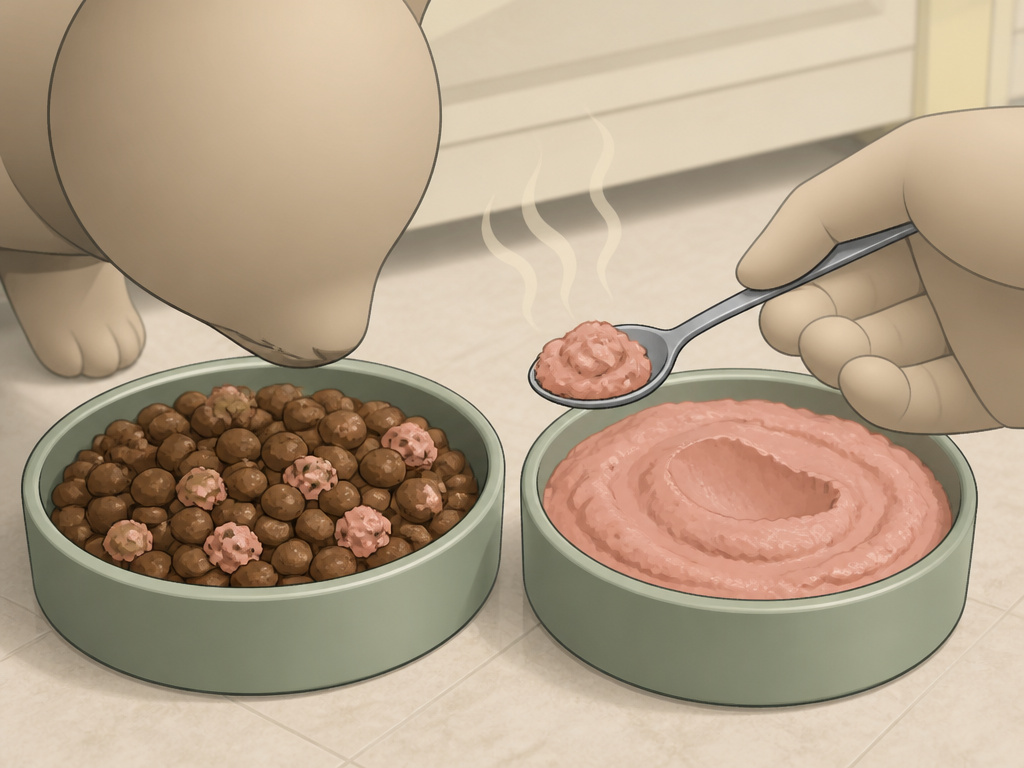
Riverside Cat Hospital documents cats that simply did not recognize canned food as food. That is not stubbornness. AAHA notes that cats fixated on one texture may refuse anything with a different one, and that a longer timeline of one to two months may be needed.
A cat raised on kibble has a category for crunch and no category for pate. You are not arguing about flavor. You are arguing about whether the object in the bowl qualifies as dinner at all.
A cat that has never eaten wet food does not have a word for it. Make the smell familiar before you make the texture mandatory.
Side by side or stirred together?
The sources disagree outright, and it is worth knowing which camp you are in before you start.
Ohio State says offer the new food in its own container beside the usual diet and keep them apart until the cat is used to seeing it. Mud Bay, Royal Canin, and PetMD all say stir them together, or coat the kibble with wet food, when the cat walks away from a separate bowl.
My call: start separate, treat mixing as the fallback. A separate bowl tells you whether the cat is refusing the food or refusing the change, and that is information you cannot get from a blended bowl. Once you know it is the food, mixing is the right tool.
Coating works because the wet food carries aroma onto a surface the cat already accepts. The crunch stays familiar while the smell changes, and smell is most of what decides whether a cat eats. If the texture itself is the wall, the wider question of food textures is worth working through before you pick a format.
Flavor without wrecking the diet
AAHA’s list of enhancers is short and cheap: a small amount of canned pet food as a topper, or low-salt broth. For cats that means low-salt tuna, clam, or chicken broth. Ohio State adds meat drippings and a splash of tuna, clam, or salmon juice, in small quantities at first.
Table scraps do not appear on either list. They dilute the balance of a complete diet and add calories fast, and a topper made of the same food does the same job without the drift.
If you make broth at home, read it like a label. No onion, no garlic, no salt. I have seen homemade broth recipes that would be a genuine hazard to a cat, so the ingredient list matters on your own stove as much as on a can.
The cat food toppers approach is a better lever than most people realize, and it doubles as a hydration tool. For the cats that hold out longest, the playbook for picky cats is a separate problem from a cat that genuinely does not recognize wet food.
Some Cats Need a Vet, Not a Longer Schedule
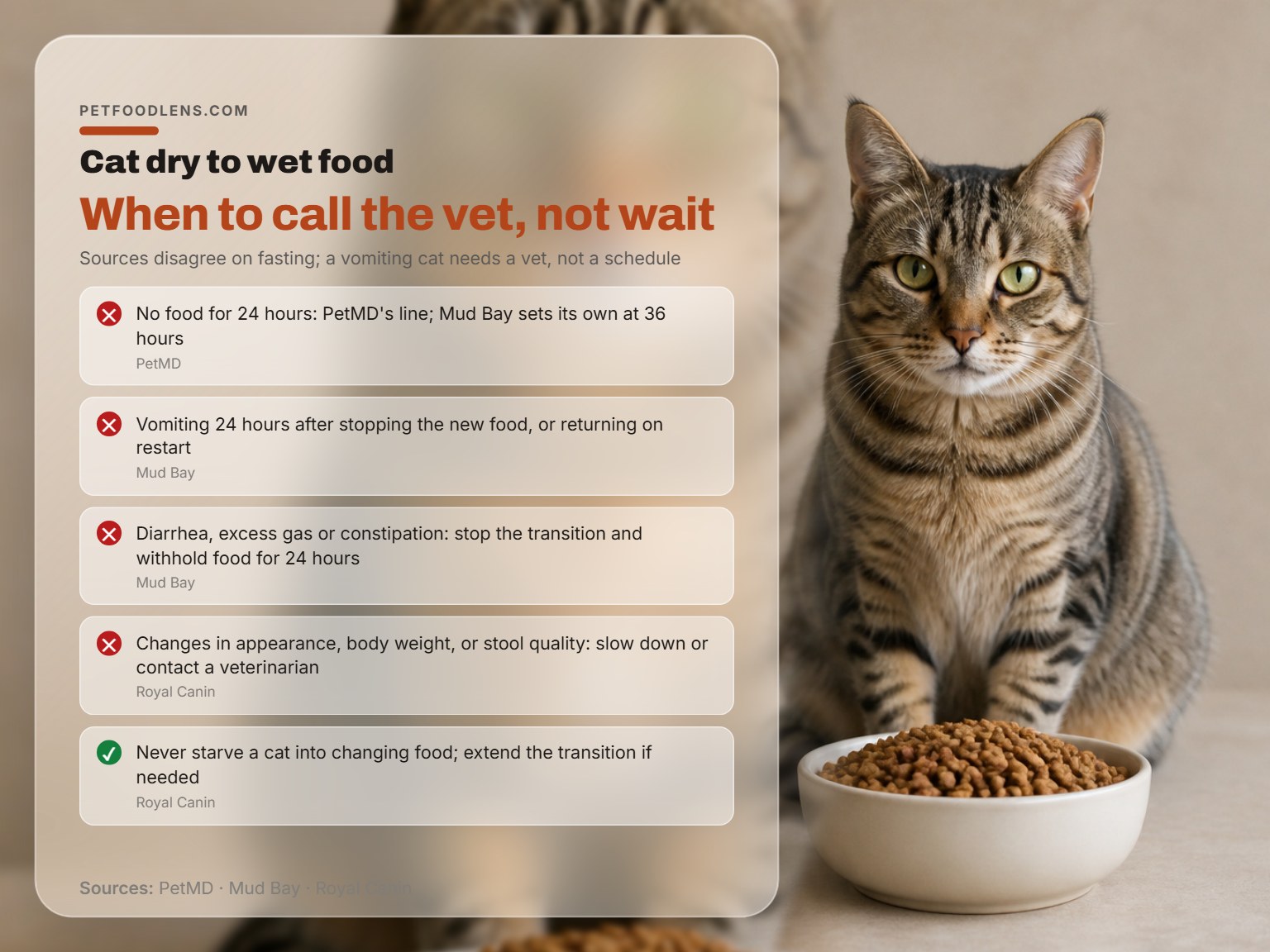
Stop signs matter more than schedules. These are the ones that end the experiment.
- No food for 24 hours. PetMD’s line. Mud Bay sets its own at 36 hours. The sources disagree on which to use.
- Vomiting that continues for 24 hours after you stop the new food, or that returns when you restart it. Both Mud Bay and PetMD treat this as a call.
- Diarrhea, excess gas, or constipation that does not settle when you back the ratio off a stage.
- Weight loss, a dull coat, or a cat that hides. Slow down and get a professional opinion.
Here is where the sources genuinely contradict each other, and you should know it before you are standing in the kitchen at 11pm. Mud Bay advises stopping the transition and withholding food for 24 hours after GI upset, then restarting with frequent small meals of the original diet. AAHA and Royal Canin both push the other way. AAHA warns that feeding a target food to a nauseous cat can create a learned aversion lasting up to 40 days, and that cats must eat adequate calories daily. Royal Canin’s wording is blunter: never starve a cat into changing food.
I am not a clinician, and this is exactly where the label-reading approach runs out. A 24-hour fast is a reasonable tool for a healthy cat that is simply refusing. It is the wrong tool for a cat that is already vomiting. That call belongs to a vet.
The AAHA pet food transition tips are the clearest short document on the aversion risk, and the 40-day window is the number to remember. A food a cat learns to hate during a bad week stays hated for over a month.
Does Warming the Food Actually Help?
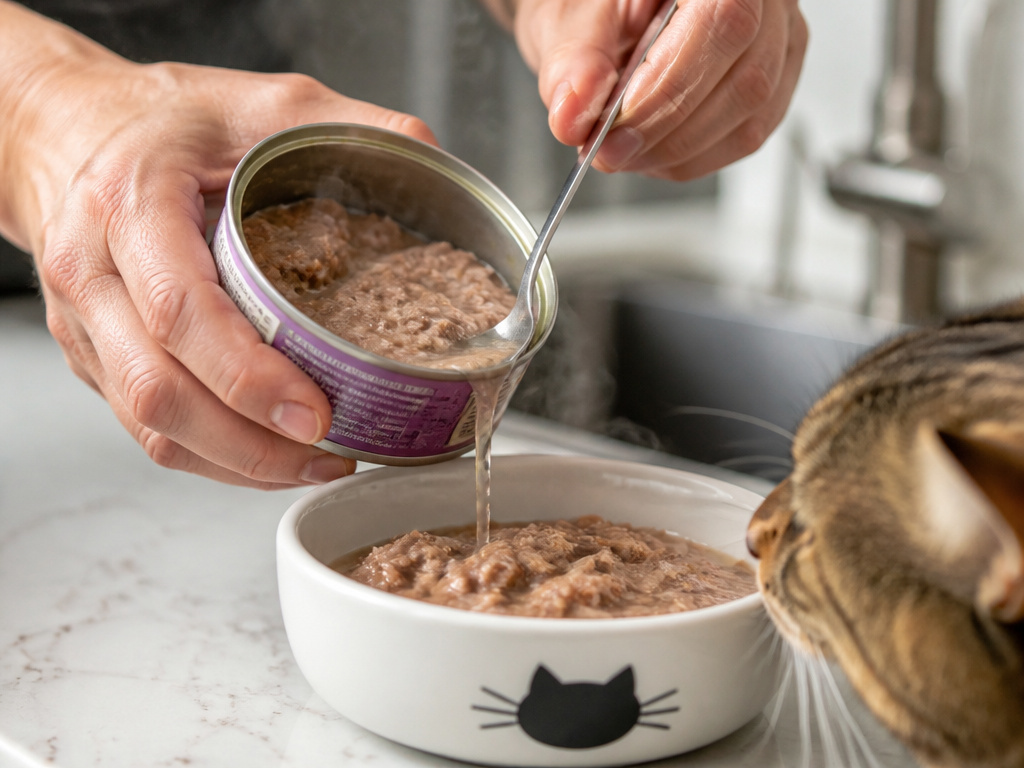
AAHA’s guidance is that cats reject food served at temperature extremes and tend to prefer it near body temperature, while Royal Canin advises warming wet food for fussy cats; the sources differ on warming.
Cold pate comes out of the can in one dense block and gives back almost nothing. No aroma, no steam, just a grey cylinder that slides out in a single piece. Ten seconds under a warm tap and the whole kitchen knows dinner is happening.
A splash of warm water stirred into the can costs nothing and can raise intake. Warming releases aroma, and aroma is probably half the reason it works. It also puts more water into a cat that needs it, which is the entire point of the switch.
How warm is warm enough?
Warm, not hot. If it is too warm against your wrist, it is too warm for the cat, and AAHA’s warning about temperature extremes cuts both ways. A few seconds in the microwave on the lowest setting, stirred, or a splash from the hot tap is enough.
It is not a substitute for moisture in food, and treating it as one is how cats end up eating kibble for another five years. The urinary argument runs through the bowl, not the fountain.
If your cat already has a diagnosed urinary or kidney problem, prescription diets exist for that reason, and choosing one off a shelf on my say-so is not how that decision should go. That is a conversation with the vet who has the labs.
For cats that clear the texture hurdle, the wet-only diet question comes next, including portion sizes and how much to put down at each meal. And if you are softening kibble rather than leaving it behind entirely, adding water to kibble covers how much actually helps.
Frequently Asked Questions
How long does it take to switch a cat from dry to wet food?
Sources disagree on duration: Mud Bay and Royal Canin give at least a week, PetMD seven to 10 days, Ohio State one to two weeks, and AAHA up to 40 days, or one to two months when texture is the sticking point. Pick the timeline that matches your cat, not the one on the can.
Can I mix the wet food into the kibble from day one?
Sources disagree: Mud Bay, Royal Canin, and PetMD suggest mixing, while Ohio State prefers separate bowls until the cat is used to the new food. Separate first tells you what the cat is actually objecting to, which is worth knowing before you commit to a two-week schedule.
What if my cat won’t touch wet food at all?
Riverside Cat Hospital describes cats that did not recognize canned food as food. Try a topper of the same wet food on the kibble, warm it slightly, and give it a week of proximity before you call it a refusal. A cat that has eaten one texture for a decade needs time, not pressure.
Should I warm the food up?
Sources differ: AAHA notes cats prefer food near body temperature and reject extremes, while Royal Canin recommends warming wet food for fussy cats. Warm to the wrist, never hot, and stir before you put it down.
How much wet food replaces a cup of dry?
Do not convert by volume. Riverside Cat Hospital notes that a quarter cup of high-calorie dry food holds 153 calories, and an average cat needs 150 to 250 calories a day. Wet food is mostly water, so the same calories take up far more space. Read the calorie statement on the can.
Is it safe to let my cat skip a meal to get hungry?
Sources disagree: Mud Bay allows withholding food for 24 hours after GI upset, while Royal Canin says never starve a cat into changing food and AAHA stresses adequate daily calories. For a cat that is vomiting or already underweight, extended fasting can lead to hepatic lipidosis. Mud Bay draws the vet-call line at 36 hours of refusal; PetMD draws it at 24. If in doubt, call.
The Bottom Line
Start tonight with the scale and the schedule, not the food. Weigh the cat, set two mealtimes, and put a teaspoon of wet beside the kibble. That is day one, and it is enough.
The number to hold onto is three. If the new food runs more than three percentage points higher in fat on a dry matter basis, every stage in the schedule doubles or triples. That one check is the difference between a one-week transition and a two-week one, and it takes ninety seconds with two cans in front of you.
None of this covers a cat with a diagnosed urinary, kidney, or GI condition. Prescription diets belong to the vet who has the labs, and reading a guaranteed analysis is not a substitute for that.
One last thing, and I will take the argument for it: I would rather see a cat stay on kibble for another month than see it develop a forty-day aversion because someone rushed a texture change to hit a chart. The chart will still be there next month. The aversion will too.
