
When to Switch a Kitten to Adult Cat Food: The 7-Day Ramp
This post contains affiliate links. As an Amazon Associate, we earn from qualifying purchases.
Switch a kitten to adult cat food between 9 and 12 months, with most published guidance landing at 10 to 12 months. The peer-reviewed range is 9 to 12 months, Hill’s and Royal Canin both say 10 to 12, and Purina says about 12. Large breeds like the Maine Coon run later.
That spread comes from sources answering slightly different questions: two manufacturers, a reference manual hosted by a standards body, and one peer-reviewed nutrition paper. Each one is protecting a different thing, and the gap between them decides how much of the transition you can safely rush.
What follows covers the age each source gives, the energy numbers behind the change, the 7-day ramp and the cats who need 40 days, and the two cases where the standard advice bends: the Maine Coon and the neutered kitten who starts gaining.
Key Takeaways
- Plan for 10 to 12 months, but know the peer-reviewed range opens at 9 and the manufacturers give 10 to 12.
- Energy needs fall by more than half between 10 weeks and 10 months, from 200 to 80 kcal/kg body weight per day.
- Ramp over 7 days at 25, 50, 75, then 100 percent new food; some cats need up to 40 days and that is documented.
- Maine Coons run late: 15 months per Royal Canin, about 18 per Hill’s, 18 months to 2 years per Purina.
- A neutered kitten gaining weight: Witzel & Murphy advise a lower-calorie kitten food, not adult food, while Hill’s and Royal Canin advise moving to adult food.
When to Switch a Kitten to Adult Cat Food: A 9-to-12-Month Range
The question of when to switch a kitten to adult cat food gets four slightly different answers, and the spread is small enough to ignore for an average kitten and wide enough to matter for a slow grower or a large breed.
Kitten foods carry an AAFCO statement for growth or for all life stages. Adult maintenance statements cover the nutrient profile for a mature cat, and growth profiles differ in protein, fat, mineral balance, and added taurine for cats. The statement, not the front of the bag, defines which profile a food meets.
Here is the full set, side by side.
| Source | Age given | Type of source |
|---|---|---|
| Hill’s Pet | 11 to 12 months | Manufacturer education |
| Hill’s Nutrition Reference Manual | 10 to 12 months, often after spay/neuter | Manufacturer reference |
| Royal Canin | 10 to 12 months | Manufacturer education |
| Wistel and Murphy, JFMS | 9 to 12 months, called debatable | Peer-reviewed |
| Purina | About 12 months | Manufacturer education |
Wistel and Murphy are the only authors on that list who call the age debatable.
That word debatable is doing real work. Nobody in this source set has settled the when to switch a kitten to adult cat food question with a trial, so every number above is an informed recommendation rather than a measured cut-off.
The manufacturers land tighter, at 10 to 12 months. Hill’s reference manual ties the switch to the spay or neuter surgery, which is a scheduling convenience as much as a nutritional one: the cat is already at the clinic, and the owner is already paying attention.
When you do move, the bag you move to matters less than the statement printed on it. For most households the sensible default is a maintenance formula whose label carries an adult maintenance statement. The adult cat food comparison is where that choice actually gets made.
What Actually Changes Between 10 Weeks and 10 Months?
Energy requirement, mostly, and it falls fast.
The AAHA-AAFP kitten nutrition guidelines put a 10-week-old kitten at 200 kcal/kg body weight per day. By 10 months the same cat needs 80 kcal/kg/day.
Energy needs fall from 200 kcal/kg/day at 10 weeks to 80 kcal/kg/day at 10 months. A portion that fit a kitten at 10 weeks will overfeed that same cat at 10 months, and the label on the bag does not change to warn you.
A growth formula is built for the top of that curve. Free-feed it past 10 months and you get a fat adolescent, which is the mechanism behind every “kitten food caused weight gain” complaint you will read.
Three other things move in that window:
- Appetite per kilogram falls as the growth rate slows, so a cat that cleaned the bowl at four months starts leaving food.
- The frame finishes before the skeleton does, which is the reason adult food stays off the menu until maturity rather than until the cat looks grown.
- Food preferences lock in early, and the queen’s diet is the strongest single influence on them, per the same AAHA guidance.
Meal counts shift too, and the cat feeding schedule by age lays out how many times a day a kitten should eat at each stage. Get the frequency right and the volume question mostly answers itself.
What a Growth Diet Delivers That Adult Food Doesn’t
Taurine is the clearest example, because cats cannot make enough of it on their own.
Growth formulas for cats add taurine. The Hill’s reference manual lists added taurine as a growth requirement for cats, sitting alongside higher fat, higher protein, and higher or controlled mineral levels. Vitamin E and DHA appear on the same list, for immunity and neurological development.
Here is where I do most of my reading. The guaranteed analysis on the back of a can is the only part of the package that has to be true. Moisture at 78 percent max is water, not a quality claim, and the number that tells you anything is protein and fat converted to a dry matter basis. I work that math out on the back of a can about once a week out of habit, and it has never once matched the impression the front of the package was selling.
What a growth formula actually carries, in plain terms:
- Higher fat and calories than a maintenance formula, because the cat is building tissue.
- Higher protein, which matters most in the first months and less later.
- Higher or controlled mineral levels, including calcium, balanced against the cat’s growth rate.
- Added taurine for cats specifically, which is not optional.
On the kitten side, look for a growth statement on the label, which confirms the food meets the nutrient profile for a kitten. That statement is the whole ballgame. The kitten food pros and cons breakdown covers where growth formulas fall short, mostly around cost and palatability rather than nutrition.
The AAFCO Statement Is the Only Claim That Counts
Front-of-bag words like natural, premium, and ancestral carry no defined nutritional meaning in this category. The AAFCO statement does.
A growth claim or an all-life-stages claim means the food meets the nutrient profile for a kitten. An adult maintenance claim means it does not, no matter what the rest of the bag says. Read the statement first and treat everything above it as advertising.
The 7-Day Ramp, and the Cats Who Need 40
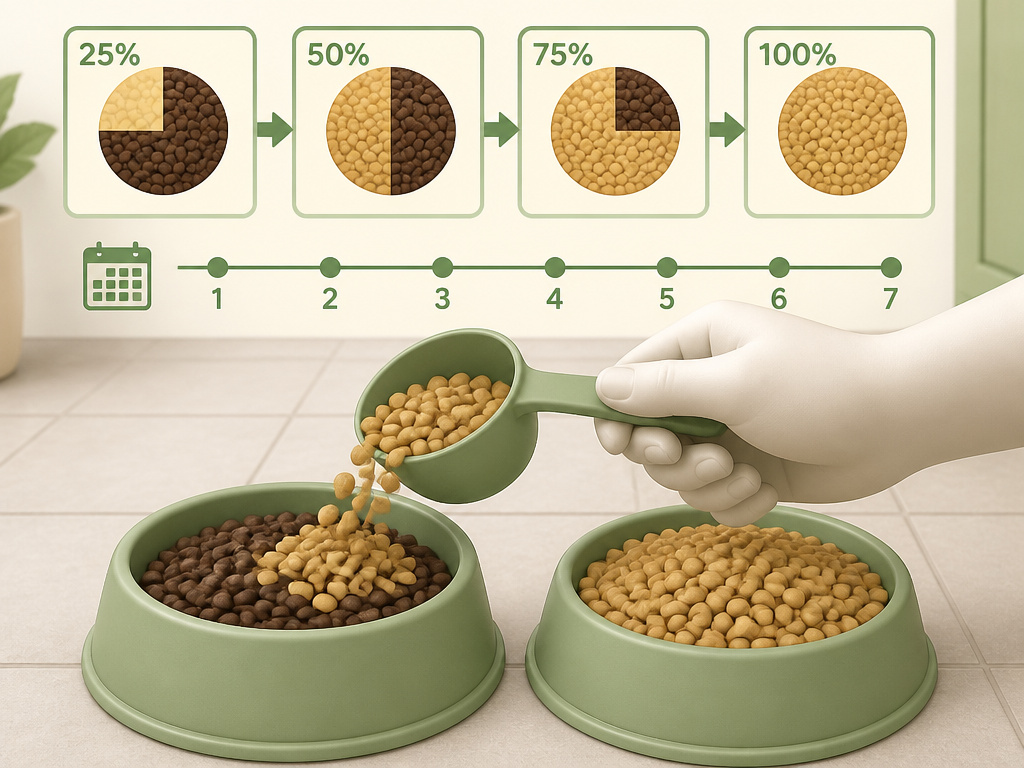
People ask whether they can just swap the bowl and get it over with. I’ve watched that fail too many times to recommend it: the cat refuses the new food outright, or eats it and spends two days with loose stool while the owner blames the food.
A gradual mix is worth the wait: Hill’s gives 7 days, Purina 7 to 10 days, and Hill’s concedes some cats need up to 40 days. The printed schedules agree on the shape even when they disagree on the length.
I plan every switch for two weeks, not seven days. The printed schedule is a floor, and the cats who get labeled picky are usually cats who were rushed. Slow costs you nothing but patience.
The ramp below is the Hill’s schedule, and Purina publishes the same four steps stretched across 7 to 10 days, while Hill’s concedes some cats need up to 40 days.
| Days | New food | Old food | What to watch |
|---|---|---|---|
| 1 to 2 | 25% | 75% | Refusal, or food left in the bowl |
| 3 to 4 | 50% | 50% | Stool firmness on day 3 |
| 5 to 6 | 75% | 25% | Appetite and litter box output |
| 7 | 100% | 0% | Any soft stool means hold at 75% |
Days 1 Through 7, Step by Step
- Days 1 and 2: 25 percent new, 75 percent old. Skip the slow start and you get loose stool by day three, which owners then blame on the new food being bad.
- Days 3 and 4: 50/50. This is the step people rush. Hold it for two full days even if the cat is eating happily.
- Days 5 and 6: 75 percent new. Watch the box here, because this is where a sensitive cat tells you the pace was too fast.
- Day 7: all new food. If output is still soft, sit at 75 percent for another few days instead of pushing through.
When the Ramp Stalls
Purina gives 7 to 10 days. Hill’s gives 7 days flat, then concedes that some cats need up to 40. That is a wide spread inside a single manufacturer’s own guidance, and it tells you the schedule is a template, not a rule.
The transition schedule deep dive covers the stall cases in more detail, and the AAHA nutritional reference manual is the document the 7-day figure comes from if you want to read it directly.
If the cat is reluctant, warm the food. Stirring warm water into the food can help a reluctant cat, and the reason is aroma. A warm can smells stronger from across the kitchen than a cold one, and the cat decides with its nose before it decides with its mouth.
Where this goes sideways: Pushing from 50 percent to 100 percent in one day because the cat ate the 50/50 mix fast. Appetite is not the signal. Stool firmness is, so the mistake shows up after you have already made it.
Maine Coons Mature Later, but Nobody Agrees How Much Later
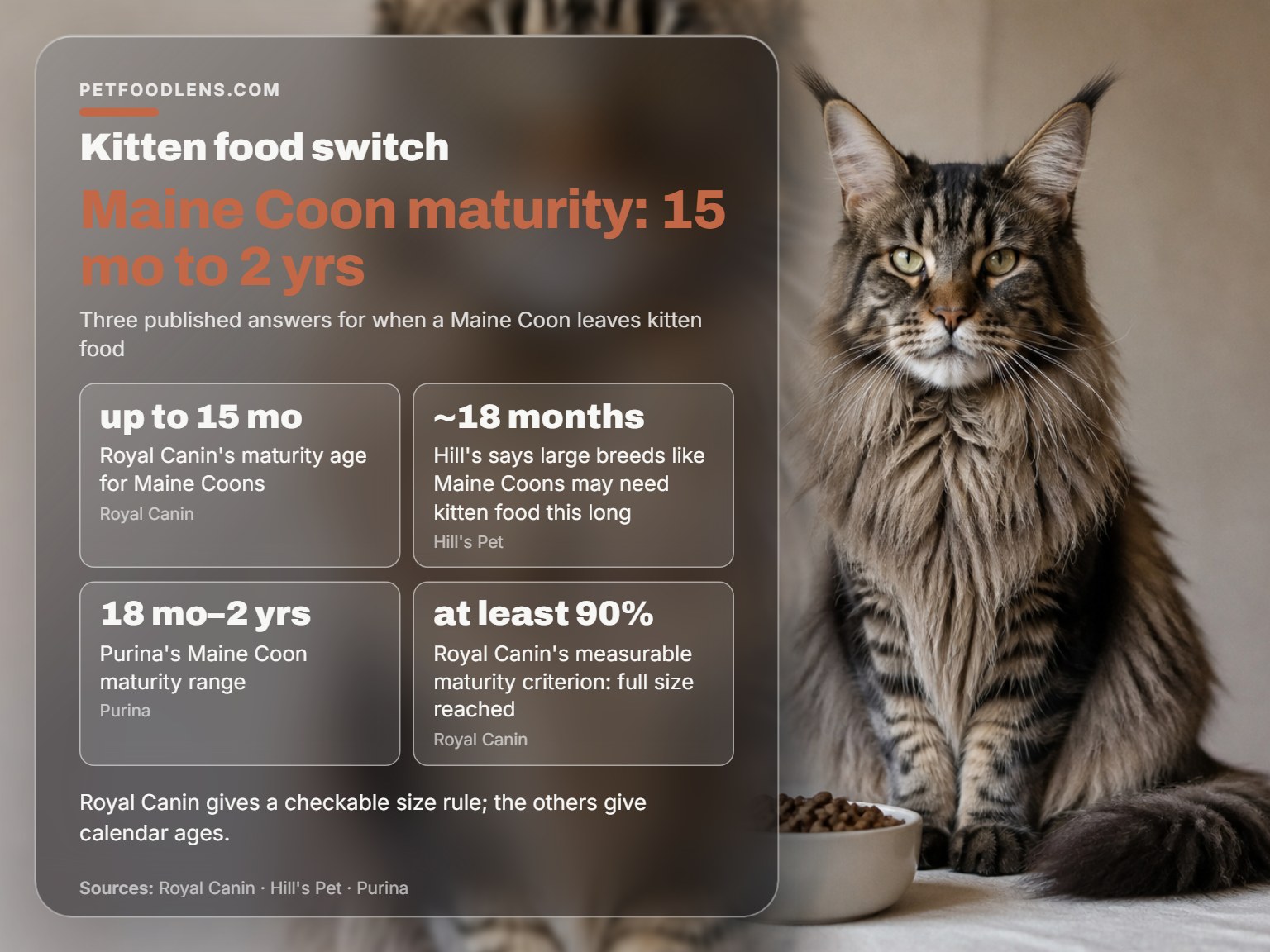
Fifteen months, 18 months, or two years. Those are the three published answers for a Maine Coon, and the spread is wider than the entire disagreement about ordinary kittens.
Royal Canin says up to 15 months. Hill’s says around 18. Purina says 18 months to 2 years. All three are describing the same breed, and all three are describing the same underlying fact, which is that a big cat finishes growing later than a small one.
Royal Canin is the only one of the three that gives a measurable criterion rather than a calendar date: at maturity the cat has reached at least 90 percent of its full size. That is a number you can actually check, and it is a better decision rule than the age on the bag.
For every other breed, the 12-month mark holds well enough. The next switch after this one is the senior cat food question, which the life stage definitions put at around 7 years, and that one has its own set of disagreements.
What Happens If Your Kitten Eats Adult Food by Accident?
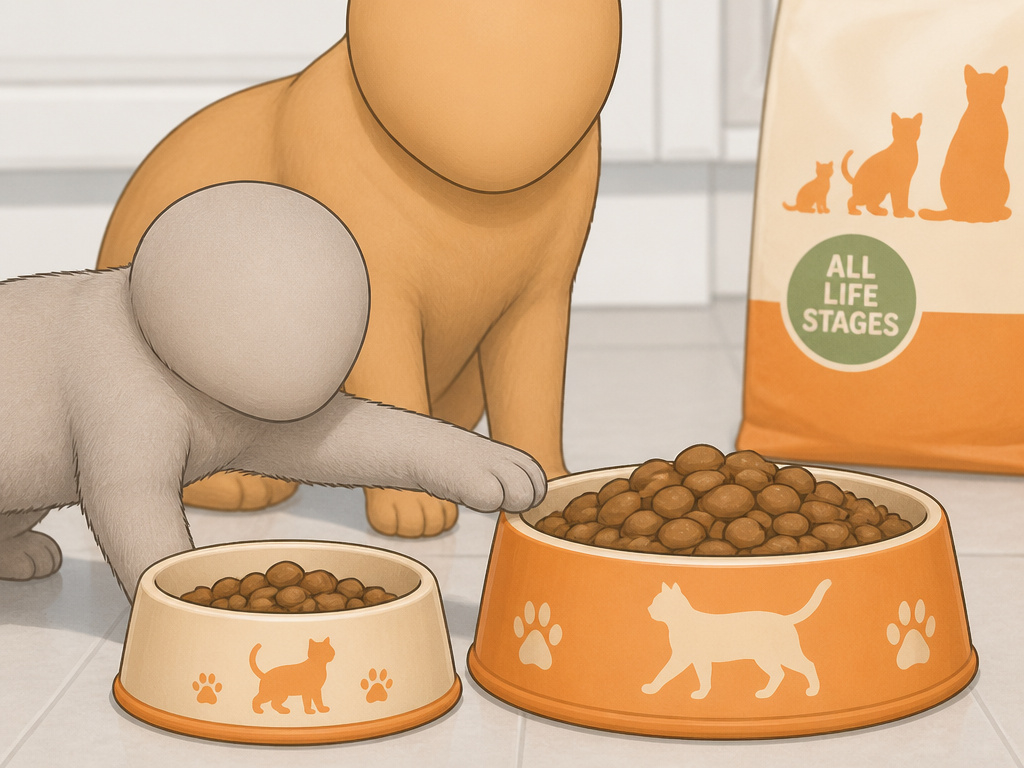
One stolen meal off the adult cat’s bowl is not an emergency.
Royal Canin says the health risk is not immediate but the behavior should not be encouraged, because the kitten simply does not get the nutrients it needs for growth. Hill’s goes a step further: ask a vet about a complete and balanced kitten food and start the transition as soon as you reasonably can.
What to do depends on which situation you are in:
- A one-off stolen meal: nothing. Put the bowls out of reach and move on.
- A steady diet of adult food: switch back to a growth formula, and do it gradually rather than overnight.
- An all-life-stages food: this is the one real exception. Purina states that a food labeled for all life stages is safe for both kittens and adult cats, and that label claim is regulated rather than marketing.
That last point undercuts the blanket “kittens cannot eat adult food” framing you see everywhere. The all life stages category exists precisely because one formula can meet both profiles, and the AAFCO statement on the bag is how you confirm it does.
The part nobody mentions: A cat that stops eating during a switch is a vet call, not a stubbornness contest. That goes double for an overweight cat, where hepatic lipidosis, a dangerous fat buildup in the liver, is the real risk and it moves faster than most owners expect.
The Multi-Cat Household Problem
The Hill’s manual recommends a plan so the kitten does not eat the adult cat’s food and the adult does not eat the kitten’s. That is harder than it sounds in a two-cat house with one kitchen.
Feeding in separate rooms behind a closed door is the simplest fix. The AAHA guidance adds that cats prefer to eat alone in a quiet spot where nothing startles them, which is a behavioral argument for the same setup.
The Neutered Kitten Weight Trap
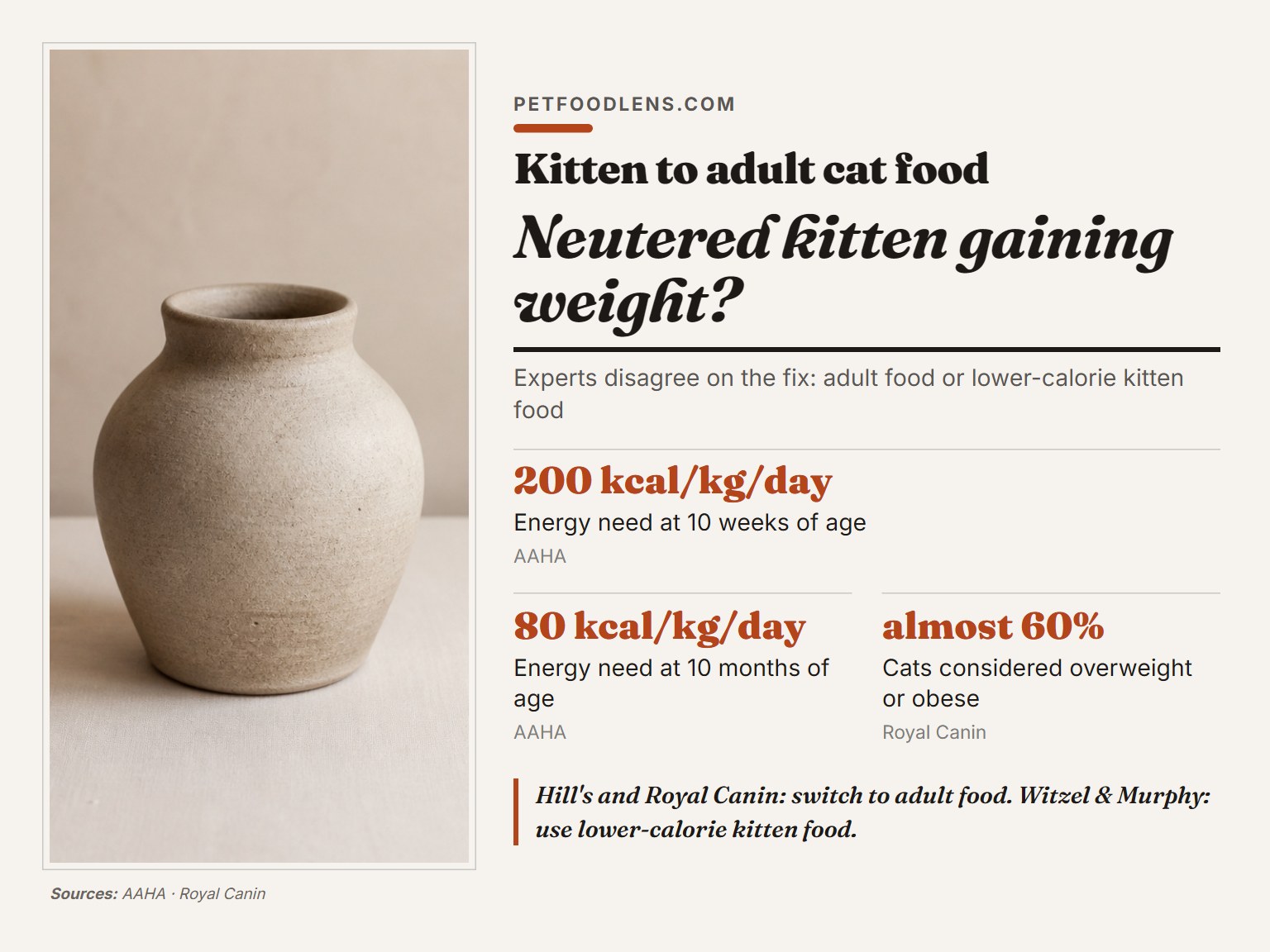
The obvious fix for a neutered kitten who starts gaining is the adult bag, per Hill’s and Royal Canin, while Witzel & Murphy say reach for a lower-calorie kitten food instead.
This is a genuine disagreement, and it is worth seeing both sides.
Wistel and Murphy argue that adult food and weight-loss food should not be used before skeletal maturity, so an overweight eight-month-old gets a reduced-calorie growth formula rather than a maintenance diet. Hill’s and Royal Canin both argue the opposite direction: keeping a kitten on kitten food too long causes unhealthy weight gain because of the higher calorie count, so the fix is to move to adult food.
The two positions are closer than they sound. One is protecting bone and joint development, the other is protecting calorie intake, and both agree the cat should not stay on a full-calorie growth formula indefinitely.
Body condition is a hands-on measurement, not a number on a bag. Run your palms down the ribcage: ribs you can feel under a thin layer are fine, ribs you have to press for are not, and a waist that disappears when you look down from above is the earliest sign. Weigh monthly and write it down, because the trend matters more than any single reading.
The AAHA guidance flags neutering as the moment to reassess all of this, since the surgery is associated with weight gain and a drop in energy needs. Royal Canin puts almost 60 percent of cats as overweight or obese, which is the population-level version of the same problem.
If you are changing more than one variable, change one at a time. Adding moisture helps with volume and satiety, and the dry to wet transition is worth reading before you stack a food change on top of a format change.
Frequently Asked Questions
Can I switch my kitten to adult food at 10 months?
Yes, that sits inside most published ranges. Hill’s, Royal Canin, and Purina put the window at roughly 10 to 12 months, and the peer-reviewed guidance opens it at 9. A 10-month switch is early but not reckless, provided the kitten has finished growing and the transition is gradual.
Do vets agree on 12 months?
No. The peer-reviewed source calls the transition age debatable and gives 9 to 12 months, while the manufacturers converge on 10 to 12. The disagreement is small in practice, but it is real, and anyone presenting 12 months as a settled biological fact is overselling the evidence.
What happens if my kitten eats adult food for a week?
Not much, according to Royal Canin, which states the health risk is not immediate. The problem is nutritional rather than toxic: adult food is not balanced for growth, so a week of it delivers the wrong proportions rather than a dangerous dose. Switch back to a growth formula and ramp gradually.
Should a Maine Coon stay on kitten food longer?
Yes, and every source agrees on the direction even though the numbers differ. Royal Canin says up to 15 months, Hill’s says about 18, and Purina says 18 months to 2 years. Royal Canin’s 90 percent of full size benchmark is the most useful test.
Is an all-life-stages food okay for a kitten?
Purina states that a food labeled for all life stages is safe for both kittens and adult cats. That label is regulated, so it means the formula meets the growth nutrient profile. Check the AAFCO statement on the specific bag rather than assuming from the product name.
The Bottom Line
The trigger for the switch is not the birthday on your calendar. It is a growth curve that has flattened plus a spay or neuter date that has passed, which is exactly why the Hill’s reference manual ties the two together. If your kitten is 10 months old, already neutered, and holding steady on the scale, you have met both conditions.
None of this replaces a vet who has the cat’s chart in front of them. I read labels and compare guaranteed analyses for a living, and I still cannot see a kitten’s growth plates or run bloodwork. Breeders and shelters know their lines, and a vet knows your specific cat.
This week, do one thing: flip the bag over and read the AAFCO statement out loud. If it says growth or all life stages, you have time. If it says adult maintenance and your kitten is still growing, you have a bag to return and a question to ask.
