
When to Switch to Senior Cat Food: Age Is Not It
This post contains affiliate links. As an Amazon Associate, we earn from qualifying purchases.
When to switch to senior cat food has three different answers: AAHA/AAFP sets senior at over 10 years, Hill’s at over 7, and 2024 research finds body changes start at 8. The real trigger is body condition and bloodwork, not the birthday.
The three ages exist because each source measures something different. AAHA/AAFP tracks clinical life stages. Hill’s tracks when nutrient needs shift in their feeding model. The 2024 paper in Animal Frontiers tracks when cellular changes begin. All three are defensible, and that’s why a single switch date doesn’t work.
What follows is the actual decision tree: what each source says, what the label hides, how to read protein and phosphorus numbers on the can, and how to transition without a hunger strike.
Key Takeaways
- AAHA/AAFP sets senior at over 10 years, but 2024 research finds body changes start at 8. The label and the biology don’t line up.
- Healthy senior cats should not be protein restricted; 30-45% dry matter is the recommended minimum.
- Commercial senior diets vary more than fivefold in sodium and phosphorus, so “senior” on the bag tells you very little.
- Underweight is common in senior cats, so a low-calorie senior formula can work against you.
- Transition over 7 days at home, not in the clinic, to avoid food aversion.
The Senior Cat Age Question: 7, 8, or 10 Years?
Three credible sources give three different ages, and none of them are guessing. AAHA/AAFP, the veterinary task force behind the 2021 Feline Life Stage Guidelines, draws the line at over 10 years. Hill’s Nutritional Reference Manual puts senior at over 7. A 2024 paper in Animal Frontiers found that physiological and health changes begin at 8 years, though cats are still classed senior at 10.
The 2021 AAHA/AAFP Feline Life Stage Guidelines define four feline life stages: kitten from birth to 1 year, young adult from 1 to 6 years, mature adult from 7 to 10 years, and senior at over 10 years. Hill’s Nutritional Reference Manual uses a different scale, with adult at 1 to 7 years and senior over 7.
| Source | Senior starts at | What it measures |
|---|---|---|
| AAHA/AAFP 2021 | Over 10 years | Clinical life stage |
| Hill’s Reference Manual | Over 7 years | Nutrient needs shift |
| Animal Frontiers 2024 | Changes at 8, classed at 10 | Cellular aging |
The gap between 8 and 10 matters for the when to switch to senior cat food question because it’s the window where body composition starts shifting before the label catches up. Muscle loss along the spine shows up as a bony ridge you can feel through the fur before you see it in the bowl. That’s the tell to watch, not the birthday.
AAHA/AAFP stress that the individual patient matters more than the calendar. A cat at 9 with good muscle and clean bloodwork doesn’t need a senior formula. A cat at 8 with a dropping body condition score does. The senior cat food category exists to serve the second cat. The 2021 AAHA/AAFP Feline Life Stage Guidelines spell out why the first cat can stay on adult food.
Why ‘Senior’ on the Bag Tells You Almost Nothing
“Senior” is a marketing word. AAFCO, the body that sets the nutrient profiles pet food is measured against, has no separate senior nutrient profile. Senior feeding trials use the adult-maintenance protocol, which only requires cats to be at least 1 year of age.
Turn the bag over. The guaranteed analysis is the only part of the packaging that has to be accurate.
What the 27-Diet Survey Found
A survey by Tufts nutritionists Hutchinson and Freeman sampled 27 commercial senior diets from two specialty stores, one mass merchandiser, and one grocery store. Sodium and phosphorus content each varied by more than fivefold across the products. Some senior diets contained levels much higher than might be desirable.
| Nutrient | Why it matters in a senior diet | What to check |
|---|---|---|
| Protein | Muscle maintenance | 30-45% dry matter minimum |
| Phosphorus | Kidney load | Lower if CKD is diagnosed |
| Sodium | Heart and kidney | Lower than adult maintenance |
| Calories | Weight direction | Match to body condition score |
The label doesn’t guarantee the nutrient profile when to switch to senior cat food. Two flavors of the same brand can carry different nutrient profiles, and the front of the bag won’t tell you which one you’re holding. That’s not a conspiracy. It’s just how pet food labeling works.
The pros and cons of senior cat food come down to whether the specific can matches the specific cat. Two cans in the same category can carry very different nutrient profiles. One PMC review of dietary strategies for aging pets describes a gradual replacement over a week, which is the minimum interval most sources agree on.
What most people get wrong: Assuming “senior” on the front of the bag means lower phosphorus and sodium. Hutchinson and Freeman found some senior diets contain levels much higher than might be desirable, and the label doesn’t have to disclose it beyond the guaranteed analysis.
What Does a Senior Cat Actually Need in the Bowl?
AAHA/AAFP are blunt about protein: healthy mature adult and senior cats should not be protein restricted. A diet with a minimum protein allowance of 30-45% dry matter is considered moderate protein and is recommended. Aging cats should receive diets higher in protein to avoid loss of lean muscle mass.
Hill’s Nutritional Reference Manual takes a different position, listing less protein among the nutrient shifts for adult and senior pets, alongside less phosphorus, less sodium, less calcium, and more fiber, whereas AAHA/AAFP recommend healthy seniors not be protein restricted and receive higher protein. Hutchinson and Freeman found that commercial senior diets commonly reduce protein versus adult maintenance, which lines up with the Hill’s position.
So the two credible sources point in opposite directions. That’s the disagreement you have to resolve with your own cat’s numbers.
Here’s what to look for on the can:
- Protein at 30-45% dry matter or higher. Healthy seniors shouldn’t be restricted, per AAHA/AAFP.
- Phosphorus lower than adult maintenance. Hill’s considers reduced phosphorus important for kidney health, while Hutchinson & Freeman found senior diets vary more than fivefold and some contain higher-than-desirable levels.
- Calories matched to body condition score. Underweight cats need more, not less.
- A named animal protein first on the ingredient list. “Chicken” beats “poultry” every time.
The Kidney Disease Exception
The one place the protein restriction advice holds is chronic kidney disease. AAHA/AAFP state that cats with CKD may benefit from prescription renal diets, which have restricted, high-quality protein and restricted phosphorus. That’s a diagnosis-driven decision, not an age-driven one.
If you want a shorter list of cat food for older cats that clears the protein bar, that’s the place to start.
I won’t put a healthy 11-year-old on a low-protein senior formula just because the bag says senior. The AAHA/AAFP guidance is clear that healthy seniors shouldn’t be protein restricted, and I’ve watched muscle come back on cats whose owners switched them off the low-protein food.
How to Read the Protein Number on a Senior Cat Food Label
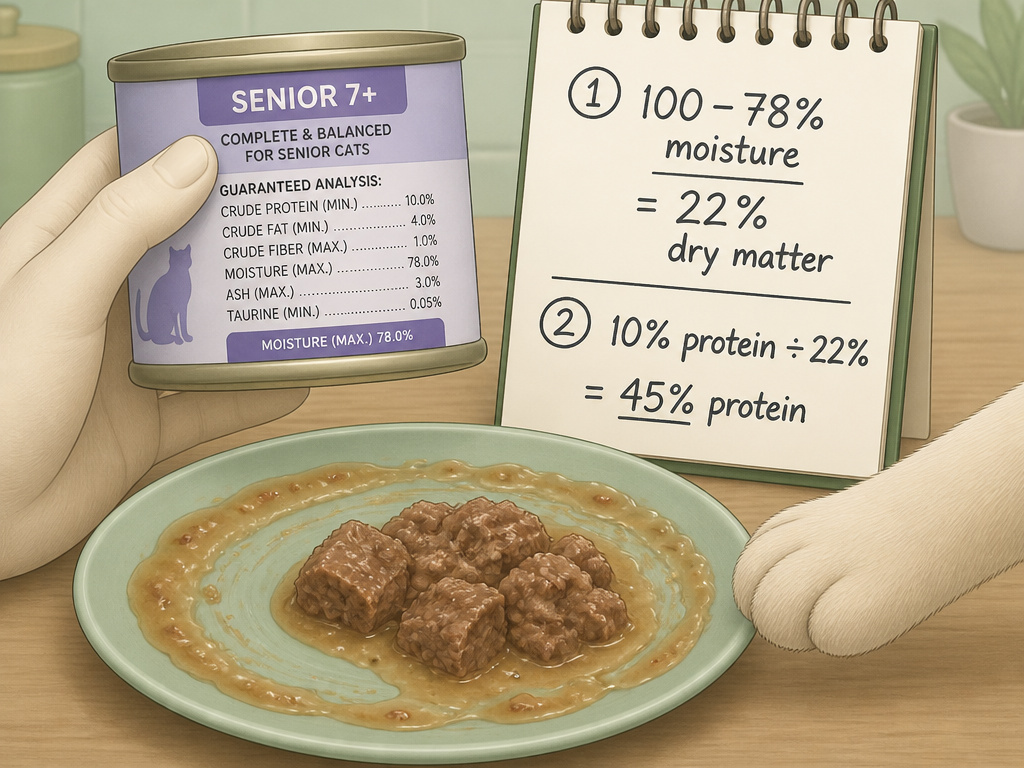
Three numbers on the can matter more than the front-of-bag claims: protein percentage, moisture percentage, and the calorie count per can. The first two combine into a dry matter figure, and that’s the only number you can compare across brands.
Converting As-Fed to Dry Matter in Two Steps
- Subtract the moisture from 100. A can that says “moisture 78% max” is 22% dry matter. That’s the part of the food that isn’t water.
- Divide the protein percentage by the dry matter figure. A can with 10% protein as-fed and 22% dry matter works out to about 45% protein on a dry matter basis.
You can see it on the plate: a gravy-heavy food leaves a glossy ring the cat licks around, and the meat pieces sit in the middle untouched.
The same math applies to wet cat food and dry cat food, but the moisture gap means you can’t compare the two directly without running the conversion.
Compare on dry matter or don’t compare at all. A 10% protein wet food at 78% moisture is roughly 45% protein dry matter. A 30% protein dry food at 10% moisture is about 33%. The wet food wins.
The 7-Day Transition (and Why Your Cat May Need 21)
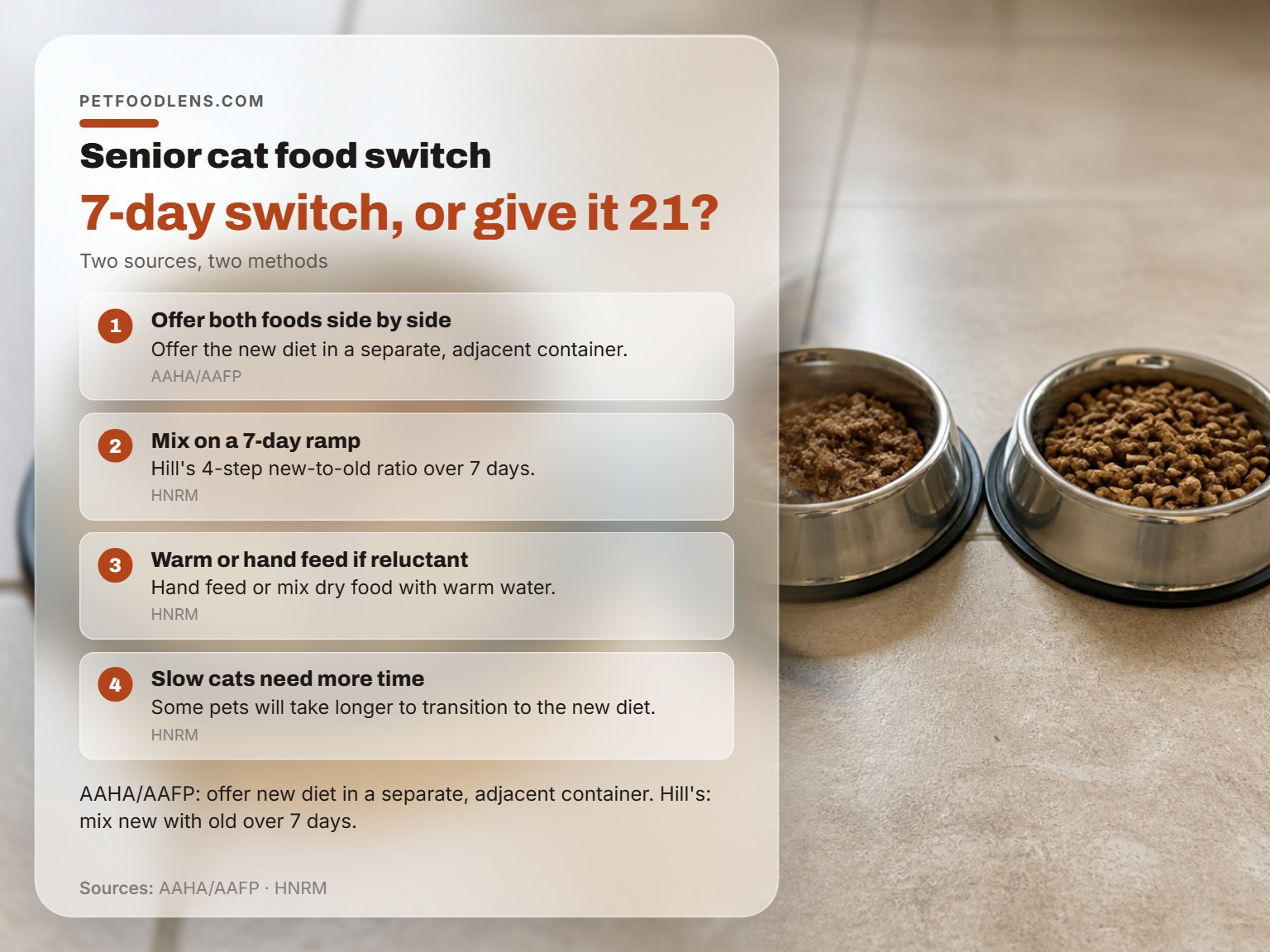
The 7-day schedule on the Hill’s bag is a floor, not a target. AAHA/AAFP recommend offering the new diet in a separate, adjacent container rather than removing the usual food and replacing it. Hill’s recommends mixing new food with old over 7 days, while AAHA/AAFP recommend offering the new diet in a separate, adjacent container; both work, and neither is the only way.
Owners ask me all the time if they can just swap the bowl overnight to save a week. I’ve watched that go wrong enough times to stop saying yes. A fast switch lands as loose stool or a cat who refuses the new food for three days, and then you’ve got two problems instead of one.
- Offer both foods side by side for the first 3 days. Let the cat choose. AAHA/AAFP recommend this over removing the old food.
- Mix on a 7-day ramp after that. Hill’s schedule is a 4-step new-to-old food ratio over 7 days.
- Warm the food slightly if the cat is reluctant. Hand feed or mix the dry food with warm water.
- Give a slow cat more time. Some pets will take longer to transition to the new diet.
- Stop and call the vet if the cat refuses food for more than a day or two. That’s a medical issue, not stubbornness.
The food transition rules apply whether you’re moving from adult to senior or from one senior brand to another.
Where this goes sideways: Changing the diet in the clinic instead of at home. AAHA/AAFP specifically warn that stress-related food aversions are more likely when the switch happens in the practice.
When the Senior Diet Is the Wrong Call
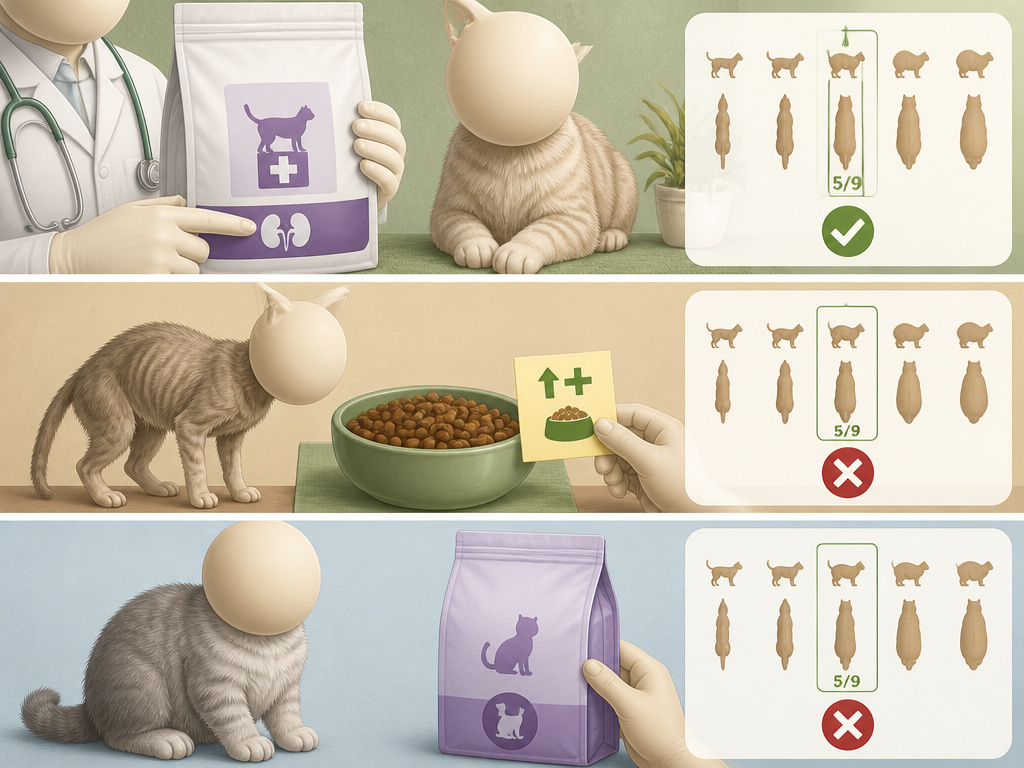
A cat comes in at 11, down half a pound, and the owner has already bought the senior bag. That’s the case where the senior label is the wrong call.
CKD is the obvious one. Prescription renal diets restrict protein and phosphorus on purpose, and that’s the opposite of what a healthy senior needs. AAHA/AAFP flag this as the key exception, and it’s why a vet diagnosis has to come before the food choice.
A thin senior is the second case. Underweight is a common problem in senior cats, and AAHA/AAFP note that senior cats may need increased caloric intake because of reduced digestive capability. A low-calorie senior formula works against that. Body condition score above 5/9 calls for achieving optimal condition, per Hutchinson and Freeman, but a cat below 5/9 needs calories, not restriction.
The third case is the one owners miss most. A kitten who looks full-size at six months is still a kitten, and moving to adult food too early cuts off growth nutrients the cat still needs. The kitten to adult food switch typically happens at age 1, per the Hill’s manual.
Easy to miss: A kitten who looks full-size at six months is still a kitten. Moving to adult food too early cuts off growth nutrients the cat still needs.
Feeding frequency also shifts with age. A cat feeding schedule by age is a better guide than the bag’s feeding chart, which is written for a generic cat at a generic weight.
Each of these cases is about what the cat’s body is doing, not how many candles are on the cake. The AAHA senior cat nutrition guidance covers the calorie math in more detail, including the RER multipliers for cats over 10.
Frequently Asked Questions
Is 7 or 10 the right age to switch to senior cat food?
AAHA/AAFP set senior at over 10 years, with mature adult at 7 to 10. Hill’s uses over 7 for senior. The right switch point depends on the individual cat’s body condition and bloodwork more than the calendar.
Should I switch my cat to senior food if she’s healthy at 8?
Not automatically. A 2024 Animal Frontiers paper found physiological changes begin at 8, but a cat with good muscle and clean bloodwork doesn’t need a senior formula just because of the number. Watch body condition score and muscle along the spine.
Does senior cat food have less protein?
Some do, and that’s a problem for healthy cats. AAHA/AAFP recommend 30-45% dry matter protein as a minimum for healthy seniors and say healthy seniors should not be protein restricted. Hutchinson and Freeman found commercial senior diets commonly reduce protein versus adult maintenance.
What if my senior cat has kidney disease?
Prescription renal diets restrict high-quality protein and phosphorus on purpose. AAHA/AAFP flag CKD as the key exception to the “don’t protein restrict” rule. Your vet manages that decision, not the bag.
How long should the transition to senior food take?
Hill’s recommends a 7-day ramp, mixing new food with old on a 100/75/50/25 schedule. AAHA/AAFP recommend offering both foods side by side first. Cats who resist may need 2 to 3 weeks.
Can I just feed an all-life-stages food to my senior cat?
Sometimes, but check the calories. All-life-stages foods are often formulated for growth and reproduction, which means higher calorie density than a sedentary senior needs. Match the portion to body condition.
The Bottom Line
Here’s the threshold I use: if your cat is over 10 and dropping weight, don’t switch to a low-calorie senior formula. Switch to a higher-protein, higher-calorie food and get bloodwork done. Underweight is a common problem in senior cats, and the standard senior-diet convention works against it.
The other thing worth saying out loud: most healthy cats don’t need a senior formula at all. They need an adult food with adequate protein, portioned to keep them at a 5/9 body condition score, and a vet who checks kidney values once a year after age 8. The senior category exists for the cats with a diagnosed condition, and for the owners who want a shorter list to shop from.
I’d rather see an 11-year-old cat on an adult food with 30–45% dry matter protein than on a senior formula with a picture of a cat on the front. The bag is not the diagnosis.
