
Types of Dog Food Formats: Water Sets the Rules
This post contains affiliate links. As an Amazon Associate, we earn from qualifying purchases.
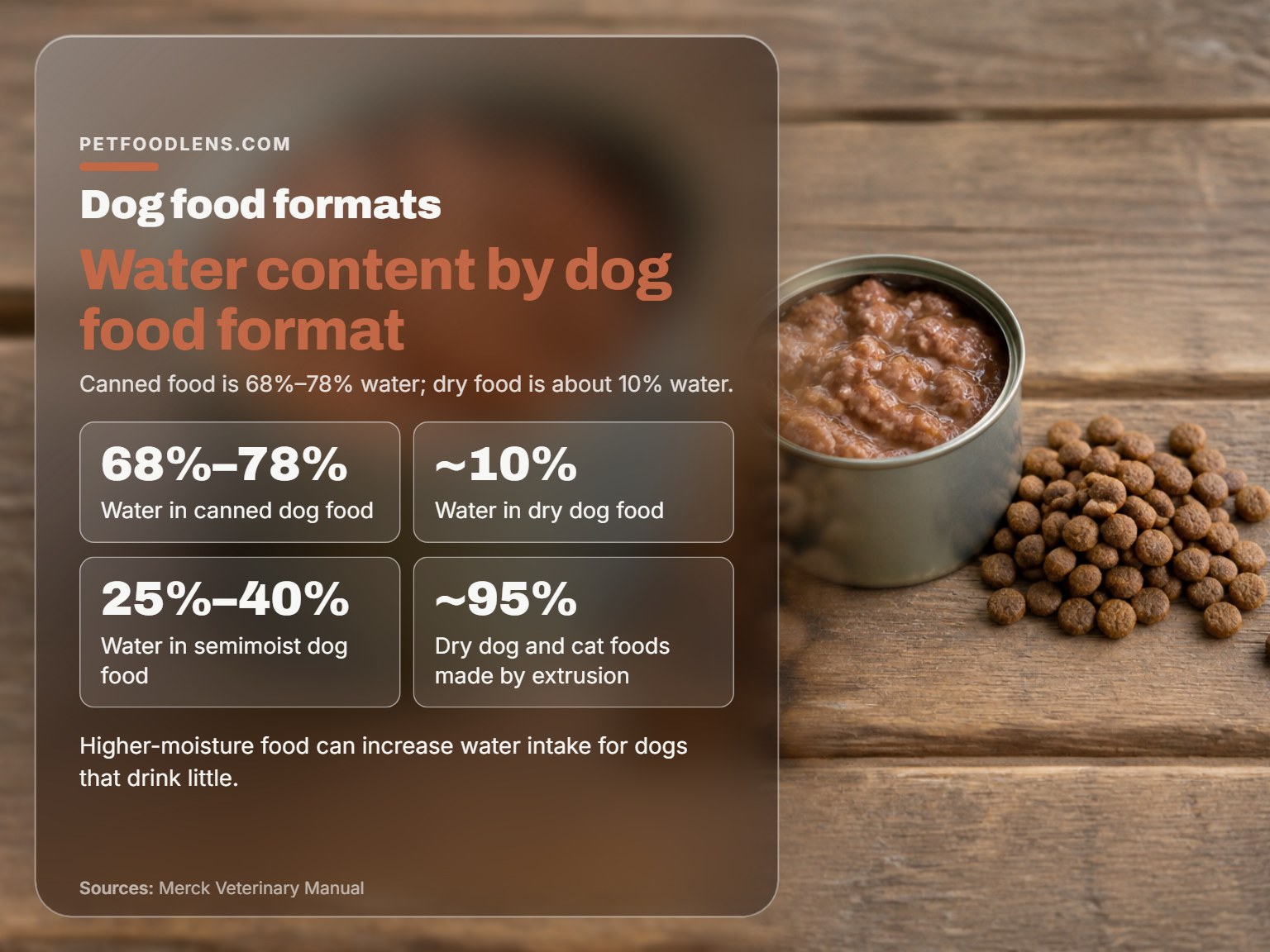
The types of dog food formats are set by water content and processing: dry kibble holds roughly 8% to 10% water, canned food holds 68% to 78%, and semimoist holds 25% to 40%. The category a food falls into says more about how it was made than about what is in it.
Water is doing two jobs in that number. It sets how long the food keeps, and it sets how many calories fit in a bowl, which is why a can of food looks like a bigger meal than the same weight of kibble.
What follows walks the three principal formats, the raw and freeze-dried categories that sit outside them, and the label statements that tell you which one you actually have in your hand.
Key Takeaways
- A minimum of 130 C (266 F) is the temperature Merck says is needed to kill both microbes and bacterial spores, and about 95% of dry dog and cat foods go through extrusion.
- UK Pet Food says opened wet food keeps five to seven days at most, covered and refrigerated.
- Semimoist food carries more sugar and sodium than dry or canned, which VCA flags as a concern for dogs with diabetes or urinary, kidney, or heart disease.
- Freezing and freeze-drying do not destroy all pathogens and spores, and high-pressure pasteurization usually does not eliminate them either.
- VCA recommends buying the bag that lasts roughly four to six weeks, because kibble begins oxidizing the moment the seal breaks.
The Three Formats Are Defined by Water, Not by Ingredients
Merck Veterinary Manual splits commercial dog food into three principal forms: canned, dry, and semimoist. The classification rests on processing method and water content, not on the ingredient panel or the nutrient profile.
Extrusion pushes a blended mix of grains, meat, fats, minerals, and vitamins through a die, and a knife cuts the rope into kibble shapes. Manufacturer temperatures run from about 80 C to 200 C (176 F to 392 F). A minimum of 130 C (266 F) is needed to kill both microbes and bacterial spores.
Dry food is the most popular category in the US, and roughly 95% of dry dog and cat food is extruded. The 130 C (266 F) figure is the minimum needed to kill microbes and spores, not the full range of extrusion temperatures.
UK Pet Food comes at the same question from a different angle. Its pet food format categories fact sheet argues that superiority should not be measured on the format of the food but on its content, and that dry food is not consistently superior to wet, or the reverse. Merck’s framing is narrower: classification depends on processing and water content, not on what went into the food.
That distinction matters the moment you compare a types of dog food formats bag to a can. A guaranteed analysis is measured as-fed, so the can’s protein and fat percentages look lower across the board.
What Do the Moisture Numbers Actually Look Like Across Sources?
Three sources, three different windows on the same can of food.
| Source | Dry | Canned / wet | Semimoist |
|---|---|---|---|
| Merck Veterinary Manual | ~10% water | 68% to 78% water | 25% to 40% water |
| UK Pet Food | 8% to 10% water | approx 70% to 80% water | not given |
The gaps look small. They matter when you repeat a figure out loud. Say “roughly 70% to 80%” and all three sources cover you. Say “78%” as a flat fact and you are wrong about a large slice of the category.
Semimoist shows the same pattern: Merck gives 25% to 40% water.
A types of dog food formats moisture number tells you how the food was made and how it keeps. It says nothing about protein or fat per calorie. That takes the dry matter conversion.
Dry Food: The 4-6 Week Rule Nobody Follows
I emptied a kibble bin once and found a yellowish, tacky film on the walls and a sharp crayon-and-paint smell that stayed on my hands after I washed them. Months of fresh kibble had gone in on top of that residue. Every new batch met old oxidized fat on day one.
That is the failure mode VCA Animal Hospitals describes in plain terms. Once a kibble package is opened, the food starts to oxidate, which affects nutrient concentration and palatability. VCA’s recommendation is to buy a package size that lasts roughly four to six weeks.
UK Pet Food gives a different instruction for the same problem. Its guidance is to store dry food in a cool, dry place to prevent vitamin destruction and fat oxidation, keep it in the original packaging sealed after each use, and refer to the best-before date on the packet. It publishes no opened-shelf-life figure at all.
Both instructions are defensible. VCA’s number assumes a bin or a resealed bag in a normal kitchen. UK Pet Food’s assumes the original packaging is doing the work.
Where this goes sideways: topping up a bin instead of emptying it. Old fat residue coats the new kibble on contact, and the best-before date on the bag stops meaning anything.
Why the Bag Size Beats the Brand
Fat oxidation is a chain reaction. Oxygen attacks the double bonds in the fat, and the products of that reaction attack more fat. Once it starts, resealing slows it and does not reverse it.
That is why a fresh bag poured into a dirty bin goes stale faster than the same bag left in its own packaging. If you want the full routine, this guide to how to store dry dog food covers the wash-and-dry step properly.
Dry food still carries two real advantages that Merck lists: it costs less than canned or semimoist, and unused portions store at room temperature.
Canned Food: Where the Water Does Real Work
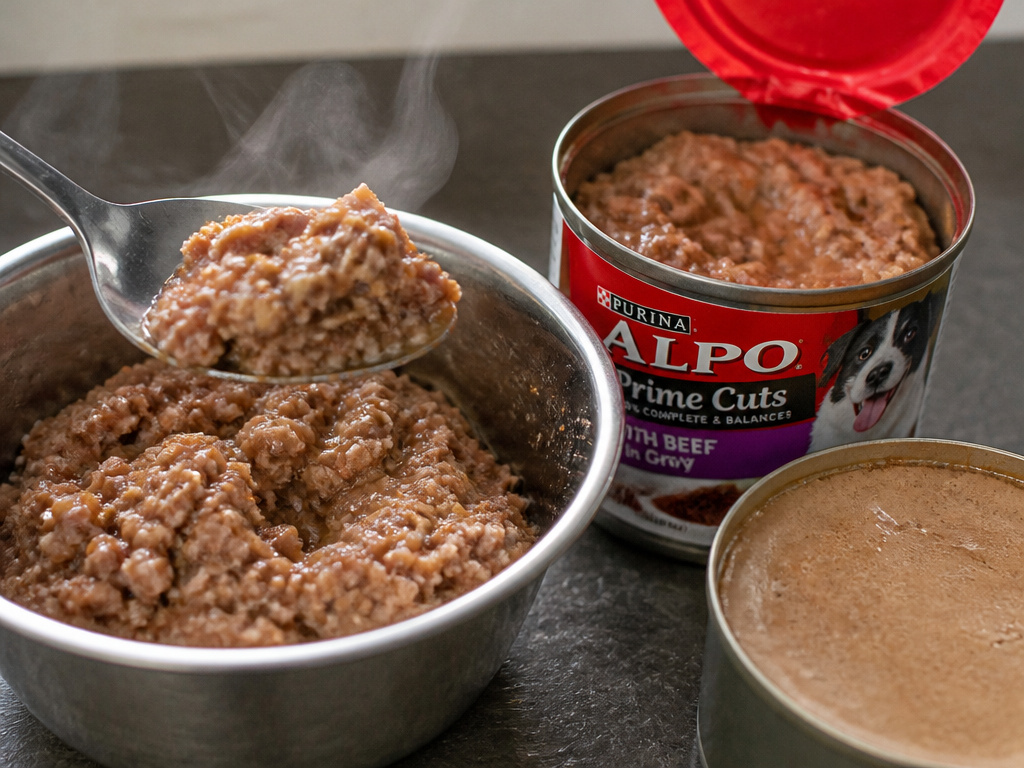
Canned food earns its place on moisture alone.
Cans are filled, sealed, and retorted, a heat-and-pressure cooking step that also sterilizes the contents. UK Pet Food describes the same sequence as sealing and then cooking at a defined temperature for sterilisation. Pathogen destruction comes from that step, which is why an unopened can keeps without refrigeration.
The water does three useful things:
- It lowers energy density, so a dog gets a bigger portion for the same calories.
- It adds water intake for dogs that do not drink well.
- It suits dogs with missing teeth, poorly aligned jaws, or smaller mouths, per UK Pet Food.
VCA is specific about who benefits most: dogs with urinary disease or chronic kidney disease, where increased water intake is the goal.
A chilled can comes out of the fridge with a hard fat cap and a dull, matte surface. Warm it gently and the surface goes glossy and the aroma lifts. That is the palatability effect VCA describes when it recommends gentle warming.
Storage is the weak point. UK Pet Food puts opened wet food at a maximum of five to seven days, covered to limit air exposure and refrigerated, though other sources give no opened-shelf-life figure. A plastic tin lid or a zip-close bag does the job. There is more on portioning and shelf life in this look at wet dog food pros and cons.
Semimoist Food: The Sugar and Sodium Trade-Off
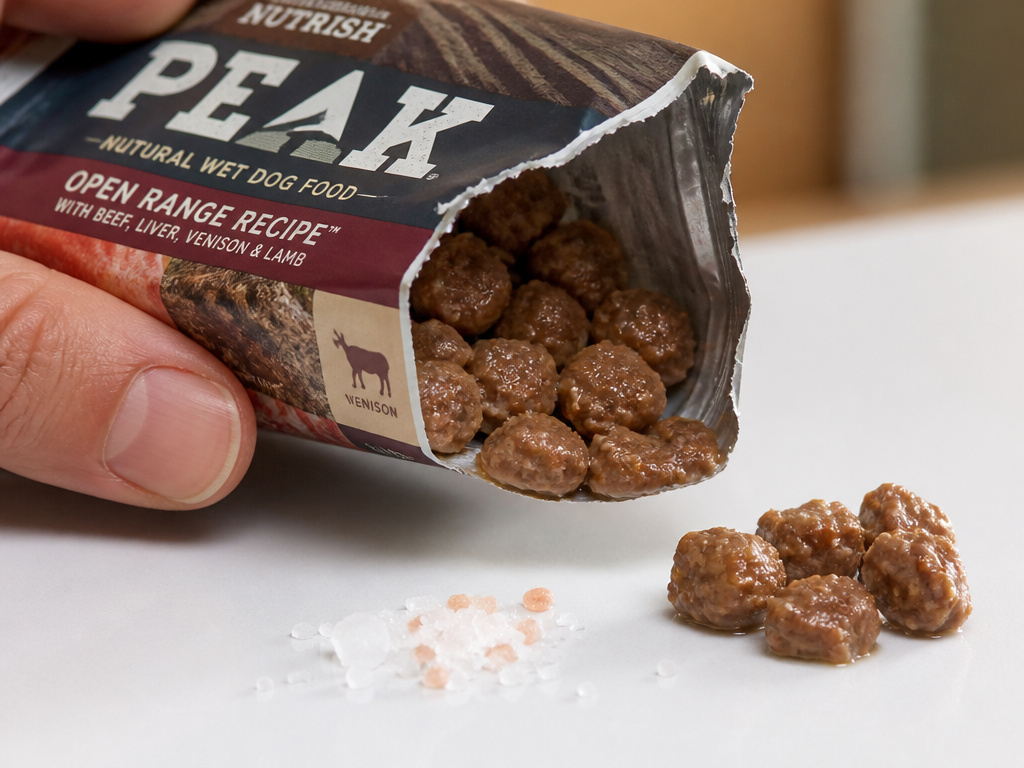
Semimoist is the format I reach for last.
It sits at 25% to 40% water and 60% to 75% dry matter, per Merck, and it needs no refrigeration. Shelf stability comes from humectants such as sucrose, sorbitol, and salts, which bind water so it is unavailable for bacteria and mold. Many semimoist foods are also acidified with phosphoric, malic, or hydrochloric acid to inhibit spoilage further.
Merck lists genuine advantages: convenience, high energy digestibility, and palatability. Dogs tend to agree.
VCA flags the cost. Semimoist food can contain more sugar and more sodium than dry or canned food, and that is a specific concern for dogs with diabetes or urinary, kidney, or heart disease.
Skip this if: your dog is diabetic or carries a urinary, kidney, or heart diagnosis. The sugar and sodium load is the concern VCA names by condition, and convenience does not offset it.
I file semimoist in the same drawer as jerky treats. Dogs love it, it travels well, and it makes a decent topper. It is a poor base for a dog on a sodium restriction.
Is Raw or Freeze-Dried Actually a Different Category?
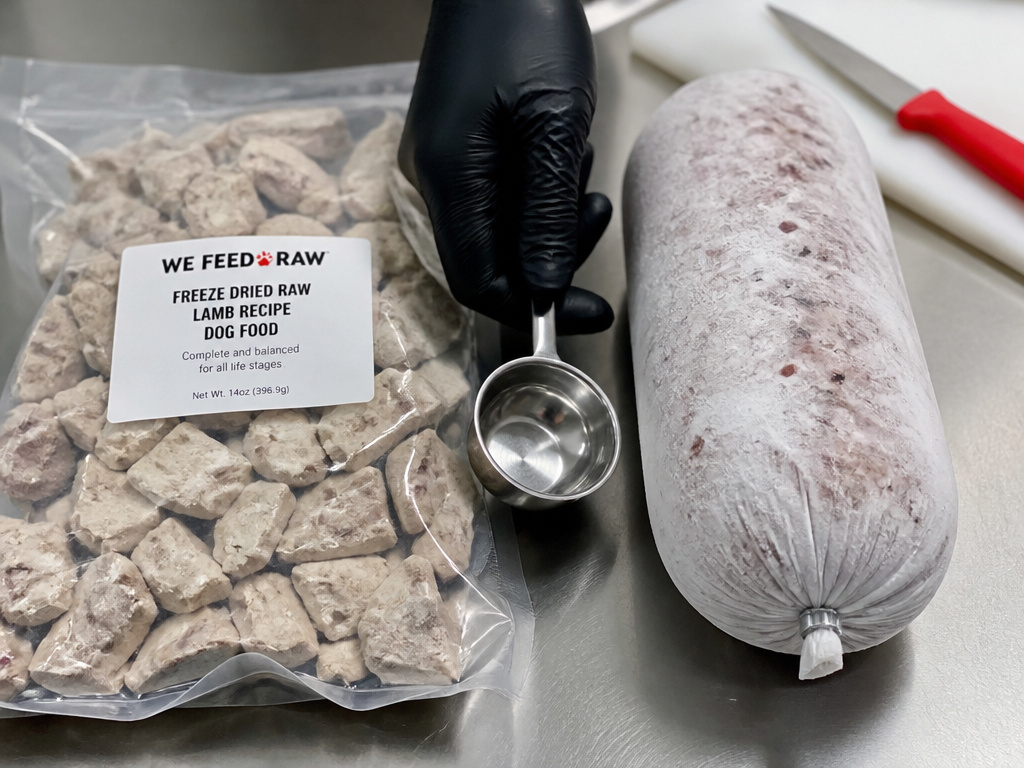
A bag of freeze-dried raw and a chub of frozen raw sit in the same aisle and behave nothing alike.
Merck lists commercial raw diets as coming fresh, frozen, pasteurized, or freeze-dried. Some are formulated to meet AAFCO nutrient profiles. Many are not. Some commercial raw diets are formulated to meet AAFCO nutrient profiles and many are not, so read the specific bag rather than the brand page.
What Freezing and Freeze-Drying Do Not Do
Neither freezing nor freeze-drying destroys all the potential pathogens and spores in raw meat. High-pressure pasteurization can decrease the numbers of many pathogens, but it usually does not eliminate them, and bacteria and viruses differ in how susceptible they are to the process.
Before you start: raw meat can carry Salmonella, E. Coli O157:H7, protozoa, and nematodes. Use a board and knife that never touch anything else, wash your hands thoroughly after handling, and sanitize the counter and sink before the next meal is prepped. Freezing does not sterilize the meat.
Merck names the risks directly: nutrient imbalances, dental injury, gastrointestinal obstruction or perforation, and pathogen exposure. It also notes that raw diets have been recalled at a much higher rate relative to their market share than cooked commercial diets.
The Organizations That Discourage Raw Feeding
Merck lists the bodies that have issued statements discouraging raw or undercooked animal-source protein for dogs and cats:
- The American Animal Hospital Association (AAHA)
- The National Association of State Public Health Veterinarians (NASPHV)
- The American Association of Feline Practitioners (AAFP)
- The American Veterinary Medical Association (AVMA)
- The CDC and the FDA Center for Veterinary Medicine
- The Canadian Veterinary Medical Association (CVMA)
That coalition cuts across countries and specialties, which is unusual for a nutrition question.
The Digestibility Question Is Still Open
None of this changes the federal rules. The FDA pet food regulation page sets out the labeling and safety requirements that apply to every format, raw included. There is more detail on handling in the linked page on raw dog food pros and cons.
Which Format Fits Your Dog?
Three questions settle most of this: how well your dog drinks, how well your dog chews, and how consistently you can feed the same thing.
| If your dog… | Start with | Because |
|---|---|---|
| Drinks very little | Canned | 68% to 78% water adds intake |
| Has urinary or kidney disease | Canned | VCA names higher water as beneficial |
| Chews poorly or has missing teeth | Canned | Softer formats suit jaw limits |
| Eats fast and needs occupying | Dry | Works in food toys and auto feeders |
| Is diabetic or on sodium restriction | Dry or canned | Semimoist runs higher in sugar and salt |
Before you commit to anything, read the adequacy statement. AAFCO recognizes four life-stage categories: growth, maintenance, gestation/lactation, and all life stages. A dog food labeled growth or all life stages carries a large-size dog statement that applies to dogs 70 lb (32 kg) or more as an adult.
A product that does not meet complete-and-balanced requirements has to say so, with the line “This product is intended for intermittent or supplemental feeding only.” That is the line that separates a food from a topper. This guide to how to read AAFCO statements walks the four permitted forms.
Calorie content must appear as kcal/kg and as kcal per household measure, so the portion math is doable without a conversion table. Here is how to calculate dog food calories if the label format is new to you.
On the label question, I am most skeptical of over-the-counter limited-ingredient foods. I have counted three or four distinct animal proteins on some of those panels, and nothing on the bag speaks to cross-contact controls in the plant. Merck notes that trace amounts of unlisted ingredients can turn up in over-the-counter diets made in shared facilities. For a real elimination trial, I want a veterinary hydrolyzed or novel-protein diet with one protein and one carbohydrate.
For most dogs, a mid-priced dry food from a company that publishes an AAFCO adequacy statement and a calorie content is the practical default. The AAHA canine life stage feeding guidelines go further on matching a diet to age and size.
How to Switch Formats Without a Bad Week
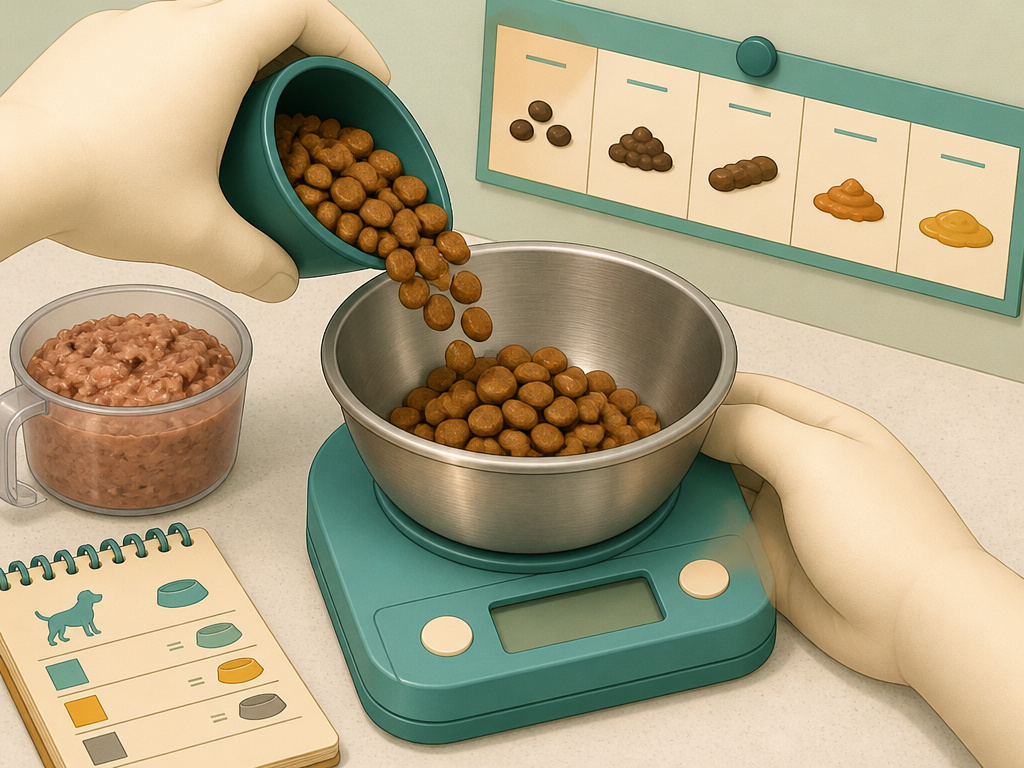
Format changes fail on portion math.
VCA’s advice for mixed feeding is to work with your veterinary team to review the portion of each type. That is the step people skip, and it is where the week goes wrong.
- Weigh the current food first. Without a baseline in grams you have nothing to compare against, and you will guess your way into a calorie swing.
- Convert to calories, not cups. Canned food has lower calories per 100 grams, so the same volume delivers less energy. UK Pet Food notes that wet portions will be bigger for exactly this reason.
- Change one format at a time. Swapping the base food and adding a topper in the same week gives you no way to tell which one caused the loose stool.
- Watch the stool for the first five days. Loose stool on day two that firms by day five is a transition. Loose stool that gets worse by day five means stop and reassess.
- Keep the base stable and rotate the topper. VCA notes that early exposure to varied textures makes later transitions easier, which is a reason to vary the topper rather than the whole bowl.
Frequently Asked Questions
Do dogs need variety in food formats?
No. VCA notes that exposing dogs to a variety of textures and forms when they are young can make later transitions easier, which is a practical argument for some variety early. A stable, well-tolerated format is fine for an adult dog. Variety is a convenience, not a nutritional requirement.
Is wet food better than dry food for dogs?
Neither format wins outright. UK Pet Food states plainly that superiority should not be measured on format but on content. Wet food has the edge on water intake, which matters for urinary disease and chronic kidney disease per VCA. Dry food has the edge on cost, room-temperature storage, and use in food toys, though UK Pet Food cautions that superiority should be judged on content rather than format.
Can I mix dry and canned food in the same meal?
Yes, and VCA recommends reviewing the portion of each type with your veterinary team rather than eyeballing it. The trap is calorie math. Canned food is less energy dense, so a mixed bowl can quietly deliver fewer calories than the dry-only bowl it replaced.
Is freeze-dried raw safer than frozen raw?
It is not sterile. Merck states that neither freezing nor freeze-drying destroys all the potential pathogens and spores in raw meat, and high-pressure pasteurization usually does not eliminate them either. Freeze-dried raw is lighter and shelf-stable, which makes handling easier, but the pathogen risk is still there.
How long does opened dry food actually last?
VCA says opened kibble can stay fresh for several weeks if it is sealed and stored appropriately, and recommends buying a bag that lasts roughly four to six weeks, while UK Pet Food gives no opened-shelf-life figure and points to the best-before date instead. UK Pet Food does not give an opened-shelf-life figure and points to the best-before date instead. Both agree on cool, dry storage in sealed packaging.
The Bottom Line
If your dog is a poor drinker, or carries a urinary or kidney diagnosis, the format decision is already made. Go wet and stop shopping for an additive that fixes hydration. VCA names canned food specifically for both situations, and no powder does that job as cheaply.
For everyone else, the trigger is simpler: buy the smallest bag that lasts roughly four to six weeks, and empty the bin before you pour. If you cannot commit to washing and fully drying a storage bin between bags, keep the kibble in its original packaging and skip the bin entirely.
One concession worth stating. Everything above assumes a healthy dog with a functioning gut and no diagnosed condition. If your dog has diabetes, kidney disease, or a confirmed food allergy, the format question gets overridden by the clinical one, and that conversation belongs with your vet rather than with a label.
