
Protein Requirements for Dogs: NRC vs AAFCO Numbers
This post contains affiliate links. As an Amazon Associate, we earn from qualifying purchases.
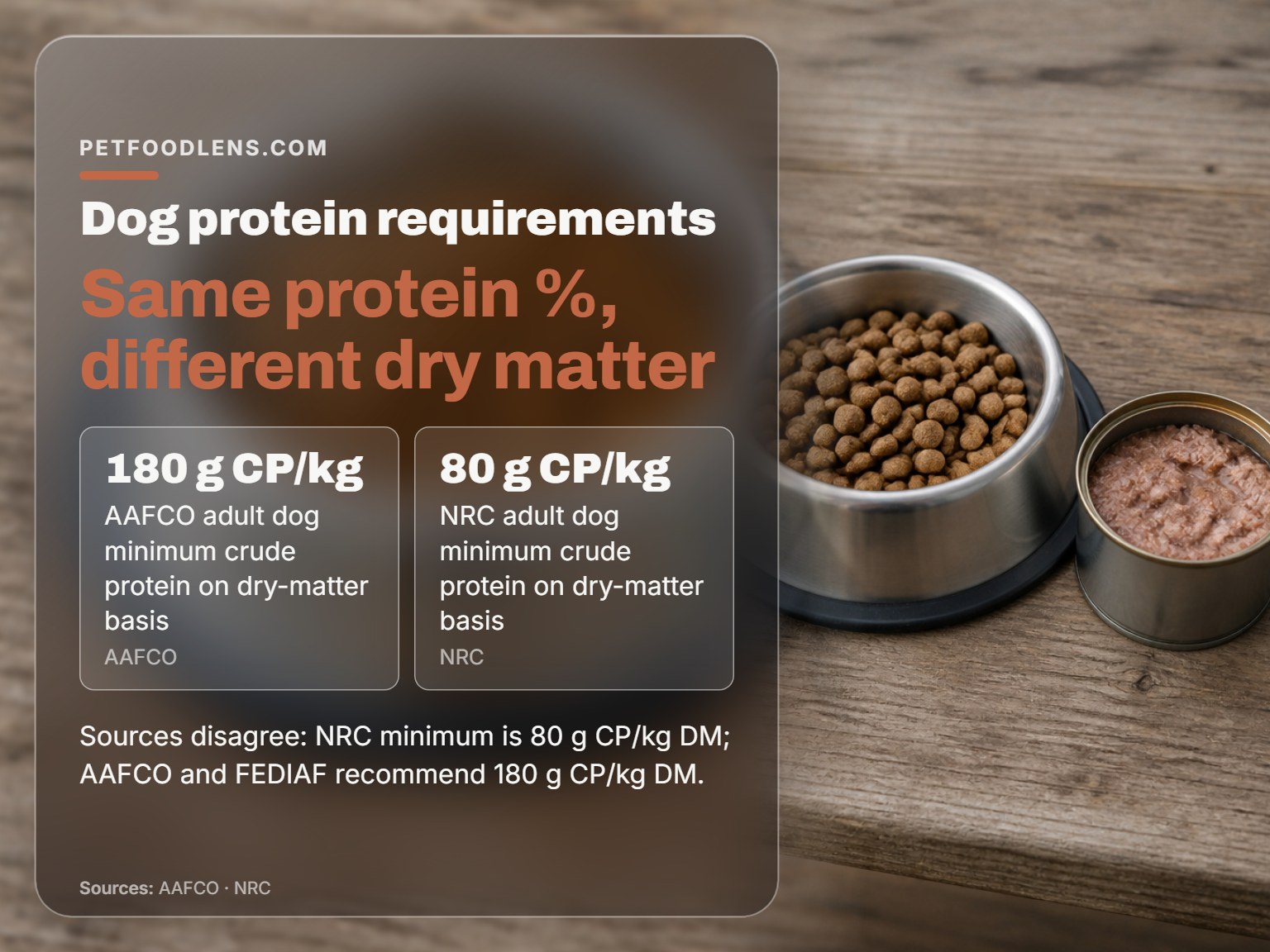
Protein requirements for dogs depend on which standard you follow: the NRC sets an adult minimum of 80 g crude protein per kg of diet on a dry-matter basis and a recommended allowance of 100 g/kg (10% dry matter), while AAFCO and FEDIAF both set 180 g/kg (18% dry matter). Most commercial dog foods exceed both figures.
The protein requirements for dogs question comes down to the 80 and 180 g/kg figures, which describe the same animal, and the gap between them is not a rounding error. The NRC’s 80 g/kg is a measured minimum requirement. AAFCO and FEDIAF both set 180 g/kg as their adult minimum crude protein recommendation. Most commercial dog foods clear both bars without trying.
What follows: the three standards side by side, the life-stage shifts that actually change the math, and the one measurement most owners never see on a bag.
Key Takeaways
- NRC and AAFCO differ on adult dog protein, and both figures are defensible for different purposes.
- Most commercial dog foods exceed both the NRC and AAFCO/FEDIAF recommendations, so the label percentage rarely tells you whether a diet is adequate on its own.
- Puppies need roughly twice the calories per pound of body weight as adults.
- Senior dogs may need more protein, not less, though the evidence on how much is thin.
- Dry matter basis is the only fair comparison between wet and dry foods.
Why Three Different Protein Numbers Exist for the Same Dog
The NRC, AAFCO, and FEDIAF each publish a protein number for adult dogs, and the NRC differs from AAFCO and FEDIAF. That sounds like a scandal until you look at what each body is actually measuring.
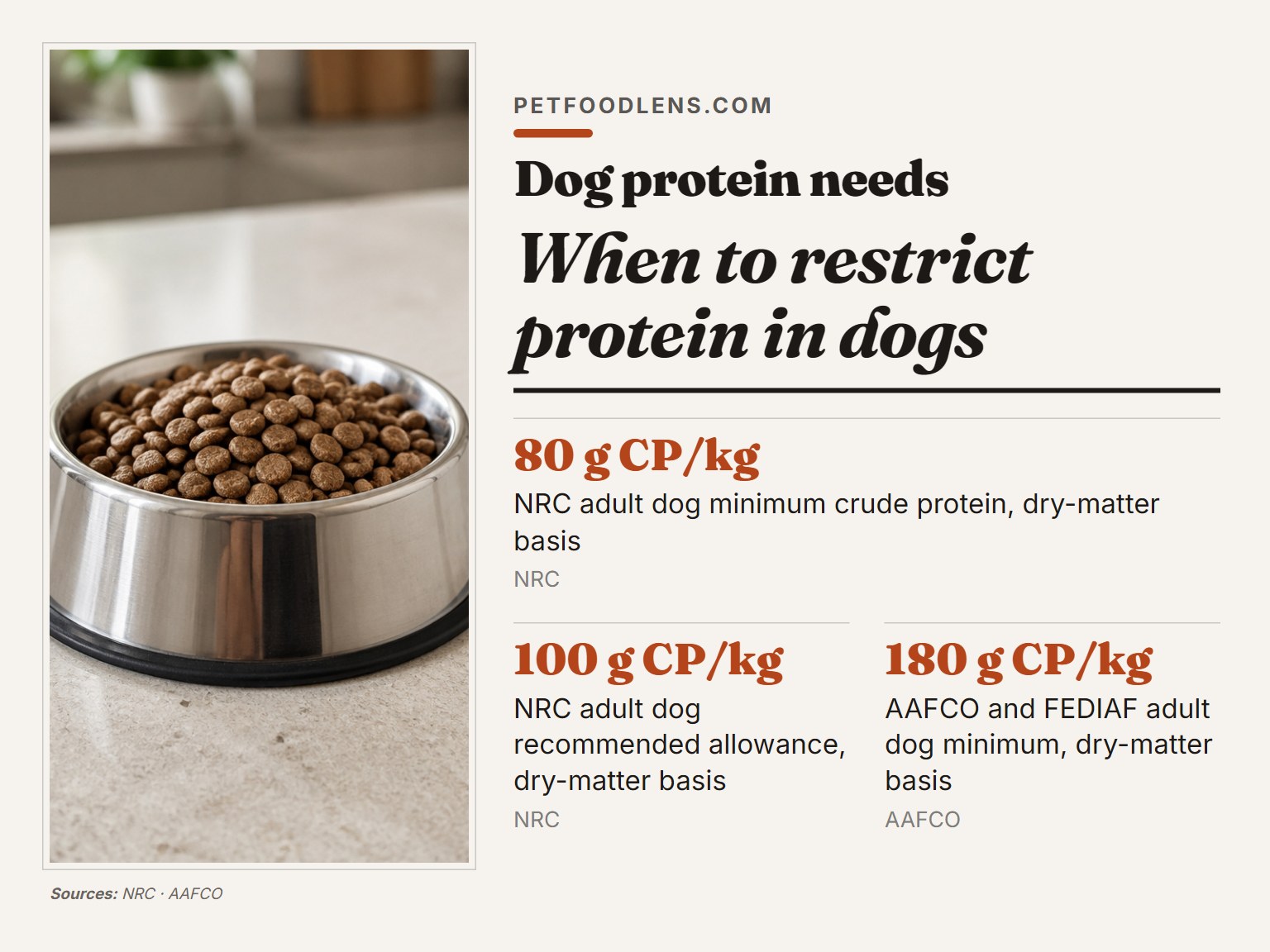
The NRC publishes two adult protein figures: a minimum requirement of 80 g crude protein per kg of diet on a dry-matter basis, and a recommended allowance of 100 g/kg at 4 kcal metabolizable energy per gram. AAFCO and FEDIAF both publish 180 g/kg as their adult minimum.
The NRC figure in the protein requirements for dogs debate is a measured minimum requirement. The NRC minimum requirement is a measured minimum for nitrogen balance. That’s the minimum requirement: 80 g/kg. The recommended allowance is 100 g/kg.
AAFCO and FEDIAF set 180 g/kg. The PMC review of canine protein requirements reports the NRC and AAFCO/FEDIAF figures. The higher number is the AAFCO and FEDIAF recommendation.
Here is what the numbers actually say: 80 is the measured minimum, 180 is the formulation floor, and most commercial foods clear both.
| Standard | Adult protein (DM basis) | What it represents |
|---|---|---|
| NRC minimum requirement | 80 g/kg (8% DM) | Measured minimum for nitrogen balance |
| NRC recommended allowance | 100 g/kg (10% DM) | Allowance with safety margin at 4 kcal ME/g |
| AAFCO | 180 g/kg (18% DM) | US formulation minimum |
| FEDIAF | 180 g/kg (18% DM) | EU formulation minimum |
The NRC recommended allowance is 100 g/kg. If you’re buying commercial food, the AAFCO 180 g/kg recommendation is the one that matters.
That comparison doesn’t survive a dry-matter conversion.
The practical question most owners are really asking is the high-protein vs moderate-protein dog food trade-off, and the answer depends on which standard you were reading.
I spend most of my working life on cat formulations, so I’ll stick to what the dog research actually says rather than extrapolating from cat logic.
What Does the NRC 80 g/kg Minimum Actually Mean?
Have you ever seen 80 g/kg printed on a dog food bag? You won’t.
The 80 g/kg figure is a minimum requirement. It’s the least protein a healthy adult dog needs to stay in nitrogen balance. The recommended allowance, 100 g/kg, is what you’d actually aim for in a diet.
The compare protein percentages question gets easier once you understand that these figures are on a dry-matter basis. A number printed on a bag is almost never on a dry-matter basis.
If two dog foods list the same protein percentage but one is wet and one is dry, you are not comparing the same thing. Convert both to dry matter before you draw any conclusion.
The NRC’s recommended allowance is 100 g/kg.
How Protein Requirements Shift Across Life Stages
A puppy needs about twice the calories per pound of body weight as an adult of the same breed, according to the National Academies dog nutrition report. Protein demand scales with that growth: puppies are building new tissue, not just maintaining it.
The same report notes that owners should start feeding puppies solid food at approximately 4 weeks after birth, because mother’s milk is no longer sufficient. Food is best offered in multiple, well-spaced meals. The transition starts earlier than most owners expect: around 4 weeks.
Adult dogs sit at the maintenance baseline. Their protein need is about replacing what they lose each day, which is why the NRC minimum is lower than the AAFCO formulation floor.
Puppies and Growing Dogs
Puppies need more protein than adults to build new tissue. The review in PMC12837855 puts it plainly: puppies need more protein to build new tissues, while adult dogs need enough to maintain muscle and organs.
Commercial puppy food is formulated for growth.
Seniors and Pregnant Females
Elderly dogs may have a potential increase in protein requirement due to sarcopenia and reduced energy intake, though the evidence remains scarce. That’s the review’s language, and the caution is warranted.
Pregnant and nursing females have greater protein requirements, but current guidelines are often based on limited or indirect evidence. A lactating mother’s calorie need increases with the number of puppies and the week of lactation, up to 4 weeks.
| Life stage | Protein need | Calorie note |
|---|---|---|
| Puppy | Higher than adult | About 2x calories per pound |
| Adult maintenance | Baseline | Standard maintenance |
| Senior | Possibly higher (evidence thin) | 20% fewer calories than middle-aged |
| Pregnant/nursing | Higher | Rises with litter size and lactation week |
Working and sporting dogs sit in a different category again, and active dog protein needs scale with training load.
For most adult dogs, a diet that formulates to AAFCO profiles will clear the 180 g/kg bar without you having to think about it.
The Senior Dog Protein Question Nobody Agrees On
The standard advice for senior dogs is to cut protein. The research points the other way.
The NRC’s own consumer pamphlet notes that older dogs need 20% fewer calories than middle-aged adults, due to decreased activity and slowed metabolism. That calorie reduction often gets translated into “seniors need less protein,” which is not what the pamphlet says.
A review in PMC12837855 suggests the opposite may be true for protein specifically: elderly dogs may have a potential increase in protein requirement due to sarcopenia and reduced energy intake, though the evidence remains scarce.
So the two sources are not actually fighting. One is about calories; the other is about protein. The confusion comes from treating them as the same number.
Where this goes sideways: Cutting protein in a senior dog because the calorie need dropped. Lean mass loss accelerates when protein intake falls, and the review flags sarcopenia as a reason protein need may rise, not fall.
The concern with cutting protein in seniors is muscle maintenance: lean mass loss accelerates when protein intake drops. I’ve seen flavors under the same brand name shift protein and fat levels by several percentage points, so I check each variant individually rather than trusting the line average.
The question of optimal protein requirements young old dogs has been live in the research literature for two decades, and it hasn’t fully settled.
What Happens When Protein Goes Too High?
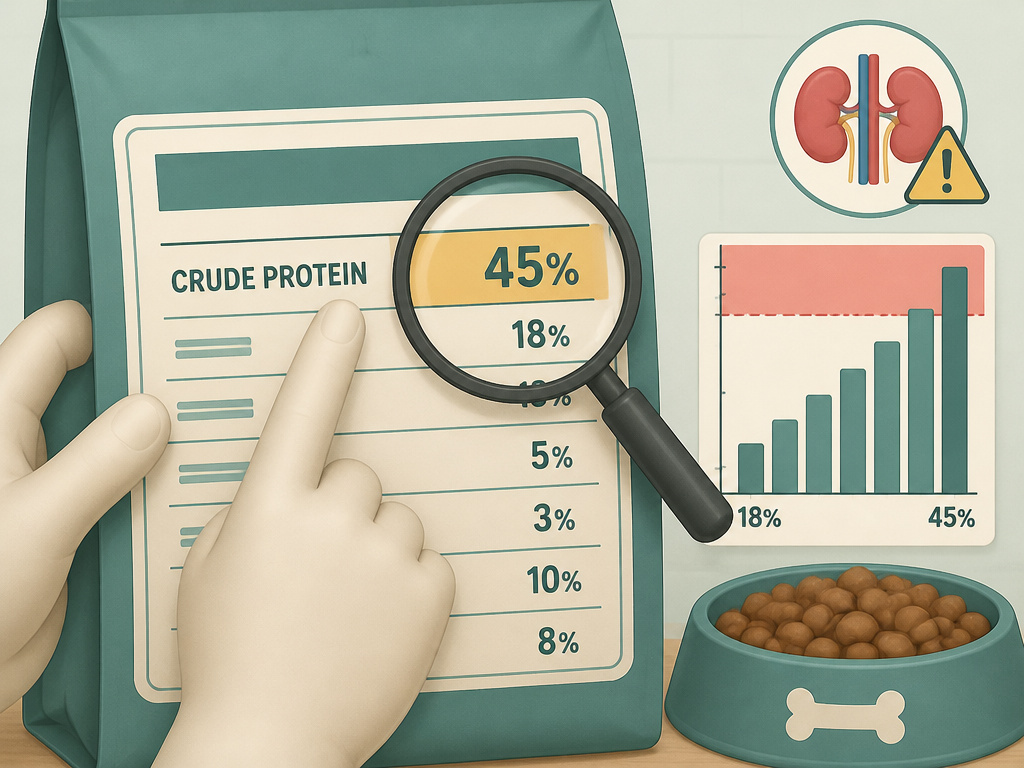
There is a ceiling, and it is lower than the marketing suggests. A 2020 trial that fed healthy adult beagles diets at 18.99%, 25.34%, and 45.77% crude protein for 90 days found that the highest-protein group showed raised serum and urine markers of inflammation and kidney dysfunction.
The varying protein levels dog metabolomics study tracked urea, p-cresol sulfate, and indoxyl sulfate, all of which rose in the 45.77% group. Fecal pH rose, proteolytic bacteria increased, and short-chain fatty acids fell.
That’s a real finding, and it’s worth taking seriously. But context matters: 45.77% crude protein is far above any normal commercial diet. Most adult foods sit between 18% and 30% on a dry-matter basis.
The pet food protein safety paper that gets cited in these debates is worth reading in full before you draw conclusions about kidney risk in healthy dogs on normal diets.
I’ve stopped treating “high protein” as a quality signal on its own. A 45% crude protein diet can still miss the amino acid targets that matter, and the 2020 trial shows that pushing protein very high shifts biomarkers in ways that aren’t obviously good.
Don’t chase a 45% protein diet for a healthy adult dog. The 2020 trial showed that level shifted inflammatory and kidney markers over 90 days, and there’s no evidence it improves anything for a normal dog.
Three things to check before you trust a high-protein claim:
- The moisture percentage. A wet food at 10% protein can beat a dry food at 26% once you convert.
- The protein source. Named meat meals are more concentrated than fresh meat, which is mostly water.
- The amino acid profile. Crude protein tells you nothing about lysine, methionine, or arginine.
The one place protein restriction is clearly warranted is existing kidney disease diet management, and even there the target is set by bloodwork, not by a bag.
Worth knowing before you start: Protein restriction is a clinical decision for diagnosed kidney disease, not a preventive measure for healthy dogs. If your vet has not run bloodwork and urinalysis, you do not have the information needed to set a protein target.
How Do You Compare Protein on a Real Dog Food Label?
What does 26% protein on a wet food label actually mean next to 26% on a dry bag? Almost nothing, until you convert both to the same basis.
I once reviewed two adult dog foods side by side: one led with fresh chicken, the other with a named chicken meal. The meal-led food delivered more protein per calorie once I converted both to dry matter. That’s the kind of thing the ingredient-order rule will never tell you, because fresh chicken is mostly water.
Pick up a can of wet food and a bag of dry food at the store. The can is dense and heavy; the bag is mostly air. That difference is water, and it’s the reason the protein percentages don’t compare directly.
The Dry Matter Conversion
Here’s the process, in order:
- Find the moisture percentage on the guaranteed analysis. Most dry foods list 10-12%; most wet foods list 75-82%.
- Subtract moisture from 100 to get the dry matter percentage.
- Divide the protein percentage by the dry matter percentage, then multiply by 100.
A 10% protein wet food at 78% moisture has 22% dry matter, which works out to about 45% protein on a dry-matter basis. A 26% protein dry food at 10% moisture has 90% dry matter, which works out to about 29%. The wet food wins on protein density, which is not what the front of either package suggests.
Flip the bag over and find the guaranteed analysis. That’s where the real numbers live.
Two diets at the same percentage can differ enormously in protein sources in dog food, and that difference shows up in digestibility. Purina Pro Plan Adult and a store-brand adult formula can both print 26% protein on the bag. What that number doesn’t tell you is how much of that protein the dog can actually digest.
The ingredient list is more useful than the brand’s website, and any company unwilling to explain where it sources its main protein should lose your trust.
Common mistake: Comparing a wet food’s protein percentage directly to a dry food’s. The wet food looks lower on the bag, but once you convert to dry matter, it often lands higher. The comparison only means something after the conversion.
Judging a dog food by the protein percentage on the front is like buying a truck because the paint is glossy. Pop the hood and read the ingredient list.
When Protein Restriction Is Actually Warranted
Your vet calls with bloodwork showing elevated kidney values, and the first question is whether to cut protein. The answer depends on which stage of kidney disease you’re dealing with, and it is not a decision to make from a bag.
Protein restriction is indicated in existing chronic kidney disease, not in healthy dogs. The research is clear on this: the “high protein harms kidneys” claim is contradicted by the evidence in healthy dogs, and restriction is only indicated in existing CKD.
The low-protein dog food category exists for this reason, and it’s a clinical tool, not a lifestyle choice.
Phosphorus is the number almost nobody checks, and it matters considerably for aging dogs. It’s rarely listed on the front of the bag.
Questions to ask your vet before changing protein:
- What do the kidney values actually show?
- Is this early-stage or late-stage disease?
- How much protein does this diet deliver on a dry-matter basis?
Skip this if: Your dog is healthy and has normal kidney bloodwork. Restricting protein in a healthy dog doesn’t prevent kidney disease, and the review flags lean mass loss as a real risk when protein intake drops.
The rest of the time, the protein number on the bag is a starting point, not a verdict.
Frequently Asked Questions
Do adult dogs really need 18% protein?
That depends on which standard you’re reading. AAFCO and FEDIAF set 180 g/kg (18% dry matter) as the adult formulation minimum. The NRC’s measured minimum requirement is 80 g/kg (8% dry matter), with a recommended allowance of 100 g/kg (10% dry matter). Most commercial foods exceed the AAFCO figure anyway.
Is high-protein dog food bad for kidneys?
In healthy dogs, the evidence doesn’t support the claim that normal high-protein diets cause kidney damage. A 2020 trial did find that an extreme 45.77% crude protein diet shifted inflammatory and kidney markers over 90 days, but that level is far above any standard commercial diet. Protein restriction is only indicated in existing chronic kidney disease.
Do senior dogs need less protein?
The calorie need drops by about 20% in older dogs, but the protein need may actually rise. A review in PMC12837855 notes that elderly dogs may have a potential increase in protein requirement due to sarcopenia and reduced energy intake, though the evidence remains scarce. Cutting protein along with calories is a common mistake.
How do I convert protein percentage to dry matter?
Find the moisture percentage on the guaranteed analysis, subtract it from 100 to get dry matter, then divide the protein percentage by the dry matter percentage and multiply by 100. A 10% protein wet food at 78% moisture works out to about 45% protein on a dry-matter basis.
Do puppies need more protein than adult dogs?
Yes. Puppies are building new tissue, not just maintaining it, so their protein demand is higher. The NRC notes that puppies need about twice the calories per pound of body weight as an adult of the same breed. Most commercial puppy foods are formulated well above the adult minimum for this reason.
The Bottom Line
One rule most guides skip: if your dog is healthy and eating a commercial diet that meets AAFCO profiles, the protein percentage on the bag is almost certainly fine. The number to watch is not the headline percentage but the dry matter conversion, because that’s where wet and dry foods stop being comparable.
If your dog is a senior, don’t cut protein just because the calorie need dropped. The review flags sarcopenia as a reason protein need may rise, not fall, and lean mass loss is harder to reverse than to prevent.
If your vet has diagnosed kidney disease, that’s a different conversation, and it belongs in the clinic, not on a bag. Everything above assumes a healthy dog with normal bloodwork.
The practical takeaway: read the guaranteed analysis, convert to dry matter, and check the amino acid profile before you trust the front of the package. Details matter more than marketing.
